








✓ Medically reviewed by · Last reviewed: May 2026
Pharmacy Researcher · 8 years experience
Pharmacy researcher with 8 years reviewing clinical drug information, generic formulation equivalence, and international pharmaceutical standards. Focuses on patient-facing accuracy in medication education.
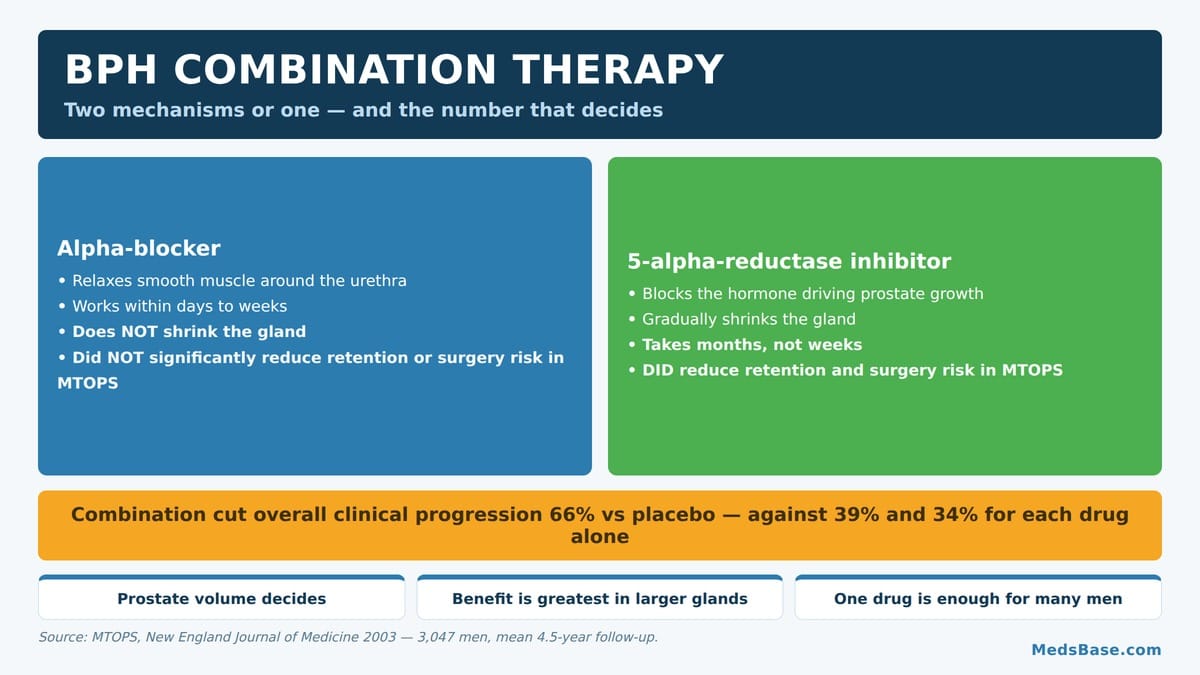
Quick Answer — BPH combination therapy pairs an alpha-blocker with a 5-alpha-reductase inhibitor. The alpha-blocker relaxes muscle for symptom relief within days but does not shrink the prostate; the 5-alpha-reductase inhibitor shrinks the gland over months. In the MTOPS trial, the combination cut overall clinical progression by 66%, against 39% and 34% for each drug alone.
Here is the question nobody answers straight: if you are already taking one prostate medicine and it is helping, is adding a second genuinely better medicine — or just more medicine?
It is a fair thing to be suspicious about. Fixed-dose combination tablets are commercially convenient, and “two drugs in one pill” is an easy thing to sell. But in this particular case the evidence is unusually strong, unusually old, and unusually specific about who benefits. That last part is what almost every article leaves out.
By the end of this guide you will know what each drug class actually does, why they are not interchangeable, the single measurement that predicts whether you need both, and the honest circumstances in which one drug is entirely enough.
There is also a timing trap in this treatment that catches a lot of men out — a point at which the treatment looks like it has failed when it has not. That comes in the practical section.
- The two drug classes do completely different jobs — and one of them does nothing at all about the size of your prostate.
- Combination roughly doubled the risk reduction either drug managed alone in a 3,047-man trial — but that headline hides who it actually helped.
- One measurement predicts your answer better than your symptoms do, and it is probably already in your notes.
- Speed is the trade-off nobody warns about. One drug works in days; the other takes months. Judging too early is the classic mistake.
- Many men genuinely need only one drug — this article says so plainly rather than pushing the bigger option.
- There is a specific reason your doctor may want you on both before symptoms get worse, rather than after.
- What Is BPH Combination Therapy?
- How BPH Combination Therapy Works
- Who Actually Needs Two Drugs?
- Side Effects and Safety
- What Does the Research Say About BPH Combination Therapy?
- BPH Combination Therapy vs Single-Drug Treatment
- Using It Properly — Practical Guidance
- Frequently Asked Questions
- The Bottom Line
What Is BPH Combination Therapy?
BPH combination therapy is the use of two different classes of prostate medicine together: an alpha-blocker, which relaxes the smooth muscle around the urethra to improve urine flow, and a 5-alpha-reductase inhibitor, which gradually shrinks the prostate gland itself. They are sometimes taken as two tablets and sometimes as a single fixed-dose combination.
Benign prostatic hyperplasia is a non-cancerous enlargement of the prostate, described in plain terms by the US National Institute of Diabetes and Digestive and Kidney Diseases. As the gland grows it presses on the urethra, producing the familiar cluster of lower urinary tract symptoms: a weak stream, hesitancy, incomplete emptying, and getting up at night.
The critical thing to understand is that those symptoms have two separate causes, and each drug class only addresses one of them.
Part of the obstruction is muscular — smooth muscle tone squeezing the urethra. Part of it is mechanical — the sheer bulk of an enlarged gland. An alpha-blocker fixes the first. A 5-alpha-reductase inhibitor slowly fixes the second. Neither one does the other’s job.
How BPH Combination Therapy Works
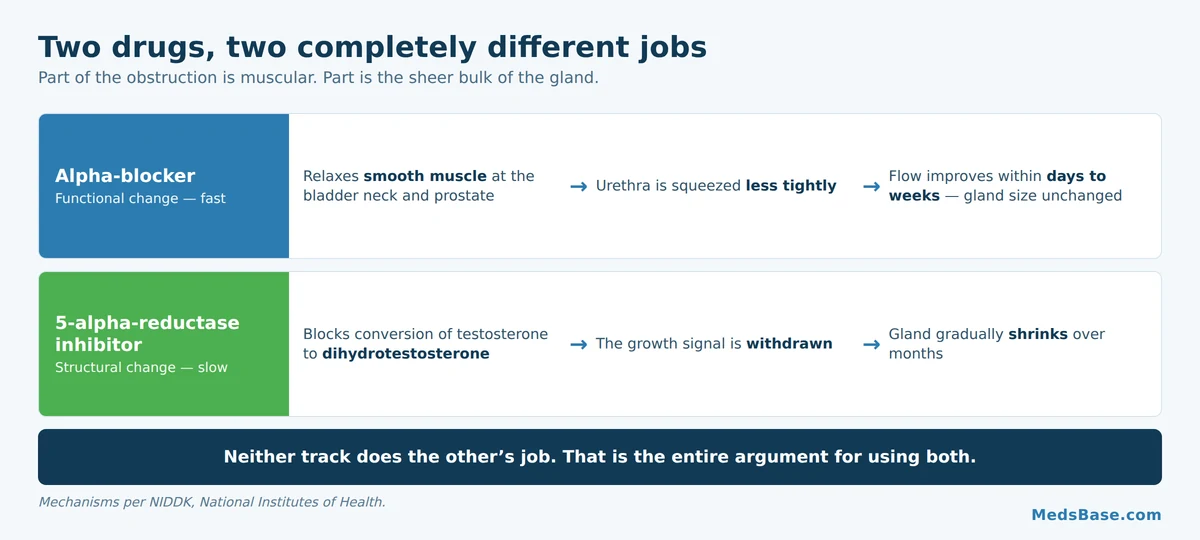
Picture a garden hose running through a clenched fist inside a tightening sleeve. The clenched fist is muscle tone. The sleeve is the growing gland.
Alpha-blockers unclench the fist. They relax smooth muscle around the bladder neck and prostate, and because that is a functional change rather than a structural one, the effect arrives quickly — typically within days to a couple of weeks. What they do not do is change the size of the prostate at all. The gland keeps growing underneath the symptom relief.
5-alpha-reductase inhibitors loosen the sleeve. They block the conversion of testosterone to dihydrotestosterone, the hormone that drives prostate growth, and over months the gland gradually shrinks. This is a structural change, so it is slow — but it addresses the thing that is actually progressing.
Here is where it gets interesting. Because one drug treats how you feel today and the other treats what happens over years, the two are not redundant. Combining them is not doubling a dose; it is covering two different failure modes.
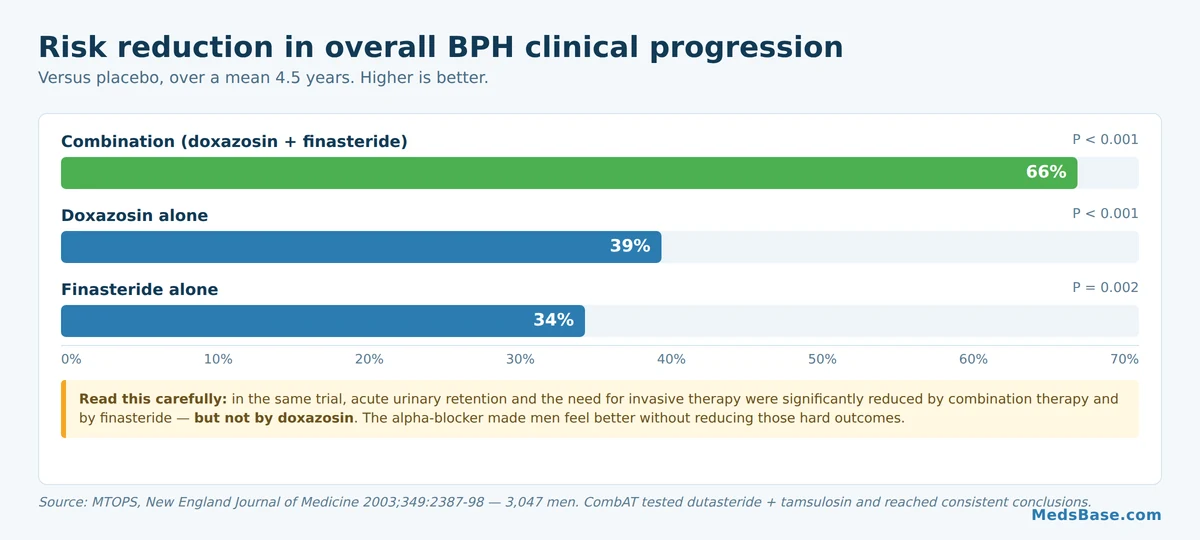
That finding is the strongest practical argument in this entire field. Symptom relief and risk reduction are not the same achievement, and only one of the two classes delivers both.
If you are choosing within the alpha-blocker class, how the individual alpha-blockers compare with each other covers that decision separately. For the other half, see our comparison of the two 5-alpha-reductase inhibitors.
Who Actually Needs Two Drugs?
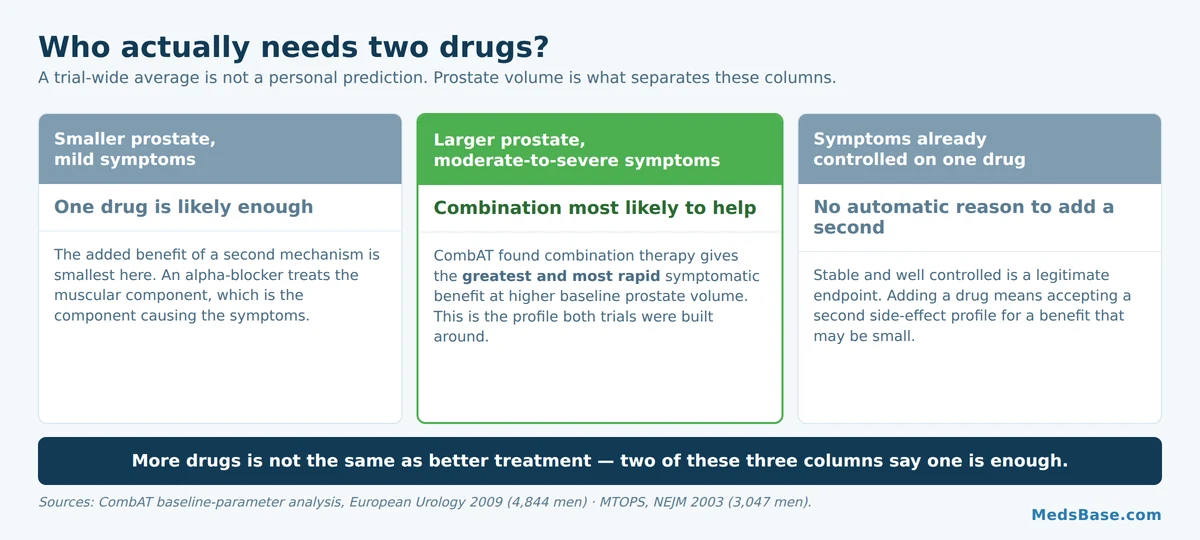
This is the question the headline numbers obscure. A 66% risk reduction across a whole trial population does not mean every man gets a 66% benefit — it means the average did, and averages hide distribution.
The most useful analysis here comes from CombAT trial data on baseline prostate volume, which examined which men actually got the benefit. Its conclusion is unusually quotable: combination therapy “affords the greatest and the most rapid symptomatic benefit among men with higher baseline prostate volume.”
So the deciding variable is not how bad your symptoms feel. It is how big your prostate is.
The same analysis found that where the gland was larger, or PSA higher, or symptoms worse, the 5-alpha-reductase inhibitor alone outperformed the alpha-blocker alone. Where the gland was smaller, that advantage faded. This is measurable, and your prostate volume or PSA is very likely already recorded in your notes.
Worth noting how the trial defined its population: CombAT enrolled men aged 50 and over with a prostate volume of at least 30 cm³ and PSA between 1.5 and 10 ng/ml. Everyone in it already had a meaningfully enlarged gland. That is the group these findings describe.
- Have a measurably enlarged prostate rather than symptoms alone
- Have moderate-to-severe lower urinary tract symptoms
- Are at higher risk of progression — larger gland, higher PSA, worse flow
- Have had partial relief from an alpha-blocker but the picture is still deteriorating
- Have mild symptoms well controlled on a single drug — there is no automatic reason to add a second
- Have a smaller prostate, where the added benefit is least
- Are troubled mainly by storage symptoms such as urgency, which may point elsewhere
- Cannot tolerate the sexual side effects of a 5-alpha-reductase inhibitor, which are the common reason men stop
Two illustrative examples — not real patients. Take Peter, 58, whose flow is weak and who gets up twice a night, but whose prostate measures at the smaller end and whose PSA is low. An alpha-blocker improves things within a fortnight and holds. On the evidence, there is no automatic reason to add a second drug — his symptoms are the muscular component, and that component is being treated.
Now take Ahmed, 67, with a substantially enlarged gland, a higher PSA and symptoms that have worsened over two years despite an alpha-blocker. He is the profile both trials were built around. For him the second drug is not an upgrade to feel better faster — the alpha-blocker is already doing that job — it is the component that addresses the gland that keeps growing underneath, and with it the risk of retention and surgery. Same condition, same symptoms on paper, opposite answers — and prostate volume is what separates them.
Side Effects and Safety
Combining two drug classes means accepting both side-effect profiles. That is the honest cost, and it deserves stating plainly rather than buried.
| Side effect | Typical source | Severity | What to do |
|---|---|---|---|
| Dizziness, light-headedness on standing | Alpha-blocker | Mild to moderate | Stand slowly; take at night if advised; report if persistent |
| Reduced or absent ejaculate | Alpha-blocker | Mild but bothersome | Not harmful; discuss alternatives within the class if it troubles you |
| Reduced libido, erectile difficulty | 5-alpha-reductase inhibitor | Moderate | Common reason for stopping; raise it rather than quietly abandoning treatment |
| Breast tenderness or enlargement | 5-alpha-reductase inhibitor | Uncommon | Report — it should be assessed |
| PSA reduced by roughly half | 5-alpha-reductase inhibitor | Not a side effect, but critical | Always tell the clinician ordering a PSA test |
| Cardiac failure imbalance between arms | Reported in CombAT | Uncertain significance | Trial authors flagged it explicitly; worth a mention if you have heart failure |
That last row deserves care rather than alarm. The four-year results from the CombAT study reported that safety was consistent with the individual drugs “with the exception of an imbalance in the composite term of cardiac failure among the three study arms.” The authors reported it rather than explaining it away. It is not established as a causal effect, and it should not stop anyone taking a recommended treatment — but if you have existing heart failure, it is a reasonable thing to raise.
The same paper is candid about its own limitation: CombAT had no placebo group, which constrains what can be concluded from it.
What Does the Research Say About BPH Combination Therapy?
| Study | Year | Finding | Source |
|---|---|---|---|
| MTOPS, NEJM (3,047 men, mean 4.5 years) | 2003 | Overall clinical progression risk reduced 39% doxazosin, 34% finasteride, 66% combination — combination superior to both | PMID 14681504 |
| MTOPS — retention and surgery | 2003 | Acute urinary retention and need for invasive therapy significantly reduced by combination and finasteride, but not by doxazosin | PMID 14681504 |
| CombAT baseline-parameter analysis (4,844 men) | 2009 | Combination gives greatest and most rapid symptomatic benefit at higher baseline prostate volume | PMID 19013011 |
| CombAT 4-year outcomes | 2010 | Combination superior to tamsulosin alone — but not to dutasteride alone — for retention or surgery; superior to both for clinical progression | PMID 19825505 |
What this means for you: the third and fourth rows are the ones that change decisions. If your prostate is large, combination is where the evidence points. If what you most want to avoid is retention and surgery, note that the alpha-blocker contributed nothing measurable to that goal in MTOPS — the 5-alpha-reductase inhibitor was doing that work, alone or in combination.
Guidance in this area is current rather than historical: the 2026 European Association of Urology guidelines on non-neurogenic male lower urinary tract symptoms were published in July 2026, updated from a structured literature review running to May 2025, and cover conservative, medical and surgical management. The trials above are two decades old because they were large, long and definitive — not because the field stopped paying attention.
Where the evidence is genuinely limited, it is worth saying so. MTOPS used doxazosin and finasteride; CombAT used tamsulosin and dutasteride. They tested different pairs and reached consistent conclusions, which is reassuring — but no single trial has compared every available pairing head to head, and neither trial was designed to tell you which specific combination product is best.
BPH Combination Therapy vs Single-Drug Treatment
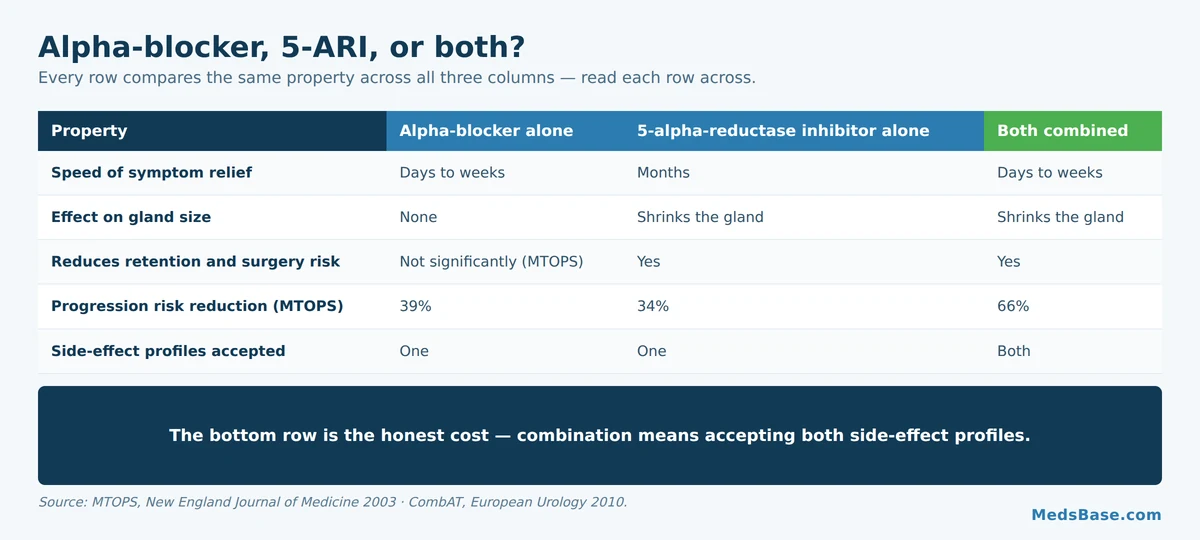
| Option | Speed of relief | Effect on gland size | Reduces retention/surgery risk | Best suited to |
|---|---|---|---|---|
| Alpha-blocker alone | Days to weeks | None | Not significantly (MTOPS) | Mild-to-moderate symptoms, smaller gland |
| 5-alpha-reductase inhibitor alone | Months | Shrinks | Yes | Larger gland, progression risk, symptoms tolerable meanwhile |
| Both combined | Days to weeks, improving further over months | Shrinks | Yes | Larger gland and bothersome symptoms now |
| Tadalafil | Days to weeks | None | Not established | Men with both urinary and erectile symptoms |
| Watchful waiting | — | — | — | Mild, non-bothersome symptoms |
Which one fits which situation? If your symptoms are mild and stable on one drug, the evidence does not push you toward a second — and this article is not going to pretend otherwise. If your gland is measurably enlarged and you want both relief now and a lower chance of retention or surgery later, that is precisely the profile combination therapy was tested in. If your symptoms are tolerable but your prostate is large and growing, a 5-alpha-reductase inhibitor alone may be the better-targeted choice, since it is the component that reduces the hard outcomes.
There is a fourth path worth naming honestly: tadalafil is licensed for BPH symptoms and suits men who also have erectile difficulties. It is a different mechanism from either class discussed here, and whether tadalafil is a better fit for your symptoms covers it properly.
Using BPH Combination Therapy — Practical Guidance
Now the timing trap from the introduction. Here it is: the two halves of this treatment work on completely different clocks, and men judge the slow one on the fast one’s schedule.
- Expect the alpha-blocker effect within days to weeks. If flow has not improved at all after a few weeks, say so — that part should be noticeable.
- Do not judge the 5-alpha-reductase inhibitor for months. Gland shrinkage is gradual. Stopping at six weeks because “nothing is happening” is the single most common error, and it discards the component that reduces retention and surgery risk.
- Take doses consistently, at the same time daily. Neither drug rewards irregular use.
- Stand up slowly in the first weeks while your body adjusts to the alpha-blocker.
- Tell any clinician ordering a PSA test that you take a 5-alpha-reductase inhibitor. Your reading will be roughly halved and must be interpreted accordingly.
- Report sexual side effects rather than quietly stopping. There are options within and between classes, but only if someone knows.
- Ask what your prostate volume actually is. It is the number this whole decision turns on, and most men have never been told theirs.
- Review the combination periodically. Some men can eventually simplify; that is a clinician-led decision, not a self-directed one.
Mistakes to avoid: judging the slow drug on the fast drug’s timeline; stopping either abruptly without advice; assuming a bigger dose substitutes for the missing mechanism; interpreting a low PSA as reassurance without adjusting for the drug; and adding a second medicine purely because symptoms are annoying, when your gland is small and the added benefit is least.
If your clinician has raised combination treatment with you, you can browse the BPH treatments MedsBase stocks — the range includes both individual classes and fixed-dose combination tablets pairing tamsulosin with either dutasteride or finasteride, all from WHO-GMP-certified manufacturers. No prescription is needed to order from MedsBase.com.
- How the individual alpha-blockers compare — choosing within the fast-acting half
- Finasteride versus dutasteride, compared — choosing within the gland-shrinking half
- Whether tadalafil is a better fit for your symptoms — the main alternative path
Frequently Asked Questions
Q: Is combination therapy better than monotherapy for BPH?
A: For the right men, yes. In the MTOPS trial, BPH combination therapy reduced overall clinical progression risk by 66%, against 39% for doxazosin alone and 34% for finasteride alone, and was significantly better than either. But CombAT data shows the benefit concentrates in men with larger prostates. If your gland is small and symptoms are controlled on one drug, the case for adding a second is much weaker.
Q: When should you add a second BPH medication?
A: The strongest indicator is a measurably enlarged prostate rather than symptom severity alone. CombAT found the greatest and most rapid symptomatic benefit in men with higher baseline prostate volume. Other prompts include worsening symptoms despite an alpha-blocker, higher PSA, or concern about progressing to retention or surgery. Ask what your prostate volume is — that is the number the decision turns on.
Q: How long does it take for a 5-alpha-reductase inhibitor to work?
A: Months, not weeks. It works by shrinking the prostate, which is a gradual structural change, unlike the alpha-blocker’s muscle relaxation that shows within days to weeks. This mismatch is why men often abandon the slower drug too early. If you are on both and feel improvement quickly, that early benefit is largely the alpha-blocker — the other half is still working.
Q: Can you stop one drug after combination therapy?
A: Sometimes, but it is a clinician-led decision and depends on which one. Stopping the 5-alpha-reductase inhibitor removes the component that reduced acute urinary retention and the need for invasive therapy in MTOPS, since doxazosin did not significantly reduce those outcomes. Never stop either drug without advice, and do not assume feeling well means the underlying enlargement has stopped.
Q: Does combination therapy prevent prostate surgery?
A: It reduces the risk. In MTOPS, the need for invasive therapy and the risk of acute urinary retention were significantly reduced by combination therapy and by finasteride, but not by doxazosin alone. The four-year CombAT results found combination superior to tamsulosin alone for retention or surgery, though not superior to dutasteride alone. Reduced risk is not elimination of risk.
Q: What prostate size needs combination treatment?
A: There is no single universal threshold, and any article that gives you one is overreaching. What the evidence supports is a direction: CombAT enrolled men with prostate volumes of at least 30 cm³ and found the greatest, fastest benefit at higher baseline volumes. Your own threshold is a judgement your clinician makes using volume, PSA, symptoms and how fast things are changing.
Q: Will BPH combination therapy affect my PSA test?
A: Yes, and this matters. 5-alpha-reductase inhibitors reduce PSA readings by roughly half. That does not mean your prostate cancer risk changed — it means the measurement scale did. Always tell whoever orders a PSA test that you take one, so the result can be interpreted correctly. A “normal” PSA on treatment may not be reassuring in the way it appears.
Q: Are the side effects of taking two drugs worse than one?
A: You accept both profiles, so more men will experience something. From the alpha-blocker, dizziness and reduced ejaculate are typical; from the 5-alpha-reductase inhibitor, reduced libido and erectile difficulty are the common reasons men stop. CombAT reported safety consistent with the individual drugs apart from an unexplained cardiac-failure imbalance the authors flagged. Most side effects are manageable if reported rather than endured.
The Bottom Line
BPH combination therapy is one of the better-evidenced decisions in men’s health — and also one of the most over-applied. The trial data is genuinely impressive: roughly double the risk reduction of either drug alone, sustained over years, replicated across two large trials using different drug pairs.
The balanced verdict: it is clearly worthwhile for men with a measurably enlarged prostate and bothersome symptoms, and clearly unnecessary for men whose mild symptoms are well controlled on a single drug. The deciding variable is prostate volume, not how annoying your symptoms feel this week. And if avoiding retention and surgery is your priority, note that the alpha-blocker half contributed nothing measurable to that in MTOPS.
One thing to do today: find out what your prostate volume and most recent PSA actually are. That single pair of numbers moves this from a guess to a decision — and most men have never been told either.
Choosing within the fast-acting half? Read how the individual alpha-blockers compare with each other. Choosing within the gland-shrinking half? Read finasteride versus dutasteride, compared.
Medical disclaimer: This article is for general information and is not medical advice. Treatment for an enlarged prostate depends on your prostate volume, symptom severity, PSA, other health conditions and current medicines. Urinary symptoms can have causes other than benign prostatic hyperplasia, including some that need prompt assessment, so new or rapidly worsening symptoms should always be reviewed by a doctor. Never start, stop or combine prostate medicines without speaking to a doctor or pharmacist, and always disclose 5-alpha-reductase inhibitor use before a PSA test.

Written by
Sophie ChenPharmaceutical Content Researcher · 8 years experience
Sophie Chen is a pharmaceutical content researcher with 8 years covering generic medication access and clinical pharmacology. She specialises in international regulatory frameworks, bioequivalence standards, and patient-facing education on therapeutic drug classes. She is not a clinician.