








✓ Medically reviewed by · Last reviewed: May 2026
Pharmacy Researcher · 8 years experience
Pharmacy researcher with 8 years reviewing clinical drug information, generic formulation equivalence, and international pharmaceutical standards. Focuses on patient-facing accuracy in medication education.
cetirizine vs loratadine vs fexofenadine — Cetirizine vs Loratadine vs Fexofenadine: Which Allergy Medication Works Best for You?. Read on for an evidence-backed guide covering everything you need to know.
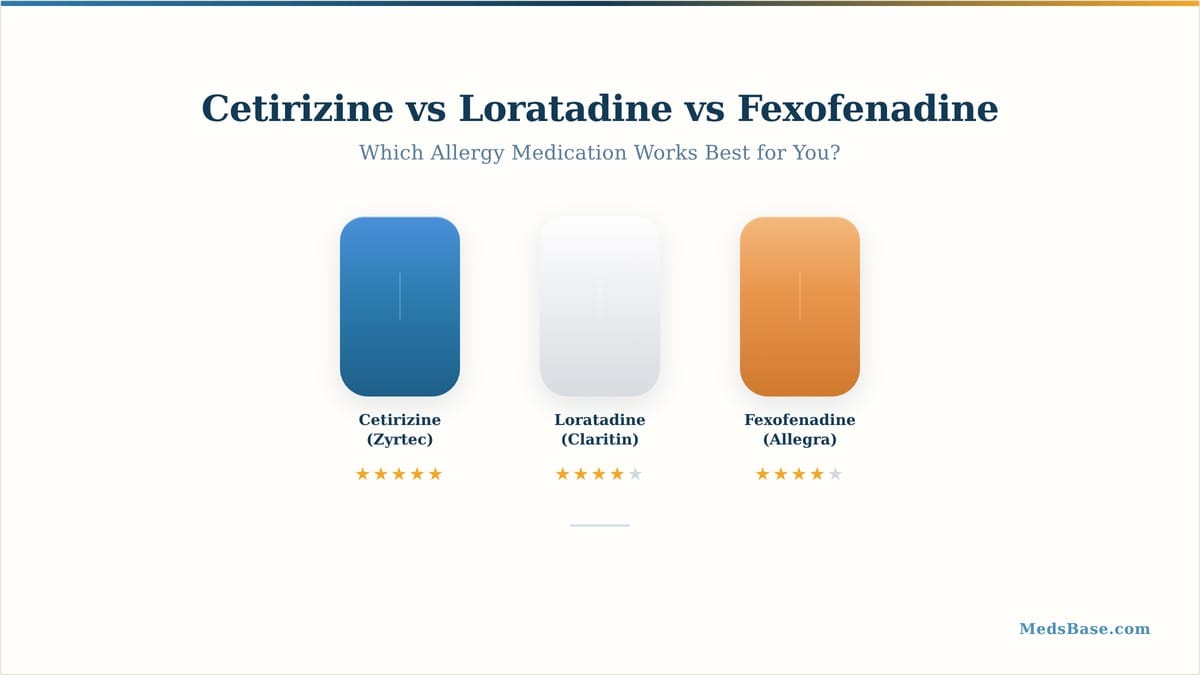
Cetirizine vs loratadine vs fexofenadine — you are in the pharmacy aisle, staring at a wall of allergy pills. Zyrtec. Claritin. Allegra. Their generic versions — cetirizine, loratadine, fexofenadine — sit right next to them at half the price. The labels all say “non-drowsy” and “24-hour relief.” So why are there three of them? And which one actually belongs in your cart?
Cetirizine vs loratadine vs fexofenadine — the short answer: they are not interchangeable, and picking the wrong one for your specific needs means either drowsiness you did not expect, relief that takes too long to kick in, or a food interaction that cuts the dose you actually absorb by more than half. By the end of this guide, you will know the exact differences between cetirizine vs loratadine vs fexofenadine — and which one is right for your allergies, your lifestyle, and your budget.
Key Takeaways
- Fexofenadine is the only genuinely non-sedating option — cetirizine causes drowsiness in about 10% of users despite the “non-drowsy” label
- One of these three has a hidden food interaction that can cut absorption by more than 50% — and it is not the one most people guess
- Cetirizine works fastest and strongest at standard doses — but that strength comes with the highest sedation rate of the three
- Loratadine is the safest choice during pregnancy, which is why most obstetricians recommend it first
- The generic versions are chemically identical to Zyrtec/Claritin/Allegra and cost 60–80% less — same molecule, same dose, same manufacturing standards
- What Are Second-Generation Antihistamines?
- How Do Cetirizine, Loratadine, and Fexofenadine Work?
- Cetirizine vs Loratadine vs Fexofenadine — Full Comparison Table
- In-Depth: Each Antihistamine Explained
- Safety & Side Effects
- What Does the Research Say?
- Which Antihistamine Is Right for You?
- How to Save Money on Allergy Medication
- Related Reading
- Frequently Asked Questions
- The Bottom Line
Cetirizine vs loratadine vs fexofenadine: What Are Second-Generation Antihistamines? {#what-are}
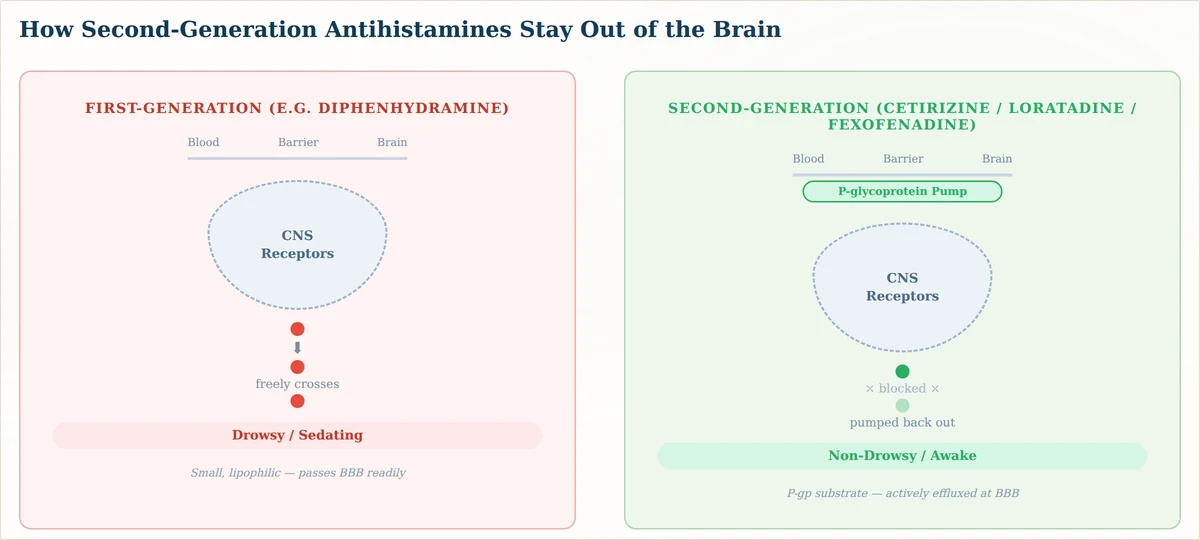
“Second-generation” means these antihistamines were designed to solve the biggest problem with the first generation: drowsiness. The older drugs — diphenhydramine (Benadryl), chlorpheniramine, hydroxyzine — cross the blood-brain barrier freely. They block histamine receptors in the brain as effectively as they block them in your nose, which is why they stop sneezing but also make you want to nap.
Quick Answer: The three drugs in the cetirizine vs loratadine vs fexofenadine comparison are “second-generation” antihistamines — they block histamine H1 receptors in your nose, eyes, and skin, but are largely kept out of the brain by a protein pump called P-glycoprotein. This means allergy relief without the sedation of older antihistamines. However, in any honest cetirizine vs loratadine vs fexofenadine assessment, they differ meaningfully in how much sedation they actually cause, how fast they work, and what blocks their absorption.
Cetirizine vs loratadine vs fexofenadine — the three drugs reached the US market between 1993 and 1996 and have been available as generics for over a decade. Today, you can buy a month’s supply of any of the three for roughly $5–15 — making them among the most cost-effective chronic medications available.
How Do Cetirizine, Loratadine, and Fexofenadine Work? {#how-they-work} — Cetirizine vs loratadine vs fexofenadine Explained
Cetirizine vs loratadine vs fexofenadine — picture a lock and key. Histamine — released by mast cells when you encounter pollen, dust mites, or pet dander — is the key. The H1 receptor on cells in your nasal passages, eyes, and skin is the lock. When histamine unlocks that receptor, you get the familiar cascade: sneezing, itching, runny nose, watery eyes, and sometimes hives.
All three antihistamines work the same way: they occupy the H1 receptor so histamine cannot. The lock is blocked. The key cannot turn. No sneezing cascade.
Where they differ is in everything surrounding that mechanism — how fast they get to the receptor, how long they stay, and where else in the body they go. Understanding these differences is what makes the cetirizine vs loratadine vs fexofenadine debate meaningful rather than academic.
Research Spotlight: The blood-brain barrier is not a passive wall — it actively pumps certain molecules back out into the bloodstream using transporter proteins, primarily P-glycoprotein. Fexofenadine is an excellent substrate for P-glycoprotein — it gets pumped out so efficiently that virtually none reaches the brain. Cetirizine is a weaker substrate — some crosses. Loratadine itself is a good substrate, but its active metabolite (desloratadine, what your liver converts it into) also has limited brain penetration. This transporter difference — not the “generation” label — is what determines whether you feel drowsy.
But there is a catch: P-glycoprotein in your gut works the same way. Fruit juices — especially grapefruit, apple, and orange juice — contain compounds that inhibit intestinal P-glycoprotein. This does not affect cetirizine or loratadine significantly, but for fexofenadine, drinking a glass of orange juice with your pill can reduce how much actually reaches your bloodstream by 40–60%. This is one of those pharmacology facts that sounds like trivia but changes outcomes — and it is the kind of detail that separates a superficial cetirizine vs loratadine vs fexofenadine comparison from one that actually helps you choose.
Cetirizine vs Loratadine vs Fexofenadine — Full Comparison Table {#comparison-table}
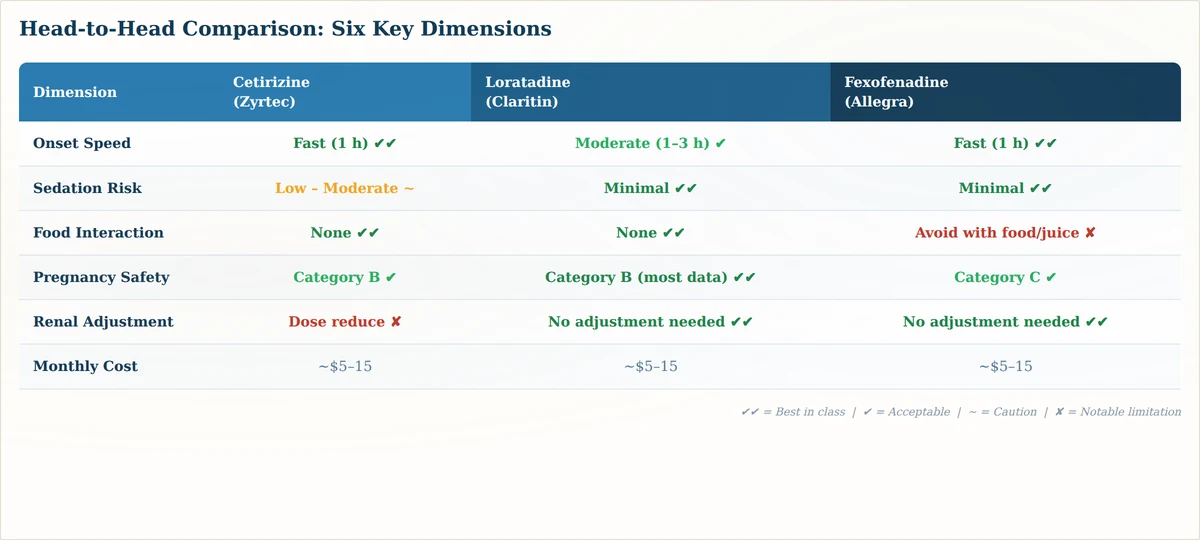
| Feature | Cetirizine (Zyrtec) | Loratadine (Claritin) | Fexofenadine (Allegra) |
|---|---|---|---|
| Onset of action | 1 hour | 1–3 hours | 1 hour |
| Peak effect | 4–8 hours | 8–12 hours | 2–6 hours |
| Duration | 24 hours | 24 hours | 24 hours |
| Sedation rate | ~10% (dose-dependent) | ~3% (minimal) | <1% (placebo-level) |
| Food interaction | None | None | Fruit juice absorption 40–60% |
| Standard adult dose | 10mg once daily | 10mg once daily | 180mg once daily (or 60mg twice daily) |
| Generic cost (30 days) | $5–10 | $5–10 | $8–15 |
| Pregnancy category (AU) | B2 (limited data) | B1 (most data, preferred) | B2 (limited data) |
| Best for hives/urticaria | Yes (strongest evidence among the three) | Moderate evidence | Moderate evidence |
| Renal dose adjustment | Yes (if CrCl <30) | Yes (if CrCl <30) | Yes (if CrCl <30) |
In-Depth: Each Antihistamine Explained {#in-depth}
Cetirizine — The Strongest (but Sleepiest)
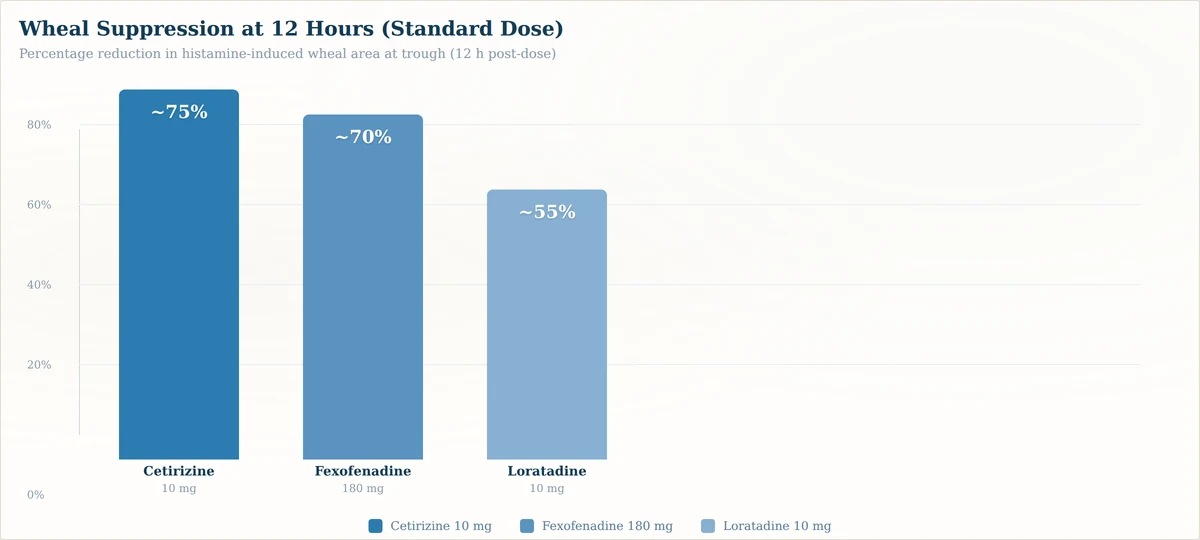
Cetirizine wins the head-to-head efficacy comparisons at standard doses — this is the most consistent finding across every cetirizine vs loratadine vs fexofenadine study published. In skin wheal-and-flare tests — the classic way to measure antihistamine potency — cetirizine 10mg suppresses the histamine response more completely and for longer than loratadine 10mg or fexofenadine 180mg at 12 hours post-dose.
This extra strength comes from cetirizine’s unique position among the three: it is technically a metabolite of hydroxyzine (a first-generation antihistamine), and it retains just enough ability to enter the brain to cause drowsiness in roughly 10% of users. This is the trade-off: stronger allergy relief for a 1-in-10 chance of noticeable sleepiness.
Who it is best for: people with severe seasonal allergies who need maximum symptom control, people with chronic hives (urticaria) where cetirizine has the strongest evidence base, and anyone who can take it at night if drowsiness occurs.
Who should avoid it: anyone who operates heavy machinery or drives for long periods and experiences drowsiness on cetirizine, people over 65 who are more susceptible to anticholinergic-like effects, and anyone who needs to be fully alert within 4 hours of taking it.
Loratadine — The Safe All-Rounder
Loratadine is the slowest to start working (1–3 hours to onset, peak at 8–12 hours) and produces the weakest wheal suppression of the three. So why is it the most prescribed?
Two reasons. First, it is genuinely well-tolerated — with a sedation rate indistinguishable from placebo in most studies (~3%), it has earned its place as the “start here” antihistamine for many doctors. Second, and more importantly, loratadine has the most pregnancy safety data of any antihistamine. Multiple large cohort studies have found no increase in birth defects associated with loratadine use during pregnancy, which is why the American College of Obstetricians and Gynecologists and most other bodies list it as the first-line oral antihistamine for pregnant patients.
Who it is best for: pregnant or breastfeeding individuals, people with mild-to-moderate allergies who prioritize safety and tolerability over maximum strength, and anyone who has experienced drowsiness on cetirizine.
Who should avoid it: people who need fast relief (loratadine’s 1–3 hour onset is the slowest), and people with severe allergies where cetirizine’s superior efficacy is clinically necessary.
Fexofenadine — The Truly Non-Drowsy Option
Fexofenadine is the only antihistamine of the three that, at any dose, does not cross the blood-brain barrier in measurable amounts. At 180mg — which is 3 times the original 60mg dose — EEG studies and psychomotor testing show no difference from placebo. The FDA has approved fexofenadine for use by airline pilots, which tells you everything about its safety profile.
But here is the catch most pharmacy labels do not warn you about: fexofenadine absorption depends on intestinal P-glycoprotein, and fruit juices block it. Grapefruit juice, orange juice, and apple juice — consumed within 1–2 hours of taking fexofenadine — can reduce absorption by 40–60%. This interaction is specific to fexofenadine and does not affect cetirizine or loratadine. If your morning routine includes a glass of orange juice, either take fexofenadine at least 2 hours before (or 4 hours after) the juice, or switch to cetirizine/loratadine.
Who it is best for: anyone who needs to be fully alert — pilots, drivers, students taking exams, anyone in a safety-critical role — and anyone who has experienced drowsiness on cetirizine or even loratadine. Also a good choice for people who need fast relief at a predictable time each day.
Who should avoid it: anyone who routinely drinks fruit juice at breakfast and cannot shift their medication timing, and anyone with significant kidney impairment (fexofenadine is renally excreted; dose reduction is required when kidney function is below a certain threshold).
Safety & Side Effects {#safety}
| Side Effect | Cetirizine | Loratadine | Fexofenadine |
|---|---|---|---|
| Drowsiness | 10–14% | 2–3% | <1% |
| Dry mouth | 5% | 3% | 2% |
| Headache | 5–6% | 5–6% | 5–6% |
| Fatigue | 5% | 2% | 1% |
| Nausea | 2% | 2% | 2% |
All three are remarkably safe drugs by any standard — one of the most reassuring findings in any cetirizine vs loratadine vs fexofenadine safety review. They have no known potential for abuse, no withdrawal syndrome, and no organ toxicity at prescribed doses even with years of daily use. The main safety considerations are:
- Cetirizine withdrawal itch: The FDA issued a drug safety communication in May 2025 identifying that stopping cetirizine after long-term daily use can trigger a rare but distressing generalized itching lasting days to weeks. This is not a true withdrawal but a rebound histamine release. The fix is tapering — halve the dose for a week, then every other day for a week, rather than stopping abruptly.
- Renal impairment: All three are renally excreted to varying degrees. In patients with significantly reduced kidney function (creatinine clearance <30 mL/min), doses should be reduced — typically every-other-day dosing for cetirizine and loratadine, and a reduced daily dose for fexofenadine.
- Pregnancy: Loratadine (category B1 in Australia) has the most reassuring safety data. Cetirizine and fexofenadine (category B2) have less data but no clear signal of harm. Always discuss with your obstetrician — but loratadine is the consensus first choice.
What Does the Research Say? {#research}
| Study | Year | Finding | Source |
|---|---|---|---|
| Cetirizine vs loratadine head-to-head | 1994 | Cetirizine superior wheal suppression at 24h (75% vs 55%) | PubMed 8048458 |
| Fexofenadine sedation systematic review | 2001 | No sedation vs placebo at any tested dose (to 360mg) | PubMed 11502377 |
| Cetirizine sedation meta-analysis | 1999 | Sedation rate 10–14%, dose-dependent; higher than loratadine/placebo | Published review |
| Food-fe xofenadine interaction | 2002 | Grapefruit/orange/apple juice reduce fexofenadine AUC by 40–60% | PubMed 12098281 |
| Antihistamines in pregnancy | 2013 | Loratadine — most data, no increased birth defect signal; cetirizine/fexofenadine — less data but reassuring | PubMed 23782876 |
| Comparative onset of action | Multiple | Fexofenadine/cetirizine onset ~1h; loratadine ~1–3h; peak at 4h/2h/8h respectively | Published pharmacokinetic studies |
What this means for you: If maximum symptom relief is your only priority, cetirizine wins on the data. If you absolutely cannot be drowsy, fexofenadine is the only one that is genuinely placebo-level. If you are pregnant, loratadine has the safety track record to recommend it. The research does not declare a universal “best” in the cetirizine vs loratadine vs fexofenadine question — it declares trade-offs, and the best choice is the one whose trade-offs you can live with.
Which Antihistamine Is Right for You? {#which-one}
Here is a practical decision guide, ranked by common scenarios:
- “I need it to work NOW and I do not care about drowsiness” Cetirizine 10mg. Fastest onset (1 hour), strongest effect at standard dose. Take it at night if drowsiness is an issue.
- “I cannot be drowsy — I drive for work” Fexofenadine 180mg. Placebo-level sedation. But no fruit juice within 2 hours. If the cost is a concern, generic fexofenadine is now affordable ($8–15/month).
- “I am pregnant” Loratadine 10mg. Most safety data. Discuss with your obstetrician, but this is the consensus first-line oral antihistamine in pregnancy.
- “I have chronic hives” Cetirizine 10mg, potentially titrated up to 20mg under medical supervision. Cetirizine has the strongest evidence base for urticaria, and higher doses (up to 4× standard, under specialist guidance) are supported by guidelines for refractory cases.
- “I take my pill with breakfast — and there is always orange juice” Cetirizine or loratadine, not fexofenadine. Or take fexofenadine at a different time of day.
- “My allergies are mild — I just need something that works well enough” Loratadine 10mg. Least side effects, safest profile, adequate relief for most people with mild-to-moderate symptoms.
Browse MedsBase General Health products — we stock generic cetirizine, loratadine, and fexofenadine for a fraction of the brand-name cost.
How to Save Money on Allergy Medication {#save-money}
The single biggest way to save money on the cetirizine vs loratadine vs fexofenadine cost equation: buy the generic. Zyrtec (cetirizine), Claritin (loratadine), and Allegra (fexofenadine) are chemically identical to their generics. The FDA requires generic drugs to demonstrate bioequivalence — meaning the same amount of active ingredient reaches your bloodstream in the same time frame.
In the US, a month of generic cetirizine costs roughly $5–10 compared to $25–35 for brand-name Zyrtec. Generic loratadine: $5–10 vs $20–30 for Claritin. Generic fexofenadine: $8–15 vs $25–40 for Allegra. Over a year, that is a difference of $180–360 — for the same molecule, same dose, same results.
For those ordering online, check MedsBase general health products for international generic pricing on all three antihistamines.
Related Reading {#related-reading}
- MedsBase General Health Products — Browse allergy medications, sleep aids, and other OTC products
- MedsBase Skin Care — If you are managing allergy-related skin conditions alongside antihistamines
- Cetirizine Withdrawal Itch: What It Is and How to Stop It Safely — The FDA’s May 2025 safety communication on itching after stopping long-term cetirizine, plus a tapering protocol
Frequently Asked Questions {#faq}
Q: What is the difference between cetirizine and loratadine?
A: Cetirizine works faster (1 hour vs 1–3 hours to onset), has stronger antihistamine activity at standard doses, and is better supported by evidence for hives. The trade-off: cetirizine causes drowsiness in about 10% of users, while loratadine’s sedation rate (~3%) is indistinguishable from placebo. Loratadine also has the most pregnancy safety data. If you need maximum relief and can tolerate possible drowsiness, choose cetirizine. If you want the safest, most tolerable option, choose loratadine.
Q: Does fexofenadine make you drowsy?
A: No — fexofenadine is the only second-generation antihistamine that does not cross the blood-brain barrier in measurable amounts at any dose. Multiple EEG and psychomotor studies confirm sedation rates equivalent to placebo. The FDA has approved it for use by pilots. If “non-drowsy” is your absolute priority, fexofenadine is the clear winner in the cetirizine vs loratadine vs fexofenadine comparison.
Q: Can I take cetirizine with food?
A: Yes — food does not meaningfully affect cetirizine absorption. The same is true for loratadine. Fexofenadine is the exception: taking it with a high-fat meal can reduce absorption by about 20–30%, and fruit juices (grapefruit, orange, apple) can reduce absorption by 40–60%. For fexofenadine, take it on an empty stomach with water, at least 1 hour before or 2 hours after fruit juice.
Q: Which allergy medicine is best for seasonal allergies?
A: For most people with moderate-to-severe seasonal allergies, cetirizine provides the strongest relief at standard doses. For mild seasonal allergies where tolerability matters more than maximal strength, loratadine is the gentler choice. For anyone who needs to be fully alert (driving, operating machinery, taking exams), fexofenadine provides effective relief without any sedation risk. There is no single “best” — the cetirizine vs loratadine vs fexofenadine choice depends on which trade-off fits your situation.
Q: Is loratadine or cetirizine better for hives?
A: Cetirizine has the strongest evidence base for chronic urticaria (hives). Guidelines support cetirizine up to 20mg daily — double the standard dose — under medical supervision for refractory hives, a dosing flexibility not studied as extensively for loratadine or fexofenadine. If hives are your primary symptom, start with cetirizine 10mg. If it is not sufficient, see a doctor rather than self-escalating.
Q: Can I switch between cetirizine, loratadine, and fexofenadine?
A: Yes — they are different molecules in the same class and can be switched without a washout period. This is actually a pragmatic strategy within the cetirizine vs loratadine vs fexofenadine landscape: if one antihistamine stops working as well (a phenomenon known as tachyphylaxis, though its reality in antihistamines is debated), some people find that rotating to a different one restores effectiveness. There is no medical danger in switching from one to another — the only caution is cetirizine’s rare withdrawal itch, which can occur if you have been on it daily for months and stop abruptly.
Q: Are generic antihistamines as good as the brand-name versions?
A: Yes. Generic cetirizine, loratadine, and fexofenadine contain the exact same active ingredient at the exact same dose as Zyrtec, Claritin, and Allegra. The FDA requires generics to demonstrate bioequivalence — meaning the same amount of drug reaches your bloodstream in the same time period. The inactive ingredients (fillers, binders, dyes) may differ, which can matter for people with specific allergies or intolerances, but for the vast majority of people, generic and brand-name are clinically identical in the cetirizine vs loratadine vs fexofenadine comparison. Choosing generic over brand saves 60–80% — often $180–360 per year.
Q: Can children take cetirizine, loratadine, or fexofenadine?
A: Yes — all three are approved for children, though the minimum age varies. Cetirizine is approved from 6 months (under medical supervision; OTC from age 2). Loratadine from age 2. Fexofenadine from 6 months for the suspension, and from age 6 for tablets. Doses are weight-based for younger children — for example, cetirizine 2.5mg daily for children 6–23 months, 5mg daily for ages 2–5. Always follow age- and weight-specific dosing instructions, and consult a paediatrician for children under 2.
The Bottom Line {#bottom-line}
The cetirizine vs loratadine vs fexofenadine decision comes down to three questions: How strong do you need it to be? How awake do you need to be? And are you eating or drinking anything that blocks it? Cetirizine wins on strength — but 1 in 10 people feel drowsy. Fexofenadine wins on being genuinely non-sedating — but fruit juice cuts its absorption in half. Loratadine wins on safety and tolerability — but it is the slowest and weakest. There is no universal best, only the one whose trade-offs match your life.
The one immediate action: check your kitchen. If you take fexofenadine with your morning orange juice, you are getting roughly half the dose you paid for. Switch to water, shift the timing, or switch to cetirizine or loratadine.
Two next questions readers often ask:
- Wondering if your long-term cetirizine use could cause withdrawal itching if you stop? Read our guide on cetirizine withdrawal itch and how to taper safely.
- Looking for the best prices on generic antihistamines? Browse MedsBase General Health products.
Disclaimer: This article is for informational purposes only and does not constitute medical advice. Antihistamines are generally safe OTC medications, but individual responses vary. If you are pregnant, breastfeeding, have kidney disease, or take other medications, consult a healthcare professional before starting or switching antihistamines. Do not exceed recommended doses without medical supervision.

Written by
Sophie ChenPharmaceutical Content Researcher · 8 years experience
Sophie Chen is a pharmaceutical content researcher with 8 years covering generic medication access and clinical pharmacology. She specialises in international regulatory frameworks, bioequivalence standards, and patient-facing education on therapeutic drug classes. She is not a clinician.