








✓ Medically reviewed by · Last reviewed: May 2026
Pharmacy Researcher · 8 years experience
Pharmacy researcher with 8 years reviewing clinical drug information, generic formulation equivalence, and international pharmaceutical standards. Focuses on patient-facing accuracy in medication education.
One of the most effective emergency-room migraine treatments ever put through a randomized trial is not a triptan. It is a 1950s anti-nausea tablet. In a head-to-head study, Compazine (prochlorperazine) relieved acute migraine in 82% of patients — nearly double the rate of metoclopramide and almost triple the rate of placebo.
Yet if you walked into an American pharmacy today and asked for Compazine by name, you would be told it no longer exists. The medicine didn’t disappear — the brand did. That quirk of pharmaceutical history confuses thousands of people every month, and it’s why you’re probably here.
This guide untangles the whole picture: what Compazine is, the names it goes by now, how it works, who it genuinely helps, honest side-effect numbers, and how it stacks up against newer anti-nausea drugs. One side-effect reaction surprises almost everyone who gets it — we’ll cover how to recognise it in the safety section. And in one country, you can buy this medication over the counter; that story is coming too.
- ✔ Compazine = prochlorperazine. The US brand is gone, but the molecule lives on under several names — the full name map is below.
- ✔ It calms the brain’s “poison alarm” by blocking dopamine — oral tablets typically start working within 30–60 minutes, though one formulation gets in faster.
- ✔ In randomized trials it outperformed metoclopramide for migraine (82% vs 46%) and beat promethazine for ER nausea with less drowsiness.
- ✔ Most side effects are mild, but one restlessness reaction is routinely mistaken for anxiety — knowing the difference matters.
- ✔ It is not for everyone: older adults with dementia, people with Parkinson’s disease, and children under 2 should not take it.
What Is Compazine? (And Why You Can’t Find It Anymore)
Compazine is the discontinued US brand name for prochlorperazine, a first-generation phenothiazine medication approved by the FDA in the 1950s. It is used mainly to control severe nausea and vomiting, and at higher doses it was historically prescribed for schizophrenia and short-term anxiety. Today the same medicine is dispensed as generic prochlorperazine worldwide.
The brand’s disappearance causes real confusion. Many people were treated with “Compazine” in a hospital years ago, or remember a parent taking it, and assume the drug was pulled for safety reasons. It wasn’t. The manufacturer simply stopped marketing the brand name once cheap generics dominated the market — a commercial decision, not a recall. Prochlorperazine remains FDA-approved and stocked in virtually every US hospital.
Outside the United States, the molecule never lost its identity. If you ask about Compazine in the UK, Ireland, Australia, or most of Europe and Asia, you’ll hear the name Stemetil instead. Here’s the map:
| Name | What it is | Status |
|---|---|---|
| Compazine | Original US brand (oral, rectal, injectable) | Brand discontinued; generics remain |
| Prochlorperazine | The active molecule / generic name | Widely available worldwide |
| Stemetil | International brand — same 5 mg prochlorperazine tablets | Marketed across Europe, Asia-Pacific & beyond |
| Buccastem | UK buccal (dissolves against the gum) format | Pharmacy-available in the UK for migraine nausea |
| Compro | US rectal suppository generic | Available |
So when people search for a Compazine generic, the answer is simple: every prochlorperazine product on the market is the generic. Same molecule, same 5 mg and 10 mg strengths, decades of clinical track record.
How Does Compazine Work as an Antiemetic?
Compazine works by blocking dopamine D2 receptors in the chemoreceptor trigger zone (CTZ) — a small area at the base of the brain that screens your blood for toxins and, when alarmed, fires the vomiting reflex. By muting that dopamine signal, prochlorperazine switches the alarm off at its source, usually within 30–60 minutes of an oral dose.
A useful analogy: the CTZ is your body’s smoke detector. It sits outside the blood-brain barrier, “sniffing” everything that circulates — medications, chemotherapy agents, toxins from a stomach bug, even the inner-ear chaos of vertigo and migraine. Nausea is the alarm going off. The drug doesn’t remove the smoke; it turns the detector’s sensitivity down so the alarm stops screaming while your body deals with the cause.
Because prochlorperazine belongs to the piperazine branch of the phenothiazine family, it hits dopamine receptors harder — and histamine and muscarinic receptors more lightly — than older relatives like chlorpromazine. In practice, that means strong anti-nausea power with comparatively less sedation than antihistamine-type anti-sickness drugs such as promethazine. You’ll see that difference show up in the trial data later.
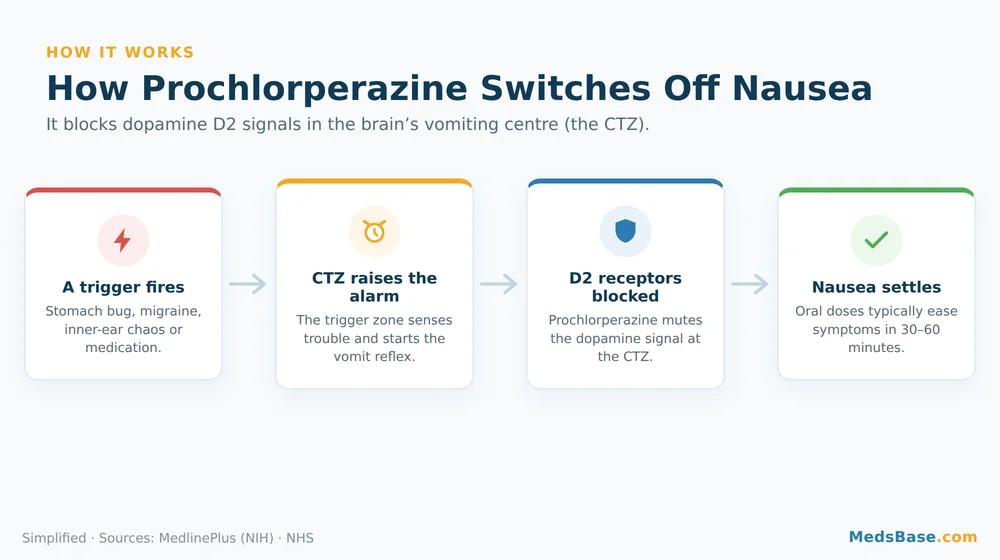
So what does this mean for you? Because the drug acts on the brain’s alarm centre rather than the stomach itself, it works on nausea from many different causes — which is exactly why its use list is so broad.
Key Uses of Compazine: Nausea, Migraine, Vertigo & More
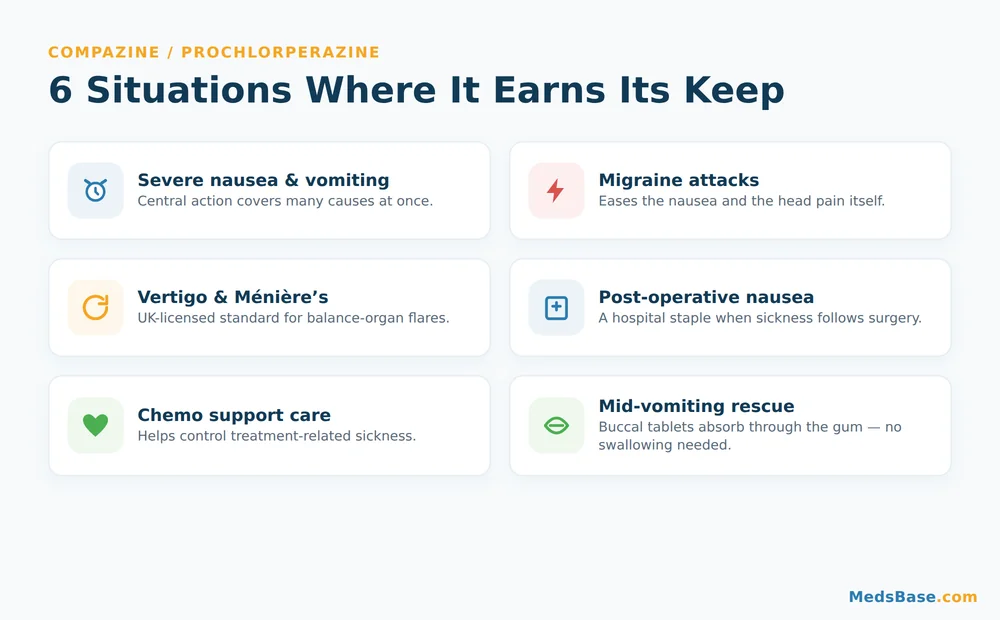
Compazine’s FDA-approved uses are severe nausea and vomiting and, historically, schizophrenia and short-term non-psychotic anxiety. In modern practice its real-world footprint is wider: emergency migraine treatment, vertigo and Ménière’s disease (a licensed use in the UK), and nausea from surgery, gastroenteritis, or chemotherapy support care.
Who should avoid it? Older adults with dementia (increased risk of death — see safety section), anyone with Parkinson’s disease, people who have reacted badly to phenothiazines before, those with severe liver disease, and children under 2 years or 20 lb (9 kg). If you’re pregnant, use it only under direct medical guidance — especially in the third trimester.
Severe nausea and vomiting
This is the core job. Whether the trigger is a stomach bug, food poisoning, post-operative recovery, or medication side effects, prochlorperazine 5–10 mg tablets remain a first-reach option in hospitals precisely because they work on the central alarm rather than one organ. For people who can’t keep a tablet down, buccal tablets (dissolved against the gum) and suppositories bypass the stomach entirely — a practical detail that matters mid-crisis.
MedsBase stocks Stemetil (prochlorperazine 5 mg tablets) — the international equivalent of generic Compazine — if you want to compare strengths and pack sizes.
Migraine attacks — especially the nausea
Migraine slows the stomach so dramatically that painkillers swallowed mid-attack often just sit there, unabsorbed. That’s the hidden reason a migraine “didn’t respond” to ibuprofen. Prochlorperazine attacks the problem twice: it settles the nausea and, per the trial data above, independently relieves migraine head pain better than several comparators.
Take Maya, 38 — an illustrative example, not a real patient. Three migraines a month, each with an hour of vomiting that made oral triptans useless. Her clinician added a buccal prochlorperazine tablet at first aura: the nausea stayed controlled, the triptan absorbed, and the attacks became manageable. That pairing — an antiemetic plus a pain-specific drug — is standard emergency-department strategy, and our guide to the best migraine medications shows where each piece fits.
Here’s the availability quirk we promised: in the UK, small packs of buccal prochlorperazine 3 mg (Buccastem M) can be bought directly from a pharmacy — no prescription — for nausea in adults with previously diagnosed migraine, according to the NHS. Few “prescription-strength” antiemetics have earned that level of regulatory comfort anywhere.
Vertigo, Ménière’s disease and labyrinthitis
When the inner ear sends corrupted balance data, the brain reads it as poisoning — spinning, sweating, vomiting. Prochlorperazine is a UK-licensed standard for acute vertigo flares, buying people enough symptom control to rehydrate and function while the underlying episode passes. If room-spinning attacks are your main problem, start with our full guide to vertigo symptoms, causes and treatment — prochlorperazine is one tool among several there.
Schizophrenia and anxiety — the historical uses
Prochlorperazine is technically a first-generation antipsychotic, and it still carries FDA approval for schizophrenia and short-term anxiety that hasn’t responded to other options. In practice, newer agents with cleaner side-effect profiles have taken over those roles almost completely. Modern prescribing is overwhelmingly at low, anti-nausea doses for days — not the high, months-long dosing that psychiatric use required. That distinction drives most of the safety picture below.
Compazine Side Effects, Safety Profile & Dosage
Compazine side effects at short-term anti-nausea doses are usually mild — drowsiness, dizziness, dry mouth. The reactions that deserve real respect are the movement-related ones (extrapyramidal symptoms), a boxed warning for older adults with dementia, and rare emergencies like neuroleptic malignant syndrome. Here’s the honest breakdown, without alarmism or minimising.
| Side effect | How often | Severity | What to do |
|---|---|---|---|
| Drowsiness | Common | Mild | Don’t drive until you know your response; avoid alcohol |
| Dizziness on standing | Common | Mild–moderate | Rise slowly, stay hydrated |
| Dry mouth, blurred vision, constipation | Common | Mild | Sip water, fibre; usually settles |
| Akathisia (inner restlessness) | Uncommon | Moderate | Tell your clinician — do not take extra doses |
| Acute dystonia (muscle spasms of neck, jaw, eyes) | Uncommon; highest in young adults | Serious but treatable | Seek urgent care — responds quickly to treatment |
| Parkinsonism (tremor, stiffness) | Uncommon, mainly with prolonged use | Moderate | Review with prescriber; usually reversible on stopping |
| Tardive dyskinesia (involuntary movements) | Rare; long-term/high-dose use | Serious, can persist | Why treatment should stay short — report early signs |
| Neuroleptic malignant syndrome (fever, rigidity, confusion) | Very rare | Emergency | Stop the drug, seek emergency care immediately |
| Jaundice, rash, photosensitivity | Rare | Moderate–serious | Stop and get medical review; use sun protection |
Now the surprise we flagged in the introduction: akathisia. It’s a creeping inner restlessness — an inability to sit still that patients describe as “crawling out of my skin.” Pharmacists commonly see it mistaken for worsening anxiety or the original illness, and the instinctive response — another dose — makes it worse. If restlessness starts after a dose of prochlorperazine, that’s a signal to pause and call your clinician, not to double down. The reaction resolves once the drug is stopped.
The boxed warning matters if you’re caring for an older relative. Antipsychotic medicines, including prochlorperazine, are associated with an increased risk of death when used in older adults with dementia-related psychosis, and the drug is not approved for that purpose, per MedlinePlus (NIH). It also shouldn’t be given to children under 2 years or under 20 lb. People with Parkinson’s disease should avoid it entirely — dopamine blockade directly worsens Parkinson’s symptoms.
Typical Compazine Dosage (Prochlorperazine 5 mg Tablets)
Most Compazine dosage questions reduce to “how much, how often, for how long?” These are the standard adult ranges from the product labelling — your own prescription may differ, and that individual advice wins every time:
- Nausea and vomiting: 5–10 mg by mouth, 3–4 times daily; usual maximum 40 mg/day.
- Buccal tablets (UK-style Buccastem): 3–6 mg twice daily, dissolved high against the gum.
- Vertigo/Ménière’s: often 5 mg three times daily, adjusted by response.
- Older adults: start at the lowest dose — sensitivity to movement and blood-pressure effects rises with age.
One line to remember: use the lowest dose that works, for the shortest time that works. Nearly every serious risk on the table above scales with dose and duration.
What Does the Research Say About Compazine?
For a 70-year-old medicine, prochlorperazine has an unusually competitive evidence base. Randomized trials — mostly in emergency departments, where nausea and migraine arrive together — repeatedly show it matching or beating both older and newer rivals. Here’s where it gets interesting: some of those rivals are drugs decades younger.
| Study | Year | Finding | Source |
|---|---|---|---|
| Jones et al., JAMA — IV prochlorperazine vs placebo for acute headache (n=82) | 1989 | 74% complete relief; 88% complete-or-partial vs 45% with placebo | PMID 2915441 |
| Coppola et al., Ann Emerg Med — vs metoclopramide vs placebo for ED migraine | 1995 | Clinical success 82% vs 46% (metoclopramide) vs 29% (placebo) | PMID 7486359 |
| Ernst et al., Ann Emerg Med — vs promethazine for uncomplicated ED nausea (n=84) | 2000 | Fewer treatment failures (9.5% vs 31%) and less drowsiness than promethazine | PMID 10918098 |
| Furyk et al., Cochrane Review — all antiemetics for undifferentiated ED nausea | 2015 | No single drug proven superior across all comparisons; choice should weigh side-effect profile and cost | PMID 26411330 |
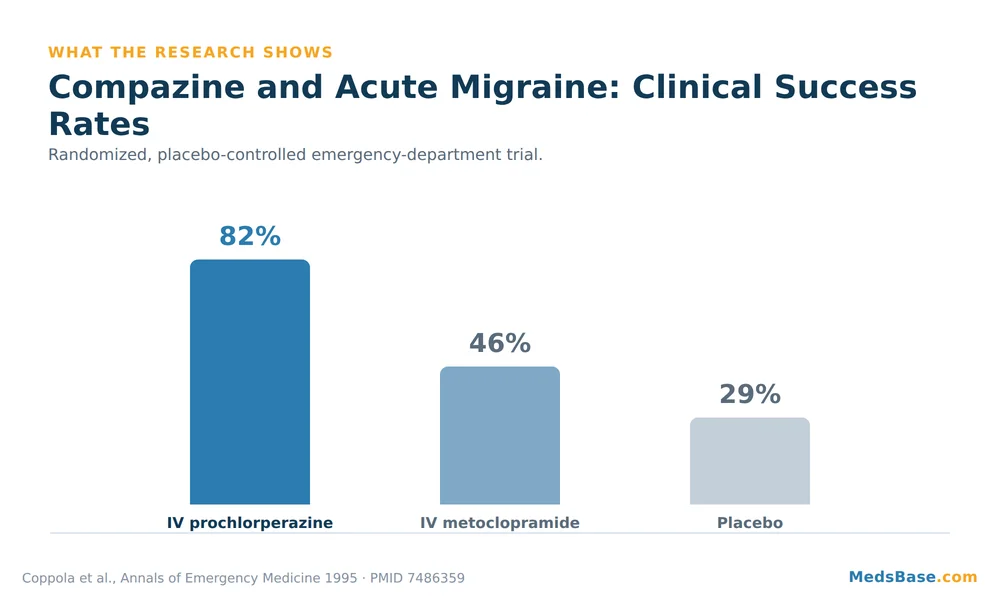
What this means for you: for specific situations — migraine with nausea, vertigo, severe vomiting where sedation is unwelcome — prochlorperazine has direct head-to-head wins. For garden-variety mild nausea, the honest Cochrane conclusion is that no antiemetic is a proven champion, and simple measures like fluids often help as much. Research suggests picking the drug whose side-effect trade-offs fit your situation — which is exactly what the next section maps out.
Compazine vs Alternatives: Ondansetron, Domperidone & More
No antiemetic wins everywhere. The practical question isn’t “what’s strongest?” but “which mechanism matches my kind of nausea, and which side-effects can I live with?” Every alternative below acts on a different alarm pathway, which is why a switch often works when the first drug fails.
| Medication | Class / target | Shines for | Sedation | Key cautions |
|---|---|---|---|---|
| Prochlorperazine (Compazine, Stemetil) | Phenothiazine — central D2 blocker | Severe nausea, migraine, vertigo | Moderate | Movement side effects; avoid in Parkinson’s & dementia |
| Ondansetron (Zofran; generic Ondem) | 5-HT3 (serotonin) blocker | Chemo, post-surgical nausea; when you must stay alert | Minimal | Constipation, headache; heart-rhythm caution at high doses |
| Domperidone (Motilium; generic Vomistop) | Peripheral D2 blocker (barely enters brain) | Sluggish-stomach nausea; when movement side effects must be avoided | Minimal | Heart-rhythm caution; not marketed in the US, widely used elsewhere |
| Promethazine (Phenergan) | Antihistamine-type phenothiazine | Motion sickness; nausea with insomnia or allergy overlap | High | Strong drowsiness — lost to prochlorperazine on this in trials |
| Metoclopramide (Reglan; generic Metopar) | D2 blocker + gut prokinetic | Gastroparesis-type nausea, reflux-related sickness | Mild | Same movement-side-effect family; regulators advise short courses |
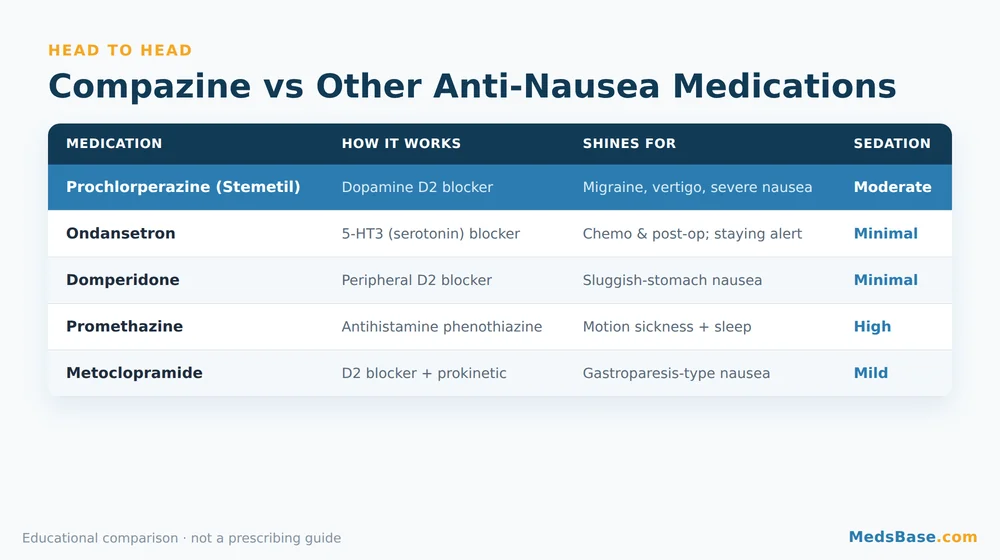
Which fits which situation? If migraine or vertigo drives your nausea, prochlorperazine’s central action is the natural first conversation. If you need to work, drive, or study through treatment, ondansetron’s alert profile usually wins. If a previous dopamine blocker gave you restlessness or spasms, domperidone offers similar anti-nausea logic while staying out of the brain. And if nausea comes with a night of no sleep, promethazine’s sedation stops being a bug and becomes the feature. There’s a catch, though: several of these look interchangeable on paper but behave very differently in specific bodies — heart rhythm, age, and other medications all shift the calculus, so run the final choice past your clinician or pharmacist.
How to Take Compazine (Prochlorperazine) Safely
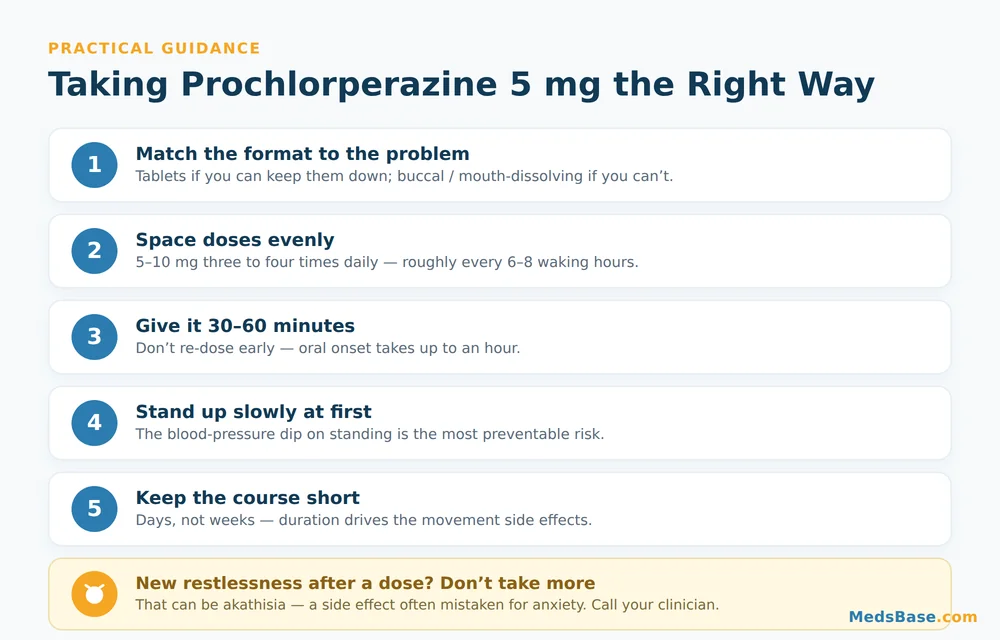
Getting the practical details right is most of the battle with prochlorperazine: the right formulation, the right spacing, and a short course. Tablets can be taken with or without food — with a snack if they unsettle your stomach. Here’s the sequence that avoids the common mistakes:
- Match the format to the problem. Standard tablets work if you can keep them down. If vomiting is already underway, buccal tablets (dissolved against the upper gum) absorb through the cheek lining and bypass the stomach entirely — Stemetil MD 5 mg mouth-dissolving tablets use the same swallow-free principle, from $1.17 per tablet in larger packs.
- Space doses evenly. 5–10 mg three to four times daily means roughly every 6–8 waking hours — not clustered when symptoms spike.
- Give it a fair window. Oral doses typically start working in 30–60 minutes. Don’t re-dose early because “nothing happened” at 20 minutes.
- Stand up slowly for the first few days. The blood-pressure dip on standing is the most preventable fall risk this drug carries.
- Keep the course short. Most nausea situations need days of treatment, not weeks. Duration is the main driver of movement side effects.
Mistakes to avoid: mixing with alcohol or sleep aids (sedation stacks), driving before you know your response, taking an extra dose to “push through” restlessness (that’s akathisia — see above), giving it to a child without specialist direction, and staying on it for weeks by inertia. If nausea persists beyond a few days, the priority is finding the cause, not extending the antiemetic.
- Vertigo: symptoms, causes and treatment — where prochlorperazine fits among balance-disorder options
- Best migraine medications: 10 evidence-backed picks — pairing antiemetics with pain-specific treatment
- Rizact (rizatriptan) guide — the triptan side of the migraine equation
Frequently Asked Questions
Q: What is Compazine used for?
A: Compazine (prochlorperazine) is used mainly for severe nausea and vomiting — from stomach bugs, surgery, chemotherapy support care, or medication side effects. It is also widely used for migraine attacks (it relieves both the nausea and the head pain) and for vertigo, Ménière’s disease and labyrinthitis. Historically it also treated schizophrenia and short-term anxiety, though newer drugs now dominate those uses.
Q: Is Compazine still available?
A: Yes — as a generic. The Compazine brand name was discontinued in the US for commercial reasons, not safety ones, but prochlorperazine tablets, suppositories and injections remain FDA-approved and widely stocked. Internationally the same medicine is sold under brand names like Stemetil and Buccastem. In practice, every prochlorperazine product on pharmacy shelves is a Compazine generic — pharmacologically the same medicine.
Q: How long does Compazine take to work?
A: Oral prochlorperazine typically starts easing nausea within 30–60 minutes, with each dose lasting roughly 3–4 hours for standard tablets. Buccal tablets absorbed through the gum reach the bloodstream without needing a settled stomach, which makes them more reliable mid-vomiting. Hospital IV or injectable doses act within minutes — one reason emergency departments favour that route for migraine.
Q: Is Compazine the same as Zofran?
A: No. Both treat nausea, but through different pathways: Compazine (prochlorperazine) blocks dopamine in the brain’s vomiting centre, while Zofran (ondansetron) blocks serotonin signals. Zofran causes almost no drowsiness or movement side effects but can cause constipation and heart-rhythm changes at high doses. Prochlorperazine covers migraine and vertigo better; ondansetron is often preferred for chemotherapy or post-surgical nausea. Neither is universally “stronger.”
Q: Is Compazine an antipsychotic?
A: Technically yes — prochlorperazine is a first-generation phenothiazine antipsychotic, and high doses were once used for schizophrenia. But at the low, short-term doses used for nausea, vertigo or migraine, it functions as an antiemetic. Taking 5–10 mg for a few days of sickness is a very different exposure from months of psychiatric dosing, which is where most of the serious long-term risks were observed.
Q: Can you buy prochlorperazine over the counter?
A: In the UK, yes in one specific case: pharmacies can sell small packs of buccal prochlorperazine 3 mg (Buccastem M) to adults with previously diagnosed migraine, per NHS guidance. In the US, prochlorperazine is dispensed rather than shelf-stocked. International generics such as Stemetil are also available through online pharmacies — check your own country’s rules before ordering.
Q: What are the most serious Compazine side effects?
A: Four deserve attention: acute dystonia (sudden muscle spasms of the neck, jaw or eyes — frightening but rapidly treatable), akathisia (severe inner restlessness often mistaken for anxiety), tardive dyskinesia (involuntary movements after long-term use, sometimes persistent), and the very rare emergency neuroleptic malignant syndrome (high fever, rigidity, confusion). Older adults with dementia face increased mortality risk on antipsychotics, so prochlorperazine is not used in that group.
Q: Can you take Compazine during pregnancy?
A: Only under direct medical guidance. Prochlorperazine has decades of use in pregnancy sickness and the NHS lists it among options for pregnancy-related nausea, but first-line care usually starts with vitamin B6 and doxylamine-based regimens. Use near delivery is specifically cautioned, because newborns exposed in the third trimester can show temporary movement and withdrawal symptoms. This is a genuinely individual decision for you and your clinician.
The Bottom Line on Compazine
Compazine is a rare thing in medicine: a 70-year-old drug that still wins head-to-head trials. As prochlorperazine, it remains one of the most effective options for severe nausea, migraine-with-vomiting, and vertigo — cheap, well understood, and fast. Its trade-off is equally clear: dopamine-blocking side effects that demand short courses, low doses, and honest respect, especially in older adults and anyone with Parkinson’s.
Your immediate action: identify what’s actually driving your nausea, then match the drug to it — this guide’s comparison table is built for exactly that conversation with your clinician or pharmacist. When you know what you need, you can browse prochlorperazine and its alternatives in our nausea treatment range, which lists strengths, pack sizes and current availability.
Wondering whether your spinning episodes are actually vertigo — and what else treats them? Our vertigo guide answers that next. Getting migraines with your nausea? See how antiemetics slot into a full attack plan in the best migraine medications rundown.

Written by
Sophie ChenPharmaceutical Content Researcher · 8 years experience
Sophie Chen is a pharmaceutical content researcher with 8 years covering generic medication access and clinical pharmacology. She specialises in international regulatory frameworks, bioequivalence standards, and patient-facing education on therapeutic drug classes. She is not a clinician.