








✓ Medically reviewed by · Last reviewed: May 2026
Pharmacy Researcher · 8 years experience
Pharmacy researcher with 8 years reviewing clinical drug information, generic formulation equivalence, and international pharmaceutical standards. Focuses on patient-facing accuracy in medication education.
buspirone vs benzodiazepines for anxiety — Buspirone vs Benzodiazepines for Anxiety — 6 Key Differences That Determine Which One Is Right for You. Read on for an evidence-backed guide covering everything you need to know.
Hero Intro
Buspirone vs benzodiazepines for anxiety — take Mark, 34, who has been living with generalized anxiety for five years — the kind where your chest tightens before meetings, your mind replays conversations at 2 a.m., and the baseline hum of worry never entirely stops. His doctor prescribed a benzodiazepine for breakthrough anxiety, and for the first month, it felt like a miracle: 30 minutes after a tablet, the edge dissolved. But six months in, Mark noticed something unsettling. The same dose was not working as well. He needed more to get the same relief. On the days he skipped it, the anxiety came roaring back worse than before. He had traded one problem for another.
Buspirone vs benzodiazepines for anxiety — mark’s experience is not unusual. Benzodiazepines — including alprazolam (Xanax), lorazepam (Ativan), clonazepam (Klonopin), and diazepam (Valium) — are among the most commonly prescribed psychiatric medications globally. They work rapidly and effectively. They also carry a well-documented risk of tolerance, dependence, and withdrawal that has made them one of the most controversial medication classes in medicine. That is where buspirone enters the conversation — an anti-anxiety medication that works through an entirely different mechanism, carries no meaningful dependence risk, and is recommended as a first-line option in multiple national guidelines. But it has a catch that every patient needs to understand before filling the prescription.
Key Takeaways
- Buspirone and benzodiazepines treat anxiety through completely different brain mechanisms — knowing the difference explains every other distinction between them
- Benzodiazepines work in 30–60 minutes but create tolerance; buspirone takes 2–4 weeks to work but maintains effectiveness indefinitely without dose escalation
- Buspirone has virtually no abuse or dependence potential — a critical advantage for the estimated 1 in 4 people with anxiety who also have a substance use history
- Buspirone is first-line only for generalized anxiety disorder (GAD); for panic disorder or acute anxiety attacks, benzodiazepines or SSRIs are better-supported
- The safest strategy — endorsed by most guidelines — is buspirone or an SSRI as the foundation, with benzodiazepines reserved for short-term breakthrough relief only
What Are Buspirone and Benzodiazepines? — Buspirone vs benzodiazepines for anxiety Explained
Buspirone vs benzodiazepines for anxiety — buspirone and benzodiazepines are two fundamentally different classes of anti-anxiety medication used to treat anxiety disorders — but the similarities largely end at the word “anxiety.” Understanding the buspirone vs benzodiazepines for anxiety distinction starts with recognizing that these medications target completely different neurotransmitter systems in the brain, and that difference explains nearly every clinical difference between them.
Buspirone vs benzodiazepines for anxiety — buspirone (brand name Buspar, though generic only in most markets) was approved by the FDA in 1986 and belongs to the azapirone class. It is chemically and pharmacologically distinct from benzodiazepines, barbiturates, and other sedative-hypnotic agents. Buspirone does not bind to GABA receptors at all, does not produce sedation at therapeutic doses, and does not interact with alcohol in the dangerous synergistic way that benzodiazepines do.
Buspirone vs benzodiazepines for anxiety — benzodiazepines, by contrast, have been in clinical use since the 1960s and work by enhancing the effect of gamma-aminobutyric acid (GABA) — the brain’s primary inhibitory neurotransmitter. By increasing GABA signaling, they broadly suppress neural activity, producing effects that include reduced anxiety, muscle relaxation, sedation, anticonvulsant action, and amnesia. This broad-spectrum suppression is what makes them effective for acute anxiety but also what makes them problematic with chronic use.
How Does Buspirone Work Differently From Benzodiazepines? — Buspirone vs benzodiazepines for anxiety Explained
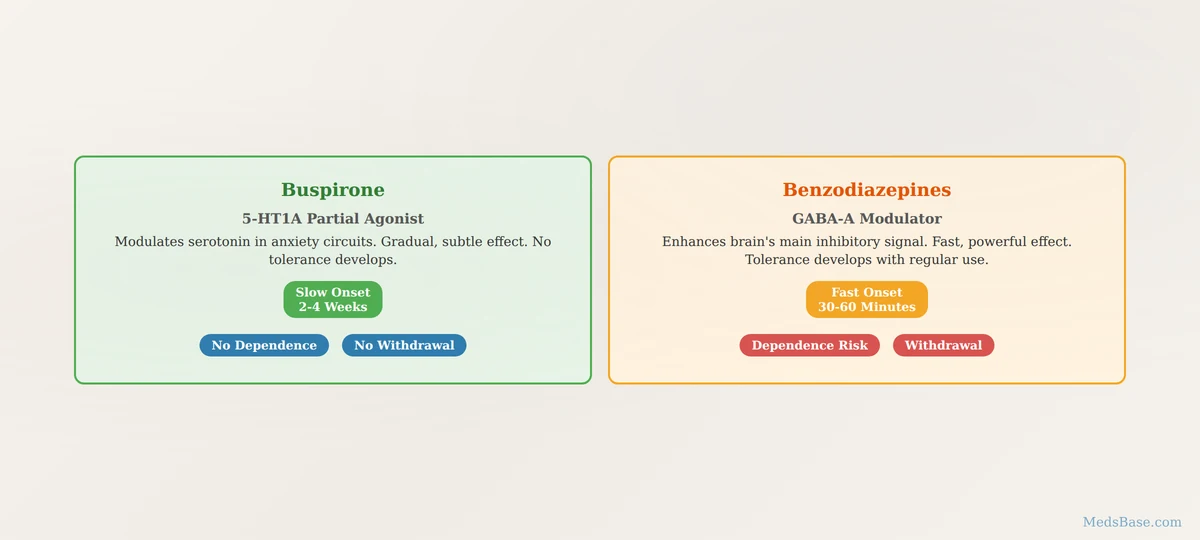
Here is where it gets genuinely interesting — and where understanding the buspirone vs benzodiazepines for anxiety mechanism distinction makes everything else click into place.
Buspirone: A Laser, Not a Sledgehammer
Buspirone vs benzodiazepines for anxiety — buspirone is a 5-HT1A receptor partial agonist — a description that sounds like pharmacology jargon but describes something elegantly specific. The 5-HT1A receptor is one of the brain’s serotonin receptors, and it functions as an autoreceptor (a brake on serotonin release) in the raphe nuclei and as a postsynaptic receptor in limbic and cortical regions involved in anxiety. When buspirone binds to the presynaptic 5-HT1A autoreceptor, it initially suppresses serotonin neuron firing — which is why it does not work immediately. Over 2–4 weeks, these autoreceptors desensitize, serotonin firing normalizes, and the postsynaptic 5-HT1A activation produces an anxiolytic effect without sedation.
Buspirone vs benzodiazepines for anxiety — the “partial agonist” part is crucial: buspirone activates the receptor, but not maximally. This means it modulates serotonin signaling rather than flooding or blocking it — more like a dimmer switch than an on-off toggle. The result is anxiety reduction that feels subtle and gradual rather than dramatic — and, critically, the brain does not compensate by downregulating the target receptor, which is why tolerance does not develop.
Benzodiazepines: Fast, Broad, and With Consequences
Buspirone vs benzodiazepines for anxiety — benzodiazepines bind to a specific site on the GABA-A receptor complex — distinct from the GABA binding site itself — and act as positive allosteric modulators. In plain English: they do not directly open the chloride channel that GABA opens, but when GABA binds, benzodiazepines make the channel stay open longer, allowing more chloride ions to flow into the neuron. More chloride means the neuron is harder to excite, which means less anxiety, less muscle tension, and — at higher doses — sedation and amnesia.
Buspirone vs benzodiazepines for anxiety — this mechanism is fast. The effect begins within 30–60 minutes of an oral dose. It is also broad: GABA-A receptors are distributed throughout the brain, so benzodiazepines affect not only anxiety circuits but also motor control, memory formation, and arousal. With regular use, the brain adapts by reducing the number and sensitivity of GABA-A receptors — a process called downregulation — which is why tolerance develops, requiring higher doses for the same effect, and why withdrawal produces rebound anxiety that is often worse than the original symptoms.
Research Spotlight: Why Benzos Stop Working
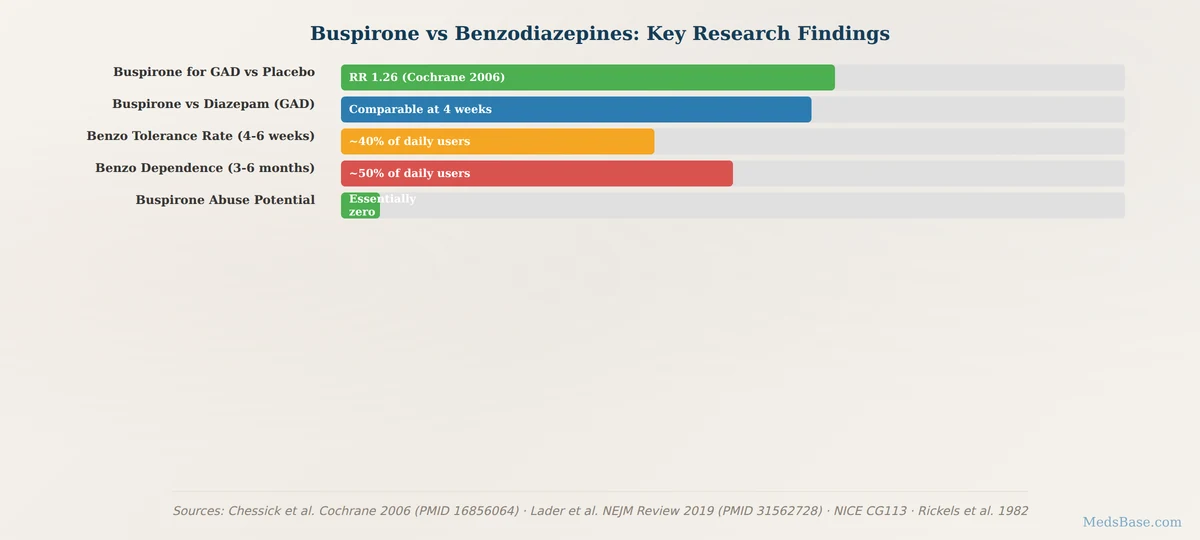
A comprehensive review published in the New England Journal of Medicine examined the neuroadaptive changes that occur with regular benzodiazepine use. Key finding: GABA-A receptor downregulation begins within days of regular use and progresses over weeks. After 4–6 weeks of daily use, approximately 40% of patients experience clinically significant tolerance — needing higher doses for the same anxiolytic effect. After 3–6 months, roughly 50% of daily users meet criteria for physiological dependence, and discontinuation produces a withdrawal syndrome that can include rebound anxiety, insomnia, tremor, perceptual disturbances, and — in severe cases — seizures. This is the central argument for buspirone vs benzodiazepines for anxiety: one maintains efficacy without receptor adaptation; the other triggers the very adaptation that makes it unsustainable.
The mechanism difference determines every clinical difference that follows. Buspirone targets serotonin in a narrow, modulatory way — slow onset, no tolerance, no withdrawal. Benzodiazepines hit GABA broadly — fast onset, tolerance with regular use, withdrawal on discontinuation. The tradeoff is speed vs sustainability.
6 Key Differences Between Buspirone and Benzodiazepines
1. Onset of Action: 30 Minutes vs 2–4 Weeks
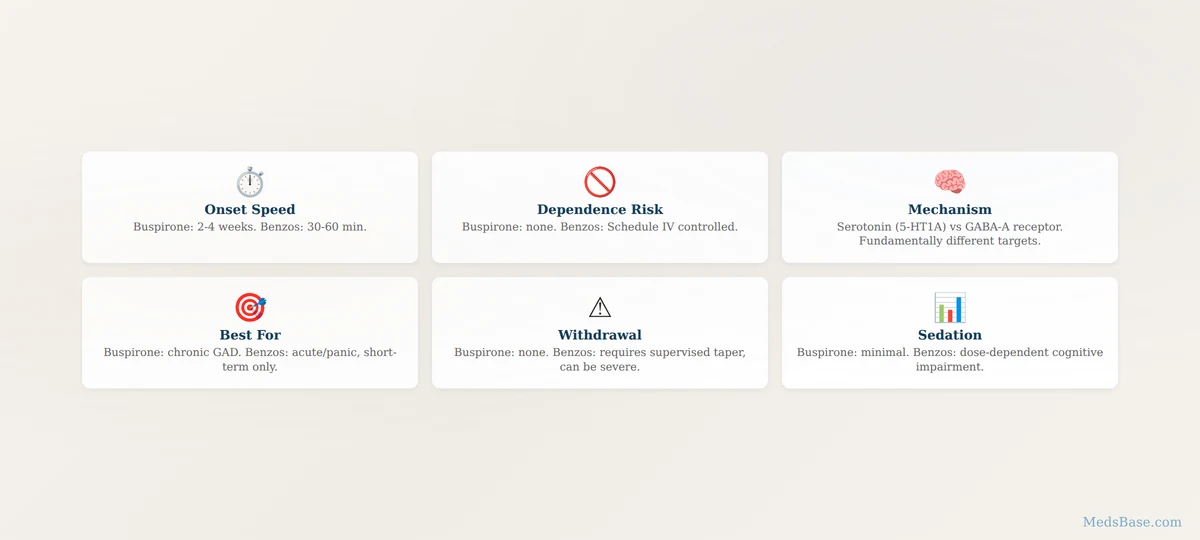
This is the single most important practical difference in the buspirone vs benzodiazepines for anxiety comparison. A benzodiazepine taken orally will reduce anxiety within 30–60 minutes. The effect is palpable — patients can feel it working. Buspirone, by contrast, requires 2–4 weeks of regular dosing before anxiolytic effects emerge, and the effect is subtler — more “I realized I have not been worrying as much” than “I feel the medication kicking in.”
This difference shapes clinical use in a fundamental way. Benzodiazepines are suitable for acute anxiety — a panic attack, a flight phobia, a procedural anxiety episode. Buspirone is for chronic, sustained anxiety management. If someone needs relief today, buspirone is not the answer. If someone needs a maintenance medication they can take for years without escalating the dose, buspirone is a strong candidate.
2. Dependence and Abuse Potential: Near-Zero vs Significant
Buspirone has no meaningful abuse potential — a key advantage in any buspirone vs benzodiazepines for anxiety evaluation. It does not produce euphoria, does not interact dangerously with alcohol (no synergistic respiratory depression), and has never developed a street market or pattern of recreational misuse. Multiple controlled studies have confirmed that buspirone produces no reinforcing effects in human or animal models — meaning the brain does not learn to seek it out. Discontinuation after long-term use does not produce a withdrawal syndrome; the medication can be stopped without tapering.
Benzodiazepines, by contrast, are Schedule IV controlled substances in the United States precisely because of their abuse and dependence liability. The reinforcing effect — the rapid relief of anxiety coupled with mild euphoria in some individuals — creates a psychological reward loop that drives continued use. Physical dependence develops with daily use over as little as 3–4 weeks, and withdrawal can be protracted and severe, sometimes lasting months.
3. Efficacy Profile: GAD Specialist vs Broad-Spectrum
Buspirone’s evidence base in the buspirone vs benzodiazepines for anxiety comparison is strongest — and in some guidelines, exclusively recommended — for generalized anxiety disorder (GAD). It is less effective (or not studied) for panic disorder, social anxiety disorder, obsessive-compulsive disorder, and post-traumatic stress disorder. The NICE guideline for anxiety recommends buspirone as a second-line option for GAD when SSRIs are not tolerated, and explicitly notes the advantage of its non-dependence profile.
Benzodiazepines are effective across a broader range of anxiety presentations — GAD, panic disorder, social anxiety, acute stress reactions, and situational anxiety. However, their role has been progressively narrowed in most guidelines: they are now recommended primarily for short-term use (2–4 weeks maximum) during the SSRI/SNRI titration period, or for infrequent, as-needed use in specific anxiety-provoking situations.
4. Side Effect Profile: Lightheadedness vs Sedation
Buspirone’s most common side effects — and this is often the deciding factor in the buspirone vs benzodiazepines for anxiety decision — are dizziness or lightheadedness (occurring in approximately 10–15% of patients, typically transient and within an hour of dosing), headache, nervousness, and nausea. Importantly, buspirone causes minimal sedation, no significant cognitive impairment, and no psychomotor slowing at therapeutic doses — which means people can drive, operate machinery, and function normally while taking it.
Benzodiazepines reliably cause sedation, drowsiness, cognitive slowing, and impaired coordination — effects that are dose-dependent and contribute significantly to the fall risk in older adults (benzodiazepines are on the Beers Criteria list of medications to avoid in patients over 65 for this reason). Anterograde amnesia — difficulty forming new memories while the medication is active — is another benzodiazepine-specific side effect not seen with buspirone.
5. Drug Interactions: Serotonergic vs CNS Depressant
The safety profile difference is one of the strongest arguments in the buspirone vs benzodiazepines for anxiety discussion. Combining buspirone with SSRIs, SNRIs, MAOIs, or other serotonergic agents can increase the risk of serotonin syndrome — a potentially serious condition characterized by agitation, hyperthermia, tachycardia, and neuromuscular abnormalities. Buspirone also interacts with grapefruit juice (CYP3A4 inhibition increases buspirone levels) and with CYP3A4 inducers and inhibitors.
Benzodiazepines interact dangerously with other central nervous system depressants — alcohol, opioids, other sedatives, and certain anticonvulsants — producing additive sedation and respiratory depression that can be fatal at high doses or in vulnerable individuals. This is a major public health concern: benzodiazepines are involved in approximately 30% of opioid overdose deaths.
6. Cost and Availability: Generic Parity
Both buspirone and all commonly prescribed benzodiazepines (alprazolam, lorazepam, clonazepam, diazepam) are available as inexpensive generics. Buspirone is typically dispensed as 5 mg, 10 mg, or 15 mg tablets taken 2–3 times daily. A month’s supply of generic buspirone costs approximately $4–15 in most markets. Benzodiazepines cost similarly in generic form, though the controlled-substance status adds prescription and dispensing requirements (no refills without a new prescription, ID verification at the pharmacy in some jurisdictions) that buspirone does not carry.
Safety, Side Effects & Dependence
| Buspirone | Benzodiazepines | |
|---|---|---|
| Common Side Effects | Dizziness (10–15%), headache, nausea, nervousness, lightheadedness | Sedation, drowsiness, cognitive impairment, impaired coordination, anterograde amnesia |
| Serious Risks | Serotonin syndrome (with other serotonergic drugs) | Respiratory depression (with alcohol/opioids), falls/fractures (elderly), dependence, withdrawal seizures |
| Tolerance | None observed with long-term use | Develops within days to weeks; ~40% of patients by 4–6 weeks |
| Physical Dependence | None | 50%+ of daily users by 3–6 months |
| Withdrawal Syndrome | None (can stop without taper) | Rebound anxiety, insomnia, tremor, perceptual disturbance, seizures (severe cases); requires gradual taper |
| Abuse Potential | Essentially zero — no euphoria, no reinforcing effects, no street market | Significant — Schedule IV controlled substance; reinforcing due to rapid anxiolysis |
| Alcohol Interaction | No synergistic CNS depression | Dangerous — additive sedation and respiratory depression; warning labels required |
| Pregnancy Category | Category B (generally considered safer) | Category D (evidence of risk; avoid in pregnancy when possible) |
| Overdose Risk | Low — no reported fatalities from buspirone alone | Significant — especially when combined with alcohol or opioids |
What Does the Research Say?
| Study | Year | Finding | Source |
|---|---|---|---|
| Chessick et al. (Cochrane) | 2006 | Azapirones (including buspirone) significantly more effective than placebo for GAD (RR of response 1.26); comparable to benzodiazepines for GAD | PubMed |
| Rickels et al. | 1982 | Buspirone equivalent to diazepam for GAD symptoms over 4 weeks; buspirone superior on depression cluster; diazepam superior first 2 weeks | PMID: 6123288 |
| Lader et al. (NEJM review) | 2019 | Benzodiazepine dependence develops in ~50% of daily users by 3–6 months; withdrawal syndrome can last months; risk-benefit favors time-limited use only | PubMed |
| NICE CG113 | 2011 (updated 2020) | Buspirone listed as second-line pharmacological option for GAD when SSRIs are ineffective or not tolerated; benzodiazepines recommended for short-term crisis only (2–4 weeks) | NICE |
| Garakani et al. | 2020 | Pharmacotherapy review for anxiety disorders: buspirone effective for GAD with favorable safety profile; benzodiazepines effective for acute anxiety but limited by dependence risk | PMID: 33227919 |
| Baldwin et al. | 2014 | Evidence-based pharmacological treatment of anxiety disorders: buspirone recommended for GAD; benzodiazepines reserved for short-term or adjunctive use | PMID: 24814576 |
Buspirone vs Benzodiazepines for Anxiety — Head-to-Head Comparison
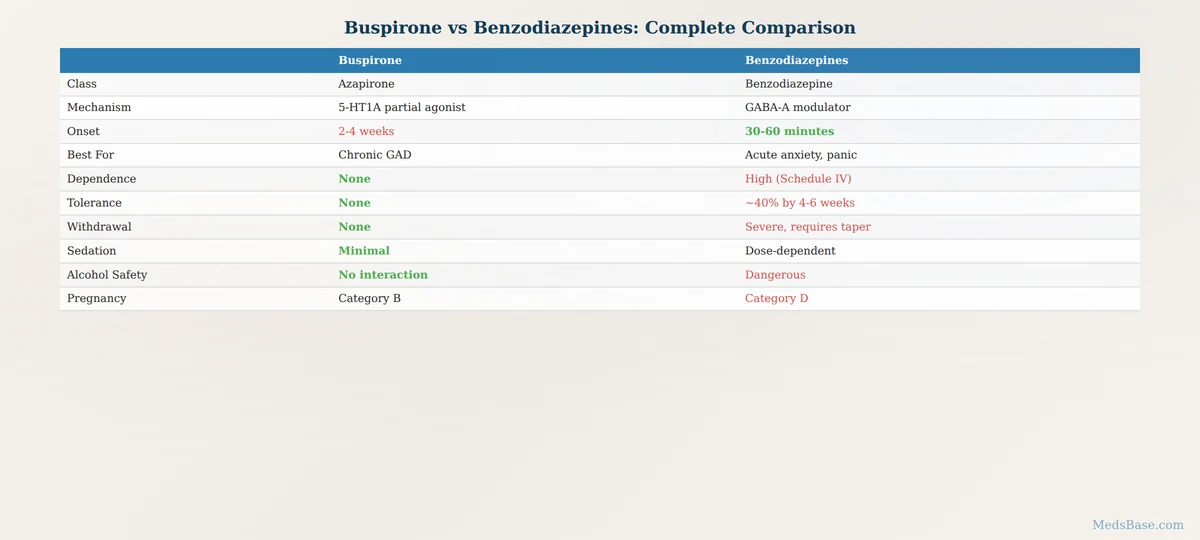
| Buspirone | Benzodiazepines | |
|---|---|---|
| Drug Class | Azapirone (non-benzo anxiolytic) | Benzodiazepine |
| Mechanism | 5-HT1A partial agonist | GABA-A positive allosteric modulator |
| Onset | 2–4 weeks | 30–60 minutes |
| Best for | Chronic GAD management | Acute anxiety, panic attacks, short-term crisis |
| GAD Efficacy | Yes — supported by Cochrane review and NICE | Yes — but tolerance limits long-term utility |
| Panic Disorder | Not recommended — limited evidence | Effective acutely; SSRIs preferred first-line for maintenance |
| Dependence Risk | None | High — Schedule IV controlled substance |
| Tolerance | None | Develops in ~40% by 4–6 weeks |
| Withdrawal | None | Significant — requires gradual taper; can be severe |
| Sedation | Minimal to none | Dose-dependent; significant at therapeutic doses |
| Cognitive Effects | Minimal | Impaired memory, concentration, coordination |
| Pregnancy | Category B (relatively safer) | Category D (avoid) |
| Alcohol Interaction | No synergistic CNS depression | Dangerous — additive sedation |
| Dosing | 7.5–15 mg 2–3× daily; max 60 mg/day | Varies by drug; typically 2–4× daily or as needed |
| Cost (generic) | $4–$15/month | $4–$15/month |
| Guideline Status | Second-line for GAD (NICE); considered when SSRIs not tolerated | Short-term only (2–4 weeks) in most guidelines |
Which One Is Right for You?
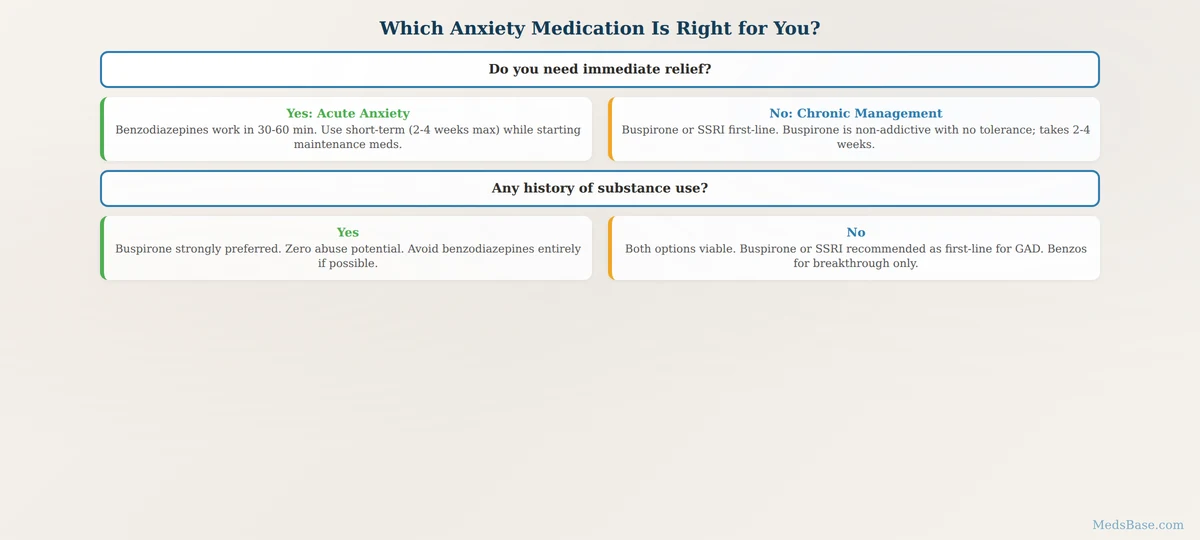
The buspirone vs benzodiazepines for anxiety decision ultimately depends on four factors: your specific anxiety diagnosis, how quickly you need relief, your personal or family history of substance use, and whether you have tried other medications first.
Buspirone May Be Right for You If:
- You have been diagnosed with generalized anxiety disorder (GAD) — the constant, diffuse worry rather than discrete panic attacks
- You can wait 2–4 weeks for the full effect — you need chronic maintenance, not immediate relief
- You have a personal or family history of substance use disorder and want to entirely avoid dependence risk
- You have tried an SSRI and could not tolerate the side effects (sexual dysfunction, emotional blunting, weight gain)
- You are older and concerned about fall risk or cognitive impairment from sedating medications
- You want a medication you can stop at any time without tapering
Benzodiazepines May Be More Appropriate If:
- You experience acute panic attacks that require rapid relief
- You have episodic, situational anxiety (flight phobia, dental procedures, public speaking)
- You are starting an SSRI and need short-term relief during the 2–4 week titration period (the most common guideline-endorsed use)
- Your anxiety is not GAD — benzodiazepines have broader evidence across anxiety disorder subtypes
- Your use will be strictly intermittent (a few times per month, not daily)
The Combination Strategy
For many people, the optimal approach — and the one reflected in most clinical guidelines — involves buspirone (or an SSRI) as the daily maintenance medication, with a benzodiazepine prescribed for as-needed use during the first 2–4 weeks while the maintenance medication takes effect, and then discontinued. This hybrid strategy captures the best of both sides in the buspirone vs benzodiazepines for anxiety tradeoff: immediate relief from the benzo during the buspirone ramp-up period, followed by a sustainable, dependence-free maintenance plan.
Frequently Asked Questions
Q: Is buspirone better than benzodiazepines for anxiety?
A: “Better” depends entirely on what you are treating and what you value. For chronic generalized anxiety disorder specifically, buspirone is often the better choice — it is effective, non-addictive, does not cause tolerance, and can be taken for years without dose escalation. For acute anxiety, panic attacks, or situational anxiety, benzodiazepines are more effective because they work within 30–60 minutes. The buspirone vs benzodiazepines for anxiety question is best reframed as: “buspirone for sustained management vs benzodiazepines for acute breakthrough relief.” Many people benefit from a strategy that incorporates both — buspirone as the daily foundation, benzodiazepines for rare breakthrough episodes only.
Q: Does buspirone work immediately?
A: No — and this is the most important thing to understand before starting buspirone. Unlike benzodiazepines, which produce noticeable anxiety relief within 30–60 minutes, buspirone requires 2–4 weeks of consistent dosing before the anxiolytic effect emerges. The effect is gradual and subtle — many people report realizing after 3–4 weeks that they are worrying less, rather than feeling a distinct “the medication kicked in” moment. This slow onset is a direct consequence of buspirone’s mechanism: the therapeutic effect depends on 5-HT1A autoreceptor desensitization, which takes time. For people who need immediate relief, buspirone alone is not the answer — which is why guidelines often recommend combining it with short-term benzodiazepines during the first 2–4 weeks.
Q: What is the safest anxiety medication without dependence risk?
A: Buspirone is widely considered the safest anti-anxiety medication in terms of dependence and abuse liability. It has no reinforcing effects, does not cause tolerance, produces no withdrawal syndrome, and can be stopped abruptly without a taper. Other non-addictive options for anxiety include SSRIs (sertraline, escitalopram, paroxetine), SNRIs (venlafaxine, duloxetine), and certain off-label agents like hydroxyzine (an antihistamine used for acute anxiety) and pregabalin (used for GAD in some countries but with its own misuse potential). Among all of these, buspirone is unique in being specifically designed as a non-sedating, non-dependence-forming anxiolytic — it was developed explicitly to fill the gap between benzodiazepines (effective but addictive) and antidepressants (effective but with their own side-effect burdens).
Q: Can buspirone replace Xanax?
A: It depends on how you are using Xanax. If you are taking Xanax (alprazolam) daily for chronic generalized anxiety, buspirone is an excellent replacement candidate — it treats the same underlying condition without the tolerance and dependence issues. However, switching from a benzodiazepine to buspirone requires a transition plan: the buspirone must be started and given 2–4 weeks to take effect while the benzodiazepine is slowly tapered. Abruptly stopping daily benzodiazepine use is dangerous and can cause seizures. If you are using Xanax only occasionally (a few times per month) for acute anxiety episodes, buspirone is not a direct replacement because it does not work acutely. In that scenario, you might consider buspirone (or an SSRI) for daily anxiety prevention, plus a non-benzo option (like hydroxyzine) for occasional breakthrough episodes. Never change your medication regimen without your doctor’s supervision.
Q: How does buspirone work differently from benzodiazepines?
A: Buspirone acts on the serotonin system as a 5-HT1A receptor partial agonist — it modulates serotonin activity in anxiety-related brain circuits without affecting GABA. Benzodiazepines act on the GABA system as positive allosteric modulators at GABA-A receptors — they enhance the brain’s main inhibitory neurotransmitter. This difference explains everything: buspirone’s serotonin modulation produces gradual, subtle anxiolysis without sedation or tolerance. Benzodiazepines’ GABA enhancement produces rapid, powerful anxiolysis with sedation — but the brain adapts to this GABA boost by reducing receptor sensitivity, creating tolerance and dependence. Buspirone is a narrow, precise intervention; benzodiazepines are a broad, blunt one. The narrow one is safer for long-term use.
Q: What are the long-term effects of benzodiazepines?
A: Long-term daily benzodiazepine use is associated with several concerning effects: (1) Tolerance — requiring higher doses for the same effect, which escalates dependence risk. (2) Physiological dependence — roughly 50% of daily users develop dependence within 3–6 months. (3) Cognitive impairment — studies show persistent deficits in memory, processing speed, and executive function in long-term users, though some recovery occurs after discontinuation. (4) Increased fall and fracture risk — particularly significant in older adults, where benzodiazepines are on the Beers Criteria list of potentially inappropriate medications. (5) Withdrawal syndrome on discontinuation — can include rebound anxiety, insomnia, tremor, perceptual disturbances, and seizures. (6) Possible increased dementia risk — observational studies have found an association between long-term benzodiazepine use and increased dementia incidence, though causality is difficult to establish. These concerns are why benzodiazepines are now recommended for short-term use only (2–4 weeks maximum) in most clinical guidelines.
The Bottom Line
The buspirone vs benzodiazepines for anxiety comparison reveals a clear clinical logic: buspirone is the safer, more sustainable choice for chronic generalized anxiety, while benzodiazepines retain an important but narrow role — short-term use, acute anxiety, and breakthrough episodes only. The medications are not competitors; they serve different clinical scenarios.
If you are living with the daily, grinding worry of GAD — the kind that does not flare up and fade but sits there, day after day, for months or years — buspirone offers a medication you can take long-term without the dread of tolerance, without the fear of dependence, and without the cognitive fog of sedation. The price you pay for that safety is patience: 2–4 weeks for the full effect, and a subtler experience of relief rather than a dramatic transformation. For many people, that tradeoff is well worth it.
If your anxiety is acute, episodic, or panic-driven — or if you simply need help right now while waiting for a maintenance medication to kick in — benzodiazepines have a role. But that role should be time-limited, prescribed with a clear exit strategy, and never the sole long-term treatment plan.
One action you can take right now: Write down the specific pattern of your anxiety — is it constant background worry (suggesting GAD and favoring buspirone/SSRI) or sudden intense episodes (suggesting panic and potentially justifying short-term benzodiazepines)? Bring that description to your next doctor’s appointment. The more precise you can be about your symptoms, the better your treatment match will be.
Browse the full range of mental health medications at MedsBase to understand your options. If you are also managing depression, read about how exercise for depression can complement your treatment plan. And if you are weighing other treatment decisions, our guide to diet vs medication for cholesterol explores a similar risk-benefit tradeoff in a different condition.
Medical Disclaimer
This article is for informational purposes only and does not constitute medical advice. Buspirone vs benzodiazepines for anxiety is a treatment decision that must be made in consultation with your healthcare provider based on your specific diagnosis, medical history, and treatment goals. Never start, stop, or change anxiety medication without medical supervision. Abruptly discontinuing benzodiazepines after regular use can cause dangerous withdrawal symptoms including seizures — always work with your doctor on a supervised taper plan. If you are experiencing thoughts of self-harm or suicide, contact a crisis helpline immediately.
Reviewed by Sophie Chen, PharmD Candidate | Last updated: 2026-10-03

Written by
Sophie ChenPharmaceutical Content Researcher · 8 years experience
Sophie Chen is a pharmaceutical content researcher with 8 years covering generic medication access and clinical pharmacology. She specialises in international regulatory frameworks, bioequivalence standards, and patient-facing education on therapeutic drug classes. She is not a clinician.