








✓ Medically reviewed by · Last reviewed: May 2026
Pharmacy Researcher · 8 years experience
Pharmacy researcher with 8 years reviewing clinical drug information, generic formulation equivalence, and international pharmaceutical standards. Focuses on patient-facing accuracy in medication education.
Epclusa vs Harvoni — Epclusa vs Harvoni: 7 Proven Differences to Choose the Right Hepatitis C Treatment. Read on for an evidence-backed guide covering everything you need to know.
Epclusa vs Harvoni: Key Takeaways
- Both Epclusa and Harvoni cure hepatitis C in the vast majority of people — with short oral courses and far milder side effects than older interferon-based treatment.
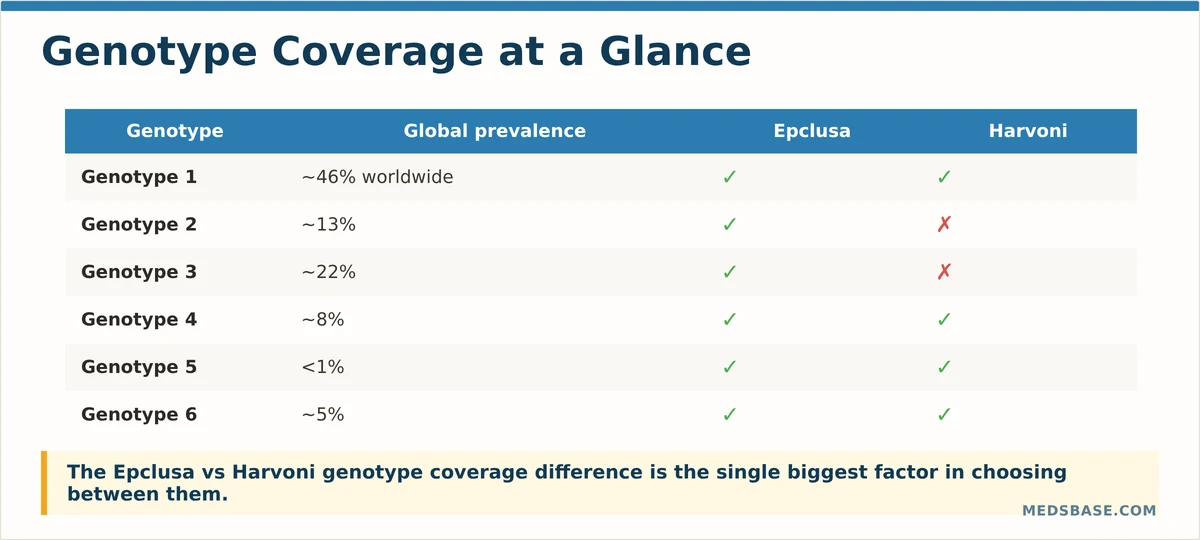
- The defining difference is genotype coverage. Epclusa is pangenotypic (all six genotypes); Harvoni targets genotypes 1, 4, 5, and 6.
- Cure rates are near-identical in their shared populations — roughly 99% — so the choice usually turns on genotype, interactions, and convenience, not raw efficacy.
- Harvoni has an 8-week option for some treatment-naive people with genotype 1, while Epclusa is typically 12 weeks.
- Drug interactions differ — Harvoni interacts more with acid-reducing medicines, a detail that matters more than most people expect.
Hepatitis C used to be a diagnosis people feared. Today it is a disease the World Health Organization has targeted for global elimination — and the reason is a generation of medicines that can cure it. The two names you will most often hear in that conversation are Epclusa and Harvoni, the brand names for two combinations that turned hepatitis C from a chronic, sometimes lifelong infection into something a short course of pills can erase.
If you are facing the question of Epclusa vs Harvoni, you are almost certainly closer to a cure than you realize. By the end of this article, you will understand exactly how these two regimens differ — in the genotypes they treat, the cure rates they achieve, and the practical details that decide which one is right for you.
Before diving in, it helps to know that the Epclusa vs Harvoni comparison is one of the most common questions patients ask, precisely because both medicines are so good that the choice rarely comes down to raw power. It comes down to fit — and that is what the rest of this guide unpacks, one practical difference at a time.
What Are Epclusa and Harvoni?
Quick Answer: Epclusa and Harvoni are both once-daily oral treatments that cure hepatitis C by shutting down the virus’s ability to copy itself. Epclusa contains sofosbuvir and velpatasvir and treats all six genotypes. Harvoni contains sofosbuvir and ledipasvir and is used for genotypes 1, 4, 5, and 6.
The two medicines share one ingredient — sofosbuvir — and differ in the second. Sofosbuvir blocks NS5B, an enzyme the hepatitis C virus needs to copy its genetic material. Epclusa pairs it with velpatasvir, which blocks a different viral protein called NS5A. Harvoni pairs sofosbuvir with ledipasvir, which also targets NS5A. Both are what doctors call direct-acting antivirals, or DAAs: they attack the virus itself rather than boosting the immune system the way older interferon injections did.
This shared backbone is the reason the Epclusa vs Harvoni comparison keeps returning to the same conclusion: they are siblings, not rivals. They differ in the second ingredient and therefore in nuance, not in fundamental effectiveness.
The practical upshot is that the Epclusa vs Harvoni question is not really a question of one being “stronger.” They are two high-powered regimens built on the same sofosbuvir backbone, differentiated mainly by which genotypes they cover and how they behave alongside other medicines. Understanding that reframes the decision from “which is better” to “which is the right fit for my situation.”
When you strip away the brand names, the Epclusa vs Harvoni decision simplifies to a handful of concrete questions: What is my genotype? Do I have cirrhosis? Have I been treated before? What other medicines do I take? Answer those, and the choice between the two regimens largely makes itself.
How Do Epclusa vs Harvoni Work?
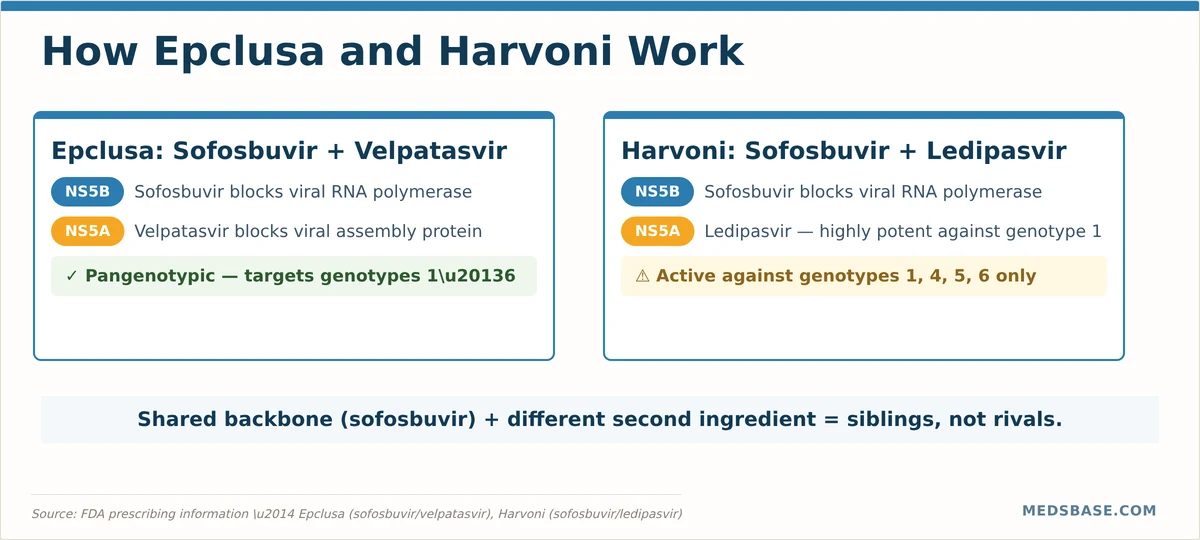
Think of the hepatitis C virus as a factory that churns out copies of itself using a small set of essential machines. Sofosbuvir jams one machine — the NS5B polymerase — stopping the virus from copying its genetic blueprint. Velpatasvir and ledipasvir jam a second machine, the NS5A protein, which the virus needs both to replicate and to assemble new virus particles. Attacking two machines at once is why the combination is so effective and why resistance is rare.
The difference between Epclusa vs Harvoni, mechanistically, is subtle but meaningful. Velpatasvir is effective against the NS5A protein across all six genotypes, which is what makes Epclusa “pangenotypic.” Ledipasvir is highly potent against genotype 1 — the most common type worldwide — and also works against 4, 5, and 6, but it is not the go-to for genotypes 2 and 3. That single fact, more than any other, drives the clinical choice between the two.
Both drugs are taken as a single tablet once a day, with or without food. A typical course lasts 12 weeks, with an 8-week option for Harvoni in certain easier-to-treat genotype 1 cases. At the end of treatment, doctors measure a “sustained virologic response” — SVR12, meaning no detectable virus 12 weeks after finishing — which is considered a cure.
For anyone still puzzling over the Epclusa vs Harvoni mechanism difference, the simplest summary is this: they both close down the viral factory from two directions at once, but Epclusa’s second punch lands against every genotype, while Harvoni’s lands hardest against genotype 1. The elegance of either approach is that two simultaneous attacks make it very hard for the virus to escape, which is why relapse is so rare.
Research Spotlight: The landmark trials for both regimens were published in the New England Journal of Medicine. ASTRAL-1 established sofosbuvir/velpatasvir’s near-universal efficacy, while ION-1 did the same for ledipasvir/sofosbuvir in genotype 1.
There is a subtlety worth understanding if you are trying to make a genuinely informed Epclusa vs Harvoni decision. Because ledipasvir is so targeted at genotype 1, its effectiveness can dip slightly in genotype 1 patients who carry certain pre-existing viral mutations (NS5A resistance-associated substitutions, or RAS). Velpatasvir, by contrast, was designed to overcome broad resistance, which is partly why Epclusa is pangenotypic. In everyday practice this rarely changes the final outcome — both regimens still cure nearly everyone — but it explains why a doctor might lean one way for a specific genotype 1 profile.
Key Uses & Indications
Epclusa (sofosbuvir + velpatasvir)
Epclusa is approved for adults with hepatitis C of any genotype (1 through 6), with or without compensated cirrhosis. Because it is pangenotypic, it simplifies treatment — in many systems, a person can start Epclusa without waiting on genotype confirmation in every case, which shortens the path to care. For decompensated (more advanced) cirrhosis, Epclusa is used together with ribavirin.
Harvoni (sofosbuvir + ledipasvir)
Harvoni is approved for genotypes 1, 4, 5, and 6. For treatment-naive genotype 1 patients without cirrhosis and with a low viral load, it can be given for just 8 weeks instead of 12 — a genuine convenience advantage for that specific group. In genotype 1 patients with cirrhosis or prior treatment failure, Harvoni may be combined with ribavirin or extended to 24 weeks.
Q: Who Is This For? / Who Should Avoid It?
A: – Epclusa is for: anyone with any genotype, especially genotypes 2 or 3 (where Harvoni isn’t used), or anyone who wants a single ribavirin-free regimen regardless of genotype. – Harvoni is better suited to: genotype 1 patients who may qualify for the shorter 8-week course, or those whose doctor prefers a genotype-1-specific regimen. – Note: neither is a self-selected medicine. The right regimen depends on genotype, fibrosis stage, prior treatment, and other medications — a decision your doctor should make.
Both generic equivalents are available through MedsBase — sofosbuvir/velpatasvir (the Epclusa combination) and sofosbuvir/ledipasvir (the Harvoni combination) — in the hepatitis C category.
To be concrete about how the Epclusa vs Harvoni choice plays out in practice: a genotype 2 or 3 patient will almost always be pointed to Epclusa, because Harvoni simply isn’t approved for those types. A genotype 1 patient without cirrhosis may be offered Harvoni’s 8-week course for its shorter duration. A patient on a daily proton-pump inhibitor for heartburn may be steered toward Epclusa to avoid the acid-reducer interaction. And a patient with decompensated cirrhosis will be treated with Epclusa plus ribavirin, since Harvoni isn’t recommended in that setting. These are the real-world forks in the road, and each one is driven by a specific, knowable fact about the patient rather than by a blanket “one drug is better” verdict.
Safety Profile, Side Effects & Dosage
One of the biggest improvements over the old interferon era is how gentle these medicines are. Both Epclusa and Harvoni are generally well tolerated, with mild and manageable side effects.
| Side effect | Frequency | Severity | What to do |
|---|---|---|---|
| Fatigue | Common | Mild | Rest as needed; usually transient |
| Headache | Common | Mild | Usually resolves on its own |
| Nausea | Common | Mild | Take with food if it helps |
| Insomnia | Less common | Mild | Report if it disrupts sleep |
| Diarrhea | Less common | Mild | Stay hydrated; report if persistent |
| Slowed heart rate (with amiodarone) | Rare | Serious | Avoid co-administration; seek medical advice |
The most important safety point applies to both: hepatitis C treatment can interact with other medicines, so your full medication list must be reviewed. A specific caution with sofosbuvir-containing regimens involves the heart-rhythm medicine amiodarone, where serious bradycardia (slow heart rate) has been reported. Both regimens also require checking for hepatitis B co-infection, because treating hepatitis C can cause hepatitis B to reactivate in people who carry both.
The drug-interaction profile is where Epclusa vs Harvoni diverge in practice. Harvoni’s ledipasvir is more sensitive to stomach acid: taking it alongside acid-reducing medicines such as proton-pump inhibitors can lower ledipasvir levels, and these should be managed carefully. Epclusa is less affected by acid reducers but still has important interactions (for example, with certain herbal products and enzyme-inducing medicines), so the same review applies. This is why the safety data for ledipasvir/sofosbuvir emphasizes a thorough medication review.
In short, when it comes to safety, the Epclusa vs Harvoni comparison produces no dramatic winner — both are gentle by historical standards — but the interaction details lean slightly in Epclusa’s favor for people who take daily acid reducers, which is a surprisingly common situation worth flagging to your doctor.
What the Research Says
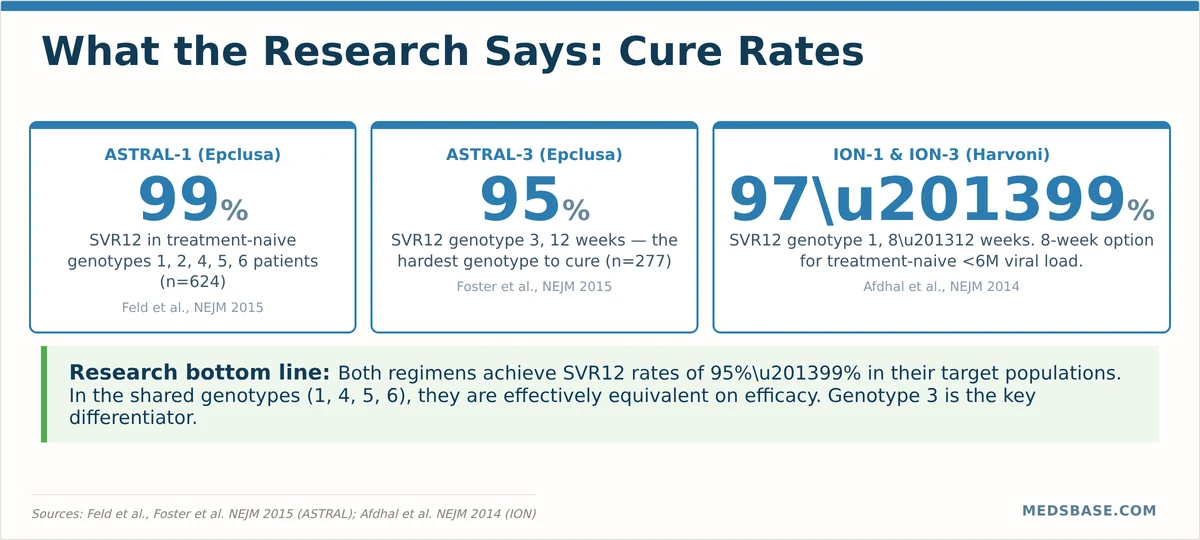
The cure-rate numbers behind these two regimens are among the most consistent in modern medicine.
| Study | Year | Finding | Source |
|---|---|---|---|
| ASTRAL-1 (Epclusa) | 2015 | Sofosbuvir/velpatasvir for 12 weeks achieved 99% SVR12 in GT1/2/4/5/6 | PMID 26571066 |
| ASTRAL-2/3 (Epclusa) | 2015 | Sofosbuvir/velpatasvir achieved 99% SVR12 in GT2 and 95% in GT3 — superior to sofosbuvir+ribavirin | PMID 26575258 |
| ION-1 (Harvoni) | 2014 | Ledipasvir/sofosbuvir for 12 weeks achieved 99% SVR12 in untreated GT1 | PMID 24725239 |
| Ledipasvir/sofosbuvir safety | 2015 | Favorable safety profile across GT1, with and without ribavirin | PMID 25963890 |
What this means for you: in the populations where both are used, the cure rates are essentially identical — roughly 99%. That is liberating news, because it means you can choose on practical grounds (genotype, duration, interactions, availability) rather than agonizing over which pill is “more powerful.” The one place efficacy meaningfully differs is genotypes 2 and 3, where Epclusa is the clear choice simply because Harvoni is not indicated for them.
It is also worth noting how far this represents an improvement over the past. Before direct-acting antivirals, hepatitis C treatment meant up to a year of interferon injections with flu-like side effects and cure rates that often hovered around 50%. The Epclusa vs Harvoni question only exists because medicine got dramatically better — a fact worth pausing on if the choice is causing you stress.
Epclusa vs Harvoni: Head-to-Head Differences
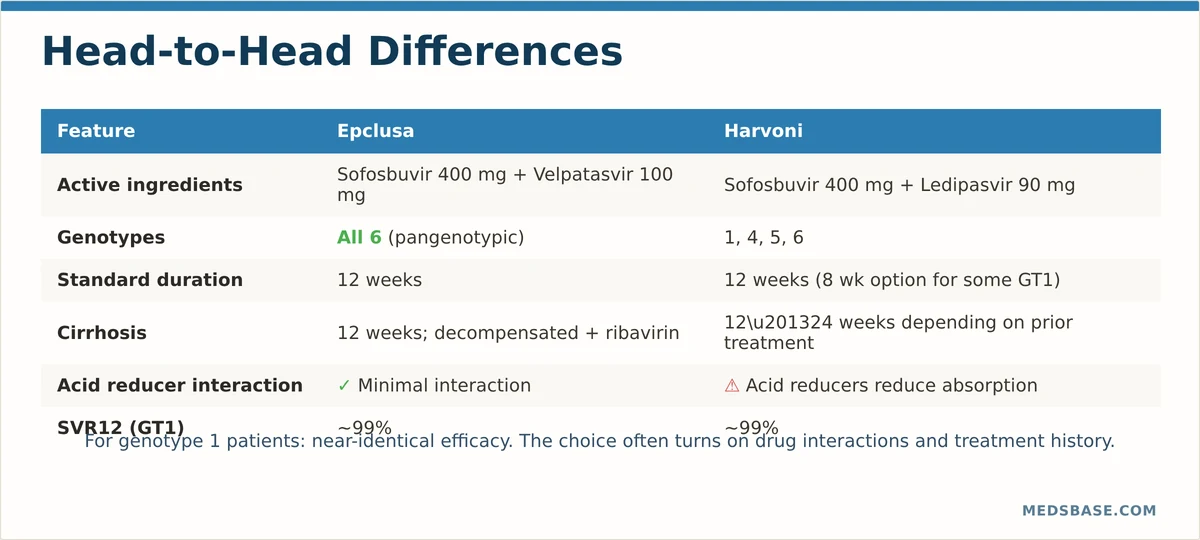
Here are the seven differences that actually matter when you compare Epclusa vs Harvoni.
| # | Factor | Epclusa (sofosbuvir/velpatasvir) | Harvoni (sofosbuvir/ledipasvir) |
|---|---|---|---|
| 1 | Genotype coverage | All six (pangenotypic) | Genotypes 1, 4, 5, 6 |
| 2 | Standard duration | 12 weeks | 12 weeks (8-week option for some GT1) |
| 3 | Ribavirin need | None for most | Sometimes (cirrhotic/experienced GT1) |
| 4 | Acid-reducer interaction | Mild | More pronounced (with ledipasvir) |
| 5 | Baseline NS5A resistance impact | Lower | Higher in some GT1a cases |
| 6 | Decompensated cirrhosis | Yes (with ribavirin) | Not recommended |
| 7 | Approval year | 2016 | 2014 |
Which one fits which situation: if you have genotype 2 or 3, the answer is simple — Epclusa. If you have genotype 1 and want the shortest possible course, Harvoni’s 8-week option may be attractive. If you take an acid-reducing medicine daily, Epclusa is generally the cleaner fit. And if you have advanced (decompensated) cirrhosis, Epclusa with ribavirin is the studied option. In every case, this is a decision to make with a clinician who has your genotype, fibrosis stage, and full medication list in front of them.
One further point often overlooked in the Epclusa vs Harvoni discussion is availability and cost. Because both combinations now exist as generics, the branded-era price barrier has largely fallen, and the choice can be made on medical fit rather than budget. That said, availability of a given generic can vary by region, which is one more reason to keep the discussion with your prescriber and pharmacist grounded in what is actually accessible to you.
How to Use / Practical Guidance
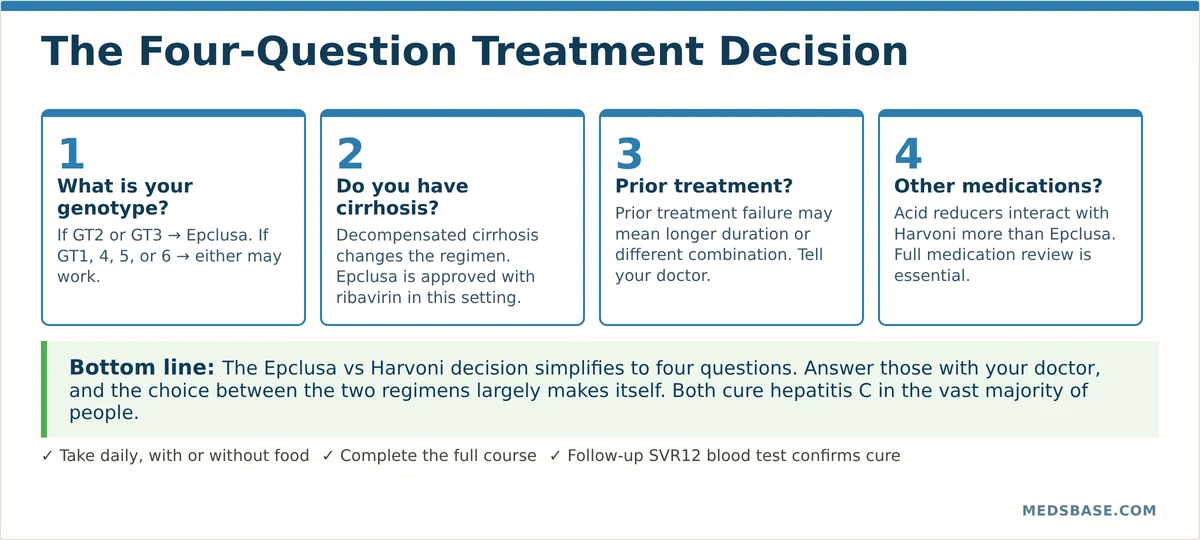
- Confirm the basics first. Your doctor will determine your genotype, whether you have cirrhosis, and any prior treatment — these three inputs largely determine the regimen.
- Review every medication you take. Both regimens have interactions; acid reducers matter most for Harvoni, amiodarone matters for both.
- Take one tablet daily, with or without food. Consistency matters more than timing — a missed dose should be taken as soon as remembered, without doubling up.
- Finish the full course, then confirm the cure. Twelve weeks after finishing, an SVR12 test confirms the virus is undetectable.
Mistakes to avoid: stopping early because you feel better; skipping the medication-interaction review; assuming a negative result at the end of treatment is the final answer (the 12-week SVR12 is what confirms cure); and self-selecting a regimen without genotype information.
A final practical note on the Epclusa vs Harvoni decision: both regimens depend on completing the full course and confirming SVR12, so adherence is the real determinant of success for most people. Whichever pill you and your doctor land on, the most important thing you can do is take it every day for the full prescribed duration — the difference between a 99% cure and a treatment failure is, for most patients, simply finishing what was started.
Browse our hepatitis C products to see available generic regimens.
Related Reading
- Want the full disease background before choosing a treatment? Read our guide to hepatitis C.
- Curious how vascular and liver health connect to broader wellness? Read our dementia risk factors guide.
- Managing multiple health priorities? See our tadalafil daily dosing guide.
Frequently Asked Questions
Q: Is Epclusa better than Harvoni?
A: Not universally. In the populations where both are used, cure rates are essentially equal at about 99%. Epclusa is the better fit for genotypes 2 and 3 (which Harvoni doesn’t treat) and for people on acid reducers; Harvoni offers an 8-week option for some genotype 1 patients.
Q: What is the difference between Epclusa and Harvoni?
A: Both contain sofosbuvir. Epclusa adds velpatasvir and treats all six genotypes; Harvoni adds ledipasvir and treats genotypes 1, 4, 5, and 6. They also differ in duration options, ribavirin need, and acid-reducer interactions.
Q: Can Epclusa cure hepatitis C?
A: Yes. In its pivotal trial, sofosbuvir/velpatasvir cured 99% of patients across genotypes 1, 2, 4, 5, and 6, and 95% of genotype 3 patients — cure meaning no detectable virus 12 weeks after finishing treatment.
Q: What genotype does Harvoni treat?
A: Harvoni is used for hepatitis C genotypes 1, 4, 5, and 6. It is not indicated for genotypes 2 and 3, where Epclusa or another pangenotypic regimen is preferred.
Q: Which hepatitis C treatment is best?
A: There is no single “best” regimen for everyone. The right choice depends on your genotype, cirrhosis status, prior treatment, and other medications. For most people today, a pangenotypic regimen like Epclusa is a common default, with Harvoni a strong option for genotype 1.
Q: What are the side effects of Epclusa vs Harvoni?
A: Both are generally mild and well tolerated — fatigue, headache, and nausea are the most common, and serious side effects are rare. Harvoni has a more pronounced interaction with acid-reducing medicines, while both carry a caution with amiodarone.
Q: How long is treatment with Epclusa vs Harvoni?
A: Epclusa is typically taken for 12 weeks. Harvoni is also usually 12 weeks, but can be shortened to 8 weeks for treatment-naive genotype 1 patients without cirrhosis and with a low viral load. In harder-to-treat cases, either regimen may be extended or combined with ribavirin.
Q: Can I switch between Epclusa and Harvoni?
A: These are not interchangeable over-the-counter choices, and they should not be swapped mid-course. The regimen is selected upfront based on your genotype and history, and it should be completed as prescribed. If a problem arises (side effects or an interaction), your doctor — not a pharmacy website — should decide whether a change is needed.
Q: Do I need a prescription to order hepatitis C treatment from MedsBase?
A: No — MedsBase.com sells generic sofosbuvir-based combinations without requiring a prescription, sourced from WHO-GMP-certified manufacturers. Because regimen choice depends on genotype, fibrosis stage, and interactions, you should still be tested and guided by a doctor.
The Bottom Line
The Epclusa vs Harvoni decision is, in the best possible way, a low-stakes one — because both are excellent. Two once-daily pills built on the same sofosbuvir backbone, both curing hepatitis C in roughly 99% of the people they treat, both with mild side effects and short courses. The differences that remain are practical: Epclusa covers all six genotypes and plays more nicely with acid reducers, while Harvoni offers a shorter 8-week option for some genotype 1 patients. Match those differences to your genotype, your fibrosis stage, and your other medicines, and the right choice usually announces itself.
In the end, the reassuring truth behind any Epclusa vs Harvoni comparison is that both roads lead to the same destination — a cure — and the only meaningful error would be not starting treatment at all.
What to do next: If you haven’t already, get your genotype and fibrosis status tested, then review your full medication list with a clinician before choosing — the cure is close, and the right regimen gets you there smoothly.
Next questions to explore:
- Want the complete disease background first? Read our guide to hepatitis C.
- Managing other health conditions alongside? See our tadalafil daily dosing guide.
Medical Disclaimer: This article is for informational purposes only and does not constitute medical advice. The information provided is not intended to replace consultation with a qualified healthcare professional. Hepatitis C treatment should always be guided by a doctor who can determine your genotype, liver status, and potential drug interactions. Always speak with your doctor or pharmacist before starting, stopping, or changing any medication.

Written by
Sophie ChenPharmaceutical Content Researcher · 8 years experience
Sophie Chen is a pharmaceutical content researcher with 8 years covering generic medication access and clinical pharmacology. She specialises in international regulatory frameworks, bioequivalence standards, and patient-facing education on therapeutic drug classes. She is not a clinician.