








✓ Medically reviewed by · Last reviewed: May 2026
Pharmacy Researcher · 8 years experience
Pharmacy researcher with 8 years reviewing clinical drug information, generic formulation equivalence, and international pharmaceutical standards. Focuses on patient-facing accuracy in medication education.
dementia risk factors — Dementia Risk Factors: 14 Proven Ways to Lower Your Risk as You Age. Read on for an evidence-backed guide covering everything you need to know.
Dementia risk factors: Key Takeaways
- Nearly half of dementia cases may be preventable. The 2024 Lancet Commission ties roughly 45% of dementia to 14 modifiable risk factors — meaning the condition is far more avoidable than most people assume.
- Your 40s matter more than your 70s. A 2026 ARIC study found that midlife smoking, diabetes, and hypertension — not late-life habits — are the dementia risk factors that most strongly predict earlier onset.
- It is rarely one thing. The same study grouped people into “morbidity clusters” and found that stacking conditions multiplies risk, which is why the whole picture matters, not one habit in isolation.
- High blood pressure is one of the most actionable targets — treating it protects both your heart and your brain through the same mechanism.
- This is a story of opportunity, not blame. No one “causes” their own dementia, but the evidence is clear that protecting vascular health early gives you real, measurable leverage.
Roughly 55 million people worldwide are living with dementia today, a number the World Health Organization expects to nearly triple by 2050. But hidden inside those projections is a finding that rarely makes the headline: according to the 2024 report of the Lancet standing Commission, up to 45% of dementia cases are linked to risk factors that can, in principle, be changed. That means the single most powerful dementia intervention available today may not be a drug at all — it may be the choices you make in your 40s, 50s, and 60s.
By the end of this article, you will know exactly which dementia risk factors the science considers modifiable, why your midlife years carry outsized weight, and — most usefully — what to change first. One specific finding from a 2026 study might surprise you, and we will unpack it in the research section.
What Are Dementia Risk Factors — and Which Can You Change?
Quick Answer: A dementia risk factor is anything that makes a person statistically more likely to develop dementia. Some are fixed — your age, your genes, your family history. Others are modifiable, meaning they can be reduced through treatment or lifestyle change. The modifiable list is longer than most people realize: blood pressure, smoking, diabetes, cholesterol, hearing loss, and more.
At the simplest level, dementia risk factors split into two categories: the ones you inherit and the ones you live with. Age remains the single strongest driver of dementia risk, and nothing changes that. Carrying certain gene variants, particularly APOE-e4, also raises risk in ways you cannot control. But researchers increasingly emphasize that these non-modifiable factors are only part of the story — and for many people, they are the smaller part.
The modifiable dementia risk factors are where prevention actually lives. The 2024 Lancet Commission identified 14 of them, ranging from midlife hypertension and obesity to late-life social isolation and untreated vision loss. Together, the Commission estimated these 14 factors account for around 45% of dementia cases worldwide. To be clear, that does not mean 45% of cases are “self-inflicted” — it means that if the entire population eliminated these exposures, the number of dementia cases would fall by roughly 45%. That is a population-level estimate, not a promise to any individual.
Here is where it gets interesting. The phrase “dementia risk factors” often conjures images of elderly years, but the research increasingly points earlier — squarely at midlife.
How Do Dementia Risk Factors Damage the Brain?
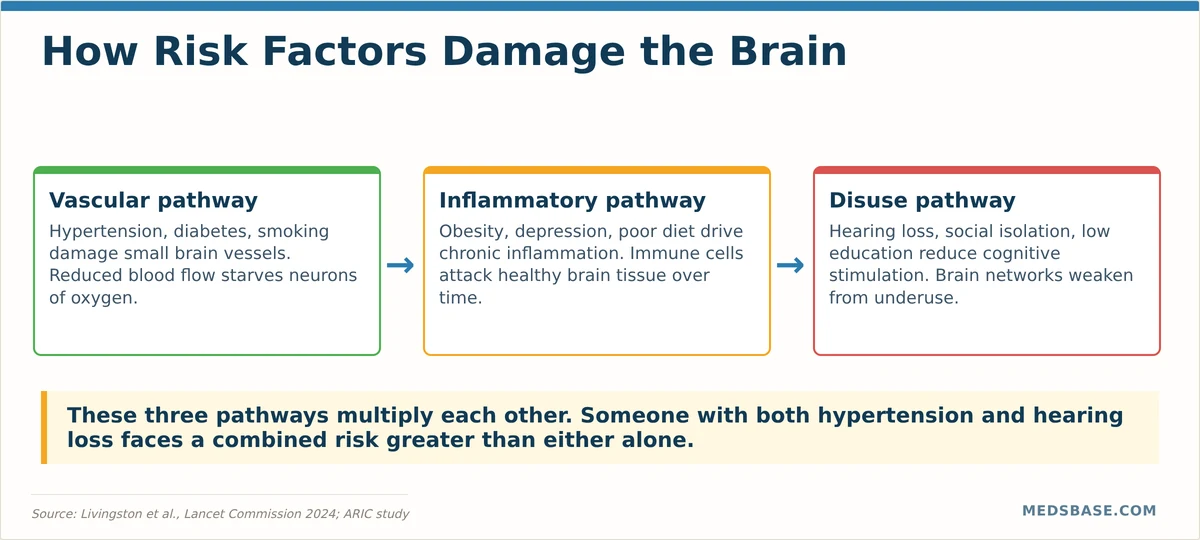
Think of your brain as a long-lived organ that depends on a flawless supply chain of oxygen and nutrients. Your blood vessels are that supply chain. Now imagine the dementia risk factors that most reliably predict the disease — hypertension, smoking, diabetes, high cholesterol — and notice that every single one of them damages blood vessels. That is not a coincidence.
High blood pressure forces blood against vessel walls with extra pressure, stiffening and thickening the small arteries that feed deep brain structures. Smoking introduces thousands of compounds that inflame the vessel lining and accelerate narrowing. Diabetes chronically elevates blood sugar, which glycates proteins and injures the tiny vessels of the brain and retina. Each condition chips away at the brain’s blood supply, and the brain — which cannot store oxygen — is uniquely vulnerable to that slow, cumulative damage.
But there is a second, less obvious mechanism: inflammation. Many modifiable dementia risk factors promote a low-grade, body-wide inflammatory state. Depression, obesity, physical inactivity, and air pollution all correlate with higher circulating inflammatory markers, and neuroinflammation is now understood to play a central role in Alzheimer’s disease pathology. The picture that emerges is one of “total vascular + inflammatory load” — the more of these exposures you carry, the harder your brain must work to stay resilient.
A 2026 study made this concrete by showing that midlife conditions tend to travel together and that their combined effect on dementia risk is greater than any one alone — which is exactly why researchers now talk about clusters rather than isolated risk factors.
Research Spotlight: The ARIC study — the Atherosclerosis Risk in Communities cohort — has followed 15,000+ American adults since 1987–1989. Because it measured midlife health in detail and then tracked who developed dementia over 25+ years, it has become one of the most powerful datasets for connecting midlife dementia risk factors to late-life cognitive outcomes.
What ties these mechanisms together is the concept of “cognitive reserve” and “brain resilience.” Every brain has a buffer — a margin of extra capacity built from education, mental engagement, and a healthy vascular system. Dementia risk factors chip away at that buffer. The person who starts with a larger reserve, or who sustains fewer hits to their vessels over the decades, simply has further to fall before symptoms appear. This is why two people with similar genes can have very different dementia timelines, and why acting early on the factors you can control is so consequential.
The 14 Modifiable Risk Factors
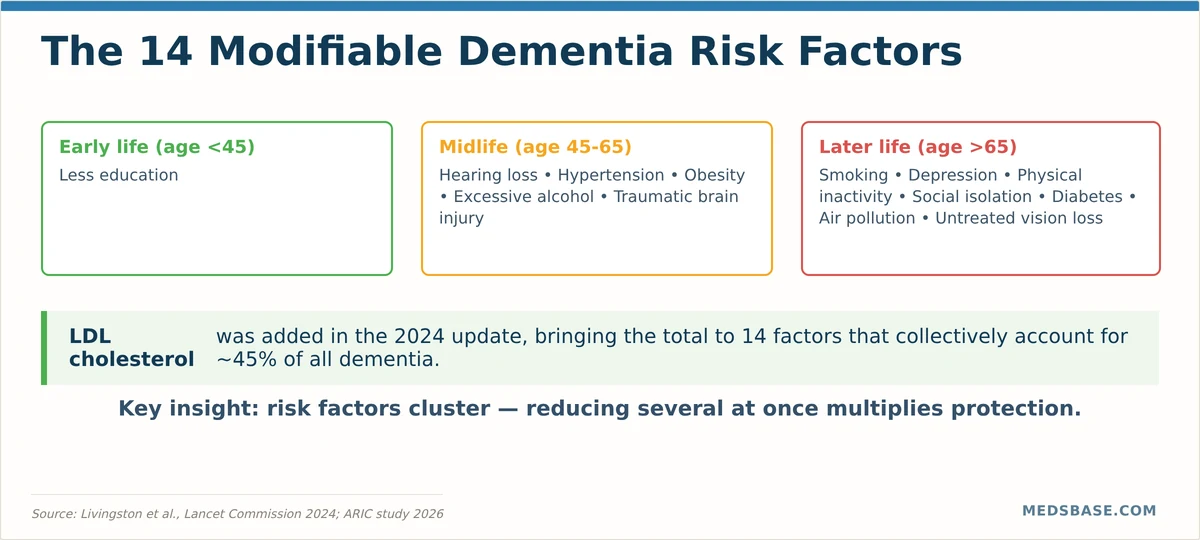
The Lancet Commission’s 2024 report is the reference list for anyone asking “which dementia risk factors can I actually change?” Its 14 factors, in roughly the life-stage order the Commission assigns them, are:
| Life stage | Modifiable dementia risk factors |
|---|---|
| Early life | Less formal education |
| Midlife | Hearing loss, hypertension, smoking, obesity, depression, physical inactivity, diabetes, low social contact, excessive alcohol, traumatic brain injury, air pollution, high LDL cholesterol |
| Later life | Untreated vision loss (and continued management of the above) |
Two of these are new additions from the 2024 update: untreated vision loss and high LDL cholesterol. Their inclusion is instructive — it signals that the list is not fixed but expands as evidence matures. What matters for you is not memorizing the list but recognizing the pattern: most modifiable dementia risk factors are vascular, metabolic, or sensory, and most respond to the same broad strategy of protecting your heart and vessels.
Let us translate a few of the most consequential ones into plain terms. Hypertension in midlife — even before any symptoms appear — is one of the strongest single dementia risk factors. Smoking roughly doubles the picture, and its effect is strongest the earlier and longer you smoke. Diabetes is especially dangerous when it begins before age 60, which is why delaying its onset has value beyond blood-sugar control. And hearing loss, once dismissed as an inconvenience, is now recognized as a major midlife contributor, possibly because it reduces cognitive stimulation and accelerates social withdrawal.
Obesity and physical inactivity sit a step behind but are deeply intertwined with the others: they raise blood pressure, worsen insulin resistance, and promote the inflammatory state that several researchers believe is a shared upstream driver. Depression and low social contact are quieter but no less real, operating through both biological and behavioral channels — depression alters stress-hormone and inflammatory balance, while isolation reduces the day-to-day cognitive stimulation that keeps the brain’s networks active. Excessive alcohol and traumatic brain injury are more straightforward in mechanism but easy to underestimate because their effects compound over years. Finally, air pollution — the most “societal” item on the list — is a reminder that some modifiable dementia risk factors are not purely personal choices but exposures shaped by where you live and the policies around you.
The honest summary: none of these 14 factors is a magic switch, and none acts alone. Their power comes from accumulation and timing, which is exactly why the midlife window matters so much.
Q: Who Is This For? / Who Should Avoid Over-Worrying?
A: – For: anyone in their 40s–60s who wants to act early, especially with a family history of dementia, or an existing diagnosis of hypertension, diabetes, or high cholesterol. – Avoid over-worrying: this is about risk reduction, not certainty. If you already manage your conditions well, you are doing the important work. Age and genetics still dominate, and no one should blame themselves or a loved one for a diagnosis.
What the Research Says: The Studies Behind the Headlines
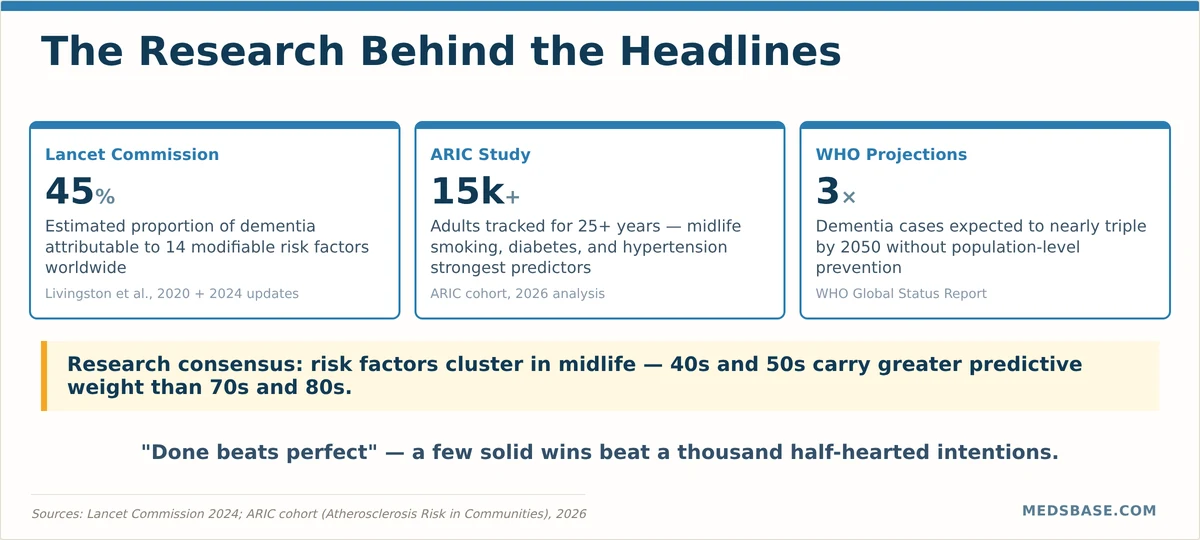
The recent excitement around dementia risk factors traces to a wave of ARIC-based studies, capped by a February 2026 analysis in Alzheimer’s & Dementia. Here is what the key papers actually found.
| Study | Year | Finding | Source |
|---|---|---|---|
| ARIC midlife morbidity clusters | 2026 | Grouping 15,250 midlife adults into 9 morbidity clusters, the smoking cluster (HR 1.62), metabolic cluster (HR 1.91), and atrial-fibrillation/heart-failure cluster (HR 2.69) each carried higher dementia risk than the healthiest cluster | PMID 41663335 |
| Lancet standing Commission | 2024 | 14 modifiable risk factors account for ~45% of dementia worldwide | PMID 39096926 |
The 2026 finding worth lingering on is the idea of clusters. Rather than asking “does smoking cause dementia?” in isolation, the researchers used machine learning to group people by their full midlife health profile. What emerged is that the highest-risk cluster was not smokers or people with metabolic syndrome — it was people with atrial fibrillation and heart failure, who faced a hazard ratio of 2.69, meaning they were nearly 2.7 times as likely to develop dementia as the healthiest group. The metabolic cluster — obesity, diabetes, hypertension, and high triglycerides stacked together — came next at 1.91, and the smoking cluster at 1.62.
What this means for you: your risk is shaped by the combination of dementia risk factors you carry, not any single one. That is actually good news, because it means addressing even one or two of them — say, getting blood pressure under control and quitting smoking — meaningfully reshapes your total profile.
Clinical Insight: Pharmacists and primary-care clinicians routinely see patients treat hypertension and cholesterol as “heart” problems and defer them until symptoms appear. The brain angle changes the framing: controlling these conditions in midlife is arguably the most evidence-backed form of cognitive protection available, and it is available now.
Which Risk Factors Matter Most?
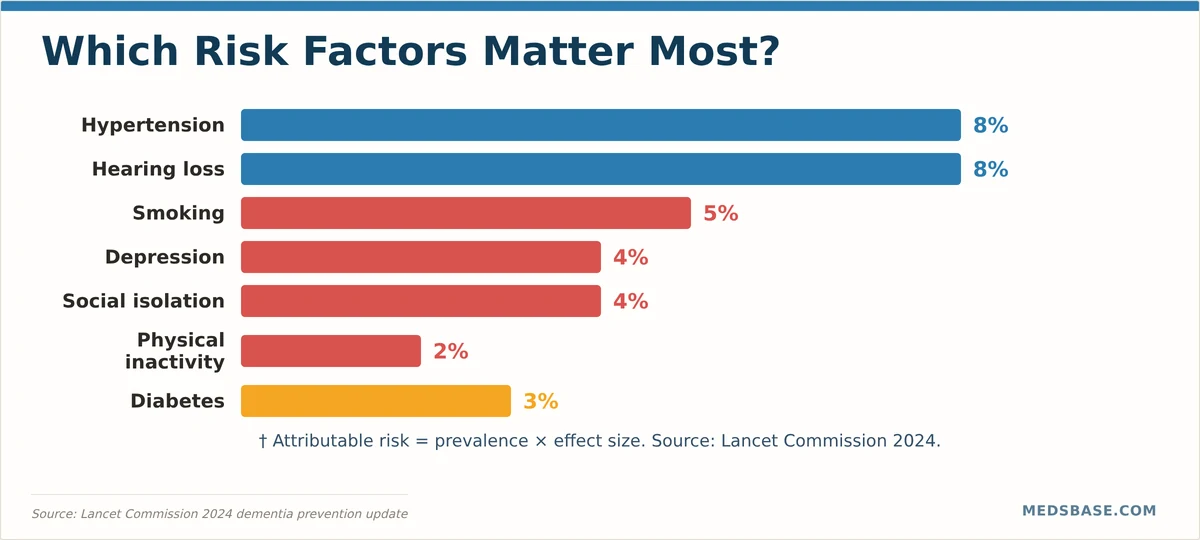
Not all modifiable dementia risk factors carry equal weight. The Commission’s population-attributable-fraction model ranks them by how much of the dementia burden each explains. The heavy hitters cluster around vascular health: hypertension, smoking, and diabetes consistently appear near the top, alongside physical inactivity and hearing loss.
Here is a practical way to prioritize. If you have limited energy to change things, focus first on the factors that are (a) most strongly linked to dementia, (b) treatable with established medication or intervention, and (c) already common in your life. For most people, that short list is: blood pressure, smoking, blood sugar, and cholesterol — the exact conditions a primary-care visit can assess in minutes. This is why the “know your numbers by 40” advice keeps recurring in the research commentary.
The comparison is stark when you place modifiable factors beside non-modifiable ones:
| Non-modifiable (fixed) | Modifiable (you can act) |
|---|---|
| Age | High blood pressure |
| Genetics (APOE-e4) | Smoking |
| Family history | Diabetes / blood sugar |
| — | High LDL cholesterol |
| — | Hearing loss, inactivity, isolation |
The honest verdict: you cannot outrun age or genetics, but the modifiable column is where your leverage lives — and it is larger than most people think.
A useful mental model is to treat the modifiable dementia risk factors as “multipliers” rather than “triggers.” A single risk factor nudges your odds up; three or four multiply them. The good news hidden in that math is symmetry: reducing a few factors at once multiplies your protection too. Someone who lowers their blood pressure, stops smoking, and gets moving has made a more meaningful change than someone who does only one thing perfectly. In other words, done beats perfect, and a few solid wins beat a thousand half-hearted intentions.
Who Should Be Most Vigilant
Certain people should treat dementia risk factors as a higher-priority conversation than others. A family history of early dementia, a personal history of stroke or atrial fibrillation, or a diagnosis of hypertension, diabetes, or high cholesterol before age 60 all raise the stakes. The NHS guidance on dementia prevention is refreshingly direct about this: manage your blood pressure, stay active, protect your hearing, and keep your mind engaged.
There is also a demographic dimension the ARIC data surfaced: Black participants in the cohort developed dementia sooner on average, and women lived longer dementia-free than men in some analyses — a reminder that risk is distributed unevenly and that access to care, not just individual behavior, shapes outcomes. None of this is about blame. It is about knowing where to direct attention.
If any of this resonates, the most useful thing you can do is start the conversation early — ideally years before any symptom. A routine primary-care check that includes blood pressure, a lipid panel, and an A1c is a low-cost, high-yield screen for the very conditions that top the modifiable list. Many people discover they have hypertension or prediabetes only at this kind of visit, which means the window to act on their dementia risk factors has been open for years without them knowing.
How to Reduce Your Dementia Risk
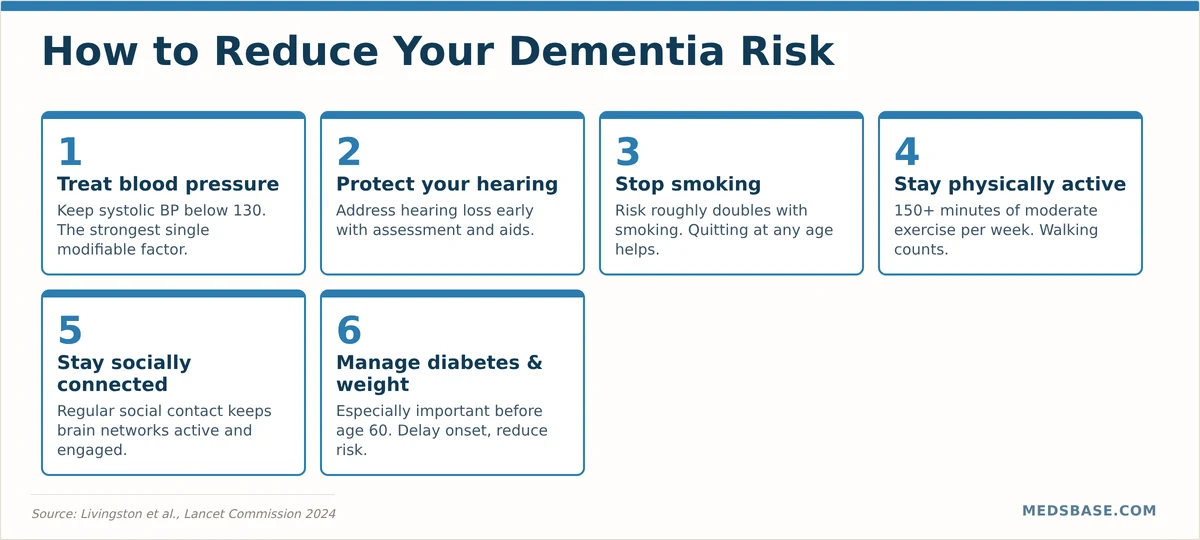
The practical playbook for acting on dementia risk factors is not exotic. It is the same heart-health advice you have heard — but now with a brain-health payoff attached.
- Know your numbers by 40. Blood pressure, A1c (a three-month blood-sugar average), and LDL cholesterol. The CDC recommends managing these conditions early rather than waiting for symptoms.
- Treat what you find. Hypertension, diabetes, and high cholesterol all respond to established, inexpensive medication. MedsBase stocks blood pressure, cholesterol, and diabetes medications without a prescription, sourced from WHO-GMP-certified manufacturers — but the decision to start treatment should always be made with a doctor.
- Protect your senses and your social life. Get your hearing checked; use hearing aids if needed. Stay socially connected and mentally engaged — both are independently protective.
- Quit smoking and go easy on alcohol. Smoking is one of the most modifiable dementia risk factors, and its benefit compounds the earlier you stop.
Mistakes to avoid: don’t wait for a “memory symptom” to start — prevention is the whole point. Don’t fixate on one supplement or superfood while ignoring your blood pressure. And don’t assume it’s too late: the research shows benefit at every life stage, even if midlife is where the largest gains sit.
Browse our blood pressure medications if hypertension is on your list.
Related Reading
- Wondering whether managing cholesterol also protects your brain? See our cholesterol-lowering treatment options.
- Curious how vascular and men’s health connect? Read our guide on tadalafil daily dosing.
- Managing blood sugar early matters most for diabetes-linked dementia risk. Explore diabetes medications.
Frequently Asked Questions
Q: Can dementia be prevented?
A: Dementia cannot be completely prevented for everyone, but research suggests up to 45% of cases are linked to modifiable dementia risk factors. Acting on blood pressure, smoking, diabetes, hearing, and activity in midlife is the most evidence-backed way to lower your personal risk.
Q: What is the biggest risk factor for dementia?
A: Age is the single biggest non-modifiable risk factor. Among modifiable dementia risk factors, midlife hypertension, smoking, and diabetes are consistently ranked among the strongest, with hearing loss and physical inactivity close behind.
Q: What are the 14 modifiable risk factors for dementia?
A: The 2024 Lancet Commission lists: less education, hearing loss, hypertension, smoking, obesity, depression, physical inactivity, diabetes, low social contact, excessive alcohol, traumatic brain injury, air pollution, untreated vision loss, and high LDL cholesterol.
Q: Does high blood pressure cause dementia?
A: High blood pressure does not “cause” dementia directly, but sustained hypertension damages the small vessels that supply the brain, and it is one of the most strongly linked modifiable dementia risk factors. Treating it in midlife is strongly associated with lower dementia risk.
Q: Does quitting smoking lower dementia risk?
A: Yes. Smoking is a major modifiable dementia risk factor, and its effect on the brain is thought to be partly reversible after quitting. The earlier you stop, the greater the benefit, though quitting at any age helps.
Q: At what age should I start addressing dementia risk factors?
A: The evidence points to midlife — roughly your 40s through 60s — as the highest-leverage window. Getting blood pressure, A1c, and cholesterol checked by 40 and managing them consistently is the most commonly recommended starting point.
Q: Do I need a prescription to order blood pressure or cholesterol medication from MedsBase?
A: No — MedsBase.com sells these medications without requiring a prescription, sourced from WHO-GMP-certified manufacturers. You should still consult your doctor about whether treatment is right for you, since these medications carry real benefits and side effects.
The Bottom Line
The most important thing to understand about dementia risk factors is that they are not a verdict — they are a to-do list. Age and genetics set the stage, but roughly 45% of dementia worldwide is tied to factors within human reach: blood pressure, smoking, blood sugar, cholesterol, hearing, activity, and connection. The newest research reframes prevention as a midlife project, and it suggests that acting on even a few of these factors — especially the vascular ones — gives you measurable leverage over a condition that once felt inevitable.
What to do next: Book a check of your blood pressure, A1c, and cholesterol, and write down the one or two dementia risk factors most relevant to you. That single step is the highest-value action in this entire guide.
Next questions to explore:
- Wondering how daily medication fits into a long-term vascular-health routine? Read our guide on tadalafil daily dosing.
- Curious about the connection between cholesterol and brain health specifically? Explore our cholesterol-lowering treatments.
Medical Disclaimer: This article is for informational purposes only and does not constitute medical advice. The information provided is not intended to replace consultation with a qualified healthcare professional. Always speak with your doctor or pharmacist before starting, stopping, or changing any medication. If you are concerned about memory or cognitive changes — in yourself or a loved one — speak with a healthcare provider for a proper assessment rather than relying on self-diagnosis.

Written by
Sophie ChenPharmaceutical Content Researcher · 8 years experience
Sophie Chen is a pharmaceutical content researcher with 8 years covering generic medication access and clinical pharmacology. She specialises in international regulatory frameworks, bioequivalence standards, and patient-facing education on therapeutic drug classes. She is not a clinician.