








✓ Medically reviewed by · Last reviewed: May 2026
Pharmacy Researcher · 8 years experience
Pharmacy researcher with 8 years reviewing clinical drug information, generic formulation equivalence, and international pharmaceutical standards. Focuses on patient-facing accuracy in medication education.
myopia control treatment — Myopia Control Treatment: 7 Proven Ways That Work for Children. Read on for an evidence-backed guide covering everything you need to know.
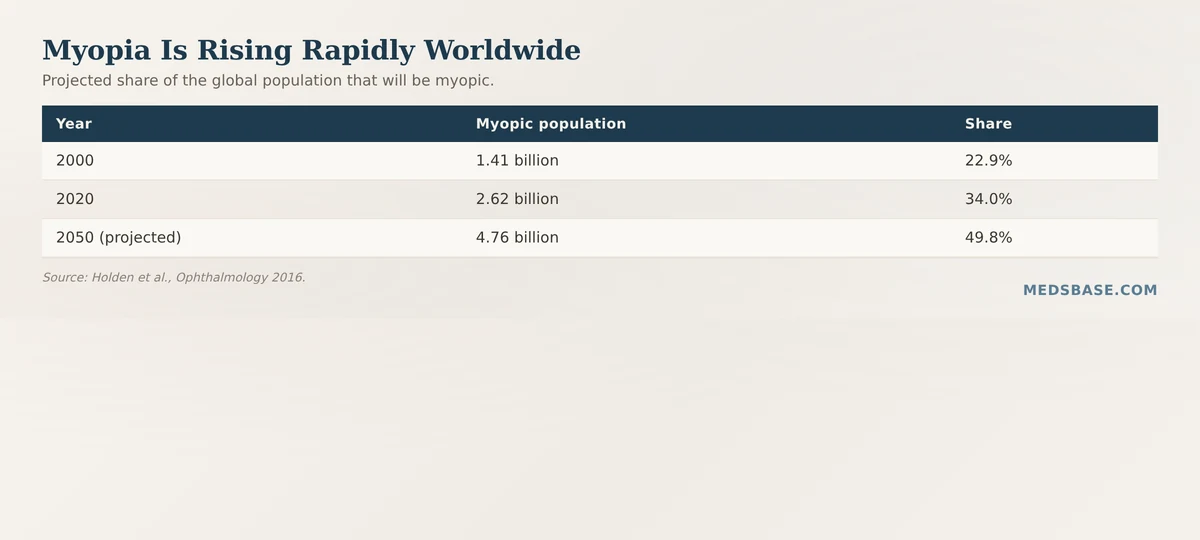
By 2050, an estimated 4.8 billion people — close to half the world’s population — are projected to be nearsighted (Holden et al., Ophthalmology 2016). If you are a parent whose child’s prescription has ticked up year after year, you have probably wondered whether anything can actually stop it. The short answer is yes, but not by reversing the changes that have already happened. The right myopia control treatment can slow the eye’s abnormal growth so a mild case does not slide into a severe one. In this guide you will learn what myopia control treatment actually is, the four strategies backed by the newest 2026 research, and how to tell which one fits your child.
- A myopia control treatment does not cure or reverse nearsightedness — it slows the eyeball’s elongation so the prescription stabilises sooner.
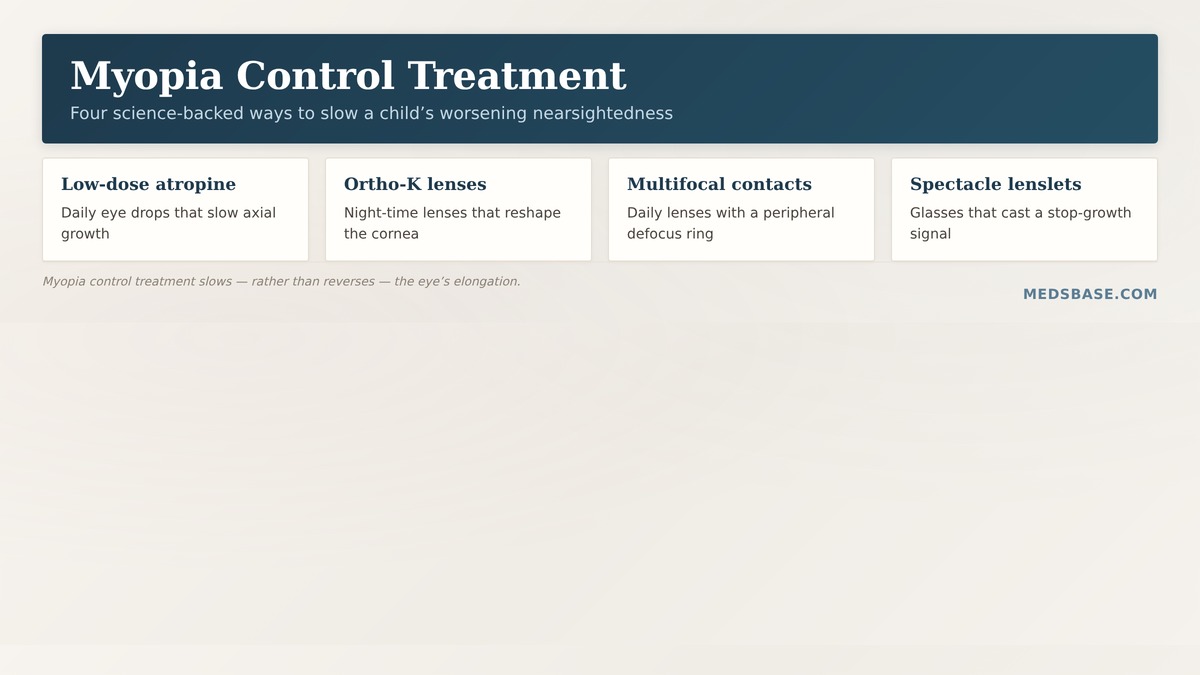
- Atropine eye drops, ortho-K contact lenses, multifocal contacts and defocus spectacle lenses are the four evidence-backed approaches.
- A 2026 network meta-analysis ranks options on both short-term slowing and the “rebound” risk after treatment stops — one side effect that surprises almost everyone is covered in the safety section.
- Myopia control treatment works best when it starts early and is checked against axial-length growth, not just the glass prescription.
- Higher myopia raises lifelong risks of retinal detachment, glaucoma and myopic maculopathy — which is why slowing it matters for eye health, not just convenience.
On this page:
- What Is Myopia Control Treatment?
- How Does Myopia Control Treatment Work?
- Key Uses & Who Is This For
- Safety Profile, Side Effects & Monitoring
- What Does the Research Say?
- Myopia Control Treatment vs Alternative Approaches
- How to Get Started: A Practical Roadmap
- Frequently Asked Questions
- The Bottom Line
What Is Myopia Control Treatment?
A myopia control treatment is any intervention designed to slow the abnormal elongation of the eyeball that drives nearsightedness in children and young adults. In a normal eye, light focuses exactly on the retina, but in a myopic eye the eyeball has grown too long from front to back, so light lands just in front of the retina and distance vision blurs. Most myopia develops and worsens through childhood and adolescence; once the eye has grown, no glasses prescription will shrink it back.
Myopia control treatment deliberately targets the signal that tells the eye to keep growing. Unlike ordinary single-vision glasses or contacts, which merely correct blur, a myopia control treatment uses a peripheral defocus — a gentle blur at the edges of vision — partly to signal the eye to stop lengthening. The goal is not perfect uncorrected vision; it is a flatter growth curve.
There are four widely used strategies, each with pros and cons that we will compare in detail: low-dose atropine eye drops, orthokeratology (ortho-K) contact lenses, multifocal soft contact lenses, and specially designed spectacle lenses. Each works through a slightly different mechanism, and the best myopia control treatment for one child is not automatically the best for another.
How Does Myopia Control Treatment Work?
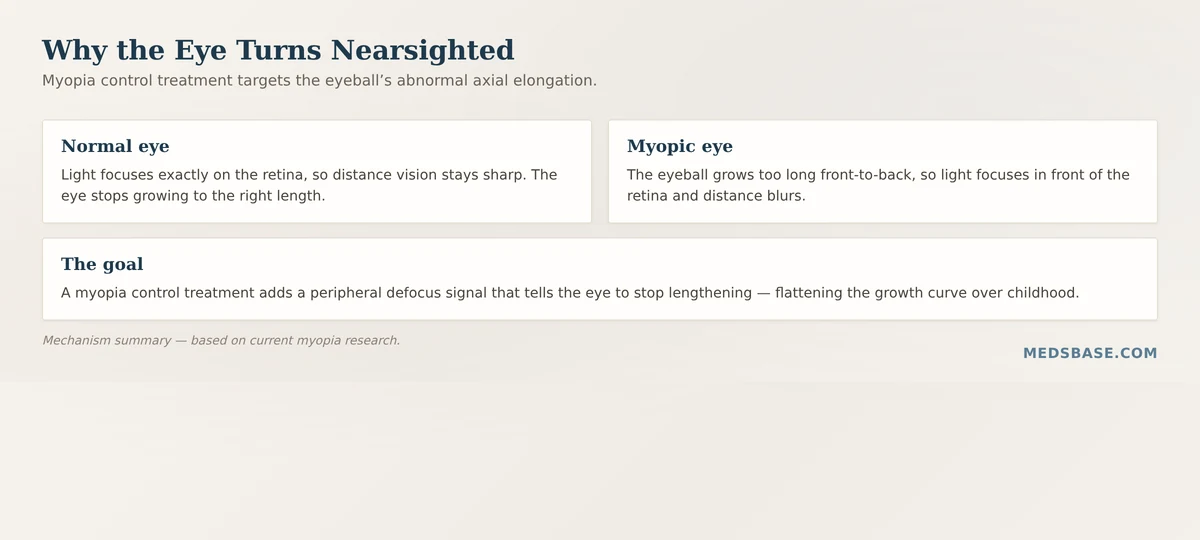
Here is where it gets interesting. The eye does not simply grow to a fixed genetic blueprint — it adjusts its own growth based on the image it sees, in a process called emmetropisation. When peripheral images land behind the retina, the eye reads that as a signal to grow longer; when they land in front, it reads that as a signal to stop.
Most myopia control treatment strategies manipulate this feedback loop.
- Low-dose atropine relaxes the eye’s focusing (accommodation) system and appears to act directly on receptors in the retina and sclera, slowing the growth signal through a pathway that is still being worked out. It does not physically reshape the eye.
- Ortho-K lenses are rigid lenses worn at night that gently flatten the cornea while your child sleeps, so vision is corrected during the day without any lenses — and the reshaping creates the same peripheral “stop-growing” signal.
- Multifocal soft contact lenses have two power zones that project part of the image in front of the peripheral retina all day.
- Spectacle lenslets (such as highly aspherical lenslet, or “HAL”, designs) put a honeycomb of tiny lenslets across the lens so parts of the peripheral image land in front of the retina.
What does this mean for you? Compression year over year is not the only measure that matters — how the eye behaves when treatment pauses can determine whether the gains stick, which is why eye doctors increasingly track axial length directly.
There is a subtle but important reason a myopia control treatment is different from ordinary glasses, and it is worth understanding because it explains an otherwise confusing detail. Traditional single-vision lenses correct the centre of the image perfectly, but they still let the peripheral image fall behind the retina — the exact pattern that signals the eye to keep growing. Some research suggests that wearing full-strength single-vision correction without any peripheral defocus may even nudge a vulnerable eye to lengthen slightly faster. That is why the modern approach deliberately adds a controlled peripheral blur. In other words, a myopia control treatment is not “weaker correction” — it is correction plus a growth-damping signal.
The timeline also matters. Axial-length growth slows naturally once a child reaches their late teens, which is why the treatment window is concentrated in the primary-school and early-secondary years. Starting a myopia control treatment at age six or seven, when the eye still has a decade of growth ahead, buys far more protection than starting at fifteen, when the growth curve is already flattening on its own.
Key Uses of Myopia Control Treatment
Slowing rapid childhood progression
The classic candidate is a child whose prescription worsens by −0.50 diopters or more every year, or who becomes myopic before age eight. Earlier onset leaves more years for the eye to grow, which is the main driver of severe outcomes later.
Reducing high-myopia risk
The central benefit of myopia control treatment is preventing a mild case from becoming a high one (usually −6.00 diopters or worse). High myopia multiplies the lifelong risk of retinal detachment, glaucoma and myopic maculopathy — the very reasons slowing matters.
Managing anisometropia (unequal eyes)
When the two eyes are very different, the blur helps drive worsening. Some 2026 studies examine ortho-K combined with atropine specifically for children with disproportionate asymmetry between their eyes.
Adult-onset and screen-driven progression
Myopia is not only a childhood problem anymore. Heavy near work — screens, studying, office work — is linked to later myopia onset and continued slow progression in young adults. While a myopia control treatment is most studied in children, low-dose atropine and multifocal lenses are increasingly offered to university students and adults in their twenties whose prescriptions are still creeping upward year after year. For adults, the goal is usually stabilisation rather than dramatic reversal, and the risk-benefit trade-off looks different because the growth years are mostly behind you.
Safety Profile, Side Effects & Monitoring
A myopia control treatment is not a one-size decision, and the side-effect profile differs by method. Here is what the research and clinical practice show, frankly.
| Side Effect / Consideration | Frequency | Severity | What To Do |
|---|---|---|---|
| Atropine — light sensitivity & near blur | Common (dose-dependent) | Mild | Tinted/photochromic glasses; read in good light |
| Atropine — rebound after stopping | Possible | Moderate | Taper rather than stop suddenly |
| Ortho-K — corneal irritation/infection | Rare | Serious if untreated | Strict hygiene; report pain or redness immediately |
| Contact lenses — dryness | Common | Mild | Preservative-free lubricating drops |
| Spectacle lenslets — peripheral distortion | Occasional | Mild | Adaptation period; report persistent distortion |
| All methods — inadequate slowing | Possible | Moderate | Re-measure axial length; escalate strategy |
The side effect that surprises most parents is the rebound. Stop a myopia control treatment too abruptly — especially atropine at higher concentrations — and the eye can lengthen quickly, erasing some of the gains. That is why the 2026 network meta-analysis emphasised post-treatment durability rather than on-treatment slowing alone.
A word on monitoring, because it is the safety net that turns a myopia control treatment from a leap of faith into a managed plan. Children on atropine need periodic checks for pupil size, near-vision comfort and, at higher doses, any difficulty reading; ortho-K wearers need corneal health reviews and should be taught that a painful, red eye is a “stop and call now” event, not a wait-and-see. Contact-lens wearers of any kind need reminders about hand washing, case replacement and never sleeping in lenses not designed for overnight wear. These are the routine disciplines that keep the small risks small, and a good eye-care provider will build them into the schedule from day one.
What Does the Research Say?
The evidence for myopia control treatment has matured sharply, and 2026 has been an unusually productive year. Here are the findings most worth knowing.
| Study | Year | Finding | Source |
|---|---|---|---|
| Network meta-analysis, pediatric myopia | 2026 | Comparative efficacy + post-treatment rebound trade-off across atropine, ortho-K and lenses | PMID 42704413 |
| Atropine for myopia prevention review | 2026 | Atropine 0.01–0.05% reduces progression dose-dependently | PMID 42752948 |
| Low-dose atropine 7-year outcomes | 2026 | First-year response predicts long-term control; guides escalation | PMID 42728089 |
| Spectacle lenslets narrative review | 2026 | HAL lenslets slow progression in 11 comparative studies | PMID 42706492 |
| Global prevalence projection | 2016 | 4.8 billion (49.8%) myopic by 2050; 9.8% high myopia | PMID 26875007 |
What this means for you: the question is no longer whether a myopia control treatment can slow progression — several can, typically cutting progression by roughly 30–60% in trials — but which fits your child’s age, lifestyle and risk profile, and how long the slowing lasts.
There is one measurement worth understanding because it separates a genuinely working myopia control treatment from one that merely moves numbers on a glasses prescription: axial length. This is the millimetre-by-millimetre length of the eyeball from front to back, measured with a quick, non-contact instrument called an optical biometer. Axial length is the truer driver of risk than the dioptre prescription, because it is the physical elongation — not the lens power — that stretches the retina and raises the odds of retinal detachment, glaucoma and myopic maculopathy down the line. Two children can share a −3.00 prescription yet have meaningfully different axial lengths and therefore different lifetime risk. An eye doctor who tracks axial length every six months will catch a failing treatment in a year or two, whereas a prescription-only review can miss real growth for longer. That is why the best clinics now treat axial length, not spectacle power, as the scoreboard.
Myopia Control Treatment: Cost, Commitment and Daily Realities
A myopia control treatment is not a one-off purchase — it is a multi-year routine, and the practical burdens differ more than the brochures usually admit. Understanding them up front prevents the frustration of abandoned treatment, which is the single most common reason a myopia control treatment appears to “fail.”
Atropine eye drops are usually the cheapest option per month and the simplest to start; a single drop at bedtime is all it takes. The hidden cost is that atropine does not correct vision, so your child still needs glasses or contacts on top of the drops, and light sensitivity may mean photochromic or tinted lenses. Ortho-K has a higher initial cost for the lens fitting and a strict nightly-wear, meticulous-cleaning routine, but it delivers daytime freedom from both glasses and contacts — a major plus for swimmers and active kids. Multifocal soft contact lenses sit in the middle on upfront cost and add daily lens care and a recurring replacement schedule. Spectacle lenslets are worn like normal glasses — the least hygienically sensitive option — but the specialised lenses are expensive to replace as the prescription (and the child’s face) grows.
What does this mean for you? Budget in two dimensions: money and daily routine. The cheapest method that your child will not use is the most expensive one of all, because the lost growth years cannot be bought back later.
Myopia Control Treatment vs Alternative Approaches
| Approach | How worn | Typical slowing | Best for | Main drawback |
|---|---|---|---|---|
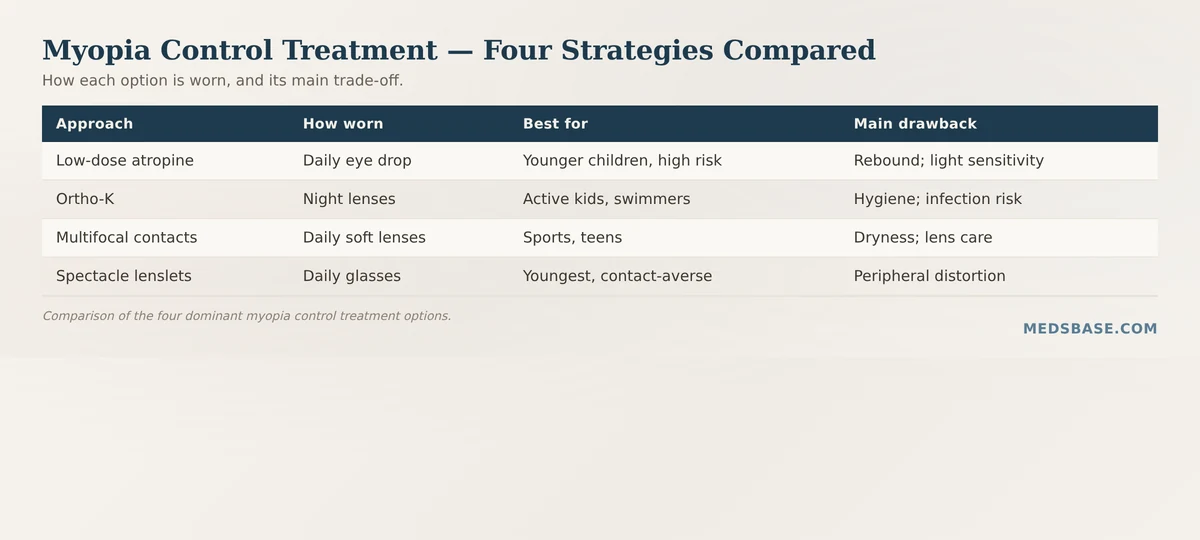
| Low-dose atropine | Daily eye drop | Dose-dependent, strong | Younger children, high risk | Rebound; light sensitivity |
| Ortho-K | Night lenses | Strong, daytime freedom | Active kids, swimmers | Hygiene discipline; infection risk |
| Multifocal contacts | Daily soft lenses | Solid | Sports, reluctant drop-takers | Dryness; lens care |
| Spectacle lenslets | Daily glasses | Good, no contact lens risk | Youngest kids, contact-averse | Peripheral distortion |
| Single-vision glasses (no control) | Daily | None | — (baseline only) | Does not slow growth |
Which one fits which situation? For the youngest or most hygiene-averse child, spectacle lenslets or low-dose atropine are the gentlest entry points. For a sporty older child who wants freedom from daytime glasses, ortho-K delivers both correction and treatment. Multifocal contacts split the difference with less rigidity than ortho-K. The honest answer is that the “best” myopia control treatment is the one your child will actually use every day, verified against an axial-length trendline.
How to Get Started: A Practical Roadmap
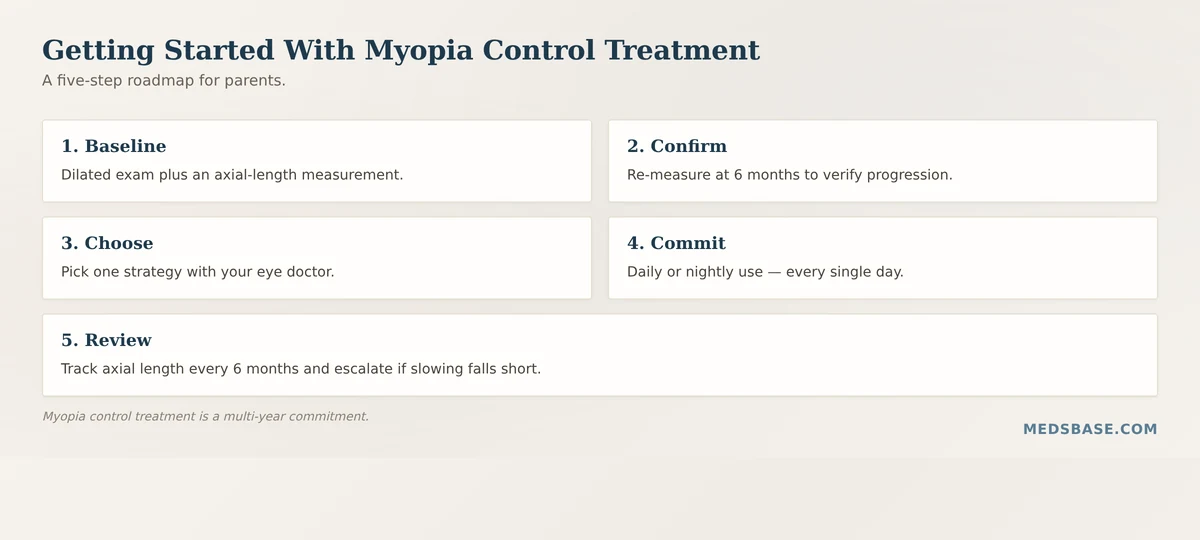
- Get a baseline — a dilated exam plus an axial-length measurement (optical biometry), not just a prescription.
- Re-measure in 6 months to confirm progression is real before committing.
- Choose one strategy with your eye doctor, weighing age, lifestyle and risk.
- Commit to daily or nightly use — inconsistent wear is the biggest reason control fails.
- Review axial length every 6 months and escalate if slowing falls short of target.
Mistakes to avoid: judging success by the glasses prescription alone (it can mask real axial growth); stopping atropine suddenly instead of tapering; skipping hygiene while lowering ortho-K infection risk; and giving up after a single 6-month result. A myopia control treatment is a multi-year commitment, not a quick fix.
Two habits amplify whatever myopia control treatment you choose, and they cost nothing. The first is outdoor daylight: time spent outdoors in bright natural light is one of the most consistently replicated protective factors against myopia onset and progression, with most guidance suggesting two hours a day as a practical target. The second is near-work breaks — the classic “20-20-20” rule (every 20 minutes, look at something 20 feet away for 20 seconds) and keeping screens and books at a reasonable distance rather than held close to the face. These do not replace a myopia control treatment, but they are the environmental scaffolding that makes the medical intervention more likely to succeed, and they build habits that outlast the treatment years entirely.
If you are researching eye-health options more broadly, you can browse the Eye Care category at MedsBase for related guides and treatments.
- Betahistine for Vertigo — does it actually work? (today’s related post on evidence-led treatment choice)
- Best Laxative for Constipation — 7 types compared (another “how to choose a medication” guide)
- Browse eye-care options at MedsBase
Frequently Asked Questions
Q: How do you stop myopia from getting worse?
A: You cannot stop it fully, but a myopia control treatment — atropine drops, ortho-K, multifocal contact lenses or defocus spectacles — can slow the eye’s axial elongation, typically cutting progression by 30–60% in trials. Starting early and using the treatment consistently is the key.
Q: What is the best myopia control treatment for kids?
A: There is no single best option. The 2026 network meta-analysis shows atropine, ortho-K, multifocal lenses and spectacle lenslets all slow progression, but they differ on rebound risk, comfort and safety. The best one is the one your child will actually use daily, matched to their age and risk.
Q: Do atropine drops slow myopia?
A: Yes. Low-dose atropine slows myopia progression dose-dependently — concentrations of 0.01% to 0.05% all work, with higher doses slowing more but causing more light sensitivity and greater rebound risk when stopped, according to 2026 reviews.
Q: Does ortho-K actually work for myopia?
A: Yes. Orthokeratology lenses worn at night flatten the cornea to correct vision by day and have strong evidence for slowing axial elongation. The trade-off is the need for meticulous lens hygiene because of a small but real infection risk.
Q: What age should myopia control treatment start?
A: As soon as reliable progression is confirmed, which can be as young as six. Earlier onset means more growth years ahead, so earlier intervention has the most to gain in preventing high myopia and its lifelong eye-health consequences.
Q: Can myopia control treatment reverse nearsightedness?
A: No. A myopia control treatment slows or stabilises progression, but it does not shrink the eye back to normal or reverse existing prescription. The benefit is preventing a mild case from becoming a severe, higher-risk one.
Q: How long does myopia control treatment take to work?
A: You should see a measurable difference in progression rate within 6 to 12 months, compared against your child’s pre-treatment growth. It is a multi-year commitment, not a short course, and most eye doctors recommend continuing through the teenage growth years, tapering only once axial-length growth has naturally slowed.
Q: Is myopia control treatment painful or risky?
A: No method is painful. The main risks are method-specific: a small infection risk with any contact lens, especially ortho-K if hygiene lapses, and light sensitivity or a rebound effect with atropine. With proper monitoring and hygiene, the risk of serious harm is low, but these are medical devices and medicines, so they warrant professional supervision rather than a self-directed trial.
The Bottom Line
A myopia control treatment is one of the few genuinely effective ways to change the course of childhood nearsightedness — it will not reverse what is already there, but it can meaningfully reduce how much worse things get, and that matters far more than most people realise, because severe myopia carries lifelong risks to the retina and optic nerve. The four options — atropine, ortho-K, multifocal contacts and spectacle lenslets — all have evidence on their side, and the 2026 research makes clear that choosing among them should weigh not just on-treatment slowing but the rebound that can follow.
Your next step is concrete: book a dilated eye exam that includes an axial-length measurement, then re-measure six months later. That single baseline turns “is the prescription getting worse?” into a number you can actually track.
Wondering how myopia control treatment compares to simply getting stronger glasses every year? The answer is in the difference between correcting a symptom and slowing its cause — and it is worth understanding before your child’s next prescription. For other evidence-led medication guides, see our betahistine for vertigo and best laxative for constipation articles.

Written by
Sophie ChenPharmaceutical Content Researcher · 8 years experience
Sophie Chen is a pharmaceutical content researcher with 8 years covering generic medication access and clinical pharmacology. She specialises in international regulatory frameworks, bioequivalence standards, and patient-facing education on therapeutic drug classes. She is not a clinician.