








✓ Medically reviewed by · Last reviewed: May 2026
Pharmacy Researcher · 8 years experience
Pharmacy researcher with 8 years reviewing clinical drug information, generic formulation equivalence, and international pharmaceutical standards. Focuses on patient-facing accuracy in medication education.
travoprost vs bimatoprost — Travoprost vs Bimatoprost for Glaucoma — Which Prostaglandin Analog Is Right for You?. Read on for an evidence-backed guide covering everything you need to know.
Travoprost vs bimatoprost — you’ve been using your glaucoma eye drops faithfully every night for six months. Your eye pressure is down — that’s the good news. But every morning you wake up with red, irritated eyes that make you look like you haven’t slept in days. Your ophthalmologist mentions there’s another drop in the same class — bimatoprost instead of travoprost, or travoprost instead of bimatoprost — and asks if you want to try switching.
Travoprost vs bimatoprost — is it worth it? Will the new drop control your pressure as well? And what about the side effects — will switching just trade one problem for another?
Here’s the short answer: when comparing travoprost vs bimatoprost, the IOP-lowering power is nearly identical. The real differences — and they do matter — are in how your eyes tolerate each drop, whether you need a preservative-free option, and the specific side-effect profile that fits your eyes and your life. By the end of this guide, you’ll know exactly which questions to ask your ophthalmologist and which drop is more likely to work for you.
Key Takeaways
- Travoprost and bimatoprost lower IOP with essentially equal power — the typical difference of 1–2 mmHg is not clinically meaningful
- The biggest practical difference: hyperemia (eye redness) tends to be more frequent and more noticeable with bimatoprost
- Travoprost offers a preservative-free unit-dose option — a significant advantage if you have dry eyes or use multiple drops
- Both drops can change your eye color permanently — but one side effect of bimatoprost catches most first-time users entirely off guard
- The single best predictor of which drop works for you is not the clinical trial data — it’s how your eyes respond after 4–6 weeks
- What Are Travoprost and Bimatoprost?
- How Do They Work?
- Travoprost vs Bimatoprost — IOP-Lowering Efficacy
- Side Effects — Where They Differ
- Preservatives — The Hidden Factor
- Cost and Availability
- What the Clinical Guidelines Say
- Travoprost vs Bimatoprost vs Latanoprost
- How to Switch Between Prostaglandin Analogs
- Which One Is Right for You?
- Frequently Asked Questions
- Related Reading
- The Bottom Line
What Are Travoprost and Bimatoprost?
Quick Answer: Travoprost (brand name Travatan) and bimatoprost (brand name Lumigan) are both prostaglandin F2α analog eye drops — the most commonly prescribed first-line treatment for primary open-angle glaucoma and ocular hypertension. They lower intraocular pressure by increasing the drainage of fluid from the eye. Both are typically used once nightly and both are now available as affordable generic medications.
Glaucoma affects more than 3 million Americans and is the second leading cause of blindness worldwide. Prostaglandin analogs — the drug class that includes travoprost and bimatoprost (along with latanoprost and tafluprost) — are the gold-standard first-line treatment because they lower IOP more effectively than any other class of eye drops, require only once-daily dosing, and have a favourable systemic safety profile.
Travoprost vs bimatoprost — travoprost and bimatoprost are so similar in mechanism that the choice between them often comes down to tolerability — which one your eyes accept without significant redness, irritation, or other bothersome side effects.
How Do Travoprost and Bimatoprost Work?
Inside your eye, there’s a constant circulation of fluid called aqueous humor. It’s produced in one part of the eye (the ciliary body) and drains out through two main pathways — the trabecular meshwork (the “main drain”) and the uveoscleral pathway (the “secondary drain”). In most types of glaucoma, the drainage system doesn’t work efficiently enough, and fluid builds up, raising the pressure inside the eye (intraocular pressure, or IOP).
Travoprost and bimatoprost work by activating prostaglandin FP receptors in the eye, which remodels the tissue in the uveoscleral pathway — essentially widening the secondary drain so more fluid can exit. This lowers IOP by approximately 25–35% from baseline.
Here’s what makes both drops in the travoprost vs bimatoprost comparison so clinically valuable: they work via a mechanism that’s completely different from beta-blockers (which reduce fluid production) or carbonic anhydrase inhibitors. This means prostaglandin analogs can be combined with other classes of drops for additive IOP reduction when needed.
Research Spotlight
A comprehensive meta-analysis of PGA comparative trials found that all three major prostaglandin analogs — latanoprost, travoprost, and bimatoprost — produced clinically meaningful IOP reductions, with mean reductions at trough of 25–35%. While bimatoprost 0.03% showed a small numerical advantage of 1–2 mmHg over travoprost in some trials, this difference was not consistent across all studies and is unlikely to be clinically significant for most patients.
What this means for you: When comparing travoprost vs bimatoprost, don’t choose based on the assumption that one “lowers pressure better.” For the vast majority of patients, both achieve target IOP reduction. The right choice comes down to tolerability, cost, and whether you need preservative-free.
Travoprost vs Bimatoprost — IOP-Lowering Efficacy
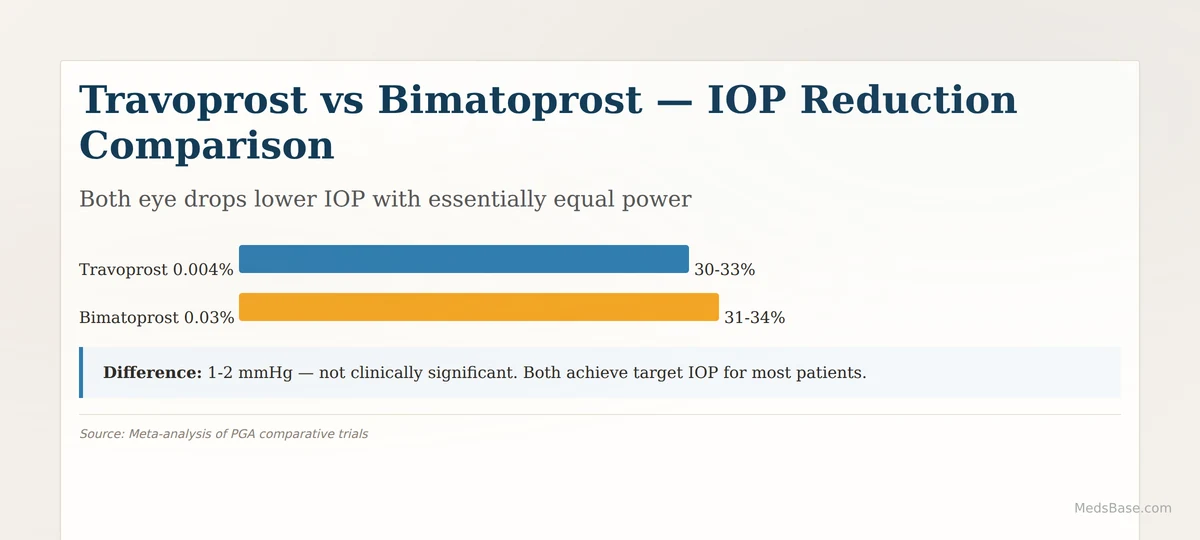
Let’s look at the numbers directly:
| Parameter | Travoprost 0.004% | Bimatoprost 0.03% | Clinical Significance |
|---|---|---|---|
| Mean IOP reduction (trough) | 30–33% | 31–34% | Not significant |
| Peak IOP reduction | 8–9 mmHg | 8–10 mmHg | Marginal |
| 24-hour IOP control | Good | Slightly better in some studies | Inconsistent |
| Effect on diurnal fluctuation | Reduces fluctuation | Reduces fluctuation | Equivalent |
| Time to peak effect | ~4 weeks | ~4 weeks | Equivalent |
Bottom line on efficacy: Across multiple head-to-head trials and meta-analyses, the IOP-lowering efficacy of travoprost vs bimatoprost is essentially equivalent. Bimatoprost 0.03% may produce an additional 0.5–1.5 mmHg of IOP reduction in some patients, but this small difference rarely changes treatment decisions. Both drops achieve the clinically meaningful threshold of ≥25% IOP reduction in the majority of patients.
For the small percentage of patients who don’t reach target IOP with one prostaglandin analog, switching to another may produce additional IOP lowering — but the evidence for within-class switching is modest, and adding a second agent from a different class is usually more effective.
Side Effects — Where Travoprost vs Bimatoprost Really Differ
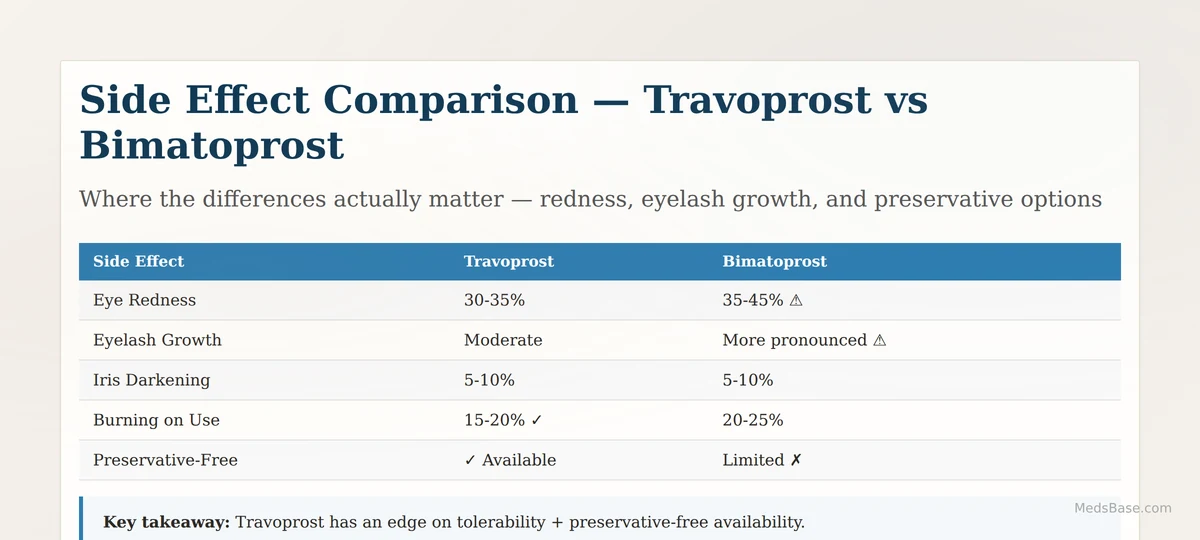
Quick Answer: The side-effect profiles overlap heavily, but bimatoprost consistently shows higher rates of conjunctival hyperemia (eye redness) in clinical trials — roughly 35–45% vs 30–35% for travoprost. The other differences are more subtle.
| Side Effect | Travoprost | Bimatoprost | Difference |
|---|---|---|---|
| Conjunctival hyperemia (redness) | ~30–35% | ~35–45% | Bimatoprost higher — often the deciding factor |
| Eyelash growth / darkening | Common | More pronounced | Bimatoprost (also used as Latisse for lashes) — stronger effect on follicles |
| Iris pigmentation change | ~5–10% with long-term use | ~5–10% | Equivalent — both can permanently darken light irises |
| Periocular skin darkening | Uncommon | Uncommon | Equivalent |
| Ocular irritation / burning on instillation | ~15–20% | ~20–25% | Slight favour to travoprost |
| Foreign body sensation | 5–10% | 5–10% | Equivalent |
| Cystoid macular edema (CME) | Rare — in at-risk eyes | Rare — in at-risk eyes | Equivalent — both are PGAs, both carry CME risk in aphakic/pseudophakic patients |
| Headache | Uncommon | Uncommon | Equivalent |
Iris darkening — the permanent change: Both travoprost and bimatoprost can increase melanin pigment in the iris, causing light-colored eyes (blue, green, hazel) to gradually become brown. This change is cosmetic but permanent — it does not reverse if you stop the medication. The effect is slow (months to years) and may not be noticeable until someone else comments on it. If you have light eyes and this concerns you, discuss it with your ophthalmologist. The IOP-lowering benefit almost always outweighs this cosmetic change, but you should be aware of it before starting.
Eyelash growth — the side effect that becomes a feature: Bimatoprost’s stronger effect on hair follicles is why the same molecule (at a different concentration) is FDA-approved as Latisse for eyelash enhancement. Travoprost also stimulates lash growth but to a lesser degree. Many glaucoma patients don’t mind longer, darker lashes, but some find it bothersome — especially if the lashes grow in unusual directions or need more frequent trimming.
Preservatives — The Hidden Factor in the Travoprost vs Bimatoprost Decision
Here’s the factor that most comparison articles completely miss, and it could be the most important one for your daily comfort.
Most eye drops contain preservatives — most commonly benzalkonium chloride (BAK) — to prevent bacterial contamination in multi-dose bottles. BAK is effective, but it’s also toxic to the corneal epithelium. With years of daily exposure, BAK can contribute to or worsen dry eye, ocular surface irritation, and chronic inflammation.
Why this matters when comparing travoprost vs bimatoprost:
- Travoprost is available in a preservative-free, single-dose (unit-dose) formulation — Travatan preservative-free. This does not contain BAK and is significantly gentler on the ocular surface.
- Bimatoprost 0.03% does NOT have a widely available preservative-free single-dose option in most markets (bimatoprost 0.01% — the lower-concentration formulation — is available preservative-free in some regions, but 0.01% is less commonly used for glaucoma than 0.03%).
The practical impact: If you have ocular surface disease, dry eye syndrome, or use multiple eye drops daily (common in glaucoma patients, who often take 2–3 different drops), the cumulative BAK exposure can cause chronic discomfort that masquerades as “my eyes just don’t tolerate drops well.” Switching from preserved bimatoprost to preservative-free travoprost could resolve that discomfort entirely — without sacrificing IOP control.
What about latanoprost? For completeness: latanoprost is also widely available in preservative-free formulations. If you’re comparing all three prostaglandin analogs, travoprost and latanoprost have the edge on preservative-free availability over bimatoprost. See our latanoprost vs bimatoprost comparison.
Travoprost vs Bimatoprost — Cost and Availability
Both travoprost and bimatoprost are available as generic medications, which has dramatically reduced their cost compared to the brand-name era (when Travatan and Lumigan could cost hundreds of dollars per month).
- Generic travoprost: Available in 0.004% concentration, multi-dose bottles (2.5mL, 5mL). Preservative-free unit-dose also available generically in some markets.
- Generic bimatoprost: Available in 0.03% concentration, multi-dose bottles (2.5mL, 5mL, 7.5mL).
- Relative cost: In most markets, the two are priced similarly. Generic bimatoprost may be slightly less expensive in some regions, while generic travoprost may have the edge in others. The difference is rarely more than $10–15 per month — not large enough to be the deciding factor for most patients.
Both travoprost and bimatoprost are available internationally. Browse the MedsBase eye care category to compare available products and find the option that fits your budget.
What the Clinical Guidelines Say
The American Academy of Ophthalmology’s Preferred Practice Pattern for Primary Open-Angle Glaucoma recommends prostaglandin analogs as first-line therapy for most patients. The guidelines do not rank individual PGAs against each other — travoprost, bimatoprost, latanoprost, and tafluprost are all considered appropriate first-line choices.
The European Glaucoma Society guidelines take a similar position: all PGAs are effective first-line agents, and the choice should be individualised based on tolerability, patient preference, preservative needs, and cost.
The key guideline takeaway for the travoprost vs bimatoprost decision: both are evidence-based, guideline-recommended, and clinically appropriate. There is no “wrong” choice — only the choice that works best for your specific eyes.
Travoprost vs Bimatoprost vs Latanoprost — The Three-Way Comparison
| Feature | Travoprost | Bimatoprost | Latanoprost |
|---|---|---|---|
| IOP reduction | 30–33% | 31–34% | 28–31% |
| Redness rate | 30–35% | 35–45% | 25–30% |
| Preservative-free available | Yes (unit-dose) | Limited | Yes |
| Eyelash growth | Moderate | Most pronounced | Moderate |
| Dosing frequency | Once nightly | Once nightly | Once nightly |
| Generic available | Yes | Yes | Yes |
| Cost tier | Low (generic) | Low (generic) | Low (generic) |
One-line verdict for each:
- Travoprost: The best choice if ocular surface comfort is a priority, especially the preservative-free formulation — nearly equivalent IOP efficacy to bimatoprost with less redness.
- Bimatoprost: The best choice if maximum IOP reduction is the absolute priority and you tolerate the redness — the strongest PGA numerically, with the trade-off of more hyperemia.
- Latanoprost: The most established option with the longest safety record, lowest redness rate, and widest availability of generic and preservative-free formulations — often the default first-line PGA.
How to Switch Between Prostaglandin Analogs
If you and your ophthalmologist decide to switch from bimatoprost to travoprost (or vice versa), the process is straightforward:
- Stop the current drop. No tapering needed — prostaglandin analogs are not associated with rebound IOP spikes when stopped, unlike beta-blockers.
- Start the new drop the following night. Same dosing schedule — one drop in the affected eye(s) at bedtime.
- Allow 4–6 weeks for full effect. IOP reduction from a new prostaglandin analog takes several weeks to plateau. Don’t judge efficacy after the first few days.
- Schedule follow-up IOP check at 4–6 weeks. This confirms the new drop is achieving target pressure.
- Monitor for side-effect changes. If you switched because of redness, expect improvement within 2–4 weeks of stopping bimatoprost.
Important: Never self-switch between glaucoma medications. The risk to your vision from uncontrolled IOP exceeds any side-effect inconvenience. All medication changes should be made under your ophthalmologist’s supervision with scheduled follow-up IOP checks.
Which One Is Right for You — A Practical Decision Guide
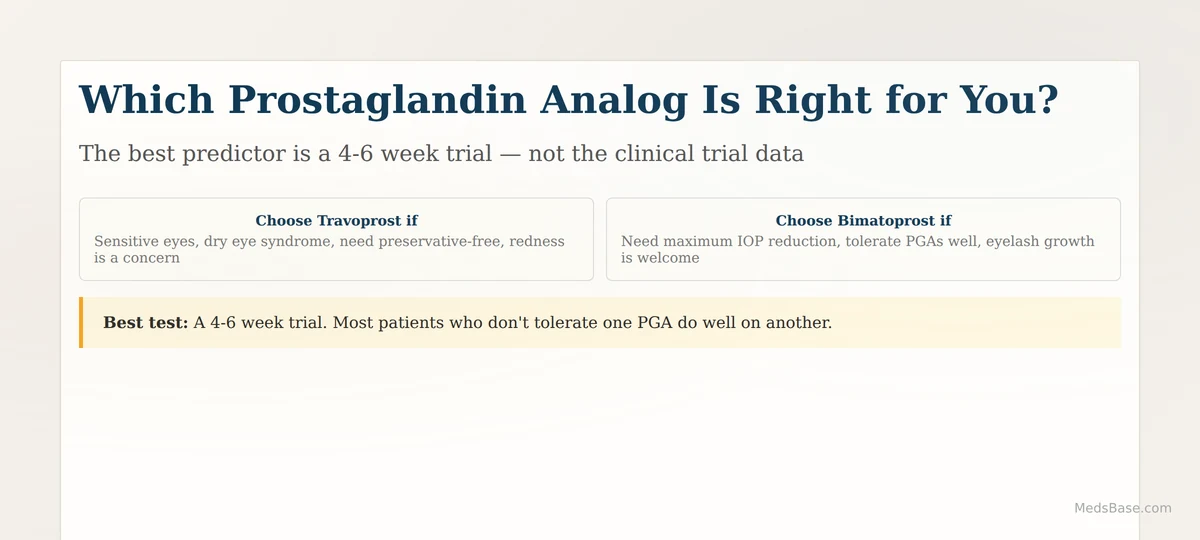
Choose Travoprost if:
- You’ve experienced significant redness with bimatoprost
- You have dry eye syndrome or ocular surface disease (preservative-free available)
- You use multiple eye drops and want to minimise cumulative BAK exposure
- You want the preservative-free option for long-term comfort
Choose Bimatoprost if:
- You need every mmHg of IOP reduction (advanced glaucoma, progressing despite treatment)
- You tolerate prostaglandin analogs well with minimal redness
- The eyelash-growth side effect is welcome rather than bothersome
- Preservative exposure is not a concern for your ocular surface
Consider Latanoprost if:
- You want the lowest redness rate in the PGA class
- You’ve tried both travoprost and bimatoprost and had tolerability issues with both
- You want the cheapest generic option available
Frequently Asked Questions About Travoprost vs Bimatoprost
Q: Which is better — travoprost or bimatoprost?
A:
A: There is no universally “better” option — both are highly effective first-line glaucoma treatments that lower IOP by approximately 30–35%. Bimatoprost may provide a small additional IOP reduction (1–2 mmHg), but travoprost causes less eye redness and offers preservative-free formulations. The best choice depends on your individual IOP target, your eyes’ tolerability, and whether you need preservative-free drops.
Q: Is travoprost better than bimatoprost for glaucoma?
A:
A: Travoprost and bimatoprost lower IOP with essentially equivalent efficacy. Travoprost’s advantages are lower rates of conjunctival hyperemia (redness) and the availability of a preservative-free formulation. Bimatoprost’s advantage is a slight numerical edge in maximum IOP reduction. For most patients, travoprost vs bimatoprost is a tolerability decision, not an efficacy one.
Q: What are the side effects of travoprost vs bimatoprost?
A:
A: Both can cause eye redness, eyelash growth, permanent iris darkening (in light-colored eyes), periocular skin darkening, and irritation upon instillation. Bimatoprost causes higher rates of redness (35–45% vs 30–35%) and more pronounced eyelash growth. Both carry a rare risk of cystoid macular edema in at-risk eyes. Systemic side effects are rare with both.
Q: Can I switch from bimatoprost to travoprost?
A:
A: Yes — your ophthalmologist can switch you from bimatoprost to travoprost directly, with no tapering period required. Stop the bimatoprost and start travoprost the following night. Schedule a follow-up IOP check at 4–6 weeks to confirm the new drop is controlling your pressure. Switching is most commonly done because of redness or irritation with the current drop.
Q: Which prostaglandin analog has the least side effects?
A:
A: Latanoprost generally has the lowest rates of conjunctival hyperemia (redness) among the three major PGAs. Travoprost has intermediate redness rates. Bimatoprost has the highest redness rates but also the strongest IOP-lowering effect. All have similar rates of iris darkening, eyelash growth, and other class-wide side effects.
Q: How much do generic travoprost and bimatoprost cost?
A:
A: Both are available as affordable generic medications. The price difference between generic travoprost and generic bimatoprost is typically small (often less than $10–15 per month) — not large enough to be the deciding factor for most patients. International pharmacies like MedsBase offer both at competitive prices. Browse the eye care category to compare.
Q: Does bimatoprost really grow eyelashes?
A:
A: Yes — bimatoprost stimulates hair follicles in the eyelid margin, causing eyelashes to grow longer, thicker, and darker. This is the same mechanism that makes bimatoprost (at a different concentration, branded as Latisse) an FDA-approved eyelash enhancement treatment. Travoprost also stimulates lash growth but to a lesser degree. If pronounced eyelash growth bothers you, travoprost may be a better choice.
Q: Do I need to refrigerate travoprost or bimatoprost?
A:
A: Storage requirements vary by formulation. Most multi-dose bottles of travoprost and bimatoprost can be stored at room temperature after opening (check your specific product labeling). Preservative-free unit-dose travoprost containers should be stored as directed — typically at room temperature, protected from light, and used immediately after opening (single-use only).
Related Reading
- Latanoprost vs Bimatoprost: Which Glaucoma Eye Drop Works Best? — The first comparison in the prostaglandin analog cluster
- Blood Pressure Medication Adherence: 9 Proven Strategies — Today’s trend post on medication consistency
- Domperidone for Nausea and Gastroparesis — Complete Guide — Today’s companion gastro guide
- Browse the MedsBase Eye Care category for travoprost, bimatoprost, and other glaucoma treatment options
The Bottom Line
When weighing travoprost vs bimatoprost, the IOP numbers are close enough that they shouldn’t drive your decision. Both drops lower eye pressure effectively enough to protect your optic nerve. The real decision comes down to three practical factors:
- Redness: If your eyes tend to get red easily or red eyes affect your daily confidence, travoprost is likely the better first choice.
- Preservatives: If you have dry eyes, use multiple drops, or want the gentlest long-term option, preservative-free travoprost has a meaningful advantage.
- IOP urgency: If you have advanced glaucoma and need every possible mmHg of pressure reduction, bimatoprost’s slight efficacy edge may matter.
Here’s the most practical advice you’ll read in this guide: the single best predictor of which drop works for you is a 4–6 week trial. Start with one. If your eyes tolerate it and your IOP is at target, you’ve found your drop. If redness or irritation bothers you, switch under your ophthalmologist’s supervision. Most patients who don’t tolerate one PGA do well on another — the within-class switching success rate is high.
Your next step: Take the decision guide above to your next ophthalmologist appointment. Discuss whether travoprost or bimatoprost is the better starting point for your eyes — and whether preservative-free matters for your ocular surface health. The conversation takes three minutes and could save you years of unnecessary eye irritation.
Wondering how bimatoprost compares to latanoprost? Read our complete latanoprost vs bimatoprost guide. Ready to compare prices and products? Browse the MedsBase eye care category.

Written by
Sophie ChenPharmaceutical Content Researcher · 8 years experience
Sophie Chen is a pharmaceutical content researcher with 8 years covering generic medication access and clinical pharmacology. She specialises in international regulatory frameworks, bioequivalence standards, and patient-facing education on therapeutic drug classes. She is not a clinician.