








✓ Medically reviewed by · Last reviewed: May 2026
Pharmacy Researcher · 8 years experience
Pharmacy researcher with 8 years reviewing clinical drug information, generic formulation equivalence, and international pharmaceutical standards. Focuses on patient-facing accuracy in medication education.
latanoprost vs bimatoprost — Latanoprost vs Bimatoprost: Which Glaucoma Eye Drop Works Best?. Read on for an evidence-backed guide covering everything you need to know.
Key Takeaways
- Both latanoprost and bimatoprost are prostaglandin analog eye drops that lower intraocular pressure by 25-33%, making them the two most commonly prescribed first-line glaucoma treatments worldwide.
- Bimatoprost may lower IOP by an additional 1-2 mmHg compared to latanoprost, but this small difference comes with a slightly higher rate of eye redness.
- Generic latanoprost is typically the most affordable first-line glaucoma medication — costing as little as a fraction of branded alternatives.
- Both medications cause eyelash growth as a side effect — the same mechanism that makes bimatoprost famous as Latisse — but latanoprost does it too, just less advertised.
- The most common mistake: stopping the drops because you cannot feel them working. Glaucoma is silent — the drops are working even though you notice nothing different.
- What Are Latanoprost and Bimatoprost?
- How Do These Glaucoma Eye Drops Work?
- Latanoprost vs Bimatoprost: What the Evidence Says
- Side Effects: Latanoprost vs Bimatoprost
- Cost and Accessibility
- Which One Should You Choose?
- Frequently Asked Questions About Latanoprost vs Bimatoprost
- The Bottom Line
What Are Latanoprost and Bimatoprost? {#what-are-they}
If you have just been diagnosed with glaucoma or ocular hypertension, there is a strong chance your doctor has prescribed one of two eye drops: latanoprost (brand name Xalatan) or bimatoprost (brand name Lumigan). Both belong to a class of medications called prostaglandin analogs, or PGAs — the gold-standard first-line treatment for lowering intraocular pressure and preventing glaucoma-related vision loss.
Latanoprost and bimatoprost work through the same fundamental mechanism: they increase the drainage of fluid from inside the eye, reducing the pressure that damages the optic nerve. But they are not identical. Differences in molecular structure, potency, side-effect profiles, and cost mean that the latanoprost vs bimatoprost decision can meaningfully affect your treatment experience — even though both drugs are clinically effective.
This head-to-head latanoprost vs bimatoprost comparison explains what the studies actually say about efficacy, why one might cause more redness but also give better pressure control, and how to think about the cost difference if you are paying out of pocket.
How Do These Glaucoma Eye Drops Work? {#how-they-work}
To understand the latanoprost vs bimatoprost comparison, you first need to understand the plumbing problem they both solve.
Your eye constantly produces a clear fluid called aqueous humour. This fluid nourishes the lens and cornea, then drains out through two pathways: the trabecular meshwork (the main drain) and the uveoscleral pathway (a secondary drain). In most forms of glaucoma, the drainage system becomes less efficient — the fluid builds up, intraocular pressure rises, and the elevated pressure gradually damages the optic nerve. This is why the National Eye Institute emphasises that lowering IOP is the only proven treatment to slow glaucoma progression.
Prostaglandin analogs like latanoprost and bimatoprost work primarily by opening up the uveoscleral outflow pathway — the secondary drain — allowing more fluid to exit the eye. Think of it like unblocking a partially clogged sink drain. Both drugs relax the ciliary muscle, widening the spaces between muscle bundles through which aqueous humour can flow out of the eye.
Research Spotlight
While both latanoprost and bimatoprost increase uveoscleral outflow, research suggests that bimatoprost may additionally enhance trabecular meshwork outflow — the main drainage pathway. This dual-site action could explain the small but consistent advantage in IOP reduction that bimatoprost shows in head-to-head trials. However, the additional effect size is modest: roughly 1-2 mmHg, which may or may not be clinically significant depending on the individual patient’s target pressure and glaucoma severity. Source: AAO Preferred Practice Pattern for Primary Open-Angle Glaucoma.
Both medications are applied once daily, always at night. This timing is not arbitrary — intraocular pressure naturally peaks during sleep hours, and applying the drop before bed positions the drug’s maximum effect to coincide with this peak.
Here is something that surprises many patients: the American Academy of Ophthalmology explains that the drops are working even though you feel nothing. Glaucoma eye drops do not produce an immediate sensation. You cannot feel your eye pressure dropping. The only way to know the medication is effective is through regular IOP measurements at your ophthalmologist’s office — which is why those follow-up appointments are not optional.
Latanoprost vs Bimatoprost: What the Evidence Says {#evidence}
The latanoprost vs bimatoprost question has been studied extensively. Here is what the key clinical trials have found.
IOP-Lowering Efficacy
Both drugs reduce intraocular pressure by approximately 25 to 35 per cent from baseline — a clinically meaningful reduction that, sustained over years, significantly slows glaucoma progression. However, most head-to-head studies find a small but consistent advantage for bimatoprost.
A pivotal randomised controlled trial by Parrish and colleagues directly compared bimatoprost 0.03% once daily with latanoprost 0.005% once daily. At the 3-month primary endpoint, bimatoprost lowered mean IOP by roughly 1 to 2 mmHg more than latanoprost across all time points measured. The difference was statistically significant. Noecker and colleagues replicated this finding in a separate RCT: bimatoprost produced slightly greater mean IOP reduction, with the gap most pronounced in patients with higher baseline pressures.
Here is what this means for you in the latanoprost vs bimatoprost decision: if your baseline IOP is 26 mmHg and your target pressure is below 18 mmHg, the extra 1-2 mmHg from bimatoprost could be the difference between reaching target and needing a second medication. If your baseline is 22 mmHg and your target is 18, latanoprost alone is likely to get you there.
Duration of Effect
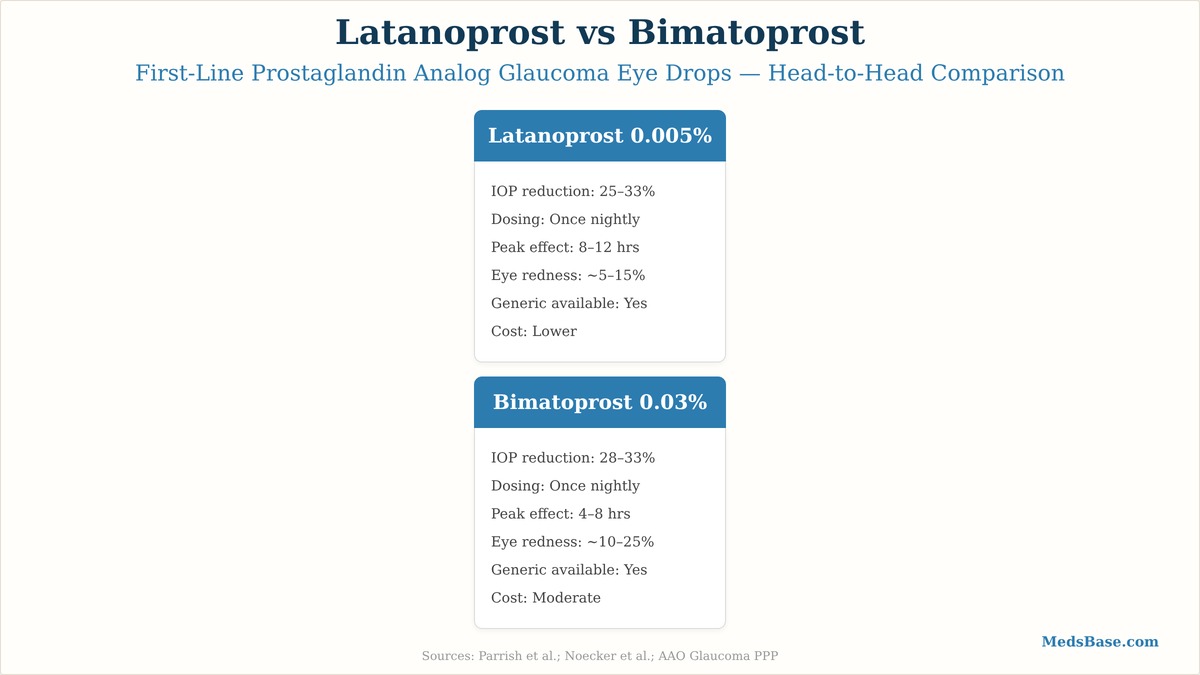
Both medications are dosed once daily at night. Both show sustained IOP control over 24 hours with once-nightly dosing. Latanoprost’s peak effect occurs approximately 8-12 hours after instillation, while bimatoprost’s peak is at roughly 4-8 hours. Both trough effects (at 24 hours, just before the next dose) are similar, which is what matters for consistent daily pressure control.
Long-Term Data
Long-term extension studies show that both latanoprost and bimatoprost maintain their IOP-lowering effect over years of continuous use — tachyphylaxis (the drug becoming less effective over time) is not a significant concern with either medication. This is an important advantage over some older glaucoma medications like beta-blockers, which can lose effectiveness over time.
Evidence Summary Table
| Comparison Point | Latanoprost 0.005% | Bimatoprost 0.03% | Verdict |
|---|---|---|---|
| Mean IOP reduction from baseline | 25-33% (6-8 mmHg) | 28-33% (7-9 mmHg) | Bimatoprost: small edge |
| Dosing frequency | Once nightly | Once nightly | Identical |
| Onset of peak effect | 8-12 hours | 4-8 hours | Bimatoprost: faster peak |
| 24-hour trough control | Sustained | Sustained | Comparable |
| Long-term maintenance of effect | Yes | Yes | Comparable |
| Once-daily dosing sufficient | Yes | Yes | Identical |
Side Effects: Latanoprost vs Bimatoprost {#side-effects}
Both medications share a class-specific side-effect profile, but the latanoprost vs bimatoprost comparison reveals some differences in tolerability.
Effects Common to Both
Increased iris pigmentation — the coloured part of your eye gradually darkening — is the most distinctive side effect shared by both latanoprost and bimatoprost. It occurs because prostaglandin analogs stimulate melanin production in iris melanocytes. The change is permanent, harmless, and usually only noticeable in people with mixed-colour irises (green-brown or blue-brown). Pure blue or pure brown eyes rarely show visible change. If you only use the drop in one eye, the two eyes may eventually differ in colour — your doctor will discuss this with you.
Eyelash growth — longer, thicker, darker lashes — occurs with both medications. This is the same biological mechanism that made bimatoprost famous as Latisse, the eyelash-enhancing serum. Latanoprost does it too, just with less brand recognition. The growth is reversible: lashes return to normal within weeks to months after stopping the drop.
Conjunctival hyperaemia — redness of the white of the eye — is the most common tolerability issue with both drugs.
Where They Differ
| Side Effect | Latanoprost | Bimatoprost |
|---|---|---|
| Conjunctival hyperaemia (eye redness) | ~5-15% | ~10-25% |
| Ocular irritation/burning | Mild, transient | Mild, transient |
| Iris darkening | Gradual, permanent | Gradual, permanent |
| Eyelash growth | Present | Present (more pronounced) |
| Periocular skin darkening | Less common | More common |
| Cystoid macular oedema | Rare (in at-risk eyes) | Rare (in at-risk eyes) |
The higher rate of eye redness with bimatoprost is usually mild and self-limiting — many patients find it decreases after the first few weeks of use. However, for a minority, it is bothersome enough to prompt a switch. In the latanoprost vs bimatoprost tolerability comparison, latanoprost generally has a slight edge, with lower discontinuation rates in clinical trials.
Periocular skin darkening — a subtle darkening of the skin around the eyes — is more common with bimatoprost. Like iris colour change, it is reversible on discontinuation.
Cost and Accessibility {#cost}
For many people, the latanoprost vs bimatoprost decision comes down to cost — and here, latanoprost has a clear advantage in most markets.
Generic latanoprost has been available since 2011, when the patent on Xalatan expired. Multiple manufacturers now produce generic latanoprost 0.005% ophthalmic solution, driving prices down substantially. In many pharmacies, generic latanoprost is one of the most affordable glaucoma medications available.
Generic bimatoprost entered the market later, and while it is now available, pricing varies more widely by region and pharmacy.
It is also worth noting that bimatoprost is sold in two different branded products for entirely different purposes: Lumigan for glaucoma and Latisse for eyelash growth. They contain the same active ingredient at different concentrations (0.03% for glaucoma, 0.03% for lashes) but the Latisse brand is priced as a cosmetic product and is typically not covered by insurance.
If you are paying out of pocket — whether through insurance with a high copay or without insurance — generic latanoprost is almost always the most cost-effective prostaglandin analog option. Discuss pricing with your pharmacist and your ophthalmologist, especially if cost is a barrier to consistent use.
Which One Should You Choose? {#which-one}
The latanoprost vs bimatoprost decision ultimately rests on four factors: your baseline IOP and target pressure, how your eyes tolerate each medication, cost and insurance coverage, and your doctor’s clinical judgment.
Choose latanoprost if: Your baseline IOP is moderately elevated (22-26 mmHg), you are paying out of pocket and cost-sensitive, or you are particularly concerned about eye redness as a side effect. Latanoprost is the default first-line prostaglandin analog in most treatment guidelines precisely because it balances efficacy, tolerability, and cost.
Choose bimatoprost if: Your baseline IOP is significantly elevated (27+ mmHg) and your target is aggressive, you have already tried latanoprost and did not quite reach your target pressure, or you have no concerns about eye redness. Bimatoprost’s additional 1-2 mmHg of IOP reduction is clinically meaningful at higher starting pressures.
What if neither one works well enough? Most glaucoma patients eventually need more than one medication to reach their target IOP. Prostaglandin analogs are typically the first-line agent, and if they are insufficient alone, a second drug from a different class is added — commonly a beta-blocker (like timolol), an alpha-2 agonist (like brimonidine), or a carbonic anhydrase inhibitor (like dorzolamide). Fixed-combination drops that combine two medications in one bottle are also available.
Never switch or stop without your doctor’s involvement. Glaucoma treatment is a long-term partnership between you and your ophthalmologist. The IOP measurements at your follow-up visits are the only objective way to judge whether a medication is working. If you are considering the latanoprost vs bimatoprost switch, ask your doctor to measure your IOP on the current medication first, then re-measure after 4-6 weeks on the new one.
Who Is This For? / Who Should Avoid It?
Prostaglandin analogs are appropriate for: Adults with primary open-angle glaucoma, ocular hypertension, or normal-tension glaucoma as first-line monotherapy; anyone needing adjunctive IOP-lowering therapy alongside other glaucoma medications.
Use with caution or avoid in: People with active intraocular inflammation (uveitis); people with a history of herpes simplex keratitis; people with known hypersensitivity to benzalkonium chloride (the preservative in most formulations — preservative-free versions exist but are more expensive and less widely available); pregnant or breastfeeding women (limited safety data).
Tell your ophthalmologist about all eye conditions: Previous cataract surgery, retinal detachment risk, macular oedema, or any history of eye inflammation may influence the latanoprost vs bimatoprost decision.
Frequently Asked Questions About Latanoprost vs Bimatoprost {#faq}
Q: Which is better, latanoprost or bimatoprost?
A: Bimatoprost may lower IOP by an additional 1-2 mmHg compared to latanoprost, based on head-to-head clinical trials. However, latanoprost is typically better tolerated with less eye redness. For many patients with moderate IOP elevation, latanoprost works well enough, and its lower cost and slightly gentler tolerability make it the more practical first choice. The latanoprost vs bimatoprost question does not have a universal answer — it depends on your specific IOP target and how your eyes respond.
Q: Is generic latanoprost as effective as branded Xalatan?
A: Yes. Generic latanoprost contains the same active ingredient at the same concentration (0.005%) and must meet the same FDA standards for purity, potency, and sterility. Large real-world studies have confirmed equivalent IOP-lowering efficacy between generic latanoprost and brand-name Xalatan.
Q: Why do these eye drops make my eyelashes grow?
A: Both latanoprost and bimatoprost stimulate the anagen (growth) phase of the hair follicle cycle in eyelash follicles. This is a class effect of prostaglandin analogs — it is why bimatoprost is also sold as Latisse for cosmetic eyelash enhancement. Latanoprost causes the same effect but to a slightly lesser degree. The mechanism is unrelated to the IOP-lowering action; it is a separate prostaglandin receptor effect on hair follicles.
Q: Can I use latanoprost or bimatoprost in the morning instead of at night?
A: Night-time dosing is strongly preferred. Intraocular pressure naturally peaks during sleep hours, and applying the drop at bedtime aligns the drug’s maximum effect with that peak. If you forget at night, apply it the following night — do not double-dose.
Q: How long does it take for these eye drops to work?
A: IOP begins to decrease within 2-4 hours of the first dose. The full effect develops over several days to a few weeks of consistent once-nightly use. Your ophthalmologist will typically recheck your IOP 4-6 weeks after starting or changing therapy to assess the full treatment effect.
Q: Can I use bimatoprost glaucoma drops for eyelash growth instead of Latisse?
A: While bimatoprost glaucoma drops (0.03%) contain the same active ingredient as Latisse, using them off-label for cosmetic purposes is not recommended. The glaucoma formulation may have a different preservative system. Also, if you only want lash growth in one expressive way — you do not have glaucoma and are exposing otherwise healthy eyes to an IOP-lowering medication. The latanoprost vs bimatoprost decision should be guided by your medical need to lower eye pressure, not by cosmetic considerations.
Q: Is the latanoprost vs bimatoprost cost difference significant?
A: Generic latanoprost is typically the lowest-cost prostaglandin analog. Generic bimatoprost costs more but less than branded Lumigan. If you have insurance, your copay may be similar for both. If you are paying out of pocket, generic latanoprost is usually the most affordable option. Ask your pharmacist for the cash price of each before filling your prescription.
Q: Will I need to use these eye drops for the rest of my life?
A: For most people with glaucoma, treatment is lifelong. Glaucoma is a chronic, progressive condition — the drainage impairment that causes elevated IOP does not resolve on its own. Consistent daily use of your prescribed eye drop is the single most important thing you can do to protect your vision. Many people find that latanoprost vs bimatoprost becomes less of an active question over time as they settle into a stable, effective treatment routine.
The Bottom Line {#bottom-line}
Latanoprost and bimatoprost are both excellent first-line glaucoma medications. The latanoprost vs bimatoprost comparison consistently finds that bimatoprost provides slightly better IOP reduction while latanoprost offers slightly better tolerability and lower cost. For most newly diagnosed glaucoma patients, either is a good choice — and the best one is the one you use consistently every night.
If you have been prescribed latanoprost and are wondering whether the latanoprost vs bimatoprost switch is worth it, the answer depends on your current IOP relative to your target. If you have already reached your target, switching offers no benefit. If you are close but not quite there, the extra 1-2 mmHg from bimatoprost could matter. In either case, discuss it with your ophthalmologist — not the internet — and let a follow-up IOP measurement guide the decision.
Your next step: Take your eye drop exactly as prescribed tonight. Set a phone reminder so you never miss a dose. And schedule your next IOP check — the numbers at that visit, not how your eyes feel, tell you whether the medication is working.
Concerned about glaucoma risk from other medications? Read our guide to tadalafil and glaucoma risk — a new 2026 study linked the ED drug to elevated glaucoma risk in long-term daily users.
Looking for a broader overview of glaucoma treatment options? See our best glaucoma eye drops listicle for evidence-backed picks across all drug classes.
Browse our eye care medications including latanoprost and bimatoprost.
Medical Disclaimer: This latanoprost vs bimatoprost comparison is for informational purposes only and does not constitute medical advice. Glaucoma treatment decisions must be made by a qualified ophthalmologist based on your individual IOP measurements, optic nerve status, and medical history. Never stop, start, or change glaucoma medications without consulting your eye doctor — uncontrolled glaucoma causes irreversible vision loss.
Reviewed by Medical Reviewer — Last updated: 2026-08-31

Written by
Sophie ChenPharmaceutical Content Researcher · 8 years experience
Sophie Chen is a pharmaceutical content researcher with 8 years covering generic medication access and clinical pharmacology. She specialises in international regulatory frameworks, bioequivalence standards, and patient-facing education on therapeutic drug classes. She is not a clinician.