







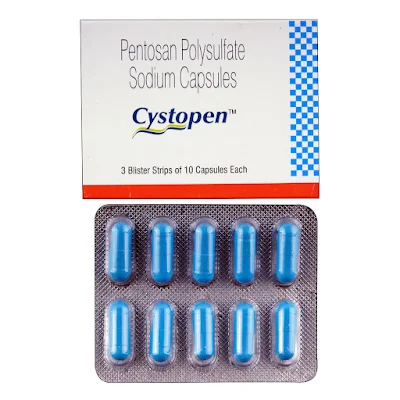
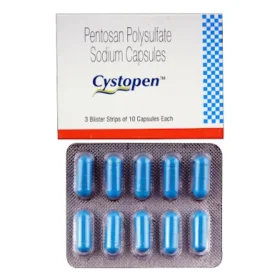
Cystopen
✅ Bladder pain relief
✅ Reduced inflammation
✅ Improved urinary function
✅ Alleviates discomfort
✅ Enhanced bladder lining
Cystopen contains Pentosan Polysulfate Sodium.
✓ Medically reviewed by Morgan Ellis — Pharmacy Researcher · 8 years experience · Last reviewed: May 2026
💡 Quick Answer
Cystopen is pentosan polysulfate sodium 100 mg, the only FDA-approved oral medication for interstitial cystitis / bladder pain syndrome (IC/BPS). It is thought to restore the damaged protective bladder lining (GAG layer). Modest effect size (20–30% response over placebo) with slow onset (3–6 months). Long-term use associated with pigmentary maculopathy — requires periodic ophthalmology review.
📦 Every order is covered by our Reshipment Assurance Policy — if your parcel does not arrive within 20 business days, we reship it.
Why order from MedsBase
Our generic medications are sourced from WHO-GMP certified manufacturers and shipped worldwide in discreet, plain packaging — no medication name on the parcel exterior. Card payments are routed through a regulated processor (statement descriptors include a regulated card-payment processor — never “MedsBase” or any medication name). Crypto and SEPA bank transfer are also accepted. Every order is backed by our Reshipment Assurance Policy.
What Is Cystopen?
Cystopen is a branded generic of pentosan polysulfate sodium (PPS) 100 mg, a semi-synthetic sulfated polysaccharide. It is the only oral medication FDA-approved specifically for interstitial cystitis/bladder pain syndrome (IC/BPS) — a chronic bladder condition causing pelvic pain, urgency, and frequency in the absence of infection. Manufactured by Cipla.
PPS is thought to replenish the damaged glycosaminoglycan (GAG) layer of the bladder urothelium, restoring a barrier that keeps urinary irritants from contacting underlying tissue.
Clinical Use
- Interstitial cystitis / bladder pain syndrome — FDA-approved indication. Oral 100 mg three times daily on an empty stomach.
- Part of the multimodal IC/BPS treatment ladder: lifestyle/diet → physiotherapy → oral therapy (PPS, amitriptyline) → intravesical therapy (heparin, DMSO) → neuromodulation → surgery.
How to Take
- Take 100 mg three times daily, on an empty stomach (1 hour before or 2 hours after food), with water.
- Slow onset: 3–6 months of continuous use typically needed to assess response.
- Only ~30% of patients have meaningful symptom improvement. If no response at 6 months, discontinue.
- Ophthalmology baseline and periodic monitoring — pigmentary maculopathy has been linked to long-term PPS use (see below).
Pigmentary Maculopathy — Critical Safety Warning
In 2018, reports emerged of a progressive pigmentary maculopathy in patients on long-term (5+ years) PPS — characterised by perifoveal hyperpigmentation, RPE atrophy, and vision changes. The FDA added a warning in 2020. Key implications:
- Baseline ophthalmology exam before starting.
- Periodic retinal examination during treatment — frequency varies by guideline (annual is common).
- If visual changes occur — blurred vision, difficulty adapting to dark environments, reading problems — stop PPS and seek urgent ophthalmology review.
- Damage may be progressive even after stopping.
Other Side Effects
Common: alopecia (hair thinning), diarrhoea, nausea, headache, rash.
Less common: liver enzyme elevation, thrombocytopenia, bleeding (mild anticoagulant effect).
Serious: pigmentary maculopathy (above), severe bleeding (rare), severe hepatotoxicity (rare).
Who Should Not Take Cystopen
- Known hypersensitivity to pentosan polysulfate
- Pre-existing bleeding disorders or recent significant bleeding
- Severe hepatic impairment
- Pregnancy and breastfeeding (insufficient data)
- Macular degeneration or other significant retinal disease (relative — discuss with ophthalmologist)
Drug Interactions
- Anticoagulants and antiplatelets: additive bleeding risk. Particular caution with warfarin, DOACs, heparin, aspirin.
- NSAIDs: additive bleeding risk.
- Few other significant interactions.
Storage
Store at room temperature (15–30 °C). Keep in original container. Keep out of reach of children.
Frequently Asked Questions
How fast does Cystopen work?
Slow onset — typically 3–6 months for meaningful symptom improvement in responders. Only ~30% of patients have meaningful benefit. If no response at 6 months, discontinue.
What is interstitial cystitis?
Chronic bladder pain syndrome with urgency, frequency, and pelvic pain — in the absence of infection. Diagnosis is clinical, often after exclusion of other causes. IC/BPS affects 3–10% of women and 1–2% of men.
Why do I need eye exams?
PPS has been associated with a progressive retinal pigment change (pigmentary maculopathy) after 5+ years of use. Baseline and periodic retinal exams detect changes early and allow timely discontinuation.
What if Cystopen isn't working?
Move up the IC/BPS treatment ladder: amitriptyline, intravesical heparin/DMSO, neuromodulation, and in refractory cases surgery. Multimodal management (diet modification, pelvic floor PT, bladder training) complements drug therapy.
Is Cystopen addictive?
No. No dependence or withdrawal concerns.
Can I take Cystopen long-term?
Yes if responding, but with periodic retinal monitoring. The maculopathy risk is the main long-term concern; most other side effects are dose-related and reversible.
Is Cystopen only for women?
No — IC/BPS affects both sexes (more common in women but occurs in men). Same dosing and considerations.
What if I have hair loss on Cystopen?
Alopecia is a recognised class effect (~5% of users). Usually mild thinning, not complete loss; reverses on discontinuation. Discuss with clinician if bothersome.
Related Women’s Health Products
- Tamodex (Tamoxifen 10 mg)
- Tamilong (Tamoxifen 20 mg)
- Letroheal (Letrozole 2.5 mg)
- Etibo (Lapatinib 250 mg)
- Duphaston (Dydrogesterone 10 mg)
- Deviry (Medroxyprogesterone 10 mg)
- Naprosyn (Naproxen 250 mg)
⚕️ Medical Disclaimer: Information is educational and does not replace medical advice. Consult a clinician before starting, stopping, or changing any medication, particularly for cancer therapy, hormonal treatments, and prescription products.
Related Alternatives
Other products in Women's Health that customers also view:
More options in Cystitis Treatment
Ranked by recent MedsBase order volume — what other customers in this category are picking.
| Strength | 100 mg |
|---|---|
| Quantity | 10 Capsule/s, 30 Capsule/s, 60 Capsule/s, 90 Capsule/s, 180 Capsule/s |
 Cystopen
Q & A
Cystopen
Related products



Reviews
There are no reviews yet