








✓ Medically reviewed by · Last reviewed: May 2026
Pharmacy Researcher · 8 years experience
Pharmacy researcher with 8 years reviewing clinical drug information, generic formulation equivalence, and international pharmaceutical standards. Focuses on patient-facing accuracy in medication education.
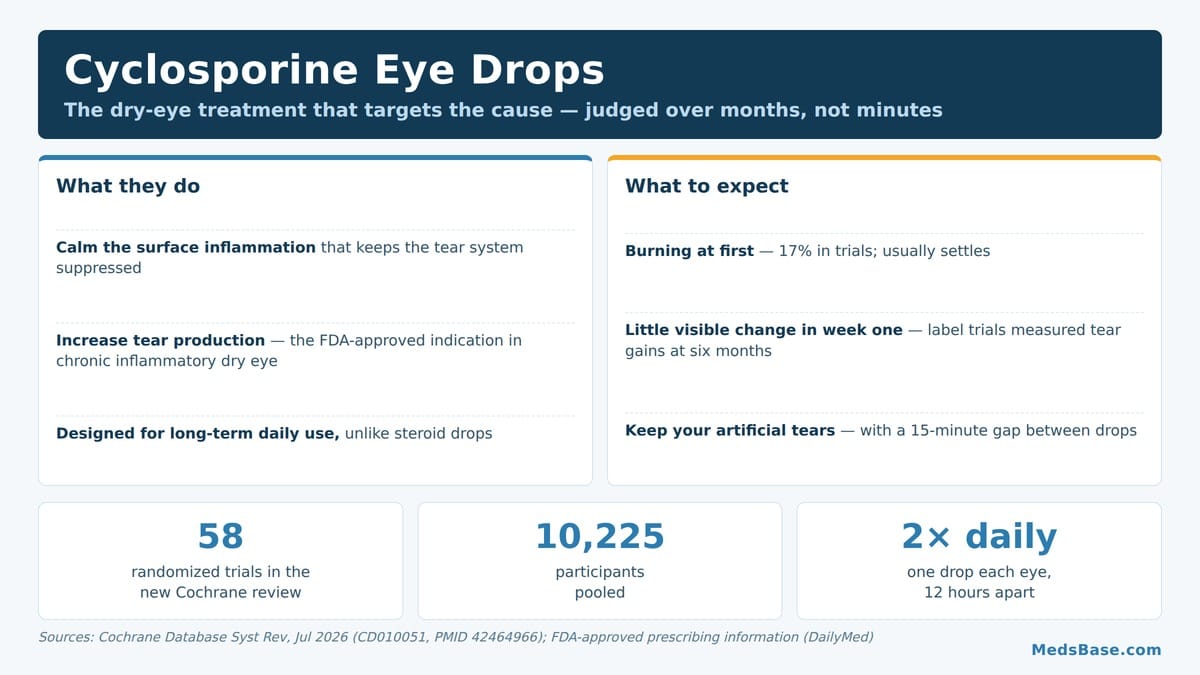
It’s 3 p.m. and your eyes are burning again. The bottle of artificial tears on your desk is the third this month; the relief lasts twenty minutes, the grit comes back, and last night you found yourself googling whether it’s normal to dread reading. If that routine sounds familiar, this article is about the next rung on the ladder: cyclosporine eye drops — the prescription-strength approach that treats the inflammation behind chronic dry eye rather than topping up moisture that keeps evaporating.
By the end you will know exactly what a brand-new Cochrane review of 58 randomized trials — published in July 2026, the largest evidence check-up this treatment has ever had — honestly says about how well these drops work, why they burn, why they take months, and how to decide between them, plain lubricants and steroid drops.
One number from that review surprises almost everyone who reads it — it’s not about how well the drops work, but about who stops using them. It’s in the safety section.
- Cyclosporine eye drops treat the cause of chronic dry eye — surface inflammation — not just the symptom; that’s also why nothing seems to happen in week one
- The new Cochrane review (58 trials, 10,225 people) finds real but modest average benefits — we print the actual effect sizes, with their certainty grades
- Burning on instillation is the most common side effect — 17% in the label’s trials — and it usually settles
- Users were roughly twice as likely to stop treatment for side effects than control users — the number nobody quotes
- You can (and usually should) keep using artificial tears alongside — but one 15-minute rule makes or breaks it
- Higher concentrations are not automatically better: the data on 0.05% vs 0.1% is messier than the marketing
What Are Cyclosporine Eye Drops?
Cyclosporine eye drops are an anti-inflammatory treatment for chronic dry eye disease. Instead of lubricating the surface like artificial tears, they suppress the immune activity that keeps the tear system underperforming — the FDA label’s indication is to increase tear production in patients whose tears are suppressed by ocular inflammation. Used twice daily, long term.
Two disambiguations before anything else. First: this is the same molecule as the oral immunosuppressant used in organ transplantation — oral cyclosporine: uses, dosage and side effects covers that entirely different world — but at eye-drop concentrations the drug acts locally on the eye’s surface. Second: you may know it by brand names. The original branded 0.05% emulsion is Restasis; generic 0.05% emulsions — including Cyclomune — contain the same active ingredient at the same strength, and newer branded products exist at other concentrations. The evidence in this article is organised by concentration, not by box.
Dry eye disease itself is more than an annoyance — the National Eye Institute’s dry-eye overview describes a condition where either you don’t make enough tears or the tears you make don’t work properly, with symptoms from grittiness and burning to blurred vision. For consumer-level drug information, MedlinePlus explains ophthalmic cyclosporine — an immunomodulator used to increase tear production.
The obvious question: how does suppressing immune cells produce more tears? That mechanism is the key to everything else in this article — including why the drops seem to do nothing for the first month.
How Do Cyclosporine Eye Drops Work?
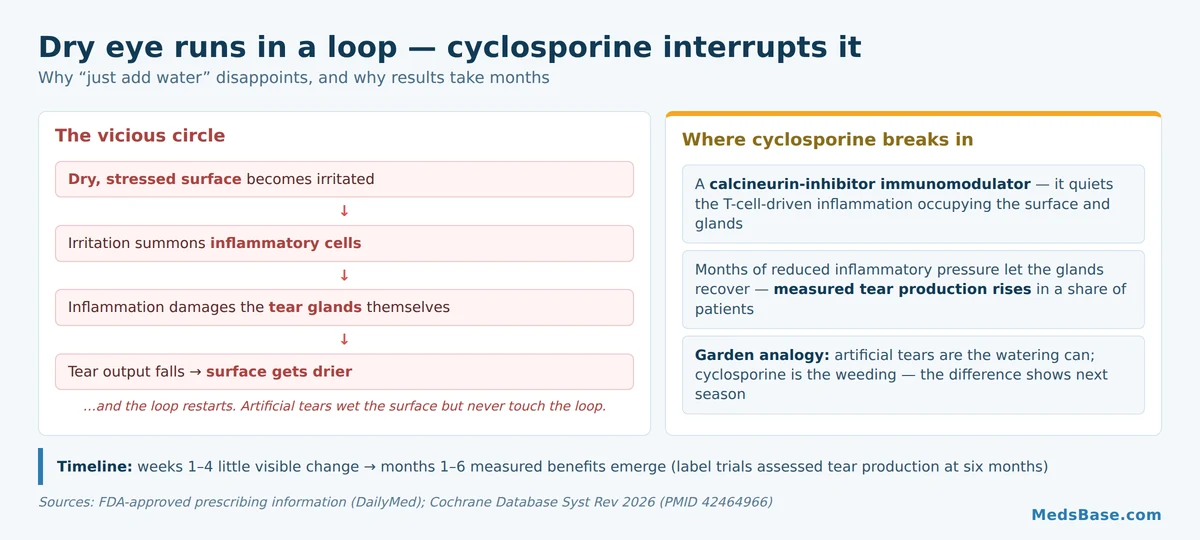
Chronic dry eye runs in a loop. A dry, stressed eye surface becomes irritated; irritation summons inflammatory cells; inflammation damages the very glands and cells that produce and stabilise tears; output falls further; the surface gets drier. Round and round — which is why “just add water” so often disappoints: artificial tears wet the surface but never touch the loop.
Cyclosporine breaks the loop at the inflammation step. It is a calcineurin inhibitor immunomodulator — in plain English, it quiets the T-cell-driven inflammatory activity occupying the eye’s surface and tear glands. Give the glands months of reduced inflammatory pressure and, in a meaningful share of patients, measured tear production rises.
Think of it like weeding a garden bed versus watering wilted plants. Artificial tears are the watering can — instant, soothing, temporary. Cyclosporine is the weeding — nothing looks different the day you do it, and the difference shows in the next season’s growth.
The timeline consequence, translated for you: this is a months-scale treatment. The label’s own pivotal trials measured tear production at six months. If you expect week-two results, you will conclude it “doesn’t work” at precisely the moment it hasn’t yet had a chance to.
Key Uses — Who Actually Benefits
Chronic dry eye that outlasts artificial tears
The core profile: symptoms most days for months, a drawer of lubricant bottles, relief measured in minutes. The FDA indication describes tear production presumed suppressed by ocular inflammation associated with keratoconjunctivitis sicca — medical shorthand for exactly this persistent, inflammatory pattern.
Dryness with an inflammatory signature
Burning, stinging and light sensitivity alongside grittiness point toward the inflammatory loop these drops target. Your optometrist or ophthalmologist can often see the signs directly — surface staining, reduced tear film stability — and those measurable signs are, notably, where the trial evidence is most consistent.
Long-term maintenance, not rescue
Cyclosporine is the marathon option: designed for indefinite daily use, unlike steroid drops, which work faster but are limited to short courses. If your problem is occasional bad flares rather than a constant baseline, our guide to short-term steroid drops for dry-eye flares covers the tool actually built for that job.
For readers who match the first profile, MedsBase stocks cyclosporine 0.05% (Cyclomune Eye Drop), the generic 0.05% emulsion strength used in most of the trials above, sourced from a WHO-GMP-certified manufacturer — with no prescription needed to order, and with the strong recommendation that persistent dry eye gets at least one proper eye-surface examination along the way.
Side Effects, Burning and the Dropout Number
The side-effect story here is refreshingly short — and one number in it deserves more attention than it gets.
| Side effect | Frequency | Severity | What to do |
|---|---|---|---|
| Burning/stinging on instillation | Most common — 17% in the label’s clinical trials | Mild–moderate, seconds-to-minutes | Expect it early; it usually settles with continued use. Cold-storing the vials is a common comfort trick — ask your pharmacist |
| Eye redness, watering, discharge, foreign-body feeling | Less common | Mild | Usually transient; persistent review |
| Blurred vision just after the drop | Common to all emulsions | Momentary | Dose when you don’t need immediate sharp vision (e.g. before bed) |
| Stopping treatment due to side effects | Roughly 2× more likely than control (RR 1.99 for 0.05%, moderate-certainty; RR 1.58 for 0.1%) | — | The promised surprise number — see below |
That last row is the Cochrane review’s least-quoted finding: across 9 trials and 2,109 participants, people on cyclosporine 0.05% were about twice as likely to discontinue for adverse events as people on vehicle or artificial tears — and the review grades that moderate certainty, firmer than its efficacy findings. The absolute numbers stay small, and “adverse events” here mostly means the burning and irritation above, not harm to the eye. But it reframes the practical challenge: the main risk isn’t damage — it’s quitting. Which is why the how-to section below is written as a fair-trial protocol rather than a dosing footnote.
Also worth naming: higher concentrations bought more dropout, not clearly more benefit — trials comparing other formulations and strengths against 0.05% found the 0.05% users less likely to stop (RR 1.72 in favour of 0.05%, moderate certainty). More drug is not automatically more better here.
What Does the Research Say?
| Study | Year | Finding | Source |
|---|---|---|---|
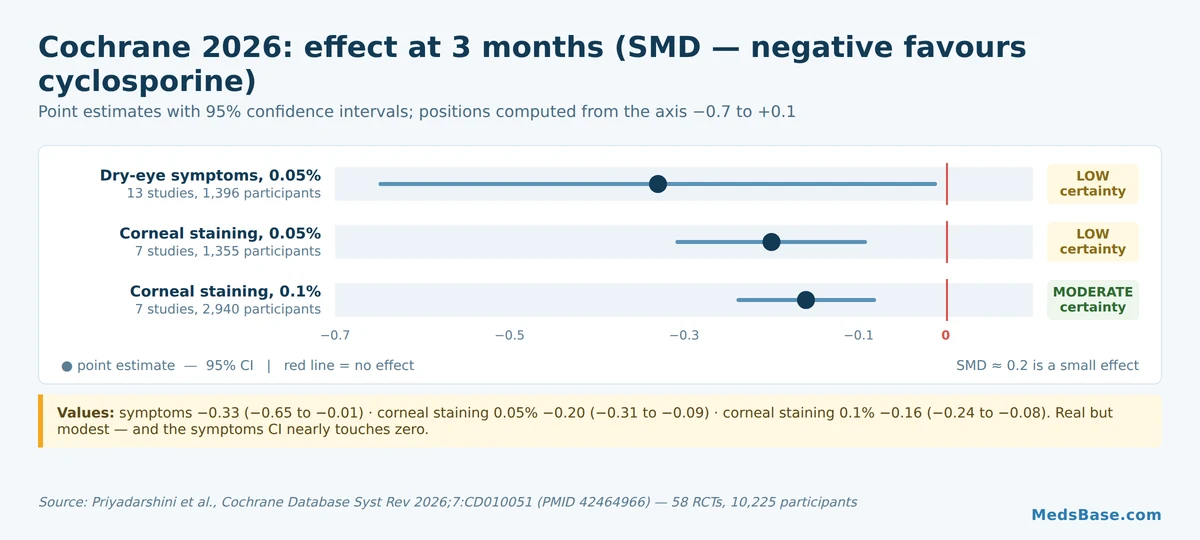
| Cochrane systematic review, 58 RCTs, 10,225 participants | 2026 | 0.05% vs control at 3 months: symptoms SMD −0.33 (95% CI −0.65 to −0.01, low certainty); corneal staining SMD −0.20 (−0.31 to −0.09, low certainty); discontinuation for adverse events RR 1.99 (moderate certainty). 0.1% vs control: corneal staining SMD −0.16, conjunctival staining SMD −0.20 (both moderate certainty); small tear-production gain (low certainty) | Priyadarshini et al., Cochrane Database Syst Rev, CD010051.pub3 (PMID 42464966) |
| Systematic review & meta-analysis, topical ciclosporin for ocular surface disease | 2025 | Independent review reaching directionally consistent conclusions on signs and symptoms across ocular surface disease | Chidi-Egboka et al., Clin Exp Ophthalmol (PMID 40056051) |
Reading the effect sizes honestly: an SMD (standardized mean difference) around 0.2 is conventionally a small effect, and −0.33 for symptoms comes with a wide confidence interval that nearly touches zero, high between-trial variation, and a “low certainty” grade. The staining results — the objective, clinician-measured signs — are smaller but far more consistent (the 0.05% corneal-staining result had essentially zero heterogeneity across seven trials, and the 0.1% sign results earn moderate certainty). A 2025 systematic review in Clinical & Experimental Ophthalmology independently lands in the same directional place.
What this means for you, in one paragraph: the evidence says these drops genuinely move the biology — the surface measurably heals — while the felt benefit averages small and varies a lot from person to person. Averages hide responders: a modest pooled mean is exactly what you get when some users improve substantially and others not at all. The research can’t tell you in advance which you’ll be; a disciplined three-month trial can.
Cyclosporine Eye Drops vs Alternatives
| Artificial tears | Cyclosporine drops | Short-term steroid drops | |
|---|---|---|---|
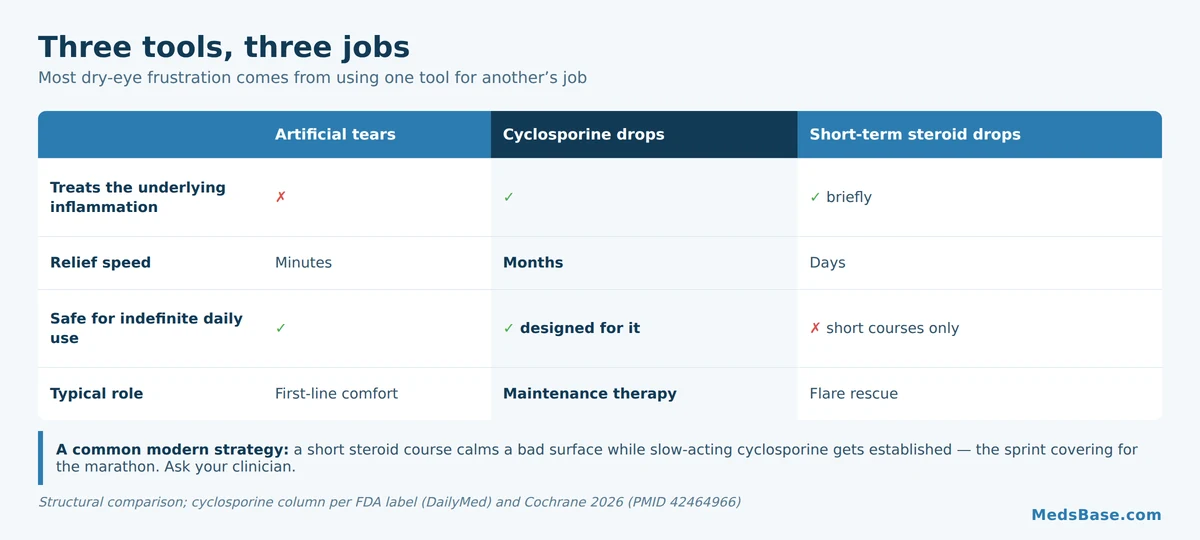
| Treats the underlying inflammation | (briefly) | ||
| Relief speed | Minutes | Months | Days |
| Safe for indefinite daily use | — designed for it | — short courses only | |
| Prescription-strength | |||
| Typical role | First-line comfort | Maintenance therapy | Flare rescue |
The verdict paragraph the table can’t give you: these are three different jobs, and most dry-eye frustration comes from using one tool for another’s job. Artificial tears are the comfort layer everyone keeps. Cyclosporine is the maintenance layer for people whose dryness is chronic and inflammatory — slow, unglamorous, cause-targeting. Steroid drops are the fire brigade: fast, effective, strictly time-limited because of pressure and cataract risks with prolonged use — how prescription steroid drops differ explains that side. A common modern strategy your clinician may suggest: a short steroid course to calm a bad surface while slow-acting cyclosporine gets established — the sprint covering for the marathon.
Illustrative scenario (not a real patient): Elena, 57, has burned through artificial tears for two years. Her optometrist shows her the staining on her cornea, and she starts cyclosporine 0.05% twice daily — warned, explicitly, about week-one stinging and the three-month horizon. Weeks 1–2 sting. Week 6, nothing obvious. At month three her staining has visibly improved and she realises she’s stopped carrying tears in her coat pocket. Her sister tried the same drops, hated the burning, quit at day 10, and concluded they “don’t work”. Same drops — the difference was the briefing.
How to Use Cyclosporine Eye Drops — a Fair-Trial Protocol
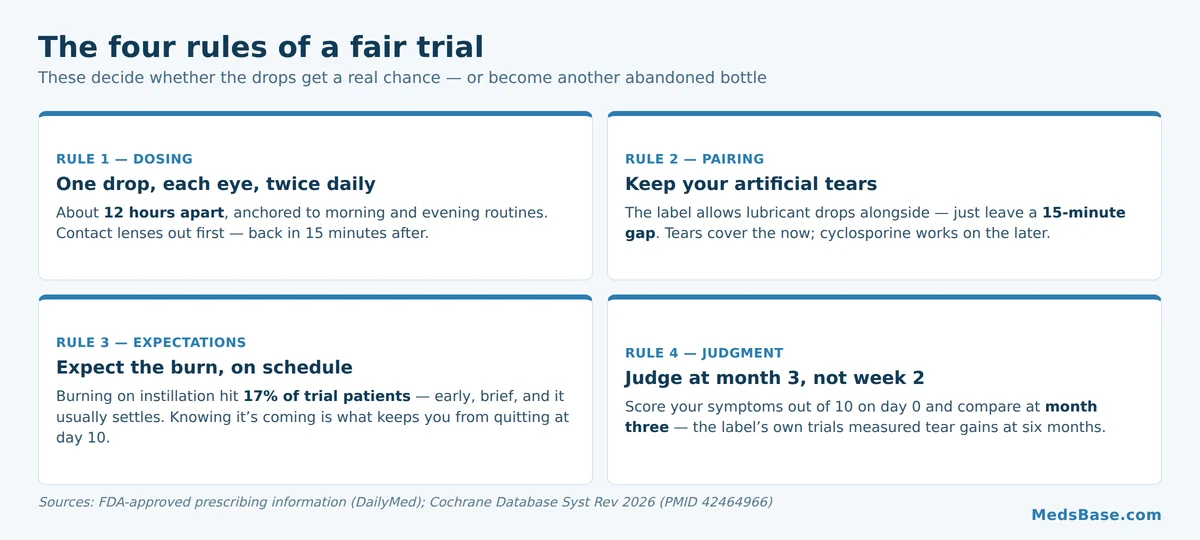
- One drop in each eye, twice a day, about 12 hours apart — per the FDA label. Anchor doses to morning and evening routines.
- Keep your artificial tears — the label explicitly allows lubricant drops alongside, with a 15-minute gap between products. Most people run both for months; tears cover the now, cyclosporine works on the later.
- Remove contact lenses before instilling — the label says the emulsion should not be administered while wearing lenses; they may be reinserted 15 minutes after the dose. (It also notes that people with reduced tear production typically shouldn’t wear lenses at all — one to raise with your clinician.)
- Expect the burn, on schedule — you already know the 17% figure. Knowing it arrives early and usually settles is what keeps you from becoming a dropout statistic.
- Set the judgment date in your calendar: three months — not two weeks. Note your symptoms on day 0 (a 1–10 score works) so month three is a comparison, not a vibe.
- Get the surface looked at — an optometrist can track staining and tear measures objectively; those signs are where the evidence is strongest, and they answer “is it working?” even when your symptoms are ambiguous.
Mistakes to avoid:
- Judging at week two — the single most common way this treatment “fails”
- Stopping the drops the week you finally feel good — the inflammation control is why you feel good
- Dosing cyclosporine and artificial tears back-to-back — respect the 15-minute gap
- Using someone else’s leftover steroid drops for a flare instead of asking a clinician
- Ignoring red flags: pain, discharge, light sensitivity or vision change need a doctor, not a stronger drop
- Eysuvis: the short-term fix for dry-eye flares — the rescue tool this article’s maintenance strategy pairs with
- Prednisolone eye drops: what they do — the stronger steroid, and why it’s never a daily habit
- Oral cyclosporine: uses, dosage and side effects — same molecule, completely different job
Frequently Asked Questions
Q: How long do cyclosporine eye drops take to work?
A: Think months, not days. The drops act by calming surface inflammation so tear function can recover — the FDA label’s pivotal trials measured tear production at six months, and the Cochrane review’s pooled outcomes were assessed at three months. Many users notice gradual change from around 4–8 weeks. Judge the treatment at month three at the earliest, with a day-0 symptom note for honest comparison.
Q: Do cyclosporine eye drops burn?
A: Often, at first. Burning on instillation was the most common side effect in the label’s clinical trials, reported by 17% of users, and it typically lasts seconds to minutes and settles with continued use. It is the main reason people quit early — in pooled trials, cyclosporine users were roughly twice as likely as control users to stop for side effects — so expecting it is genuinely protective.
Q: Are cyclosporine eye drops worth it?
A: For chronic inflammatory dry eye that has outlasted artificial tears, the evidence supports a properly run trial: a 58-trial Cochrane review found real but modest average improvements in symptoms and consistent improvements in measurable surface signs. Averages hide responders — some users improve substantially. Worth it, on the evidence: yes, if you commit to three months and judge honestly at the end.
Q: Can you use artificial tears with cyclosporine eye drops?
A: Yes — and most people should. The FDA label states the drops can be used together with lubricant eye drops, with a 15-minute interval between the two products. Artificial tears handle immediate comfort while cyclosporine works on the underlying inflammation; they are complementary layers, not competitors. Just respect the gap so the second drop doesn’t wash out the first.
Q: What is the difference between Restasis and generic cyclosporine?
A: Restasis is the original branded cyclosporine 0.05% ophthalmic emulsion; generic versions — including Cyclomune — contain the same active ingredient at the same 0.05% strength with the same twice-daily dosing. Newer branded products exist at other concentrations, but the Cochrane evidence doesn’t show higher strengths clearly outperforming 0.05% — and users of other formulations were more likely to stop for side effects.
Q: Do cyclosporine eye drops cure dry eye?
A: No — chronic dry eye is managed, not cured, and no honest source claims otherwise. Cyclosporine controls the inflammatory loop that keeps the tear system suppressed; while you use it, the surface can heal and symptoms can ease, and stopping typically lets the underlying tendency return. Think of it like blood-pressure treatment for the eye surface: effective control, not eradication.
Q: Do I need a prescription to buy cyclosporine eye drops?
A: MedsBase supplies cyclosporine 0.05% (Cyclomune Eye Drop) with no prescription needed to order. A sensible middle path: order the drops without the paperwork, but let an optometrist or eye doctor examine the surface at least once — both to confirm inflammation-driven dry eye is what you have, and to track the objective signs that best show whether treatment is working.
The Bottom Line
Cyclosporine eye drops are the honest middle of dry-eye care: not the instant comfort of artificial tears, not the fast-but-capped power of steroids, but the only one of the three built to quiet the inflammation that keeps chronic dry eye chronic. The newest and largest evidence review says the benefits are real and modest on average, the objective surface signs improve most consistently, and the biggest failure mode is quitting before the drug has had its months.
The verdict: if your dry eye is chronic, inflammatory and artificial-tear-resistant, a disciplined three-month trial of cyclosporine 0.05% is an evidence-backed next step — entered with correct expectations about burning and timing.
One thing to do today: score your symptoms out of ten and write it down with the date. Whatever you decide about treatment, future-you will need that number.
Wondering whether your real problem is flares rather than a constant baseline? Our Eysuvis guide covers the short-term tool built for exactly that. Want to see the maintenance option alongside everything else? Browse the full eye care range.

Written by
Sophie ChenPharmaceutical Content Researcher · 8 years experience
Sophie Chen is a pharmaceutical content researcher with 8 years covering generic medication access and clinical pharmacology. She specialises in international regulatory frameworks, bioequivalence standards, and patient-facing education on therapeutic drug classes. She is not a clinician.