








✓ Medically reviewed by · Last reviewed: May 2026
Pharmacy Researcher · 8 years experience
Pharmacy researcher with 8 years reviewing clinical drug information, generic formulation equivalence, and international pharmaceutical standards. Focuses on patient-facing accuracy in medication education.
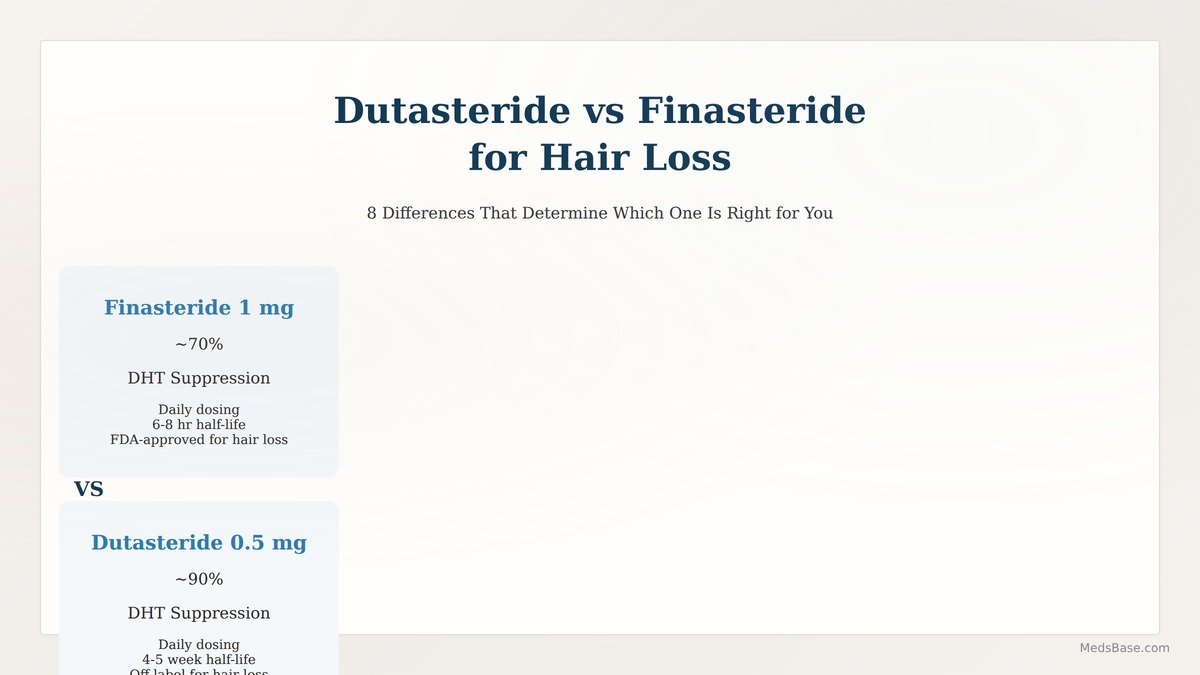
dutasteride vs finasteride for hair loss — Dutasteride vs Finasteride for Hair Loss — 8 Differences That Determine Which One Is Right for You. Read on for an evidence-backed guide covering everything you need to know.
Key Takeaways
- Dutasteride suppresses about 90% of serum DHT versus roughly 70% for finasteride — but more DHT suppression does not always mean more hair growth.
- The side effect difference is real but smaller than most online forums suggest: roughly 3–5% absolute increase in sexual side effects with dutasteride, most reversible.
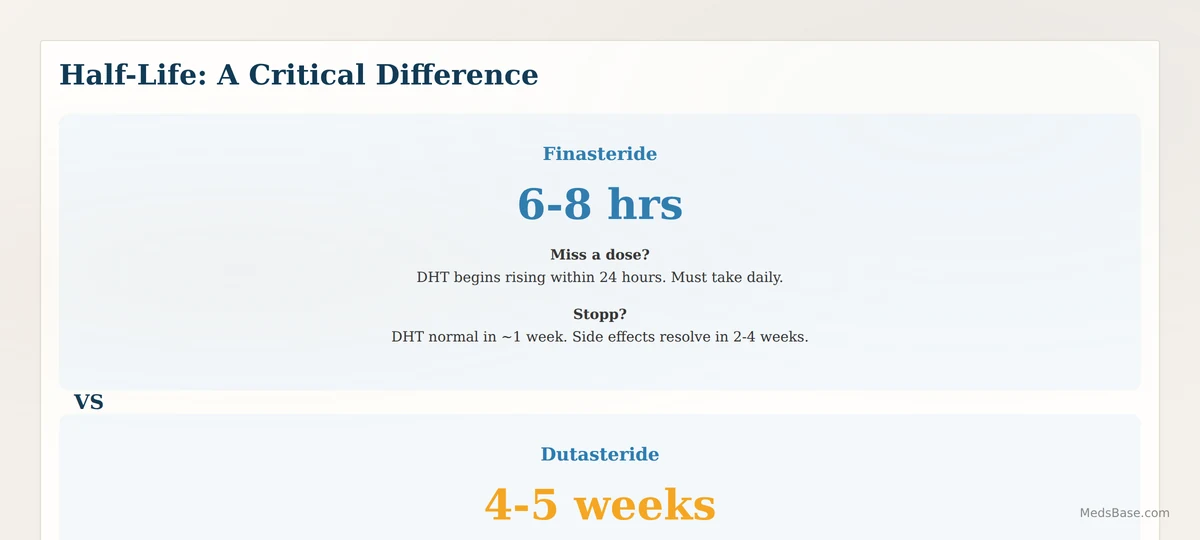
- The half-life difference (6–8 hours for finasteride vs 4–5 weeks for dutasteride) has practical consequences you don’t hear about: dosing forgiveness on one hand, much longer side-effect recovery on the other.
- Finasteride is FDA-approved for hair loss. Dutasteride is not — and the reasons are commercial, not safety-related.
- One of these drugs performs better in the crown; the other is studied more extensively in the frontal scalp. We’ll cover which one for which pattern.
- What Are Dutasteride and Finasteride?
- How Do These Drugs Work?
- DHT Suppression: The Numbers
- Hair Growth Results: What the Trials Show
- Side Effects: What the Data Actually Shows
- Half-Life and Dosing Forgiveness
- Approval Status and What It Actually Means
- Cost and Availability
- Which One Should You Start With?
- Frequently Asked Questions
- The Bottom Line
Dutasteride vs finasteride for hair loss — you have been on finasteride for 8 months. The shedding stopped around month 4, and you see some regrowth at the temples — but your crown still looks thin under harsh light. A friend mentions dutasteride. “It’s stronger,” he says. “Blocks 90% of DHT instead of 70%.” You search dutasteride vs finasteride for hair loss and find forums full of conflicting information: some users swear dutasteride saved their hairline after finasteride failed; others warn of side effects that “never went away.”
Dutasteride vs finasteride for hair loss — you need to know: is the extra 20% DHT suppression worth it? Does it actually produce more hair? And what trade-offs are you making that the forums don’t tell you about? By the end of this comparison, you will understand every clinically meaningful difference between dutasteride and finasteride for hair loss — not just the DHT numbers — so you can make a decision based on evidence, not anecdotes.
What Are Dutasteride and Finasteride?
Both dutasteride vs finasteride for hair loss are 5-alpha reductase inhibitors (5ARIs) — oral medications that reduce the conversion of testosterone to dihydrotestosterone (DHT), the androgen primarily responsible for male pattern baldness. Finasteride 1mg (brand name Propecia, now generic) has been FDA-approved for androgenetic alopecia since 1997 and is the most-prescribed oral hair loss medication worldwide. Dutasteride 0.5mg (brand name Avodart) is FDA-approved for benign prostatic hyperplasia (enlarged prostate) and is used off-label for hair loss — a distinction that matters more for insurance coverage than for safety.
Quick Answer: Finasteride blocks one form of the 5-alpha reductase enzyme and reduces serum DHT by about 70%. Dutasteride blocks both forms and reduces DHT by about 90%. The clinical hair-growth advantage of this extra 20% DHT suppression is modest (~10–15% more hair count improvement in comparator studies) but may be meaningfu l for men with aggressive hair loss or inadequate response to finasteride.
How Do These Drugs Work?
Dutasteride vs finasteride for hair loss — testosterone circulates in your bloodstream and enters hair follicle cells, where the enzyme 5-alpha reductase converts it to DHT. DHT then binds to androgen receptors in the follicle, triggering a process called miniaturisation: the follicle shrinks, produces thinner and shorter hairs, and eventually stops producing visible hair entirely.
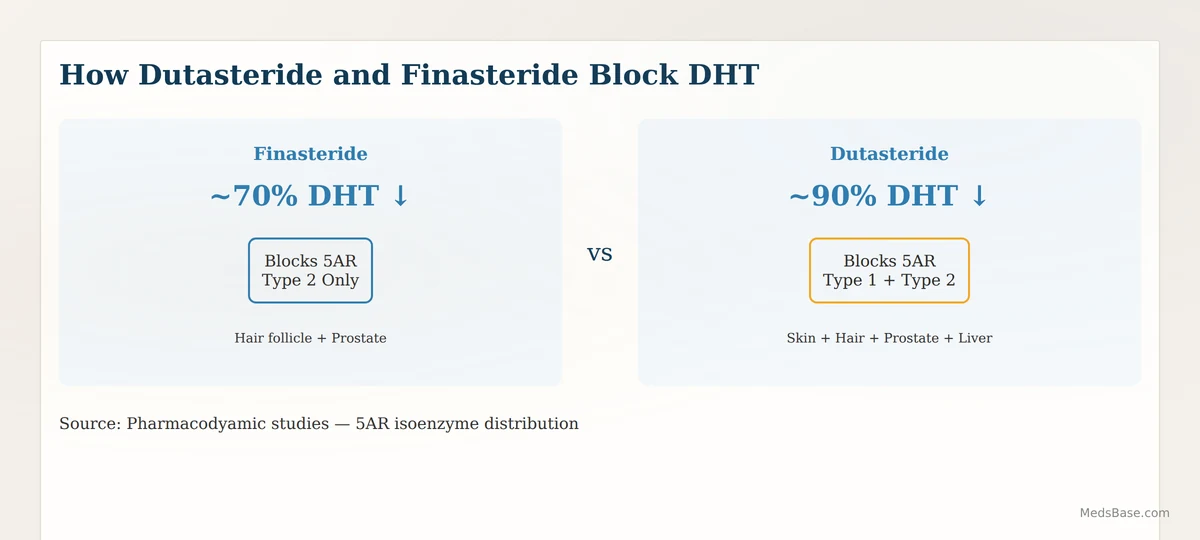
Dutasteride vs finasteride for hair loss — there are two types of 5-alpha reductase. Type 1 is found predominantly in the skin, sebaceous glands, and liver. Type 2 is found predominantly in the prostate, hair follicles, and genitals. Finasteride inhibits only type 2. Dutasteride inhibits both type 1 and type 2 — with roughly three times the binding affinity for type 2 and 100 times the affinity for type 1 compared to finasteride.
This is the biochemical basis of the entire dutasteride vs finasteride for hair loss comparison. Dutasteride is not just “a bit stronger” — it is a fundamentally broader-acting drug because it blocks an additional enzyme form that finasteride does not touch.
Dutasteride vs finasteride for hair loss — but — and this is a clinically important but — whether blocking type 1 5AR in the scalp provides additional hair benefit beyond what blocking type 2 already achieves is not settled science. Type 1 is present in the scalp but at lower concentrations than type 2, and the incremental DHT suppression from type 1 blockade may matter more in some men than others.
DHT Suppression: The Numbers
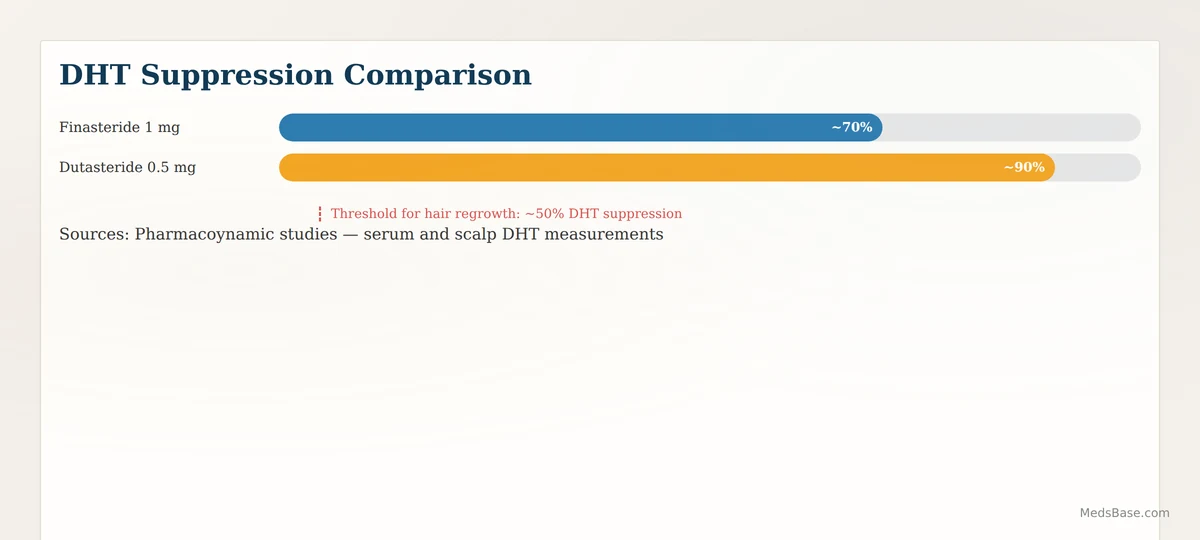
When people compare dutasteride vs finasteride for hair loss, the DHT numbers are always the first thing cited — and they are real. Finasteride 1mg daily reduces serum DHT by approximately 68–72% within 24 hours of the first dose. Dutasteride 0.5mg daily reduces serum DHT by approximately 90–93% after reaching steady state (about 3 months, given its long half-life). At the scalp level, the suppression is even more pronounced: a small study measuring scalp skin DHT found finasteride reduced it by about 64% and dutasteride by about 92%.
Dutasteride vs finasteride for hair loss — these are large, measurable biochemical differences. But clinical response — actual hair count changes — does not track linearly with DHT suppression. The dose-response curve flattens: once you suppress DHT below roughly 50–60% of the baseline level, additional suppression produces diminishing returns in hair growth.
Dutasteride vs finasteride for hair loss — this is why the clinical hair count difference between the two drugs is around10–15% — not 30% as the DHT numbers alone might suggest.
Hair Growth Results: What the Trials Show
The most commonly cited head-to-head evidence for dutasteride vs finasteride for hair loss comes from a 2014 systematic review and meta-analysis published in the Journal of the American Academy of Dermatology. Across three comparator studies with a total of 616 patients, dutasteride 0.5mg produced a mean increase of approximately 13–17 more hairs per square centimetre at 24 weeks than finasteride 1mg. At 24 weeks, dutasteride-treated patients had a mean hair count increase from baseline of roughly 22–25 hairs/cm² versus 10–12 hairs/cm² for finasteride.
Dutasteride vs finasteride for hair loss — in plainer terms: after 6 months, dutasteride delivers about twice the hair count increase of finasteride, but both drugs produce real, visible regrowth in most patients. The gap narrows at 12 months as finasteride responders continue impro ving — but dutasteride maintains a lead of roughly10–15% in most studies.
What this means for you: If you are a strong responder to finasteride, dutasteride may give you modestly thicker results. If you are a poor or non-responder to finasteride, dutasteride may produce a response where finasteride did not — potentially because blocking type 1 5AR is the missing piece in your biochemistry. But there is no way to pre-test for this; it is a trial-and-outcome decision.
Side Effects: What the Data Actually Shows
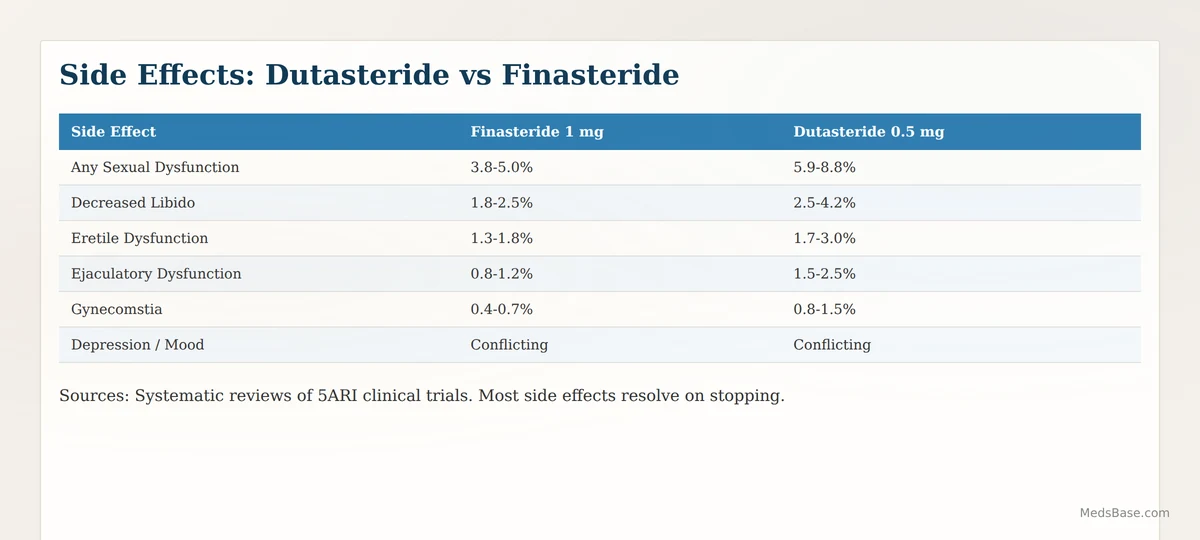
No aspect of the dutasteride vs finasteride for hair loss conversation generates more heat and less light than side effects. Here is what the largest and most recent systematic reviews actually report:
| Side Effect | Finasteride 1mg | Dutasteride 0.5mg | Notes |
|---|---|---|---|
| Any sexual dysfunction | 3.8–5.0% | 5.9–8.8% | Dutasteride modestly higher; both decrease over time |
| Decreased libido | 1.8–2.5% | 2.5–4.2% | Most common individual sexual side effect |
| Erectile dysfunction | 1.3–1.8% | 1.7–3.0% | Usually reversible on stopping |
| Ejaculatory dysfunction | 0.8–1.2% | 1.5–2.5% | Reduced ejaculate volume; does not affect fertility per se |
| Gynecomsastia | 0.4–0.7% | 0.8–1.5% | Breast tenderness or enlargement; rare; usually resolves on stopping |
| Depression / mood changes | Conflicting | Conflicting | Association found in some observational studies; large RCTs show no consistent signal |
Dutasteride vs finasteride for hair loss — two clinical realities that online discussions routinely miss:
First: the majority of side effects emerge in the first 3–6 months and decrease or resolve with continued treatment. This is counterintuitive — you might expect side effects to accumulate, not fade — but the body’s androgen receptor system appears to partially adapt to lower DHT levels over time. In the landmark finasteride trials, the side effect rate in the treatment group actually dropped below the placebo group rate by month 12, because men who could not tolerate the drug had already dropped out, and those who continued had adapted.
Second: the absolute difference in side effects between dutasteride vs finasteride for hair loss is about 2–4% — meaning for every 100 men who switch from finasteride to dutasteride, 2–4 more will experience a new or worse sexual side effect. That is not trivial, but it is also not the 50/50 coin flip that some forums portray.
Persistent side effects after stopping: A small subset of men report ongoing sexual, cognitive, or physical symptoms after discontinuing 5ARIs — sometimes called “post-finasteride syndrome.” The existence, prevalence, and mechanism of this syndrome are debated in the medical literature because it has not been consistently detected in large RCTs. The current evidence base does not support or refute it definitively. If you are considering either drug, you should be aware of these case reports and weigh them in your personal risk calculus.
Half-Life and Dosing Forgiveness
This is arguably the most important practical difference in dutasteride vs finasteride for hair loss — and the one most people never hear about. Finasteride has a plasma half-life of 6–8 hours. This means that if you miss a day, your DHT starts creeping back within 24 hours. The practical consequence: finasteride users must take the medication daily, and missing more than 1–2 doses per week will meaningfully reduce efficacy.
Dutasteride has a half-life of 4–5 weeks. Yes, weeks. After a single dose, detectable drug levels remain in your bloodstream for over 4 months. The clinical implication is a double-edged sword:
The upside — dosing forgiveness: Missing a dose of dutasteride is almost irrelevant. You could miss an entire week and your DHT suppression would barely budge. For men who travel frequently, have irregular schedules, or simply forget pills, this is a genuine advantage.
The downside — slow washout: If you experience side effects on dutasteride, they will not resolve quickly after stopping. With finasteride, DHT returns to baseline within about a week of discontinuation, and most side effects resolve within 2–4 weeks. With dutasteride, DHT remains suppressed for months after the last dose, meaning side effects — if they occur — may persist for 3–6 months before resolving. This makes dutasteride a higher-commitment decision: starting it is easier to maintain, but stopping it is not a quick exit.
Approval Status and What It Actually Means
Finasteride 1mg is FDA-approved specifically for androgenetic alopecia (male pattern baldness). Dutasteride 0.5mg is FDA-approved for benign prostatic hyperplasia only — its use for hair loss is off-label.
Many men interpret this as a safety signal: “If dutasteride were safe enough for hair loss, the FDA would have approved it.” The reality is commercial, not regulatory. Dutasteride’s patent for hair loss was held by GlaxoSmithKline, which conducted Phase III trials for the indication and obtained approval in South Korea and Japan — but never filed for FDA approval in the United States or EMA approval in Europe. The most likely reason: by the time those trials completed (around 2010–2012), finasteride was already generic and generating minimal revenue, and GSK judged that the cost of regulatory filing was not commercially justified against the revenue they expected from a second generic-priced 5ARI.
In other words, dutasteride’s off-label status is a quirk of patent economics, not a judgement on its safety or efficacy for hair loss. The South Korean and Japanese approvals are based on the same Phase III data that would have supportedan FDA filing. Many dermatologists prescribe dutasteride off-label for hair loss, and it appears in multiple national and international treatment guidelines.
But there is one practical consequence: insurance almost never covers off-label dutasteride for hair loss. You will pay out of pocket.
Cost and Availability
| Factor | Finasteride 1mg | Dutasteride 0.5mg |
|---|---|---|
| Generic available? | Yes — widely available | Yes — widely available |
| Approximate monthly cost (US retail, no insurance) | $10–30 | $15–40 |
| Insurance coverage for hair loss? | Sometimes (if plan covers “lifestyle” drugs) | Almost never (off-label) |
| Strengths available | 1mg (hair loss), 5mg (prostate — not for hair loss) | 0.5mg (prostate + hair loss) |
| Pill-cutting option? | Some men buy 5mg tablets and cut into quarters (~1.25mg) to save money | No — 0.5mg is the lowest strength; Avodart capsules cannot be split |
Finasteride is typically cheaper and more likely to be covered by insurance. Dutasteride’s off-label status means you will almost certainly pay cash — though the generic version is now affordable enough that this matters less than it did 10 years ago.
Which One Should You Start With?
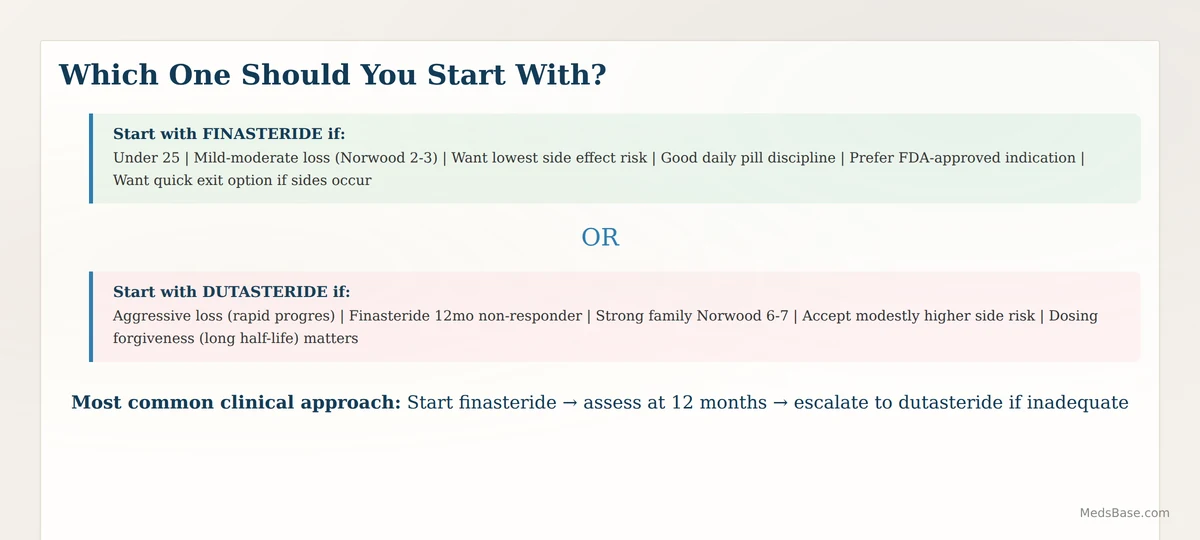
There is no right answer — but there is a rational framework. Here is the decision logic that reflects current evidence and real-world clinical practice:
Start with finasteride if:
- You are under 25 (dutasteride’s broader systemic DHT suppression is less desirable during the final years of pubertal development, even though androgenic maturation is mostly complete by 18–20)
- Your hair loss is mild-to-moderate (Norwood 2–3)
- You prefer a drug with decades of safety data and FDA approval for the exact indication
- You want the lowest possible side effect risk
- You have good pill-taking discipline (daily dosing)
- You want the option of a quick exit if side effects occur
Start with dutasteride if:
- Your hair loss is aggressive (rapid progression, Norwood ≥4, onset in teens or early 20s)
- You have been on finasteride for 12 months with inadequate response (still losing ground or no visible regrowth)
- You have a strong family history of advanced baldness (biological father, grandfathers at Norwood 6–7)
- You want maximum DHT suppression and accept the modestly higher side effect rate
- Dosing forgiveness (half-life) is a priority for your lifestyle
The escalation pathway (most common clinical approach): Start finasteride. Assess response at 12 months. If adequate response, continue. If inadequate, switch to dutasteride. This pathway gives you the best of both worlds: the lower-risk option first, with the stronger option available if needed.
Do not start dutasteride if:
- You have a known hypersensitivity to either drug
- You are trying to conceive (both drugs reduce semen volume; limited evidence on fertility impact’)
- You have significant baseline sexual dysfunction — 5ARIs can worsen it
- You are unable or unwilling to commit to long-term treatment (both drugs require ongoing use; stopping reverses all gains within 6–12 months)
Browse both finasteride and dutasteride options at MedsBase — both are available as quality generic medications.
Frequently Asked Questions
Q: Is dutasteride better than finasteride for hair loss?
A: “Better” depends on your definition. In the comparison of dutasteride vs finasteride for hair loss, dutasteride produces approximately 10–15% more hair count at 12–24 months and blocks about 20% more DHT. For men with aggressive hair loss or finasteride non-response, dutasteride is often more effective. For men with mild-to-moderate loss who respond well to finasteride, the incremental benefit of dutasteride may not justify the higher side effect risk and off-label status.
Q: Does dutasteride cause more side effects than finasteride?
A: Yes, modestly. Sexual side effects occur in approximately 3.8–5.0% of finasteride users and 5.9–8.8% of dutasteride users in clinical trials — roughly a 2–4% absolute increase. Most side effects are reversible and many diminish with continued use.
Q: How much DHT does dutasteride block vs finasteride?
A: Finasteride 1mg reduces serum DHT by approximately 68–72%. Dutasteride 0.5mg reduces serum DHT by approximately 90–93%. At the scalp level, finasteride reduces DHT by about 64% and dutasteride by about 92%.
Q: Why is finasteride FDA approved for hair loss but dutasteride isn’t?
A: This is a commercial decision, not a safety judgement. GlaxoSmithKline — dutasteride’s original manufacturer — never filed for FDA approval for the hair loss indication in the US despite completing positive Phase III studies, likely because the expected revenue from a second generic 5ARI did not justify the regulatory filing cost. Dutasteride IS approved for hair loss in South Korea and Japan based on thee sam data.
Q: Can I switch from finasteride to dutasteride?
A: Yes. The most common clinical approach is cold-switch: stop finasteride and start dutas teride the next day. There is no washout period needed because dutasteride’s onset is gradual — it takes about 3 months to reach steady-state DHT suppression. Some men experience a temporary shed 4–8 weeks after switching; this is a normal response to the change in DHT environment and regrowth typically follows within 3–6 months.
Q: How long does dutasteride take to work for hair loss?
A: Like finasteride, dutasteride takes time. Shedding of miniaturised hairs may increase in the first 2–3 months (a positive sign — it means the drug is resettingthe hair cycle). Stabilisation (no further loss) is typically visible by 6 months. Visible regrowth by 9–12 months. Maximum results take 18–24 months. The timeline is similar for both drugs in the comparison of dutasteride vs finasteride for hair loss, though some data suggest earlier response (by ~1–2 months) with dutasteride in some men.
Q: Will I lose all my hair gains if I stop taking dutasteride or finasteride?
A: Yes — both drugs are suppressive, not curative. They work by continuously blocking DHT; when you stop, DHT returns to baseline, and the balding process resumes from wherever it was genetically programmed to go. All hair maintained or regrown will be lost within 6–12 months of stopping. This is a long-term treatment commitment regardless of which drug you choose.
Q: What about topical finasteride or dutasteride — are they safer?
A: Topical formulations exist and may reduce systemic DHT exposure (and potentially side effects), but the evidence base is far smaller. The few comparator studies show topical finasteride gel produces less systemic DHT suppression than the oral form while maintaining reasonable scalp efficacy. Topical dutast eride data is even sparser. Topical formulations are not a guaranteed side-effect-free option — some systemic absorption still occurs — but they represent a reasonable intermediate for men concerned about oral 5ARI side effects.
The Bottom Line
The dutasteride vs finasteride for hair loss decision comes down to this: how aggressive is your hair loss, and how do you weigh the 10–15% greater efficacy of dutasteride against its modestly higher side effect rate, off-label status, and months-long washout period?
For most men starting treatment, finasteride is the rational first choice. It has 25+ years of safety data, is FDA-approved for exactly this indication, is cheaper, and allows a quick exit if side effects occur. If it works well enough, you never need to consider dutasteride.
But for men with rapidly progressive loss, a strong family history of advanced baldness, or an inadequate response to finasteride at 12 months, dutasteride offers a real — and evidence-backed — step up in efficacy. The side effect trade-off is manageable for most, and the “off-label” stigma reflects commercial history, not missing data.
Your next step: Photograph your hair under consistent lighting today. Assess your Norwood stage and rate of progresion. If you have been losing ground slowly over years, try finasteride first. If you are losing ground visibly month to month and the men in your family are Norwood 6–7, dutasteride may be the stronger opening move. Either way, start now — both drugs work better at preserving existing hair than regrowing lost hair.
What to read next:
- For the full picture on finasteride, read our Finasteride Long-Term Results guide.
- Today we also published GLP-1 Medications Beyond Weight Loss and How to Treat Eczema at Home — browse the full cluster.

Written by
Sophie ChenPharmaceutical Content Researcher · 8 years experience
Sophie Chen is a pharmaceutical content researcher with 8 years covering generic medication access and clinical pharmacology. She specialises in international regulatory frameworks, bioequivalence standards, and patient-facing education on therapeutic drug classes. She is not a clinician.