








✓ Medically reviewed by · Last reviewed: May 2026
Pharmacy Researcher · 8 years experience
Pharmacy researcher with 8 years reviewing clinical drug information, generic formulation equivalence, and international pharmaceutical standards. Focuses on patient-facing accuracy in medication education.
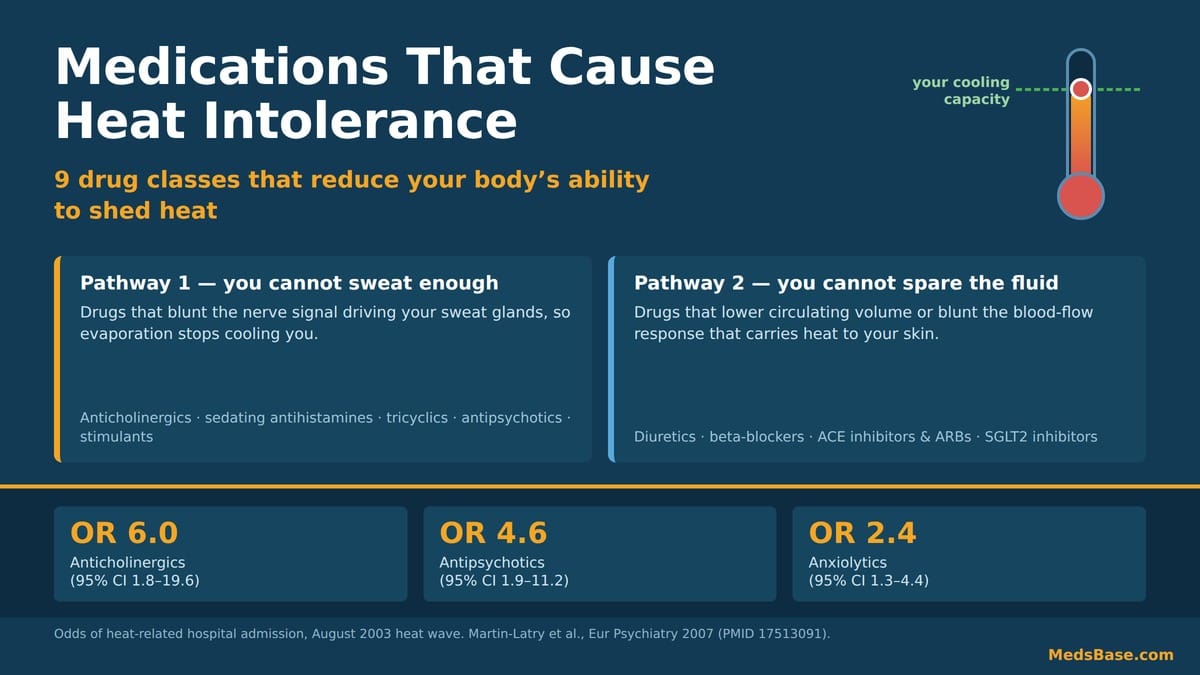
Roughly 489,000 heat-related deaths occur worldwide each year, and the World Health Organization reports that heat-related mortality in people over 65 rose by about 85% between 2000–2004 and 2017–2021. Buried inside that number is something almost nobody is told at the pharmacy counter: medications that cause heat intolerance are ordinary, widely prescribed, and taken by millions of people who have no idea their tablets have quietly narrowed the margin between “uncomfortable” and “dangerous.”
This is not about your medicine spoiling in a hot car. It is about what certain drugs do to your body’s cooling system — the sweating and blood-flow machinery that keeps your core temperature steady when the air around you does not.
By the end of this article you will know which nine drug classes are implicated, how much they actually raise the risk (with real numbers, not vague warnings), how to tell heat intolerance apart from two problems it is constantly confused with, and — the part most pages skip — what to do about it that isn’t “stop your medication.” One of these classes raised the odds of heat-related hospital admission sixfold in the study we’ll look at. We’ll get to which one.
- Nine common drug classes can reduce your ability to shed heat — and most people taking them were never warned
- There are two completely different failure modes, and telling them apart changes what you should do
- One class carried six times the odds of heat-related hospital admission — but the confidence interval matters as much as the number
- The single most dangerous response is the one people reach for first, and we’ll name it in the safety section
- Heat intolerance, sun sensitivity and heat-spoiled tablets are three separate problems — mixing them up costs you the right fix
- Around 40% of one category of heat-season hospital admissions were judged potentially preventable
What Heat Intolerance From Medication Actually Means
Your body sheds heat in two main ways. It sends blood to the skin, where warmth radiates away, and it sweats, so evaporation pulls heat off the surface. Both need something to work with: enough circulating fluid to move to the skin, and functioning sweat glands responding to nerve signals. Together these make up your thermoregulation — the system that holds your core temperature steady no matter what the air around you is doing.
Take away either one and the system runs at reduced capacity. You don’t notice on a mild day. You notice badly on the fourth day of a heatwave.
That is the whole idea, and it explains why medications that cause heat intolerance so often go unrecognised. There is no rash, no obvious reaction, nothing that looks like a side effect. There is just a person who finds August harder than everyone around them and assumes they are getting old, unfit, or run down.
Heat intolerance is a capacity problem, not an allergy — which is why it shows up as fatigue and dizziness rather than anything dramatic.
Why this matters more than it used to
Two things changed. Heatwaves got longer and more frequent, and the population taking long-term medication got larger. The overlap between those groups is where the risk lives — and it is why medications that cause heat intolerance are worth understanding now even if they never troubled you before. WHO puts European excess deaths in the summer of 2022 alone at an estimated 61,672. If you take anything long-term, you sit somewhere in that overlap, and knowing where is the entire point of the next few sections.
How Medications That Cause Heat Intolerance Interfere With Cooling
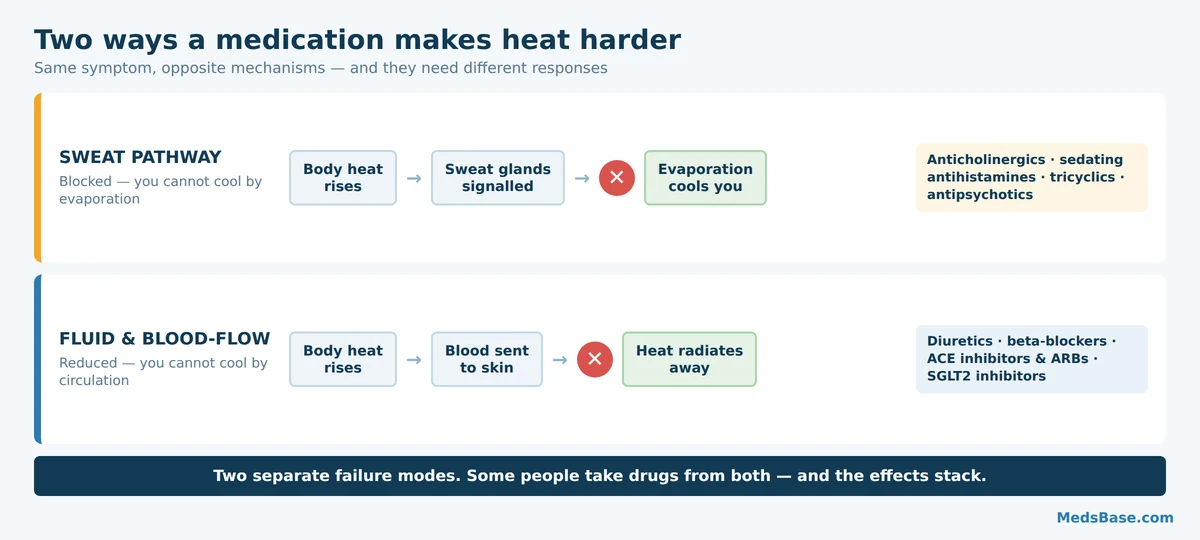
Here’s where it gets interesting. The nine classes involved don’t share a mechanism — they split into two groups that fail in opposite ways, and the practical response differs for each.
Pathway one: you can’t sweat enough. Sweating is driven by acetylcholine acting on sweat glands. Any drug with anticholinergic activity blunts that signal. The gland is fine; the message never fully arrives. This includes the obvious candidates and a long tail of drugs people don’t think of as anticholinergic at all — older sedating antihistamines, some antidepressants, some bladder medications.
Pathway two: you can’t move or spare the fluid. Sending blood to the skin costs volume and cardiac output. Diuretics reduce circulating fluid directly. Beta-blockers blunt the heart-rate response that supports skin blood flow. ACE inhibitors, ARBs and SGLT2 inhibitors each affect fluid and electrolyte handling in ways that matter more when you’re already losing water through sweat.
Think of it like a house with air conditioning. Pathway one is a broken compressor — the system is switched on and doing nothing. Pathway two is a power supply that can’t deliver enough current — the compressor works, but not at the capacity you need. Both leave the house hot. You would not fix them the same way.
That last point deserves emphasis, because it is the honest frame for everything below. This is a real effect with a thin evidence base. Eleven studies is not a lot. The direction of the finding is consistent; the precision is not. Any page that gives you confident per-drug risk percentages is inventing them.
The fluid problem, specifically
The fluid pathway has one pattern that shows up repeatedly in the hospital data: diuretics combined with a RAAS inhibitor — an ACE inhibitor or an ARB. Neither is dangerous in heat on its own for most people. Together, in a week where you’re also losing fluid through sweat, they narrow your margin considerably.
A 2024 case series looked at 75 hospital admissions in patients aged 65 and over for acute kidney injury, dehydration or dehydration-related electrolyte imbalance judged to be medication-related. Diuretics and RAS-inhibitors were the most prevalent medication combination. Around 40% of those admissions — 29 of 75 — were considered potentially preventable if the medication had been adjusted in time. Eighty percent of patients had a non-acute onset of symptoms, and 60% had contacted their GP within the two weeks before admission.
Read that again, because it is the most actionable finding in this entire article: most of these people saw the problem coming, told someone, and were admitted anyway. Source: a 2024 case series of medication-related admissions, European Journal of Clinical Pharmacology.
The Nine Medications That Cause Heat Intolerance, by Class
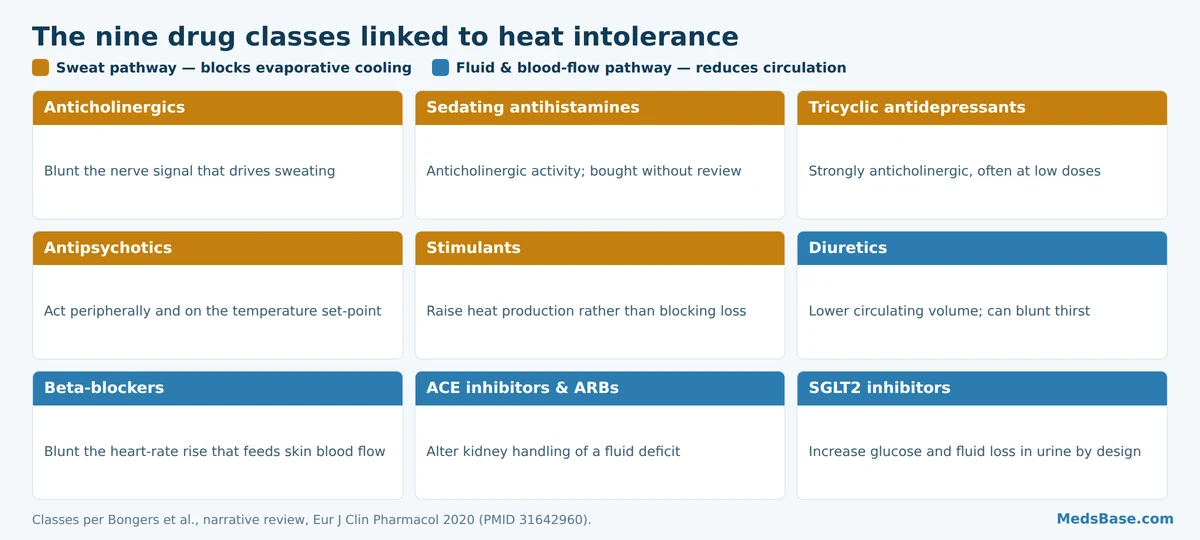
These are grouped by mechanism, not by how common they are. If you take something from both groups, the effects stack — and that stacking is what turns a modest risk into one worth planning around.
Sweat-pathway drugs (you can’t cool by evaporation)
1. Anticholinergics. The clearest signal in the literature. Includes bladder antispasmodics, some Parkinson’s medications, and drugs prescribed for muscle spasm. This is the class with the highest measured odds ratio, and we’ll look at the number in the research section.
2. Sedating antihistamines. The older generation — the ones that make you drowsy — have meaningful anticholinergic activity. Many are sold without a prescription for hay fever and sleep, which means people take them in exactly the summer weeks when it matters most, without anyone reviewing it.
3. Tricyclic antidepressants (TCAs). Amitriptyline and its relatives are strongly anticholinergic. They are also widely used at low doses for nerve pain and migraine prevention, so plenty of people take one without thinking of themselves as being on an antidepressant at all.
4. Antipsychotics. These act on both pathways — anticholinergic effects peripherally, and effects on the brain’s temperature set-point centrally. That dual action is why they show up so consistently in heat-wave admission data.
5. Stimulants. Including those used for ADHD. They raise heat production rather than blocking heat loss, which is a third mechanism, but the net effect on your margin is the same.
Fluid and blood-flow drugs (you can’t cool by circulation)
6. Diuretics. Directly reduce circulating volume. They also blunt thirst perception in some people, which is a nasty combination — less fluid available and less signal telling you to drink.
7. Beta-blockers. Blunt the heart-rate rise that supports skin blood flow, and reduce sweating in some people. The dizziness people report on hot days is often this.
8. ACE inhibitors and ARBs. Central to blood pressure control and generally well tolerated — but they affect how your kidneys handle a fluid deficit, which is precisely the situation a heatwave creates. The risk is concentrated in the combination with a diuretic.
9. SGLT2 inhibitors. Increase glucose and fluid loss through urine by design. In hot weather that designed effect adds to an unplanned one.
MedsBase carries a broad range across several of these classes without a prescription, which means the responsibility for reviewing your own combination sits more squarely with you — a good reason to read the practical section carefully rather than skim it.
Warning Signs, Severity and What To Do
This is where the safety loop from the introduction gets resolved. The most dangerous response to suspecting you take medications that cause heat intolerance is to stop the medication. People do it constantly, usually with blood pressure drugs, usually mid-heatwave, and it swaps a manageable risk for an unmanaged one — rebound hypertension, arrhythmia, or a return of whatever the drug was controlling. Adjustment is a conversation, not a unilateral act.
Here is what you should watch for in yourself and in anyone you’re caring for. Symptom descriptions and first-aid steps follow the NHS guidance on heat exhaustion and heatstroke. Your goal is to catch heat-related illness in the top rows of this table, not the bottom two.
| Sign | How often it’s the first clue | Severity | What to do |
|---|---|---|---|
| Tiredness, weakness out of proportion to activity | Very common | Mild — but it’s the earliest signal | Move somewhere cool, drink, rest 30 minutes |
| Dizziness or feeling faint on standing | Common | Mild to moderate | Sit or lie down, cool the skin, rehydrate; recurring episodes need a medication review |
| Headache with nausea | Common | Moderate | Cool environment, fluids; if not improving in 30 minutes, treat as escalating |
| Sweating much less than the people around you | Common, rarely noticed | Moderate — this is the mechanism showing itself | Do not rely on sweating to cool you; use external cooling actively |
| Skin pale and clammy, cramps in arms, legs or stomach | Common in heat exhaustion | Moderate | NHS first aid: cool place, remove excess clothing, water or isotonic drink, cool the skin |
| Very high temperature with hot, dry skin and no sweating | Uncommon | EMERGENCY | Call emergency services immediately — this is heatstroke, not heat exhaustion |
| Confusion, restlessness, fast breathing, seizure, loss of consciousness | Uncommon | EMERGENCY | Call emergency services immediately |
The single rule worth memorising: if someone has not improved after 30 minutes of rest in a cool place, that is the threshold to call for emergency help, not to wait longer.
The distinction between the two emergency rows and everything above them is not academic. Heatstroke that reaches intensive care is genuinely lethal — in a national multi-centre study of 345 patients admitted to French ICUs with heatstroke during the August 2003 heat wave, hospital mortality was 62.6%.
What Does the Research Say About Medications That Cause Heat Intolerance?
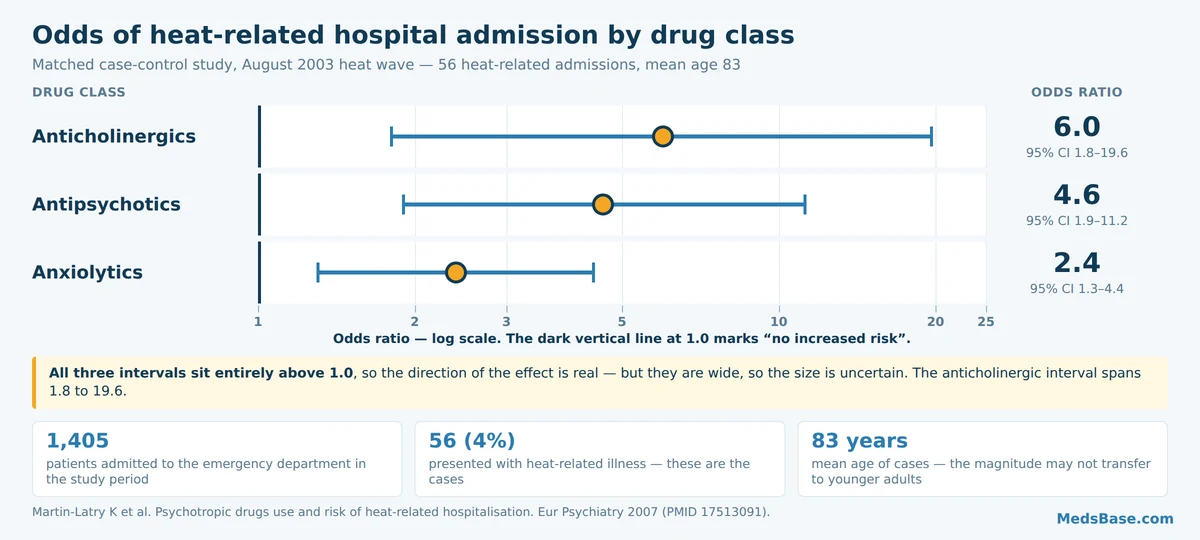
The strongest quantitative evidence comes from a matched case-control study conducted during the August 2003 European heat wave. Of 1,405 patients admitted to one emergency department during that period, 56 (4%) presented with heat-related illness. Their mean age was 83.
| Study | Year | Finding | Source |
|---|---|---|---|
| Matched case-control, August 2003 heat wave | 2007 | Anticholinergic drugs: OR 6.0 (95% CI 1.8–19.6) for heat-related admission | PMID 17513091 |
| Same study | 2007 | Antipsychotics: OR 4.6 (95% CI 1.9–11.2) | PMID 17513091 |
| Same study | 2007 | Anxiolytics: OR 2.4 (95% CI 1.3–4.4) | PMID 17513091 |
| Narrative review, 2,609 records screened | 2020 | Only 11 studies met inclusion criteria; classes implicated include psychotropics, anticholinergics, antihistamines, diuretics and cardiovascular agents | PMID 31642960 |
| Case series, 75 medication-related admissions | 2024 | Diuretics + RAS-inhibitors the most prevalent combination; ~40% of admissions potentially preventable | PMID 38831143 |
| National multi-centre ICU study, 345 patients | 2006 | Hospital mortality among ICU-admitted heatstroke patients: 62.6% | PMID 16484920 |
What this means for you. An odds ratio of 6.0 sounds alarming, and the honest reading is more nuanced than the headline. Look at the confidence interval: 1.8 to 19.6. That range is enormous, which tells you the study was small — 56 cases — and that the true effect could be much closer to 1.8 than to 6.0. What the interval does establish is that it sits entirely above 1.0, so the direction is real even though the size is uncertain. Research suggests anticholinergic drugs carry the highest heat risk of the classes studied; it does not establish that they multiply your personal risk sixfold.
Note also who these people were: mean age 83, admitted during an exceptional heat event. That is not the average reader of this page. The mechanism applies broadly; the magnitude does not transfer.
Where the evidence is genuinely weak, this article says so. There is no good trial evidence on whether temporarily adjusting doses during a heatwave improves outcomes. That is a clinical judgement made case by case, not a settled question, and anyone telling you otherwise is going beyond what has been published.
Heat Intolerance vs the Two Things It Gets Confused With
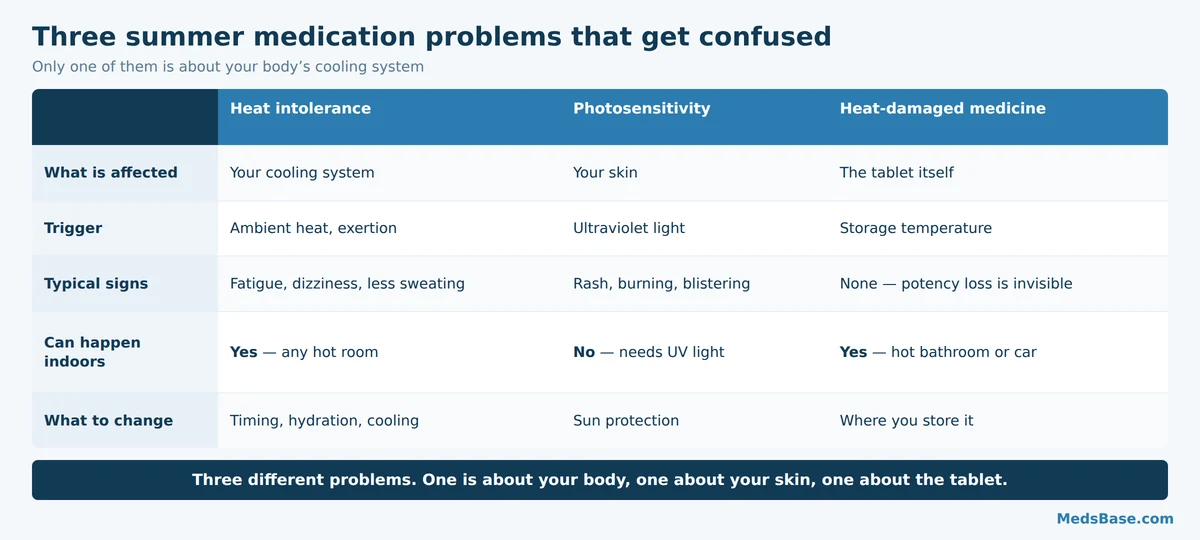
But there’s a catch — and it’s the reason so many people apply the wrong fix. Three separate summer medication problems get collapsed into one in most people’s heads, and only one of them is actually about medications that cause heat intolerance.
| Heat intolerance (this article) | Photosensitivity | Heat-damaged medicine | |
|---|---|---|---|
| What’s affected | Your body’s cooling system | Your skin | The tablet or its packaging |
| Trigger | Ambient heat, exertion | Ultraviolet light — even through cloud | Storage temperature over time |
| Typical signs | Fatigue, dizziness, reduced sweating | Rash, burn, blistering in exposed areas | No signs at all — reduced potency is invisible |
| Happens indoors? | Yes, in any hot room | No | Yes — a hot bathroom or car is the usual culprit |
| What to change | Behaviour, hydration, timing; medication review if severe | Sun protection and exposure timing | Where and how you store it |
Which one fits your situation? If you feel wiped out on hot days but your skin is fine, that’s heat intolerance and this article is the right one. If you’re getting a rash or burning unusually fast on drugs like doxycycline or certain diuretics, read whether your medication also makes your skin burn faster — that’s a different mechanism with a different fix. If neither fits but your medication seems to have stopped working since the weather turned, storage is the thing to check.
They are not mutually exclusive. Some diuretics appear on both the heat intolerance list and the photosensitivity list, which is worth knowing before you conclude you only have one problem.
Practical Guidance: Getting Through a Hot Week Safely
Pharmacists commonly see the same mistake each summer — someone who has correctly identified that their medication is making the heat worse, and has responded by skipping doses without telling anyone. It is an understandable instinct and it is usually the wrong one. Here is the better sequence, and none of the first five steps requires anyone’s permission.
- Write down every medication you take, including the ones you bought yourself. Sedating antihistamines and sleep aids are the most commonly missed, and they belong on the sweat-pathway list.
- Check whether you’re on two or more from the same pathway. Two sweat-pathway drugs, or a diuretic plus an ACE inhibitor or ARB, is the combination that concentrates the risk.
- Front-load your day. Do anything physical before 11am. This costs nothing, requires no medication change, and removes more risk than any other single step.
- Drink to a schedule, not to thirst — particularly on a diuretic or a beta-blocker, where thirst perception can be blunted. But do not flood yourself with plain water, especially if you take a diuretic; electrolyte balance matters and low sodium during heat illness is a real complication.
- Cool from the outside, deliberately. If a drug has reduced your sweating, evaporation is not going to save you. Cool water on the skin, a fan, cold packs to the armpits and neck — do it actively rather than waiting to feel bad.
- Book a medication review before the hot season, not during it. This is the step that would have changed the outcome for a large share of the admissions in that 2024 case series.
- Know your emergency threshold. Thirty minutes of rest in a cool place with no improvement means call for help.
- Stopping a blood pressure medication because you felt dizzy in the heat. Dizziness is manageable; uncontrolled blood pressure is not. Ask about timing or dose instead.
- Assuming an over-the-counter product is exempt. Sedating antihistamines are among the most anticholinergic things in most people’s cupboards.
- Relying on “I’ll drink when I’m thirsty.” On several of these drugs, thirst arrives late.
- Treating hot, dry skin as a good sign. It is the opposite — no sweating during heat illness is a red flag, not relief.
- Waiting out confusion or a very high temperature. Those are emergency-services symptoms, immediately.
If your blood pressure treatment is the part of this you want to look at more closely, you can browse blood pressure medication options to see what’s available — though the point of this section is that the first move is a review of what you’re already taking, not a change of product.
- How to keep your tablets stable when the house is 30 °C — the storage half of the summer medication problem
- Whether your medication also makes your skin burn faster — the photosensitivity list, with the drugs that appear on both
- What changes when you take these drugs abroad — summer travel, time zones and dose timing
Frequently Asked Questions
Q: Which medications make you more sensitive to heat?
A: Nine classes are consistently implicated: anticholinergics, sedating antihistamines, tricyclic antidepressants, antipsychotics, stimulants, diuretics, beta-blockers, ACE inhibitors and ARBs, and SGLT2 inhibitors. They split into two mechanisms — drugs that reduce sweating and drugs that reduce circulating fluid or skin blood flow. The strongest measured signal in the literature is for anticholinergic drugs, with an odds ratio of 6.0 for heat-related hospital admission in one case-control study, though that estimate carries a wide confidence interval of 1.8 to 19.6.
Q: Can blood pressure medication cause heat intolerance?
A: Yes, though usually mildly and usually via the fluid pathway rather than by blocking sweating. Diuretics reduce circulating volume, beta-blockers blunt the heart-rate response that drives skin blood flow, and ACE inhibitors and ARBs affect how the kidneys handle a fluid deficit. The pattern that appears most often in hospital data is a diuretic combined with an ACE inhibitor or ARB. That combination is extremely common and usually appropriate — the point is to know it needs more attention in hot weather, not that it should be avoided.
Q: Should I stop taking my medication during a heatwave?
A: No — not on your own initiative. Stopping blood pressure, cardiac or psychiatric medication abruptly can cause serious problems of its own, and it replaces a manageable risk with an unmanaged one. What you can do without asking anyone: shift activity to the cool part of the day, hydrate to a schedule, cool your skin actively, and avoid adding a sedating antihistamine on top. If your symptoms are significant, ask about timing or dose adjustment rather than deciding alone.
Q: Do antihistamines make heat worse?
A: The older sedating ones can, because they have meaningful anticholinergic activity and reduce sweating. Newer non-sedating antihistamines are much less anticholinergic and are generally the better choice in hot weather. This matters more than people expect, because these are bought without any consultation, often for hay fever or sleep, in exactly the weeks when the effect is least welcome.
Q: How do I know if my medication is causing heat intolerance?
A: The most useful clue is comparative. If you feel noticeably worse in the heat than people of a similar age and fitness in the same room, and particularly if you notice you’re sweating less than you used to, that is worth investigating. A change that started after beginning or increasing a medication is a stronger signal still. There is no test for it — the assessment is clinical, based on your symptom pattern and your medication list.
Q: Does drinking more water fix medication-related heat intolerance?
A: It helps with the fluid pathway and does very little for the sweat pathway. If your medication has blunted sweating, no amount of water restores evaporative cooling, so external cooling becomes the important intervention. And on a diuretic, drinking a large volume of plain water can dilute sodium at exactly the wrong moment, so an electrolyte-containing drink is often the better option during heat exposure.
Q: Are there heat-intolerance warnings on the packaging?
A: Rarely, and inconsistently. Some labels mention reduced sweating or caution in hot weather; many do not, and over-the-counter products almost never do. That gap is one reason this problem stays under-recognised — the information exists in the clinical literature but does not reliably reach the patient leaflet.
Q: Is heat intolerance the same as heat exhaustion?
A: No. Heat intolerance is the ongoing reduced capacity to shed heat — it is a state you live in. Heat exhaustion is an acute event that can result from it, with a defined symptom set: tiredness, dizziness, headache, nausea, excessive sweating with pale clammy skin, cramps and thirst. Heat intolerance makes heat exhaustion more likely at a lower level of heat exposure.
The Bottom Line on Medications That Cause Heat Intolerance
The balanced verdict: medications that cause heat intolerance produce a real, mechanistically well-understood effect resting on a thin evidence base. Nine drug classes can measurably reduce your ability to shed heat, the direction of that finding is consistent across the studies that exist, and the size of the effect is far less certain than most articles imply. Eleven studies met inclusion criteria in the most thorough review available. That is not a lot to build confident personal risk estimates on, and this article has deliberately not built them.
What is not uncertain: the mechanisms of impaired thermoregulation are clear, the highest-risk combinations are identifiable, and the responses most likely to keep you out of a heat-related illness statistic cost nothing and require no medication change at all.
Your one immediate action: write out every medication you take — including anything you bought over the counter — and check whether two or more come from the same pathway in the list above. That single sheet of paper is what makes a medication review productive rather than vague, and it takes five minutes.
Wondering whether the same drugs also affect your skin in sunlight? Read our full guide to whether your medication also makes your skin burn faster. And if you take amitriptyline or a similar drug and have been wondering why ordinary painkillers never touched your pain, that has a mechanical explanation too — see why nerve pain doesn’t respond to ordinary painkillers.

Written by
Sophie ChenPharmaceutical Content Researcher · 8 years experience
Sophie Chen is a pharmaceutical content researcher with 8 years covering generic medication access and clinical pharmacology. She specialises in international regulatory frameworks, bioequivalence standards, and patient-facing education on therapeutic drug classes. She is not a clinician.