








✓ Medically reviewed by · Last reviewed: May 2026
Pharmacy Researcher · 8 years experience
Pharmacy researcher with 8 years reviewing clinical drug information, generic formulation equivalence, and international pharmaceutical standards. Focuses on patient-facing accuracy in medication education.
tadalafil and glaucoma risk — Tadalafil and Glaucoma Risk: What the New Research Means for You. Read on for an evidence-backed guide covering everything you need to know.
Key Takeaways
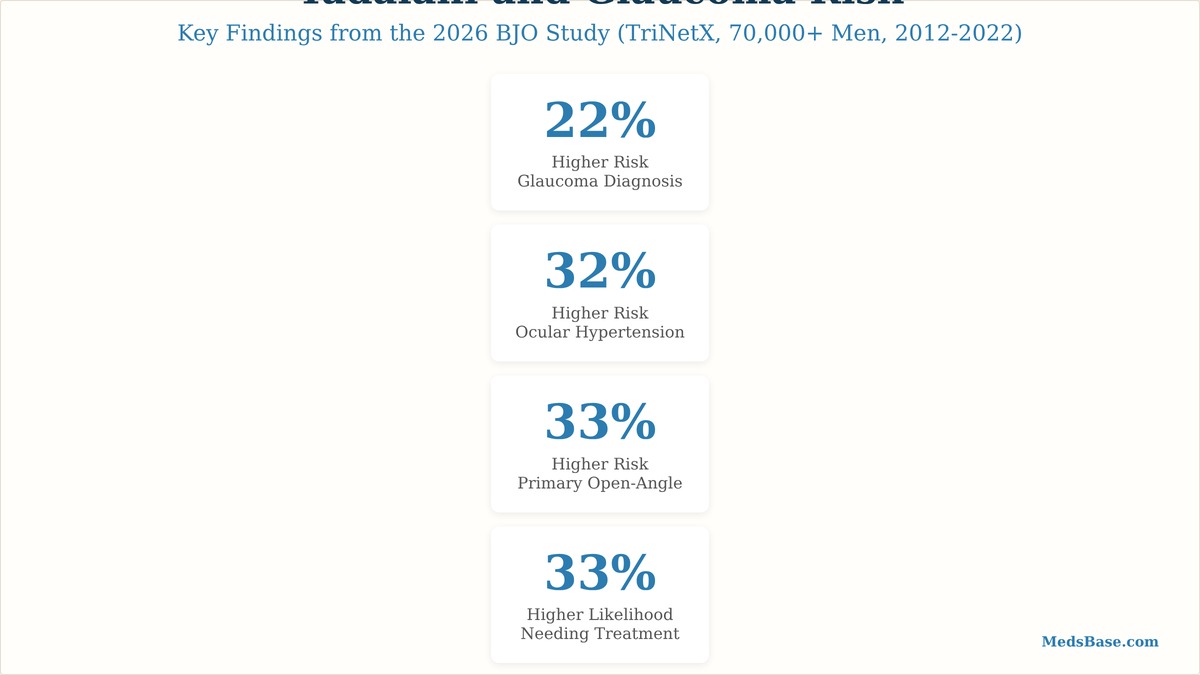
- A 2026 study of 70,000+ men found daily tadalafil users had a 22% higher glaucoma risk — but the absolute increase was less than one percentage point.
- The risk applies almost entirely to men taking tadalafil every day for an enlarged prostate, not those using it occasionally for erectile dysfunction.
- Tadalafil’s unusually long 17.5-hour half-life stays in your system far longer than sildenafil or vardenafil, which may explain why its eye effects accumulate.
- You can protect your vision with one simple annual screening — telling your eye doctor you take tadalafil changes what they look for.
- Most men on tadalafil will never develop glaucoma. The study’s message is about awareness, not alarm.
- What Is Tadalafil and Why Is Glaucoma Suddenly in the News?
- How Does Tadalafil Affect Eye Pressure?
- Key Uses — and Why the BPH Connection Matters
- What the Research Says About Tadalafil and Glaucoma Risk
- Who Is Most at Risk?
- Tadalafil and Glaucoma Risk vs Other ED Drugs
- How to Protect Your Vision While Taking Tadalafil
- Related Reading
- Frequently Asked Questions About Tadalafil and Glaucoma Risk
- The Bottom Line
What Is Tadalafil and Why Is Glaucoma Suddenly in the News? {#what-is-tadalafil}
Tadalafil is the active ingredient in Cialis, one of the world’s most widely prescribed medications for erectile dysfunction. It belongs to a class of drugs called phosphodiesterase type 5 inhibitors, or PDE5 inhibitors — the same family that includes sildenafil (Viagra) and vardenafil (Levitra). What makes tadalafil different from its cousins is its extraordinary staying power: a single dose can remain active in your body for up to 36 hours, earning it the nickname “the weekend pill.”
For years, tadalafil’s known eye side effects were considered minor and temporary — a faint blue tinge to vision, mild light sensitivity, or slightly blurred sight that typically fades within hours. These effects are well-documented across all PDE5 inhibitors and appear on every product label. But in July 2026, a study published in the British Journal of Ophthalmology introduced a more serious concern: the possibility that long-term daily tadalafil use might raise a man’s risk of developing glaucoma, a progressive eye disease that can lead to permanent vision loss.
Here is what you need to know before you jump to conclusions: the tadalafil and glaucoma risk connection is real but small. The absolute increase in risk was less than one per cent. The finding applies to men who take tadalafil every single day for urinary symptoms from an enlarged prostate — not to the man who takes it twice a month for date night. And even for daily users, simple, accessible screening makes the risk manageable.
How Does Tadalafil Affect Eye Pressure? {#eye-pressure}
To understand the tadalafil and glaucoma risk connection, you need to understand two things: how PDE5 inhibitors work, and how your eye maintains its internal pressure.
PDE5 inhibitors work by blocking an enzyme called phosphodiesterase type 5. This enzyme normally breaks down cyclic GMP, or cGMP, which relaxes smooth muscle and dilates blood vessels. By blocking PDE5, tadalafil keeps cGMP levels higher and longer, increasing blood flow — exactly how it helps produce an erection. But PDE5 does not live only in the penis. The enzyme is also present in the smooth muscle of blood vessels throughout the body, and critically, in the eye.
Inside the eye, PDE5 is found in two essential structures: the ciliary body, which produces the fluid filling the front of your eye, and the trabecular meshwork, which drains that fluid. Your intraocular pressure, or IOP, depends on a precise balance between fluid production and fluid drainage. If the drainage system works less efficiently, pressure builds. That elevated pressure is the primary mechanism behind glaucoma.
Research Spotlight
The eye contains PDE5 in its drainage channels, not just in blood vessels. When tadalafil blocks this enzyme, it may subtly alter how fluid exits the eye. Over years of daily use, that subtle change could be enough to tip someone with pre-existing risk factors into clinically elevated eye pressure. This is the leading biological explanation for the tadalafil and glaucoma risk association — it is not direct toxicity to the optic nerve, but rather a slow shift in fluid dynamics. Source: StatPearls NBK549843; AAO clinical guidance on PDE5 inhibitors and eye health.
The key point: tadalafil does not damage the eye directly. It alters the eye’s internal plumbing in a way that, over time and in susceptible individuals, may raise pressure. This is why the risk accumulates with daily, long-term use rather than occasional doses — the exposure is chronic, not acute.
Here is where it gets interesting. The ciliary body and trabecular meshwork contain not just PDE5 but also PDE6, a related enzyme involved in phototransduction — how your retina converts light into nerve signals. PDE5 inhibitors cross-inhibit PDE6 to varying degrees, which is why sildenafil causes blue-tinted vision more often than tadalafil does. Tadalafil is actually more selective for PDE5 over PDE6 than sildenafil, which is why its acute visual side effects are milder. But selectivity says nothing about what happens to PDE5 in the drainage system over months and years — and that longer-term story is what connects tadalafil and glaucoma risk.
Key Uses — and Why the BPH Connection Matters {#key-uses}
Tadalafil is prescribed for two main reasons, and which one you are using it for changes the tadalafil and glaucoma risk story dramatically.
Erectile Dysfunction — As-Needed Dosing
For ED, most men take tadalafil on an as-needed basis — typically 10 mg or 20 mg about 30 to 60 minutes before sexual activity. Some take a lower daily dose of 2.5 mg or 5 mg for spontaneity. Either way, the total monthly exposure is relatively low. The 2026 study specifically examined men taking tadalafil for urinary tract symptoms — not the as-needed ED population. Occasional users were not studied, but pharmacology suggests their risk is minimal.
Benign Prostatic Hyperplasia — Daily Dosing
For BPH, men take 5 mg every single day, without breaks, to relax the smooth muscle in the prostate and bladder neck, improving urine flow. This is the dosing pattern the study examined — continuous daily exposure over up to five years. The BPH population also skews older (all participants were 40+), and age is the single biggest risk factor for glaucoma.
The tadalafil and glaucoma risk association is really about three intersecting factors: a drug that subtly affects eye fluid dynamics, taken daily for years, by men already in the age group where glaucoma becomes common. The drug may be the trigger, but age and cumulative exposure are the loaded gun.
Who Is This For? / Who Should Avoid It?
This matters most to: Men over 40 taking daily tadalafil for BPH; men with a family history of glaucoma considering starting tadalafil; anyone on long-term PDE5 inhibitors who has not had a recent eye exam.
Lower concern: Men under 40 using tadalafil as-needed for ED; men with no glaucoma risk factors using any PDE5 inhibitor occasionally; men who had a normal eye exam within the past year.
If you have existing glaucoma or ocular hypertension: Discuss the tadalafil and glaucoma risk with both your urologist and ophthalmologist before starting or continuing. Do not stop any prescribed medication without consulting your doctor first.
If you use tadalafil for ED, browse our erectile dysfunction medications including tadalafil in multiple strengths.
What the Research Says About Tadalafil and Glaucoma Risk {#research}
Let us look at the numbers directly — because news headlines about the tadalafil and glaucoma risk story can make relative risks sound much scarier than absolute risks.
The study, published July 2026 in the British Journal of Ophthalmology, analysed medical records from the TriNetX Analytics Network, a massive US healthcare database. Researchers identified over 70,000 men aged 40 and older with no history of glaucoma. Half had been prescribed tadalafil for lower urinary tract symptoms between January 2012 and December 2022. The other half — matched by age and health status — had not taken the drug. Both groups were followed for up to five years.
| Outcome | Tadalafil Users vs Non-Users |
|---|---|
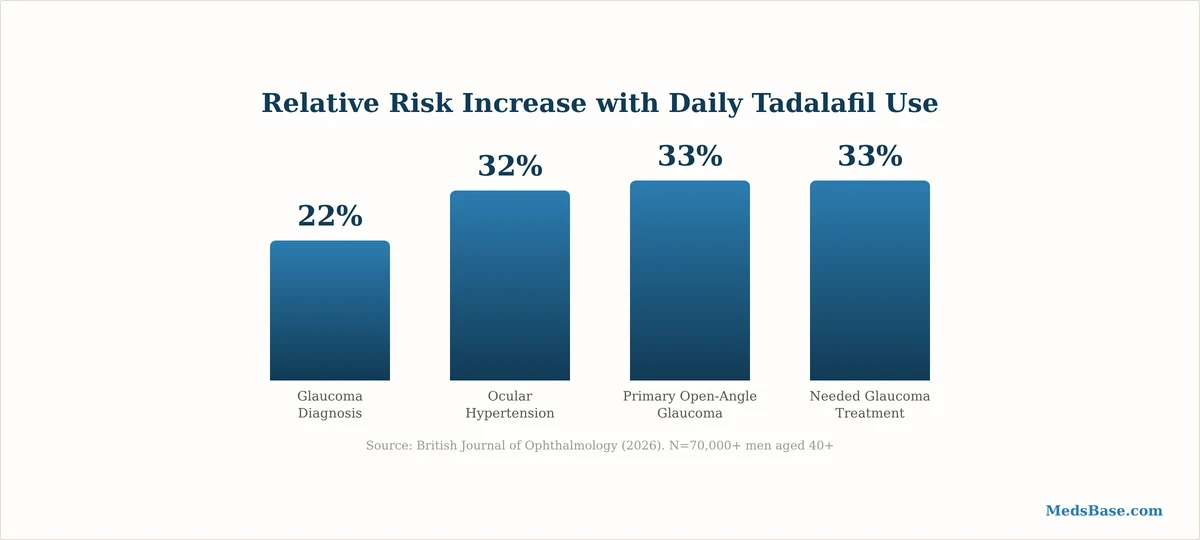
| Any glaucoma diagnosis | 22% higher relative risk |
| Ocular hypertension | 32% higher relative risk |
| Primary open-angle glaucoma | 33% higher relative risk |
| Started glaucoma treatment | 33% higher relative risk |
Those percentages sound dramatic until you examine the absolute numbers. The baseline rate of new glaucoma cases among men in this age group is low — roughly 1 to 2 per cent over five years. A 22% relative increase on a 1.5% baseline means absolute risk rises to about 1.8%. That is an extra three cases per thousand men over five years. The absolute increase was less than one percentage point.
The study authors acknowledged limitations: the population was predominantly white, the study was observational (showing association, not causation), and the database recorded prescriptions dispensed, not pills actually taken.
Research Summary Table
| Study | Year | Design | Finding | Source |
|---|---|---|---|---|
| TriNetX PDE5i Study | 2026 | Retrospective cohort, N=70,000+ | Daily tadalafil: 22-33% higher relative risk of glaucoma-related outcomes across 4 measures | Br J Ophthalmol |
| AAO Clinical Guidance | 2024 | Professional statement | PDE5 inhibitors may cause minor transient visual effects; monitor at-risk patients | aao.org |
| Global Glaucoma Burden | 2024 | Systematic review | ~80 million people worldwide have glaucoma; ~50% undiagnosed; primary open-angle most common form | PMC12302165 |
Approximately 80 million people worldwide have glaucoma, and the National Eye Institute explains that roughly half are unaware they have the condition. This is why screening matters — the tadalafil and glaucoma risk is manageable, but only if you know your baseline.
Who Is Most at Risk? {#who-is-at-risk}
Not every man who takes tadalafil faces the same glaucoma concern. Risk exists on a spectrum, depending on medication use pattern, age, family history, and ethnicity.
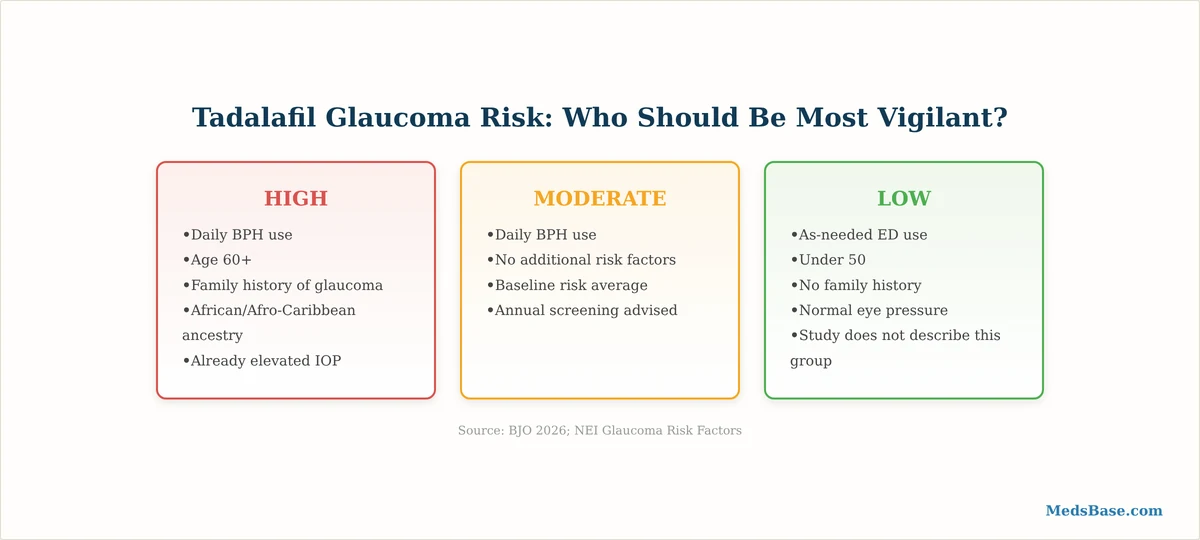
Higher-risk profile: You should take the tadalafil and glaucoma risk most seriously if you take daily tadalafil for BPH, are over 60, have a first-degree relative with glaucoma, are of African or Afro-Caribbean ancestry, or already have elevated eye pressure. Each factor independently raises baseline glaucoma risk. Combined with daily PDE5 inhibition, the additive effect could be meaningful.
Moderate-risk profile: You take daily tadalafil for BPH but have none of the additional risk factors. Your baseline risk is average. Annual screening is prudent — the odds are strongly in your favour.
Lower-risk profile: You take tadalafil as-needed for ED, are under 50, have no family history of glaucoma, and have normal IOP at your last eye exam. The tadalafil and glaucoma risk study simply does not describe your situation. Your concern level should be low.
But there is a catch. The American Academy of Ophthalmology notes and the NEI confirm: roughly half of the estimated four million Americans with glaucoma do not know they have it. Glaucoma is painless in early stages and takes peripheral vision first — the part you do not notice until significant damage has occurred. You could have elevated eye pressure today with no symptoms at all. This is why the tadalafil and glaucoma risk conversation should lead to an eye exam, not to panic.
Tadalafil and Glaucoma Risk vs Other ED Drugs {#other-ed-drugs}
A natural question: do other erectile dysfunction drugs carry the same glaucoma concern? The short answer: we do not know yet, but there are reasons to think tadalafil may be unique.
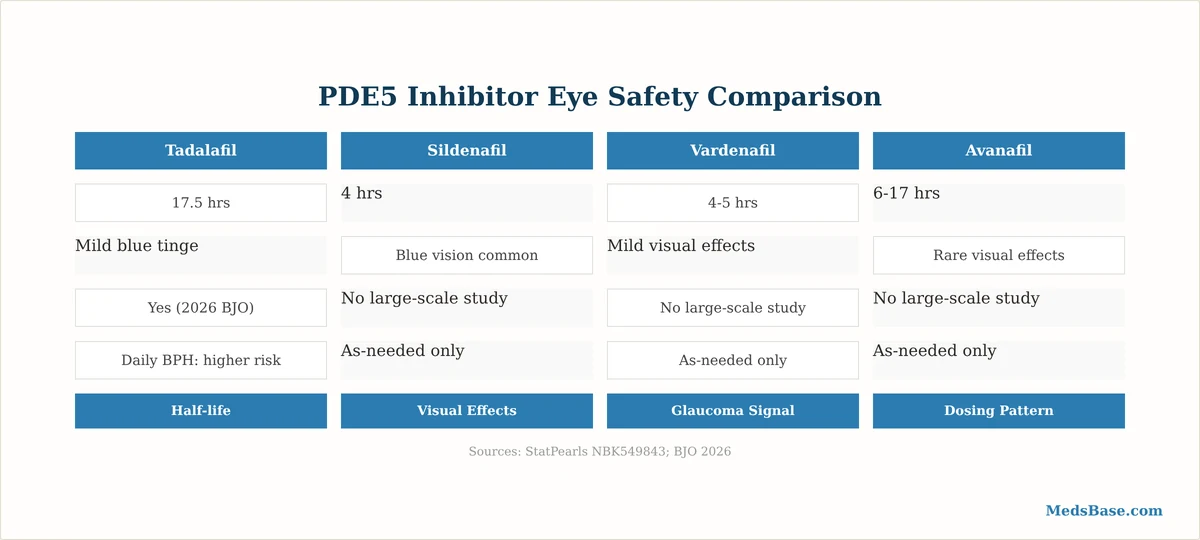
The critical variable is half-life. Tadalafil has a half-life of 17.5 hours — far longer than sildenafil (4 hours), vardenafil (4-5 hours), or avanafil (6-17 hours). With daily dosing, tadalafil reaches a steady-state concentration that never fully clears. The other PDE5 inhibitors are taken only as-needed for ED, and their short half-lives mean they are eliminated between doses.
This pharmacokinetic difference is almost certainly why the first large-scale glaucoma signal appeared with tadalafil. If PDE5 inhibition in the eye’s drainage system contributes to pressure elevation, a drug always present in the bloodstream is more likely to produce a measurable effect than one that comes and goes.
Sildenafil has its own distinct eye effects — blue-tinted vision — because it is less selective for PDE5 over PDE6 than tadalafil. These acute visual changes are usually harmless and reversible, but they remind us that all PDE5 inhibitors interact with the visual system. The tadalafil and glaucoma risk concern is about a different mechanism: anterior segment fluid dynamics, not retinal phototransduction.
No equivalent large-scale studies examine sildenafil or vardenafil and glaucoma risk specifically. The prudent approach: apply the same screening recommendation to any daily PDE5 inhibitor user, while recognising tadalafil is the only drug in the class with both a daily-dosing indication and an epidemiological signal.
Considering Switching?
Do not stop tadalafil based solely on this study. The absolute risk increase is small. If you have glaucoma risk factors, schedule appointments with both your prescribing doctor and an ophthalmologist. They can weigh the tadalafil and glaucoma risk against your urinary symptoms, discuss alternative BPH medications like tamsulosin, and check your baseline eye pressure before any decision.
How to Protect Your Vision While Taking Tadalafil {#protect-vision}
The tadalafil and glaucoma risk is manageable — simple screening is all most men need. Think of it like checking blood pressure on a medication that can raise it: you do not stop the drug, you monitor.
1. Get a baseline dilated eye exam. If you are starting daily tadalafil, or have been on it without a comprehensive eye exam, schedule one. A dilated exam lets the ophthalmologist see your optic nerve directly and measure intraocular pressure. This establishes your personal baseline.
2. Know your risk factors and tell your eye doctor. Family history of glaucoma, African ancestry, age over 60, high myopia, previous eye injury, and long-term corticosteroid use all raise baseline risk. Mention both your risk factors and that you take tadalafil. The combination shapes your personal tadalafil and glaucoma risk assessment.
3. Ask about optic nerve imaging. Optical coherence tomography, or OCT, creates a detailed 3D image of your optic nerve and can detect glaucoma-related thinning years before it shows up on a visual field test. For higher-risk daily tadalafil users, OCT provides early reassurance or early warning.
4. Report any vision changes promptly. Do not wait for your annual exam if you notice gradual peripheral vision loss, difficulty adjusting to dark rooms, halos around lights, or persistent eye discomfort. These are potential glaucoma warning signs, and early treatment is far more effective than late intervention. The link between tadalafil and glaucoma risk makes prompt reporting especially important.
5. Consider as-needed dosing if appropriate. If you take daily tadalafil for ED rather than BPH, discuss with your doctor switching to as-needed dosing. The study’s risk signal was in the daily-use population. Occasional use means lower cumulative exposure and less concern about tadalafil and glaucoma risk.
Glaucoma is treatable. When caught early, medicated eye drops like latanoprost or bimatoprost can slow or halt progression in the vast majority of cases. The goal: catch any pressure elevation before it damages the optic nerve.
Related Reading
- Latanoprost vs Bimatoprost: 7 Evidence-Based Facts About Glaucoma Eye Drops — if you or someone you know has been diagnosed, understand your first-line treatment options.
- Sildenafil Side Effects: A Complete Safety Guide — full side-effect profile of Viagra and generic sildenafil, including visual effects.
- Tadalafil vs Vardenafil: Which ED Medication Is Right for You? — direct comparison of two ED medications.
Frequently Asked Questions About Tadalafil and Glaucoma Risk {#faq}
Q: Should I stop taking tadalafil because of the glaucoma risk?
A: For most men, no. The absolute increase was less than one percentage point, and the finding applies mainly to daily BPH users. If you take tadalafil as-needed for ED, your risk profile is different. Never stop a prescribed medication without discussing it with your doctor. If you are on daily tadalafil and have glaucoma risk factors, schedule an eye exam rather than discontinuing the drug — the screening will tell you whether any action regarding tadalafil and glaucoma risk is warranted.
Q: Does sildenafil carry the same glaucoma risk as tadalafil?
A: There is no equivalent large-scale study examining sildenafil and glaucoma risk specifically. Sildenafil’s shorter half-life (4 hours vs 17.5 hours for tadalafil) and as-needed-only dosing pattern mean cumulative PDE5 inhibition in the eye is far lower. Sildenafil’s known visual effects — blue-tinted vision, light sensitivity — are acute, transient, and related to PDE6 cross-inhibition in the retina, not to glaucoma. Until dedicated studies exist, sildenafil’s glaucoma risk profile is considered lower than tadalafil’s for daily users.
Q: How often should I get my eyes checked if I take daily tadalafil?
A: A reasonable starting point is a comprehensive dilated eye exam within the first year of starting daily tadalafil, then annually thereafter. If your baseline shows elevated pressure or suspicious optic nerve changes, your ophthalmologist may recommend monitoring every 6 months. This approach directly addresses the tadalafil and glaucoma risk concern through established clinical monitoring.
Q: Can glaucoma caused by tadalafil be reversed?
A: Glaucoma-related optic nerve damage cannot be reversed. However, the tadalafil and glaucoma risk association describes a detectable pressure increase that can be caught and managed long before any vision loss occurs. If screening detects rising eye pressure, medicated eye drops such as latanoprost or bimatoprost are highly effective at lowering IOP and preventing further damage.
Q: What are the first signs of glaucoma?
A: In primary open-angle glaucoma — the type linked to the tadalafil and glaucoma risk study — there are typically no symptoms in early stages. Vision loss begins in the peripheral field and progresses so slowly you may not notice until significant damage has occurred. This is precisely why screening matters. Acute angle-closure glaucoma, a rarer form, causes sudden eye pain, headache, nausea, blurred vision, and halos around lights — a medical emergency.
Q: Is the tadalafil and glaucoma risk the same for all ages?
A: No. The study population was men aged 40+, and glaucoma risk rises with age regardless of medication use. A 45-year-old on daily tadalafil with no other risk factors has substantially lower absolute risk than a 70-year-old with a family history. Age, family history, and ethnicity are the dominant risk factors. Tadalafil appears to contribute to risk in susceptible individuals, not act as a primary cause.
Q: Does occasional tadalafil use for ED have any glaucoma risk?
A: The 2026 study did not include occasional ED users — it specifically examined men prescribed tadalafil for lower urinary tract symptoms implying daily dosing. Based on pharmacology, occasional use provides far less cumulative PDE5 inhibition in the eye and is unlikely to produce the same risk signal. However, if you have pre-existing glaucoma or ocular hypertension, mention your PDE5 inhibitor use to your ophthalmologist regardless of dosing frequency.
Q: Are there alternative BPH medications without glaucoma risk?
A: Yes. Alpha-blockers like tamsulosin and terazosin relax smooth muscle in the prostate and bladder neck without inhibiting PDE5. They are not associated with elevated glaucoma risk. 5-alpha-reductase inhibitors like finasteride and dutasteride are another option for some men. The best BPH medication choice involves discussing your individual tadalafil and glaucoma risk factors with your urologist.
The Bottom Line {#bottom-line}
The tadalafil and glaucoma risk study is important science — but the practical takeaway for most men is reassuring. The absolute risk is small. The mechanism is plausible but not proven causal. The finding applies almost exclusively to daily long-term use, not occasional ED dosing. And the most effective response — an annual eye exam — is something everyone over 40 should be doing anyway.
If you take daily tadalafil for BPH, your best next step is not to stop the medication but to get a baseline eye pressure check and talk to your doctor. If you take tadalafil as-needed for ED with no other glaucoma risk factors, this study does not meaningfully change your risk profile.
Glaucoma is serious — but also one of the most treatable eye conditions when caught early. The real message of the tadalafil and glaucoma risk research is not that tadalafil is dangerous for your eyes. It is that men on daily PDE5 inhibitors should add an eye exam to their health maintenance routine. That is a small ask for a lot of peace of mind.
Your next step: Schedule a comprehensive eye exam, especially if you have not had one in the past two years. Tell your eye doctor you take tadalafil and ask about your intraocular pressure.
Wondering what glaucoma treatment looks like if you do need it? Read our latanoprost vs bimatoprost comparison — the two most commonly prescribed first-line glaucoma eye drops.
Curious about tadalafil vs other ED medications? See our tadalafil vs vardenafil comparison.
Medical Disclaimer: This article is for informational purposes only and does not constitute medical advice. The tadalafil and glaucoma risk association is based on observational research and does not establish causation. Do not stop, start, or change any medication without consulting your doctor. If you experience sudden vision changes, eye pain, or other concerning symptoms, seek immediate medical attention.
Reviewed by Medical Reviewer — Last updated: 2026-08-31
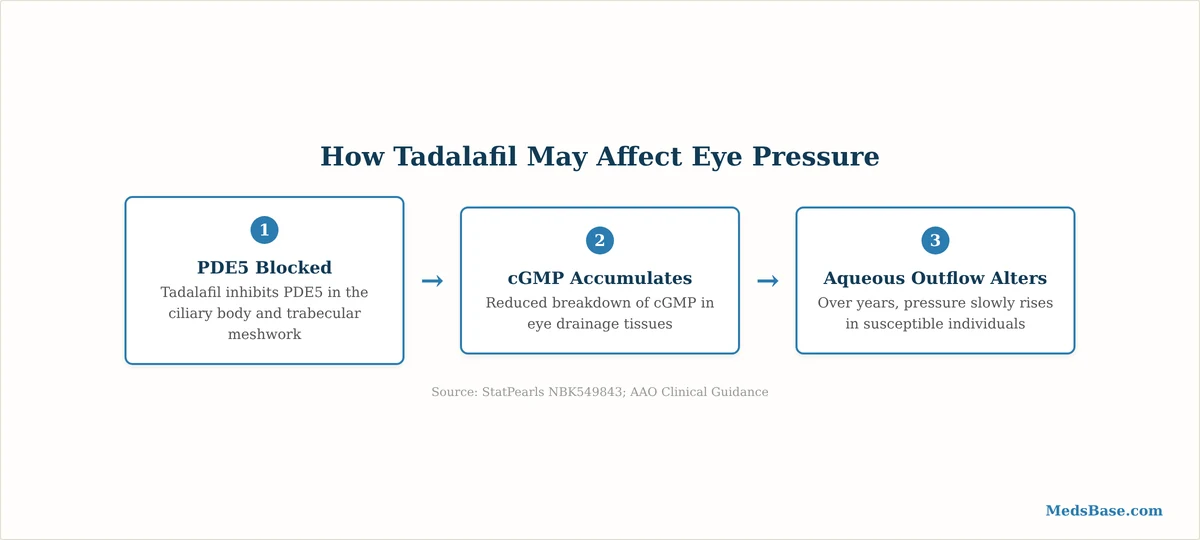
The three-step process by which PDE5 inhibition may alter intraocular pressure over time.

Written by
Sophie ChenPharmaceutical Content Researcher · 8 years experience
Sophie Chen is a pharmaceutical content researcher with 8 years covering generic medication access and clinical pharmacology. She specialises in international regulatory frameworks, bioequivalence standards, and patient-facing education on therapeutic drug classes. She is not a clinician.