








✓ Medically reviewed by · Last reviewed: May 2026
Pharmacy Researcher · 8 years experience
Pharmacy researcher with 8 years reviewing clinical drug information, generic formulation equivalence, and international pharmaceutical standards. Focuses on patient-facing accuracy in medication education.
endometriosis type 2 diabetes link — Endometriosis Type 2 Diabetes Link: What Women Need to Know. Read on for an evidence-backed guide covering everything you need to know.
What the Study Found — The Numbers That Changed Our Understanding
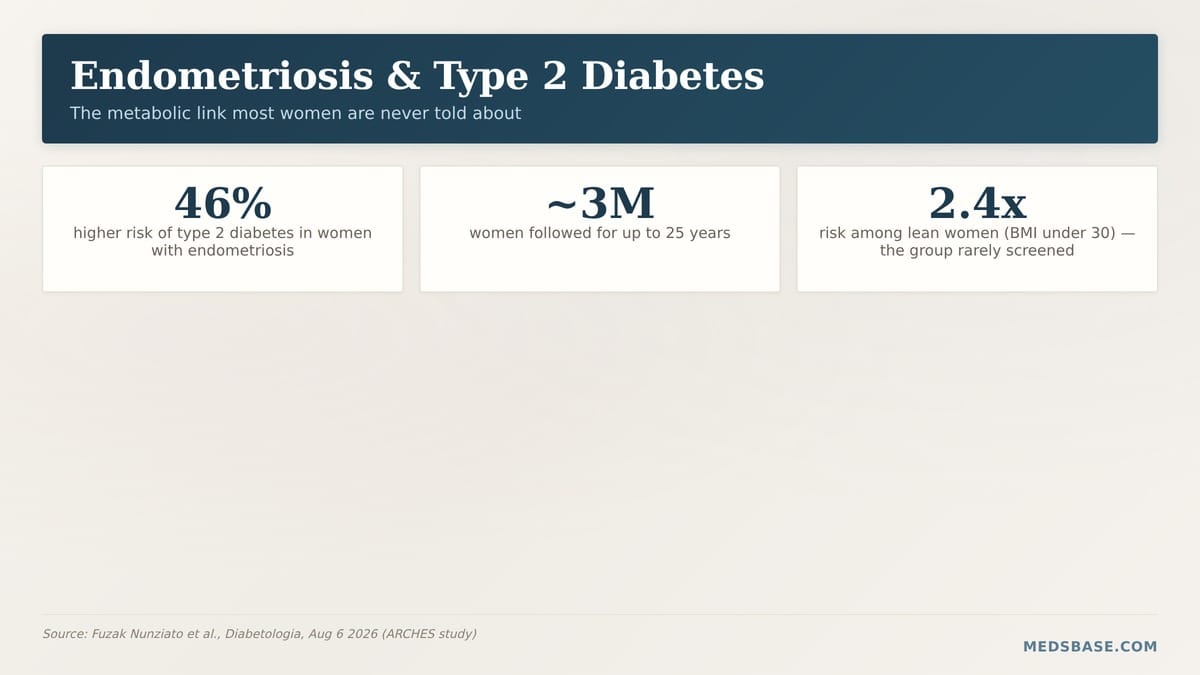
The study behind the headlines is unusually large and unusually long. Led by researcher Fuzak Nunziato at George Mason University, it pulled together health records for close to 3 million women, tracking them for as long as 25 years.
The core result is the number everyone quotes: women diagnosed with endometriosis had a 46% higher risk of developing type 2 diabetes compared to women without the condition. That held up even after the researchers adjusted for other factors that influence diabetes risk, including age and body weight.
Why does this study carry more weight than a typical headline? Three reasons.
First, the scale. Three million women is not a small clinic sample. It’s a population-level dataset, which makes the finding far less likely to be a statistical fluke.
Second, the length. Type 2 diabetes develops slowly, often over a decade or more. You need long follow-up to see it emerge — and 25 years is enough time to catch it.
Third, the specificity. The researchers didn’t just report one blanket number. They dug into who was most affected. That’s where the really interesting — and clinically useful — findings live.
Beyond the headline figure, the study’s design deserves a quick explanation, because it changes how confident you should feel in the result. The researchers drew on a large longitudinal dataset, which let them follow women forward from the time of an endometriosis diagnosis and observe who went on to develop diabetes. They adjusted for age, body weight, and other confounders — so the 46% figure is the extra risk left over after accounting for the usual suspects. The link isn’t simply a reflection of the fact that some women with endometriosis also carry extra weight.
It’s also worth pausing on what “46% higher” actually means, because relative-risk numbers can sound scarier than they are. A 46% higher relative risk does not mean 46% of women with endometriosis will develop diabetes. If the background risk of type 2 diabetes over a given period is around 5%, a 46% increase lifts that to roughly 7%. That’s meaningful and worth acting on — but nowhere near a certainty. The takeaway is increased vigilance, not increased alarm.
A quick word on study limitations. The data came from health registries, so the researchers couldn’t account for every variable — things like diet quality, physical activity levels, or the severity of each woman’s endometriosis weren’t captured uniformly. The study also can’t prove cause and effect; it demonstrates a strong association, not a direct causal chain. Still, the size, duration, and internal consistency of the findings — the same pattern holding across subgroups — give the conclusion unusual weight. Future research will clarify the exact pathways, but the signal is too loud to ignore today.
How Endometriosis Might Raise Diabetes Risk
Endometriosis is classed as a condition of the reproductive system, but researchers increasingly describe it as a whole-body inflammatory disease. The NHS describes it as a condition where tissue similar to the lining of the womb grows in other parts of the body — and, notably, the symptoms and their impact are not confined to the pelvis. Understanding that shift is the key to understanding the endometriosis type 2 diabetes link.
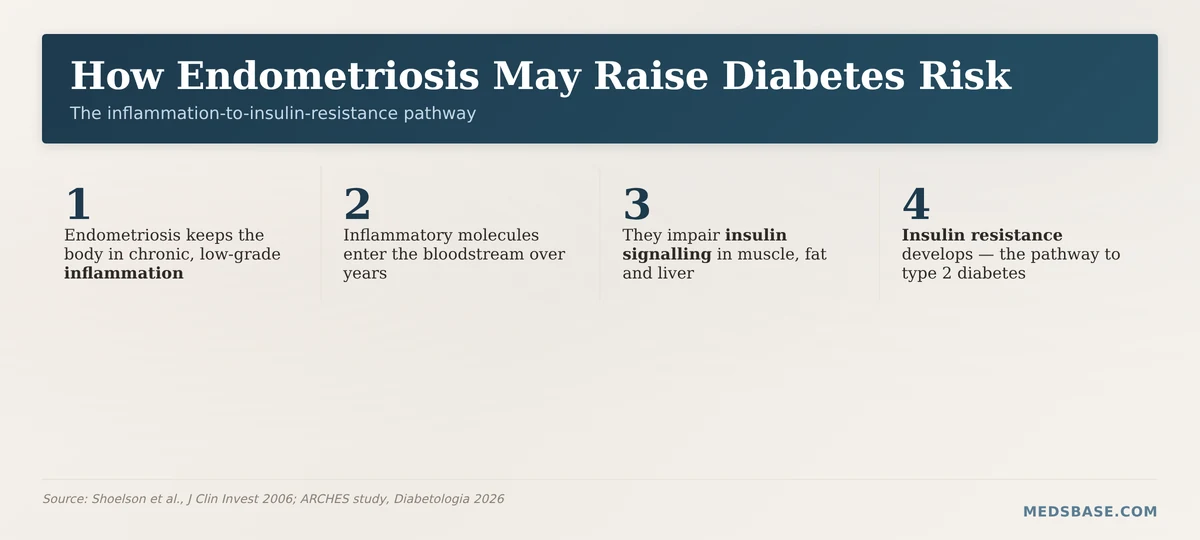
The tissue that grows where it shouldn’t doesn’t just sit there quietly. It bleeds, sheds, and triggers an immune response every month. Over years, that produces a state of chronic, low-grade inflammation that circulates far beyond the pelvis.
That matters for diabetes because inflammation and blood sugar are deeply connected.
The Inflammation Connection
Here’s the simple version of a complex process.
When you have endometriosis, your immune system is constantly reacting to tissue that your body flags as “out of place.” That reaction releases inflammatory signalling molecules — things like cytokines and C-reactive protein — into your bloodstream.
Those molecules don’t stay localised. They circulate. And when they reach tissues like muscle, fat, and liver, they start to interfere with the way those tissues respond to insulin.
This is the bridge between two conditions that, on the surface, look unrelated. Endometriosis lives in the pelvis. Diabetes lives in the metabolism. Chronic inflammation is the road connecting them.
Researchers have measured this directly. Women with endometriosis tend to run higher levels of inflammatory markers — including C-reactive protein (CRP) and interleukin-6 (IL-6) — in their blood. Those are the same markers found elevated in people with insulin resistance. When inflammation stays switched “on” for years, your metabolic machinery is forced to work under constant, low-level stress. It’s that chronic stress that gradually erodes insulin sensitivity, forming the biological backbone of the endometriosis type 2 diabetes link.
Insulin Resistance Pathways
Insulin is the hormone that tells your cells to absorb sugar from your blood. Insulin resistance is what happens when your cells stop listening — and it’s the process at the heart of type 2 diabetes, the most common form of diabetes.
Picture it this way: insulin is knocking on the door, but the cells have turned down the volume on the doorbell. Your pancreas responds by making more insulin to get the same job done. It works for a while. Then, over time, the pancreas can’t keep up, and blood sugar starts to climb.
Inflammation accelerates this whole process. Research published in the Journal of Clinical Investigation established the mechanism years ago: inflammatory cytokines can directly impair insulin signalling, essentially jamming the doorbell that insulin rings.
That’s the biological story behind the 46%. Years of endometriosis-driven inflammation can slowly tip the scales toward insulin resistance — and eventually toward type 2 diabetes. Over that long stretch, someone whose blood sugar read “normal” one decade can cross into a diagnosis the next, often without ever feeling a symptom.
Hormonal Factors at Play
Hormones add another layer to the endometriosis type 2 diabetes link.
Endometriosis is an oestrogen-dependent condition. Treatments that manage it — including hormonal therapies — can shift the body’s oestrogen and progesterone balance. Oestrogen itself influences how your body handles glucose and how sensitive your tissues are to insulin.
This is also part of why the premenopausal finding is so interesting. The hormonal environment of the reproductive years appears to interact with endometriosis in ways that raise metabolic risk, even before menopause typically drives those changes.
None of this means you should avoid hormonal treatments for endometriosis — they remain effective tools for managing pain and slowing disease progression. It does mean that if you use hormonal therapy, keeping an eye on your metabolic numbers alongside it is especially worthwhile. Your prescriber can help you weigh the symptom benefits against any metabolic considerations and adjust your monitoring accordingly.
Research Spotlight
The 2026 Diabetologia study is consistent with a growing body of evidence linking endometriosis to cardiovascular and metabolic risk. Earlier research has tied endometriosis to higher rates of high blood pressure and elevated cholesterol. The new study extends that picture to type 2 diabetes specifically — and, importantly, shows the association is not explained by obesity. This suggests inflammation, not weight, is the primary driver.
Who Is Most at Risk — and Who Should Get Screened
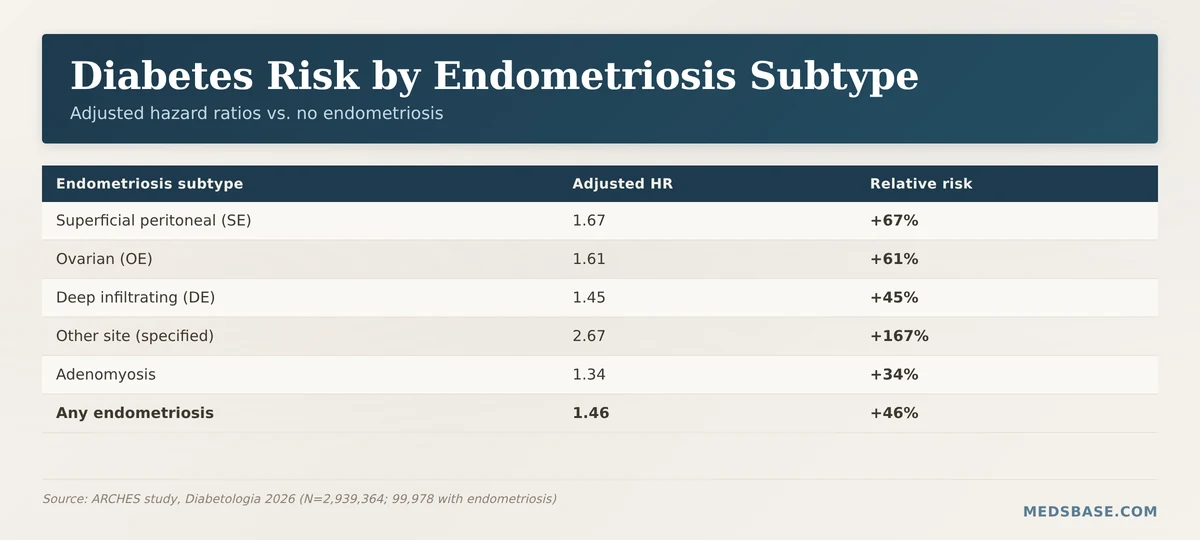
Not every woman with endometriosis carries the same level of risk. The study identified specific groups where the endometriosis type 2 diabetes link is strongest. Knowing which group you fall into can help you decide how urgently to act.
High-Risk Groups the Study Identified
The researchers found three subgroups with elevated risk:
Endometriosis beyond the pelvic region. When endometrial-like tissue spreads to the bowel, bladder, diaphragm, or elsewhere outside the pelvis, the inflammatory burden appears to be larger. These women showed a higher diabetes risk than those with pelvic-only disease.
Premenopausal women. The risk was most pronounced before menopause. That’s counterintuitive — you might expect menopause to be the bigger risk window — but the data suggests the reproductive years are when the inflammatory and hormonal drivers of insulin resistance are most active.
Women without obesity. This is the finding that should change how clinicians think. Normally, type 2 diabetes is tightly linked to excess weight. Here, the association held — and was even more striking — in women who were not overweight. It’s a strong signal that endometriosis raises diabetes risk through a pathway that has little to do with body weight.
Who Should Get Screened — and Who Can Breathe Easier
Here’s the reassuring part: this is an association, not a destiny.
Q: Who Is This For?
A:
Ask your doctor about blood-sugar screening if you have: endometriosis beyond the pelvic area, a long history (many years) of endometriosis, a family history of diabetes, or a personal history of gestational diabetes or PCOS.
You can take a more measured pace if: you have mild, pelvic-only endometriosis, you’re young with no other risk factors, and your recent bloodwork has been normal. Routine annual checks are still sensible.
The single most useful thing you can do is get a baseline. An HbA1c test measures your average blood sugar over the past two to three months. A fasting glucose test captures a single snapshot. Either one, done once a year, will catch a rising trend years before you’d ever feel a symptom.
If you’re already managing endometriosis symptoms with medication, it’s worth a conversation with your prescriber about what’s in your routine. You can browse the Women’s Health range to see the options we carry for hormonal and symptom management — but always bring screening questions to your own doctor.
What This Means for Women With Endometriosis — 5 Practical Steps
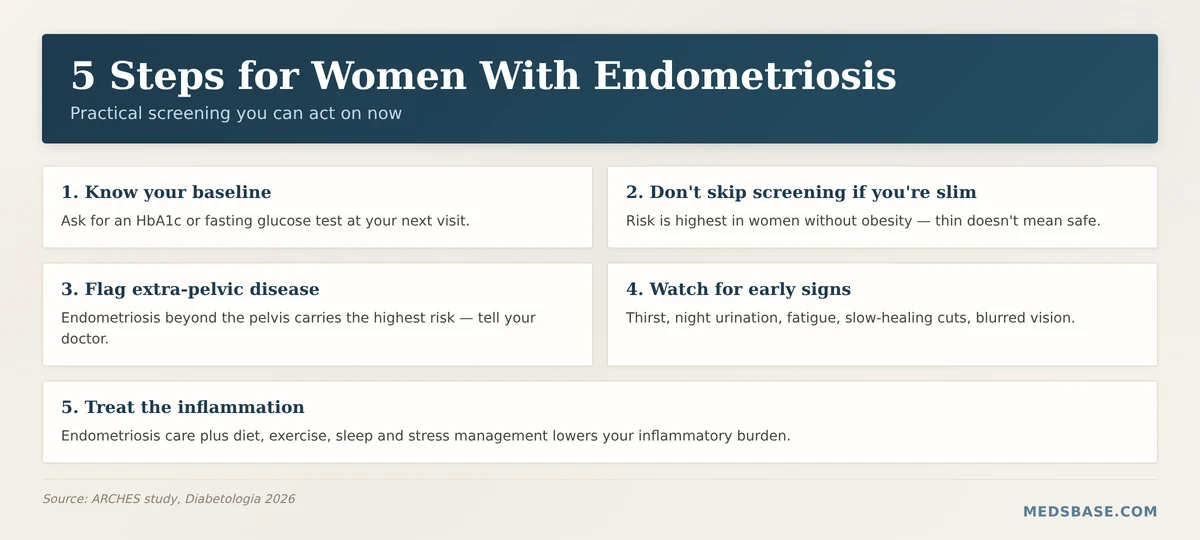
You can’t rewrite your diagnosis. But you can absolutely respond to this information in ways that protect your long-term health. These five steps are the pragmatic playbook.
1. Get a baseline blood-sugar reading this year. Ask for an HbA1c and a fasting glucose test. Write the numbers down. Next year’s number is the one that matters — you want to see a stable line, not a rising one. Fold it into your next annual visit rather than booking a separate appointment; most providers can add the panel to routine bloodwork at no extra trip.
2. Tell your doctor about the endometriosis type 2 diabetes link. Many clinicians still think of endometriosis purely as a gynaecological condition. A sentence like “given my endometriosis, should we monitor my blood sugar more closely?” can meaningfully change the care you receive — especially if you fall into one of the higher-risk subgroups.
3. Lower the inflammation you can control. You can’t switch off endometriosis-driven inflammation entirely, but you can stop adding to it. Regular movement, adequate sleep, stress management, and a diet rich in whole foods and vegetables all dampen background inflammation. The same habits that help your heart help your blood sugar. And you don’t need perfection — even a daily walk, an earlier bedtime, and one extra serving of vegetables measurably reduce inflammatory markers over time.
4. Know the early signs of type 2 diabetes. Increased thirst, frequent urination, unusual fatigue, blurred vision, slow-healing cuts, and recurring infections are classic early signals. They’re easy to dismiss one at a time — but together, they warrant a prompt check.
5. Track your cycles and your energy together. Women with endometriosis are often excellent self-observers. Add one more data point: note if you’re feeling unusually drained or thirsty. Patterns you notice over months are genuinely useful to a doctor — and they help separate the fatigue that comes with endometriosis itself from the fatigue that signals a metabolic shift.
The Bigger Picture — Endometriosis and Metabolic Health
The diabetes finding doesn’t exist in isolation. It fits into a larger, still-developing picture of endometriosis as a condition with whole-body consequences. Type 2 diabetes itself is a growing global challenge — the World Health Organization counts it among the leading noncommunicable diseases worldwide.
Related Conditions to Watch
Studies over the last decade have linked endometriosis to a cluster of metabolic and cardiovascular conditions. The pattern that emerges is consistent with the inflammation story:
- High blood pressure. Several large studies have found higher rates of hypertension in women with endometriosis. If you’re tracking one number, consider tracking your blood pressure too.
- Elevated cholesterol. Dyslipidaemia also appears more common, and it frequently travels with insulin resistance.
- Cardiovascular disease. Endometriosis has been associated with higher long-term risk of heart attack and stroke, especially in younger women.
None of this means endometriosis causes these conditions directly. What it suggests is that the chronic inflammation at the heart of endometriosis can, over many years, affect systems far beyond the pelvis — your blood vessels, your liver, your pancreas.
Taken together, those conditions form a cluster doctors call metabolic syndrome: high blood pressure, elevated blood sugar, abnormal cholesterol, and insulin resistance, all bound together by the same inflammatory threads. The endometriosis type 2 diabetes link appears to add fuel to that particular fire. The practical implication is simple — your metabolic health deserves the same year-to-year attention as your gynaecological health, ideally from the same care team reviewing the same bloodwork.
That reframing matters for how you manage your health. If you’ve been told to think of endometriosis only as a period problem, this research is your cue to think bigger.
It’s also a reminder that blood-sugar management can matter even before a formal diabetes diagnosis. If you or a loved one are already exploring options for managing blood sugar, you can compare the Diabetes category to understand what’s available — again, in partnership with your prescriber, not instead of one.
What Does the Research Say — Research Summary
| Study | Year | Finding | Source |
|---|---|---|---|
| Nunziato et al., Diabetologia | 2026 | Endometriosis linked to 46% higher type 2 diabetes risk across ~3M women over 25 years | Diabetologia |
| Shoelson et al., J. Clin. Invest. | 2006 | Established that inflammatory cytokines directly impair insulin signalling, driving insulin resistance | PMC |
| NHS — Endometriosis overview | Ongoing | Describes endometriosis symptoms, diagnosis, and its systemic (not purely gynaecological) nature | NHS |
| WHO — Diabetes fact sheet | Ongoing | Global diabetes statistics, risk factors, and the burden of type 2 diabetes | WHO |
| NIH — Diabetes symptoms & causes | Ongoing | Defines type 2 diabetes, insulin resistance, and known causes and risk factors | NIH |
Related Reading
- Diabetes and Menopause Symptoms — the hormonal shifts of menopause and how they interact with blood sugar.
- Women’s Health category — our full range for hormonal and reproductive health management.
- Diabetes category — medications and support for blood-sugar management.
Frequently Asked Questions
Q: Does endometriosis cause type 2 diabetes?
A: Endometriosis doesn’t directly cause type 2 diabetes, but it raises the risk. The 2026 Diabetologia study found a 46% higher risk, which researchers attribute mainly to the chronic inflammation endometriosis produces over many years. That inflammation can gradually drive insulin resistance, the underlying process behind type 2 diabetes. Think of it as a strong risk factor rather than a guaranteed outcome — and one you can meaningfully act on with early screening and lifestyle habits.
Q: What is the risk of type 2 diabetes with endometriosis?
A: Women with endometriosis had a 46% higher risk of developing type 2 diabetes in a 25-year study of nearly 3 million women. To put that in perspective, it’s a meaningful elevation, not a certainty — most women with endometriosis will never develop diabetes. The risk was highest for those with endometriosis beyond the pelvic region, premenopausal women, and women without obesity, which suggests the link isn’t driven by weight.
Q: Why does endometriosis increase diabetes risk?
A: The leading explanation is chronic inflammation. Endometriosis keeps the immune system in a low-grade, always-on state, releasing inflammatory molecules into the bloodstream. Over years, those molecules can impair insulin signalling in muscle, fat, and liver tissue, producing insulin resistance — the same process that leads to type 2 diabetes. Hormonal factors, particularly oestrogen’s influence on glucose handling, likely play a supporting role.
Q: Should all women with endometriosis get tested for diabetes?
A: You don’t need a full diabetes workup the day after an endometriosis diagnosis, but an annual baseline is sensible. An HbA1c test (your three-month average blood sugar) or a fasting glucose test is cheap, simple, and catches a rising trend years before symptoms appear. If you have additional risk factors — endometriosis beyond the pelvis, a family history of diabetes, or a history of gestational diabetes — ask your doctor about starting screening sooner.
Q: Does the endometriosis-diabetes link apply to women who aren’t overweight?
A: Yes — and this is one of the study’s most important findings. The association was strongest in women without obesity. Because type 2 diabetes is usually thought of as a weight-related condition, doctors may not think to screen a slim woman with endometriosis. This study argues they should. If you’re not overweight, your risk isn’t zero — the inflammation pathway still applies.
Q: What are the early signs of type 2 diabetes in women?
A: The early signs are easy to brush off individually: increased thirst, needing to urinate more often (especially at night), unusual fatigue, blurred vision, slow-healing cuts, and recurring yeast or urinary infections. Women may also notice darkened skin in skin folds (a sign of insulin resistance called acanthosis nigricans). If several of these appear together — especially with an endometriosis history — get a blood test promptly.
Q: Can treating endometriosis lower your diabetes risk?
A: Potentially, though this isn’t yet proven directly. Effective endometriosis treatment can reduce the inflammatory burden, which is the presumed driver of the diabetes link. Managing inflammation through treatment, alongside diet, exercise, sleep, and stress management, is the best available strategy. What’s clearer is that keeping blood sugar monitored — regardless of your endometriosis treatment plan — lets you catch problems early, when they’re easiest to manage.
Q: Is the link stronger for deep or severe endometriosis?
A: The study found that endometriosis spreading beyond the pelvic region carried higher risk than pelvic-only disease, suggesting the extent of the disease matters. This aligns with the inflammation theory: more widespread endometrial-like tissue means a larger ongoing inflammatory burden. If you’ve been diagnosed with deep, infiltrating, or extra-pelvic endometriosis, it’s worth flagging that specific detail when discussing metabolic screening with your doctor.
The Bottom Line
The endometriosis type 2 diabetes link is real, well-documented, and — most importantly — actionable.
Here’s the verdict in plain terms: endometriosis is not just a pelvic condition. It’s a whole-body inflammatory state, and over years that inflammation can quietly raise your risk of type 2 diabetes by roughly 46%. The risk isn’t about your weight, and it isn’t about your age. It’s about inflammation — and inflammation is something you can track, discuss, and partially control.
Your action item is simple and specific: get a baseline HbA1c and fasting glucose reading this year. One blood draw, once a year. If the number is stable, you sleep easier. If it’s rising, you’ve caught a problem at the point where it’s easiest to reverse.
You’ve been managing a difficult condition for years. This is one more piece of information to use, not one more thing to fear.
To go deeper, read our guide to diabetes and menopause symptoms, or explore how hormonal health and metabolism interact across the Women’s Health category.
Medical Disclaimer: This article is for informational purposes only and does not constitute medical advice. Always consult a qualified healthcare professional before making decisions about your health, screening, or medication. Never stop or change a prescribed treatment without speaking to your doctor.

Written by
Sophie ChenPharmaceutical Content Researcher · 8 years experience
Sophie Chen is a pharmaceutical content researcher with 8 years covering generic medication access and clinical pharmacology. She specialises in international regulatory frameworks, bioequivalence standards, and patient-facing education on therapeutic drug classes. She is not a clinician.