








✓ Medically reviewed by · Last reviewed: May 2026
Pharmacy Researcher · 8 years experience
Pharmacy researcher with 8 years reviewing clinical drug information, generic formulation equivalence, and international pharmaceutical standards. Focuses on patient-facing accuracy in medication education.
testosterone therapy for women — Testosterone Therapy for Women — 7 Essential Facts Every Woman Should Know. Read on for an evidence-backed guide covering everything you need to know.
Key Takeaways
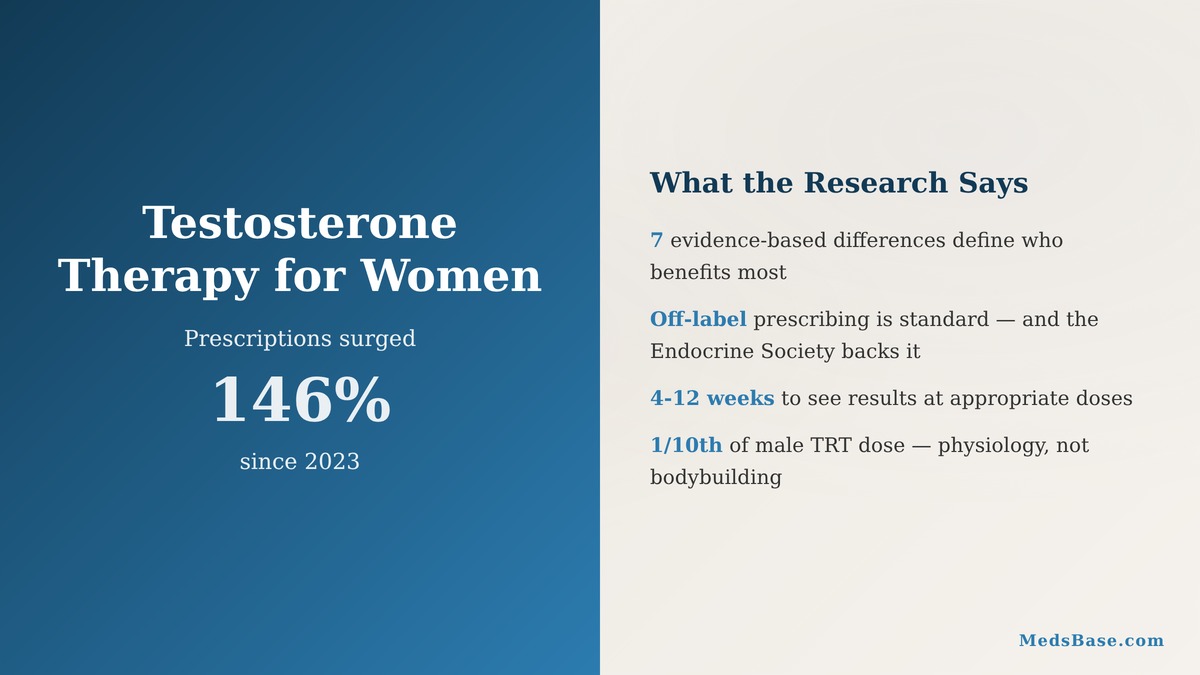
- Testosterone prescriptions for women have surged 146% since 2023 — but reliable online guidance written specifically for women remains scarce
- Testosterone is not just a “male hormone” — women produce it naturally, and levels decline sharply after menopause
- The strongest evidence supports testosterone therapy for women with hypoactive sexual desire disorder (HSDD), not general “anti-aging”
- One form of testosterone therapy is FDA-approved for men but used off-label for women — here is what that actually means for safety and access
- Not every woman is a candidate — a specific set of blood tests and ruled-out conditions determines who benefits
Nearly every conversation about testosterone still starts and ends with men. Search “testosterone therapy for women” and the first page of results is dominated by men’s health clinics, TRT-for-men guides, and the occasional 400-word news piece that barely scratches the surface. Meanwhile, prescriptions for women have surged 146% since 2023 — nearly tripling in under three years — and the women filling those prescriptions are largely figuring it out on their own.
This guide is the resource those women are searching for. By the end, you will know exactly what testosterone does in the female body, which symptoms it can and cannot address, what the research actually says (not what wellness influencers claim), and the practical steps to take if you are considering it.
But here is the open loop: one of the most commonly prescribed forms has zero FDA-approved indications for women. We will unpack what that means for safety — and why it matters far less than you might think.
What Is Testosterone Therapy for Women?
Quick Answer: Testosterone therapy for women is the medical use of testosterone — a hormone women naturally produce — to treat specific conditions, most notably hypoactive sexual desire disorder (HSDD) that does not respond to non-hormonal approaches. It is typically prescribed in much lower doses than those used for men and can be administered as a cream, gel, injection, or subcutaneous pellet.
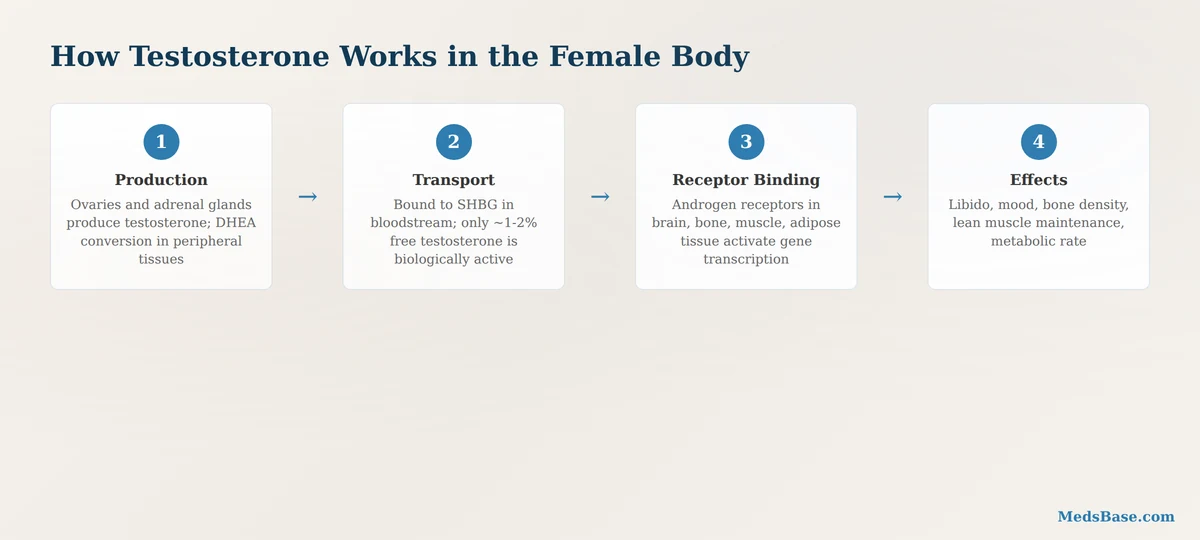
Testosterone belongs to a class of hormones called androgens. While often labeled a “male hormone,” women produce testosterone too — primarily in the ovaries and adrenal glands — and it plays essential roles in libido, bone density, muscle maintenance, mood regulation, and energy levels. In premenopausal women, the ovaries produce roughly half of circulating testosterone; the rest comes from the adrenal glands and peripheral conversion of precursor hormones like DHEA.
After menopause — whether natural or surgical — testosterone levels can drop by 50% or more. For some women, this decline causes noticeable symptoms: a loss of sexual desire that feels qualitatively different from stress-related low libido, persistent fatigue that sleep does not fix, and a sense that something fundamental has shifted. Testosterone therapy for women aims to restore levels to the physiological range for younger women — not to supraphysiological levels used in male TRT.
A critical distinction: testosterone therapy for women is not the same as “hormone pellet therapy” marketed by some med-spas as a broad anti-aging or wellness treatment. The evidence base for testosterone in women is strongest for one specific condition — HSDD — and the dosing principles are fundamentally different from those used in men.
How Does Testosterone Work in the Female Body?
Think of testosterone as a key that fits into locks — androgen receptors — scattered throughout your body. When testosterone reaches these receptors, it triggers a cascade of cellular signals that affect everything from neurotransmitter release in the brain to protein synthesis in muscle tissue.
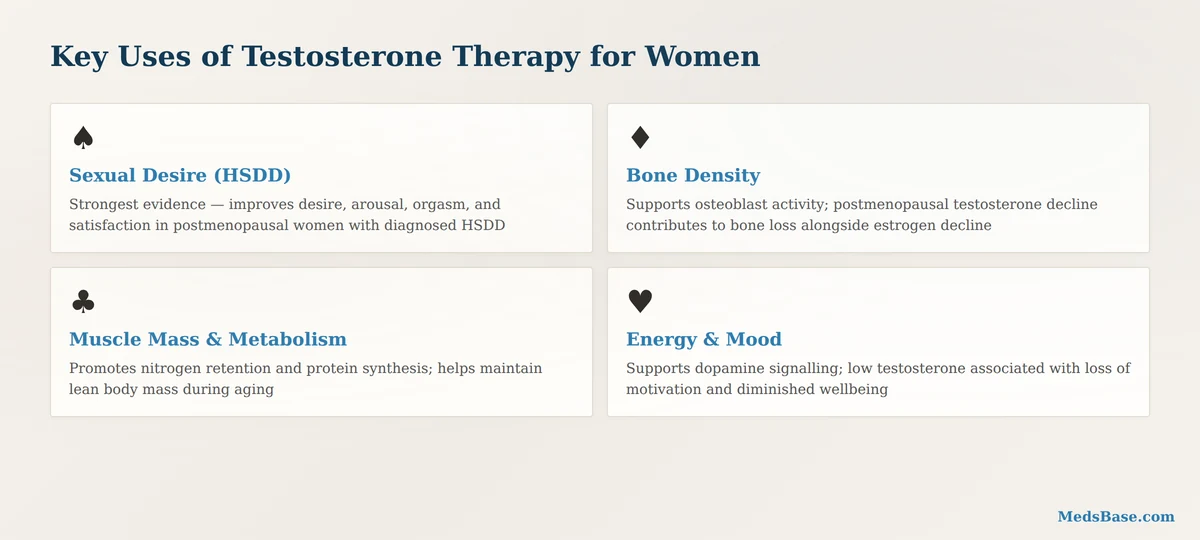
In the brain, testosterone influences the circuits governing sexual motivation and desire — particularly in the hypothalamus and limbic system. It also supports dopamine signaling, which is why low testosterone is associated not just with low libido but with a broader loss of motivation and pleasure in daily activities. This is not about “feeling sexy” — it is about the neurochemical drive that makes you want to engage with the world at all.
In bone, testosterone supports osteoblast activity (bone-building cells), which is why postmenopausal testosterone decline contributes to accelerated bone loss alongside estrogen decline.
In muscle, testosterone promotes nitrogen retention and protein synthesis, helping maintain lean body mass — a function that matters for metabolic health and physical independence as women age.
Research Spotlight
Here is what makes testosterone therapy for women genuinely distinct from testosterone therapy for men: the dosing is an order of magnitude lower, and the goal is restoration to normal female physiology — not pushing levels into a male range. A typical female dose might be one-tenth of a male dose, and blood monitoring aims for the upper end of the premenopausal female reference range.
Key Uses and Who Qualifies for Testosterone Therapy for Women
The conversation around testosterone therapy for women has become muddied by wellness marketing. Let us clarify what the evidence actually supports.
FDA-Recognised Indications
Currently, no testosterone product has FDA approval specifically for women. The FDA approved a testosterone patch (Intrinsa) for HSDD in surgically menopausal women on estrogen therapy in Europe and other regions, but it was never approved in the United States. In practice, testosterone therapy for women is prescribed off-label using products approved for men, at appropriately adjusted doses.
This sounds alarming, but off-label prescribing is standard in medicine — roughly 20% of all prescriptions are off-label — and physician organisations including the Endocrine Society and the International Society for the Study of Women’s Sexual Health (ISSWSH) have published clinical practice guidelines supporting appropriate use.
Conditions Where Evidence Is Strongest
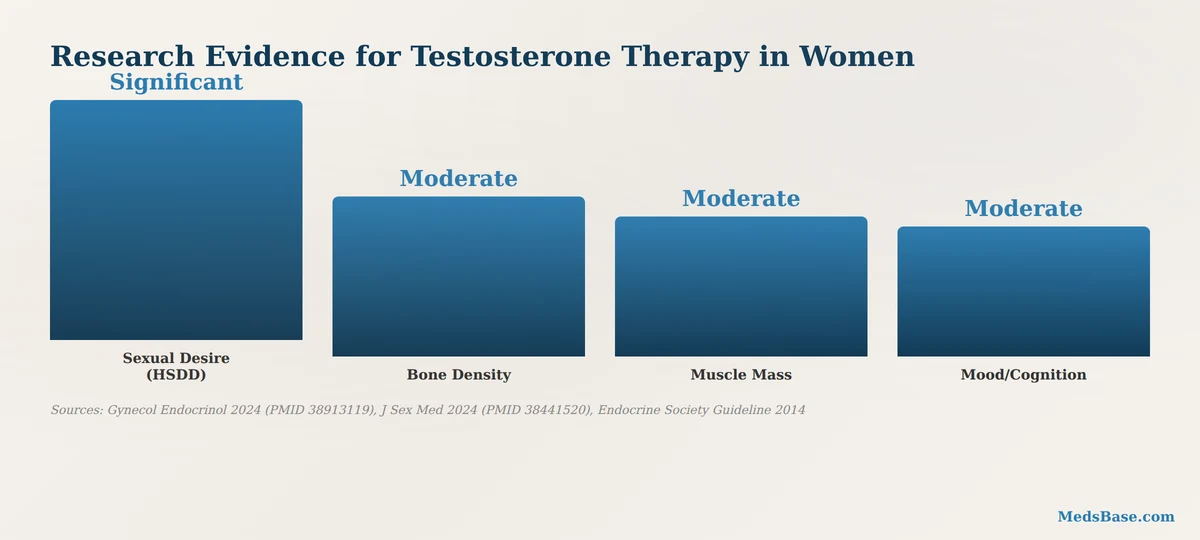
Hypoactive Sexual Desire Disorder (HSDD) — By far the strongest evidence. Multiple randomised controlled trials show that testosterone therapy for women with HSDD produces statistically and clinically significant improvements in sexual desire, arousal, and satisfying sexual events. The 2024 ISSWSH practice guideline identifies testosterone as a first-line pharmacological option for postmenopausal women with HSDD after addressing modifiable factors.
Surgical Menopause — Women who have had both ovaries removed (bilateral oophorectomy) experience an abrupt 50% drop in testosterone. For those who develop persistent low libido despite adequate estrogen therapy, testosterone supplementation has the most consistent trial support.
Natural Menopause with Persistent Symptoms — Evidence is moderate but growing. A 2024 claims database analysis of over 33,000 women found that systemic testosterone was most commonly prescribed to naturally postmenopausal women for low libido, with prescription rates accelerating sharply since 2023 (PMID 38441520).
Who Is This For?
- Postmenopausal women (natural or surgical) with persistent low sexual desire causing distress
- Women who have tried non-hormonal approaches (counseling, lifestyle changes, addressing relationship factors) without adequate improvement
- Women with documented low serum testosterone on a reliable morning blood test
Who Should Avoid It?
- Women with a history of hormone-sensitive breast cancer or endometrial cancer
- Women with severe, uncontrolled cardiovascular disease
- Women who are pregnant, breastfeeding, or trying to conceive
- Women with severe acne, androgenic alopecia, or hirsutism that could be worsened by androgens
- Women with untreated severe obstructive sleep apnea (testosterone can worsen it)
- Women seeking testosterone solely for “anti-aging” or athletic performance without a diagnosed medical indication
If you fall into the “should consider” group, MedsBase carries testosterone-related products, and browsing the Woman’s Health category can help you understand the broader landscape of treatment options available without prescription.
The Safety Profile of Testosterone Therapy for Women
Here is where we resolve the open loop from the introduction.
The side effect nobody expects: virilisation — the development of male-pattern characteristics — is the side effect that catches most women off-guard, not because doctors do not mention it, but because the term itself sounds abstract until it happens. Acne along the jawline, a slight deepening of the voice, or increased facial hair growth can develop gradually enough that a woman does not notice until someone else points it out. The good news: these effects are almost always dose-dependent and reversible with dose reduction or discontinuation.
Side Effect Table
| Side Effect | Frequency | Severity | What To Do |
|---|---|---|---|
| Acne/oily skin | Common (~15–20%) | Mild–Moderate | Topical treatment; reduce dose if persistent |
| Hirsutism (facial/body hair) | Moderate (~8–12%) | Mild–Moderate | Cosmetic management; dose reduction |
| Voice deepening | Uncommon (~1–3%) | Potentially Permanent | Stop treatment immediately; ENT evaluation |
| Clitoral enlargement | Uncommon (~2–5%) | Usually Reversible | Dose reduction |
| Hair loss (scalp) | Uncommon in women at physiological doses | Variable | Reduce dose; consider topical minoxidil |
| Mood changes/irritability | Moderate (~5–10%) | Mild | Often transient; lower dose if persistent |
| Lipid changes (HDL decrease) | Variable | Mild | Monitor lipids at follow-up; usually not clinically significant at female doses |
| Erythrocytosis (high red blood cells) | Rare at female doses | Potentially Serious | Monitor hematocrit; phlebotomy if severe |
The heart question — A 2024 study we covered recently found elevated arrhythmia risk with testosterone therapy, but that analysis was conducted on an almost entirely male population. The cardiovascular risk profile for testosterone therapy for women at physiological replacement doses is not well-characterised, and the Endocrine Society’s current guideline states that short-term use (up to 2 years) in appropriately selected women does not appear to increase cardiovascular events. However, this is an area of active research, and any woman with existing heart disease should discuss this carefully with her physician. You can read our full deep-dive on how testosterone therapy affects heart rhythm.
The cancer question — The relationship between testosterone and breast cancer is complex. Testosterone can be aromatised (converted) to estradiol in breast tissue, and estradiol can stimulate hormone-sensitive breast cancers. However, epidemiological studies have not consistently shown an increased breast cancer risk with testosterone therapy at physiological female doses. The Endocrine Society recommends against testosterone use in women with a history of breast cancer, and this guidance should be followed.
Key safety takeaway: Testosterone therapy for women at appropriately monitored, physiological doses has a manageable safety profile in the short to medium term (up to 2–3 years). Longer-term safety data is limited, which is why ongoing monitoring — blood tests every 3–6 months, plus clinical assessment for signs of virilisation — is non-negotiable.
What the Research Says About Testosterone Therapy for Women
| Study | Year | Finding | Source |
|---|---|---|---|
| Systemic testosterone for FSIAD in postmenopause — systematic review | 2024 | Testosterone significantly improved sexual desire, arousal, orgasm, and satisfaction scores; effect sizes comparable to non-hormonal HSDD treatments | Gynecol Endocrinol (PMID 38913119) |
| Characteristics of systemic testosterone therapy — 33,000+ claims analysis | 2024 | Prescriptions surged 146% since 2023; most prescribed to naturally postmenopausal women for low libido; topical gels and creams were the most common form | J Sex Med (PMID 38441520) |
| ISSWSH clinical practice guideline update | 2024 | Testosterone recommended as a first-line pharmacological option for postmenopausal HSDD after addressing modifiable factors; transdermal preparations preferred | J Sex Med (PMID 39222959) |
| Androgen therapy in women — Endocrine Society guideline | 2014 | Against routine use of testosterone in women without HSDD; for short-term use (≤2 years) in surgically menopausal women with HSDD on concomitant estrogen | JCEM (DOI 10.1210/jc.2014-2260) |
What this means for you: The research is clear on one point — testosterone therapy for women works for low sexual desire when the low desire is truly hormonal in origin, but it is not a general wellness tonic. If your libido is low because of stress, relationship issues, depression, or medications (SSRIs are notorious for this), testosterone may not be the right lever to pull. A thorough evaluation that rules out other causes is the step most women skip — and the one that separates effective treatment from disappointment.
Testosterone Therapy vs Other Options for Low Libido in Women
| Treatment | Mechanism | Evidence Strength | Onset | Key Limitation |
|---|---|---|---|---|
| Testosterone therapy for women | Restores androgen levels | Strong for HSDD | 4–12 weeks | Off-label; monitoring required |
| Flibanserin (Addyi) | Serotonin modulator | Moderate | ~8 weeks | Daily pill; alcohol interaction; prescription-only |
| Bremelanotide (Vyleesi) | Melanocortin agonist | Moderate | ~45 min (as-needed injection) | Nausea (~40%); prescription-only |
| Bupropion (off-label) | Dopamine/norepinephrine | Weak–Moderate | 4–8 weeks | Side effect profile varies |
| Cognitive-behavioral therapy (CBT) | Addresses psychological factors | Moderate–Strong | Variable, 8–16 sessions | Requires trained therapist; time commitment |
| Lifestyle modifications (exercise, stress reduction, sleep) | Multifactorial | Moderate | Variable | Requires sustained effort |
Q: Which one fits which situation?
A: – If your low libido started after surgical menopause and you are already on estrogen: testosterone therapy for women has the strongest evidence – If you have contraindications to hormones or prefer a non-hormonal option: flibanserin or bremelanotide, prescribed by a specialist – If psychological or relational factors are the primary driver: CBT or sex therapy, possibly combined with medication – If you are simply curious about improving a normal-but-want-more libido: lifestyle and behavioral approaches first — testosterone is not indicated for this
How to Start Testosterone Therapy for Women — Practical Steps
Step 1 — Find a knowledgeable provider. Not every gynecologist or primary care physician is comfortable prescribing testosterone to women. Look for a menopause specialist certified by the North American Menopause Society (NAMS) or a sexual medicine specialist affiliated with ISSWSH. In your first conversation, ask directly: “Do you have experience prescribing testosterone therapy for women, and what monitoring protocol do you follow?”
Step 2 — Get the right blood work FIRST. Before starting, you need: total testosterone, free testosterone, SHBG (sex hormone binding globulin), a complete metabolic panel, lipid profile, and estradiol level (if postmenopausal and not on estrogen therapy). Do NOT accept a prescription based on symptoms alone — and do NOT accept a prescription based on salivary testosterone testing, which is unreliable.
Step 3 — Start low. The guiding principle in testosterone therapy for women is “start low, go slow.” Typical starting doses are approximately one-tenth of male TRT doses. A common starting regimen is 0.5–1.0 mg per day of transdermal testosterone cream or gel. Compounded creams allow precise dose titration.
Step 4 — Give it time. Sexual desire does not change overnight. Most trials show significant improvement at 8–12 weeks, with continued improvement through 24 weeks. Do not evaluate effectiveness before 12 weeks unless side effects force a change.
Step 5 — Monitor and adjust. Blood tests at 3–6 months after starting, then every 6–12 months. Target total testosterone in the upper-normal premenopausal female range (roughly 40–70 ng/dL, though lab reference ranges vary). If side effects occur, reduce the dose before adding medications to manage side effects.
Mistakes women commonly make:
- Getting testosterone from a med-spa without proper lab monitoring — this is how virilisation happens
- Expecting results in the first week — testosterone therapy for women works gradually
- Self-adjusting the dose upward when they feel it “isn’t working” at week 4 — impatience leads to side effects
- Assuming testosterone is a replacement for estrogen therapy — it is not; low estrogen has its own set of risks
- Stopping abruptly rather than tapering — though withdrawal is not dangerous, some women report mood dips with sudden discontinuation
Related Reading
- Testosterone Therapy and Heart Rhythm Risks: What Every Patient on TRT Should Know — the cardiovascular safety deep-dive
- Menopause Hormone Therapy and Cardiovascular Disease: What the Research Says — broader HRT context
- Alopecia Treatment Options: A Complete Guide — if you’re concerned about androgen-related hair changes
Frequently Asked Questions About Testosterone Therapy for Women
Q: Can women take testosterone therapy?
A: Yes. Women produce testosterone naturally, and medically supervised testosterone therapy for women is an accepted treatment for specific conditions, particularly HSDD in postmenopausal women. It is prescribed off-label using lower doses than those used for men, and should always include baseline and follow-up blood monitoring.
Q: What does testosterone do for women?
A: Testosterone supports sexual desire, arousal, and orgasm; helps maintain bone density and lean muscle mass; contributes to energy and mood regulation; and influences cognitive function. In women with documented low testosterone, replacement therapy targets these domains, with sexual function showing the strongest treatment response.
Q: What are the side effects of testosterone therapy in females?
A: The most common side effects are acne (15–20%), increased facial or body hair (8–12%), and scalp hair thinning (less common at physiological doses). More concerning but rarer effects include voice deepening and clitoral enlargement, both of which are dose-dependent and usually reversible with dose reduction. Regular monitoring catches most side effects before they become persistent.
Q: Does testosterone help with menopause symptoms?
A: Testosterone therapy for women primarily addresses low sexual desire associated with menopause, not the vasomotor symptoms (hot flashes, night sweats) that estrogen therapy treats. Some women report improved energy and mood, but the strongest evidence is specifically for sexual function. Testosterone is not a replacement for estrogen therapy.
Q: How much testosterone should a woman take?
A: There is no single standard dose — it is individualised based on blood levels, symptoms, and response. Typical transdermal doses range from 0.5 to 5.0 mg per day, with most women finding their optimal dose between 1.0 and 3.0 mg. The goal is to reach the upper-normal premenopausal female range for total testosterone, not to exceed it.
Q: Is testosterone therapy safe for women long-term?
A: Short- to medium-term safety data (up to 2–3 years) is reassuring when monitoring is in place. Long-term safety data beyond 3–5 years is limited. Current guidelines recommend periodic reassessment of the risk-benefit balance and ongoing monitoring of lipid profiles, hematocrit, and liver function.
Q: Can testosterone therapy cause weight gain?
A: Testosterone tends to shift body composition toward more lean mass and less fat mass, so weight gain from fat accumulation is unlikely. Some women notice a modest increase in scale weight from water retention or increased muscle mass, but this is not harmful. If you experience rapid weight gain, bloating, or swelling, contact your prescribing doctor — this may indicate fluid retention requiring dose adjustment.
Q: Will testosterone therapy for women affect my fertility?
A: Yes — testosterone can suppress ovulation and should not be used by women who are pregnant, trying to conceive, or not using reliable contraception. If fertility preservation is a priority, testosterone therapy for women is not appropriate at this stage of life.
The Bottom Line
Testosterone therapy for women sits at an inflection point: prescriptions are surging, the evidence base is solidifying, but reliable public-facing information written for women is still catching up. Here is the verdict in plain terms: if you are a postmenopausal woman with persistent, distressing low sexual desire that has not responded to non-hormonal approaches — and you have no contraindications like hormone-sensitive cancer — testosterone therapy is a reasonable, evidence-supported option worth discussing with a knowledgeable provider.
If, on the other hand, you are considering testosterone for general “wellness,” anti-aging, or athletic performance, the evidence does not support it, and the risks — particularly virilisation from unnecessarily high dosing — outweigh the unproven benefits.
Your immediate action: if low libido is affecting your quality of life, start with a conversation with your primary care provider or gynecologist. Ask for a morning blood draw measuring total and free testosterone plus SHBG. This single lab panel tells you whether testosterone is even part of the picture — and if it is not, you have saved yourself from months of pursuing the wrong solution.
Wondering how testosterone fits into the broader menopause treatment landscape? Read our guide on hormone therapy and cardiovascular health in menopause. And if you are concerned about potential hair changes from any hormonal treatment, our alopecia treatment guide walks through every evidence-based option available today.
Browse MedsBase’s Woman’s Health category for accessible treatment options and evidence-based guidance written for women.
Medical Disclaimer: This article is for informational purposes only and does not constitute medical advice. Testosterone therapy should only be initiated and monitored by a qualified healthcare professional. Always consult your doctor before starting, stopping, or changing any medication or treatment.

Written by
Sophie ChenPharmaceutical Content Researcher · 8 years experience
Sophie Chen is a pharmaceutical content researcher with 8 years covering generic medication access and clinical pharmacology. She specialises in international regulatory frameworks, bioequivalence standards, and patient-facing education on therapeutic drug classes. She is not a clinician.