








✓ Medically reviewed by · Last reviewed: May 2026
Pharmacy Researcher · 8 years experience
Pharmacy researcher with 8 years reviewing clinical drug information, generic formulation equivalence, and international pharmaceutical standards. Focuses on patient-facing accuracy in medication education.
gepants vs CGRP monoclonal antibodies — Gepants vs CGRP Monoclonal Antibodies — Which Migraine Prevention Is Right for You?. Read on for an evidence-backed guide covering everything you need to know.
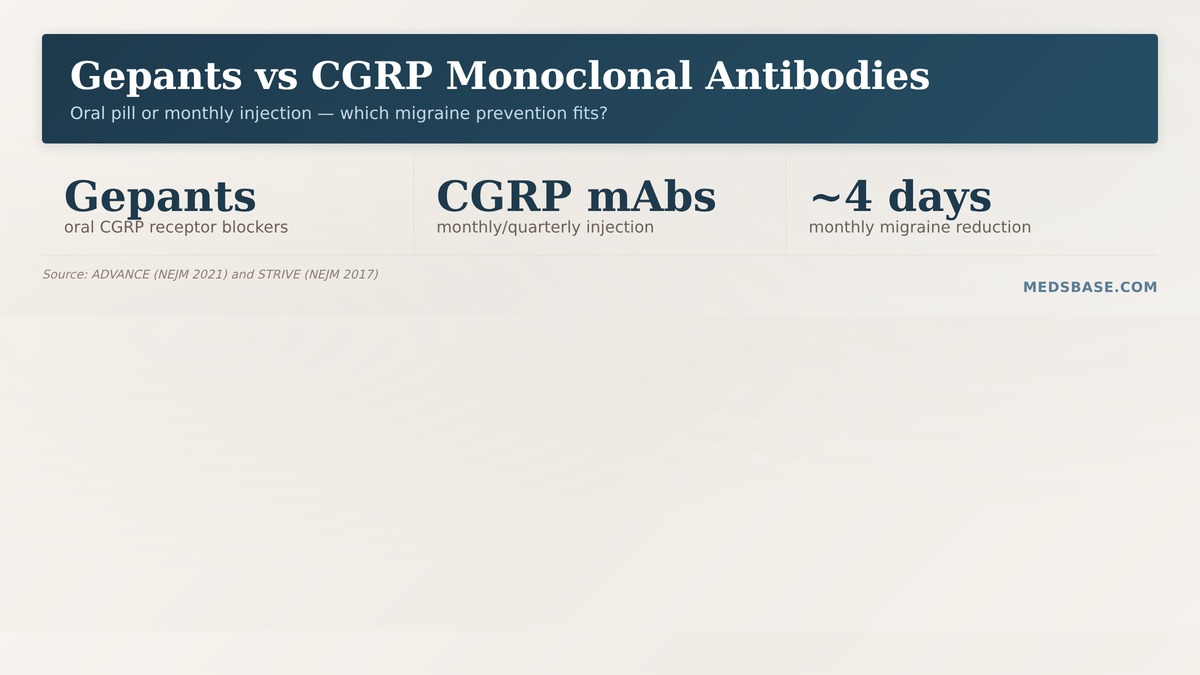
Gepants vs CGRP monoclonal antibodies — imagine you have lived with 12 to 15 migraine days every month for years — and now your neurologist offers you two new options. One is a daily oral pill you take at home. The other is a monthly injection you give yourself (or receive at a clinic) using an autoinjector pen. Both target the same biological pathway — CGRP — and both were approved within the last several years. This is not a hypothetical scenario. The choice between gepants vs CGRP monoclonal antibodies is one that tens of thousands of people with chronic and episodic migraine are navigating right now. The two drug classes share a therapeutic target but differ in practically every other dimension — how you take them, how fast they work, how you stop them, what they cost, and what side effects you should watch for. Here is a clear, evidence-backed head-to-head comparison to help you walk into your next appointment with the right questions.
- Gepants (atogepant, rimegepant) are small-molecule oral pills that block the CGRP receptor directly — rimegepant works for both acute treatment and prevention, while atogepant is prevention-only.
- CGRP monoclonal antibodies (erenumab, galcanezumab, fremanezumab, eptinezumab) are injectable biologic drugs that either bind CGRP itself or block its receptor — dosed monthly or quarterly.
- The ADVANCE trial showed atogepant reduced monthly migraine days by ~4 days vs ~2.5 with placebo; the STRIVE trial showed erenumab reduced days by ~3.2 vs ~1.8 with placebo. The absolute differences between the two classes are small.
- The practical differentiator between gepants vs CGRP monoclonal antibodies is not efficacy — it is route (oral vs injectable), onset speed (gepants faster), washout (gepants faster if you need to stop), and half-life (mAbs persist for weeks; gepants clear in hours).
- Both classes have favourable side-effect profiles compared to older migraine preventives like topiramate. The gepants cause more nausea; the mAbs cause more injection-site reactions and constipation.
- Rimegepant is unique: it is the only drug approved for both acute treatment AND prevention, meaning one prescription can serve both roles.
Gepants vs CGRP monoclonal antibodies: On this page:
- What Is CGRP and Why Block It? — The biology behind both drug classes
- What Are Gepants? — Oral CGRP receptor antagonists explained
- What Are CGRP Monoclonal Antibodies? — The injectable approach
- What the Trials Show — ADVANCE, STRIVE, and the evidence
- Side Effects Compared — Gepants vs CGRP Monoclonal Antibodies
- Which One Fits You? — A decision framework
- Frequently Asked Questions
Q: Gepants vs CGRP Monoclonal Antibodies: Which Migraine Prevention Is Right for You?
A:
Gepants vs CGRP monoclonal antibodies: What Is CGRP and Why Block It?
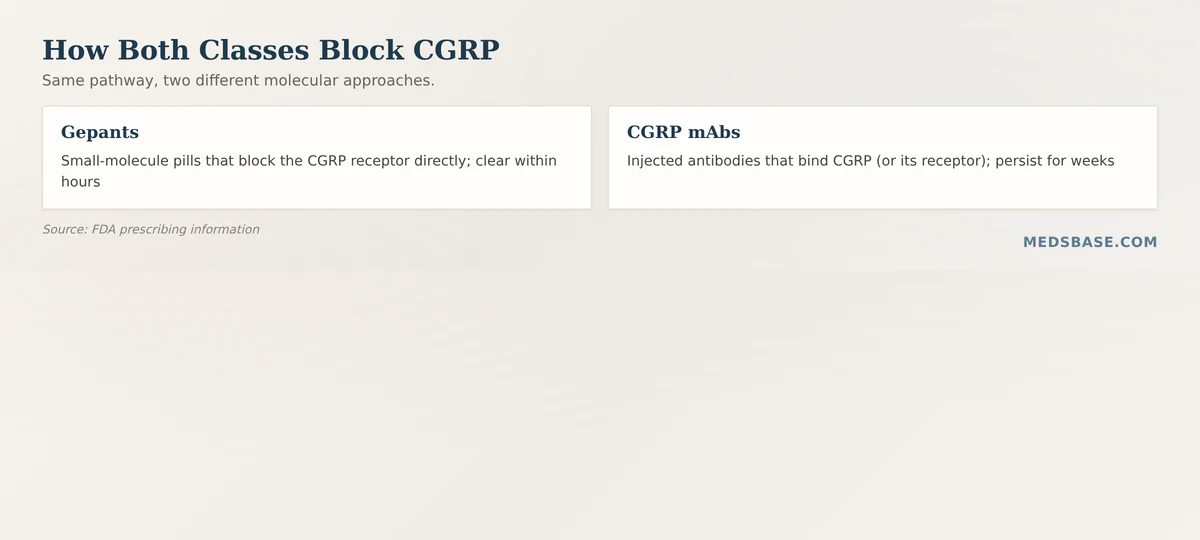
To understand the choice between gepants vs CGRP monoclonal antibodies, you first need to understand what CGRP is and why blocking it works for migraine. Calcitonin gene-related peptide (CGRP) is a small protein released from trigeminal nerve endings during a migraine attack. It is not the cause of migraine — the underlying neurological susceptibility is more complex — but CGRP is the primary mediator of the pain signal. When CGRP binds to its receptor on blood vessels and nerve cells in the meninges (the protective layers around the brain), it triggers vasodilation (vessel widening), neurogenic inflammation, and pain-signal transmission. Blocking this pathway — either by neutralising CGRP itself or by blocking its receptor — interrupts the pain cascade. This is the shared mechanism behind both gepants and CGRP monoclonal antibodies. They target the same pathway through different molecular approaches.
Gepants vs CGRP monoclonal antibodies — the clinical significance of targeting CGRP specifically — rather than the broader mechanisms targeted by older preventives like beta blockers, tricyclic antidepressants, or topiramate — is selectivity. CGRP is a migraine-specific mediator. Drugs that block it do not lower blood pressure (like beta blockers), do not cause weight gain or cognitive dulling (like tricyclics and topiramate), and do not require weeks or months of dose titration. For the first time, migraine prevention can be specific to the migraine pathway.
What Are Gepants?
Gepants (pronounced JEE-pants) are small-molecule CGRP receptor antagonists — oral drugs that directly block the CGRP receptor, preventing CGRP from delivering the pain signal. Because they are small molecules (not large antibody proteins), they can be absorbed through the gut and taken as pills. Three gepants are currently approved, with distinct roles:
- Atogepant (Qulipta) — approved for migraine PREVENTION. Taken once daily as an oral tablet (10mg, 30mg, or 60mg). The ADVANCE trial (Ailani et al., NEJM 2021) showed atogepant 30mg and 60mg reduced monthly migraine days by approximately 3.9-4.2 days versus 2.5 days with placebo.
- Rimegepant (Nurtec ODT) — approved for BOTH acute treatment and prevention. Taken as an orally-disintegrating tablet (75mg). For prevention: every-other-day dosing. Unique in being the only single drug approved for both roles.
- Ubrogepant (Ubrelvy) — approved for acute treatment ONLY (not prevention). Taken as needed at the onset of a migraine attack (50mg or 100mg).
When people ask about gepants vs CGRP monoclonal antibodies for prevention specifically, the comparison is primarily between atogepant (daily pill) and the injectable CGRP mAbs. But rimegepant’s dual-role capability means some people can use one drug for both acute and preventive treatment — a convenience advantage neither atogepant nor the mAbs can match.
What Are CGRP Monoclonal Antibodies?
Gepants vs CGRP monoclonal antibodies — cGRP monoclonal antibodies are large protein molecules — biologic drugs — that either bind CGRP directly in the bloodstream (preventing it from reaching its receptor) or bind the CGRP receptor itself (blocking it, similar to how gepants work but through a different molecular approach). Because they are proteins, they cannot be taken orally — stomach acid would digest them. They must be injected, either subcutaneously (under the skin) or intravenously. Four are approved:
- Erenumab (Aimovig) — monthly subcutaneous injection (70mg or 140mg). Blocks the CGRP receptor directly — the only mAb that targets the receptor rather than the ligand. The STRIVE trial (Goadsby et al., NEJM 2017) showed erenumab 70mg and 140mg reduced monthly migraine days by 3.2 and 3.7 days versus 1.8 days with placebo.
- Galcanezumab (Emgality) — monthly subcutaneous injection (120mg, with 240mg loading dose). Binds CGRP itself.
- Fremanezumab (Ajovy) — monthly or quarterly subcutaneous injection (225mg monthly or 675mg quarterly). Binds CGRP itself.
- Eptinezumab (Vyepti) — quarterly intravenous infusion (100mg or 300mg). Binds CGRP itself. Administered in a clinic setting rather than at home.
Gepants vs CGRP monoclonal antibodies — the practical experience is quite different from taking a daily pill. Most patients self-inject at home using an autoinjector pen (similar to an EpiPen) once a month. The injection is subcutaneous — into the thigh or abdomen — and takes about 10-15 seconds. Some patients experience a transient injection-site reaction (redness, swelling, mild pain), but these typically resolve within hours.
What the Trials Show
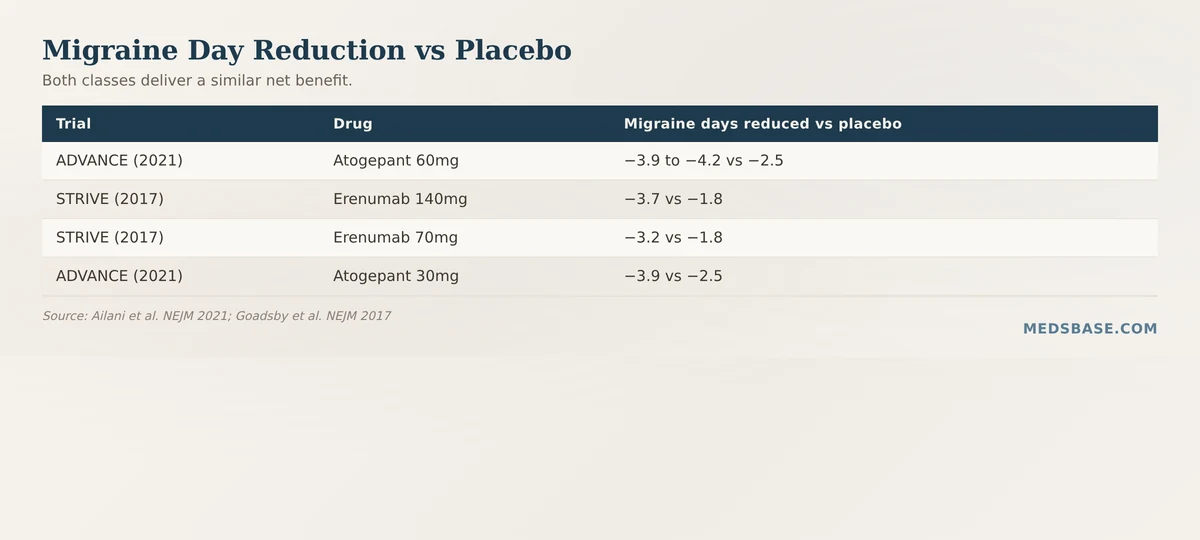
Direct head-to-head trials comparing gepants vs CGRP monoclonal antibodies do not exist — no trial has randomised patients to atogepant versus erenumab, for example. The comparisons we can make are between each drug’s placebo-controlled trial programme, which introduces the usual caveats about cross-trial comparisons (different populations, different baseline characteristics). With that acknowledged, the efficacy data is remarkably consistent across both classes.
Side Effects — Gepants vs CGRP Monoclonal Antibodies
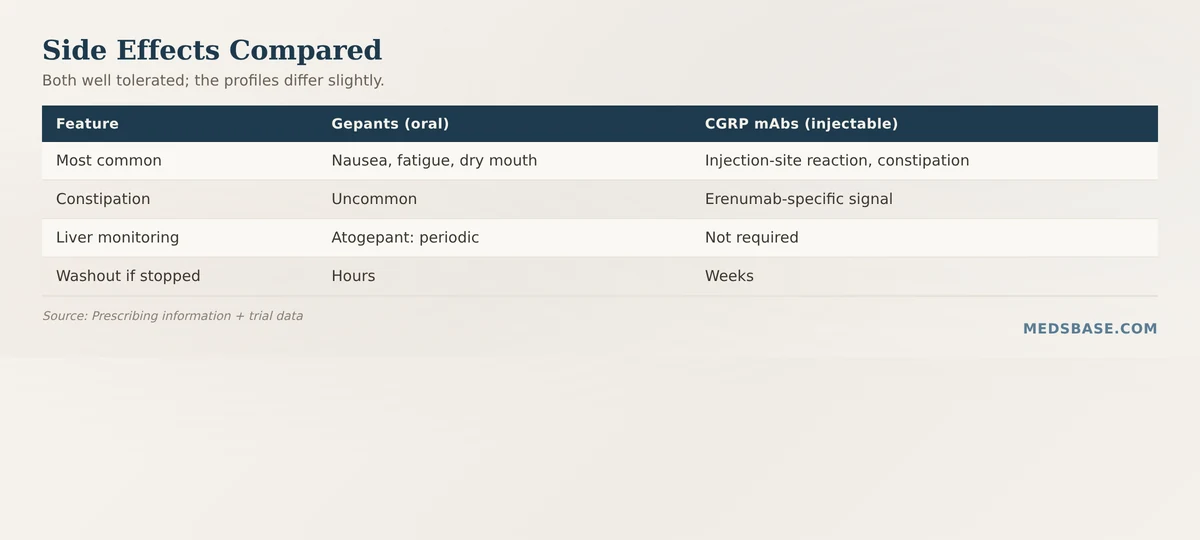
Both classes are well-tolerated compared to the older generation of migraine preventives — a major reason for their rapid clinical adoption. But the side-effect profiles differ in ways that may matter for individual patients.
The constipation signal deserves emphasis. While erenumab’s constipation rate in STRIVE was approximately 3-4%, post-marketing reports have identified rare cases of severe constipation requiring hospitalisation. This appears to be erenumab-specific — the CGRP ligand-binding mAbs (galcanezumab, fremanezumab) do not carry the same signal strongly. For patients with pre-existing slow-transit constipation or irritable bowel syndrome with constipation, this may tilt the gepants vs CGRP monoclonal antibodies decision toward a gepant — or, if an injectable is preferred, toward galcanezumab or fremanezumab rather than erenumab.
Which One Fits You? — A Practical Decision Framework
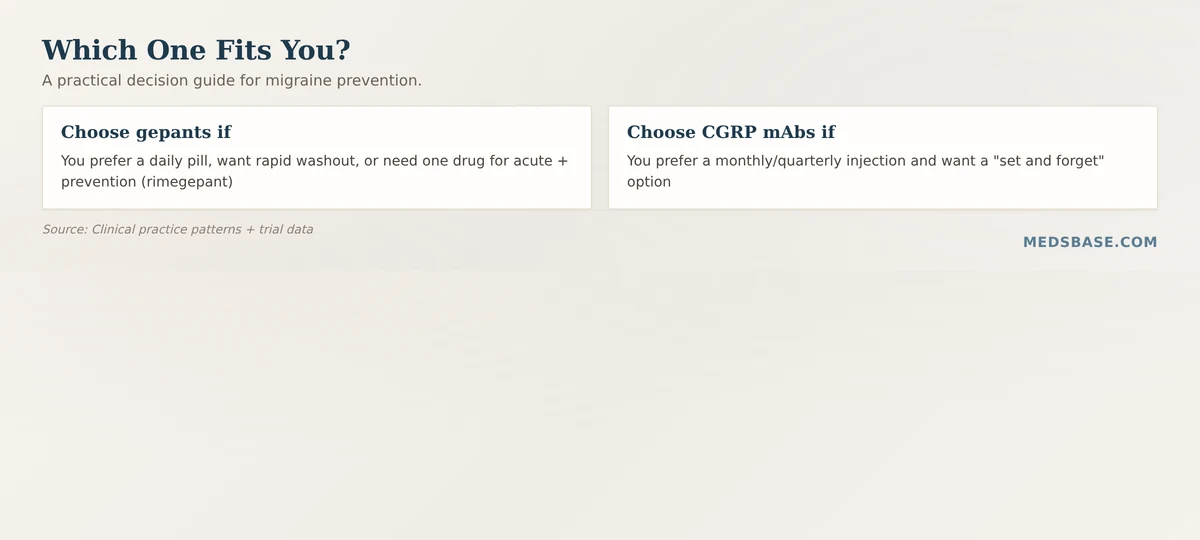
When the efficacy data is essentially equivalent, the choice between gepants vs CGRP monoclonal antibodies comes down to the practicalities of your life — how you prefer to take medication, what fits your schedule, and which side-effect concerns matter most to you.
If you are planning to become pregnant or are pregnant, neither class has adequate human pregnancy data — the default conservative approach is avoidance. If you are switching from oral preventives like topiramate and want to stay on an oral medication you control daily, gepants keep that familiarity. If you have struggled with daily pill adherence and want a “set and forget” option, a monthly or quarterly injectable may be more practical.
For many people, the conversation is simpler: you try the class your insurance covers first. Both classes are expensive brand-name medications, and insurance prior authorisation often dictates which you can access. If both are available, the choice between gepants vs CGRP monoclonal antibodies comes back to your preference for pills versus injections — because neither class has a clear efficacy advantage. If you are exploring migraine management alongside other pain conditions, browse pain management options at MedsBase for an overview of available treatments.
- Sumatriptan vs Rizatriptan — which triptan fits you? —. If you also use acute migraine medications, understanding the differences between triptans matters.
- Migraine prevention medication guidelines —. How CGRP-targeted drugs fit into the broader prevention landscape.
- Pain management at MedsBase — Browse the full range of pain management options.
Frequently Asked Questions
Q: Which works better — gepants or CGRP monoclonal antibodies?
A: In cross-trial comparison, gepants vs CGRP monoclonal antibodies show essentially equivalent efficacy. Both reduce monthly migraine days by approximately 1.5-2 days more than placebo, from a baseline of roughly 8-9 migraine days per month. The ADVANCE trial (atogepant) showed a net 1.4-1.7 day advantage over placebo; the STRIVE trial (erenumab) showed a net 1.4-1.9 day advantage. No head-to-head trial has directly compared a gepant to a CGRP mAb, so claims of superiority for either class are not evidence-based. The choice should be driven by practical factors — route of administration, side-effect profile, and cost — not a presumed efficacy difference.
Q: How quickly do gepants work for migraine prevention?
A: Gepants work relatively quickly. The ADVANCE trial showed significant separation from placebo within the first 4 weeks. Rimegepant, used every other day for prevention, showed onset of preventive benefit within the first week of treatment in its pivotal trial. The rapid onset is one reason gepants are attractive for patients who cannot wait 8-12 weeks — the typical assessment period for older preventives — to know if a drug is working. CGRP monoclonal antibodies also show relatively rapid onset (~4 weeks for most), but the gepants’ short half-life means they achieve steady-state concentrations faster, which may translate into a slightly quicker initial response.
Q: Can I take a gepant and a CGRP monoclonal antibody together?
A: In theory, combining gepants vs CGRP monoclonal antibodies — using both simultaneously — would block the CGRP pathway at two points (the receptor, via the gepant, and CGRP itself, via the mAb). However, this combination has not been studied in clinical trials, and combining two drugs with the same therapeutic target without evidence of additive benefit exposes you to additive risk — particularly the constipation signal with CGRP blockade. Most headache specialists do not combine them and instead switch between classes if one fails. If you are not responding to one class, the evidence supports trying the other — sequential use, not simultaneous use.
Q: Do CGRP monoclonal antibodies cause hair loss?
A: Hair loss (alopecia) is not listed as a common side effect in the prescribing information for erenumab, galcanezumab, fremanezumab, or eptinezumab, and it did not occur at higher rates than placebo in the pivotal trials. However, post-marketing reports and patient forums contain anecdotal accounts of hair thinning or shedding while on CGRP mAbs. These reports are difficult to interpret because migraine itself is associated with stress, and stress-related telogen effluvium (temporary hair shedding) can coincide with treatment initiation. If you notice significant hair loss after starting a CGRP-targeted drug, discuss it with your neurologist — switching to the other class (from mAb to gepant, or vice versa) is one option to explore.
Q: Are gepants safer than CGRP monoclonal antibodies?
A: Both classes have favourable safety profiles, and neither has a clearly superior safety record in the available data. The gepants have the advantage of short half-life — if a side effect develops, the drug clears from your system within hours, whereas a CGRP mAb persists for weeks after the last injection. This makes gepants the safer choice if you are concerned about tolerability or if you might need to stop the drug quickly (for example, for pregnancy planning). The CGRP mAbs have the advantage of a longer post-marketing surveillance record — they were approved earlier (2018 for erenumab, versus 2021 for atogepant) — meaning the real-world safety database is larger. Neither class has a hepatic, renal, or cardiovascular safety signal of major concern. For reliable background on migraine itself, the NHS migraine information page and the MedlinePlus migraine guide provide comprehensive, evidence-based overviews.
Q: How much do gepants and CGRP monoclonal antibodies cost?
A: Both gepants vs CGRP monoclonal antibodies are expensive brand-name drugs. In the US market, the list price for a monthly supply of atogepant, rimegepant, or any of the CGRP mAbs is typically in the range of $600-$800 per month before insurance. Most patients with commercial insurance pay significantly less through manufacturer copay cards and prior-authorisation approvals. Medicare Part D coverage varies by plan. Manufacturer patient-assistance programmes exist for those without insurance or with high deductibles. The cost question is often the real decision-maker — your insurance formulary may cover one class but not the other, or may require step therapy (trying and failing an older preventive first) before approving either. Your neurologist’s office will typically handle the prior-authorisation process.
Q: Can gepants be used as both preventive and acute treatment?
A: Only rimegepant (Nurtec ODT) is approved for this dual role. It is taken every other day for prevention and as a single dose for acute treatment of a breakthrough migraine. Triptan users switching to a CGRP-targeted approach often find this convenient — one prescription, one pharmacy, one drug for both roles. Atogepant and ubrogepant are NOT dual-role: atogepant is prevention-only, ubrogepant is acute-only. None of the CGRP monoclonal antibodies are approved for acute treatment — they are solely preventive. If dual-role capability is important to you, rimegepant is the unique option in the CGRP class.
Q: What happens if I stop taking a gepant or CGRP monoclonal antibody?
A: This is an underappreciated practical difference between gepants vs CGRP monoclonal antibodies. If you stop a gepant, the drug clears from your system in hours — migraines typically return to their pre-treatment frequency within days. If you stop a CGRP monoclonal antibody, the drug persists in your body for weeks to months due to the long half-life (approximately 28 days for erenumab, similar for others). Migraines typically return gradually over 4-8 weeks as drug levels decline. This difference matters for pregnancy planning (gepant is easier to clear), surgical planning (mAb may interact with anaesthesia considerations), and side-effect management (gepant side effects resolve quickly; mAb side effects can linger). Neither class causes a withdrawal syndrome — migraines returning is the natural history of the condition, not a drug withdrawal.
The Bottom Line
The choice between gepants vs CGRP monoclonal antibodies is genuinely one of the better problems to have in migraine medicine — you have two effective, well-tolerated classes targeting the same pathway through different delivery methods. The efficacy is comparable. The safety is comparable. The difference comes down to your preference, your lifestyle, your insurance coverage, and how your body responds. Some people do better on one class than the other for reasons that clinical trials have not yet explained — and for them, having two classes to try, sequentially, is a genuine advance.
Your immediate action: If you are considering CGRP-targeted prevention, ask your neurologist: “Which class — gepants or CGRP monoclonal antibodies — fits my situation given my medication preferences, side-effect concerns, and insurance coverage?” Bring the decision table from this article. If you have tried one class without adequate benefit or with intolerable side effects, the other class is the logical next step. And if you are managing migraine alongside other pain conditions, browse pain management options at MedsBase for a broader view of your treatment landscape.
Two questions worth asking next: If you want to understand how the acute migraine medications you use alongside prevention compare, [read our sumatriptan vs rizatriptan guide — EDITOR: link to published post]. And if this evidence-based approach to medication comparisons resonates with you, [[our companion article on SGLT2 inhibitors for heart failure — EDITOR: link to today’s draft]](#) applies the same framework to a different therapeutic area.

Written by
Sophie ChenPharmaceutical Content Researcher · 8 years experience
Sophie Chen is a pharmaceutical content researcher with 8 years covering generic medication access and clinical pharmacology. She specialises in international regulatory frameworks, bioequivalence standards, and patient-facing education on therapeutic drug classes. She is not a clinician.