








✓ Medically reviewed by · Last reviewed: May 2026
Pharmacy Researcher · 8 years experience
Pharmacy researcher with 8 years reviewing clinical drug information, generic formulation equivalence, and international pharmaceutical standards. Focuses on patient-facing accuracy in medication education.
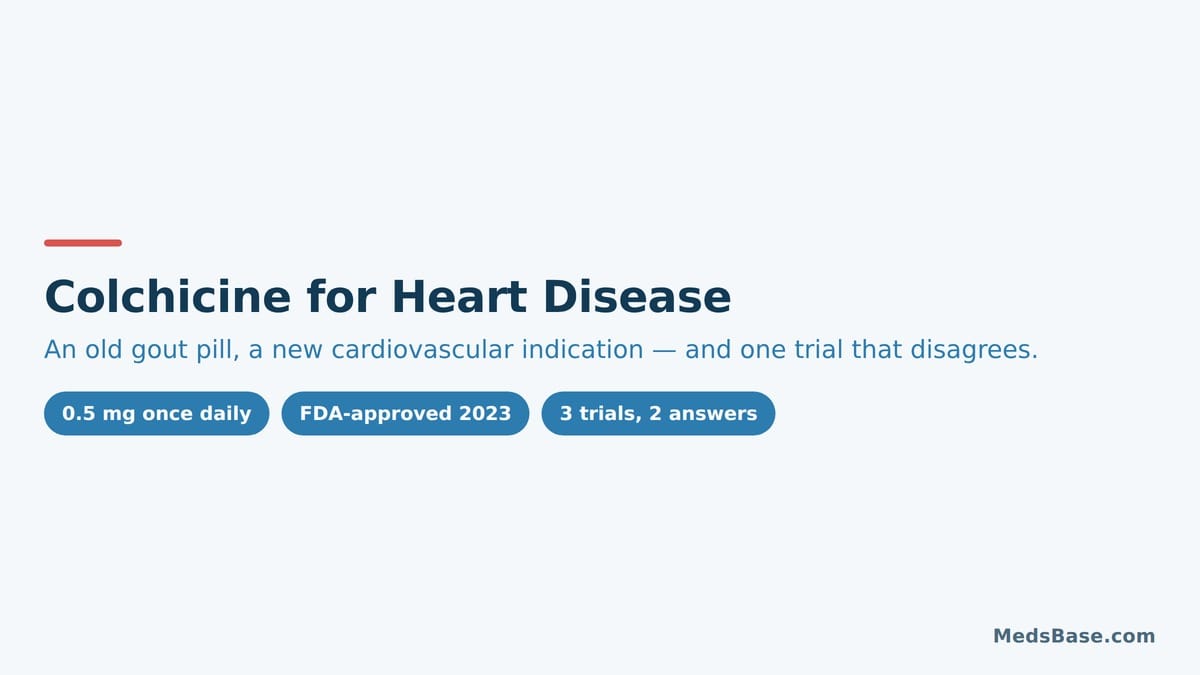
Most people believe colchicine is a gout drug. That was true for about two hundred years, and it is still the reason most bottles get dispensed. But the research says something else has happened: colchicine for heart disease is now an approved cardiovascular treatment, taken daily at a low dose by people who have never had a gout attack in their lives.
By the end of this guide you will know exactly what the approval covers, why the same drug produced a 31% risk reduction in one trial and essentially nothing in another, and what that contradiction should mean for a conversation with your own doctor. There is also a safety finding buried in the meta-analyses that almost no coverage mentions — we will come back to it in the safety section, because it is the single most important reason not to self-start this medicine.
- Colchicine does nothing to your cholesterol — it targets a completely different problem, and that is exactly why it was tested.
- Two major trials showed a clear benefit, and one bigger, newer trial showed none. The likely explanation is not that anyone made a mistake.
- The cardiovascular dose is far lower than the gout-flare dose, and mixing the two up is a genuine risk.
- There is a mortality signal in the pooled data that points in an uncomfortable direction — details in the safety section.
- If you already take a statin and your risk is still high, this is a real conversation to have. If you are hoping to skip the statin, this is not the drug for that.
What Is Colchicine, and Why Is It Being Used for Heart Disease?
Colchicine is an anti-inflammatory medicine extracted from the autumn crocus, used for centuries to treat gout. It works by blocking the inflammatory response that white blood cells mount in tissue — which is why it stops a gout flare, and why researchers wondered whether it could calm the very similar inflammation that goes on inside a diseased artery.
That question turned out to matter enormously. For thirty years, cardiovascular prevention has been built around lowering cholesterol. It works. But a large number of people do everything right — statin taken, LDL down to target, blood pressure controlled — and still have heart attacks. Cardiologists call what is left over residual risk, and a substantial share of it appears to be inflammatory rather than lipid-driven.
Here is where it gets interesting. If inflammation is a separate problem, then lowering cholesterol harder will never fully solve it. You need a drug that does a different job. Colchicine is cheap, generic, has a two-century safety record, and blocks exactly the kind of white-cell activity involved. So it got tested.
One practical thing to get straight immediately: the heart dose and the gout dose are not the same. Cardiovascular use is 0.5 mg once daily, taken indefinitely. Acute gout treatment uses a higher, short burst — typically a dose followed by another an hour later, then stopping. If you take colchicine already and are wondering whether you are “covered,” you almost certainly are not, and if you want the flare protocol instead, that is covered separately in our guide to what actually stops a gout attack.
How Does Colchicine Work in Heart Disease?
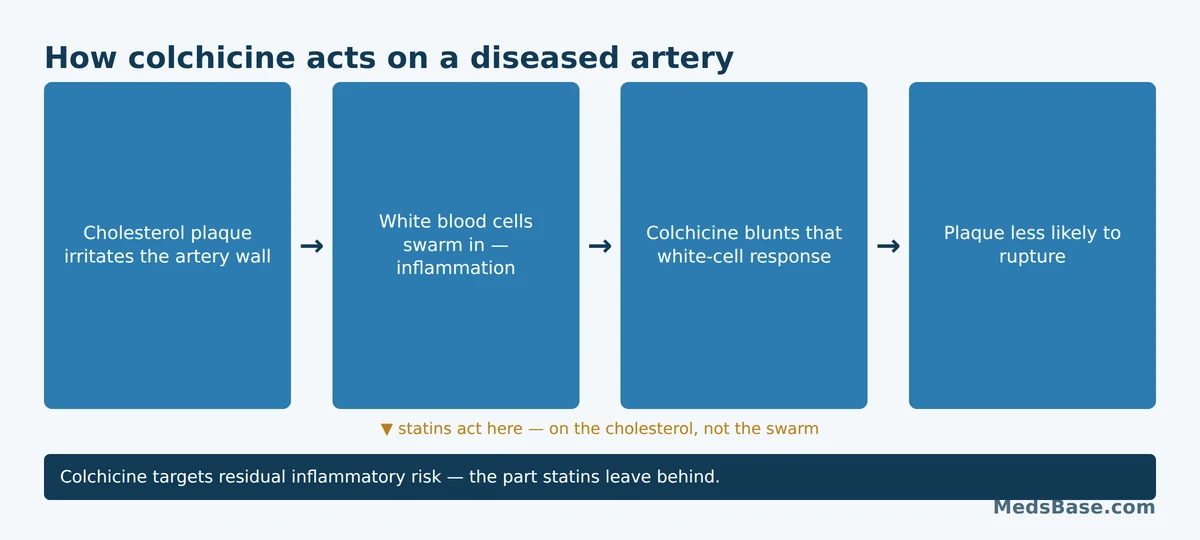
Picture an artery wall as a road surface with a pothole forming under the tarmac. Cholesterol is the material collecting in the pothole. Inflammation is the repair crew that shows up, digs around the edges, and sometimes makes the surface less stable than it was before. A heart attack usually happens when that patch of surface finally breaks open and a clot forms on top of it.
Statins reduce the material going into the pothole. Colchicine interferes with the crew.
More precisely: colchicine binds to tubulin inside white blood cells, which disrupts the internal scaffolding those cells need to migrate, to swarm, and to assemble the inflammatory machinery that drives plaque instability. The plaque does not disappear. It becomes less likely to rupture.
That mechanism explains something readers often find confusing. Your cholesterol numbers will not improve on colchicine. Your LDL will sit exactly where your statin left it. If you are the kind of person who measures progress by lab results, this drug will feel like nothing is happening — and there is currently no routine blood test that tells you it is working.
Who Is Colchicine for Heart Disease Actually For?
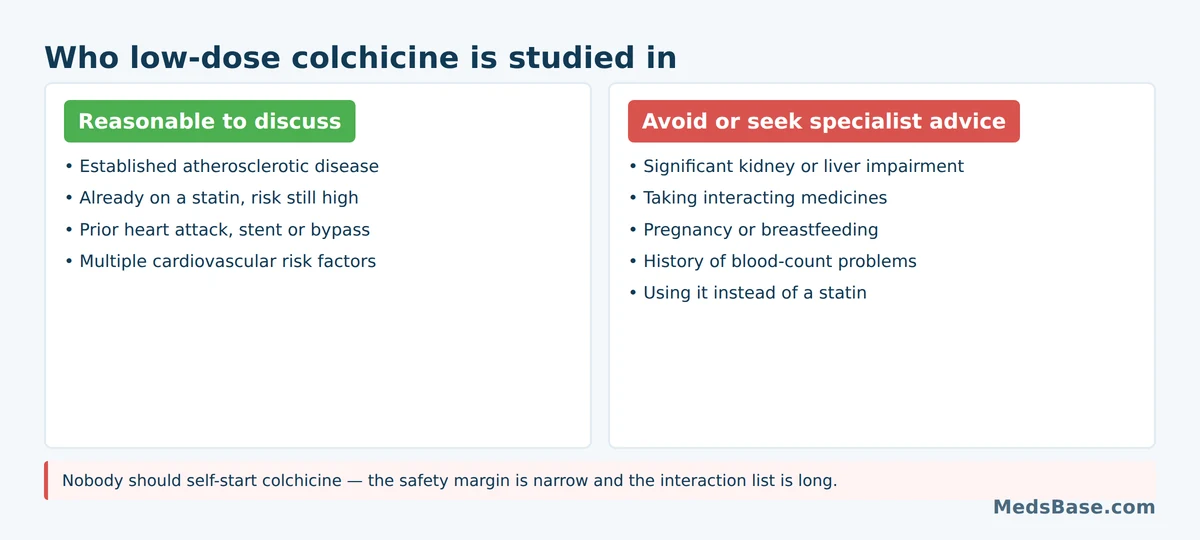
The approved indication is adults with established atherosclerotic disease, or with multiple risk factors for it. In practice that means people who have already had a heart attack, a stent, a bypass, or documented narrowing in their coronary arteries — and who are already on the standard therapy.
That last part is not a footnote. In the trials, more than 90% of participants were on statins. Colchicine was tested on top of good care, not instead of it. Any framing that treats it as an alternative to lipid-lowering therapy misrepresents every study that has been done.
People already on a statin whose risk remains high
This is the core group. Researchers modelled how many US adults this could apply to and found roughly 9.2 million adults with stable coronary artery disease on statin therapy, of whom about 6.9 million (95% CI 4.8–8.9 million) would meet the eligibility criteria used in LoDoCo2. That is a very large group — comparable in scale to statin eligibility itself.
People whose risk keeps declaring itself despite good control
If you have had a second event while your LDL was at target, the inflammatory pathway is a reasonable thing for your cardiologist to consider addressing. This is precisely the scenario European guidance had in mind.
People who cannot take a statin at all
Here the honest answer is: this drug was not studied for that. Colchicine has never been shown to substitute for lipid-lowering therapy, and nobody should read the trial data as permission to stop a statin. If statins are the problem for you, the useful path is figuring out which part of the statin is causing trouble — statin intolerance is real and has options, and most of them still involve lowering LDL by some route.
Colchicine for Heart Disease: Safety Profile, Side Effects and Dosing
The cardiovascular dose is 0.5 mg once daily, with no loading dose. It is taken long-term. Most people who tolerate the first few weeks continue to tolerate it.
The first few weeks are where the trouble is. Roughly 10% of patients experience gastrointestinal intolerance, and it is the most common reason people stop. In the LoDoCo2 run-in period — a phase specifically designed to filter out people who could not tolerate the drug — about 15.4% withdrew, mostly for gastrointestinal reasons.
| Side effect | Frequency | Severity | What to do |
|---|---|---|---|
| Diarrhoea, nausea, abdominal cramps | Common (around 10%) | Mild to moderate; usually early | Often settles over weeks. Report it — do not just endure it, and do not double up on doses you think you “lost” |
| Muscle pain or weakness | Uncommon | Potentially serious | Contact your doctor promptly — this needs checking, particularly alongside a statin |
| Numbness or tingling in fingers or toes | Uncommon | Needs assessment | Report to your prescriber |
| Unusual bruising or bleeding | Uncommon | Serious | Seek medical advice promptly |
| Blood count changes | Rare | Serious | Detected on monitoring; follow your prescriber’s testing schedule |
Bold takeaway: the muscle-symptom question is the one people get wrong. Because statins are famous for muscle aches, a lot of patients assume adding colchicine multiplies that risk. The reassuring finding from the trial data is that across roughly 10,000 participants in COPS and LoDoCo2 — where statin use exceeded 90% — there was no difference in statin-associated myopathy between the colchicine and placebo arms. That does not make muscle symptoms nothing. It means the combination is not the automatic problem it is often assumed to be, and symptoms should be assessed rather than blamed in advance.
Two practical interaction points from the MedlinePlus drug information for colchicine: do not eat grapefruit or drink grapefruit juice during treatment, and kidney or liver impairment requires a doctor’s assessment before starting. Colchicine is cleared by pathways that several common medicines block, and when clearance falls, levels rise. This is the mechanism behind most serious colchicine toxicity.
Now the open loop from the introduction. Pooled analyses have found a higher rate of non-cardiovascular death in colchicine arms — an odds ratio of 1.55 (95% CI 1.10–2.17, p = 0.010) over an average of about 25 months of follow-up. No mechanism has been established, and it may yet turn out to be a statistical artefact of combining trials with different populations. But it is a real, statistically significant signal in the data, it points the wrong way, and it is the reason the honest answer to “should everyone with heart disease take this?” is no. It is also why a prescriber, not a search engine, should make this call.
What Does the Research Say About Colchicine for Heart Disease?
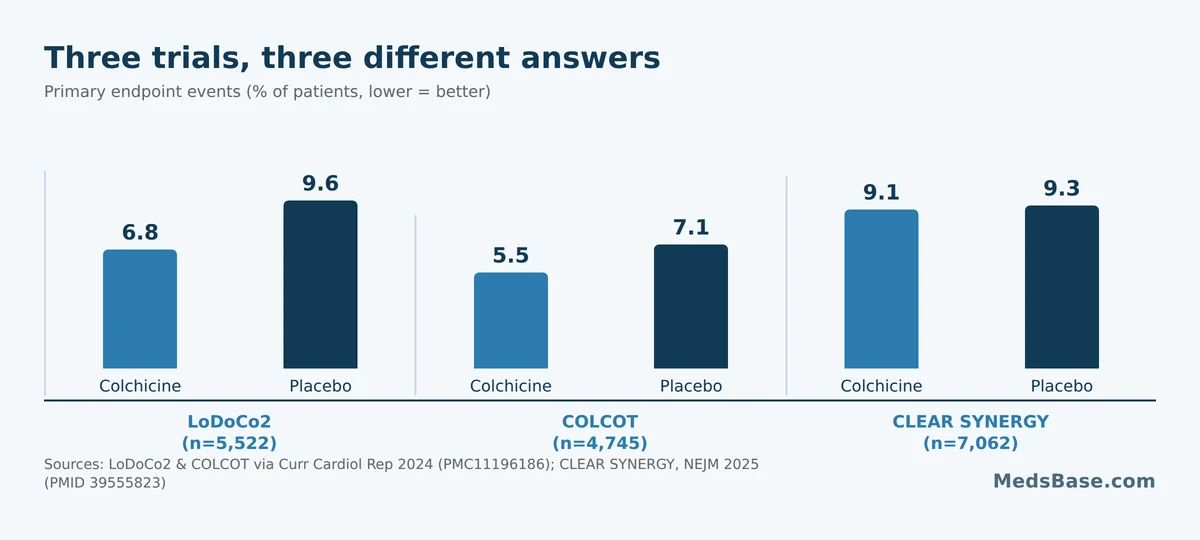
This is where the story stops being tidy. Three large randomised trials have tested colchicine in cardiovascular disease, and they do not agree.
| Study | Year | Patients | Finding | Source |
|---|---|---|---|---|
| COLCOT (recent myocardial infarction) | 2019 | 4,745 | 5.5% vs 7.1% primary endpoint events; HR 0.77 (95% CI 0.61–0.96) — about a 23% relative reduction | Curr Cardiol Rep review |
| LoDoCo2 (stable coronary disease) | 2020 | 5,522 | 6.8% vs 9.6% primary endpoint events; HR 0.69 (95% CI 0.57–0.83) — about a 31% relative reduction | NEJM 2020 |
| CLEAR SYNERGY / OASIS 9 (acute myocardial infarction) | 2025 | 7,062 | 9.1% vs 9.3%; HR 0.99 (95% CI 0.85–1.16), p = 0.93 — no reduction | NEJM 2025 |
What this means for you: the two trials that support colchicine are real, large, and well conducted. So is the one that does not. Anyone telling you this question is settled — in either direction — is overselling their certainty.
But there’s a catch, and it is an informative one. Look at when the drug was started. In CLEAR SYNERGY, colchicine was given a median of about 1.6 hours after the artery was reopened, in the immediate chaos of an acute heart attack, and followed for a median of three years. LoDoCo2 recruited people with stable, long-standing coronary disease. These are different biological moments. Suppressing inflammation during acute healing may simply not be the same intervention as suppressing the slow, smouldering inflammation of chronic plaque — and it is plausible that the drug helps in one setting and not the other.
That reading is not just post-hoc rationalising. It is why guideline committees did not throw out the earlier evidence. The 2024 European Society of Cardiology chronic coronary syndromes guideline upgraded low-dose colchicine to a Class IIa recommendation with Level of Evidence A, at 0.5 mg daily, for chronic coronary syndrome patients with atherosclerotic coronary disease. “Class IIa” is guideline language for should be considered — stronger than optional, weaker than mandatory. That is an accurate reflection of evidence this mixed.
Where the evidence is genuinely limited: there is no good long-term data beyond a few years, no biomarker to tell an individual whether it is working for them, and no resolution of the non-cardiovascular mortality signal. Say that out loud to anyone who tells you this is a no-brainer.
Colchicine vs Statins and Other Cardiovascular Options
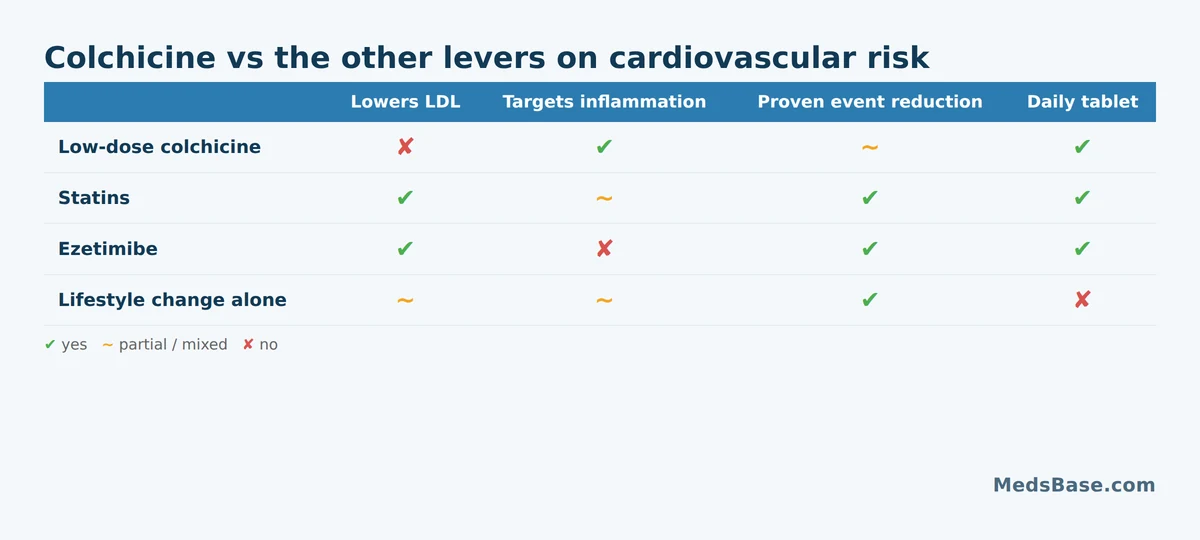
The most common misunderstanding about colchicine is treating it as a competitor to cholesterol drugs. It is not in the same category, and it does not do the same thing.
| Option | What it targets | Effect on LDL | Evidence for event reduction | Best used |
|---|---|---|---|---|
| Low-dose colchicine | Inflammation in the artery wall | None | Mixed — strong in stable disease, absent in one acute-MI trial | Added on top of statin therapy when risk stays high |
| Statins | Cholesterol production | Large reduction | Extensive and consistent | First-line for essentially everyone with atherosclerotic disease |
| Ezetimibe | Cholesterol absorption in the gut | Moderate additional reduction | Established as add-on | When a statin alone does not reach target |
| Lifestyle change | Multiple pathways at once | Modest | Consistent across decades | Always — it is not optional, and it is not sufficient alone for established disease |
Which one fits which situation? If you have atherosclerotic disease and are not on a statin, that is the gap to close first — nothing on this list substitutes for it. If you are on a statin and your LDL is still above target, the next move is usually adding a cholesterol drug, and the choice there is covered in how ezetimibe stacks on top of a statin. Colchicine enters the conversation in a specific place: LDL is at target, everything conventional is optimised, and your risk is still high. That is residual inflammatory risk, and it is the only scenario where the trial evidence actually speaks to you.
How to Approach Colchicine for Heart Disease — Practical Guidance
- Establish where you stand first. Know your LDL, your blood pressure, and whether you have documented atherosclerotic disease. Colchicine is an add-on question, and it cannot be answered without those numbers.
- Bring the disagreement to your appointment, not just the headline. Saying “I read that colchicine cut events by 31% in stable coronary disease but a 2025 trial in acute MI found nothing — does the stable-disease evidence apply to me?” gets a far more useful answer than “should I take colchicine?”
- Get your medicine list checked. This matters more than usual here. Several common drugs slow colchicine clearance, and that is how toxicity happens. Bring everything, including supplements.
- Have kidney and liver function checked before starting. Impaired clearance is the main risk multiplier.
- Start at 0.5 mg once daily and expect a settling-in period. Gastrointestinal effects are common early and often improve. Do not skip and double up.
- Do not stop your statin. Nothing in the colchicine evidence supports that, and every trial was run on top of statin therapy.
- Taking gout-flare dosing as if it were the cardiovascular dose. They are different regimens for different jobs.
- Adding grapefruit juice to your morning routine without checking. It is a genuine interaction, not folklore.
- Assuming muscle aches are “just the statin.” Get them assessed rather than attributed.
- Reading the 2025 trial as proof the drug does not work, or the 2020 trial as proof it always does. Both are overreadings.
- Self-starting from a leftover gout supply. The safety margin is not wide enough for guesswork.
If your prescriber agrees this fits your situation, MedsBase stocks Goutnil (colchicine) — and no prescription is needed to order from MedsBase.com, though the decision to take it long-term genuinely should be made with a clinician who knows your kidney function and your other medicines.
- Statin intolerance: what is real and what to do — because most people asking about colchicine are really asking about residual risk.
- Atorvastatin vs rosuvastatin — the foundation therapy colchicine is added on top of.
- Allopurinol vs febuxostat — if colchicine entered your life through gout rather than cardiology.
Frequently Asked Questions
Q: Does colchicine prevent heart attacks?
A: In some settings, the evidence says yes. LoDoCo2 found a 31% relative reduction in cardiovascular events in stable coronary disease (6.8% vs 9.6%), and COLCOT found a 23% reduction after recent myocardial infarction (5.5% vs 7.1%). However, the larger CLEAR SYNERGY trial in 7,062 patients treated during acute myocardial infarction found no reduction at all (9.1% vs 9.3%). The honest summary is that colchicine appears to help in chronic, stable disease and has not been shown to help when started in the acute phase.
Q: Is colchicine approved for heart disease?
A: Yes. In June 2023 the FDA approved colchicine 0.5 mg daily to reduce the risk of myocardial infarction, stroke, coronary revascularisation and cardiovascular death in adults with established atherosclerotic disease or multiple cardiovascular risk factors. The 2024 European Society of Cardiology chronic coronary syndromes guideline gives it a Class IIa, Level A recommendation for chronic coronary syndrome patients with atherosclerotic coronary disease.
Q: How does colchicine reduce cardiovascular risk if it does not lower cholesterol?
A: It works on a completely different pathway. Colchicine disrupts the internal scaffolding white blood cells use to migrate and mount an inflammatory response, which reduces the inflammation around cholesterol plaque in artery walls. Less inflammation means plaque is less likely to rupture, and rupture is what triggers most heart attacks. Your LDL will not change on colchicine, and there is currently no routine blood test that confirms it is working for you.
Q: Can you take colchicine with a statin?
A: In the trials, over 90% of participants were taking statins, so the combination is the studied scenario rather than an exception. Across roughly 10,000 patients in the COPS and LoDoCo2 trials there was no difference in statin-associated muscle problems between the colchicine and placebo groups. That said, muscle pain or weakness on this combination should always be reported and assessed rather than assumed to be harmless.
Q: What are the side effects of low-dose colchicine?
A: Gastrointestinal effects are the main issue — diarrhoea, nausea and abdominal cramps affect roughly 10% of patients, mostly early on, and in the LoDoCo2 run-in phase about 15.4% withdrew largely for this reason. Less commonly, muscle pain or weakness, numbness or tingling in the fingers or toes, and unusual bruising or bleeding can occur and need prompt medical assessment. Pooled data also show a signal of increased non-cardiovascular death (OR 1.55, 95% CI 1.10–2.17) that remains unexplained.
Q: Who should not take colchicine for heart disease?
A: People with significant kidney or liver impairment need specialist assessment first, because impaired clearance is the main route to colchicine toxicity. The same applies to anyone taking medicines that slow colchicine clearance, anyone pregnant or breastfeeding, and anyone with a history of blood-count problems. Nobody should take it as a replacement for statin therapy, and nobody should self-start it from a leftover gout supply.
Q: Is the cardiovascular dose the same as the gout dose?
A: No, and confusing them is a real risk. The cardiovascular dose is 0.5 mg once daily taken indefinitely. Acute gout treatment uses a higher short burst — typically an initial dose followed by another an hour later, then stopping. Taking flare dosing daily would be a meaningful overdose, and taking the cardiovascular dose during a flare is unlikely to control it.
Q: Do I need a prescription to order colchicine from MedsBase?
A: No prescription is needed to order from MedsBase.com. That said, colchicine has a narrow safety margin and a long interaction list, so the decision to take it daily for cardiovascular protection is one worth making with a clinician who knows your kidney function, your liver function and your full medicine list.
The Bottom Line on Colchicine for Heart Disease
Here is the balanced verdict. Colchicine for heart disease is a genuine advance — the first affordable, approved way to treat the inflammatory half of cardiovascular risk rather than the cholesterol half. In stable, established coronary disease the evidence for a meaningful reduction in events is strong. In the acute aftermath of a heart attack, the largest trial to date found nothing, and an unresolved non-cardiovascular mortality signal in the pooled data means this is not a drug to take casually or on your own initiative.
Your one immediate action: find out whether your LDL is actually at target. If it is not, that is the conversation to have first — colchicine is an add-on for people whose conventional therapy is already optimised, and skipping that step means asking the wrong question. If it is at target and your risk is still high, print the three trial results from this page and take them to your next appointment.
MedsBase stocks colchicine as Goutnil from WHO-GMP-certified manufacturers if you and your doctor decide it fits.
Wondering what to do if a medicine you already rely on gets pulled from the market? Read our guide to what to do if your medication is recalled. And if you are still weighing up how to get your cholesterol where it needs to be first, start with how ezetimibe stacks on top of a statin.

Written by
Sophie ChenPharmaceutical Content Researcher · 8 years experience
Sophie Chen is a pharmaceutical content researcher with 8 years covering generic medication access and clinical pharmacology. She specialises in international regulatory frameworks, bioequivalence standards, and patient-facing education on therapeutic drug classes. She is not a clinician.