








✓ Medically reviewed by · Last reviewed: May 2026
Pharmacy Researcher · 8 years experience
Pharmacy researcher with 8 years reviewing clinical drug information, generic formulation equivalence, and international pharmaceutical standards. Focuses on patient-facing accuracy in medication education.
inhaler technique mistakes — Inhaler Technique Mistakes: 8 Critical Errors That Reduce Your Medication Dose. Read on for an evidence-backed guide covering everything you need to know.
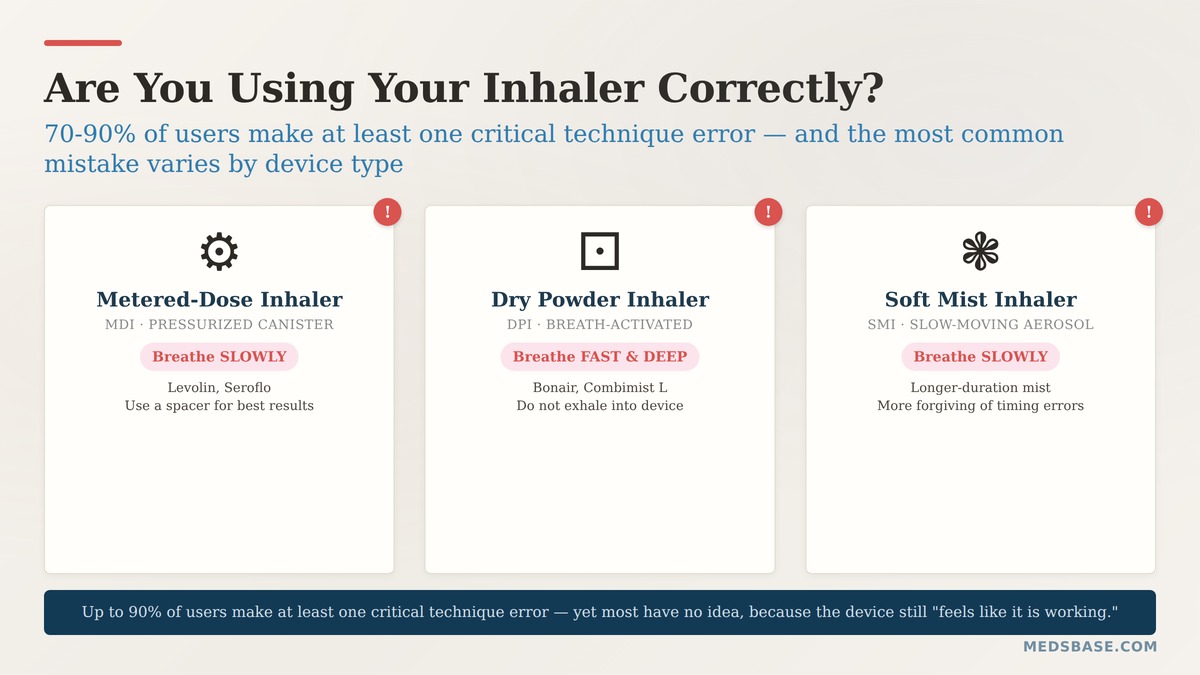
Q: You pick up your inhaler, take a puff, and go about your day. But here is a question worth asking: did any medication actually reach your lungs?
A:
If you are like most people who use an inhaler for asthma or COPD, the answer may surprise you. A systematic review published in BMJ Open Respiratory Research confirmed that inhaler technique mistakes are extremely common — and they directly lead to worse clinical outcomes including more symptoms, more flare-ups, and more emergency visits.
In some cases, a single critical error can reduce the dose reaching your lungs by half or more. And the most unsettling part? Research shows that between 70 and 90 percent of inhaler users make at least one of these errors — often without realizing anything is wrong, because the device still “feels like it is working.”
By the end of this article, you will know the three types of inhaler devices, the 8 most common inhaler technique mistakes, exactly which errors affect which devices, and a step-by-step self-check you can use at home. One of these mistakes is shockingly common and almost never discussed.
Key Takeaways
- Between 70-90% of inhaler users make at least one critical technique error — and most errors reduce the medication dose reaching the lungs by 25-50%.
- The most damaging inhaler technique mistake is breathing in too fast with a metered-dose inhaler (MDI) — this causes most of the medication to hit the back of the throat instead of the airways.
- Dry powder inhalers (DPIs) require a fast, deep breath — the opposite of an MDI. Using the wrong breathing speed for your device type is arguably the most common and most damaging inhaler technique mistake.
- A spacer is the single most effective fix for MDI technique errors — but only about 20-30% of MDI users actually have one.
- Even experienced users make inhaler technique mistakes: technique tends to degrade over time without periodic re-checking.
- The Three Types of Inhaler Devices
- The 8 Most Common Inhaler Technique Mistakes
- What Happens When You Fix Inhaler Technique Mistakes
- How to Check Your Inhaler Technique: Step-by-Step Guide
- How to Choose the Right Inhaler Device
- Frequently Asked Questions
- The Bottom Line
The Three Types of Inhaler Devices — Inhaler technique mistakes Explained
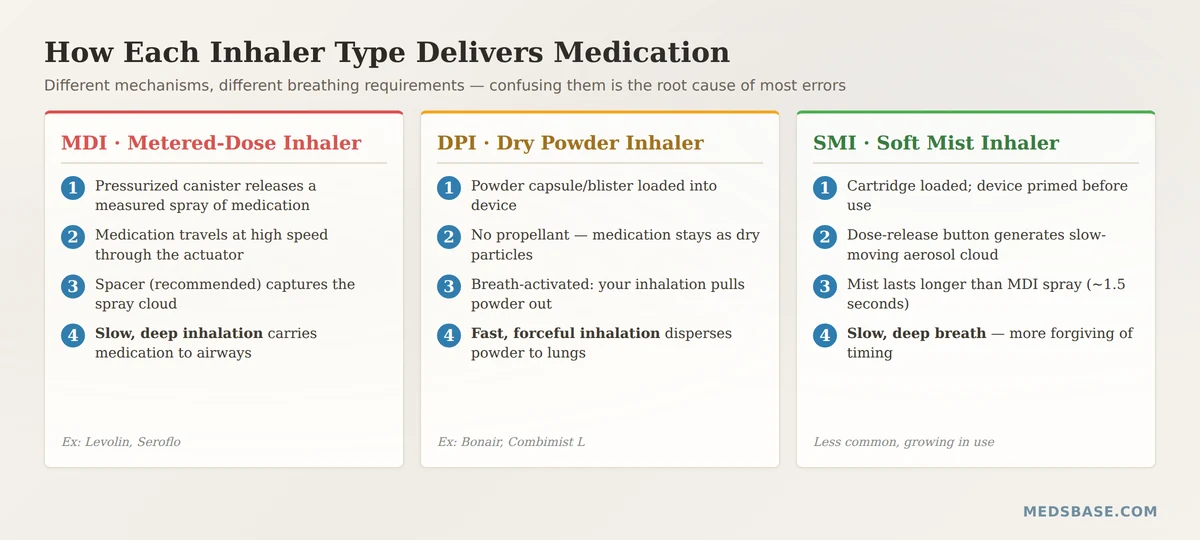
Before you can fix your technique, you need to know which type of inhaler you use. The three main categories require fundamentally different breathing patterns — and confusing one for another is the root cause of many inhaler technique mistakes.
Metered-Dose Inhaler (MDI) — the pressurized canister This is the classic “puffer” — a small metal canister inside a plastic actuator. You press the canister down to release a measured spray of medication. MDIs require a slow, deep inhalation (about 3-5 seconds) and ideally a spacer (a plastic holding chamber that captures the spray so you can inhale it more effectively). Examples: Levolin Inhaler, Seroflo Inhaler.
Dry Powder Inhaler (DPI) — breath-activated DPIs contain medication as a fine powder inside a capsule or blister. There is no propellant — you have to inhale fast and deep to pull the powder out of the device and into your lungs. The breathing technique for a DPI is essentially the opposite of an MDI. Examples: Bonair Inhaler, Combimist L Inhaler.
Soft Mist Inhaler (SMI) — slow-moving aerosol SMIs produce a slow-moving cloud of medication that lasts longer than an MDI spray, giving you more time to inhale. They require a slow, deep breath — similar to an MDI but with a longer-duration mist that is more forgiving of timing errors. SMIs are less common but growing in use.
Here is where it gets interesting: a 2024 randomized crossover study comparing two common DPIs found that patients made critical errors with both devices at similar rates — and that prior experience with one device did not guarantee correct use of another. Device confusion is real.
Quick Answer: The three main inhaler types are metered-dose inhalers (MDIs — slow, deep inhalation needed), dry powder inhalers (DPIs — fast, deep inhalation needed), and soft mist inhalers (SMIs — slow inhalation, longer mist). Using the wrong breathing speed for your device type is the single most common and damaging inhaler technique mistake.
The 8 Most Common Inhaler Technique Mistakes
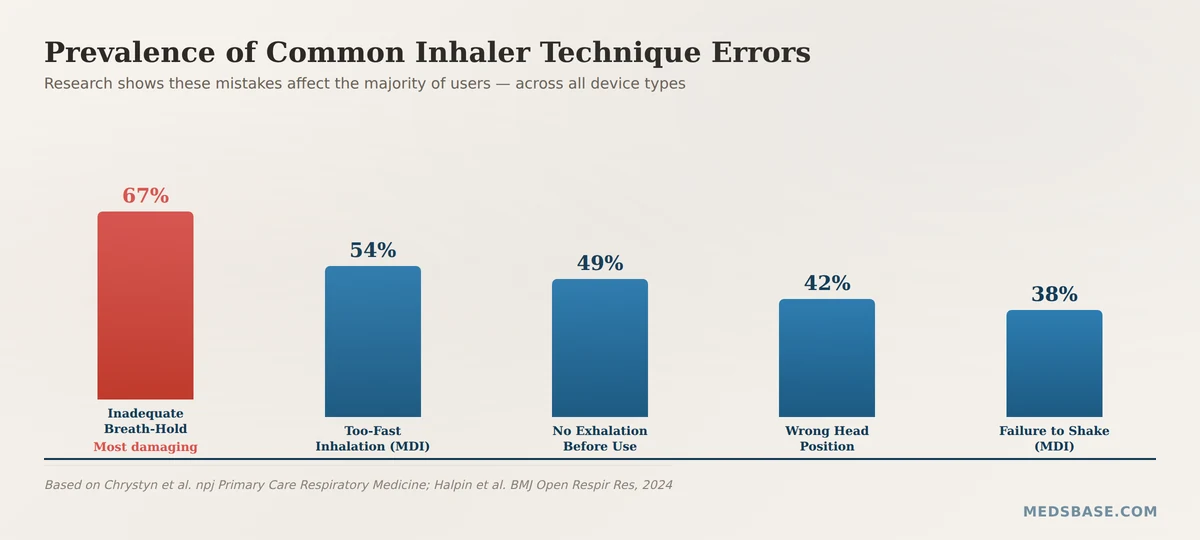
Each of these inhaler technique mistakes has been documented in peer-reviewed research. The key detail: different errors affect different device types, and some errors are more damaging than others.
Mistake 1: Breathing in too fast (MDI)
What happens: When you inhale too quickly with a metered-dose inhaler, the high-speed spray hits the back of your throat and sticks there. Only a fraction reaches the airways. This is one of the most damaging inhaler technique mistakes because it can reduce lung deposition by half or more. Research suggests that slow inhalation (30 liters per minute) delivers roughly twice as much medication to the lungs as fast inhalation (90 liters per minute).
Affects: MDI users primarily.
Fix: Practice inhaling as slowly as you can — aim for 4-5 seconds per breath. A spacer makes this dramatically easier because it holds the medication cloud while you inhale at your own pace.
Mistake 2: Breathing in too slowly (DPI)
What happens: A dry powder inhaler requires a fast, forceful inhalation to break up the powder particles and carry them into the lungs. If you inhale too slowly or weakly, the powder clumps in the device or your mouth. The 2024 study by Tinke et al. found that insufficient inspiratory flow was one of the most common critical inhaler technique mistakes with DPI devices.
Affects: DPI users.
Fix: Take a deep, fast breath — as if you are trying to inhale through a straw. Think “quick and strong,” not “slow and gentle.”
Mistake 3: Not exhaling before use
What happens: If you do not breathe out fully before using your inhaler, your lungs are already partially full. This means you cannot inhale deeply enough to pull the medication into the small airways where it is needed. Studies show this is among the most common inhaler technique mistakes — affecting roughly half of all inhaler users.
Affects: All device types.
Fix: Before each dose, breathe out fully — not forcefully, just comfortably emptying your lungs. Then immediately bring the inhaler to your mouth.
Mistake 4: Not holding your breath after inhaling
What happens: After you inhale the medication, it needs time to settle in the airways. If you exhale immediately, you blow a significant portion of the dose right back out. Breath-holding for 10 seconds allows the medication particles to deposit rather than being exhaled. A study from Cureus in 2024 found that inadequate breath-holding was among the most frequent inhaler technique mistakes in a real-world patient population.
Affects: All device types, but especially MDIs and SMIs.
Fix: After inhaling, hold your breath and count slowly to 10. If 10 seconds is too long, hold for as long as you comfortably can and build up over time.
Mistake 5: Wrong head position
What happens: Tilting your head too far back or forward changes the angle of the airway, causing medication to impact the throat or soft palate instead of flowing smoothly into the trachea. A neutral or slightly chin-up position keeps the airway open and aligned.
Affects: All device types.
Fix: Keep your chin level or slightly elevated. Imagine a string pulling gently upward from the top of your head.
Mistake 6: Not shaking the inhaler (MDI)
What happens: The medication in an MDI canister can settle or separate between uses. Shaking remixes the drug particles with the propellant so each dose contains the correct amount of medication. An unshaken MDI can deliver a dose that is either too weak or too concentrated. A 2024 Indian study found failure to shake the MDI was the most common pre-inhalation error.
Affects: MDI users only (DPIs do not need shaking; shaking some DPIs can actually damage the device).
Fix: Shake the MDI vigorously 5-10 times immediately before each use. Get into the habit of shaking every single time.
Mistake 7: Not waiting between puffs
What happens: If your prescription calls for two puffs, taking them in rapid succession means the second puff enters airways that are already partially constricted from the first puff’s impact. Waiting 30-60 seconds between puffs allows the first dose to begin working (opening the airways slightly) so the second dose can penetrate deeper.
Affects: MDI and SMI users taking multiple puffs.
Fix: Wait at least 30 seconds between puffs. Use this time to check your technique for the next dose.
Mistake 8: Not cleaning the device
What happens: Over time, medication residue builds up around the mouthpiece and inside the actuator, partially blocking the spray and changing the particle size of the dose. A clogged inhaler delivers less medication and can even cause the dose to spray unevenly. This is particularly common with MDIs.
Affects: All device types.
Fix: Follow the manufacturer’s cleaning instructions — typically, remove the canister and rinse the plastic actuator in warm water once a week, then air-dry completely before reassembling. Do not submerge the canister itself.
Research Spotlight: The Australian Prescriber review from October 2024 made a crucial point often missed by generic inhaler guides: device selection should be individualized based on the patient’s inspiratory flow, manual dexterity, coordination, and personal preferences. A device that the patient cannot or will not use effectively is worse than a theoretically “optimal” device that sits in a drawer.
What Happens When You Fix Inhaler Technique Mistakes

Correcting inhaler technique mistakes is not just about “better form” — it produces measurable clinical improvements. Studies consistently find that when inhaler technique mistakes are identified and corrected:
- Asthma control scores improve by 40-60% after structured education addressing inhaler technique mistakes. This translates to fewer daytime symptoms, less rescue-inhaler use, and better sleep.
- COPD exacerbation rates drop by approximately 35% when technique errors are identified and corrected — because the maintenance medication is actually reaching the lungs consistently.
- Emergency department visits and hospitalizations decrease. A patient who gets their full maintenance dose every day is far less likely to experience a crisis that sends them to the hospital.
- Medication waste is reduced. When technique errors cause 25-50% of each dose to be lost, correcting those errors means you are actually getting the treatment you are paying for.
The systematic review by Halpin and Mahler in BMJ Open Respiratory Research concluded that while the evidence directly linking specific errors to specific outcomes is still accumulating, the overall pattern is clear: inhaler errors reduced lung deposition worse disease control.
How to Check Your Inhaler Technique: A Step-by-Step Guide
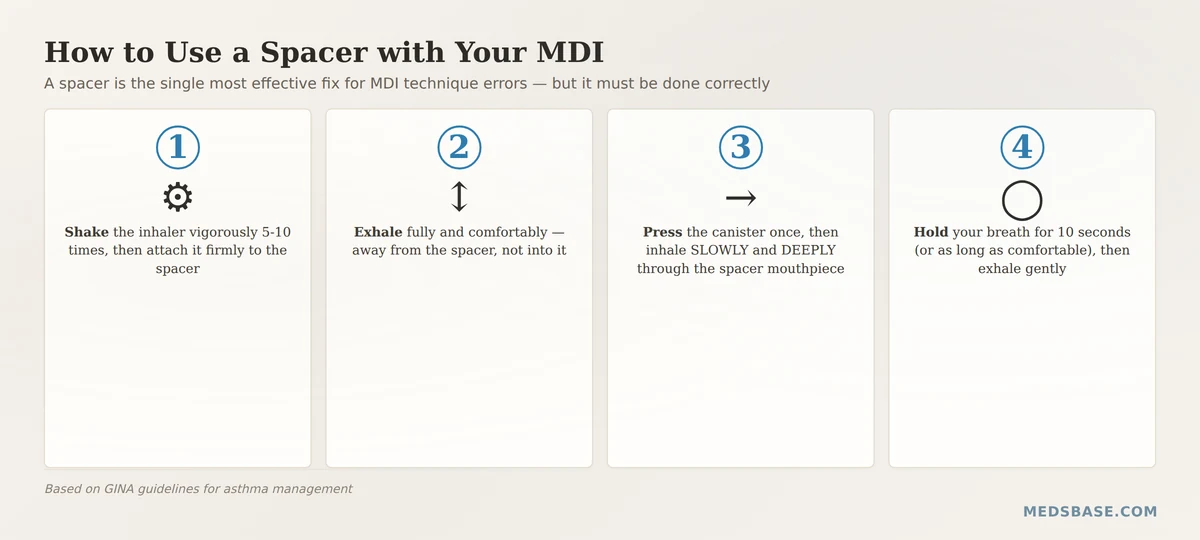
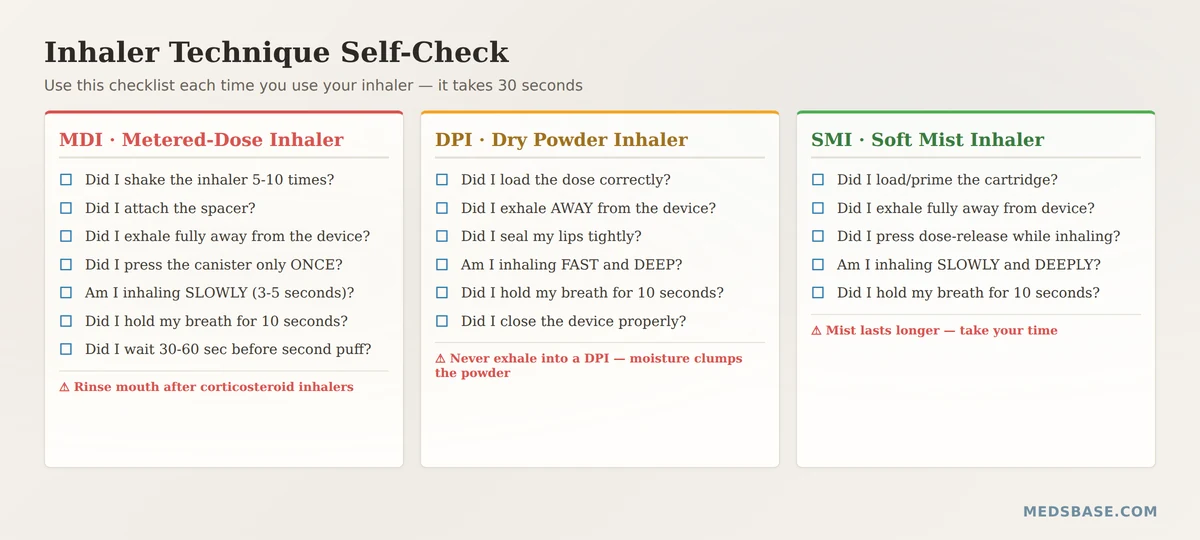
Use this self-check every time you use your inhaler. It takes an extra 30 seconds but can dramatically improve your medication delivery.
For MDI users (with spacer recommended):
- Remove the cap and shake the inhaler vigorously 5-10 times.
- Attach the spacer if you have one.
- Breathe out fully, away from the device.
- Place the mouthpiece between your teeth and seal your lips around it.
- Press the canister ONCE — do not press multiple times.
- Inhale SLOWLY and DEEPLY over 3-5 seconds. You should not hear a whistling sound (that means you are inhaling too fast).
- Hold your breath for 10 seconds (or as long as comfortable).
- If a second puff is prescribed, wait 30-60 seconds and repeat.
- Rinse your mouth with water after corticosteroid-containing inhalers.
For DPI users:
- Load the dose according to your device instructions (open, slide, or pierce the capsule).
- Breathe out fully, AWAY from the device (do not exhale into the DPI — moisture from your breath can clump the powder).
- Place the mouthpiece between your teeth and seal your lips.
- Inhale QUICKLY and DEEPLY — as fast and strong as you comfortably can.
- Hold your breath for 10 seconds.
- Close the device. If the dose indicator shows remaining puffs, you are set for next time.
- Rinse your mouth with water after corticosteroid inhalers.
For SMI users:
- Load the cartridge if needed and prime if it is a new device or has not been used recently.
- Breathe out fully, away from the device.
- Place the mouthpiece between your teeth and seal your lips.
- Press the dose-release button while inhaling SLOWLY and DEEPLY — the mist lasts longer than an MDI spray, so take your time.
- Hold your breath for 10 seconds.
- Rinse your mouth after corticosteroid-containing medications.
If you are uncertain about your technique, ask your pharmacist or respiratory nurse to watch you use your inhaler and provide feedback. Most are happy to do this and it takes only a few minutes. And if you need to explore different inhaler options, you can browse the MedsBase asthma and COPD inhaler range.
How to Choose the Right Inhaler Device
If you have the option to choose between devices, consider these factors — summarized from the 2024 Australian Prescriber review:
Your inspiratory flow. DPIs require a minimum inspiratory flow rate to work. If you have severe COPD or are very frail, you may not generate enough airflow for a DPI, making an MDI with spacer or an SMI a better choice.
Your manual dexterity. Some DPIs require you to load a capsule, pierce it, or slide a lever. If you have arthritis or hand weakness, an MDI (which requires only pressing down a canister) or a pre-loaded disposable DPI may be easier.
Your coordination. MDIs require you to coordinate pressing the canister with starting your inhalation — timing that many people find difficult. A spacer removes this coordination requirement entirely. If coordination is a problem, a spacer or a breath-activated DPI may suit you better.
Your lifestyle. MDIs are small and portable. Some DPIs are bulkier. SMIs require more frequent priming and maintenance. Choose a device you will actually carry with you and use consistently.
Who Is This For? Anyone who uses an inhaler for asthma, COPD, or any respiratory condition. If you have been using the same inhaler for years without anyone checking your technique, this guide is for you. Technique degrades over time — even experienced users benefit from periodic re-checking.
Who Should Take Extra Caution? If you have severe COPD with limited inspiratory capacity, a DPI may not work for you without confirmed adequate inspiratory flow. If you have hand arthritis or tremor, choose a device with minimal dexterity requirements. Always consult your doctor or pharmacist before switching inhaler types — different devices often use different medications or doses.
Related Reading
- Asthma and COPD Inhaler Options at MedsBase
- Inhaler Overuse: Heart Risks of Over-Reliance on Rescue Inhalers — our Aug 30 post
- Cardiovascular-Kidney-Metabolic Syndrome: The Chronic Disease Framework — if you have metabolic comorbidities alongside respiratory disease
- Living with Chronic Conditions: Medication Management
Frequently Asked Questions
Q: Am I using my inhaler correctly?
A: Most people are not — research consistently finds that 70-90% of inhaler users make at least one critical technique error. These inhaler technique mistakes are so widespread that most respiratory clinics now include a dedicated technique assessment at every visit. The most common signs that your technique may be among these inhaler technique mistakes: you often taste the medication (it should go to your lungs, not your tongue), you hear a whistling sound during inhalation (you are breathing too fast), or your symptoms are not well controlled despite regular use. Ask your pharmacist to watch your technique — they can spot inhaler technique mistakes instantly.
Q: What happens if you use an inhaler wrong?
A: The primary consequence is reduced medication delivery to the lungs. These inhaler technique mistakes can cause anywhere from 25% to over 50% of the dose to be lost. The result of these inhaler technique mistakes is less symptom control, more reliance on rescue inhalers, higher risk of exacerbations requiring emergency care, and wasted medication. In COPD specifically, a systematic review found that inhaler technique mistakes are associated with worse clinical outcomes across multiple studies.
Q: How do you use a metered dose inhaler?
A: Shake 5-10 times, exhale fully away from the device, place the mouthpiece between your teeth with lips sealed, press the canister once while beginning a slow (3-5 second) deep inhalation, hold your breath for 10 seconds, and wait 30-60 seconds before a second puff. Using a spacer dramatically improves medication delivery and eliminates the coordination challenge. Rinse your mouth after corticosteroid-containing inhalers.
Q: Why does my inhaler not work?
A: If your maintenance inhaler does not seem to control your symptoms, the most likely cause is inhaler technique mistakes rather than the medication itself — these errors are far more common than truly drug-resistant asthma or COPD. Before assuming the medication is wrong, have a healthcare professional assess your technique to identify any inhaler technique mistakes.
Q: Can inhaler technique affect asthma control?
A: Yes, and significantly. Studies show that after structured inhaler technique education addressing common inhaler technique mistakes, asthma control scores typically improve by 40-60%. Correcting inhaler technique mistakes is often the single most impactful intervention short of starting or changing medication.
Q: Do I really need a spacer with my MDI?
A: For most people, yes — a spacer is the single most effective way to correct many common inhaler technique mistakes. It holds the medication cloud so you can inhale at your own pace rather than trying to perfectly time your breath with the spray. Spacers reduce throat deposition and increase lung delivery, eliminating several of the most damaging inhaler technique mistakes at once.
Q: How often should I have my inhaler technique checked?
A: At minimum, once a year — ideally at every medication review or respiratory clinic visit. Inhaler technique mistakes tend to return even after correction; patients who demonstrate perfect technique in a clinic may revert to the same inhaler technique mistakes within weeks.
Q: Can switching inhaler devices help if I keep making mistakes?
A: Yes. A 2024 Australian Prescriber review emphasized that device selection should be individualized. If you consistently struggle with the coordination required for an MDI, switching to a breath-activated DPI or adding a spacer may eliminate the specific inhaler technique mistakes you keep repeating.
The Bottom Line
Inhaler technique mistakes are the hidden reason many people with asthma and COPD do not get the full benefit of their medication. Between 70 and 90 percent of users are affected by these inhaler technique mistakes. But the fix is straightforward, costs nothing, and starts with a simple self-check.
The single most impactful action you can take: identify which of the three device types you use, memorize the correct breathing technique for that type, and — if you use an MDI — get a spacer. Then have your technique checked by a pharmacist or respiratory nurse at least once a year.
If you need a new inhaler or want to explore different options, MedsBase stocks a range of generic inhalers — including Levolin, Seroflo, Bonair, and Combimist L — through the Asthma and COPD category. Always consult your doctor before switching inhaler types or medications.
What to read next:
- Using your rescue inhaler too often? Read: Inhaler Overuse: The Heart Risks You Need to Know
- Managing multiple chronic conditions? Read: Cardiovascular-Kidney-Metabolic Syndrome: The Big Picture
Medical Disclaimer: This article is for educational purposes only and does not constitute medical advice. Do not change your inhaler technique, device, or medication regimen without consulting your healthcare provider. If you experience worsening respiratory symptoms, seek immediate medical attention.

Written by
Sophie ChenPharmaceutical Content Researcher · 8 years experience
Sophie Chen is a pharmaceutical content researcher with 8 years covering generic medication access and clinical pharmacology. She specialises in international regulatory frameworks, bioequivalence standards, and patient-facing education on therapeutic drug classes. She is not a clinician.