







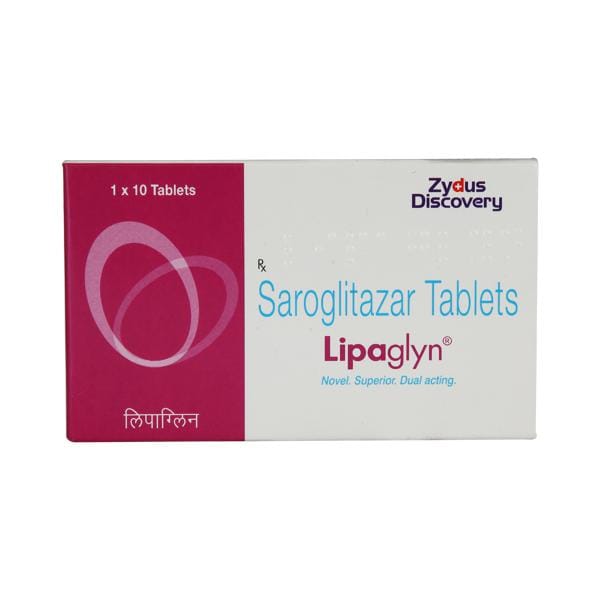
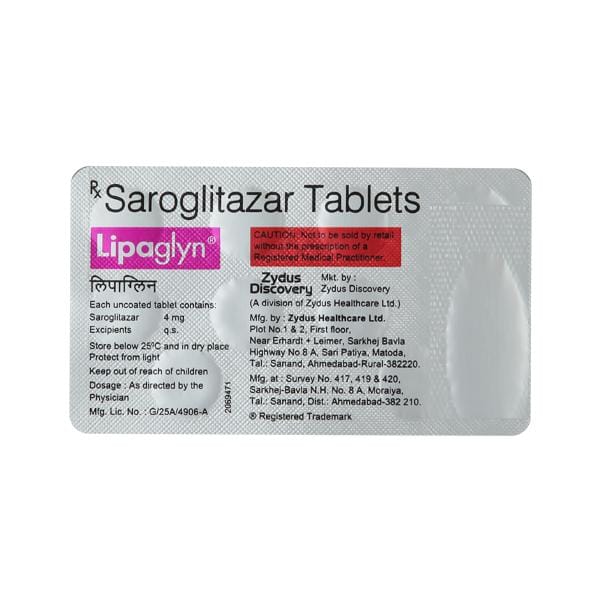
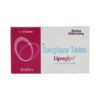
Lipaglyn
✅ Manages lipid levels
✅ Controls blood sugar
✅ Reduces cardiovascular risk
✅ Improves insulin sensitivity
✅ Enhances metabolic health
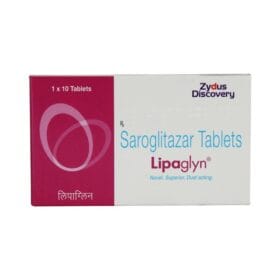
Lipaglyn contains Saroglitazar.
✓ Medically reviewed by Morgan Ellis — Pharmacy Researcher · 8 years experience · Last reviewed: May 2026
⚡ Quick Answer — What is Lipaglyn?
Lipaglyn is a brand of saroglitazar (4 mg), a dual PPAR-α/γ agonist developed in India (approved 2013). It is unique: predominantly a PPAR-α agonist (like fibrates) with partial PPAR-γ agonism (like pioglitazone). Used for diabetic dyslipidaemia (elevated triglycerides with type 2 diabetes) and non-alcoholic fatty liver disease (NAFLD/NASH) — approved in India for both indications. Lowers triglycerides by 40–50%, raises HDL, reduces HbA1c by ~0.5 points, and improves liver fat and enzymes. One tablet (4 mg) once daily before food. Does not cause hypoglycaemia. Generally well-tolerated — mild GI upset, rare weight gain. Not a substitute for statins in primary lipid lowering. Avoid in severe hepatic impairment, pregnancy, and known hypersensitivity.
📦 Every order is covered by our Reshipment Assurance Policy — if your parcel does not arrive within 20 business days, we reship it.
Why order from MedsBase
Our generic medications are sourced from WHO-GMP certified manufacturers and shipped worldwide in discreet, plain packaging — no medication name on the parcel exterior. Card payments are routed through a regulated processor (statement descriptors include a regulated card-payment processor — never “MedsBase” or any medication name). Crypto and SEPA bank transfer are also accepted. Every order is backed by our Reshipment Assurance Policy.
What Is Lipaglyn?
Lipaglyn is an oral dual PPAR-α/γ agonist containing saroglitazar (4 mg), developed by Zydus Cadila (India) and approved in India in 2013. Available in packs of 30, 60, 90 or 180 tablets. It is prescribed for:
- Diabetic dyslipidaemia — elevated triglycerides in patients with type 2 diabetes who are not controlled on statins alone
- Hypertriglyceridaemia not adequately controlled by statins
- Non-alcoholic fatty liver disease (NAFLD) and non-alcoholic steatohepatitis (NASH)
- Primary biliary cholangitis (PBC) — recent indication
Saroglitazar is unique because it is the first dual PPAR-α/γ agonist to reach market. Previous attempts (muraglitazar, tesaglitazar) were abandoned due to safety concerns; saroglitazar’s balanced profile (mostly α, partial γ) appears to avoid them.
How Does Lipaglyn Work?
Peroxisome proliferator-activated receptors (PPARs) are nuclear receptors that control gene expression in lipid and glucose metabolism. Saroglitazar activates two of them:
- PPAR-α (predominant) — similar to fibrates. Increases fatty-acid oxidation in the liver, lowers triglycerides by 40–50%, modestly raises HDL, and reduces liver fat.
- PPAR-γ (partial) — similar to pioglitazone but weaker. Improves insulin sensitivity in muscle and adipose tissue, reducing HbA1c by ~0.5 percentage points.
The net effect is improvement in both the lipid profile and glycaemic control of diabetic dyslipidaemia in a single tablet. Importantly, because PPAR-γ activation is only partial, the weight gain and fluid-retention seen with pioglitazone are much less common.
Dosage and Administration
Standard dose: one 4 mg tablet once daily, approximately one hour before food (in the morning).
- Consistent daily timing is recommended.
- Effects on triglycerides are seen within 2–4 weeks; maximum lipid effect at 12 weeks. HbA1c falls over 12–24 weeks.
- Miss a dose — skip it and take the next at the usual time.
- No standard dose adjustment for renal impairment in mild-to-moderate CKD; use with caution in severe impairment.
- Avoid in severe hepatic impairment; check LFTs at baseline and periodically.
Side Effects
Saroglitazar is generally well-tolerated.
Common:
- Mild gastric discomfort, dyspepsia, nausea
- Asthenia (mild tiredness)
- Headache
Uncommon:
- Mild transaminase elevation (usually dose-related, reversible)
- Slight weight gain (typically < 1 kg; much less than pioglitazone)
- Peripheral oedema (rare, much less than pioglitazone)
No clear signal of heart failure or bladder cancer (unlike pioglitazone). No outcome-trial CV data yet, but the limited trials to date are reassuring.
Drug Interactions
- Statins — generally well-tolerated in combination; watch for myopathy.
- Fibrates (other PPAR-α agonists) — avoid combining; overlapping mechanism.
- Warfarin — potential INR change; monitor.
- Insulin and sulfonylureas — hypoglycaemia unlikely with saroglitazar alone, but possible in combination.
- Bile acid sequestrants — may reduce absorption; separate dosing.
Who Should Not Take Lipaglyn?
- Severe hepatic impairment
- Severe renal impairment
- Pregnancy and breastfeeding
- Children — safety not established
- Known hypersensitivity to saroglitazar or other PPAR agonists
- Active heart failure — use with caution, though risk appears lower than with pioglitazone
Storage
Store Lipaglyn below 30°C in a dry place, in the original blister. Keep out of reach of children.
Frequently Asked Questions
How does saroglitazar differ from pioglitazone?
Both are PPAR agonists, but with different selectivity. Pioglitazone is primarily PPAR-γ (strong insulin-sensitiser, weight gain, fluid retention). Saroglitazar is primarily PPAR-α with partial PPAR-γ (strong triglyceride-lowering, modest insulin-sensitising, far less weight gain and oedema). For a patient with diabetic dyslipidaemia, saroglitazar has the stronger lipid effect; for pure insulin resistance with normal lipids, pioglitazone is still more commonly used.
Can Lipaglyn replace my statin?
No — saroglitazar and statins target different lipid abnormalities. Statins lower LDL-cholesterol (the main atherogenic lipid); saroglitazar lowers triglycerides and raises HDL. In diabetic patients with mixed dyslipidaemia, the two are typically used together.
Does Lipaglyn help fatty liver or NASH?
Yes — saroglitazar has approved indications for NAFLD/NASH in India based on Indian trial data showing reductions in ALT, liver fat on MRI-PDFF, and improvement in fibrosis markers. It is one of the few oral treatments with regulatory approval for NASH anywhere.
Does Lipaglyn cause hypoglycaemia?
Not on its own — saroglitazar does not stimulate insulin release. Hypoglycaemia only becomes a concern in combination with a sulfonylurea, meglitinide, or insulin.
Is Lipaglyn approved outside India?
Saroglitazar is approved primarily in India, with some approvals in Mexico and a few other countries. It is not yet approved in the US, EU, UK, or Australia — those agencies have not completed review. Clinically, the drug has been used in over 2 million patient-years in India with a good safety record.
Where can I buy Lipaglyn online?
You can order Lipaglyn (4 mg) from MedsBase in packs of 30, 60, 90 or 180 tablets. We ship worldwide, with discreet packaging and genuine WHO-GMP certified manufacturer stock.
Related Diabetes and Lipid Medications
- Pioz 15 — Pioglitazone (PPAR-γ agonist)
- Jardiance — Empagliflozin (SGLT-2, CV/HF benefit)
- Forxiga — Dapagliflozin (SGLT-2, DAPA-HF)
- Glycomet SR — Metformin sustained-release
- Januvia — Sitagliptin (DPP-4 inhibitor)
- Browse all Diabetes Medications
Related Alternatives
Other products in Chronic Conditions that customers also view:
- Tegrital 100 mg Chewable (Carbamazepine) — Trigeminal Neuralgia & Seizures
- Sertafine
- Wysolone
- Leetrexate
- Novonorm
More options in Diabetes
Ranked by recent MedsBase order volume — what other customers in this category are picking.

| Strength | 30 Tablet/s, 60 Tablet/s, 90 Tablet/s, 180 Tablet/s |
|---|
 Lipaglyn
Q & A
Lipaglyn
Related products







Reviews
There are no reviews yet