








✓ Medically reviewed by · Last reviewed: May 2026
Pharmacy Researcher · 8 years experience
Pharmacy researcher with 8 years reviewing clinical drug information, generic formulation equivalence, and international pharmaceutical standards. Focuses on patient-facing accuracy in medication education.
medical gaslighting — Medical Gaslighting: 7 Signs Your Symptoms Are Being Dismissed (and What to Do About It). Read on for an evidence-backed guide covering everything you need to know.
You leave the doctor’s office with a knot in your stomach. Your symptoms — the pain, the exhaustion, the dizziness — are real to you. But the doctor used the phrase “it’s probably just stress” for the third time this year, and you’re starting to wonder if the problem is in your head.
It probably isn’t. And the experience you just had has a name: medical gaslighting.
Medical gaslighting is what happens when a genuine symptom or concern is repeatedly dismissed, minimised, or attributed to something like anxiety — to the point where you begin to doubt your own experience of your own body. It’s not usually deliberate or malicious. More often, it’s the quiet, cumulative effect of bias, time pressure, and the way medicine has historically been taught.
By the end of this article, you’ll know the seven signs to watch for, the research that proves this happens more to some groups than others, and — most importantly — a practical, respectful way to push back that actually works.
One of the seven signs trips up almost everyone, even confident patients. We’ll get to it.
Medical gaslighting is when a healthcare provider repeatedly dismisses, minimises, or mislabels your symptoms — often as stress, anxiety, or “all in your head” — so that you begin to doubt your own experience. Research shows it happens disproportionately to women and to people from marginalised groups, and it can delay real diagnoses by years.
- It’s usually not deliberate. Most medical gaslighting is unconscious bias, not a doctor trying to deceive you.
- Women face it more. A 2018 systematic review found women’s pain is more likely to be attributed to emotional causes than men’s.
- It delays diagnosis. Conditions like endometriosis average years of dismissal before diagnosis.
- The “stress” label is a red flag — but one sign on this list surprises even the most self-assured patients.
- You can push back respectfully. A few specific phrases measurably change how seriously you’re taken.
- What Is Medical Gaslighting — and What It Isn’t
- 7 Signs Your Symptoms Are Being Dismissed
- Why Does Medical Gaslighting Happen?
- Who It Affects Most — and the Evidence
- What Does the Research Say — Summary
- How to Advocate for Yourself at the Doctor
- Frequently Asked Questions
- The Bottom Line
What Is Medical Gaslighting — and What It Isn’t
The term “gaslighting” comes from psychology — originally describing a form of manipulation that makes someone doubt their own reality. Applied to healthcare, medical gaslighting describes the experience of having a clinician repeatedly dismiss or explain away your symptoms until you start to question whether they were ever real.
It’s important to be precise about what it is and isn’t. Medical gaslighting is not the same as a doctor giving you a different diagnosis than you hoped for, or a doctor who is simply wrong, or a difficult conversation about risk. A doctor who runs tests, listens, and disagrees with your self-diagnosis is doing their job. Gaslighting is different: it’s the pattern of dismissal — the “it’s just anxiety,” the “you’re too young for that,” the “come back if it gets worse” that never seems to lead anywhere.
In a 2026 qualitative study of women’s experiences, participants described exactly this arc: symptoms repeatedly re-labelled as psychological, concerns waved away, and a growing sense that their own perception of their body couldn’t be trusted. The study title — “It’s not a headache! It’s a migraine” — captures the frustration of knowing something is wrong while being told otherwise.
The cost isn’t just emotional. Dismissed symptoms mean delayed diagnosis. And in medicine, delay can mean the difference between a condition that’s manageable and one that’s progressed.
7 Signs Your Symptoms Are Being Dismissed
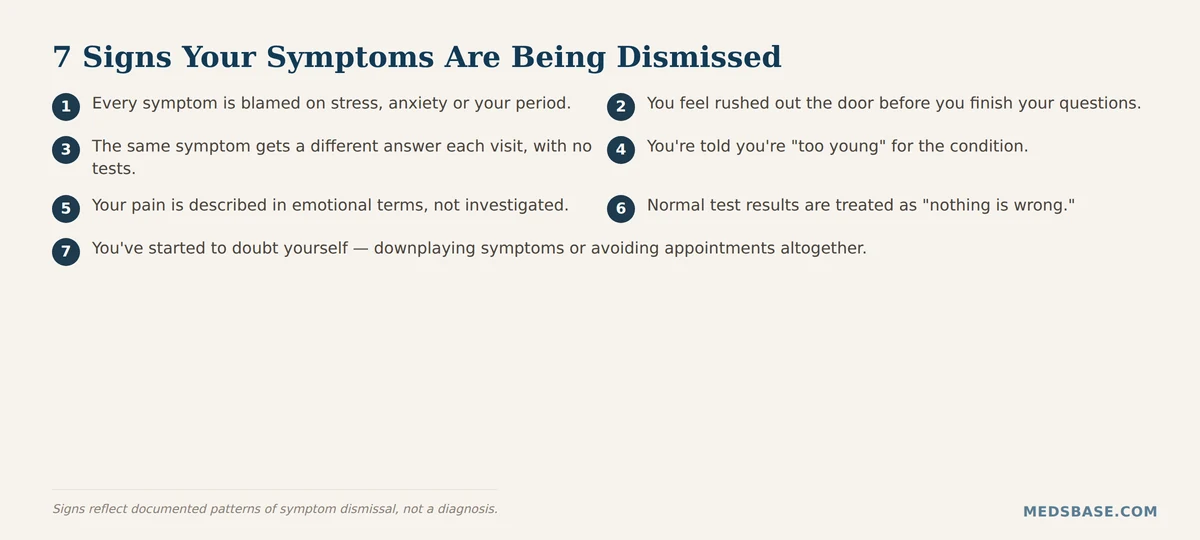
Here are seven signs you might be experiencing medical gaslighting. They rarely appear all at once — even two or three, repeated over time, are worth noticing.
1. Your symptoms are repeatedly blamed on stress, anxiety, or your period. A mental-health explanation should be a considered possibility, not a reflex. If every symptom you report gets routed to the same “stress” conclusion without investigation, that’s a pattern.
2. You feel rushed out the door. You prepared questions, but the appointment was over before you got to them. Chronic conditions don’t fit into a 10-minute slot, and a provider who never makes room for your full story is missing things.
3. The same symptom gets a different “answer” each time, with no tests. One visit it’s a virus, the next it’s “just getting older,” the next it’s stress. When the explanations change but nothing is ever ruled in or out, you’re not getting a diagnosis — you’re getting deflected.
4. You’re told you’re “too young” for the condition. Many serious conditions — including autoimmune diseases and heart problems — occur in young people. Age alone is not a diagnostic test.
5. Your pain is described in emotional terms. This is the big one, and the one research documents most clearly. A 2018 systematic review found that women’s pain is more likely than men’s to be attributed to psychological or emotional causes — the “emotional woman” stereotype. If you hear “you’re just anxious” instead of “let’s investigate the pain,” that’s a red flag.
6. Test results are normal, so you’re told nothing is wrong. A normal result rules out one thing — it doesn’t rule out everything. Many conditions (migraine, some autoimmune and neurological conditions, endometriosis in its early stages) don’t show up on standard tests.
7. You start to doubt yourself. This is the sign that surprises people. When you’ve been dismissed enough, the gaslighting gets internalised: you stop making appointments, you downplay your own symptoms, you tell yourself “I don’t want to waste the doctor’s time.” The moment you catch yourself doing that is the moment to recognise what’s happening.
If several of these feel familiar, the problem likely isn’t your imagination. It’s the communication — and the next section explains why it happens.
Why Does Medical Gaslighting Happen?
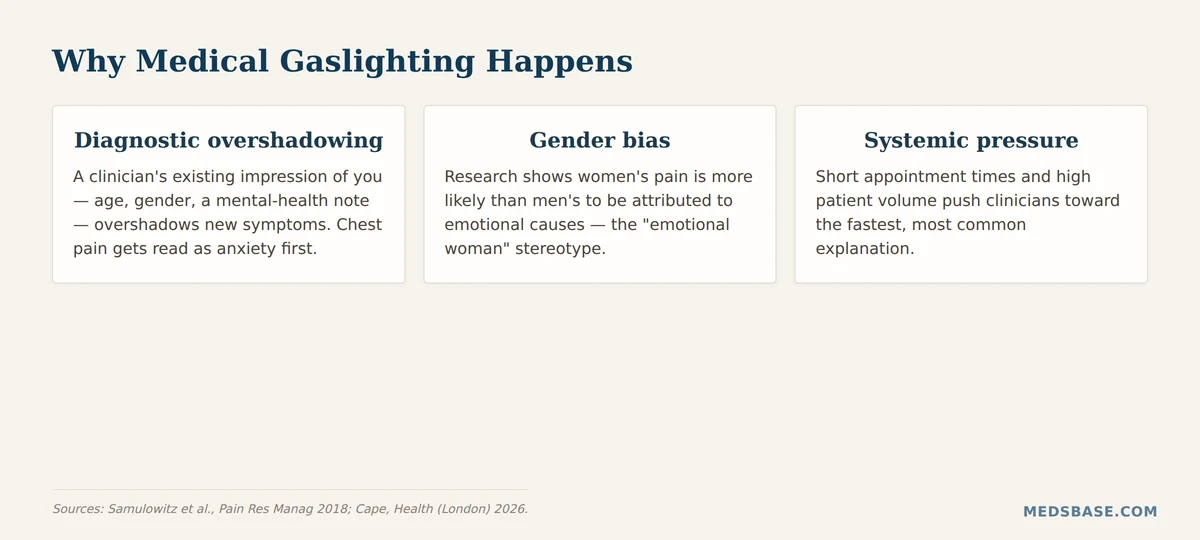
Most medical gaslighting isn’t a villain story. Three things, working together, explain the vast majority of it.
Diagnostic overshadowing. This is a documented phenomenon where a clinician’s existing impression of you — your age, your gender, your mental-health history — overshadows the new symptoms you’re presenting. If you have anxiety on your chart, chest pain may be read as a panic attack before it’s read as a cardiac symptom. It’s a recognised cognitive shortcut, and it’s a major source of missed diagnoses.
Gender bias. The Samulowitz review from 2018 synthesised decades of research showing that pain — the single most common reason people see a doctor — is treated differently depending on your gender. Men are more often described as “brave” for tolerating pain; women are more often described as “emotional” for reporting it. That bias translates into real differences in how seriously pain is investigated and treated.
Systemic pressure. Short appointment times, defensive medicine, and the sheer volume of patients all push clinicians toward fast, common explanations. None of that excuses dismissal, but it does explain why it’s so widespread — and why it’s not necessarily a comment on you.
The result of all three is measurable. A 2026 study of ocular-trauma patients found that even in emergency settings, women and racial-minority patients received less opioid pain medication than white men with comparable injuries — a concrete, quantifiable example of bias in the moment of care.
Who It Affects Most — and the Evidence
Medical gaslighting is a universal problem, but it’s not evenly distributed. The research consistently points to a few groups who experience it most.
Women. The pattern is clearest here. From chronic-pain bias to cardiac symptoms being read as anxiety, women’s health complaints are systematically taken less seriously. The consequence is measurable in diagnosis times: a 2026 review on endometriosis documents that this common, treatable condition still averages years — sometimes close to a decade — between symptom onset and diagnosis, in large part because the pain is dismissed as “normal period pain.”
People with chronic pain. Pain is invisible, subjective, and easy to dismiss. Patients with conditions like fibromyalgia, migraine, or chronic fatigue routinely describe being told their pain is psychological.
People with existing mental-health diagnoses. The diagnostic-overshadowing effect is strongest here. Once “anxiety” or “depression” is on your chart, new physical symptoms are more likely to be attributed to it — sometimes correctly, often not.
Racial and ethnic minorities. Multiple studies, including the ocular-trauma study above, show that pain is systematically undertreated in minority patients, compounding the problem of delayed diagnosis.
None of this means every doctor is biased, or that your particular doctor is gaslighting you. It means the system has patterns that are worth understanding — because understanding the pattern is the first step to protecting yourself against it.
What Does the Research Say — Summary
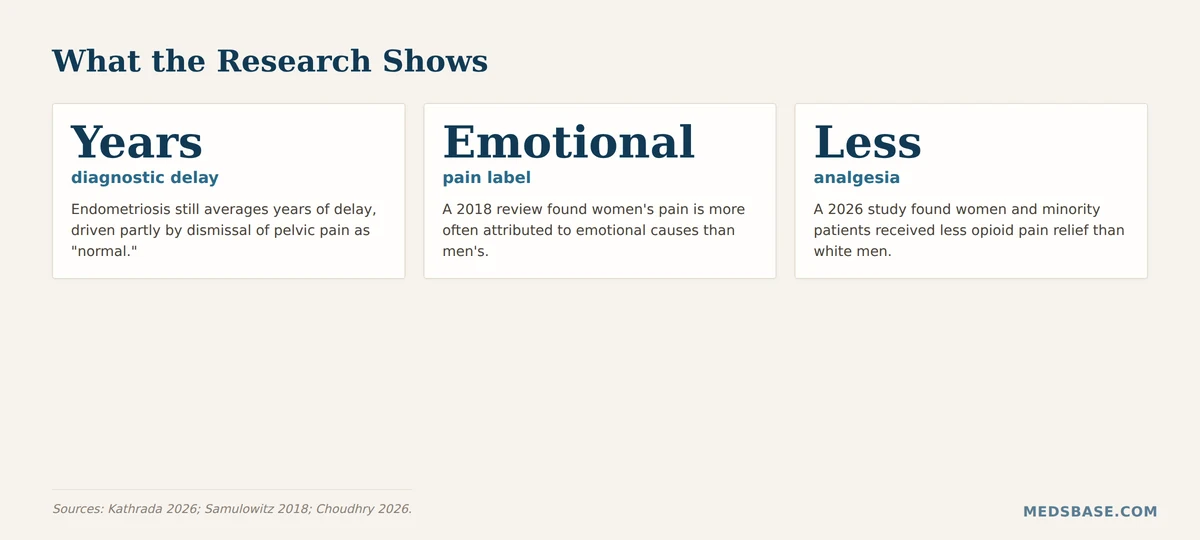
| Study | Year | Finding | Source |
|---|---|---|---|
| Cape, Health (London) | 2026 | Qualitative study of women whose symptoms were re-labelled as psychological, delaying real diagnosis | PubMed |
| Samulowitz et al., Pain Res Manag | 2018 | Systematic review: gender bias leads to women’s pain being attributed to emotional causes more than men’s | PubMed |
| Choudhry et al., Ophthalmic Epidemiol | 2026 | Women and minority patients received less opioid analgesia than white men for comparable ocular trauma | PubMed |
| Kathrada et al., J Womens Health | 2026 | Endometriosis still averages years of diagnostic delay, driven partly by symptom dismissal | PubMed |
What this means for you: the evidence doesn’t say your doctor is out to get you. It says the system has a measurable, documented tendency to underestimate certain patients’ symptoms — and knowing that lets you correct for it, calmly and strategically.
How to Advocate for Yourself at the Doctor
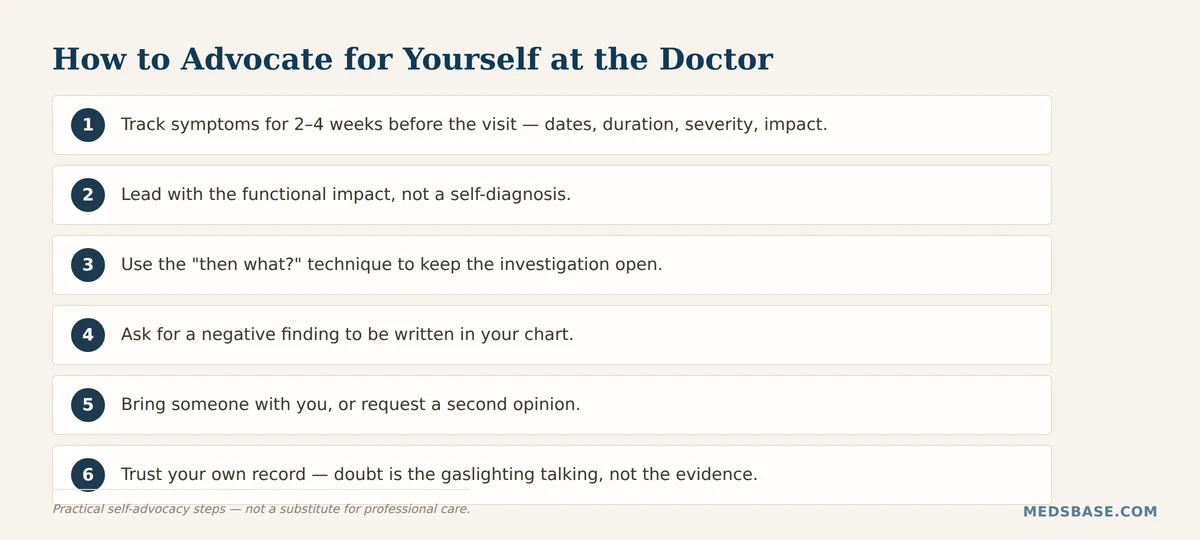
You don’t need to become confrontational. The goal is to make your symptoms harder to dismiss — and a few specific techniques measurably help.
1. Track your symptoms before the visit. Write down what you’re experiencing, how often, how long, and what makes it better or worse — for two to four weeks if you can. A dated log turns “I’m tired all the time” into “for the last three weeks I’ve needed to nap daily and can’t climb a flight of stairs.” Concrete data is harder to dismiss than a vague feeling.
2. Lead with the impact, not the label. Instead of “I think I have X,” say “This pain stops me from working three days a week.” Doctors respond to functional impact. Let them do the diagnosis; you supply the evidence.
3. Use the “then what” technique. If a symptom is dismissed, ask the question that keeps the investigation open: “If it’s just stress, what would explain the fever I’ve been running?” or “What would be the next step if it isn’t stress?” This politely refuses the dead end.
4. Ask for the negative to be written down. “Could you note in my chart that I’ve reported chest pain on exertion and you’re recommending no further testing?” This isn’t confrontational — it’s a standard patient-rights practice — and it genuinely changes how thoroughly your concern is considered.
5. Bring someone with you, or request a second opinion. A second person in the room shifts the dynamic, and a second opinion is always within your rights. If you’ve been dismissed repeatedly, seeking a different clinician is not overreacting — it’s the correct response.
6. Trust your own record. When you catch yourself thinking “I don’t want to waste their time,” return to your symptom log. That doubt is the gaslighting talking, not the evidence.
If a symptom has been going on for months and you feel unheard, the healthiest thing you can do is find a provider who listens — not talk yourself out of seeking one.
Related Reading
- Everything You Should Know About Menopause — a condition whose symptoms are frequently dismissed as “just ageing.”
- PCOS and Heart Disease — a commonly under-diagnosed women’s condition.
- Antidepressant Discontinuation Syndrome — understanding what a real, physical medication effect looks like.
Frequently Asked Questions
Q: What is medical gaslighting?
A: Medical gaslighting is when a healthcare provider repeatedly dismisses, minimises, or mislabels your symptoms — typically attributing them to stress, anxiety, or “nothing serious” — so that you begin to doubt your own experience. It’s usually unconscious bias rather than deliberate deception, and it can delay real diagnoses by months or years.
Q: How do I tell if my doctor is gaslighting me?
A: Look for a pattern, not a single frustrating visit. Signs include symptoms being repeatedly blamed on stress or your period, being told you’re “too young” for a condition, changing explanations with no tests, and feeling rushed. The strongest signal is internal: if you’ve started downplaying your own symptoms or avoiding appointments because you expect dismissal, that’s a sign it’s happening.
Q: Why do doctors dismiss women’s symptoms more often?
A: Research documents a clear gender bias in healthcare. A 2018 systematic review found women’s pain is more likely to be attributed to emotional causes than men’s. Combined with “diagnostic overshadowing” (where an existing impression, like an anxiety diagnosis, overshadows new symptoms) and short appointment times, the result is that women’s complaints — especially pain — are more often under-investigated.
Q: What should I do when my doctor doesn’t listen?
A: Prepare a symptom log before your visit, lead with the functional impact (“this stops me working three days a week”), and use the “then what” technique to keep the investigation open. You can also ask for a negative finding to be written in your chart, bring a support person, or request a second opinion. None of these are confrontational — they’re standard self-advocacy.
Q: Is medical gaslighting intentional?
A: Usually not. Most medical gaslighting stems from unconscious bias, time pressure, and diagnostic shortcuts rather than a deliberate effort to deceive. That doesn’t make it harmless — it still delays care — but it does mean the problem is often fixable with better communication on both sides, and that you don’t need to treat your doctor as an adversary.
Q: Can medical gaslighting delay a real diagnosis?
A: Yes, and the delays can be substantial. Endometriosis, for example, still averages years between symptom onset and diagnosis, driven in part by the dismissal of pelvic pain as “normal.” Autoimmune conditions, migraine, and certain heart conditions in women show similar patterns. The cost of dismissal isn’t just emotional — it’s the progression of disease during the delay.
Q: Should I switch doctors if I feel dismissed?
A: If you’ve been dismissed repeatedly after trying clear communication, switching is reasonable and often the right call. You are entitled to a provider who takes your concerns seriously, and a second opinion is always within your rights. The goal isn’t to find someone who agrees with you — it’s to find someone who investigates.
Q: Is it my fault if I get dismissed?
A: No. Medical gaslighting reflects systemic patterns and clinical shortcuts, not a failure on your part. Your symptoms are data, and you are their most accurate reporter. The single most important thing you can do is keep trusting your own record and keep advocating until you get an answer.
The Bottom Line
Here’s the honest verdict: your symptoms are real, and being dismissed is not a reflection of their validity.
Medical gaslighting is a documented, measurable pattern — women and marginalised groups are systematically more likely to have their symptoms minimised, and the cost is measured in delayed diagnoses. But it’s also a pattern you can push back against, calmly and effectively.
Your immediate action: before your next appointment, spend ten minutes starting a symptom log — dates, duration, severity, and how it affects your daily life. That single habit is the most effective anti-dismissal tool there is, because concrete data is much harder to wave away than a feeling.
And if you’ve been sitting on a symptom that worries you — especially one that’s been dismissed before — consider this your sign to book the appointment. For a deeper look at conditions whose symptoms are commonly dismissed, read our menopause guide or PCOS and heart disease explainer.

Written by
Sophie ChenPharmaceutical Content Researcher · 8 years experience
Sophie Chen is a pharmaceutical content researcher with 8 years covering generic medication access and clinical pharmacology. She specialises in international regulatory frameworks, bioequivalence standards, and patient-facing education on therapeutic drug classes. She is not a clinician.