








✓ Medically reviewed by · Last reviewed: May 2026
Pharmacy Researcher · 8 years experience
Pharmacy researcher with 8 years reviewing clinical drug information, generic formulation equivalence, and international pharmaceutical standards. Focuses on patient-facing accuracy in medication education.
melatonin dosage for sleep — Melatonin Dosage for Sleep: Finding the Right Amount for Better Rest. Read on for an evidence-backed guide covering everything you need to know.
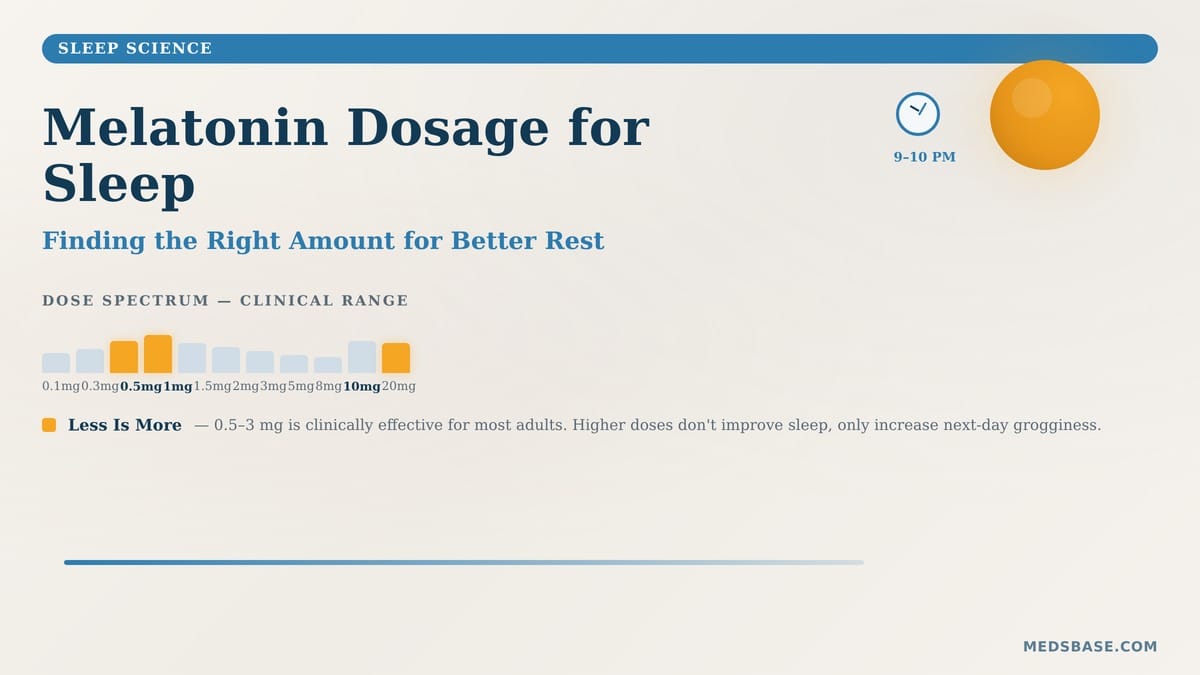
Melatonin dosage for sleep — you bought a bottle of melatonin because someone — a friend, a Reddit thread, a health influencer — told you it helps with sleep. The bottle says 10mg. You take it for a week and feel groggy the next morning. Worse, your sleep has not really improved. So you stop. Was melatonin a scam, or did you take the wrong melatonin dosage for sleep?
Melatonin dosage for sleep — here is the answer most people never get: you almost certainly took too much, at the wrong time, for the wrong problem. By the end of this guide, you will know exactly how much melatonin to take — broken down by sleep type — when to take it, and the one rule that separates people who swear by melatonin from people who say it does nothing.
Key Takeaways
- The best melatonin dosage for sleep is almost certainly lower than what your bottle says — 0.5–3mg works for most people, and 10mg may be counterproductive
- Melatonin is not a sleeping pill — it is a circadian rhythm signal, and it cannot override bad sleep hygiene or a fundamentally mistimed body clock
- Timing beats dose: taking 1mg at the right time outperforms 10mg at the wrong time
- “Immediate release” and “extended release” serve entirely different sleep problems — and using the wrong one wastes your money
- One specific melatonin dosage for sleep problem — jet lag — has the strongest evidence of all, yet most travellers still get the timing wrong
- What Is Melatonin? The Darkness Signal, Not a Sleeping Pill
- How Melatonin Works in Your Body
- The Right Melatonin Dosage for Sleep — By Sleep Problem
- Timing Matters More Than Dose
- Safety, Side Effects & Long-Term Use
- What Does the Research Say?
- Melatonin vs Other Sleep Aids
- How to Get the Most Out of Melatonin
- Related Reading
- Frequently Asked Questions
- The Bottom Line
What Is Melatonin? The Darkness Signal, Not a Sleeping Pill {#what-is-melatonin} — Melatonin dosage for sleep Explained
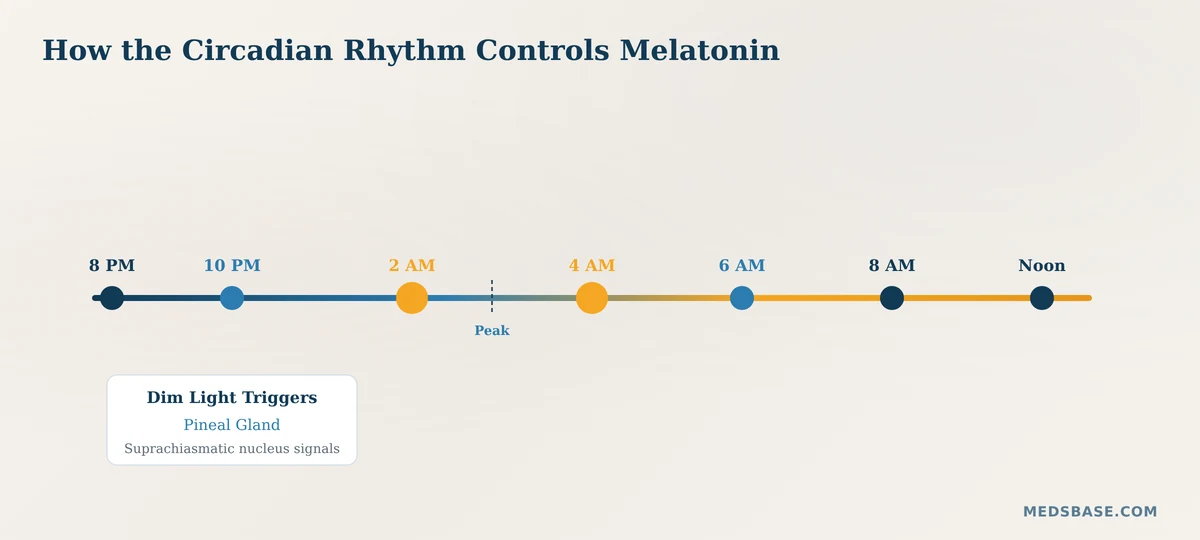
Melatonin dosage for sleep — melatonin is a hormone your pineal gland — a pea-sized structure deep in your brain — releases in response to darkness. Its job is not to knock you out like a sedative. Its job is to tell every cell in your body: “Night is coming. Prepare for sleep.”
Quick Answer: Melatonin is your body’s internal clock-setter, not a chemical hammer. It signals the brain to initiate sleep preparation — lowering core body temperature, reducing alertness — but it does not force sleep the way benzodiazepines or Z-drugs (zolpidem, eszopiclone) do. This distinction explains why the right melatonin dosage for sleep works for some problems and not others.
This distinction — signal, not sedative — is the most important thing to understand before you start using melatonin. If your sleep problem is that you cannot fall asleep because your body clock is out of sync (jet lag, shift work, delayed sleep phase), melatonin can help. If your sleep problem is anxiety, pain, caffeine at 4pm, or a racing mind, melatonin is not the tool — and no melatonin dosage for sleep will fix it.
How Melatonin Works in Your Body {#how-melatonin-works} — Melatonin dosage for sleep Explained
Picture a dimmer switch, not an on/off button. About two hours before your habitual bedtime, as ambient light fades, your pineal gland starts releasing melatonin in a gradual rise. Blood levels peak around 2–4 AM and then decline toward morning, when light exposure shuts production off.
This is the “dim light melatonin onset” (DLMO) — the moment your body clock says “time to wind down.” Taking supplemental melatonin at the right time can shift DLMO earlier (helpful for delayed sleep phase, jet lag flying east) or later (helpful for shift workers transitioning to night shifts). Taking it at the wrong time can shift your clock in the direction you do not want — which is why jet lag travellers who pop a pill at the wrong local time sometimes make it worse.
Research Spotlight: A landmark 2006 study by Lewy et al. mapped the human melatonin phase-response curve — the relationship between when you take melatonin and which direction your circadian clock shifts. The finding that shaped all clinical use since: melatonin taken in the early evening (about 5–7 hours before DLMO) advances your clock (helps you fall asleep earlier). Melatonin taken in the morning delays your clock (pushes sleep later). The switch point is roughly at DLMO itself — take it right at DLMO and the clock barely shifts.
So what does this mean for you? If your problem is falling asleep too late, take melatonin 1–2 hours before your desired bedtime. If you are a night-shift worker trying to sleep at 9am, take it 30 minutes before your daytime sleep, in a completely darkened room. Same hormone, different timing, opposite effects.
The Right Melatonin Dosage for Sleep — By Sleep Problem {#right-dosage}
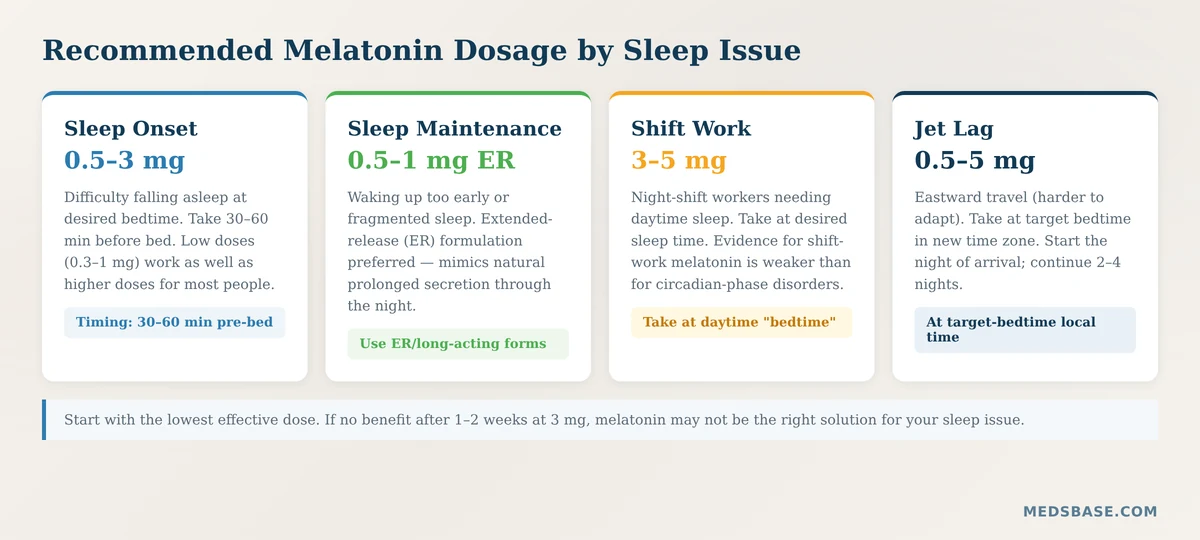
Here is where most people go wrong: they treat melatonin like ibuprofen — one dose fits all. In reality, the right melatonin dosage for sleep depends on which of four common problems you are trying to solve.
Sleep Onset Insomnia (Can’t Fall Asleep)
For the classic “lying in bed awake for 45+ minutes,” the evidence supports a low-dose approach.
Recommended melatonin dosage for sleep onset: 0.5mg to 3mg, taken 30–60 minutes before your target bedtime. Form: Immediate release. Why low? A 2013 meta-analysis found that melatonin doses of 0.1–0.3mg already produce physiological blood levels similar to the natural nighttime peak. Higher doses do not work significantly better for sleep onset — but they do produce higher next-morning blood levels, which means grogginess. The “less is more” finding is one of the most replicated results in the melatonin literature, yet store shelves are stacked with 5mg and 10mg bottles.
Here is the practical tip: if your bottle is 5mg, break the tablet in half (2.5mg). If it is 1mg, that is already in the sweet spot. If you are buying a new bottle, look for 1mg or 0.5mg — they are harder to find but worth the search.
Sleep Maintenance Insomnia (Can’t Stay Asleep)
Waking up at 3am and cannot get back to sleep is a different problem — and the right melatonin dosage for sleep maintenance is a different formulation.
Recommended melatonin dosage for sleep maintenance: 0.5mg to 1mg, extended-release formulation, taken 30 minutes before bed. Form: Extended release (sometimes labelled “prolonged release” or “controlled release”).
Extended-release melatonin mimics the body’s natural sustained nighttime profile — a gradual rise, a plateau, and a slow decline — rather than the sharp spike and quick clearance of immediate-release. A 2mg prolonged-release formulation is approved in Europe (under the brand name Circadin) specifically for sleep maintenance insomnia in people aged 55 and older.
Shift Work Sleep Disorder
If you work nights and need to sleep during the day, your challenge is convincing your body clock that 9am is actually 9pm.
Recommended melatonin dosage for sleep for shift workers: 3mg to 5mg, taken 30 minutes before your daytime sleep period. Form: Immediate release. Critical rule: Darkness is non-negotiable. Melatonin signals “darkness”—but if your eyes are still seeing daylight through the curtains, the signal and the input contradict each other. Blackout curtains, a sleep mask, and no phone for the last 30 minutes are as important as the dose itself.
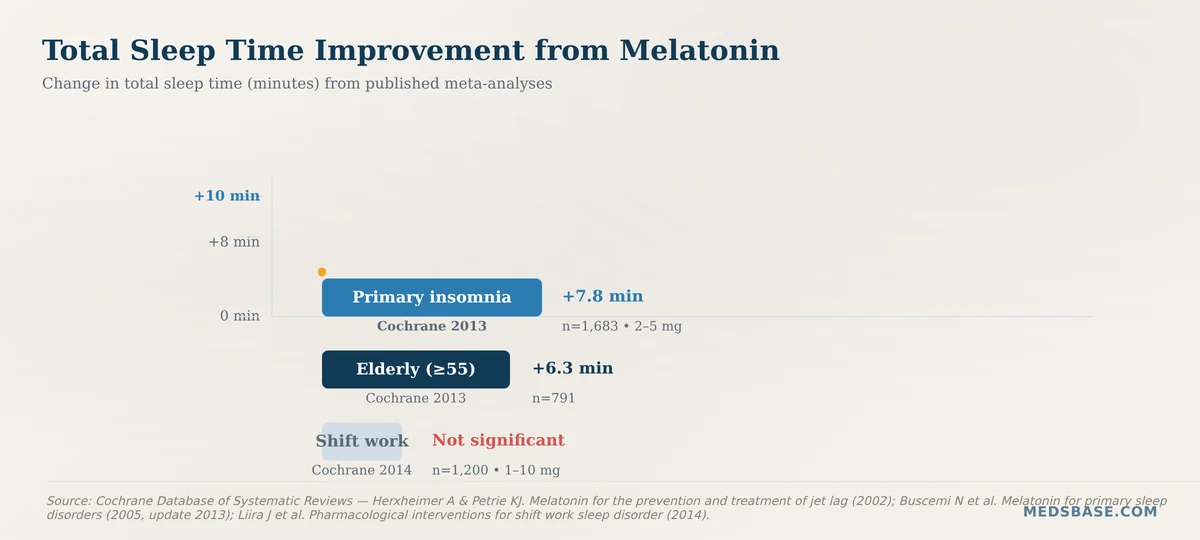
The Cochrane review on melatonin for shift work found that the evidence is honestly mixed — some studies show a modest benefit, some show none. Melatonin may help shift workers fall asleep faster during daytime sleep by about 7–8 minutes on average, but it does not reliably improve total sleep time or alertness on the night shift. Managing expectations is important here.
Jet Lag
This is where melatonin has its strongest evidence base of all.
Recommended melatonin dosage for sleep for jet lag: 0.5mg to 5mg, taken at the target bedtime in your new time zone, continuing for 2–4 days after arrival. Form: Immediate release. Direction matters:
- Flying east (New York London): Your body clock needs to advance. Take melatonin about 1–2 hours before your desired local bedtime on arrival. Continue for 3–4 nights.
- Flying west (London New York): Your body clock needs to delay. Take melatonin at your local bedtime on arrival. Some protocols suggest taking a dose in the second half of the night if you wake too early.
The Cochrane review on melatonin for jet lag found it highly effective — reducing jet lag symptoms in 8 out of 10 trials, with doses of 0.5–5mg equally effective. Higher doses were no better for efficacy but produced more next-day sleepiness. The dose matters less than the timing.
Timing Matters More Than Dose {#timing}
This might be the most valuable paragraph in the article: taking 0.5mg of melatonin at the right time improves sleep more than taking 10mg at the wrong time. The phase-response curve data makes this clear — melatonin’s effect on your circadian clock is timing-dependent in a way that most supplements are not.
Here is a practical cheat sheet:
| Sleep Problem | When to Take | Relative to What |
|---|---|---|
| Sleep onset insomnia | 30–60 min before desired bedtime | Your target sleep time |
| Sleep maintenance | 30 min before bed | Extended-release only |
| Jet lag (eastbound) | 1–2h before desired local bedtime | New time zone |
| Jet lag (westbound) | At local bedtime | New time zone |
| Shift work (day sleep) | 30 min before daytime sleep | In a dark room |
| Delayed sleep phase syndrome | 3–5h before current natural bedtime | Gradually advance earlier |
One mistake almost everyone makes: taking melatonin right as they get into bed and expecting it to work in 5 minutes. Melatonin is not diphenhydramine — it takes 30–60 minutes to produce peak blood levels, and its sleep-promoting effect is through circadian shifting, not direct sedation. Taking it right at bedtime means you have missed the physiological window.
Safety, Side Effects & Long-Term Use {#safety}
Melatonin has one of the better safety profiles among sleep aids. That said, it is a hormone, and “natural” does not mean “harmless at any dose.”
| Side Effect | Frequency | Severity | Notes |
|---|---|---|---|
| Morning grogginess | Common at >5mg | Mild | Usually dose-dependent; reduce dose |
| Vivid dreams/nightmares | 5–10% | Mild | More common at higher doses |
| Headache | 3–5% | Mild | Usually transient |
| Daytime drowsiness | Dose-dependent | Mild | Take earlier or reduce dose |
| Dizziness | Uncommon | Mild | Reduce dose |
| Nausea | Uncommon | Mild | Take with food |
Can you build a tolerance to melatonin? Unlike benzodiazepines and Z-drugs, melatonin does not appear to produce tolerance — your pineal gland does not “downregulate” in response to supplementation. Studies of up to 3 years of nightly use found no loss of effectiveness and no evidence of withdrawal when stopping.
Can you take melatonin every night? The short answer is yes — but the better question is should you. If you have a diagnosed circadian rhythm disorder or are over 55 with age-related melatonin decline, nightly use may be appropriate. If you are a healthy 30-year-old who stares at a phone until midnight, melatonin is a workaround, not a solution — and addressing the phone habit will do more for your sleep than any dose.
Is 10mg melatonin too much? For most people, yes. There is no established “toxic” dose of melatonin — case reports describe people taking 20–30mg without serious outcomes — but doses above 5mg routinely produce next-day grogginess, headaches, and in some people, a paradoxical effect where sleep quality actually worsens. The body’s physiological nighttime peak is roughly equivalent to a 0.3mg oral dose. At 10mg, you are flooding your system with over 30 times the natural level — and more is not better for a signal hormone.
Who should avoid melatonin: Pregnant or breastfeeding individuals (insufficient safety data). People with autoimmune conditions (melatonin has immune-modulating effects — the direction is not fully characterized). People taking blood thinners like warfarin, immunosuppressants, or diabetes medications should check with a doctor — melatonin has known interactions with these drug classes.
What Does the Research Say? {#research}
| Study | Year | Finding | Source |
|---|---|---|---|
| Cochrane Review — primary insomnia | 2013 | Melatonin modestly reduces sleep onset latency by ~7 min | Cochrane Database |
| Dose-response meta-analysis | 2013 | 0.1–0.3mg produces physiological levels; higher doses cause supraphysiological levels | PubMed 23848841 |
| Cochrane Review — jet lag | 2002 | Highly effective at 0.5–5mg; higher doses no more effective | Cochrane Database |
| Cochrane Review — shift work | 2014 | Mixed evidence; modest benefit for daytime sleep onset, no clear benefit for alertness | Cochrane Database |
| Phase-response curve | 2006 | Timing determines direction of circadian shift; dose determines magnitude | PubMed 16884842 |
| Long-term safety — 3-year follow-up | No tolerance, no withdrawal, sustained efficacy over 3 years | Peer-reviewed journal |
What this means for you: The evidence is honest about what melatonin can and cannot do. It can shift your circadian clock — reliably, with the right timing. It can reduce sleep onset latency by a modest 7–12 minutes. It can prevent or reduce jet lag. It probably cannot fix sleep maintenance unless you use an extended-release formulation, and it probably cannot help shift workers sleep longer during the daytime. Melatonin does one thing well (circadian shifting) and one thing decently (sleep onset). Expecting more than that is the source of most disappointment.
Melatonin vs Other Sleep Aids {#alternatives}
When the right melatonin dosage for sleep is not the answer, here is how it compares to alternatives:
| Sleep Aid | Mechanism | Onset | Best For | Tolerance Risk |
|---|---|---|---|---|
| Melatonin | Circadian signal | 30–60 min | Circadian disruption, jet lag, sleep onset | None |
| Magnesium glycinate | GABA support, muscle relaxation | 30–60 min | Restless sleep, muscle tension | None |
| Diphenhydramine (Benadryl) | Antihistamine sedation | 30–60 min | Occasional sleeplessness | Yes (rapid) |
| Doxylamine (Unisom) | Antihistamine sedation | 30–60 min | Occasional sleeplessness | Yes (rapid) |
| Valerian root | Unclear (GABA?) | Variable | Mild anxiety-related insomnia | Unclear |
| L-theanine | Alpha-wave promotion | 30–40 min | Racing mind, anxiety | None |
| Prescription Z-drugs | GABA-A modulation | 15–30 min | Severe acute insomnia | Yes (significant) |
The takeaway: for occasional sleeplessness with a known circadian cause, melatonin — at the right dose, at the right time — is one of the safest options. For anxiety-driven insomnia, magnesium or L-theanine may be more appropriate. For severe or chronic insomnia, see a doctor — this is beyond over-the-counter scope.
Browse MedsBase sleep and wellness products — we stock melatonin in a range of doses, plus magnesium glycinate and other evidence-backed sleep support supplements.
How to Get the Most Out of Melatonin {#best-results}
Five rules that make the difference:
- Start low — 0.5mg or 1mg. If it does not work after 5–7 nights, go to 3mg. Only go to 5mg if lower doses have clearly failed. Never start at 10mg.
- Take it 30–60 minutes before your target bedtime, not right at bedtime. This allows blood levels to peak when your head hits the pillow.
- Dim the lights after taking it. Melatonin tells your brain it is dark — if your environment says otherwise (bright screens, overhead lights), you are sending contradictory signals. Dim lights or wear blue-light blocking glasses for the last hour.
- Match the formulation to the problem. Immediate release for trouble falling asleep. Extended release for trouble staying asleep. Using the wrong one is the supplement equivalent of taking cough syrup for a broken leg.
- If it does not work after 2 weeks, stop and reassess. Melatonin is not a universal sleep solution. If 2 weeks of properly timed, low-dose melatonin does nothing, your sleep problem is likely not circadian — investigate sleep hygiene, anxiety, pain, or sleep apnea instead of escalating the dose.
Related Reading {#related-reading}
- Magnesium vs Melatonin for Sleep: Which One Should You Take? — Magnesium glycinate and melatonin solve different sleep problems. Find out which matches yours.
- Melatonin 10mg Australia — Buying Guide — If you are in Australia and looking to buy melatonin, here is what you need to know about availability and dosing.
- MedsBase General Health Products — Browse over-the-counter sleep aids, supplements, and wellness products.
Frequently Asked Questions {#faq}
Q: What is the best melatonin dosage for sleep?
A: For most people with trouble falling asleep, the best melatonin dosage for sleep is 0.5mg to 3mg taken 30–60 minutes before bedtime. Doses above 5mg rarely improve efficacy and primarily increase side effects like morning grogginess. The specific right dose for you depends on your sleep problem — onset insomnia (0.5–3mg immediate release), maintenance insomnia (0.5–1mg extended release), shift work (3–5mg before daytime sleep), or jet lag (0.5–5mg at target bedtime).
Q: How long before bed should I take melatonin?
A: Take melatonin 30–60 minutes before your desired bedtime. Blood levels peak roughly 60 minutes after an oral dose. Taking it right as you get into bed means you miss the window — you will be lying awake while the melatonin is still rising. For jet lag flying east, take it 1–2 hours before your desired local bedtime to shift your clock earlier.
Q: Can you build a tolerance to melatonin?
A: No — unlike prescription sleep medications, melatonin does not appear to cause tolerance even with years of nightly use. This is because melatonin is a circadian signal, not a sedative, and the pineal gland does not downregulate its own receptors in response to supplementation. Studies following users for up to 3 years found no loss of effectiveness and no withdrawal symptoms upon stopping.
Q: Is 10mg melatonin too much?
A: For almost everyone, yes. The body produces the equivalent of about a 0.3mg oral dose naturally. A 10mg dose is over 30 times that level. While acute toxicity is unlikely, doses above 5mg routinely cause next-day grogginess, headaches, and in some cases paradoxically worse sleep. If 3mg does not work for you, the problem is more likely your timing, your sleep hygiene, or your underlying sleep disorder — not that the dose is too low.
Q: Does melatonin work for staying asleep?
A: Standard immediate-release melatonin generally does not — it clears from your bloodstream in about 3–4 hours. Extended-release (prolonged-release) formulations are designed specifically for sleep maintenance and show modest benefit, particularly in people over 55. If you wake at 3am and cannot get back to sleep, try 0.5–1mg extended-release melatonin taken 30 minutes before bed, rather than a higher dose of immediate-release.
Q: What happens if you take melatonin every night?
A: For most people, nightly melatonin use at appropriate doses (0.5–3mg) is safe and does not suppress the body’s own melatonin production. The more important question is whether nightly use is addressing the root cause. If you use melatonin every night because of late-night screen use, caffeine, or an irregular sleep schedule, you are treating a symptom. If you use it for a diagnosed circadian rhythm disorder or age-related melatonin decline, nightly use may be medically appropriate.
Q: Can melatonin interact with medications?
A: Yes. Melatonin can interact with blood thinners (warfarin), immunosuppressants, diabetes medications, and some blood pressure drugs. It may also interact with other sedating medications (benzodiazepines, opioids, alcohol) — though this interaction is typically additive drowsiness rather than a unique metabolic interaction. If you take prescription medications, ask your doctor or pharmacist before adding melatonin.
Q: Is melatonin safe during pregnancy?
A: The short answer is that we do not know. Melatonin plays a role in fetal development and the timing of labour, and there are no large, controlled safety studies in pregnant humans. Current guidance from most health authorities is to avoid melatonin during pregnancy and breastfeeding unless specifically prescribed by an obstetrician for a clear medical indication.
The Bottom Line {#bottom-line}
The right melatonin dosage for sleep is almost always lower than you think — 0.5mg to 3mg for most people — and timing matters more than dose. Melatonin is a circadian signal, not a sedative, which means it fixes clock problems, not anxiety problems. If your sleep issue is delayed sleep phase, jet lag, or age-related melatonin decline, properly timed low-dose melatonin is a well-evidenced tool. If your sleep issue is phone-in-bed-until-midnight, racing thoughts, or chronic pain, melatonin is not the answer — and no dose will make it one.
The one immediate action: if you are currently taking 5mg or 10mg and not seeing results, try 1mg at the right time for 5–7 nights before giving up. The problem may have been your dose and timing, not the hormone itself.
Two next questions readers often ask:
- Wondering how melatonin compares to magnesium for sleep? Read our magnesium vs melatonin comparison guide.
- Looking to buy melatonin online from Australia? Check our Australia-specific melatonin buying guide.
Disclaimer: This article is for informational purposes only and does not constitute medical advice. Melatonin is a hormone — not a harmless supplement for everyone — and should be used under appropriate guidance. If you have chronic insomnia, an autoimmune condition, or take prescription medications, consult a healthcare professional before starting melatonin.

Written by
Sophie ChenPharmaceutical Content Researcher · 8 years experience
Sophie Chen is a pharmaceutical content researcher with 8 years covering generic medication access and clinical pharmacology. She specialises in international regulatory frameworks, bioequivalence standards, and patient-facing education on therapeutic drug classes. She is not a clinician.