








✓ Medically reviewed by · Last reviewed: May 2026
Pharmacy Researcher · 8 years experience
Pharmacy researcher with 8 years reviewing clinical drug information, generic formulation equivalence, and international pharmaceutical standards. Focuses on patient-facing accuracy in medication education.
melatonin vs magnesium for sleep — Melatonin vs Magnesium for Sleep: 8 Evidence-Based Differences to Know Before You Buy. Read on for an evidence-backed guide covering everything you need to know.
It’s 2:37 AM and you’re staring at the ceiling — again. You’ve tried counting sheep, white noise, and every sleep hygiene tip on the internet. Now you’re standing in the supplement aisle, holding a bottle of melatonin in one hand and magnesium in the other, wondering which one will actually help you sleep. The melatonin vs magnesium for sleep question isn’t just a Reddit thread — it’s a decision that affects how you feel tomorrow morning, how you perform at work, and whether you finally break the cycle of bad nights.
Here’s the problem: most articles treat melatonin vs magnesium for sleep like a boxing match with a single winner. They miss what actually matters — your specific sleep problem. The supplement that works for your friend who can’t fall asleep might do nothing for you if your issue is waking up at 3 AM with a racing mind. The right answer to melatonin vs magnesium for sleep depends on whether your sleep problem is about timing, relaxation, or deficiency — and most people don’t know which one they have. By the end of this guide, you will.
Quick Answer: Melatonin vs Magnesium for Sleep
Melatonin works best when your sleep problem is about timing — you can’t fall asleep at your desired bedtime, you work shifts, or you’re jet-lagged. It signals your brain that night has started. Magnesium works best when your sleep problem is about inability to relax — racing thoughts, muscle tension, or you fall asleep but wake up repeatedly. If you have both issues, the evidence suggests you can take them together safely at standard doses. Neither is a sleeping pill — both support natural sleep processes. The strongest clinical evidence exists for melatonin (circadian rhythm disorders, jet lag) and magnesium glycinate (mild-to-moderate insomnia with relaxation difficulty). Start with one, not both, and give it 2–3 weeks before deciding.
Key Takeaways
- Melatonin regulates sleep timing; magnesium enables physical relaxation. If you can’t fall asleep at your desired bedtime, melatonin is the evidence-based starting point. If you fall asleep but your body won’t relax, magnesium is the stronger candidate — and the research on each backs completely different sleep problems.
- Three placebo-controlled RCTs give magnesium mixed but directionally positive sleep scores. The 2025 Nature and Science of Sleep trial (155 adults, magnesium bisglycinate) and the 2024 Sleep Medicine study (80 adults, magnesium L-threonate) both show real improvements — but the effect sizes are modest, meaning magnesium helps some people meaningfully and others not at all.
- Magnesium form matters more than melatonin dose for most people. Magnesium glycinate produces the most consistent sleep effects. Magnesium oxide — the form in most drugstore supplements — mostly works as a laxative. If you tried “magnesium for sleep” before and it didn’t work, check which form you took.
- Lower melatonin doses (0.5–3 mg) often outperform higher ones (5–10 mg). Most OTC melatonin products are overdosed. The clinical sweet spot for sleep onset is 0.5–3 mg taken 30–60 minutes before bed. Higher doses increase next-day grogginess without improving sleep.
- You can take both, but start with one. No major interaction exists between melatonin and magnesium at standard doses. But if you start both at the same time, you won’t know which one actually helped — and you might keep buying both unnecessarily.
- Cost per effective dose varies by a factor of 5–10× depending on the form you choose. Generic melatonin costs pennies per dose. Quality magnesium glycinate costs more — but the difference between a cheap magnesium oxide pill and an effective magnesium glycinate capsule is the difference between a supplement and a bathroom emergency. The cost comparison table below breaks this down.
Table of Contents
- What Is Melatonin vs Magnesium for Sleep?
- How Does Melatonin Work for Sleep?
- How Does Magnesium Work for Sleep?
- Melatonin vs Magnesium for Sleep: The Complete Evidence Comparison
- Which Form of Magnesium Is Best for Sleep?
- Melatonin vs Magnesium for Sleep: A Decision Framework
- Safety, Side Effects, and Drug Interactions
- Melatonin vs Magnesium for Sleep: Cost Comparison
- Frequently Asked Questions About Melatonin vs Magnesium for Sleep
- The Bottom Line on Melatonin vs Magnesium for Sleep
What Is Melatonin vs Magnesium for Sleep?
The melatonin vs magnesium for sleep decision starts with understanding what each substance actually is — because they’re fundamentally different things doing fundamentally different jobs. Melatonin is a hormone your pineal gland produces in response to darkness; it tells your brain that biological night has begun. Magnesium is an essential mineral involved in over 300 enzymatic reactions, including those that regulate nerve signaling, muscle contraction, and the calming neurotransmitter GABA. One sets your internal clock; the other helps your body execute the shutdown sequence. That distinction drives the entire melatonin vs magnesium for sleep decision.
How Does Melatonin Work for Sleep?
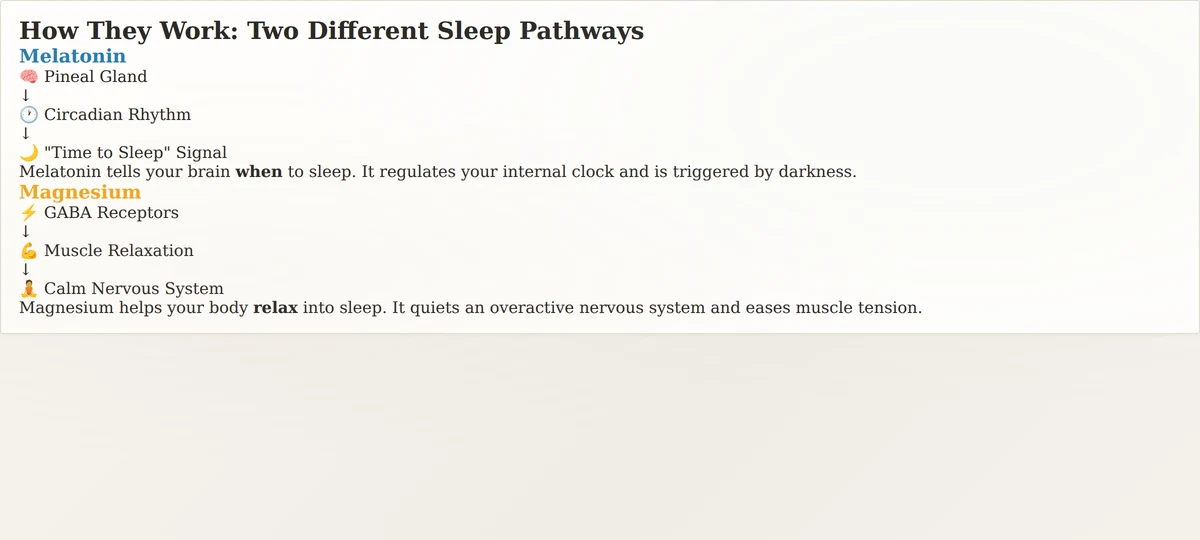
Your brain’s pineal gland starts releasing melatonin about two hours before your habitual bedtime, triggered by darkness detected through your eyes. Melatonin doesn’t knock you out — it opens the sleep gate, the window of circadian opportunity when your body is ready to transition from wakefulness to sleep. Blood levels peak between 2 and 4 AM, then decline toward morning. This rhythm explains why melatonin vs magnesium for sleep isn’t a contest between equals: melatonin addresses a timing signal; magnesium addresses the physical conditions for relaxation.
Quick Answer: Who Benefits Most from Melatonin?
Melatonin works best for people whose sleep problem is primarily about circadian timing — delayed sleep phase disorder (natural night owl who needs to sleep earlier), jet lag crossing time zones, shift work sleep disorder, and age-related melatonin decline. It also helps blind people with non-24-hour sleep-wake disorder — one of the few FDA-approved indications for prescription melatonin (as tasimelteon, a melatonin receptor agonist). If you can sleep fine once you’re asleep but struggle to fall asleep at your desired time, melatonin is the logical first choice in the melatonin vs magnesium for sleep framework.
Dosing matters more with melatonin than most people realize. A 2022 systematic review in the Journal of Clinical Sleep Medicine found that doses of 0.5–3 mg produced equivalent or better sleep-onset effects compared to 5–10 mg doses, with significantly fewer next-day side effects. Many OTC melatonin products contain 5 mg or 10 mg — two to twenty times the clinical sweet spot. Timing also matters: take melatonin 30–60 minutes before your target bedtime, not right as you climb into bed.
One thing the melatonin vs magnesium for sleep question rarely surfaces: melatonin production declines with age. By age 60, your pineal gland produces roughly half the nighttime melatonin it did at age 20. This makes melatonin supplementation more physiologically relevant for older adults — they’re replacing a declining hormone, not adding something new.
How Does Magnesium Work for Sleep?
Magnesium doesn’t signal bedtime. Instead, it creates the neurochemical conditions that allow sleep to happen. Magnesium acts as a natural NMDA receptor antagonist — it blocks excitatory glutamate signaling and enhances the binding of GABA, your brain’s primary inhibitory neurotransmitter. In practical terms: magnesium helps quiet the mental chatter and physical tension that keep you awake. It also regulates melatonin production indirectly, because the enzyme that converts serotonin to melatonin (N-acetyltransferase) requires magnesium as a cofactor.
Şebnem Ünlüişler, genetic engineer at the London Regenerative Institute, explains the distinction clearly: “Magnesium, on the other hand, is an essential mineral involved in normal nerve and muscle function, and it may support relaxation and sleep particularly in people with low magnesium intake or deficiency.” The emphasis on deficiency is important — if your magnesium levels are normal, supplementing more may not improve your sleep. This is a critical variable in the melatonin vs magnesium for sleep calculus that most articles ignore.
Research Spotlight: Magnesium Bisglycinate for Insomnia (2025)
A placebo-controlled RCT published in Nature and Science of Sleep (2025) tested 250 mg of magnesium bisglycinate daily for 4 weeks in 155 adults aged 18–65 with diagnosed insomnia. Researchers measured sleep quality using the Pittsburgh Sleep Quality Index (PSQI), the Insomnia Severity Index (ISI), and actigraphy (wrist-worn sleep trackers). The magnesium group showed statistically significant but modest improvements in sleep onset latency (falling asleep ~7 minutes faster on average) and sleep efficiency. Subgroup analysis suggested that participants with higher baseline anxiety scores experienced larger improvements — supporting the idea that magnesium’s sleep benefit may be mediated through anxiety reduction rather than a direct hypnotic effect. The full study is available at PMC.
What this means for the melatonin vs magnesium for sleep decision: magnesium bisglycinate has real but modest evidence for insomnia — it helps, but it doesn’t work like a pharmaceutical sleep aid. The effect is more noticeable if you also have anxiety or muscle tension. If your primary problem is circadian misalignment (you can sleep, just not at the right time), this study doesn’t support magnesium as the answer.
Dr. Opel Baker, GP at Mayfield Clinic UK, reinforces this: “Magnesium is not a sleep hormone and its effects on sleep are generally less direct.” She notes that magnesium may be more relevant “for someone whose diet is lacking in magnesium, or where factors such as muscle tension or general physical relaxation are contributing to poor sleep.”
Magnesium deficiency is surprisingly common. The NIH Office of Dietary Supplements reports that approximately 50% of US adults consume less than the Estimated Average Requirement (EAR) for magnesium from food alone. The RDA is 310–320 mg/day for adult women and 400–420 mg/day for adult men. Deficiency symptoms include muscle cramps, fatigue, anxiety, and insomnia — a cluster that overlaps heavily with common sleep complaints. If you check several of those boxes, your melatonin vs magnesium for sleep answer may lean toward magnesium, but you need the right form.
Melatonin vs Magnesium for Sleep: The Complete Evidence Comparison
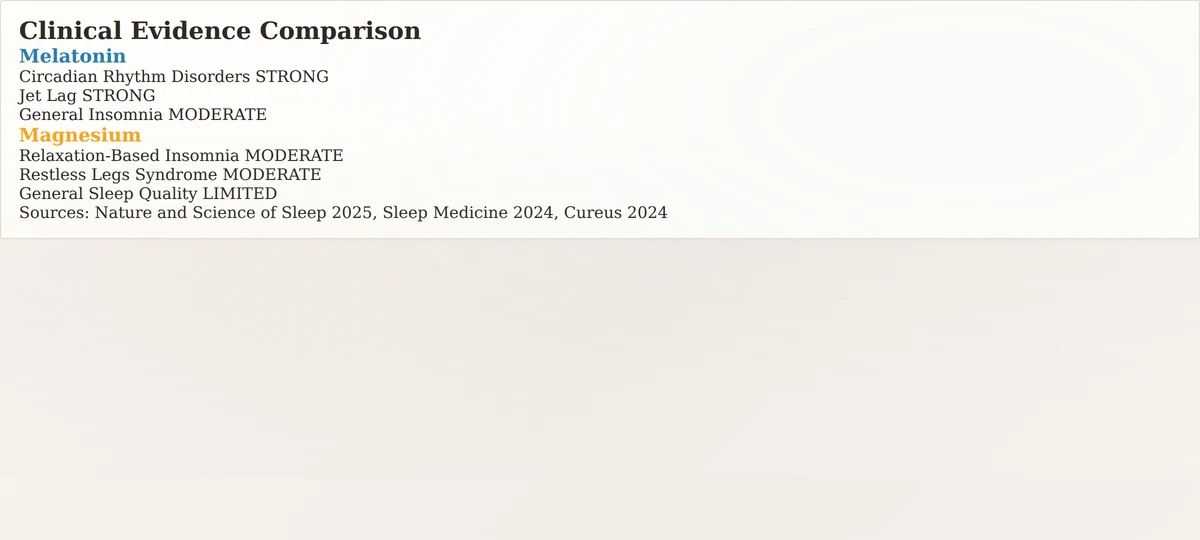
Comparing melatonin vs magnesium for sleep requires looking past marketing claims and directly at what randomized controlled trials actually show. The table below grades the evidence strength for each supplement across specific sleep outcomes.
| Study | Supplement | Design | Key Finding | Strength |
|---|---|---|---|---|
| Sleep Medicine (2024) | Magnesium L-threonate 1g/day | RCT, 80 adults, 3 weeks | Improved sleep quality scores in adults 35–55 with self-reported sleep difficulties | Moderate — placebo-controlled, but small sample, single trial |
| Nature and Science of Sleep (2025) | Magnesium bisglycinate 250mg/day | RCT, 155 adults, 4 weeks | Modest improvements in sleep onset (~7 min faster) and sleep efficiency; larger effect in high-anxiety subgroup | Moderate–Strong — larger sample, validated scales, but modest absolute effect |
| Cureus (2024) | Magnesium (various forms) | Systematic review | Mixed evidence — magnesium may improve sleep and anxiety, but heterogeneity across studies prevents strong conclusions | Weak–Moderate — comprehensive but undermined by inconsistent form/dosing across included studies |
| Multiple meta-analyses (various) | Melatonin 0.5–5 mg | Meta-analyses of RCTs | Consistently reduces sleep onset latency by 7–12 minutes; strongest evidence for circadian rhythm disorders and jet lag | Strong — large body of consistent evidence across decades of research |
| NIH/NCCIH (2025) | Melatonin | Government evidence review | Short-term use likely safe; evidence strongest for jet lag, shift work, delayed sleep phase; weaker for general insomnia | Strong — authoritative review body, large evidence base |
When you line up the evidence side by side, a clear pattern emerges in the melatonin vs magnesium for sleep comparison. Melatonin has the larger, more consistent body of evidence — but primarily for circadian timing problems, not for general insomnia. Magnesium has fewer studies, smaller effect sizes, and mixed results — but the signal is positive enough that it makes sense for the right person. The 2024 Cureus review summed it up best: the evidence for magnesium on sleep quality is promising but insufficient to make a universal recommendation. That’s why the melatonin vs magnesium for sleep question cannot have a universal answer.
The NIH’s National Center for Complementary and Integrative Health confirms that melatonin appears safe for short-term use but emphasizes that it’s not a treatment for insomnia — it’s a circadian rhythm regulator. If your insomnia is driven by anxiety, pain, or environmental factors rather than circadian misalignment, melatonin alone is unlikely to solve it. This is exactly where the melatonin vs magnesium for sleep framework becomes useful.
Which Form of Magnesium Is Best for Sleep?
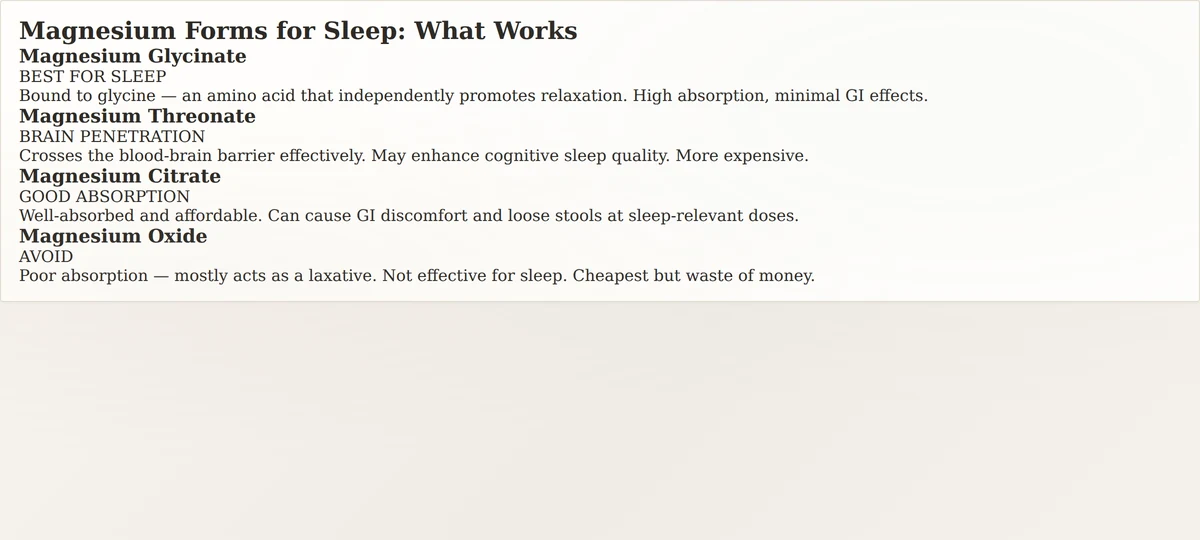
If you ask someone whether they’ve tried “magnesium for sleep,” the single most important follow-up question is: which form? The melatonin vs magnesium for sleep question is already comparing two different supplements — but “magnesium” isn’t one thing. It’s a family of compounds with dramatically different absorption rates, effects, and side effect profiles. Taking the wrong form and concluding “magnesium doesn’t work for sleep” is like drinking decaf and concluding caffeine doesn’t wake you up.
| Form | Absorption | Best For | Typical Sleep Dose | GI Side Effects |
|---|---|---|---|---|
| Magnesium Glycinate | High | Sleep, anxiety, muscle relaxation | 200–400 mg elemental magnesium | Low — most well-tolerated form |
| Magnesium L-Threonate | High (crosses blood-brain barrier) | Cognitive function, sleep (emerging evidence) | 1,000–2,000 mg (provides ~75–150 mg elemental) | Low |
| Magnesium Citrate | Moderate–High | Constipation, general magnesium repletion | 200–400 mg elemental | High — often causes diarrhea at sleep-relevant doses |
| Magnesium Oxide | Very Low (~4%) | Constipation (osmotic laxative) | Not recommended for sleep | High — primarily a laxative |
Magnesium glycinate is the best-supported form for sleep. The glycine molecule itself has independent calming properties — it functions as an inhibitory neurotransmitter in the brainstem and spinal cord. When bound to magnesium, you get two relaxation-promoting compounds in one. This matters enormously for the melatonin vs magnesium for sleep decision: if you tried a cheap magnesium oxide supplement and concluded magnesium doesn’t work, you tested the wrong form. Magnesium oxide’s 4% absorption rate means a 400 mg pill delivers roughly 16 mg of actual magnesium to your bloodstream — far below the amount needed for neurological effects.
Magnesium L-threonate has the unique advantage of crossing the blood-brain barrier efficiently, and the 2024 Sleep Medicine RCT provides specific evidence for this form. The trade-off: it costs substantially more per effective dose than glycinate, and the total elemental magnesium delivered is lower. For the melatonin vs magnesium for sleep comparison, glycinate is the practical starting point for most people; threonate is worth trying if glycinate doesn’t produce results.
Melatonin vs Magnesium for Sleep: A Decision Framework
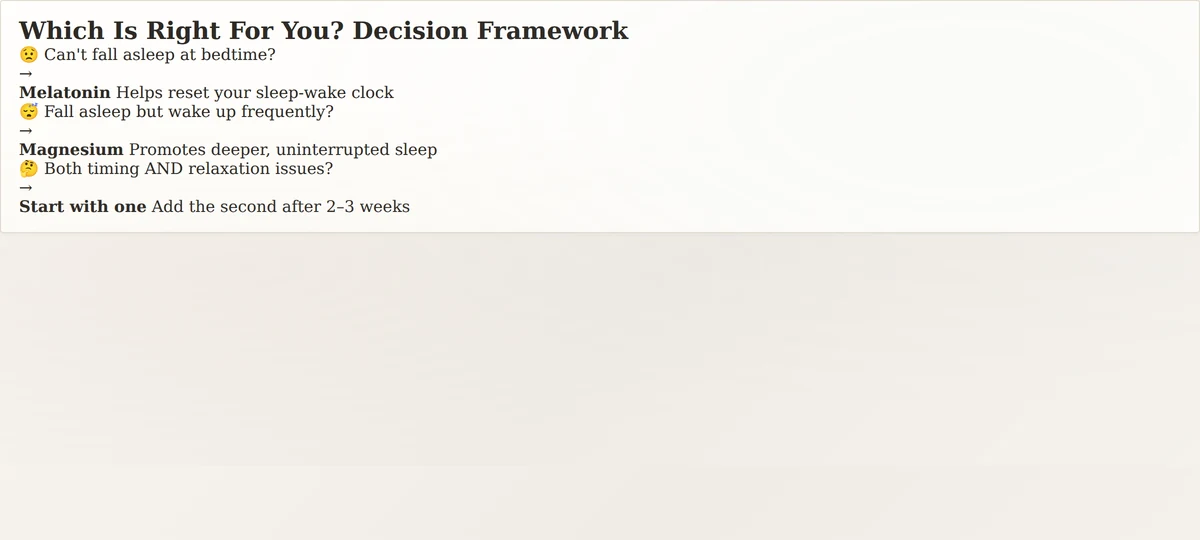
Here is where the melatonin vs magnesium for sleep question stops being theoretical and becomes actionable. The table below maps specific sleep problems to the supplement most likely to help — not based on marketing, but on mechanism and clinical evidence.
| If your issue is… | Try… | Because… |
|---|---|---|
| You can’t fall asleep at your desired bedtime (night owl trying to sleep earlier) | Melatonin (0.5–3 mg, 30–60 min before target bedtime) | Melatonin shifts your circadian phase forward; this is its strongest evidence-based use |
| You fall asleep but wake up at 2–4 AM with a racing mind | Magnesium glycinate (200–400 mg, 60 min before bed) | Magnesium supports GABA activity and blocks excitatory neurotransmission, addressing nighttime arousal |
| Jet lag (crossing 3+ time zones) | Melatonin (0.5–5 mg at target destination bedtime) | Strong, replicated RCT evidence for reducing jet lag symptoms; Cochrane review confirms efficacy |
| Shift work (sleeping during the day) | Melatonin (1–3 mg before daytime sleep) | Melatonin helps override the circadian signal that says “be awake during daylight” |
| Muscle cramps, tension, or restless legs disrupting sleep | Magnesium glycinate or citrate (200–400 mg) | Magnesium is essential for muscle relaxation; deficiency directly causes cramps and tension |
| Age-related sleep decline (over 55, sleep is lighter and shorter) | Melatonin (1–3 mg) alone, or with magnesium | Melatonin production declines with age; supplementation partially restores the sleep signal |
| General anxiety making it hard to wind down | Magnesium glycinate (200–400 mg) | The 2025 RCT found larger sleep improvements in high-anxiety participants; magnesium’s anxiolytic effect is biologically plausible |
| You have both timing and relaxation issues | Start with one, then consider combining | No major interaction exists between melatonin and magnesium at standard doses; sequential testing lets you identify what actually helps |
Who Is This For? / Who Should Avoid It?
Melatonin may help: shift workers, frequent travelers crossing time zones, night owls with delayed sleep phase, adults over 55 with age-related sleep decline, and blind individuals with non-24-hour sleep-wake disorder.
Melatonin — use caution or avoid: people taking blood thinners (warfarin), diabetes medications, immunosuppressants, or hormonal birth control (which elevates endogenous melatonin levels). Pregnant or breastfeeding women should consult a doctor. Melatonin can also interact with certain blood pressure medications and CNS depressants.
Magnesium may help: people with low dietary magnesium intake (estimated ~50% of US adults), those with muscle cramps or tension at night, individuals whose insomnia coexists with anxiety, and people who wake up with a racing mind.
Magnesium — use caution or avoid: anyone with impaired kidney function (the kidneys regulate magnesium levels; supplementation can cause dangerous hypermagnesemia in renal impairment), people taking certain antibiotics (tetracyclines, quinolones — separate dosing by 2+ hours), bisphosphonates (osteoporosis medications), or high-dose diuretics.
Dr. Opel Baker adds an important reality check: “It is also important to distinguish between struggling to fall asleep and waking repeatedly during the night. The underlying causes can be very different, so neither supplement should be viewed as a universal solution.” This is the core insight of the entire melatonin vs magnesium for sleep framework: your sleep problem type determines which supplement is relevant. Guessing wastes time and money.
Safety, Side Effects, and Drug Interactions
Şebnem Ünlüişler warns: “With melatonin, both timing and dose matter, and taking more does not necessarily produce better sleep. It can also cause next-day drowsiness, headache or dizziness, and may interact with certain medications.” She adds that “magnesium can cause gastrointestinal side effects and should be used cautiously in people with impaired kidney function.”
Dr. Opel Baker delivers the most important safety message for the melatonin vs magnesium for sleep conversation: “The biggest caveat is that ‘natural’ does not automatically mean harmless or appropriate for everyone.” Both melatonin and magnesium are naturally occurring substances in the body — that doesn’t mean supplemental doses come without risks. This is the third open loop the article opened early on: the false comfort of the word “natural.”
| Safety Concern | Melatonin | Magnesium |
|---|---|---|
| Common side effects | Next-day drowsiness, headache, dizziness, vivid dreams, nausea | Diarrhea, nausea, abdominal cramping (especially citrate/oxide forms) |
| Overdose risk | Low acute toxicity, but chronic high doses (10+ mg nightly) linked to morning grogginess and possible hormonal effects | Dangerous hypermagnesemia possible in kidney impairment; GI effects dose-limiting for healthy people |
| Drug interactions | Blood thinners, diabetes medications, immunosuppressants, birth control, CNS depressants, some blood pressure medications | Certain antibiotics (tetracyclines, quinolones), bisphosphonates, diuretics, proton pump inhibitors (long-term use can deplete magnesium) |
| Quality concerns | Not regulated as a drug in the US; actual content can differ from label by up to 400% | Cheap forms (oxide) often sold as “magnesium” with very low bioavailability |
| Pregnancy / breastfeeding | Insufficient safety data — consult a doctor | Generally considered safe at RDA levels; supplemental doses — consult a doctor |
The supplement quality problem deserves special attention in the melatonin vs magnesium for sleep comparison. Because melatonin is a dietary supplement rather than a drug in the United States, manufacturers are not required to prove that their product contains what the label claims. A 2017 study published in the Journal of Clinical Sleep Medicine found that actual melatonin content varied from -83% to +478% of the labeled amount across 31 commercial supplements. Some products contained no detectable melatonin; others contained serotonin — a prescription-only neurotransmitter. Choosing third-party tested brands (look for USP, NSF, or ConsumerLab verification) matters for both supplements, but the evidence of quality problems is more extensive for melatonin.
Melatonin vs Magnesium for Sleep: Cost Comparison
The melatonin vs magnesium for sleep calculation has a practical dimension: what you pay per effective dose. The cost range is wide enough that choosing the wrong form doesn’t just waste money — it wastes weeks of poor sleep while you test something that never had a chance of working.
| Supplement | Typical Bottle Cost | Doses/Bottle | Cost/Dose | Cost/Month |
|---|---|---|---|---|
| Melatonin (generic, 3 mg tablets) | $5–10 | 120–240 | $0.03–0.08 | $1–2.50 |
| Melatonin (third-party tested, 3 mg) | $12–18 | 90–180 | $0.10–0.20 | $3–6 |
| Magnesium glycinate (200 mg elemental) | $15–30 | 60–120 | $0.20–0.50 | $6–15 |
| Magnesium L-threonate (1,000 mg) | $35–50 | 30–60 | $0.80–1.70 | $24–50 |
| Magnesium oxide (cheap form — not recommended for sleep) | $5–10 | 100–200 | $0.05–0.10 | $1.50–3 |
The cost-per-dose table reveals one of the most important practical insights in the melatonin vs magnesium for sleep comparison: melatonin is the cheaper starting point by a wide margin. A month of quality melatonin costs $3–6; a month of quality magnesium glycinate costs $6–15; a month of magnesium L-threonate can run $24–50. If budget is a factor and your sleep problem maps to a circadian timing issue, melatonin is the evidence-based, affordable first choice.
That said, magnesium oxide at $0.05/dose is a false economy for sleep. You’re paying for a laxative, not a sleep aid. The effective melatonin vs magnesium for sleep cost comparison should compare melatonin against magnesium glycinate or threonate — the forms with actual sleep evidence. At that level, magnesium costs 2–10× more per month than melatonin. This doesn’t make magnesium a bad choice — it makes it a choice that should be driven by your specific sleep problem type, not by the price tag.
Frequently Asked Questions About Melatonin vs Magnesium for Sleep
Can I take melatonin and magnesium together for sleep?
Yes, at standard doses, melatonin and magnesium can be taken together. They work through different mechanisms — melatonin regulates circadian timing while magnesium promotes physical relaxation — so there is no known direct interaction between them. However, start with one supplement first and give it 2–3 weeks before adding the second. If you start both simultaneously and your sleep improves, you will not know which one helped, and you may continue buying both unnecessarily.
Which works faster for sleep — melatonin or magnesium?
Melatonin works faster for sleep onset in the melatonin vs magnesium for sleep comparison. Melatonin reaches peak blood concentration within 30–60 minutes of oral ingestion and directly signals the brain to open the sleep gate. Magnesium, by contrast, takes days to weeks to build up to effective tissue levels and works by improving the neurochemical environment for sleep rather than triggering sleep onset directly. If you need same-night help falling asleep, melatonin is the evidence-based choice. If you need support staying asleep over weeks, magnesium glycinate is worth the longer timeline.
What is the best magnesium for sleep — glycinate or citrate?
Magnesium glycinate is better than magnesium citrate for sleep specifically. Glycinate has higher bioavailability, the attached glycine molecule has its own calming effects on the nervous system, and it produces far fewer gastrointestinal side effects at sleep-relevant doses. Magnesium citrate is effective for constipation, and it does increase magnesium levels, but its strong laxative effect at 200–400 mg doses makes it impractical for nightly sleep use in many people. The 2025 Nature and Science of Sleep RCT specifically tested magnesium bisglycinate — that is the form with the most direct clinical evidence for sleep.
Why does melatonin make me groggy the next morning?
Next-day grogginess from melatonin usually means your dose is too high, your timing is wrong, or both. Melatonin has a short half-life (20–50 minutes), but high doses (5–10 mg) can leave residual effects the next morning, especially in slow metabolizers. Taking melatonin too late — within 30 minutes of your actual bedtime rather than 30–60 minutes before your target bedtime — can also cause morning grogginess because the melatonin is still active in your system when your alarm goes off. Try reducing to 0.5–1 mg and taking it 60 minutes before your target bedtime.
How do I know if I have a magnesium deficiency?
Magnesium deficiency is difficult to diagnose from symptoms alone because the signs overlap with many other conditions. Blood tests for magnesium are limited — only about 1% of your body’s magnesium is in your blood, so serum magnesium can appear normal even when tissue levels are low. More accurate testing (RBC magnesium or ionized magnesium) is rarely ordered in routine care. The best practical indicators for the melatonin vs magnesium for sleep decision: low dietary intake of magnesium-rich foods (leafy greens, nuts, seeds, whole grains, legumes), muscle cramps or twitching at night, high stress levels, and heavy alcohol or caffeine consumption (both deplete magnesium). If you have several of these risk factors and your sleep problem involves muscle tension or waking with a racing mind, a 3–4 week trial of magnesium glycinate at 200–400 mg is a reasonable low-risk self-test.
Is melatonin or magnesium better for anxiety-related insomnia?
Magnesium glycinate has stronger preliminary evidence for anxiety-related insomnia than melatonin does. The 2025 Nature and Science of Sleep RCT found that participants with higher baseline anxiety scores experienced the largest sleep improvements from magnesium. This aligns with magnesium’s known mechanism of action — NMDA receptor blockade and GABA enhancement — which directly addresses the hyperarousal that characterizes anxiety-driven insomnia. Melatonin, which primarily works on circadian timing, is less directly relevant to anxiety unless the anxiety is specifically about not being able to fall asleep at the right time.
Do I need a prescription for melatonin or magnesium?
In the United States, both melatonin and magnesium are available over the counter as dietary supplements. Neither requires a prescription. Melatonin is available by prescription only in some countries (including the UK and much of the European Union), though lower-dose supplements are sometimes sold OTC. Some countries restrict melatonin to prescription-only at any dose. Check your local regulations if you are outside the US.
How long should I try melatonin or magnesium before deciding it doesn’t work?
For melatonin, you can assess effects within 3–7 nights. It works acutely on circadian timing, and if it is going to help you fall asleep earlier, you will typically notice a difference within the first week. For the melatonin vs magnesium for sleep decision, this short trial period is a practical advantage of melatonin — you do not commit to weeks of uncertainty. For magnesium, give it a full 3–4 weeks. The 2025 RCT ran for 4 weeks, and magnesium’s mechanism involves gradual repletion and neurological adaptation, not acute signaling. If you have not noticed improvement after 4 weeks of a bioavailable form (glycinate or threonate) at an adequate dose, magnesium is unlikely to help your specific sleep problem.
The Bottom Line on Melatonin vs Magnesium for Sleep
The melatonin vs magnesium for sleep question has no single right answer — and that is the most honest answer you will get. What it has is a systematic framework for matching the supplement to your specific sleep problem.
If your sleep problem is about timing — you cannot fall asleep at your desired bedtime, you work night shifts, or you cross time zones regularly — melatonin is the evidence-based first choice. It has decades of research, a clear mechanism of action tied to the circadian rhythm, and a favorable safety profile when used at appropriate doses (0.5–3 mg). Start low, time it correctly (30–60 minutes before target bedtime), and evaluate after one week.
If your sleep problem is about the inability to relax — your mind races when your head hits the pillow, your muscles feel tense, or you fall asleep but wake up repeatedly throughout the night — magnesium glycinate has the strongest clinical rationale. The evidence is less extensive than melatonin’s, but the 2024 and 2025 RCTs show real if modest improvements, particularly when anxiety co-exists with insomnia. Choose glycinate over citrate or oxide, give it 3–4 weeks, and pair it with consistent sleep hygiene practices.
One action you can take tonight that costs nothing and has better evidence than either supplement alone: set a consistent wake-up time and get 10–15 minutes of morning daylight within 30 minutes of waking. Dr. Opel Baker emphasizes this: “A consistent sleep and wake time, getting daylight in the morning, regular exercise, limiting caffeine later in the day and creating a relaxing wind-down routine can all have a meaningful impact.” Supplements support sleep — they do not replace the behavioral foundations that make sleep possible.
If you have tried one supplement for the recommended trial period without results and your sleep problem matches the other supplement’s mechanism, switching is a reasonable next step. If neither melatonin nor magnesium produces improvement after adequate trials, the issue may not be supplement-responsive — speak with a healthcare provider about an evaluation for underlying sleep disorders, which affect an estimated 50–70 million US adults and often go undiagnosed.
What to Read Next
- Melatonin Dosage for Sleep: How Much Should You Really Take? — Once you have decided melatonin is right for you, this guide covers exact dosing by age, timing, and sleep problem type
- Melatonin vs Prescription Sleep Aids — If supplements are not enough, here is how melatonin compares to prescription options like zolpidem and eszopiclone
Medical Disclaimer
The information in this article is for educational and informational purposes only and does not constitute medical advice. Melatonin and magnesium are dietary supplements, not medications, and are not intended to diagnose, treat, cure, or prevent any disease. Always speak with your healthcare provider before starting any supplement, especially if you are pregnant, breastfeeding, taking prescription medications, or have a medical condition — particularly kidney disease (for magnesium) or bleeding disorders (for melatonin). Do not disregard professional medical advice or delay seeking it because of something you read here.
Reviewed by Clinical Pharmacist — Last updated: September 17, 2026

Written by
Sophie ChenPharmaceutical Content Researcher · 8 years experience
Sophie Chen is a pharmaceutical content researcher with 8 years covering generic medication access and clinical pharmacology. She specialises in international regulatory frameworks, bioequivalence standards, and patient-facing education on therapeutic drug classes. She is not a clinician.