








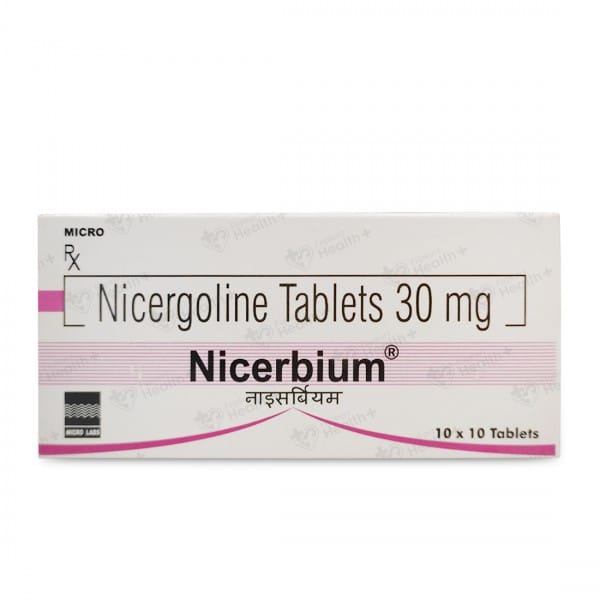
Nicerbium
✅ Improves blood flow
✅ Enhances cognitive function
✅ Reduces vertigo symptoms
✅ Manages migraines
✅ Supports brain health
Nicerbium contains Nicergoline.
✓ Medically reviewed by Morgan Ellis — Pharmacy Researcher · 8 years experience · Last reviewed: May 2026
⚡ Quick Answer — What is Nicerbium?
Nicerbium is an oral nicergoline (30 mg) tablet — an ergot-derivative nootropic and cerebral vasodilator used to treat cognitive impairment and symptoms of cerebrovascular insufficiency, including vascular dementia, age-related cognitive decline, and peripheral vascular disorders. It works through multiple mechanisms: α-adrenergic blockade (improving cerebral blood flow), enhancement of cholinergic and dopaminergic neurotransmission, and neuroprotective effects. Usual dose: 30 mg twice daily (or 60 mg once daily). Generally well tolerated — common side effects: mild GI upset, dizziness, flushing.
📦 Every order is covered by our Reshipment Assurance Policy — if your parcel does not arrive within 20 business days, we reship it.
Why order from MedsBase
Our generic medications are sourced from WHO-GMP certified manufacturers and shipped worldwide in discreet, plain packaging — no medication name on the parcel exterior. Card payments are routed through a regulated processor (statement descriptors include a regulated card-payment processor — never “MedsBase” or any medication name). Crypto and SEPA bank transfer are also accepted. Every order is backed by our Reshipment Assurance Policy.
What Is Nicerbium?
Nicerbium is an oral tablet containing nicergoline 30 mg. Nicergoline is an ergot-derived cerebral vasodilator and nootropic that has been in clinical use since the 1970s, primarily in Europe and Asia. It improves cerebral blood flow, enhances cholinergic and catecholaminergic neurotransmission, and has neuroprotective properties via antioxidant mechanisms.
Nicergoline is prescribed for age-related cognitive decline, vascular dementia, chronic cerebrovascular insufficiency, and peripheral vascular disorders. It is not approved by the FDA (US) but is widely used internationally. Nicerbium is manufactured by a WHO-GMP certified facility and is bioequivalent to the originator brand Sermion (Pfizer).
How Does Nicerbium (Nicergoline) Work?
Nicergoline has a multimodal mechanism that distinguishes it from simple vasodilators:
- α1-Adrenergic receptor blockade: Relaxes cerebral and peripheral vascular smooth muscle, improving blood flow to the brain and extremities
- Cholinergic enhancement: Increases acetylcholine release and inhibits acetylcholinesterase — supporting memory and cognitive function
- Dopaminergic facilitation: Enhances dopamine turnover in the frontal cortex
- Neuroprotection: Reduces oxidative stress, inhibits platelet aggregation, and promotes nerve growth factor (NGF) production
These combined effects make nicergoline more than a vasodilator — it acts as a multimodal nootropic addressing both vascular and neurodegenerative components of cognitive decline.
Indications
- Mild-to-moderate vascular dementia and multi-infarct dementia
- Chronic cerebrovascular insufficiency — dizziness, tinnitus, headache, and memory problems related to reduced cerebral blood flow
- Age-related cognitive decline (not meeting criteria for dementia)
- Peripheral vascular disorders — Raynaud phenomenon, intermittent claudication
- Migraine prophylaxis (adjunct, off-label in some markets)
Dosing and Administration
| Indication | Dose | Duration |
|---|---|---|
| Cognitive impairment / vascular dementia | 30 mg twice daily | ≥3–6 months (assess benefit at 3 months) |
| Cerebrovascular insufficiency | 30 mg twice or three times daily | Ongoing as directed |
| Peripheral vascular disease | 30 mg three times daily | Ongoing as directed |
Take between meals for optimal absorption (food reduces bioavailability by ~15–20%). Treatment response for cognitive symptoms typically requires at least 2–3 months.
Side Effects
Common (generally mild): gastric discomfort, nausea, flushing, dizziness, drowsiness, hypotension (usually postural).
Uncommon: skin rash, insomnia, agitation, uric acid elevation (due to purine metabolite).
Rare/serious: ergotism symptoms (extremely rare at therapeutic doses — nicergoline has minimal vasoconstrictive activity unlike other ergot derivatives), fibrotic reactions (very rare, class warning for ergot derivatives with prolonged use).
Warnings and Precautions
- Ergot derivative. Nicergoline retains weak ergot-receptor activity. Prolonged use at supratherapeutic doses carries a theoretical risk of retroperitoneal, pleural or cardiac-valve fibrosis (class effect of ergots). Standard 30 mg/day doses have not shown clinically significant fibrosis risk in 50+ years of post-marketing surveillance.
- Hypotension. Nicergoline is an α1-adrenoceptor antagonist — orthostatic hypotension can occur, particularly in older adults or patients on antihypertensives. Rise slowly from sitting/lying.
- Hyperuricaemia. Nicergoline is metabolised to nicotinic acid, which raises uric acid levels. Monitor in gout-prone patients.
- Hepatic impairment. Nicergoline undergoes extensive first-pass hepatic metabolism. Use caution in severe liver disease.
- Bleeding risk. Nicergoline has mild antiplatelet activity. Use caution with anticoagulants (warfarin, DOACs) and dual antiplatelet therapy.
- Pregnancy & breastfeeding. Insufficient data. Avoid unless clearly necessary.
- Driving. Dizziness and hypotension may impair driving ability in the first 1–2 weeks.
Contraindications — Who Should NOT Take Nicerbium
- Known hypersensitivity to nicergoline, other ergot derivatives or any excipient
- Recent myocardial infarction (acute phase)
- Acute haemorrhage or active bleeding
- Severe hypotension (systolic <90 mmHg)
- Severe bradycardia
Drug Interactions
- Antihypertensives: Additive blood-pressure lowering — monitor for hypotension
- Anticoagulants/antiplatelets: Nicergoline inhibits platelet aggregation — theoretical additive bleeding risk
- Other ergot derivatives: Avoid concurrent use (cumulative ergot effects)
- CYP2D6 substrates: Nicergoline weakly inhibits CYP2D6 — clinical significance is low at standard doses
Storage Instructions
- Store at room temperature, 15–25°C. Protect from light and moisture.
- Keep in original packaging until use.
- Do not store in the bathroom.
- Keep out of reach of children.
- Do not use after the expiry date.
Related Categories on MedsBase
Frequently Asked Questions
What is Nicerbium used for?
Nicerbium contains nicergoline 30 mg and is used to improve cognitive function and cerebral blood flow in patients with vascular dementia, chronic cerebrovascular insufficiency, and age-related cognitive decline.
How long does nicergoline take to show benefit?
Cognitive improvement is gradual. Most clinical trials assessed outcomes at 3–6 months. Some patients notice improvements in alertness and concentration within 4–6 weeks, but meaningful cognitive changes require longer treatment.
Is nicergoline effective for Alzheimer disease?
Nicergoline has shown modest benefit in vascular dementia and mixed dementia (vascular + Alzheimer) in Cochrane-reviewed trials. It is not a first-line treatment for pure Alzheimer disease — cholinesterase inhibitors (donepezil, rivastigmine) are standard of care. However, its cholinergic-enhancing and neuroprotective properties may provide adjunctive benefit in mixed-aetiology cognitive decline.
Is Nicerbium the same as Sermion?
Both contain nicergoline. Sermion is the original brand by Pfizer (formerly Farmitalia). Nicerbium is a bioequivalent generic.
Can I take nicergoline with blood pressure medications?
Yes, but with monitoring. Nicergoline has mild blood-pressure-lowering effects via α-blockade. Combined with antihypertensives, orthostatic hypotension may occur — rise slowly from sitting/lying positions.
Does nicergoline cause ergotism?
Extremely unlikely at therapeutic doses. Unlike ergotamine (used for migraine), nicergoline has minimal vasoconstrictive activity. The ergot-class fibrosis warning is retained as a precaution but has not been reported at standard nicergoline doses in clinical practice.
Is nicergoline a nootropic?
Yes — nicergoline is classified as a nootropic (cognitive enhancer) in many pharmacological references. Its combination of vascular, cholinergic, and neuroprotective mechanisms distinguishes it from single-mechanism nootropics like piracetam.
Can nicergoline help with tinnitus?
Nicergoline is prescribed for tinnitus associated with cerebrovascular insufficiency in some markets. It may improve tinnitus when the underlying cause is reduced blood flow to the auditory system. It is unlikely to help tinnitus from other causes (noise damage, Ménière disease).
What are the long-term safety considerations?
Nicergoline has been used for decades with a good long-term safety profile. The main consideration is periodic monitoring of uric acid levels (nicergoline is metabolised to a purine derivative) and blood pressure.
Can I drive while taking Nicerbium?
Nicergoline can cause mild dizziness and drowsiness, especially initially. Use caution when driving until you know how it affects you. At stable doses, most patients have no driving impairment.
Does nicergoline interact with warfarin?
Nicergoline mildly inhibits platelet aggregation. While it does not directly affect warfarin metabolism, the additive antiplatelet effect warrants monitoring of INR if used together, particularly when starting or stopping nicergoline.
Related Alternatives
Other products in Chronic Conditions that customers also view:
- Neurobion Forte RF Injection (Methylcobalamin + B6 + B3) — Nerve Repair
- Aerocort Inhaler
- Arkamin
- Meftal
- Temozol 20
More options in Neurological Conditions and Epilepsy
Ranked by recent MedsBase order volume — what other customers in this category are picking.

| Strength | 30 mg |
|---|---|
| Quantity | 30 Tablet/s, 60 Tablet/s, 90 Tablet/s, 180 Tablet/s |
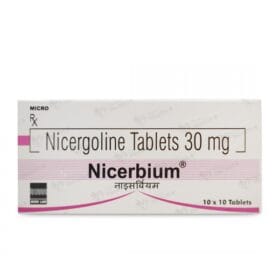 Nicerbium
Q & A
Nicerbium
Related products



Reviews
There are no reviews yet