








✓ Medically reviewed by · Last reviewed: May 2026
Pharmacy Researcher · 8 years experience
Pharmacy researcher with 8 years reviewing clinical drug information, generic formulation equivalence, and international pharmaceutical standards. Focuses on patient-facing accuracy in medication education.
ondansetron for nausea — Ondansetron for Nausea: 7 Essential Facts & Dosage Guide. Read on for an evidence-backed guide covering everything you need to know.
You feel waves of nausea coming and you just want it to stop. A doctor has handed you a small dissolvable tablet called ondansetron and told you it will help — but you are not entirely sure how it works, how much to take, or whether the heart-rhythm warning you skimmed on the label is something to actually worry about. Ondansetron for nausea is one of the most common prescription anti-nausea drugs in the world, and it is worth understanding properly.
By the end of this guide you will know exactly when ondansetron for nausea is the right tool, how to dose it, and which safety details genuinely matter for you.
Key Takeaways
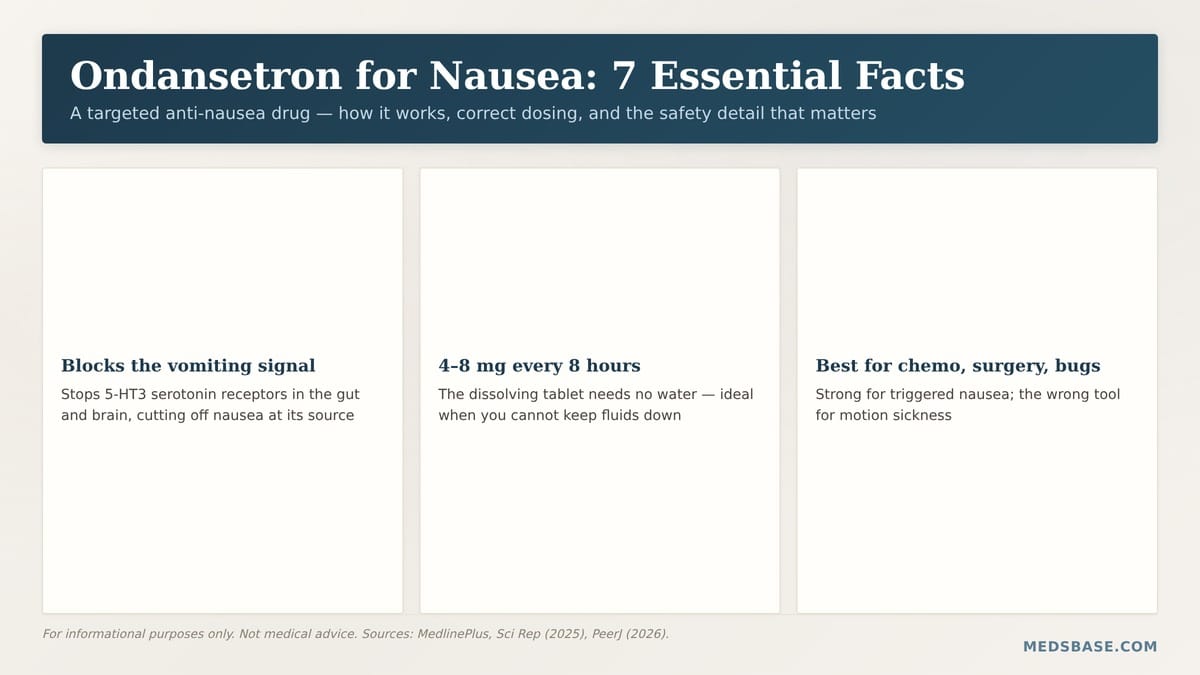
- Ondansetron for nausea works by blocking the vomiting signal in the gut and brain — it is not a stomach soother or a general “settler,” and it targets specific causes better than others
- The standard adult dose is 4 mg to 8 mg every 8 hours as needed, and the dissolving tablet needs no water, which is a lifesaver when you cannot keep fluids down
- It is a genuine breakthrough for chemotherapy- and surgery-related nausea, and it helps in acute gastroenteritis — but it is not the best choice for travel sickness
- The heart-rhythm warning is real but narrow: it matters most for people with certain heart conditions or electrolyte problems, and for the high intravenous doses now withdrawn from use
- Constipation and headache are the side effects most people actually notice — and one of them catches people by surprise
- What Is Ondansetron for Nausea?
- How Does Ondansetron for Nausea Work?
- Ondansetron for Nausea: Dosage
- Safety Profile, Side Effects & Warnings
- What Does the Research Say?
- Ondansetron for Nausea vs Alternatives
- How to Get the Best Results From Ondansetron
- Related Reading
- Frequently Asked Questions
- The Bottom Line
What Is Ondansetron for Nausea?
Ondansetron for nausea is a prescription medication from a class called 5-HT3 receptor antagonists. It is used to prevent and treat nausea and vomiting caused by chemotherapy, radiotherapy, and surgery, and it is frequently used off-label for the vomiting of acute gastroenteritis (stomach bugs) and other causes. It is most often taken as a tablet that dissolves on the tongue, but it also comes as a standard tablet, a liquid, and an injection.
Ondansetron was first approved in the early 1990s and quickly became a standard part of care for people receiving chemotherapy, because it dramatically reduced the vomiting that was once an almost inevitable part of cancer treatment. It is a prescription-only medicine used to prevent nausea and vomiting caused by cancer treatment, surgery, and radiotherapy. MedlinePlus — the US National Library of Medicine’s drug reference — adds that ondansetron is also used to prevent nausea and vomiting after surgery and that it works by blocking a natural substance called serotonin.
What makes ondansetron for nausea different from older anti-nausea drugs is that it is highly targeted. Rather than broadly sedating the whole system the way some older treatments do, it blocks one specific receptor involved in the vomiting reflex. That specificity is why it is so effective for some causes — and comparatively weak for others.
The situations where ondansetron for nausea genuinely excels are those with a clear, serotonin-driven trigger: the nausea that follows chemotherapy, the nausea that trails surgery and anaesthesia, and the vomiting of an acute stomach bug. In each of these, serotonin release in the gut plays a central role, and blocking its receptor produces rapid, meaningful relief. By contrast, when the nausea is vague, chronic, or functional — or driven by inner-ear motion signals — ondansetron for nausea is less reliably helpful, and a different drug is usually the better first choice.
How Does Ondansetron for Nausea Work?
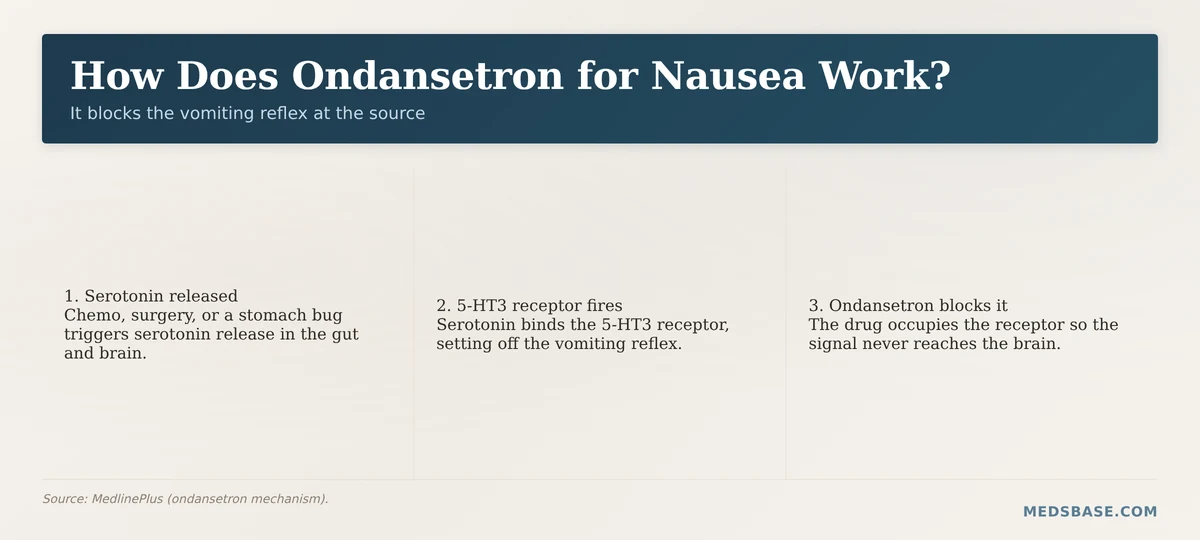
When your body is triggered to vomit — by chemotherapy, surgery, a stomach bug, or something else — it releases a chemical called serotonin in the gut and in a part of the brain called the vomiting centre. Serotonin binds to a specific docking point, the 5-HT3 receptor, and that binding sets off the chain of events that ends in vomiting.
Ondansetron for nausea blocks that 5-HT3 receptor. With the receptor occupied, the serotonin cannot deliver its “start vomiting” message, and the reflex is interrupted at the source. This is why it works for the nausea that follows chemotherapy and surgery, where serotonin release in the gut is a major driver.
A useful analogy: if the vomiting reflex were a fire alarm, serotonin is the smoke, and ondansetron for nausea is the cap you place over the smoke detector. The smoke (trigger) is still there, but the alarm can no longer sound.
Clinical insight: Clinicians often reach for ondansetron for nausea in situations where keeping anything down is the whole problem. The orally-dissolving tablet is deliberately designed for this — it absorbs through the lining of the mouth, so even a person who is actively vomiting can often hold a dose on the tongue long enough for it to work.
Ondansetron for Nausea: Dosage
Dosing for ondansetron for nausea depends on what it is being used for and who is taking it. Here is the practical framework.
Standard Adult Dose
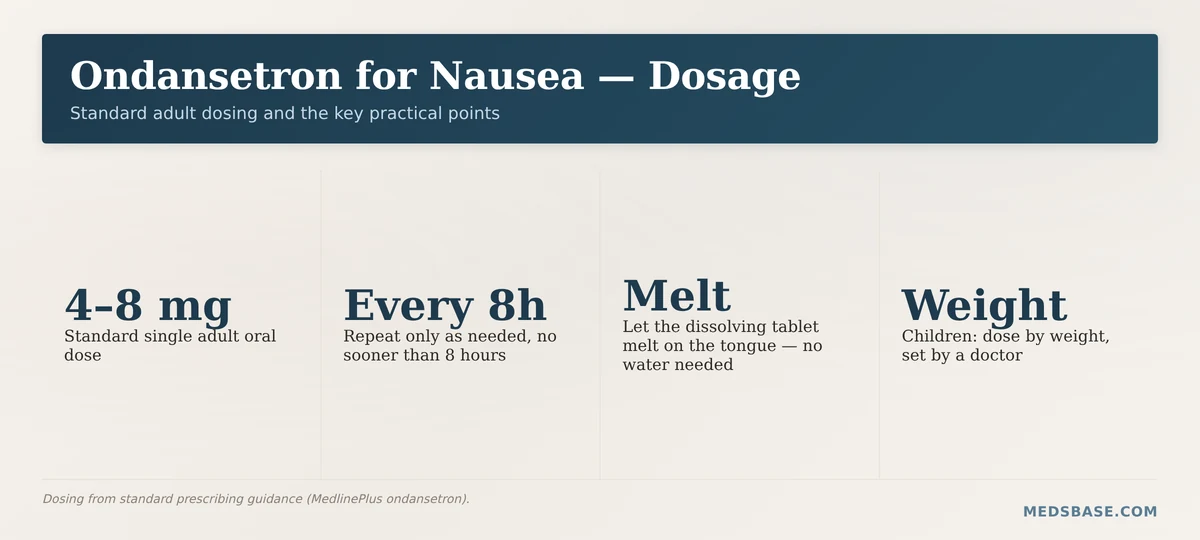
For most adults, ondansetron for nausea is taken as 4 mg or 8 mg, repeated every 8 hours as needed. A single dose is usually 4 mg to 8 mg, and 8 mg is the maximum recommended single oral dose. The dissolving tablet is placed on the tongue and allowed to dissolve — no water is needed, and this is exactly why it is so useful during vomiting.
Children
Ondansetron for nausea is used in children too, but the dose is weight-based and must be calculated by a doctor or pharmacist. It is never a “small adult dose” guessed at home.
Special Situations
For chemotherapy- and radiotherapy-related nausea, dosing is planned around the treatment itself and is usually given before the treatment starts, sometimes alongside other anti-nausea medicines. For post-operative nausea, it may be given by injection in hospital.
- Take 4 mg to 8 mg at the first sign of significant nausea (or as your doctor prescribed)
- If nausea returns, you may repeat the dose after 8 hours
- Do not exceed the dose your doctor set for a single day
- For the dissolving tablet: let it melt on the tongue — do not swallow it whole
- If you are taking it before chemotherapy or surgery, follow the pre-treatment timing exactly
Mistakes to avoid:
- Swallowing the dissolving tablet whole (it should melt on the tongue)
- Assuming ondansetron for nausea will work for travel sickness — it targets a different pathway
- Taking more than the prescribed daily amount to “be safe” during a bad bout
- Ignoring the interaction with certain heart-rhythm and psychiatric medications
Safety Profile, Side Effects & Warnings
For most people, ondansetron for nausea is well tolerated and the side effects are mild. The two that come up most often are headache and constipation — and constipation is the one that surprises people, because it seems unrelated to a nausea drug but follows directly from the drug slowing down gut movement.
| Side Effect | Frequency | Severity | What To Do |
|---|---|---|---|
| Headache | Common | Mild | Usually passes; standard pain relief if needed |
| Constipation | Common | Mild–moderate | Increase fluids and fibre; ask pharmacist if persistent |
| Dizziness or drowsiness | Occasional | Mild | Avoid driving until you know how it affects you |
| QT prolongation (heart rhythm) | Rare | Potentially serious | Discuss with doctor if you have heart disease or take certain medicines |
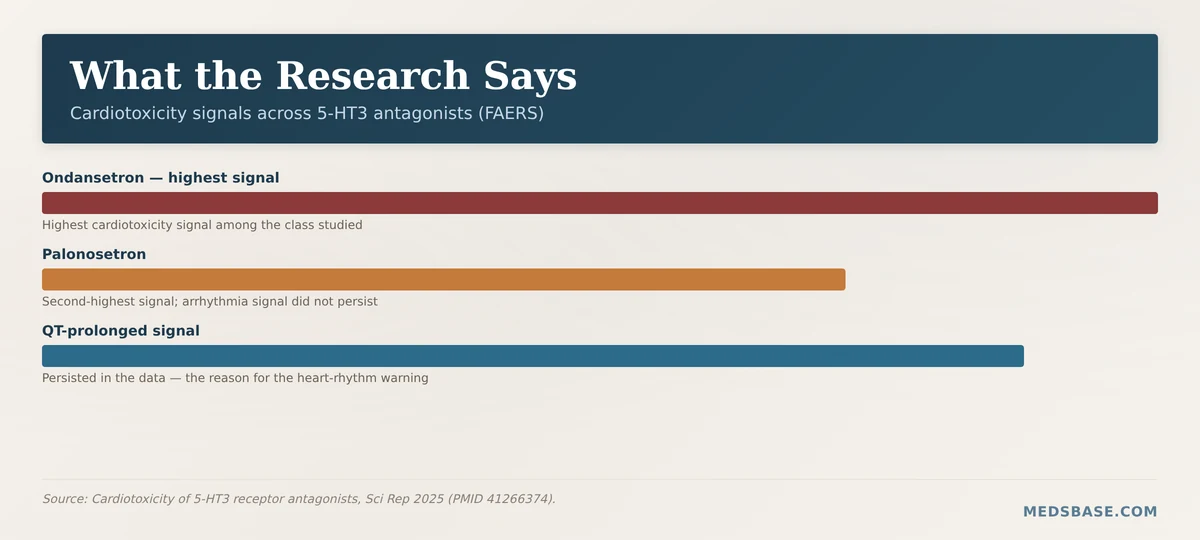
The heart-rhythm warning, explained honestly. Ondansetron can affect a part of the heart’s electrical rhythm called the QT interval. For the vast majority of people taking the standard oral doses, this is clinically insignificant. The concern is real mainly for: people with a pre-existing long-QT condition, people with low blood potassium or magnesium, people taking other medicines that also prolong the QT interval, and — historically — the high 32 mg intravenous dose. A 2025 analysis of cardiotoxicity across different 5-HT3 receptor antagonists documents this QT-prolongation signal, and it is the reason the 32 mg single intravenous dose was withdrawn from use years ago. The standard oral dose of ondansetron for nausea is not in this high-risk category.
- For: adults and children with nausea and vomiting from chemotherapy, radiotherapy, surgery, or acute gastroenteritis, who need targeted relief without heavy sedation
- Discuss first or avoid: anyone with a long-QT heart condition, low potassium or magnesium, or taking other QT-prolonging drugs (certain antiarrhythmics, some antibiotics and antidepressants); also certain use in pregnancy should be discussed with a doctor first
The official FDA-approved prescribing label for ondansetron for nausea also lists a small number of drug interactions, including some anti-seizure and antibiotic medicines and the use of other drugs that affect serotonin. If you take regular medication, tell your pharmacist before starting ondansetron.
What Does the Research Say?
Ondansetron’s strongest evidence is in the prevention of chemotherapy-induced nausea and vomiting, where it changed practice. Before the 5-HT3 antagonists arrived, vomiting was one of the most feared side effects of cancer treatment; ondansetron for nausea sharply reduced it. A 2026 meta-analysis of the comparative efficacy of 5-HT3 receptor antagonists documents this benefit, showing these drugs substantially reduce vomiting in the first 24 hours after chemotherapy.
| Study / Source | Year | Finding | Source |
|---|---|---|---|
| Ondansetron for chemotherapy-induced nausea | 1990s–onwards | Markedly reduces acute vomiting in the first 24 h after chemotherapy | Cochrane / oncology literature |
| FDA Drug Safety Communication | 2012 | QT-prolongation risk; 32 mg IV dose withdrawn | FDA |
| Ondansetron for acute gastroenteritis in children | 2000s–onwards | Reduces vomiting and reduces need for IV rehydration in some studies | Pediatrics literature |
What this means for you: ondansetron for nausea is at its most effective when the nausea has a clear physiological trigger — chemotherapy, surgery, or an acute stomach bug — because that is where serotonin release is a major driver. For more vague, chronic, or functional nausea, the benefit is less certain, and other approaches are often tried first.
The honest caveat: for motion sickness, ondansetron for nausea is not a first-choice drug. Motion sickness is driven more by inner-ear and brain-stem signals than by gut serotonin, which is why dedicated motion-sickness medicines exist.
There is also a practical point about children worth knowing: ondansetron for nausea is used in children with acute gastroenteritis, where studies have shown it can reduce vomiting and sometimes reduce the need for intravenous fluids. But it must be dosed by weight and given under medical guidance — it is not a drug to reach for casually in a young child, where dehydration itself is the real danger to watch.
Ondansetron for Nausea vs Alternatives
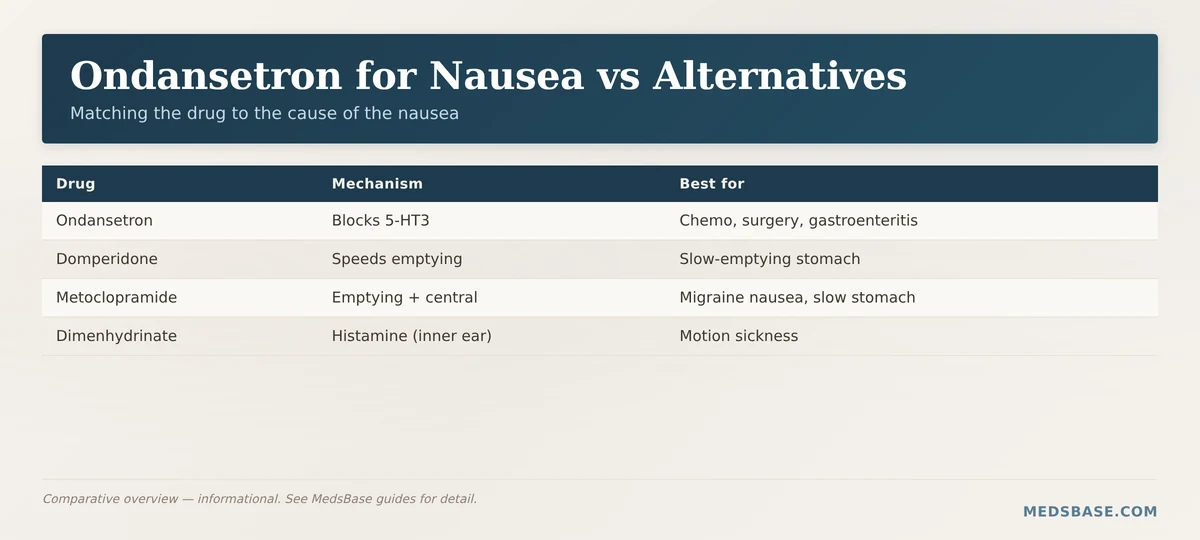
Ondansetron is one member of a broader family of anti-nausea drugs, and they are not interchangeable. Here is how they compare.
| Drug | Mechanism | Speed | Best For |
|---|---|---|---|
| Ondansetron | Blocks 5-HT3 receptor | Fast (within ~30 min) | Chemo, surgery, gastroenteritis nausea |
| Domperidone | Speeds stomach emptying | Moderate | Gastroparesis, slow-stomach nausea |
| Metoclopramide | Speeds emptying + central action | Moderate | Migraine nausea, slow stomach |
| Dimenhydrinate / meclizine | Blocks histamine (inner ear) | Moderate | Motion sickness, vertigo |
| Promethazine | Antihistamine + anti-cholinergic | Moderate | General nausea, but sedating |
Which fits which situation? For the sharp, acute nausea of a stomach bug or the aftermath of surgery, ondansetron for nausea is often the most targeted and least sedating choice. If the problem is a slow-emptying stomach or nausea with migraine, a prokinetic drug like domperidone or metoclopramide may suit better. If travel is the trigger, a motion-sickness drug is the right tool. The key is matching the drug to the cause.
For a deeper comparison of the prokinetic options, see our Domperidone vs Metoclopramide guide. And if your nausea is travel-related, our Motion Sickness Medication guide is the more useful read.
How to Get the Best Results From Ondansetron for Nausea
A few simple habits make ondansetron for nausea work as well as it should.
Match It to the Right Cause
Ondansetron shines for chemo, surgery, and stomach-bug nausea. If your nausea is from travel, vertigo, or a vague chronic upset, ask whether a different drug is more appropriate before assuming ondansetron “failed.”
Let the Dissolving Tablet Dissolve
The orally-dissolving form is absorbed through the mouth lining. Swallowing it whole delays and partly wastes the dose — melt it on the tongue instead.
Watch the Two Common Side Effects
Headache and constipation are the price most people pay. Hydrate well, and if constipation becomes troublesome, a pharmacist can suggest a simple, safe approach.
Do not self-treat through repeated vomiting in children or the elderly. Persistent vomiting risks dehydration. Ondansetron for nausea can help, but dehydration itself may need medical attention, especially in the very young or very old.
When you need to keep a supply on hand, you can browse ondansetron products in the MedsBase Nausea Treatment range.
Related Reading
- Comparing the other anti-nausea options? Domperidone vs Metoclopramide: 7 Proven Safety Facts
- Nauseated specifically by travel? Motion Sickness Medication: What Works and How to Time It
- Dealing with a stomach bug while away from home? Travelers Diarrhea Treatment: 7 Proven Steps
Frequently Asked Questions
Q: How long does ondansetron take to work?
A: Ondansetron for nausea usually begins to work within about 30 minutes, with the orally-dissolving tablet tending to act slightly faster because it absorbs through the mouth. If you are taking it to prevent chemotherapy- or surgery-related nausea, it is timed to be on board before the trigger. For acute nausea, relief typically builds over the first hour.
Q: Can I take ondansetron every 8 hours?
A: Yes — the standard adult regimen is 4 mg to 8 mg every 8 hours as needed. Do not take it more often than every 8 hours, and do not exceed the daily amount your doctor set. If you find you need it around the clock for more than a day or two, that is worth flagging to a doctor, because persistent vomiting can signal something that needs attention.
Q: Is ondansetron safe during pregnancy?
A: The evidence on ondansetron for nausea in pregnancy is mixed, and it should only be used when a doctor has weighed the benefits against any risk. It is sometimes prescribed for severe pregnancy-related vomiting (hyperemesis gravidarum) when other measures have not worked. If you are pregnant, always discuss ondansetron for nausea with your doctor or midwife rather than starting it yourself.
Q: Why is ondansetron given after surgery?
A: Anaesthesia and certain pain medicines used around surgery commonly cause nausea and vomiting as they wear off. Ondansetron for nausea is given — often by injection while still in hospital — to prevent this. It is now a standard part of many surgical protocols precisely because it works without the heavy sedation older anti-nausea drugs caused.
Q: Does ondansetron cause constipation?
A: Yes, constipation is one of the most common side effects of ondansetron for nausea, because the drug slows movement in the gut as a consequence of blocking serotonin there. It is usually mild. Staying well hydrated and increasing fibre can help, and a pharmacist can suggest more if it becomes persistent.
Q: What is the max dose of ondansetron per day?
A: For adults, a single oral dose is typically 4 mg to 8 mg, repeated no more often than every 8 hours. The total daily amount is set by your prescriber based on the cause and your health. The high 32 mg intravenous single dose was removed from use because of heart-rhythm risk, which is why the injected dose is now limited too.
Q: Does ondansetron work for a stomach bug?
A: Yes, ondansetron for nausea is commonly used to reduce vomiting from acute gastroenteritis, and it can help you keep fluids down — which is the real goal during a stomach bug. It is not an antibiotic and does nothing to the underlying infection; it only treats the vomiting. In children it should be used under medical guidance, with close attention to hydration.
Q: Can ondansetron and domperidone be taken together?
A: These are usually used as alternatives rather than in combination, and combining anti-nausea drugs can increase the risk of side effects, including heart-rhythm effects. Do not combine ondansetron for nausea with domperidone or metoclopramide unless a doctor has specifically told you to.
The Bottom Line
Ondansetron for nausea is a remarkably targeted, low-sedation treatment that transformed the care of chemotherapy- and surgery-related nausea and remains a first-line tool for acute gastroenteritis. Used for the right cause, at the right dose — 4 mg to 8 mg every 8 hours, tablet dissolved on the tongue — it is safe and effective for most people.
Your one immediate action: match the drug to the cause. If your nausea is from chemo, surgery, or a stomach bug, ondansetron for nausea is a strong choice. If it is from travel or a slow-emptying stomach, a different drug will likely serve you better — ask before you assume.
Two next questions readers often ask:
- Comparing your anti-nausea options? Read our Domperidone vs Metoclopramide guide.
- Nauseated specifically by motion? Here is our Motion Sickness Medication guide.
Disclaimer: This article is for informational purposes only and does not constitute medical advice. The decision to use ondansetron — especially in pregnancy, in children, or with heart conditions — should always be guided by a qualified healthcare professional. Individual responses to medication vary.

Written by
Sophie ChenPharmaceutical Content Researcher · 8 years experience
Sophie Chen is a pharmaceutical content researcher with 8 years covering generic medication access and clinical pharmacology. She specialises in international regulatory frameworks, bioequivalence standards, and patient-facing education on therapeutic drug classes. She is not a clinician.