








✓ Medically reviewed by · Last reviewed: May 2026
Pharmacy Researcher · 8 years experience
Pharmacy researcher with 8 years reviewing clinical drug information, generic formulation equivalence, and international pharmaceutical standards. Focuses on patient-facing accuracy in medication education.
prednisone withdrawal symptoms — Prednisone Withdrawal Symptoms — 7 Signs Your Taper Is Too Fast and How to Come Off Safely. Read on for an evidence-backed guide covering everything you need to know.
Most people believe you can stop taking prednisone the moment you feel better. It makes intuitive sense — your asthma cleared up, your rash disappeared, your joint pain is gone. Why keep swallowing pills? The problem is that your body has been quietly making a trade-off while you were taking prednisone, and it doesn’t know you’ve decided to cash out. Prednisone withdrawal symptoms are not a sign that you’re “addicted” to the drug — they’re a sign that your body’s internal hormone factory shut down while prednisone was doing the work, and it needs time to restart. Skip the taper, and you could be in for a ride that lasts weeks, not days.
Here’s the statistic that should worry you: research indexed in PubMed shows that adrenal suppression — the root cause of most prednisone withdrawal symptoms — can occur after just 5 to 7 days of corticosteroid use at moderate doses. Not months. Days. And the longer you were on it, the harder the landing. But here’s the thing almost nobody tells you: there is a specific, evidence-backed way to come off prednisone that dramatically reduces your odds of crashing. Most patients are never taught it. By the time you finish reading this guide, you will know exactly what to expect, why it happens, and how to navigate every stage of prednisone withdrawal safely.
Key Takeaways
- Prednisone withdrawal symptoms are caused by HPA axis suppression — your adrenal glands temporarily stop producing cortisol because prednisone was supplying it for them.
- Symptoms range from mild (fatigue, body aches, low mood) to life-threatening (adrenal crisis — inability to respond to physical stress).
- Even 5–7 days of use can trigger withdrawal if you stop abruptly.
- A structured tapering protocol is the only safe way to discontinue — cutting your dose by 5–10 mg every 1–2 weeks, slowing further below 10 mg/day.
- Most people recover fully, but the timeline depends on how long you took prednisone and at what dose.
- Never stop prednisone on your own — always work with the prescribing doctor.
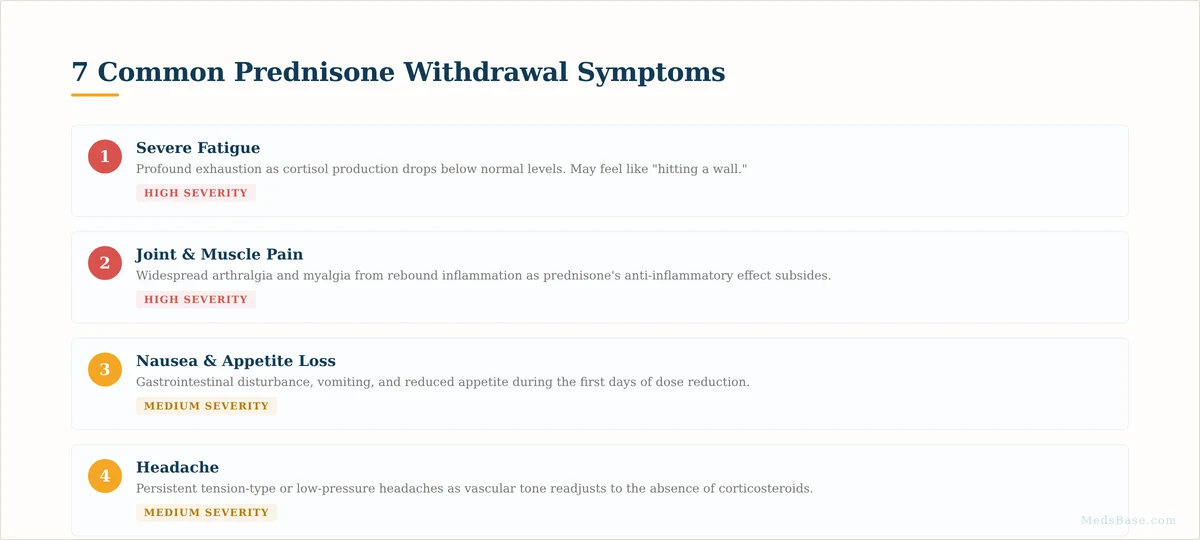
- The 7 most common prednisone withdrawal symptoms are fatigue, muscle/joint pain, nausea, headache, low blood pressure, mood swings, and fever.
Table of Contents
- What Causes Prednisone Withdrawal Symptoms?
- The 7 Most Common Prednisone Withdrawal Symptoms
- Why Tapering Is Non-Negotiable
- How Long Do Prednisone Withdrawal Symptoms Last?
- Who Is at the Highest Risk?
- The Safe Prednisone Tapering Protocol
- Frequently Asked Questions About Prednisone Withdrawal Symptoms
- The Bottom Line
What Causes Prednisone Withdrawal Symptoms?
Recognizing prednisone withdrawal symptoms early helps you distinguish withdrawal from a flare of the original condition.
To understand prednisone withdrawal symptoms, you first need to understand what prednisone does inside your body — and what your body does in response.
Prednisone is a synthetic corticosteroid that mimics cortisol, a hormone your adrenal glands naturally produce every day. Cortisol is not a “stress hormone” in the pop-psychology sense — it is a survival hormone. It regulates your blood pressure, controls inflammation, manages your blood sugar, and determines how your body responds to infection, injury, and physical stress. Without cortisol, you cannot survive a fever, a surgery, or even a bad fall.
When you take prednisone at doses above what your body naturally produces (roughly 5–7.5 mg per day of prednisone or equivalent), your brain notices the surplus. Specifically, your hypothalamus and pituitary gland — the command centres that tell your adrenal glands when to release cortisol — detect that cortisol levels are already high and stop sending the signal. This feedback loop is called the hypothalamic-pituitary-adrenal (HPA) axis, and it is the central reason that prednisone withdrawal symptoms exist at all.
Here’s what happens in sequence:
- You start taking prednisone at a therapeutic dose (typically 20–60 mg/day for inflammatory conditions).
- Your HPA axis detects the elevated corticosteroid levels and reduces — then eventually stops — its natural signalling.
- Your adrenal glands, no longer receiving the “produce cortisol” command, shrink and become dormant. This is called adrenal atrophy.
- When you suddenly stop taking prednisone, the synthetic cortisol disappears from your bloodstream within hours.
- Your adrenal glands are still dormant and cannot produce enough natural cortisol to meet your body’s baseline needs — let alone the surge required during illness, injury, or stress.
- You experience prednisone withdrawal symptoms, which are essentially the symptoms of acute cortisol deficiency.
This is not addiction. It is not psychological dependence. It is a physiological shutdown of one of the most critical systems in your body. As the NHS confirms, taking prednisolone (the active form of prednisone) for even a few weeks can suppress your adrenal glands, which is why you “should never stop taking [it] suddenly.” The MedlinePlus drug monograph for prednisone reiterates the same warning: abrupt discontinuation after prolonged use can trigger withdrawal symptoms including “weakness, weight loss, nausea, and low blood pressure.”
Think of it this way: while you were on prednisone, your adrenal glands were on an extended vacation. They didn’t just take a nap — they packed up and powered down. Prednisone withdrawal symptoms are the chaos that erupts when you demand they return to full-time work with zero notice.
The 7 Most Common Prednisone Withdrawal Symptoms
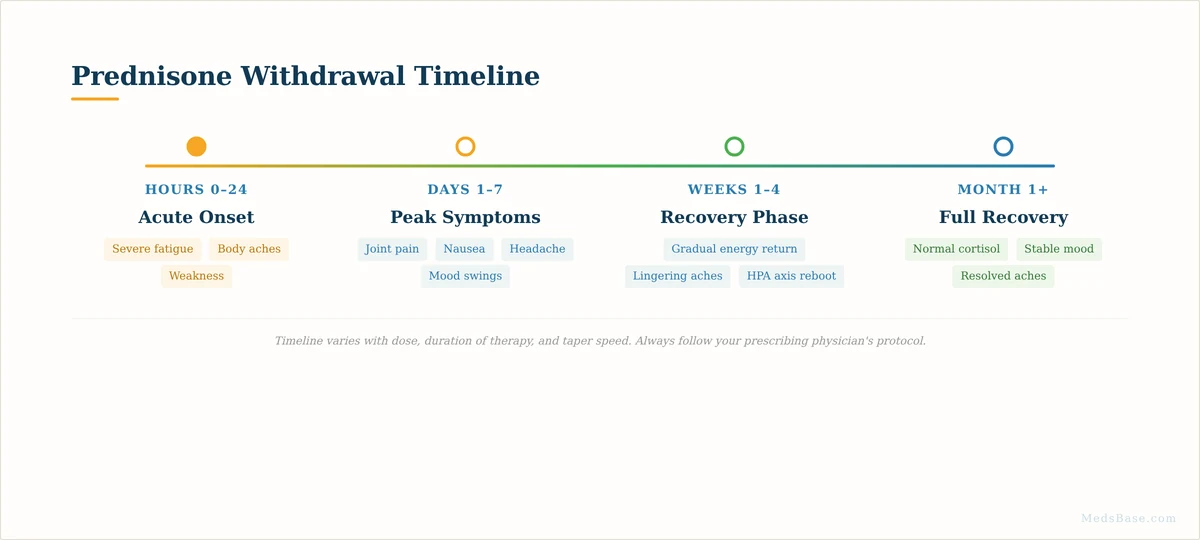
Prednisone withdrawal symptoms typically appear within hours and can persist for weeks as the HPA axis gradually recovers.
Not everyone experiences every symptom, and severity varies dramatically depending on your dose, duration, and how abruptly you stopped. But these are the seven that appear most consistently across clinical reports and patient accounts.
1. Severe Fatigue and Weakness
This is the most universally reported prednisone withdrawal symptom, and it is not ordinary tiredness. Patients describe it as bone-deep exhaustion — the kind where standing up to make a cup of tea feels like running a marathon. Without adequate cortisol, your body cannot maintain blood sugar between meals, regulate blood pressure when you stand up, or generate the metabolic energy to power your muscles. You feel hollowed out. This fatigue can persist for weeks and is the #1 reason people relapse and restart prednisone prematurely.
2. Muscle and Joint Pain
Prednisone is a powerful anti-inflammatory. When it leaves your system, the inflammation it was suppressing — whether from rheumatoid arthritis, lupus, asthma, or another condition — can return with a vengeance. But even people who took prednisone for non-inflammatory reasons (allergic reactions, skin conditions) often report diffuse muscle aches and joint stiffness during withdrawal. This happens because cortisol naturally dampens pain signalling and inflammation throughout the body. When cortisol drops below normal, even minor tissue irritation that you would normally not notice becomes amplified.
3. Nausea, Vomiting, and Appetite Loss
Cortisol influences gut motility, stomach acid production, and appetite signalling. During withdrawal, many people experience nausea — sometimes severe enough to prevent eating — along with vomiting and a complete loss of appetite. These prednisone withdrawal symptoms can create a dangerous spiral: you cannot eat, so your blood sugar drops, which makes the fatigue and dizziness worse, which makes the nausea worse. Dehydration becomes a real risk if vomiting persists.
4. Headaches
Withdrawal-related headaches range from dull, persistent pressure to full-blown migraines. The mechanism involves blood vessel dilation (cortisol normally helps maintain vascular tone) and altered fluid balance. These headaches often worsen when you stand up or move your head quickly — a clue that low blood pressure is also in play. In a cohort of patients undergoing corticosteroid taper, headache was reported in roughly 25–40% of cases, making it one of the more common prednisone withdrawal symptoms.
5. Low Blood Pressure and Dizziness
This is one of the more dangerous prednisone withdrawal symptoms because it can cause falls, fainting, and — in severe cases — circulatory collapse. Cortisol helps your blood vessels maintain tone and respond to catecholamines (adrenaline and noradrenaline). Without it, your blood vessels relax too much, and your blood pressure drops — especially when you stand up. This is called orthostatic hypotension. If you feel dizzy, lightheaded, or like the room is spinning every time you stand, your blood pressure is likely bottoming out. Lie down, elevate your legs, and call your doctor.
6. Mood Swings, Anxiety, and Depression
Prednisone is notorious for its psychological effects. While taking it, many people experience euphoria, irritability, or — at high doses — corticosteroid-induced psychosis. When you stop, the pendulum swings the other way. Withdrawal can trigger profound depression, anxiety, panic attacks, and emotional lability (crying without reason, sudden rage). These prednisone withdrawal symptoms are partly biochemical (cortisol receptors in the brain need time to recalibrate) and partly situational (you feel physically terrible, which wears down your emotional resilience). They are real, they are common, and they are temporary — but they can be severe enough to require supportive counselling or short-term medication.
7. Fever
A low-grade fever (typically 37.5–38.3°C / 99.5–101°F) can develop during withdrawal. This is your immune system rebounding — prednisone suppresses immune activity, and when the brake comes off, your body can overreact with a mild inflammatory fever. However, any fever above 38.3°C (101°F) during prednisone withdrawal symptoms requires immediate medical attention, as it may signal an adrenal crisis or an underlying infection that your suppressed adrenal glands cannot help you fight.
Research Spotlight: How Common Are Prednisone Withdrawal Symptoms?
A 2017 systematic review of corticosteroid withdrawal in patients with rheumatic diseases found that 15–50% of patients experienced clinically significant withdrawal symptoms when tapering was too rapid or unguided. The wide range depends on dose, duration, and underlying condition, but the message is consistent: prednisone withdrawal symptoms are not rare edge cases — they affect a substantial proportion of people who take corticosteroids for more than two weeks. A separate study published in Clinical Endocrinology noted that adrenal recovery can take 6–12 months after long-term high-dose therapy, meaning the risk window for withdrawal symptoms is far longer than most patients assume.
Why Tapering Is Non-Negotiable
If you take away one message from this guide, let it be this: you cannot safely stop prednisone by going cold turkey. Tapering — reducing your dose gradually over weeks or months — is not a suggestion. It is a physiological necessity. And the reason goes deeper than most people realise.
When you taper slowly, you give your HPA axis time to notice that cortisol levels are dropping. Your pituitary gland begins sending adrenocorticotropic hormone (ACTH) again — the chemical “wake-up” signal to your adrenal glands. Your adrenal glands, which atrophied during prednisone therapy, start to regenerate and hypertrophy (regrow) in response. Cortisol production creeps back toward normal. By the time you take your last tapering dose, your body is already producing a meaningful percentage of its own cortisol, and the landing is soft.
Skip the taper, and you demand that dormant adrenal glands go from zero to full output overnight. They cannot do it. The resulting prednisone withdrawal symptoms are not just uncomfortable — they can be dangerous. An adrenal crisis (also called Addisonian crisis) occurs when your body faces a stressor — infection, injury, surgery, even severe emotional stress — and your adrenal glands cannot produce the cortisol surge needed to survive it. Symptoms include severe vomiting, diarrhoea, dehydration, confusion, loss of consciousness, and — without emergency treatment — death.
Adrenal crisis is rare in outpatient prednisone withdrawal, but it is not hypothetical. It happens. And it is entirely preventable with a proper taper. This is also why managing chronic inflammation through lifestyle strategies — diet, gentle exercise, stress reduction — can play a supporting role during withdrawal, helping to reduce the inflammatory burden your body faces as the prednisone leaves your system.
How Long Do Prednisone Withdrawal Symptoms Last?
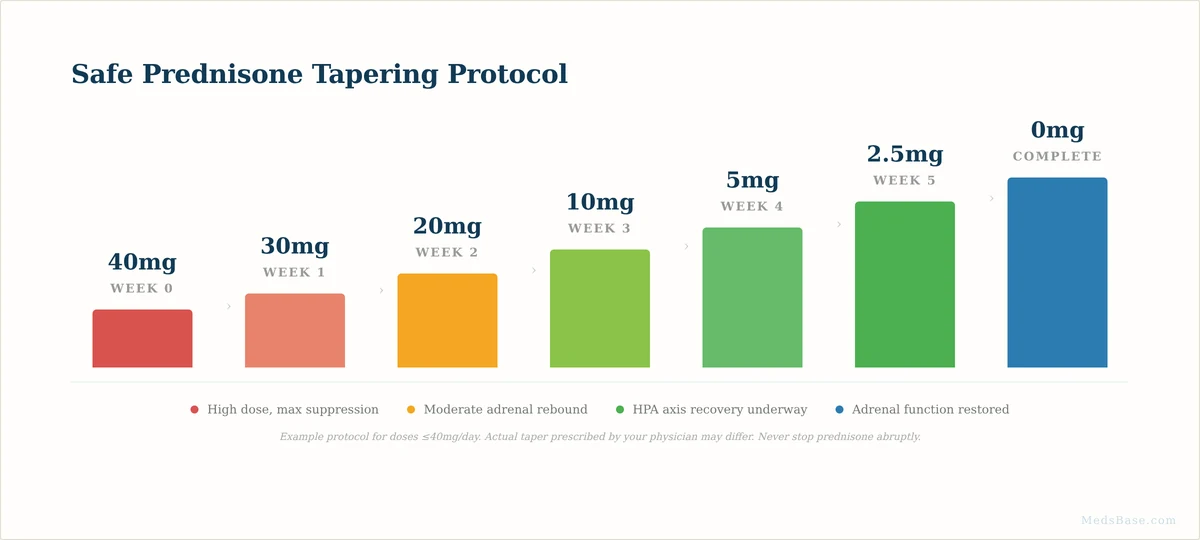
A slow, stepwise taper gives your adrenal glands time to resume normal cortisol production and minimizes withdrawal symptoms.
The timeline for prednisone withdrawal symptoms depends primarily on two factors: how long you took prednisone and at what dose. But in general, withdrawal unfolds in phases.
| Phase | Timeline After Last Dose | What Happens |
|---|---|---|
| Acute Withdrawal | 24–72 hours | The most intense prednisone withdrawal symptoms appear — fatigue, body aches, nausea, headache. Cortisol levels plummet as synthetic prednisone clears from your bloodstream, and your adrenal glands have not yet responded. |
| Subacute Withdrawal | 3–14 days | Symptoms may fluctuate day to day. Some days you feel 70% normal; other days you crash. Your HPA axis is starting to send signals but output is inconsistent. Mood swings are common during this phase. |
| Protracted Withdrawal | 2 weeks – 6 months | Lingering fatigue, low stress tolerance, and exercise intolerance. Your adrenal glands are producing cortisol at baseline but may not yet be able to mount a full stress response. Prednisone withdrawal symptoms during this phase are typically mild and intermittent. |
| Full Recovery | 3–12 months (long-term use) | Normal HPA axis function restored. You can handle physical stress, illness, and exercise without crashing. Confirmed via an ACTH stimulation test if clinically indicated. |
The key variable is duration of prior use:
- Less than 2 weeks: Most people can taper rapidly (over 3–7 days) with mild or no prednisone withdrawal symptoms.
- 2–4 weeks: A 2- to 4-week taper is typical. Withdrawal symptoms are common but usually manageable.
- 1–6 months: Tapering may take 6–12 weeks. Protracted withdrawal symptoms are more likely.
- More than 6 months: Tapering can take 3–12 months. Adrenal recovery may take a full year. Some patients never fully recover normal HPA responsiveness and require stress-dose steroids during illness or surgery for life.
PubMed-indexed research on glucocorticoid withdrawal consistently identifies duration of therapy as the strongest predictor of both severity and length of prednisone withdrawal symptoms. The dose you were on matters too — people tapering from 60 mg/day face a longer road than those tapering from 10 mg/day — but duration is the dominant factor.
Who Is at the Highest Risk?
While anyone who stops prednisone abruptly is at risk, certain people face significantly higher odds of severe or prolonged prednisone withdrawal symptoms:
- Long-term users (≥6 months): The longer your adrenal glands were suppressed, the longer they take to recover. Some studies suggest partial or permanent adrenal insufficiency in a small percentage of ultra-long-term users.
- High-dose users (≥20 mg/day): Higher doses suppress the HPA axis more completely and more quickly.
- Evening dosers: Taking prednisone in the evening or at bedtime suppresses the natural early-morning cortisol surge more than morning dosing, potentially deepening adrenal suppression.
- People with prior withdrawal attempts: If you have tried to stop before and experienced severe symptoms, your next attempt is likely to be challenging too — your adrenal glands may not have fully recovered from the first withdrawal.
- People on multiple courses per year: Repeated cycles of high-dose prednisone without adequate recovery time between courses can cause cumulative adrenal damage.
- Older adults: Adrenal reserve naturally declines with age, making older patients more vulnerable to withdrawal symptoms.
- People with comorbidities: Diabetes, cardiovascular disease, and pre-existing mood disorders can all be destabilised by the physiological stress of withdrawal.
Who Is This Guide For?
- Anyone currently tapering off prednisone and experiencing symptoms they did not expect.
- People about to start a prednisone taper who want to know what to expect.
- Patients who were prescribed prednisone for asthma, arthritis, skin conditions, allergic reactions, autoimmune diseases, or organ transplant immunosuppression.
- Caregivers and family members supporting someone through prednisone withdrawal.
Who Should NOT Rely on This Guide Alone?
- Anyone currently experiencing severe vomiting, fainting, confusion, or symptoms of adrenal crisis — seek emergency care immediately.
- People on prednisone for organ transplant rejection prevention — your taper protocol is specialised and must be managed by your transplant team.
- Patients on supraphysiologic doses (≥100 mg/day) for conditions like giant cell arteritis or severe autoimmune flares — your withdrawal requires close medical supervision.
- Pregnant or breastfeeding individuals — corticosteroid metabolism changes during pregnancy, and withdrawal must be managed by an obstetrician and endocrinologist together.
The Safe Prednisone Tapering Protocol
There is no one-size-fits-all taper, but the core principle is universal: reduce by small increments, go slower at lower doses, and never rush the final step. The Endocrine Society clinical practice guidelines on glucocorticoid therapy emphasise that tapering should be individualised based on the patient’s underlying condition, duration of therapy, and clinical response — but they provide a framework that has been refined over decades of clinical practice.
Standard Taper Example (Starting at 40 mg/day)
| Week | Daily Dose (mg) | Reduction | Notes |
|---|---|---|---|
| Week 1–2 | 40 mg | Baseline | Stabilise at current dose before tapering begins |
| Week 3–4 | 30 mg | −10 mg | Reduce by 10 mg; monitor for prednisone withdrawal symptoms |
| Week 5–6 | 20 mg | −10 mg | Larger reductions are usually well-tolerated above 20 mg |
| Week 7–8 | 15 mg | −5 mg | Slowing down — below 10–15 mg, adrenal recovery becomes the bottleneck |
| Week 9–10 | 10 mg | −5 mg | This is roughly double the body’s natural cortisol production; withdrawal symptoms often intensify below this level |
| Week 11–12 | 7.5 mg | −2.5 mg | Now near physiologic range — taper very slowly from here |
| Week 13–14 | 5 mg | −2.5 mg | Equivalent to baseline cortisol production; HPA axis must restart |
| Week 15–16 | 2.5 mg | −2.5 mg | The hardest step — some clinicians switch to 1 mg dosing or alternate-day dosing here |
| Week 17–18 | 0 mg | −2.5 mg | Continue monitoring for prednisone withdrawal symptoms; carry a steroid emergency card |
Critical Rules for Any Taper
- Never reduce by more than 10 mg per step when above 20 mg/day. Below 20 mg/day, reduce by 5 mg or less. Below 10 mg/day, reduce by 1–2.5 mg at a time.
- Stay at each dose level for at least 1–2 weeks before reducing again. This gives your HPA axis time to sense the change and begin ramping up ACTH production. Rushing this step is the most common reason tapers fail.
- If your underlying condition flares, pause the taper. Do not increase back to the original dose unless your doctor instructs you to. Simply hold at the current dose until symptoms of the underlying condition stabilise, then resume the taper. This is not a failure — it is expected.
- Split dosing may help late in the taper. Below 10 mg/day, some doctors prescribe a split dose (e.g. 5 mg morning + 2.5 mg afternoon) or switch to alternate-day dosing to give the adrenal glands periodic “rest days” where they must produce cortisol on their own.
- Get an endocrinology consult if you have been on prednisone for more than 6 months. Long-term users may need an ACTH stimulation test before the final dose reduction to confirm adrenal recovery.
- Report severe prednisone withdrawal symptoms immediately. Nausea that prevents eating, fainting, severe dizziness, or a fever above 38.3°C are not things to push through — they require medical reassessment.
Some patients benefit from supporting their immune system and adrenal health during the taper with adequate rest, balanced nutrition, and stress reduction. Recovery is not passive — the conditions you create for your body during the taper directly influence how smoothly it goes.
Frequently Asked Questions About Prednisone Withdrawal Symptoms
What is the difference between prednisone withdrawal and prednisone side effects?
Side effects happen while you are taking prednisone — weight gain, moon face, insomnia, increased appetite, mood elevation, high blood sugar. Prednisone withdrawal symptoms happen when you stop taking it or reduce the dose too quickly — fatigue, muscle pain, nausea, low blood pressure, depression. One is caused by drug exposure; the other is caused by drug removal. They are essentially opposite physiological states: side effects reflect cortisol excess; withdrawal symptoms reflect cortisol deficiency.
Can prednisone withdrawal symptoms start while I am still tapering?
Yes. The threshold for prednisone withdrawal symptoms varies by individual. Some people start feeling withdrawal effects when they drop below 10–15 mg/day because that is the range where synthetic corticosteroid levels approach the body’s natural cortisol production. If symptoms appear during a taper step, it usually means the step was too large or too fast. The solution is typically to go back up to the previous dose (the one at which you felt stable), hold for another week, and then try a smaller reduction.
How do I know if my prednisone withdrawal symptoms are serious?
Mild fatigue, occasional headache, and aching muscles are common and expected. But the following prednisone withdrawal symptoms require urgent medical attention: vomiting that prevents you from keeping fluids down, fainting or near-fainting when you stand up, confusion or disorientation, a fever above 38.3°C (101°F), severe abdominal pain, or a sense of impending doom that does not pass. These can signal an adrenal crisis, which is a medical emergency.
Can I exercise during prednisone withdrawal?
Gentle movement — walking, stretching, slow yoga — is generally beneficial and helps combat muscle wasting and joint stiffness. But intense exercise is risky during the acute and subacute withdrawal phases because your body cannot mount the necessary cortisol response. Pushing yourself into a high-intensity workout when your adrenal glands are suppressed can trigger a crash that sets your recovery back by days. Listen to your body: if you feel worse after exercise rather than better, pull back.
Will my underlying condition come back when I stop prednisone?
It might — and this is why tapering must be coordinated with your treating doctor. If your asthma, arthritis, skin condition, or autoimmune disease flares as the dose drops, it means the prednisone was still doing therapeutic work at that dose level. Your doctor may need to introduce or adjust alternative treatments (disease-modifying drugs, biologics, inhaled steroids for asthma) before the prednisone taper can continue. This is not unusual, and it is not a sign that you are “failing” at tapering.
How long until I feel completely normal after stopping prednisone?
For short-term users (under 4 weeks), most prednisone withdrawal symptoms resolve within 1–2 weeks of the final dose. For medium-term users (1–6 months), expect 4–8 weeks for baseline energy and mood to stabilise. For long-term users (over 6 months), full recovery — including normal stress responsiveness — can take 6–12 months, and a small percentage of people have permanent, partial adrenal insufficiency requiring lifelong precautions during illness or surgery. The timeline is frustratingly variable, but the trajectory is almost always one of gradual improvement.
Is prednisone withdrawal the same as prednisolone withdrawal?
Yes — for clinical purposes, they are identical. Prednisone is a prodrug that your liver converts into prednisolone, which is the active form. Some countries prescribe prednisolone directly; others prescribe prednisone. Both suppress the HPA axis in exactly the same way, produce the same withdrawal syndrome, and require the same tapering approach. If you see references to “prednisolone withdrawal” in medical literature, mentally substitute “prednisone” — the information applies equally.
Do I need a special diet during prednisone withdrawal?
There is no single “withdrawal diet,” but three nutritional priorities matter. First, sodium and fluid balance — without adequate cortisol, you can lose sodium rapidly, so do not restrict salt during the taper unless specifically instructed. Second, stable blood sugar — eat small, frequent meals with protein and complex carbohydrates to avoid the glucose crashes that worsen fatigue and dizziness. Third, calcium and vitamin D — prednisone depletes bone density, and recovery continues long after you stop taking it; maintaining calcium intake supports the repair process.
The Bottom Line
Prednisone withdrawal symptoms are not a sign of weakness, addiction, or failure. They are a predictable, well-documented consequence of HPA axis suppression — your body’s hormonal command centre shutting down while a synthetic replacement did the work. The severity and duration depend almost entirely on how long you took prednisone, at what dose, and — critically — how you come off it.
If you are tapering now and feeling terrible, know this: what you are experiencing is normal, it is temporary, and it will end. Your adrenal glands know how to recover — they just need time and the right conditions. Do not rush. Do not skip steps. And do not try to gut it out alone if symptoms become severe. A doctor who understands corticosteroid withdrawal can make the difference between a difficult but manageable taper and a medical crisis.
If you are about to start prednisone, use this knowledge proactively. Ask your doctor about the planned taper before you take the first pill. Knowing the exit strategy makes the entire treatment less stressful — because you know that prednisone withdrawal symptoms are not a trap you fall into, but a process you can navigate with the right plan.
For more evidence-based guides on managing your health while on medication, explore our general health resource library.
Medical Disclaimer: This article is for informational purposes only and does not constitute medical advice. Prednisone is a prescription medication with potentially serious withdrawal effects. Never stop taking prednisone or modify your dose without consulting the prescribing doctor. If you are experiencing severe symptoms — including vomiting, fainting, confusion, or high fever — seek emergency medical care immediately.
Related Reading

Written by
Sophie ChenPharmaceutical Content Researcher · 8 years experience
Sophie Chen is a pharmaceutical content researcher with 8 years covering generic medication access and clinical pharmacology. She specialises in international regulatory frameworks, bioequivalence standards, and patient-facing education on therapeutic drug classes. She is not a clinician.