







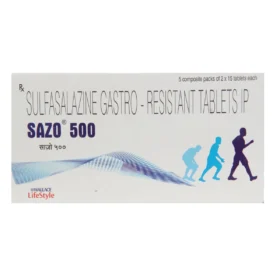
Sazo
✅ Rheumatoid arthritis relief
✅ Inflammatory bowel disease treatment
✅ Ulcerative colitis management
✅ Crohn’s disease alleviation
✅ Joint pain reduction
Sazo contains Sulfasalazine.
✓ Medically reviewed by Morgan Ellis — Pharmacy Researcher · 8 years experience · Last reviewed: May 2026
⚡ Quick Answer — What is Sazo?
Sazo contains sulfasalazine (500 mg), a prodrug that is split in the colon by gut bacteria into two active components: 5-aminosalicylic acid (5-ASA, mesalamine) which acts locally in the colon, and sulfapyridine which is absorbed systemically. Used for ulcerative colitis, Crohn’s disease with colonic involvement, and rheumatoid arthritis. Not a first-line treatment for IBS — IBS is a functional disorder without inflammation. Sulfasalazine is older than pure mesalamine formulations and has more systemic side effects (driven by the sulfapyridine component), but remains useful in RA and in IBD patients who tolerate it well. Typical starting dose: 500 mg 4 times daily, titrated. Common side effects: nausea, headache, orange discolouration of urine/tears/skin (harmless), reduced sperm count (reversible). Check FBC, LFTs, U&Es periodically; screen G6PD deficiency if relevant.
📦 Every order is covered by our Reshipment Assurance Policy — if your parcel does not arrive within 20 business days, we reship it.
Why order from MedsBase
Our generic medications are sourced from WHO-GMP certified manufacturers and shipped worldwide in discreet, plain packaging — no medication name on the parcel exterior. Card payments are routed through a regulated processor (statement descriptors include a regulated card-payment processor — never “MedsBase” or any medication name). Crypto and SEPA bank transfer are also accepted. Every order is backed by our Reshipment Assurance Policy.
What Is Sazo?
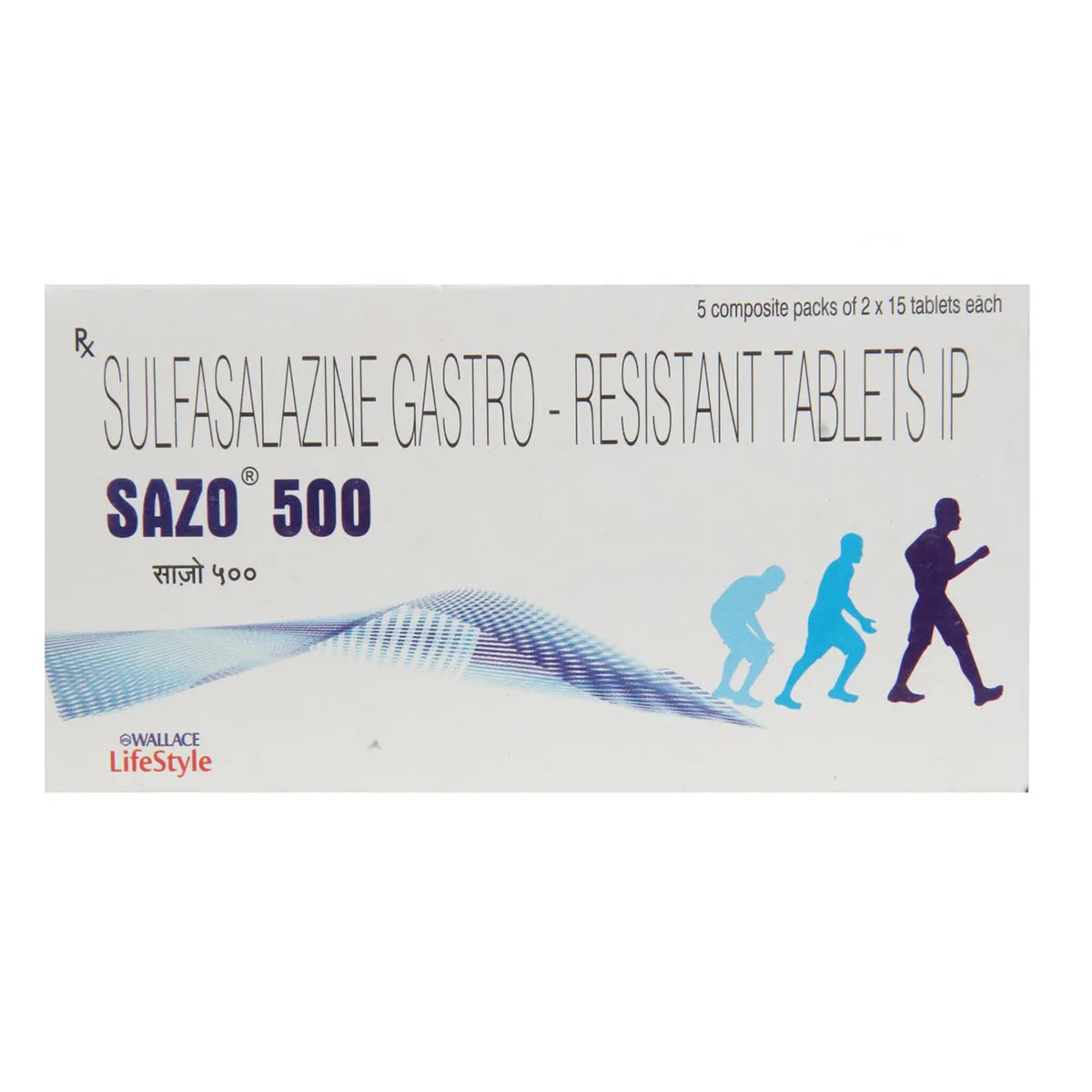
Sazo is an oral tablet containing sulfasalazine (500 mg), manufactured by WHO-GMP certified manufacturer. Supplied in packs of 30, 60, 90 or 180 tablets. Sulfasalazine has been in clinical use since the 1940s and was the first disease-modifying anti-inflammatory drug used in ulcerative colitis. It is on the WHO Essential Medicines List.
Sulfasalazine is a prodrug (azo-bonded sulfapyridine + 5-ASA). The intact molecule is not absorbed in the small intestine; gut bacteria in the colon cleave the azo bond, releasing both components. 5-ASA stays in the colon and acts locally (this is the UC effect); sulfapyridine is absorbed and circulates systemically (responsible for the RA effect and most of the side effects).
What Is Sazo Used For?
- Ulcerative colitis — induction and maintenance of remission in mild-to-moderate disease
- Crohn’s disease with colonic involvement (modest effect; pure mesalamine formulations or other agents usually preferred)
- Rheumatoid arthritis — a conventional disease-modifying antirheumatic drug (cDMARD) used alone or in combination with methotrexate and hydroxychloroquine
- Juvenile idiopathic arthritis
- Ankylosing spondylitis with peripheral joint involvement (modest effect)
Sazo is not for irritable bowel syndrome (IBS), which is a functional disorder and does not involve intestinal inflammation.
How Does Sazo Work?
After oral dosing, about 10–20% of sulfasalazine is absorbed in the small intestine; the rest reaches the colon intact. There, bacterial azoreductases cleave the azo bond, liberating:
- 5-aminosalicylic acid (5-ASA) — stays in the colon, exerts topical anti-inflammatory action via COX/LOX inhibition, ROS scavenging, NF-κB inhibition, and PPAR-γ agonism. This is the UC effect.
- Sulfapyridine — absorbed and circulates systemically; modulates immune function and is thought to contribute to the anti-rheumatic effect (the exact mechanism in RA is not fully understood but involves T-cell and cytokine modulation).
Because the cleavage happens in the colon, sulfasalazine delivers 5-ASA efficiently to colitis patients without needing an enteric coating — effectively an early “biological” colon-targeting system.
Dosage and Administration
Ulcerative colitis (adults, induction): 500 mg four times daily for 1–2 weeks, then increase to 1 g four times daily (total 4 g/day). Maintenance: 2 g/day in divided doses.
Rheumatoid arthritis (adults): 500 mg/day for the first week, then increase by 500 mg/day each week to a maintenance of 2 g/day (maximum 3 g/day). Gradual titration is the single biggest predictor of tolerability.
Paediatric: weight-based; specialist prescribing only.
- Take with or after food — reduces nausea.
- Swallow whole; enteric-coated tablets should not be crushed.
- Ensure adequate hydration (at least 1.5 L water/day) — reduces renal crystal risk.
- Check G6PD status before starting in high-risk populations (Mediterranean, African, Asian ancestry) — sulfapyridine can trigger haemolysis in G6PD-deficient patients.
- Monitoring: FBC + LFT + U&E at baseline, every 2 weeks for 3 months, monthly for 3 months, then quarterly.
- Folic acid 5 mg weekly supplementation is recommended for long-term users — sulfasalazine inhibits folate absorption.
Side Effects
Sulfasalazine’s side-effect profile is broader than pure mesalamine because of the sulfapyridine component. Most effects are dose-dependent and improve with slower titration.
Common (up to 30% of users in the first weeks):
- Nausea, dyspepsia, loss of appetite
- Headache
- Dizziness
- Orange-yellow discolouration of urine, tears, sweat, and (occasionally) skin — harmless but may stain contact lenses and clothing
- Mild reversible reduction in sperm count (~80% of male users) — counselling for patients trying to conceive
Uncommon but important:
- Haemolytic anaemia — particularly in G6PD deficiency. Screen where relevant.
- Neutropenia, agranulocytosis, thrombocytopenia — most common in the first 3–6 months; hence frequent FBC monitoring.
- Hepatitis — raised transaminases usually mild; rare severe hepatitis.
- Renal effects — interstitial nephritis, crystalluria (hydrate well).
- Pulmonary reactions — eosinophilic pneumonitis, fibrosing alveolitis (rare).
- Severe cutaneous reactions — Stevens-Johnson syndrome, toxic epidermal necrolysis, DRESS. Stop immediately if unexplained fever, rash, or mouth ulcers appear.
- Folate deficiency with long-term use — megaloblastic anaemia.
Drug Interactions
- Azathioprine / mercaptopurine — additive myelosuppression risk; monitor FBC.
- Methotrexate — additive myelosuppression; widely used combination in RA but requires close monitoring.
- Warfarin — sulfasalazine can raise INR; monitor.
- Digoxin — sulfasalazine reduces digoxin absorption; separate doses by at least 2 hours.
- Folic acid — absorption reduced; supplement with 5 mg weekly.
- Oral hypoglycaemics (glibenclamide, tolbutamide) — sulfasalazine may enhance hypoglycaemic effect.
- Live vaccines — generally safe on sulfasalazine alone but avoid when combined with other immunosuppressants (azathioprine, biologics).
Who Should Not Take Sazo?
- Known hypersensitivity to sulfasalazine, sulfonamides, or salicylates (including aspirin)
- Intestinal or urinary obstruction
- Porphyria
- Severe renal or hepatic impairment
- G6PD deficiency — relative contraindication; use under specialist supervision with haemolysis monitoring
- Children below the label age cutoff
- Breastfeeding premature or ill infants — sulfasalazine enters breast milk; bilirubin displacement risk
- Pregnancy — generally continued when needed for UC control with folate supplementation; specialist input advised
Storage
Store Sazo below 25°C in a dry place, in the original blister. Keep out of reach of children. Protect from light.
Frequently Asked Questions
Is Sazo the same as mesalamine?
Not quite. Sulfasalazine is a prodrug of mesalamine joined by an azo bond to sulfapyridine. In the colon, bacteria split it, releasing free mesalamine (which acts locally in UC) and sulfapyridine (which is absorbed and causes most of the systemic side effects). Pure mesalamine (Asacol, Mesacol) gives you the UC benefit without the sulfa. Sulfasalazine is preferred when you want both the UC effect and the anti-rheumatic effect — e.g. in UC patients who also have peripheral arthritis, or in pure rheumatoid arthritis.
Why does my urine turn orange on Sazo?
Sulfapyridine metabolites are coloured. Orange discolouration of urine, sweat, and sometimes tears is expected, harmless, and not an indication to stop. Do warn soft-contact-lens wearers — the pigment can stain lenses permanently.
Does Sazo affect fertility?
It causes reversible oligospermia in about 80% of male users (low sperm count, reduced motility). Sperm counts usually return to normal within 2–3 months of stopping. Men planning conception can switch to pure mesalamine (for UC) or another cDMARD (for RA). No similar effect has been described in women.
Can I take Sazo for IBS?
No — IBS is a functional disorder without bowel inflammation. Sulfasalazine has no role in IBS. For IBS, see mebeverine (Colospa) for cramps, rifaximin (Rifagut) for IBS-D, dietary intervention (low-FODMAP), or central modulators.
Do I need blood tests on Sazo?
Yes. Baseline FBC, LFTs, U&Es; then every 2 weeks for 3 months, monthly for the next 3 months, quarterly thereafter. This catches the rare but important blood, liver, and kidney adverse effects early.
Where can I buy Sazo online?
You can order Sazo (500 mg) from MedsBase in packs of 30, 60, 90 or 180 tablets. We ship worldwide with discreet packaging and genuine WHO-GMP certified manufacturer stock.
Related IBS & IBD Medications
- Mesacol — Mesalamine 400/800 mg (Sun Pharma)
- Asacol — Mesalamine 400 mg (Win-Medicare)
- Mesacol OD — Mesalamine once-daily MMX
- Sazo — Sulfasalazine 500 mg
- Salazar — Sulfasalazine
- Colospa — Mebeverine 135 mg (IBS antispasmodic)
- Rifagut — Rifaximin (gut-selective antibiotic)
- Browse all IBS & IBD Medications
Related Alternatives
Other products in Chronic Conditions that customers also view:
More options in Irritable Bowel Syndrome (IBS) Treatment
Ranked by recent MedsBase order volume — what other customers in this category are picking.


| Strength | 500 mg |
|---|---|
| Quantity | 30 Tablet/s, 60 Tablet/s, 90 Tablet/s, 180 Tablet/s |
 Sazo
Sazo
Q & A
Sazo
Related products

Reviews
There are no reviews yet