








✓ Medically reviewed by · Last reviewed: May 2026
Pharmacy Researcher · 8 years experience
Pharmacy researcher with 8 years reviewing clinical drug information, generic formulation equivalence, and international pharmaceutical standards. Focuses on patient-facing accuracy in medication education.
sumatriptan for migraine — Sumatriptan for Migraine: 7 Proven Facts & Safety Guide. Read on for an evidence-backed guide covering everything you need to know.
A migraine hits hard and fast. You have a pack of sumatriptan on the bedside table and one question: will this actually stop it — and how quickly? If you are like most people prescribed sumatriptan for migraine, nobody walked you through the timing rules that decide whether the tablet works or fizzles into disappointment.
By the end of this guide, you will know exactly how to use sumatriptan for migraine correctly — the right dose, the right moment, the second-dose rule, and the few safety questions that actually matter.
Key Takeaways
- Sumatriptan for migraine works best taken the moment the headache begins — waiting until the pain peaks is the single most common reason it “doesn’t work”
- A second dose is allowed two hours after the first if the headache returns — but only up to 200 mg per day, and it will not help if the first dose did nothing at all
- For every five or six people who take oral sumatriptan, one more is pain-free at two hours than with placebo — real relief, but not a miracle, which is why expectations and timing matter
- Sumatriptan is a “stopper,” not a “preventer” — taking it every day backfires, and there is a name for the trap it creates
- The heart-safety worry is real but narrow — for most people without heart disease, sumatriptan for migraine is safe, with one condition that changes everything
- What Is Sumatriptan for Migraine?
- How Does Sumatriptan for Migraine Work?
- Sumatriptan for Migraine: Dosage & Timing
- Safety, Side Effects & Who Should Avoid It
- What Does the Research Say?
- Sumatriptan for Migraine vs Other Options
- How to Get the Best Results From Sumatriptan
- Related Reading
- Frequently Asked Questions
- The Bottom Line
What Is Sumatriptan for Migraine?
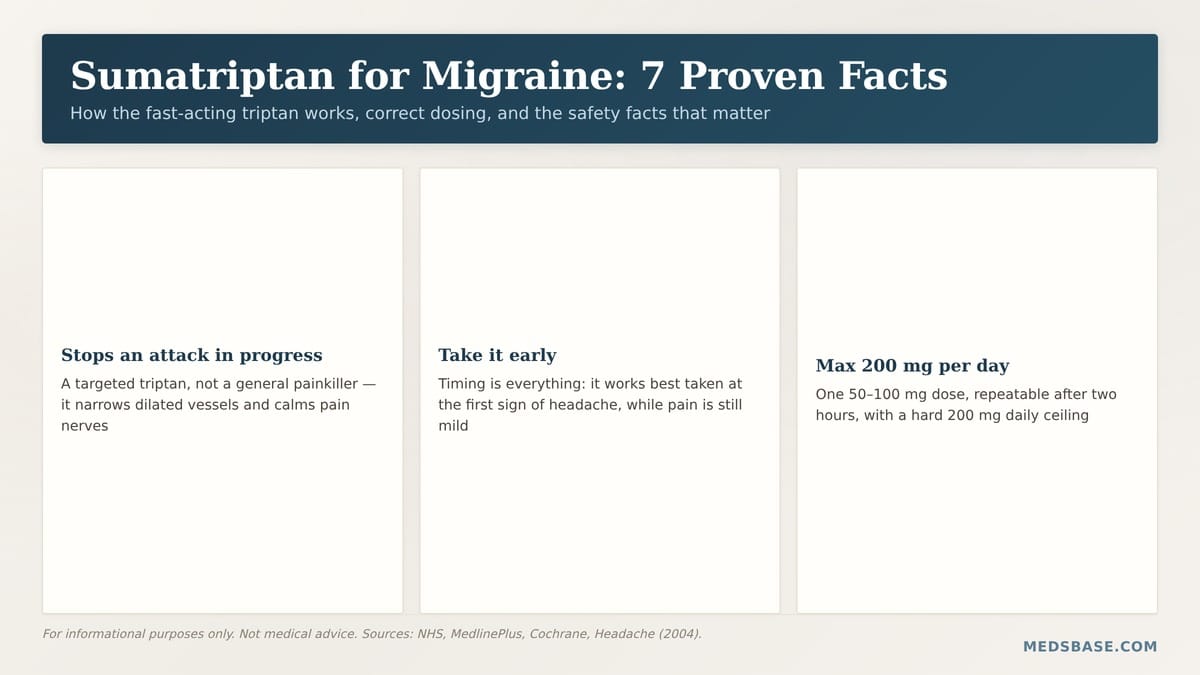
Sumatriptan for migraine is a fast-acting “triptan” medication that stops an attack already in progress by narrowing dilated blood vessels around the brain and calming pain signals. It is not a painkiller in the traditional sense, and it is not a daily preventive — it is an acute, as-needed treatment taken at the first sign of a migraine.
Sumatriptan was the first triptan to be developed, in the early 1990s, and it remains one of the most widely used migraine drugs in the world. It is available as an oral tablet, a nasal spray, and an injection, which makes it flexible for different situations — a tablet for most attacks, a nasal spray when you cannot swallow, and an injection for the fastest possible relief. The NHS describes sumatriptan as a medicine for the relief of migraine and cluster headaches, and it notes that it works best when taken as soon as the migraine begins. MedlinePlus, the US National Library of Medicine’s drug reference, adds that sumatriptan is also used to treat cluster headaches and that it works by helping to narrow blood vessels in the brain.
Most people reach for sumatriptan for migraine in the oral form first. It is short-acting, well understood, and cheap in its generic versions. The trade-off is that it does not prevent migraines — it only treats the one happening right now.
How Does Sumatriptan for Migraine Work?
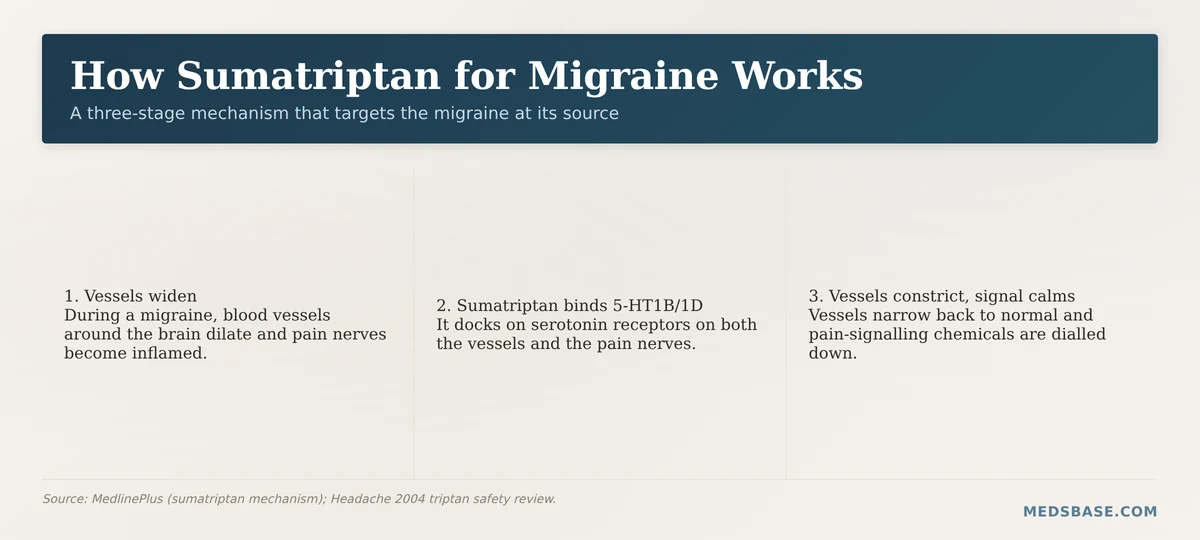
To understand sumatriptan for migraine, it helps to picture what is happening inside your head during an attack. Two things occur together: the blood vessels around your brain widen, and the nerves that carry pain become inflamed and overactive.
Sumatriptan targets a very specific receptor — the 5-HT1B/1D serotonin receptor — found on both the blood vessels and the pain nerves. When sumatriptan binds to this receptor, two useful things happen. First, the widened blood vessels constrict back to normal. Second, the release of pain-signalling chemicals is dialled down. The combined effect is that the headache eases and the nausea and sensitivity to light and sound often improve alongside it.
A useful analogy: think of sumatriptan for migraine like turning down both the volume knob (the pain nerves) and the pressure (the dilated vessels) at the same time, rather than simply numbing the area like a standard painkiller would.
Clinical insight: Pharmacists routinely see patients try sumatriptan for migraine for the first time with the wrong expectation — they treat it like paracetamol and take it late. Sumatriptan is time-sensitive: the longer a migraine has had to “set in,” the less responsive it becomes. This is not the drug failing; it is the drug being asked to fight a fully-developed attack with a tool designed for the earliest stage.
Sumatriptan for Migraine: Dosage & Timing
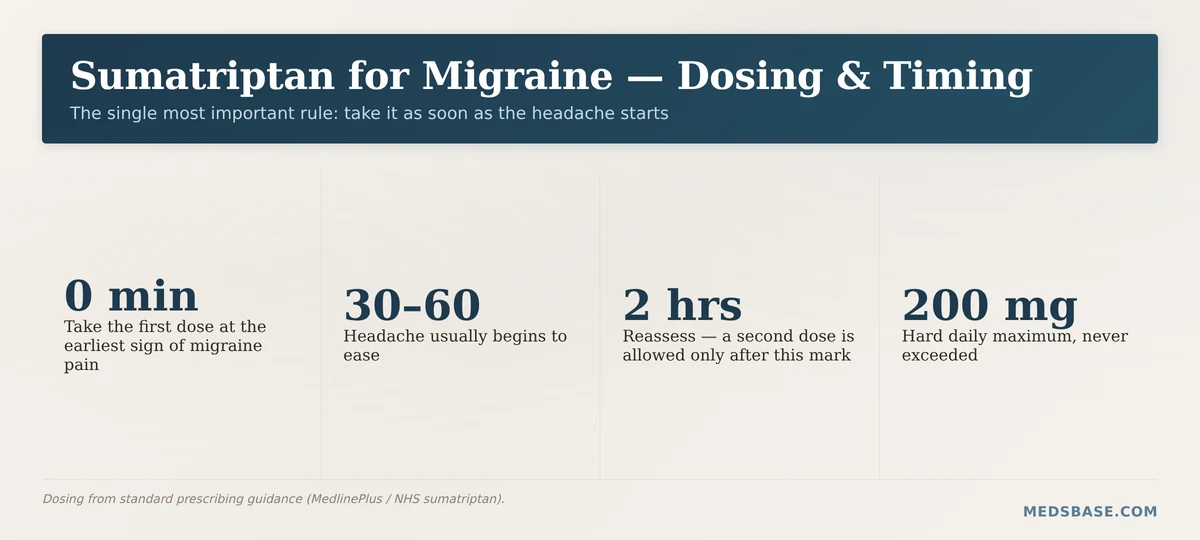
Getting the timing right is worth more than almost anything else in this guide. Here is the dosing framework most prescribers follow.
The Standard Oral Dose
Sumatriptan for migraine is usually started at 50 mg taken as soon as the headache starts. If 50 mg is not enough, many people step up to 100 mg. The maximum single oral dose is 100 mg, and the maximum total in 24 hours is 200 mg.
The Golden Rule — Take It Early
Sumatriptan for migraine works best the moment the head pain begins, ideally while it is still mild. Waiting until the migraine is fully established reduces the chance it will work, because the pain pathways are already running at full speed.
The Second-Dose Rule
If the first tablet helped but the headache comes back after a few hours, you may take a second dose — but only after at least two hours have passed since the first. If the first dose did nothing at all, a second dose in the same attack is unlikely to help; this is the point to talk to your doctor about a different dose, form, or drug.
Never Exceed 200 mg in 24 Hours
This is a hard ceiling, not a suggestion.
Choosing Between Tablet, Spray, and Injection
The form you use matters as much as the dose. The oral tablet is the default for most people — convenient, cheap, and well tolerated. The nasal spray is useful when a migraine brings nausea that makes swallowing or keeping a tablet down difficult, and it can act slightly faster. The injection (usually a pre-filled auto-injector) is the fastest option of all, often providing relief within ten to fifteen minutes, but it is more expensive and reserved for attacks that come on very rapidly or are especially severe. If your migraines are consistently arriving with disabling nausea or escalating within minutes, ask your doctor whether the spray or injection might suit you better than the tablet.
A Note on Food
Sumatriptan for migraine can be taken with or without food. If the tablet occasionally makes you feel briefly nauseated, taking it with a small amount of food and a full glass of water often smooths that over without meaningfully slowing absorption for most people.
- Take the first dose at the earliest sign of migraine pain
- Wait two hours — if the pain is mostly gone, do nothing more
- If the pain eases then returns, take a second dose after the two-hour mark
- If the first dose had no effect, do not chase it — note it and discuss with your doctor
- Stop at 200 mg per 24 hours, no exceptions
Mistakes to avoid:
- Waiting until the pain is severe before taking it
- Redosing too early (under two hours) because you are impatient
- Taking sumatriptan for migraine every single day to “get ahead” of attacks
- Mixing sumatriptan with another triptan or an ergot drug within 24 hours
Safety Profile, Side Effects & Who Should Avoid It
Sumatriptan for migraine is generally well tolerated, and most side effects are mild and short-lived. The most common are a feeling of tightness or heaviness — often in the chest, throat, or jaw — plus tingling, warmth, flushing, dizziness, and drowsiness. These “triptan sensations” can feel alarming the first time but are usually harmless and pass within minutes to an hour.
The side effect that surprises people most is that tightness in the chest or throat. It feels like something serious, but in the vast majority of cases it is the expected effect of the drug on blood vessels and is not a heart attack. Still, because it is hard for a patient to tell the difference, any significant chest tightness should be discussed with a doctor — especially the first time.
| Side Effect | Frequency | Severity | What To Do |
|---|---|---|---|
| Tingling, warmth, flushing | Common | Mild | Usually passes; no action needed |
| Chest/throat tightness or heaviness | Common | Mild–moderate | Report to doctor at first occurrence; usually benign |
| Dizziness or drowsiness | Common | Mild | Avoid driving until you know how it affects you |
| Nausea | Occasional | Mild | Can take with food; report if severe |
| Serious heart or blood-vessel event | Very rare | Severe | Seek emergency care for crushing chest pain, breathlessness |
Who should avoid sumatriptan for migraine? This is the part where safety gets real. Sumatriptan constricts blood vessels, so it is not suitable for people with certain heart or circulation conditions. You should not use sumatriptan for migraine if you have:
- A history of heart attack, angina, or other coronary artery disease
- A history of stroke or transient ischaemic attack (TIA)
- Peripheral vascular disease or severe circulation problems
- Uncontrolled high blood pressure
- A rare type of migraine with brainstem aura (such as hemiplegic or basilar migraine), which your doctor can identify
- For: adults with moderate-to-severe migraine attacks who want fast, targeted acute relief and have no significant heart or vascular disease
- Avoid or discuss first: anyone with heart disease, a history of stroke or TIA, uncontrolled high blood pressure, or certain rare migraine subtypes; also anyone already taking another triptan, an ergotamine, or an MAOI antidepressant
If you have any doubt about your heart or vascular health, the right move is a conversation with your doctor before the first dose — not a guess.
What Does the Research Say?
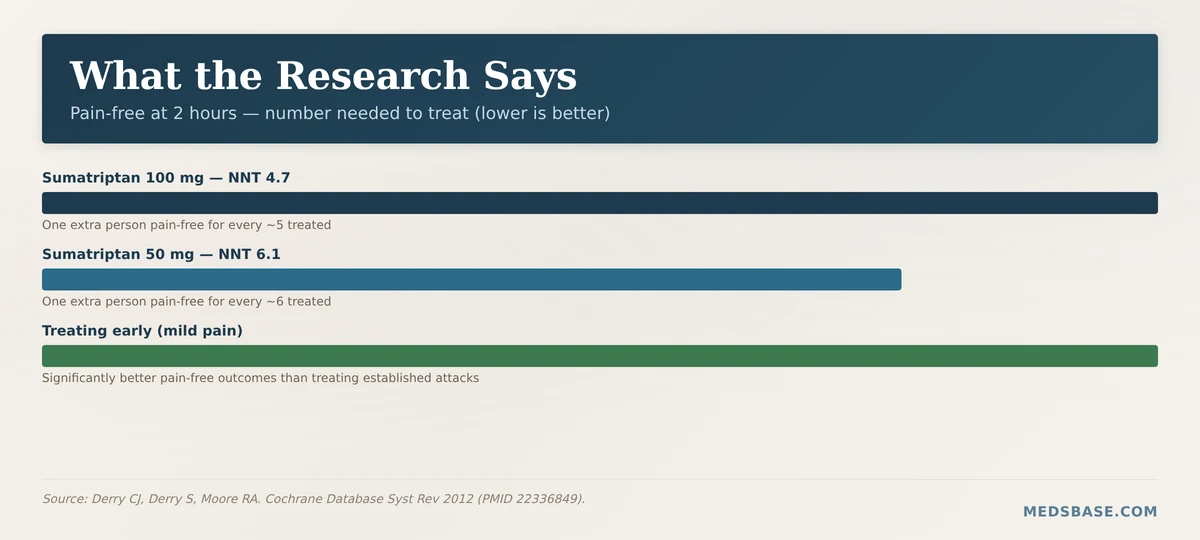
The evidence base for sumatriptan for migraine is one of the most thoroughly studied in all of headache medicine. The headline numbers come from a Cochrane systematic review, which pooled the results of many randomised trials comparing oral sumatriptan with placebo. A separate review of the cardiovascular safety of triptans sets out why these drugs are avoided in people with coronary artery disease — the concern that underpins the warnings described in the section above.
| Study | Year | Finding | Source |
|---|---|---|---|
| Cochrane review — oral sumatriptan for acute migraine | 2012 | NNT 6.1 (50 mg) and 4.7 (100 mg) for pain-free at 2 h vs placebo | Derry CJ et al., Cochrane |
| Cochrane review — oral sumatriptan | 2012 | 100 mg significantly better than 50 mg for pain-free and headache relief at 2 h; treating early in the mild-pain phase gave significantly better NNTs | Derry CJ et al., Cochrane |
| Triptan cardiovascular safety review | 2004 | Contraindicated in coronary artery disease; adverse events transient and mild | Headache (triptans review) |
What this means for you: the research shows sumatriptan for migraine is genuinely effective — for every five or six people treated with the 50 mg dose, one more is pain-free at two hours than would be with placebo (a number-needed-to-treat of about 6), and the 100 mg dose does slightly better. The effect is real but modest in absolute terms, which is exactly why timing, dose, and realistic expectations decide whether your own experience feels like a win.
It is also worth being honest about a limitation: sumatriptan for migraine does not work for everyone, and a meaningful minority of people find another triptan (or a non-triptan option) suits them better. The good news is that the triptan class offers several alternatives, so a poor response to one is not a dead end.
One more nuance from the research deserves a mention: timing genuinely matters in the data. Trials consistently show better outcomes when the drug is taken while the headache is mild. By the time a migraine is severe and fully established, the same dose produces a smaller and slower response. This is why the practical advice in this guide — act early — is not opinion but a direct reading of how the trials were run and what they found.
Sumatriptan for Migraine vs Other Options
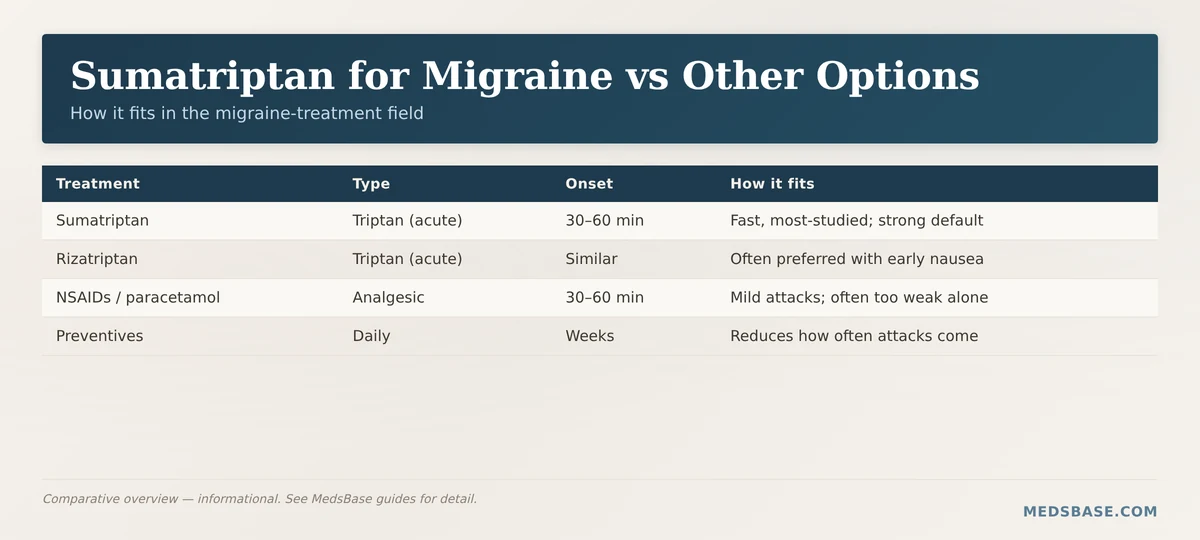
Sumatriptan sits in a crowded field, and it is easy to wonder whether it is actually the right choice for you. Here is how it compares.
| Treatment | Type | Onset | How It Fits |
|---|---|---|---|
| Sumatriptan | Triptan (acute) | 30–60 min oral; faster as spray/injection | Fast, short-acting, most-studied; great default |
| Rizatriptan | Triptan (acute) | Similar, sometimes faster | Often preferred when nausea makes tablets hard to keep down |
| Other triptans (eletriptan, zolmitriptan) | Triptan (acute) | Variable | Alternatives when sumatriptan disappoints |
| NSAIDs / paracetamol | Simple analgesic | 30–60 min | Best for mild attacks; often too weak for severe migraine |
| Preventive drugs (beta-blockers, topiramate) | Prevention | Weeks | For frequent attacks — reduces how often they come |
Which fits which situation? For a typical severe migraine where you need fast, targeted relief, sumatriptan for migraine is an excellent first choice — it is the benchmark against which other triptans are measured. If you frequently feel nauseated early in an attack, a faster-acting or non-oral option may suit better. If you get migraines several times a month, acute treatment alone is rarely enough — prevention belongs in the conversation too.
For a wider view of the medication landscape, see our Best Migraine Medications guide. And if you are weighing sumatriptan against another specific triptan, our Rizatriptan (Rizact) guide breaks down that head-to-head.
How to Get the Best Results From Sumatriptan for Migraine
A few habits separate people who get great results from sumatriptan for migraine from those who give up on it.
Take It Early, Every Time
This cannot be overstated. Keep a dose accessible — in a bag, at your desk — so the moment the aura or the first twinge appears, you can act.
Use the Right Dose From the Start
If your doctor started you on 50 mg and it is only partially working, do not silently accept half-relief — ask about 100 mg. The research shows a dose–response, meaning 100 mg is more likely to achieve the “pain-free at two hours” outcome.
Track Your Attacks
Note when the migraine starts, when you take sumatriptan for migraine, whether it helped, and whether the headache returned. This simple log is the fastest way for your doctor to tune your treatment.
Do Not Use It as a Crutch
Using sumatriptan for migraine on ten or more days a month is linked to medication-overuse headache — a vicious cycle where the treatment itself starts causing headaches. If you are heading into that territory, prevention is the real answer.
When you are ready to keep a supply on hand, you can browse sumatriptan products in the MedsBase Anti Migraine range to compare strengths and forms.
Related Reading
- Wondering what actually works for a migraine when triptans fall short? Best Migraine Medications: 10 Evidence-Backed Picks
- Comparing sumatriptan with its closest cousin? Rizact (Rizatriptan) Guide
- Planning ahead for travel? Motion Sickness Medication: What Works and How to Time It
Frequently Asked Questions
Q: How long does sumatriptan take to work?
A: Oral sumatriptan for migraine typically starts to ease pain within 30 to 60 minutes, with peak benefit around two hours. The nasal spray and injection work faster, often within 15 minutes. The key is taking it while the pain is still mild — a tablet taken late in a severe attack works more slowly and less reliably.
Q: Can I take a second dose of sumatriptan for migraine?
A: Yes, but with rules. If the first dose helped and the headache returns, you can take a second dose after at least two hours have passed. If the first dose did nothing at all, a second dose in the same attack is unlikely to help. Never take more than 200 mg in 24 hours.
Q: Why did my sumatriptan not work?
A: The most common reasons are taking it too late, using too low a dose, or expecting it to work when the attack is already fully established. Sometimes a particular triptan simply does not suit an individual — trying a different triptan or a different form (spray or injection) often helps. A small number of migraines do not respond to triptans at all, which is worth discussing with your doctor.
Q: Is sumatriptan safe for the heart?
A: Sumatriptan for migraine constricts blood vessels, so it is avoided in people with known coronary artery disease, a history of heart attack, stroke or TIA, or uncontrolled high blood pressure. For people without these conditions, the heart risk is very low. The chest tightness many people feel is usually the expected effect, not a heart problem — but report it to your doctor the first time it happens.
Q: What is the difference between sumatriptan and rizatriptan?
A: Both are triptans that work the same way, and both are effective. Rizatriptan is sometimes described as having a slightly faster onset and is often chosen when nausea is a prominent early symptom, because it can be more tolerable to keep down. Sumatriptan is the older, most-studied option and is available in more forms, including an injection. For many people the choice comes down to personal response and cost.
Q: Can you take sumatriptan every day?
A: No. Sumatriptan for migraine is an as-needed acute treatment, not a daily preventive. Using it on ten or more days a month raises the risk of medication-overuse headache — the treatment itself starts causing headaches. If you need relief that often, talk to your doctor about a preventive medication instead.
Q: Does sumatriptan work for migraine with aura?
A: Yes, sumatriptan for migraine works for attacks with or without aura. The timing still matters — the general guidance is to take it at the start of the headache phase rather than during the aura itself, although some people take it as soon as the headache begins regardless of aura. Check with your doctor for the approach that suits your pattern.
Q: What should I avoid while taking sumatriptan for migraine?
A: Do not take another triptan or an ergotamine (like ergotamine or dihydroergotamine) within 24 hours of sumatriptan, and avoid combining it with an MAOI antidepressant. Alcohol can worsen the migraine and the dizziness, so many people find it better to avoid it during an attack. If you are unsure about an interaction, ask your pharmacist.
The Bottom Line
Sumatriptan for migraine is a safe, fast, and well-studied first-choice treatment for stopping an attack in its tracks — provided you use it the way it was designed to be used: early, at the right dose, and no more than 200 mg in a day. The people who get the best results are the ones who treat it as a precise, time-sensitive tool rather than a general painkiller.
Your one immediate action: keep a dose close at hand and take it at the very first sign of the next migraine. If your current dose or form is not delivering, do not give up on the whole class — the fix is often a simple dose or formulation change.
Two next questions readers often ask:
- Wondering how sumatriptan stacks up against the full menu of migraine treatments? Read our Best Migraine Medications guide.
- Comparing it with the most common alternative triptan? Here is our Rizatriptan (Rizact) guide.
Disclaimer: This article is for informational purposes only and does not constitute medical advice. Migraine treatment, and especially the decision to use sumatriptan with any heart or vascular history, should always be guided by a qualified healthcare professional. Individual responses to medication vary.

Written by
Sophie ChenPharmaceutical Content Researcher · 8 years experience
Sophie Chen is a pharmaceutical content researcher with 8 years covering generic medication access and clinical pharmacology. She specialises in international regulatory frameworks, bioequivalence standards, and patient-facing education on therapeutic drug classes. She is not a clinician.