







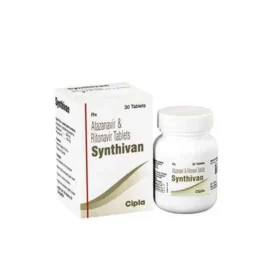
Synthivan
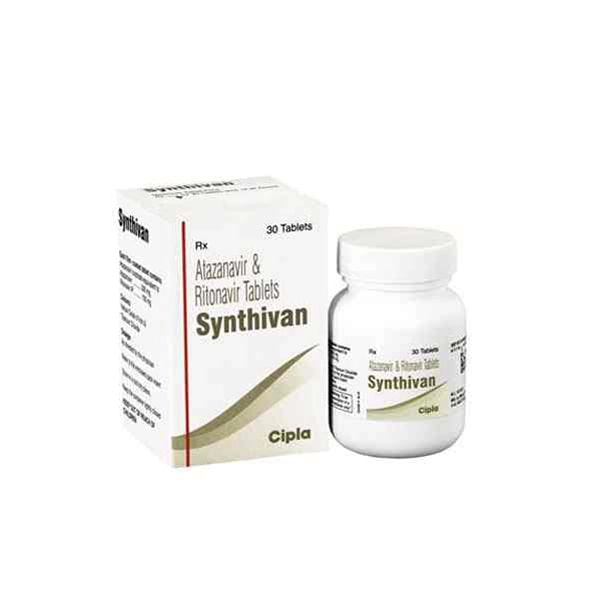
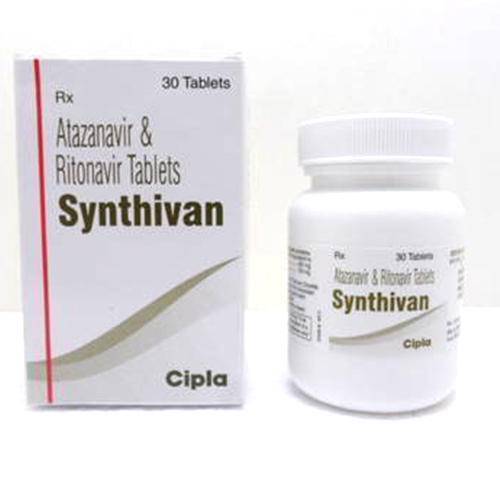
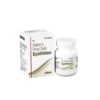
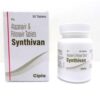
Synthivan (Atazanavir 300 mg + Ritonavir 100 mg) — fixed-combination boosted protease inhibitor for HIV. Once-daily oral. Reversible indirect hyperbilirubinaemia is cosmetic. PPI-incompatible.
✓ Medically reviewed by Morgan Ellis — Pharmacy Researcher · 8 years experience · Last reviewed: May 2026
Quick Answer
Synthivan — Atazanavir + Ritonavir 300 + 100 mg (WHO-GMP certified manufacturer). Atazanavir 300 mg + ritonavir 100 mg booster — once-daily PI regimen with two NRTIs. Reversible indirect hyperbilirubinaemia is cosmetic. PPI-incompatible.
What you get with MedsBase:
- WHO-GMP certified manufacturer
- Discreet plain-envelope packaging
- Worldwide shipping
- Rated by 1,400+ customers (read reviews)
📦 Reshipment Assurance: if your order has not arrived 20 business days after dispatch, we reship it at no extra cost. Read the policy.
Why order from MedsBase
Synthivan ships from a WHO-GMP certified manufacturer in plain packaging, billed through a regulated payment processor (the statement descriptor reads a regulated card-payment processor — never MedsBase or any medication name). Every order carries our 20-business-day Reshipment Assurance.
PIs have a relatively higher genetic barrier to resistance than NNRTIs but still require >95% adherence. Always combined with two NRTIs (typically TDF/FTC or ABC/3TC) for a complete regimen. PI/r refers to ritonavir-boosted PI — ritonavir is given at low dose (100 mg) as a CYP3A4 inhibitor to raise the levels of the partner PI.
How protease inhibitors work
HIV protease cleaves the gag-pol polyprotein into mature, functional viral proteins. Without protease, HIV produces immature non-infectious virions. PIs bind the protease active site and block cleavage.
Modern PI therapy almost always uses ritonavir or cobicistat as a pharmacokinetic booster — these CYP3A4 inhibitors raise levels of the partner PI (atazanavir, darunavir, lopinavir) and allow once-daily dosing.
Class-specific side effects
- GI: diarrhoea, nausea, abdominal pain (especially lopinavir/r — most diarrhoea-prone)
- Metabolic: dyslipidaemia, insulin resistance, lipodystrophy (less prominent with newer PIs darunavir, atazanavir than older lopinavir)
- Hepatic: liver enzyme rises; caution in HBV/HCV co-infection
- Cardiovascular: small association with MI risk (older PIs); newer PIs less affected
- Atazanavir-specific: reversible indirect hyperbilirubinaemia (Gilbert-like jaundice — cosmetic, not hepatotoxic), nephrolithiasis, cholelithiasis
- Darunavir-specific: rash (sulfa-related), hepatitis
Important drug interactions
- Strong CYP3A4 substrates with narrow therapeutic index — absolute contraindications: simvastatin, lovastatin (use pravastatin/fluvastatin/pitavastatin instead); ergot alkaloids; pimozide; midazolam/triazolam (oral); rifampicin; St John’s wort; cisapride.
- PPIs: reduce atazanavir absorption — separate by ≥12 hours OR avoid. Less issue with darunavir, lopinavir.
- Rifampicin: drops PI levels >75% — use rifabutin instead, with PI dose adjustment.
- Hormonal contraception: some PIs reduce ethinyl estradiol — use barrier contraception or alternative.
- Anti-HCV DAAs: always check current Liverpool HIV-DDI database before combining HIV + HCV therapy.
Frequently Asked Questions
Why is ritonavir used as a booster?
Ritonavir at low dose (100 mg) inhibits CYP3A4, raising levels of the partner PI (atazanavir, darunavir, lopinavir). This allows once-daily dosing and lower pill burden. Cobicistat is an alternative booster (no antiviral activity, just CYP inhibition).
Will the regimen cure HIV?
No — ART suppresses viral replication for life. Stopping ART allows viral rebound within weeks. With consistent therapy and undetectable viral load, life expectancy approaches that of HIV-negative peers (U=U).
What if I miss a dose?
Take it when you remember if <6 hours late. If >6 hours late, skip and resume normal schedule — do not double up. Repeated missed doses risk resistance development.
Side effects management?
Diarrhoea is the most common — usually settles within 4-6 weeks; can use loperamide. Lipid changes may need a statin (avoid simvastatin/lovastatin — use atorvastatin low-dose, rosuvastatin, or pitavastatin). Atazanavir jaundice is cosmetic and not hepatotoxic — no need to switch.
When should I take it?
Most boosted PIs are taken with food (improves absorption and tolerability). Atazanavir/r needs an acidic stomach — avoid PPIs; H2 blockers OK with timing separation. Darunavir/r and lopinavir/r are less pH-sensitive.
Drug interactions?
Major class — always disclose all medications. PIs are strong CYP3A4 inhibitors. Statins, rifampicin, ergotamines, oral contraceptives, anticonvulsants, antifungals, and many psychiatric drugs need adjustment or substitution. Use Liverpool HIV-DDI database (hiv-druginteractions.org).
HBV co-infection?
PI-based regimens do not treat HBV. The NRTI backbone (TDF + FTC or 3TC) treats both HIV and HBV — keep this combination if HBV co-infected. Stopping abruptly can flare HBV.
Pregnancy?
Atazanavir/r and darunavir/r have the most pregnancy data and are commonly used. Lopinavir/r is also acceptable. Cobicistat-boosted PIs are generally avoided in pregnancy due to reduced levels in 2nd/3rd trimester.
When are PIs preferred?
PIs are second-line under modern guidelines (integrase inhibitors are first-line). PIs remain useful for: pre-treated patients with INSTI resistance, patients with CNS disease (CSF penetration variable but useful), HIV-2 (where INSTIs work but resistance pathways differ), and pregnancy in some settings.
What about cardiovascular risk?
Older PIs (lopinavir, indinavir) carry small absolute MI excess. Newer PIs (atazanavir, darunavir) less so. Manage traditional CV risk factors (smoking, BP, lipids, weight, exercise) — these dominate over modest PI effect.
Other HIV & Antiviral Medications
- Trioday — TDF + 3TC + EFV — single-tablet regimen by Cipla
- Triomune — d4T + 3TC + NVP — older 3-in-1 (stavudine-based)
- Zepdon — raltegravir 400 mg — integrase inhibitor
- Abamune L — abacavir + lamivudine — alternative NRTI backbone
- Tenvir L — tenofovir + lamivudine — alternative NRTI backbone
More options in HIV Medication
Ranked by recent MedsBase order volume — what other customers in this category are picking.
| Strength | 300 mg & 100 mg |
|---|---|
| Quantity | 30 Tablet/s, 60 Tablet/s, 90 Tablet/s |
| Pharma Form | Tablet/s |
| Treatment | HIV Infection |
| Generic Brand | Atazanavir and Ritonavir |
 Synthivan
Q & A
Synthivan
Related products


Reviews
There are no reviews yet