








✓ Medically reviewed by · Last reviewed: May 2026
Pharmacy Researcher · 8 years experience
Pharmacy researcher with 8 years reviewing clinical drug information, generic formulation equivalence, and international pharmaceutical standards. Focuses on patient-facing accuracy in medication education.
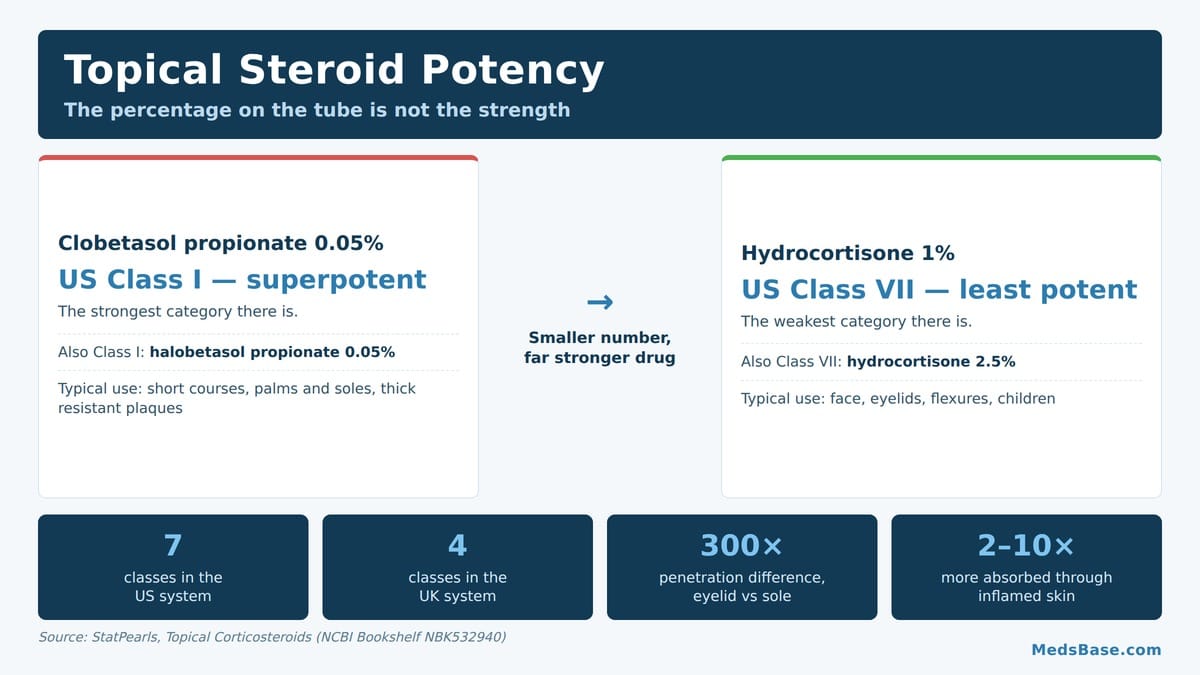
Most people read the percentage on a steroid cream and assume it tells them the strength. When it comes to topical steroid potency, it is close to the least useful number on the tube.
Here is the proof, and it takes one line: clobetasol propionate 0.05% is classified as superpotent — the strongest category there is — while hydrocortisone 1% sits in the weakest. The cream with the smaller number is dramatically more powerful. Percentage tells you how much of a molecule is in the base; it says nothing about how strong that molecule is, how well the base delivers it, or how much of it your particular patch of skin will absorb.
By the end of this article you will be able to place any steroid cream on the topical steroid potency ladder properly, know which class your face, scalp or palms actually call for, and understand the one thing that quietly doubles the strength of whatever you apply. That last point catches out more people than skin thinning does.
- A 0.05% cream can be twenty times stronger than a 1% one — the percentage is not the potency
- Topical steroid potency is measured experimentally, by a blanching test, not calculated from the label
- The US uses seven classes and the UK four, numbered in ways that invite exactly the wrong conclusion
- Absorption varies up to 300-fold across body sites, which is why the site often outranks the severity
- Inflamed skin absorbs far more than healthy skin — so the same tube is stronger during a flare
- Skin thinning is real, is the most common local side effect, and is usually reversible — the detail is in the safety section
What Topical Steroid Potency Actually Means
Topical steroid potency is a ranking of how strongly a corticosteroid cream, ointment or lotion suppresses inflammation in skin — determined experimentally for each finished product, not calculated from the percentage of drug it contains. Two products with identical percentages can sit several classes apart, and a lower-percentage product is frequently the stronger one.
The reason is that three separate things decide the answer, and only one of them appears on the front of the tube.
First, the molecule. Clobetasol propionate, betamethasone valerate, fluticasone propionate, desonide and hydrocortisone differ enormously in intrinsic anti-inflammatory activity — by orders of magnitude, not by percentages. A small amount of a powerful molecule beats a large amount of a weak one.
Second, the vehicle. The cream, ointment, lotion or foam carrying the drug is not a neutral container. A 2021 review in a British Association of Dermatologists journal found that the vehicle itself changes how much drug reaches your skin, stating that topical vehicles “are not inert and can affect TCS bioavailability”. The same paper makes a blunter point that explains a great deal of the confusion in this area: this principle “is not commonly understood, and has contributed to inconsistencies in potency classification systems”. In other words, even the official charts disagree with each other, and the vehicle is a large part of why.
Third, your skin. Which brings us to the section that changes most people’s behaviour.
The two classification systems, and why they trip people up
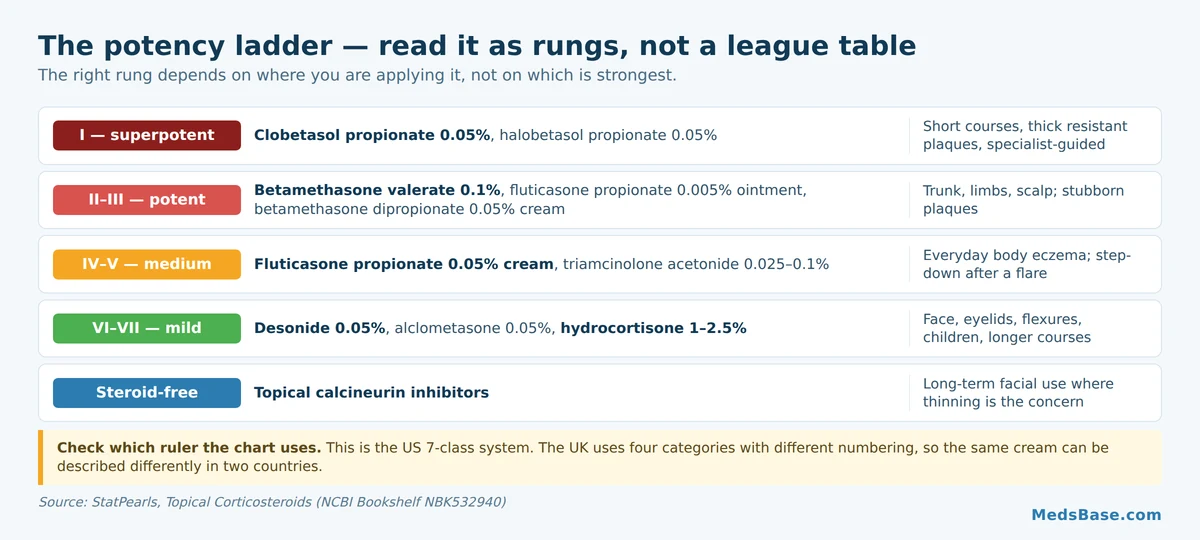
According to StatPearls’ review of topical corticosteroids, the US classification runs to seven classes, with class I superpotent and class VII least potent. The UK uses four categories, running from mild to very potent.
Both systems put the strongest products first. But because the US scale runs to seven and the UK scale to four, “Class III” means quite different things depending on which chart you are reading — and a product described as potent in the UK may appear in the medium band of the US system. Neither is wrong. They are measuring the same property with different rulers.
Before you compare two creams against a chart, check which country’s system that chart uses. It is the single most common way people talk themselves into the wrong strength.
How Topical Steroid Potency Is Measured — the Blanching Test
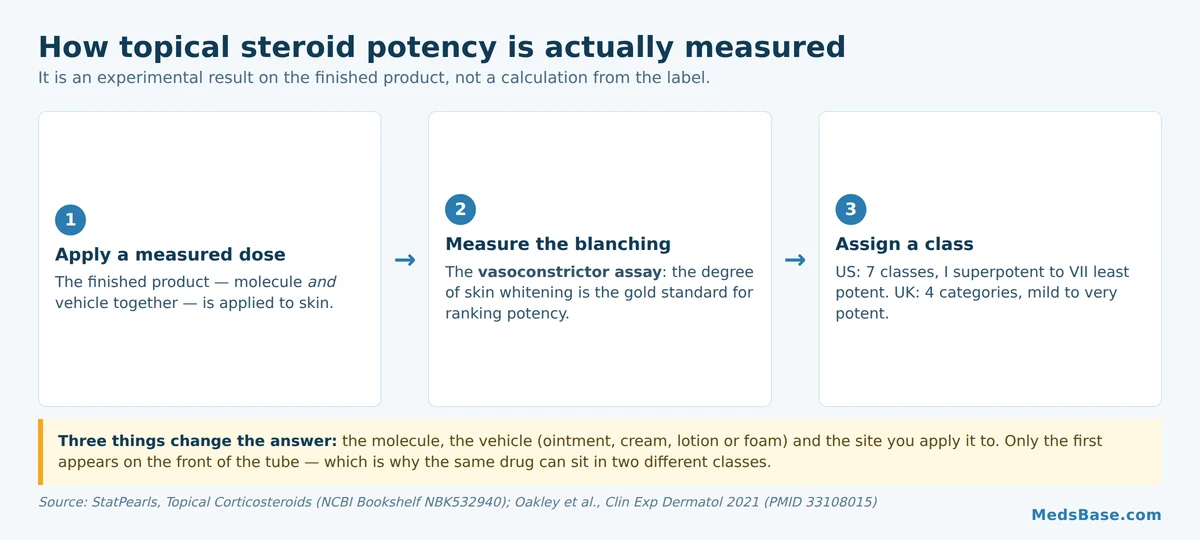
Topical steroid potency is not an opinion or a marketing claim. It is a measurement, and the method is oddly elegant.
Apply a corticosteroid to skin and it constricts the tiny blood vessels underneath, producing a pale patch — blanching. The degree of blanching tracks the drug’s anti-inflammatory strength closely enough to serve as a proxy for it. StatPearls describes this vasoconstrictor assay as the gold standard for determining potency.
The practical consequence is the part worth remembering: because the test is run on the finished product, the vehicle is baked into the result. Change a molecule from an ointment to a cream and you may change its potency class outright, because ointments generally deliver more drug through skin than creams do.
A pharmacist’s observation: the most common question at the counter is not “is this strong enough?” — it is “is this too strong?”, asked while holding a mild cream that will not touch the problem it was bought for. Under-treatment driven by fear of steroids causes more prolonged flares than over-treatment does.
Why the Site You Are Treating Matters More Than You Think
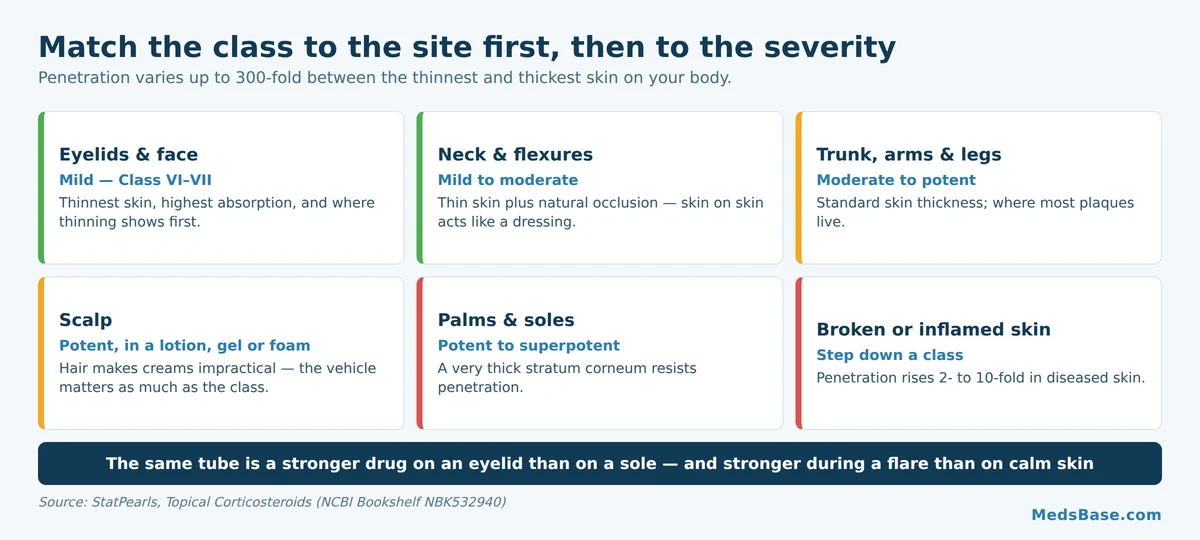
Time to resolve the loop from the introduction. The thing that quietly doubles the strength of whatever you apply is not the tube. It is where you put it, and what state that skin is in.
StatPearls puts the range starkly: corticosteroids are better absorbed in regions of thin epidermis, such as the eyelid, than in thick regions, such as the sole — and the penetration difference between them varies by 300-fold. Not 30% — three hundred times.
Then there is the second multiplier, which almost nobody is told: penetration increases 2- to 10-fold in diseased skin — inflamed, scaling, broken. The skin you are treating is by definition not healthy skin, so a cream is meaningfully stronger during a bad flare than the same cream is on calm skin.
Put those together and the logic of the site map becomes obvious:
| Site | Sensible class band | Why |
|---|---|---|
| Eyelids, face | Mild (Class VI–VII) | Thinnest skin, highest absorption, and the areas where thinning shows first |
| Neck, armpits, groin, under breasts | Mild to moderate | Thin skin plus natural occlusion — skin touching skin acts like a dressing and drives absorption up |
| Trunk, arms, legs | Moderate to potent | Standard skin thickness; most eczema and psoriasis plaques live here |
| Scalp | Potent, in a lotion, gel or foam | Hair makes creams impractical; the vehicle matters as much as the class |
| Palms, soles | Potent to superpotent | Very thick stratum corneum resists penetration |
| Any broken or acutely inflamed skin | Step down a class | Penetration rises 2- to 10-fold |
The rule that follows: match topical steroid potency to the site first, then adjust for severity. Doing it the other way round is how people end up applying a potent cream to their eyelids because their eczema “is bad”.
For facial and eyelid use, the mild end is where you should be. Desonide 0.05% is a mild, low-potency corticosteroid despite its small-sounding percentage — another illustration of the point — and the mild end of the ladder is stocked for exactly this purpose. No prescription is needed to order it from MedsBase.com, which makes reading the site rules your job rather than a pharmacist’s.
Choosing a Topical Steroid Potency Class: the Practical Ladder
Here is where the classes map onto real products.
| Class band (US) | Examples | Typical use |
|---|---|---|
| I — superpotent | Clobetasol propionate 0.05%, halobetasol propionate 0.05% | Short courses on thick, resistant plaques; palms and soles; specialist-guided |
| II–III — potent / medium-to-high | Betamethasone valerate 0.1%, fluticasone propionate 0.005% ointment, betamethasone dipropionate 0.05% cream | Trunk, limbs, scalp; stubborn plaques |
| IV–V — medium | Fluticasone propionate 0.05% cream, triamcinolone acetonide 0.025–0.1%, hydrocortisone butyrate 0.1% ointment | Everyday eczema on the body; step-down after a flare |
| VI — low | Desonide 0.05%, alclometasone dipropionate 0.05% | Face, flexures, children, longer courses |
| VII — least potent | Hydrocortisone 1% and 2.5% | Mildest irritation, facial use, over-the-counter strength |
Two products on that table deserve a second look. Betamethasone valerate 0.1% appears in the potent band under UK classification while the US seven-class system places betamethasone valerate 0.1% cream in the medium range — a live example of the two-ruler problem, and precisely why the classification system in use has to be named before two creams are compared. And fluticasone propionate appears twice, in two different bands, purely because of its vehicle.
In practice, most people need two tubes rather than one: a stronger one to break a flare, and a milder one to hold the ground afterwards. MedsBase stocks that ladder — a mid-strength option in fluticasone propionate 0.05%, and the potent tier in betamethasone valerate 0.1% — alongside the mild desonide already mentioned. Compare the class, the vehicle and the site before the price.
Safety, Skin Thinning and the Fingertip Unit
Now the loop everyone came for: does steroid cream really thin your skin?
Yes — and the honest version is more useful than either the scare or the dismissal. StatPearls identifies skin atrophy as the most common local adverse effect of topical corticosteroids, caused by their anti-mitotic action, with risk driven by potency, vehicle and application site. Intertriginous areas — armpits, groin, under the breasts — are most at risk, because the skin is thin and naturally occluded.
The part that usually goes unsaid: atrophy is reversible once the steroid is stopped, although the skin may take months to look normal again. That is a meaningfully different message from “permanent damage”, and it is the message that lets people use these drugs properly instead of abandoning them halfway through a flare.
| Side effect | Frequency | Severity | What to do |
|---|---|---|---|
| Skin atrophy (thinning) | Most common local effect with prolonged use | Moderate; reversible on stopping, may take months | Step down a class, limit continuous use, avoid potent classes on thin skin |
| Stretch marks (striae) | Uncommon | Moderate — these do not reverse | Avoid potent classes in flexures; a genuine reason to respect the site map |
| Telangiectasia, easy bruising | Uncommon | Mild to moderate | Usually follows prolonged facial use; step down and reassess |
| Perioral dermatitis, steroid acne | Uncommon | Mild | Stop facial application and seek advice — treating it with more steroid worsens it |
| Tachyphylaxis (declining response) | Reported with continued use | Mild, but drives escalation | Treat as a signal to review, not to increase strength |
| Adrenal suppression (systemic) | Rare with sensible use | Serious | Risk rises with superpotent classes, large surface areas, occlusion and long courses — the situations that warrant medical supervision |
The fingertip unit — how much is one application
Dose matters as much as class, and there is a simple standard for it. One fingertip unit is 0.5 grams — a ribbon squeezed from the tube along an adult index finger from tip to first crease. One fingertip unit covers roughly two adult palms of skin.
There is also good evidence for restraint on frequency: StatPearls notes that a study of topical corticosteroid use in atopic dermatitis showed no benefit from applying more than once daily — applying more often only increased adverse effects. Once daily, correctly measured, beats three anxious dabs.
Under-treatment is the other failure mode
A 2026 systematic review of 50 studies covering 17,124 adults across 17 countries examined why people do not use their topical treatments as directed. Among the patient-related barriers it identifies, alongside forgetfulness and knowledge gaps, is topical corticosteroid phobia — a documented, named phenomenon rather than an anecdote.
What this means for you: if you have been applying a mild cream sparingly for three weeks to a flare that needs a potent one for one week, you are not being cautious. You are extending your exposure while getting less benefit from it.
For a full breakdown of a specific molecule’s warnings, MedlinePlus on topical betamethasone is a reliable plain-language reference.
What the Research Says About Topical Steroid Potency
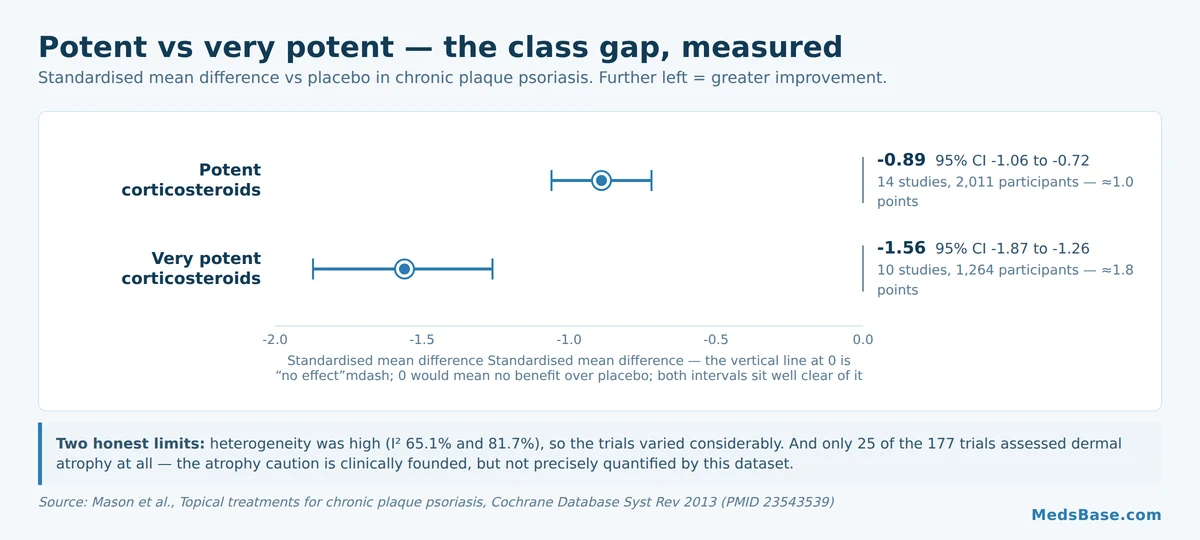
The strongest evidence that topical steroid potency classes are genuinely different — rather than a marketing convenience — comes from psoriasis trials, where topical steroids have been studied against placebo at scale.
| Study | Year | Finding | Source |
|---|---|---|---|
| Mason et al., topical treatments for chronic plaque psoriasis (Cochrane) | 2013 | 177 RCTs, 34,808 participants. Potent corticosteroids SMD −0.89 (95% CI −1.06 to −0.72; 14 studies, 2,011 participants); very potent SMD −1.56 (95% CI −1.87 to −1.26; 10 studies, 1,264 participants) — about 1.0 and 1.8 points on a 6-point global improvement scale | PMID 23543539 |
| Same review, adverse events | 2013 | Potent corticosteroids were less likely than vitamin D analogues to cause local adverse events such as burning or irritation. Only 25 of the 177 trials assessed clinical dermal atrophy | PMID 23543539 |
| Schoepe-era vehicle review (Clin Exp Dermatol) | 2021 | Vehicles are not inert, affect bioavailability, and have contributed to inconsistencies in potency classification systems | PMID 33108015 |
| Cochrane, topical treatments for scalp psoriasis | 2016 | 59 RCTs, 11,561 participants. For clearance, steroids beat vitamin D (RR 1.82; 95% CI 1.52–2.18; NNTB 8) and caused fewer withdrawals for adverse events (RR 0.22; 95% CI 0.11–0.42) | PMID 26915340 |
| Systematic review of adherence in atopic dermatitis (Am J Clin Dermatol) | 2026 | 50 studies, 17,124 adults, 17 countries. Barriers include forgetfulness, knowledge gaps and topical corticosteroid phobia | PMID 42426351 |
What this means for you: a Cochrane review of 177 randomised trials found the very potent class delivered roughly 1.8 points of improvement on a 6-point scale against about 1.0 for the potent class. That is a real, measurable difference — and it is also modest enough to explain why picking the right class for the right site beats simply picking the strongest thing available.
Two honest limitations. The heterogeneity in those Cochrane estimates was high (I² of 65.1% and 81.7%), meaning the trials varied considerably. And the atrophy caution that dominates public discussion rests on a thinner evidence base than you might expect: only 25 of 177 trials assessed dermal atrophy at all, and the review noted insufficient information to judge whether those assessment methods were robust. The caution is clinically well founded; it is not, in this dataset, precisely quantified.
Take Priya, 34 — an illustrative example, not a real patient. She had stubborn plaques on both elbows and a patch of eczema on her eyelids, and she used the same 0.1% cream on both because it was what she had. The elbows improved. The eyelid skin became fragile and faintly veined within a couple of months. Nothing about her behaviour was careless — she simply had one tube and no site map. Two tubes, chosen by site, would have resolved both problems and caused neither.
Topical Steroids vs the Steroid-Free Alternatives
| Topical corticosteroid | Calcineurin inhibitor (steroid-free) | Vitamin D analogue | Emollient alone | |
|---|---|---|---|---|
| Speed on an active flare | Fast — days | Slower — one to two weeks | Slower | Slow, supportive only |
| Causes skin thinning | Yes with prolonged use, site-dependent | No | No | No |
| Suitable for long-term facial use | Only mild classes, intermittently | Yes — this is its main advantage | Not usually | Yes |
| Common early side effect | Stinging, and atrophy over time | Burning or stinging in the first days | Irritation — more frequent than with potent steroids in trials | None |
| Best role | Breaking a flare, matched to site | Maintaining sensitive sites without thinning | Psoriasis, often combined | The foundation everything else sits on |
Which one fits which situation. For an active flare on the body, a correctly chosen potency class is fast and, used properly, low-risk. For the face, eyelids and flexures — the sites where thinning shows earliest — a calcineurin inhibitor is the option specifically designed for the problem steroids have. For psoriasis, the picture is more nuanced than “steroids or not”, and our full guide to treating psoriasis covers how the classes and combinations are actually used together.
And whichever you use, emollients underpin all of it. Nothing on this list works as well on skin that is not moisturised.
- Our full guide to treating psoriasis — how these classes fit into a complete treatment plan
- The seven different types of eczema — because the type changes the site, and the site changes the class
- Browse eczema and psoriasis treatments — the full ladder from mild to potent, plus steroid-free options
Frequently Asked Questions
Q: Is 0.05% stronger than 0.1% in a steroid cream?
A: It often is, because percentage and potency are different things. Clobetasol propionate 0.05% is superpotent — the strongest US class — while hydrocortisone 1% is the least potent. The percentage tells you how much of a molecule is present; the class tells you how strong that molecule and its vehicle actually are. Only compare percentages between two products containing the same drug in the same vehicle.
Q: How do I know how strong my steroid cream is?
A: Read the active ingredient, not the percentage, then look it up on a potency chart — and check whether that chart uses the US seven-class or UK four-class system, because they number differently. Note the vehicle too: the same molecule in an ointment usually ranks higher than in a cream. If the label names only a brand, the ingredient list on the carton will give you the molecule.
Q: Which steroid cream is safe for the face?
A: Generally the mild classes — the low-potency end, such as desonide 0.05% or hydrocortisone 1% — and then only for short, intermittent courses. Facial and eyelid skin is the thinnest on the body and absorbs far more than the trunk, so a potent cream that is unremarkable on an elbow can cause visible thinning on a cheek within weeks. For ongoing facial treatment, a steroid-free calcineurin inhibitor avoids the thinning problem entirely.
Q: How long can you use a potent steroid cream?
A: Follow the specific product’s guidance and your clinician’s, and treat continuous use beyond a couple of weeks on the body as a point to reassess rather than continue. Risk of local effects rises with potency, duration, occlusion and thin-skin sites. Guidelines for plaque psoriasis describe topical corticosteroid courses of around four weeks, with longer use considered only under dermatologist supervision.
Q: What is a fingertip unit of steroid cream?
A: One fingertip unit is 0.5 grams — the ribbon of cream squeezed from a standard nozzle along an adult index finger from the tip to the first crease. It covers roughly the area of two adult palms. It exists because “a thin layer” means something different to everyone, and under-dosing a flare is as common as over-dosing one.
Q: Does steroid cream really thin your skin?
A: It can. Skin atrophy is the most commonly reported local adverse effect, driven by potency, duration, occlusion and site — thin, naturally occluded areas like the groin and armpits are most vulnerable. The important qualifier is that atrophy is generally reversible once the steroid is stopped, though the skin may take months to normalise. Stretch marks, by contrast, do not reverse, which is the stronger reason to respect the site rules.
Q: Can I use a stronger cream for a shorter time instead?
A: Often yes, and it is frequently the better strategy. A correctly chosen potent class for a short course can settle a flare that a mild cream would fail to control over many weeks — leaving you with more total steroid exposure and an unresolved flare. This is exactly the trade-off worth discussing with a pharmacist or doctor rather than resolving by guesswork.
Q: Why do different charts put the same cream in different classes?
A: Because there is more than one classification system, and because the vehicle changes the result. The US uses seven classes, the UK four. On top of that, published reviews note that vehicle composition affects bioavailability and has itself contributed to inconsistencies between classification systems. When two charts disagree, check which system each is using and whether they are describing the same vehicle.
The Bottom Line
Topical steroid potency is decided by three things — the molecule, the vehicle carrying it and the skin you put it on — and the percentage on the tube reflects only a fraction of the first. A 0.05% cream can comfortably outrank a 1% one, and until that clicks, every comparison you make between two tubes is guesswork.
The balanced verdict: these are effective, well-studied drugs whose main risks are predictable and largely site-driven. The two failure modes are mirror images — using a potent class on thin skin for too long, and using a mild class on a stubborn flare for far too long. Matching the class to the site first, then to the severity, avoids both.
One thing to do today: find the tube you already own, read the active ingredient rather than the percentage, and check which class band it falls into. If it is a potent class and you have been using it on your face, neck or groin, that is worth a conversation this week.
Wondering how these classes fit into treating a whole condition rather than a patch? Our full guide to treating psoriasis is the natural next step. Not sure which type of eczema you are dealing with, and therefore which sites you will be treating? The seven different types of eczema sorts that out first. And when you know which rung you need, browse eczema and psoriasis treatments.
Medical disclaimer: This article is general information and does not replace individual medical advice. Corticosteroid strength, duration and site should be matched to your own diagnosis, skin and history — particularly for children, for facial or genital skin, during pregnancy, and where large areas or long courses are involved. Speak to a doctor or pharmacist about your own treatment, and seek advice promptly if a treated area becomes infected, fails to improve, or changes in texture.

Written by
Sophie ChenPharmaceutical Content Researcher · 8 years experience
Sophie Chen is a pharmaceutical content researcher with 8 years covering generic medication access and clinical pharmacology. She specialises in international regulatory frameworks, bioequivalence standards, and patient-facing education on therapeutic drug classes. She is not a clinician.