







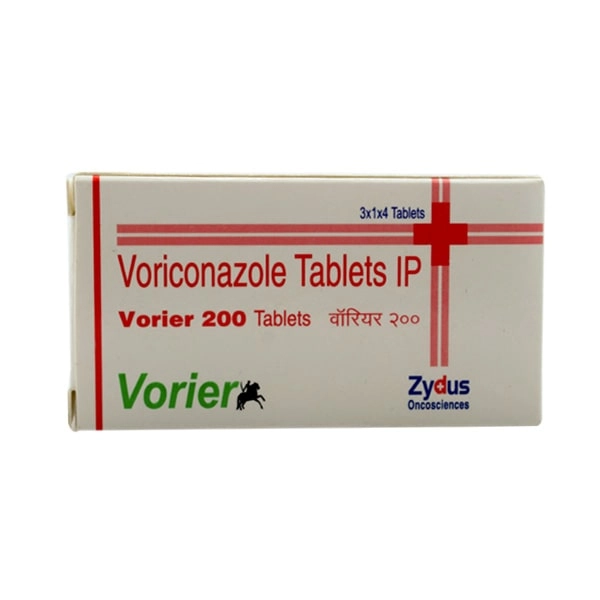
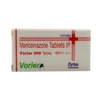
Vorier
✅ Rapid Fungal Infection Relief
✅ Effective Fungi Eradication
✅ Expert-Reviewed and Trusted
✅ Well-Tolerated, Common Effects
✅ Convenient Dosage Administration
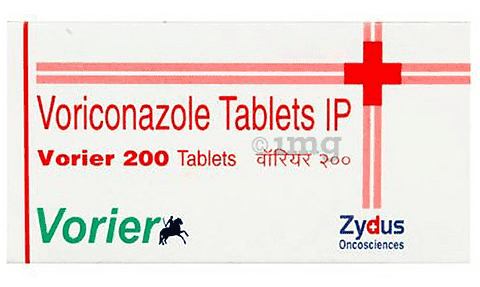
Vorier contains Voriconazole
✓ Medically reviewed by Morgan Ellis — Pharmacy Researcher · 8 years experience · Last reviewed: May 2026
💡 Quick Answer
Vorier is voriconazole 200 mg oral tablet — a second-generation triazole and the first-line treatment for invasive aspergillosis. Also covers Candida (including some fluconazole-resistant strains), Scedosporium, Fusarium. Specialist hospital-initiated drug — TDM (trough 1–5.5 mg/L) required, mandatory ophthalmology baseline (visual disturbances common), and frequent LFT monitoring. Hugely complex pharmacokinetics: non-linear (CYP2C19 polymorphism), strong CYP3A4 inhibitor, photosensitivity → skin cancer risk on long-term use.
WHO-GMP
certified manufacturer
📦 Every order is covered by our Reshipment Assurance Policy — if your parcel does not arrive within 20 business days, we reship it.
Why order from MedsBase
Our generic medications are sourced from WHO-GMP certified manufacturers and shipped worldwide in discreet, plain packaging — no medication name on the parcel exterior. Card payments are routed through a regulated processor (statement descriptors include a regulated card-payment processor — never “MedsBase” or any medication name). Crypto and SEPA bank transfer are also accepted. Every order is backed by our Reshipment Assurance Policy.
Discreet packaging
plain envelope
Worldwide shipping
to most countries
🔒 Why order Vorier from MedsBase
- WHO-GMP certified manufacturer — sourced from a regulated facility, finished pack with batch number and expiry.
- Discreet packaging — plain envelope, no medication name on the outside.
- Worldwide shipping to most countries with Reshipment Assurance.
- Loyalty points — 1 point per $1 spent (excludes peptides/shipping); 100 points = $5 off your next order.
Uses & indications
Vorier (voriconazole 200 mg, Glenmark) is a specialist antifungal — first-line for invasive aspergillosis (Herbrecht 2002 NEJM trial established this), and an option for invasive candidiasis, Scedosporium and Fusarium infections, oesophageal candidiasis refractory to fluconazole, and febrile neutropenia in selected cases. It is not a first-line drug for vaginal thrush, oral thrush, or onychomycosis — use fluconazole or terbinafine for those.
| Indication | Typical regimen |
|---|---|
| Invasive aspergillosis | IV loading 6 mg/kg q12h × 24 h, then 4 mg/kg q12h IV; or oral 200 mg q12h (≥ 40 kg) / 100 mg q12h (< 40 kg) |
| Candidaemia (non-neutropenic) | Same dosing — 14 days minimum after first negative blood culture |
| Oesophageal candidiasis (fluconazole-refractory) | 200 mg q12h × 14–21 days |
| Scedosporium / Fusarium infection | 200 mg q12h, duration based on response |
| Empirical therapy in febrile neutropenia | 200 mg q12h |
How to take
- Take 1 hour before or 1 hour after a meal — food reduces absorption ~22%.
- Swallow whole with water.
- Loading dose is critical — without it, steady-state takes 5–7 days to reach.
- Therapeutic drug monitoring (trough 1–5.5 mg/L) at day 5–7 and after dose change.
How it works
Voriconazole inhibits fungal CYP51 with a higher affinity than fluconazole, extending coverage to Aspergillus and most non-albicans Candida. Pharmacokinetics are non-linear in adults — small dose changes cause large concentration changes. CYP2C19 polymorphism: poor metabolisers (15% of East Asians, 3% of Caucasians) have 4× higher levels; ultra-rapid metabolisers may not reach therapeutic levels. This is why TDM is mandatory.
Side effects & monitoring
| Frequency | Effects |
|---|---|
| Very common | Visual disturbances — blurred vision, photopsia, altered colour perception (~30%, especially in first week, reversible) |
| Common | Rash, nausea, vomiting, abdominal pain, diarrhoea, peripheral oedema, fever, raised LFTs |
| Uncommon | Photosensitivity / phototoxicity, hallucinations, confusion, hypokalaemia |
| Rare but serious | Hepatotoxicity (including fatal hepatitis), QT prolongation / torsades, SJS/TEN, periostitis (long-term — fluoride accumulation), squamous-cell skin cancer (long-term photosensitivity) |
Drug interactions — extensive
Voriconazole is metabolised by CYP2C19, CYP2C9, CYP3A4 — and is itself a strong inhibitor of all three. Major concerns:
| Drug | Effect | Action |
|---|---|---|
| Rifampicin / rifabutin / carbamazepine / phenobarbital | Potent induction → undetectable voriconazole | Contraindicated |
| St John’s wort | Same induction effect | Contraindicated |
| Sirolimus | 8× rise — severe toxicity | Contraindicated |
| Pimozide / quinidine / terfenadine / cisapride | QT prolongation | Contraindicated |
| Ergot alkaloids | Vasoconstriction → ergotism | Contraindicated |
| Tacrolimus / ciclosporin | 2–3× rise | Reduce dose; trough monitoring |
| Warfarin | INR rises | Monitor INR closely |
| Statins (simvastatin, atorvastatin) | Rhabdomyolysis risk | Stop or switch to pravastatin |
| Phenytoin | Bidirectional — voriconazole levels fall, phenytoin levels rise | Avoid; if used, increase voriconazole 100% and monitor phenytoin |
| Omeprazole / esomeprazole | PPI levels rise; modest effect on voriconazole | Halve PPI dose |
| Methadone, opioids | Increased CNS depression | Reduce opioid dose |
Mandatory monitoring
- Therapeutic drug monitoring — trough plasma level at day 5–7 and after every dose change. Target 1.0–5.5 mg/L (some labs 2.0–5.5 for invasive aspergillosis).
- Liver function — baseline, then weekly for 2–4 weeks, then monthly while on therapy.
- Visual function — baseline ophthalmology if therapy > 28 days expected.
- Renal function — IV form contains cyclodextrin; avoid in CrCl < 50 unless benefit clearly outweighs risk (oral form is fine).
- Skin / dermatology — annual review on long-term therapy.
Contraindications
- Concurrent rifampicin, rifabutin, carbamazepine, phenobarbital, St John’s wort.
- Concurrent pimozide, quinidine, terfenadine, cisapride, ergot alkaloids, sirolimus.
- Pregnancy (teratogenicity).
- Severe hepatic impairment.
- Hypersensitivity to other azoles.
Pregnancy & breastfeeding
Voriconazole is teratogenic in animals and contraindicated in pregnancy except in life-threatening systemic mycoses. Effective contraception required. Excretion in breast milk unknown — alternatives preferred while breastfeeding.
Frequently Asked Questions
I see flashes of light when I take voriconazole — is that normal?
Yes — visual disturbances (photopsia, blurred vision, altered colour perception) occur in ~30% of patients, usually within the first 2 hours of dosing and resolve over days to weeks even on continued therapy. Do not drive at night until the effect is clear. If severe or persistent, request TDM — high troughs make it worse.
Why is everyone so worried about my CYP2C19 status?
Voriconazole is metabolised by CYP2C19. Poor metabolisers (15% of East Asian descent, 3% of Caucasians) have 4× higher exposure at standard doses → toxicity. Ultra-rapid metabolisers may not reach therapeutic levels → treatment failure. Pharmacogenetic testing or simply TDM at day 5–7 fixes this.
Can I switch from IV to oral voriconazole?
Yes — once the patient is stable and tolerating oral. The oral bioavailability is ~96% in adults, so the dose is the same (200 mg q12h for adults ≥ 40 kg).
What sunscreen should I use?
Broad-spectrum SPF 50+ minimum, daily, including on cloudy days. Reapply every 2 hours when outdoors. Long-sleeve UV-protective clothing for prolonged exposure. Avoid sunbeds completely.
What are ‘periostitis’ and ‘fluoride toxicity’?
Voriconazole contains fluoride. Long-term therapy (months) can cause painful periostitis with elevated alkaline phosphatase and serum fluoride. Bone scan shows uptake. Resolves on discontinuation. New unexplained bone pain on long-term therapy — get an ALP and serum fluoride.
Is voriconazole the same as Vfend?
Yes — Vfend is the original Pfizer brand. Vorier contains the same active ingredient, manufactured by Glenmark under WHO-GMP. Bioequivalent.
Why does my onychomycosis specialist not use voriconazole?
Voriconazole is reserved for invasive systemic mycoses. For dermatophyte nail infection (the common cause), terbinafine 250 mg/day × 12 weeks is first-line — better cure rate, fewer interactions, far cheaper. Voriconazole would be used only for unusual moulds (Scedosporium, Fusarium) confirmed on culture.
What if I have hepatitis on voriconazole?
Stop voriconazole if AST/ALT > 5× ULN, or any rise + symptoms (jaundice, dark urine, RUQ pain). Switch to alternative (caspofungin / micafungin / amphotericin B / posaconazole / isavuconazole depending on indication). Rechallenge sometimes possible at lower dose with close monitoring.
Can I take voriconazole with PPIs?
Voriconazole inhibits CYP2C19, raising omeprazole and esomeprazole levels by ~2×. Halve the PPI dose if continuing. Pantoprazole and rabeprazole are less affected. The interaction does not significantly alter voriconazole levels.
What’s TDM and why every week at first?
Therapeutic drug monitoring — measuring trough voriconazole plasma level. Target 1–5.5 mg/L. Below 1: treatment failure risk. Above 5.5: hepatotoxicity, encephalopathy, visual problems. CYP2C19 polymorphism makes the dose-response unpredictable, so TDM is non-negotiable for invasive aspergillosis.
Storage
Store tablets at 15–30 °C in the original pack. Protect from light. Do not use after expiry. Keep out of reach of children.
Other Antifungal Medications you may be interested in
Voriconazole is specialist therapy. Listed below — same molecule from a different manufacturer, plus first-line antifungals for the common indications where voriconazole is overkill.
- Zocon (fluconazole 150 mg) — First-line for non-Aspergillus Candida; well-tolerated.
- Sporanox (itraconazole 100 mg) — For dimorphic mycoses + non-Aspergillus moulds.
- Zimig (terbinafine 250 mg) — Dermatophyte nail / skin infection (not invasive moulds).
- Clocip (clotrimazole 1%) — Topical Candida, dermatophyte tinea.
- Loceryl (amorolfine 5%) — Topical nail lacquer for mild onychomycosis.
More options in Anti Fungal
Ranked by recent MedsBase order volume — what other customers in this category are picking.
| Strength | 200 mg |
|---|---|
| Quantity | 28 Tablet/s, 56 Tablet/s, 84 Tablet/s |
| Pharma Form | Tablet/s |
| Manufacturer | Zydus Pharma |
| Treatment | Serious fungal infections |
| Generic Brand | Fluconazole |
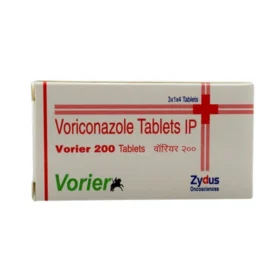 Vorier
Q & A
Vorier
Related products




Reviews
There are no reviews yet