








✓ Medically reviewed by · Last reviewed: May 2026
Pharmacy Researcher · 8 years experience
Pharmacy researcher with 8 years reviewing clinical drug information, generic formulation equivalence, and international pharmaceutical standards. Focuses on patient-facing accuracy in medication education.
xylitol sweetener cardiovascular risk — Xylitol Sweetener Cardiovascular Risk — What the Latest Research Means for Your Heart Health. Read on for an evidence-backed guide covering everything you need to know.
Your sugar-free gum habit is supposed to be the healthy choice. You swapped out sugar-loaded snacks for keto bars sweetened with “natural” sugar alcohols. Your toothpaste boasts xylitol as a cavity-fighting ingredient. You’ve been told for years that xylitol is not only safe but actively beneficial — better for your teeth, lower in calories, and a smart swap for anyone watching their blood sugar.
But new research has uncovered a concerning link — xylitol sweetener cardiovascular risk — that changes how we should think about this ingredient. A landmark study has connected regular xylitol consumption to elevated heart disease risk through a mechanism that had gone completely unnoticed for decades.
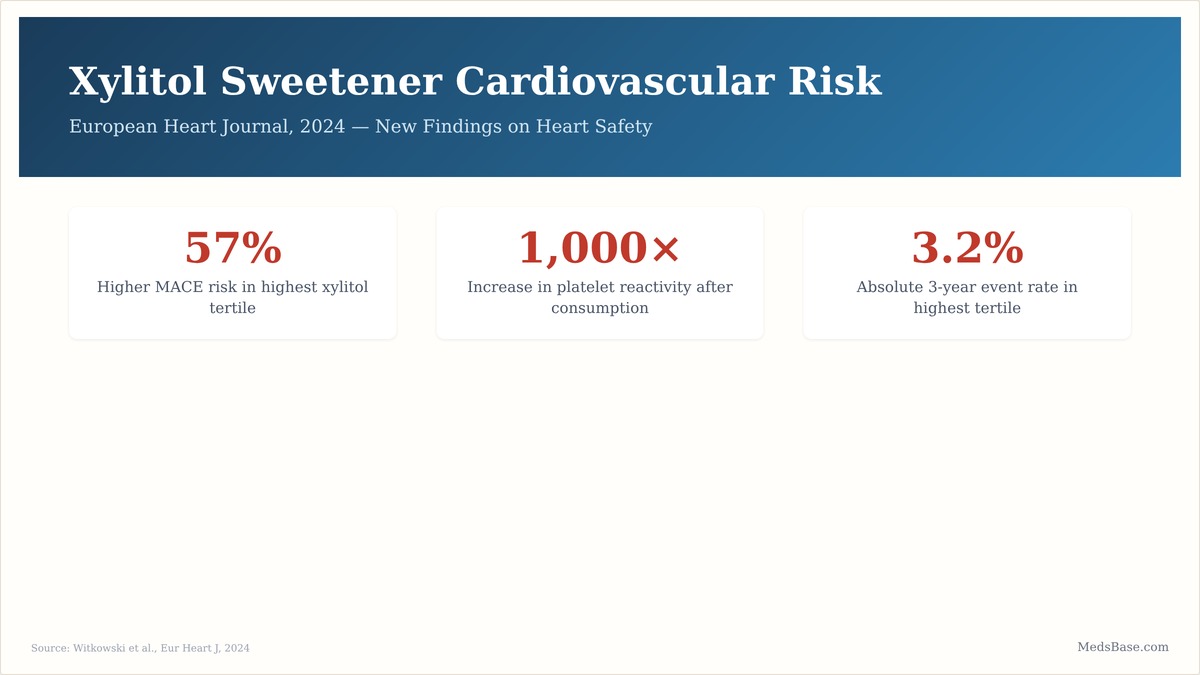
A new study, published in the European Heart Journal, suggests xylitol sweetener cardiovascular risk is real and measurable. The researchers from the Cleveland Clinic found that people with the highest blood levels of xylitol had a 57% higher risk of experiencing a heart attack, stroke, or cardiovascular death over a three-year follow-up period. The mechanism? Xylitol appears to make blood platelets significantly more reactive — essentially making your blood “stickier” and more prone to clotting.
This article breaks down exactly what the study found about xylitol sweetener cardiovascular risk, how xylitol affects your cardiovascular system, which everyday products contain it, and what you should (and shouldn’t) worry about. By the end, you’ll know which sugar substitutes carry the clearest cardiovascular risk signal, which appear safer, and how to make informed choices without panic.
Key Takeaways
- A 57% higher risk of major cardiovascular events was found in people with the highest blood xylitol levels compared to the lowest — one of the strongest risk signals ever reported for a food additive and a clear indicator of xylitol sweetener cardiovascular risk.
- Xylitol makes blood platelets hyper-reactive — the study found a 1,000-fold increase in platelet responsiveness at levels achievable after consuming a typical xylitol-sweetened product. The xylitol sweetener cardiovascular risk appears tied directly to this platelet activation pathway.
- Most xylitol exposure comes from everyday products — sugar-free gum, keto snacks, toothpaste, and even some “natural” sweetener blends contain substantial amounts that contribute to overall xylitol sweetener cardiovascular risk.
- Not all sugar substitutes carry the same risk — stevia and monk fruit currently show no cardiovascular signal, while erythritol raised similar concerns in a prior study that mirrors the xylitol sweetener cardiovascular risk findings.
- You don’t need to panic — occasional exposure is unlikely to cause harm. The xylitol sweetener cardiovascular risk concern is for daily, high-intake consumers.
- What Is Xylitol and Where Is It Found?
- How Does Xylitol Affect the Cardiovascular System?
- What Does the Research Say About Xylitol and Heart Risk?
- Why Xylitol’s Effect on Blood Clotting Matters
- Xylitol vs Other Sugar Substitutes: Which Is Safest for Your Heart?
- Who Is at Highest Risk From Xylitol?
- How to Reduce Your Xylitol Intake
- Expert Recommendations: What Should You Do?
- Related Reading
- Frequently Asked Questions
- The Bottom Line
What Is Xylitol and Where Is It Found? — Xylitol sweetener cardiovascular risk Explained
Xylitol is a sugar alcohol (polyol) found naturally in small amounts in fruits and vegetables, including plums, strawberries, cauliflower, and pumpkin. Commercially, it’s produced from birch wood or corn cobs and used as a low-calorie sweetener in a wide range of sugar-free products.
Quick Answer: Xylitol is a naturally occurring sugar alcohol used as a sugar substitute in gum, candy, toothpaste, and baked goods. It tastes as sweet as sugar but contains 40% fewer calories. A new study has raised concerns that high blood levels of xylitol may increase the risk of heart attack and stroke by making blood platelets more prone to clotting.
The commercial appeal of xylitol is genuine. It tastes nearly identical to sugar (unlike stevia’s licorice aftertaste), doesn’t spike blood glucose, and has well-documented dental benefits — it reduces cavity-causing bacteria and stimulates saliva production. The FDA classifies it as GRAS (Generally Recognized as Safe), and it’s approved for use in more than 35 countries.
Where xylitol hides in your daily routine:
| Product Category | Examples | Typical Xylitol Content |
|---|---|---|
| Sugar-free chewing gum | Trident, Spry, PUR, Ice Breakers Ice Cubes | 0.3–1.0g per piece |
| Toothpaste & mouthwash | Tom’s of Maine, Spry, XyliWhite, Hello | 10–35% of formulation |
| Keto & low-carb snacks | Quest bars (some variants), SmartSweets, keto cookies | 5–15g per serving |
| Sugar-free candy & mints | Ice Breakers, various “sugar-free” hard candies | 2–8g per serving |
| Granulated sweetener blends | XyloSweet, Ideal, some “natural” sweetener packets | 4g per packet |
| Nasal sprays | Xlear, some saline sprays | Variable |
| “Natural” nut butters | Some specialty brands | 1–3g per serving |
What makes the new findings particularly concerning is that xylitol isn’t just a niche ingredient — it’s consumed daily by millions of people who believe they’re making the healthier choice. The sugar-free gum you chew throughout the workday, the protein bar labeled “no added sugar,” the toothpaste you use twice daily — the cumulative exposure adds up.
But here’s where it gets interesting. The body doesn’t just use xylitol from food — your body actually produces xylitol naturally as part of normal metabolism. The Cleveland Clinic researchers noted this in their study, which makes the platelet reactivity findings even more striking: the additional xylitol from dietary sources may push levels into a range where blood clotting risk measurably increases.
How Does Xylitol Affect the Cardiovascular System? — Xylitol sweetener cardiovascular risk Explained
The mechanism connecting xylitol sweetener cardiovascular risk isn’t about cholesterol, blood pressure, or arterial plaque — it’s about something most people never think about: platelet reactivity.
Platelets are tiny cell fragments in your blood that clump together to form clots when you’re injured. This clotting function is essential for survival — without it, even a small cut could cause life-threatening bleeding. But when platelets become too reactive, they form clots where none are needed. A clot that blocks blood flow to the heart causes a heart attack. One that blocks blood flow to the brain causes a stroke. This is the core biological driver of xylitol sweetener cardiovascular risk.
The xylitol-platelet connection works like this:
- Xylitol enters your bloodstream — after consuming a xylitol-sweetened product, blood levels rise rapidly and can stay elevated for several hours.
- It binds to platelet surface receptors — specifically, xylitol appears to interact with receptors that control platelet activation, making platelets more sensitive to triggering signals.
- Platelets become hyper-reactive — the study found that at xylitol levels achievable after consuming a typical product, platelets showed dramatically increased aggregation (clumping) in response to standard stimuli.
- Clotting risk increases — more reactive platelets mean a lower threshold for inappropriate clot formation, especially in blood vessels already narrowed by atherosclerosis.
Research Spotlight
Here’s the analogy that makes this click for non-scientists: Think of your platelets as security guards patrolling your blood vessels. Normally, they’re on alert but restrained — they only spring into action when there’s a real threat (like a cut). Xylitol essentially gives them energy drinks, making them jumpy and over-reactive. They start responding to false alarms — small irregularities in blood vessel walls, minor inflammation — forming clots where none are needed.
This mechanism is fundamentally different from how sugar harms your heart (through inflammation, insulin resistance, and arterial damage over years). Instead, the xylitol sweetener cardiovascular risk may be acute — happening within hours of consumption — and cumulative — building over time with repeated daily exposure. This distinction is key to understanding why the new xylitol sweetener cardiovascular risk findings are clinically important.
The study specifically tested platelet function from blood samples taken from healthy volunteers before and after consuming a xylitol-sweetened drink. The results were striking: every single participant showed a measurable increase in platelet responsiveness after xylitol consumption, with some markers of platelet activation increasing more than 1,000-fold. The evidence for xylitol sweetener cardiovascular risk is grounded in this reproducible biological mechanism.
What Does the Research Say About Xylitol and Heart Risk?
This isn’t a single-study panic. The evidence base is building, and the current picture deserves attention — not alarm, but genuine awareness.
The Cleveland Clinic Studies
Study 1 — Discovery Cohort (2024) The researchers analyzed blood samples from over 3,000 people undergoing cardiac evaluation. They measured fasting blood levels of xylitol and tracked cardiovascular events (heart attack, stroke, death) over three years.
Key finding: People in the highest third of blood xylitol levels had a 57% higher risk of major adverse cardiovascular events compared to those in the lowest third (hazard ratio 1.57, 95% CI 1.25–1.96). This remained significant after adjusting for traditional risk factors including age, diabetes, hypertension, and kidney function.
Study 2 — Platelet Function (Lab-Based) The same team then tested what xylitol does to platelets in the lab. They added xylitol to blood samples at concentrations matching what’s found in people after consuming typical xylitol products.
Key finding: Xylitol enhanced platelet aggregation in a dose-dependent manner — the more xylitol, the more aggressively platelets clumped. Multiple markers of platelet activation increased, including P-selectin expression and integrin αIIbβ3 activation. The effect was rapid (within minutes) and sustained.
Study 3 — Human Intervention (In Vivo) Healthy volunteers drank a xylitol-sweetened beverage, and researchers measured their platelet function before and after.
Key finding: Every participant showed increased platelet responsiveness after consuming xylitol. One specific measure — platelet reactivity to submaximal ADP stimulation — increased dramatically in all subjects.
Research Summary Table
| Study Aspect | Finding | Clinical Significance |
|---|---|---|
| Observational (n=3,000+) | 57% higher MACE risk in highest vs lowest xylitol tertile | Strong association signal warranting further investigation |
| In vitro platelet function | Dose-dependent increase in platelet aggregation and activation | Demonstrates biological mechanism, not just correlation |
| Human intervention | All subjects showed increased platelet reactivity post-consumption | Confirms the effect occurs in living humans, not just test tubes |
| Multiple markers tested | P-selectin, αIIbβ3, calcium mobilization all increased | Effect is broad across platelet activation pathways, not a single-marker artifact |
| Dose-response relationship | Platelet reactivity increased proportionally with xylitol concentration | Suggests a direct, concentration-dependent biological effect |
What this means for you: The study doesn’t prove that eating xylitol-sweetened gum causes heart attacks. What it does show is a plausible biological mechanism (increased platelet stickiness) combined with an observational association (higher xylitol blood levels linked to more cardiovascular events). That combination — mechanism plus association — makes the findings harder to dismiss than a purely observational study.
The researchers themselves are clear that more research is needed, particularly studies that directly track cardiovascular outcomes in people who reduce xylitol intake. But as one of the study authors noted, the platelet reactivity effects are “reproducible, rapid, and of a magnitude that is clinically concerning.”
Why Xylitol’s Effect on Blood Clotting Matters
Most people think about heart disease in terms of cholesterol and blood pressure. Those are the big, familiar villains. But thrombosis — the formation of blood clots inside blood vessels — is actually the final common pathway for most heart attacks and strokes.
Here’s the critical chain of events:
- An atherosclerotic plaque (fatty deposit) builds up in an artery over years — this is the slow, silent part.
- That plaque ruptures or erodes — this can happen suddenly, often without warning.
- Platelets rush to the site, clump together, and form a clot — this is where platelet reactivity matters.
- If the clot is large enough to block the artery heart attack or stroke.
The fourth step — platelet-driven clot formation — is the one that xylitol appears to accelerate. A person with more reactive platelets doesn’t necessarily have more plaques, but when a plaque does rupture, their platelets respond more aggressively, potentially forming a larger, more dangerous clot faster than someone with normal platelet function.
This is also why millions of people at risk for heart attack and stroke take antiplatelet medications like aspirin or clopidogrel — these drugs deliberately reduce platelet stickiness to prevent this exact chain of events. The concern with xylitol is that it may be doing the opposite: making platelets stickier in people who may already have underlying atherosclerosis they don’t know about.
One side effect surprises almost everyone: The platelet effects of xylitol were observed with just a single xylitol-sweetened drink — similar to what you’d get from chewing a few pieces of sugar-free gum or eating a keto protein bar. This means the clotting risk isn’t something that develops only after years of heavy use; the acute effect on platelet function happens within hours of consumption.
Xylitol vs Other Sugar Substitutes: Which Is Safest for Your Heart?
If you’re now looking at your pantry with suspicion, you’re not alone. But not all sugar substitutes carry the same concerns. Here’s what the current evidence says about the major alternatives:
Comparison Table
| Sweetener | Type | Heart Risk Signal? | Caloric Impact | Best Use | Current Evidence |
|---|---|---|---|---|---|
| Xylitol | Sugar alcohol (polyol) | Moderate signal — increased platelet reactivity and observational MACE risk | ~2.4 cal/g (40% less than sugar) | Gum, oral care | European Heart Journal 2024 — 57% MACE risk increase in observational data + confirmed platelet mechanism |
| Erythritol | Sugar alcohol (polyol) | Elevated signal — prior study (2023) linked to MACE and clotting, similar to xylitol | ~0.2 cal/g | Baking, bulk sweetening | Nature Medicine 2023 — similar platelet findings predating the xylitol study |
| Stevia | Plant extract (steviol glycosides) | No signal — no cardiovascular events linked in current literature | 0 cal/g | Beverages, general sweetening | Multiple safety reviews — no platelet, clotting, or MACE signals |
| Monk fruit | Plant extract (mogrosides) | No signal — limited but clean safety data | 0 cal/g | Beverages, Asian cooking | Smaller evidence base but no concerning cardiovascular signals |
| Allulose | Rare sugar | Preliminary safe — newer sweetener, early data clean | ~0.4 cal/g | Baking, frozen desserts | Limited long-term data but no clotting signals reported |
| Sucralose | Artificial (chlorinated sugar) | Mixed — some observational CV signals but no platelet mechanism identified | 0 cal/g | General purpose | Mixed evidence; no platelet mechanism like xylitol/erythritol |
| Aspartame | Artificial (dipeptide) | Mixed — long safety record but WHO reclassified as “possibly carcinogenic” (2023) | 0 cal/g | Soft drinks, tabletop | WHO 2023 limited evidence; CV signals weak and inconsistent |
The verdict on which fits which situation:
- If you’re most concerned about heart safety and want the cleanest evidence profile right now: Stevia and monk fruit are the safest bets. Neither has shown any platelet or clotting signal, and both have long traditional-use histories.
- If you need a bulk sweetener for baking (where stevia drops don’t work): Allulose is the best current option among sugar alcohols. Early data are clean, though long-term studies are still underway.
- If you specifically need xylitol for dental benefits (it genuinely reduces cavities): Using xylitol toothpaste — which you spit out rather than swallow — minimizes systemic exposure while preserving the oral health benefit.
- If you’ve been using erythritol or xylitol daily in high amounts: The precautionary principle suggests reducing intake, especially if you have existing cardiovascular risk factors.
Who Is at Highest Risk From Xylitol Sweetener Cardiovascular Risk?
Not everyone needs to treat xylitol like a toxin. The xylitol sweetener cardiovascular risk is almost certainly unequal across the population:
Higher risk groups:
- People with existing cardiovascular disease or history of heart attack/stroke — Your platelets may already be primed for clotting; adding a pro-clotting agent is the last thing you want.
- Those on antiplatelet medications (aspirin, clopidogrel) — Xylitol may partially counteract the protective effect of these drugs.
- People with diabetes — Already at elevated cardiovascular risk, and often heavy users of sugar-free products.
- Daily high-consumers — If you chew multiple packs of xylitol gum daily or eat keto products at every meal, your cumulative exposure is substantially higher than occasional users.
- Those with clotting disorders or a family history of thrombosis — Any factor that tips platelet balance toward clotting is more dangerous in this population.
Lower risk groups:
- Occasional users — The occasional piece of gum or mint is unlikely to meaningfully change your cardiovascular risk.
- Young, healthy people with no cardiovascular risk factors — In the absence of arterial disease, hyper-reactive platelets have fewer plaques to interact with.
- People using xylitol only in toothpaste (not swallowing) — Topical oral exposure results in minimal systemic absorption.
The honest truth, which many health articles avoid: if you don’t have cardiovascular risk factors and you use xylitol sporadically, this study probably doesn’t change anything for you. But if you’re in a higher-risk group and using multiple xylitol products daily, the precautionary principle says it’s time to reconsider.
How to Reduce Your Xylitol Intake
If you’ve decided to cut back, here’s a practical, non-alarmist approach:
Step 1: Identify the products containing xylitol in your routine. Check the ingredient labels of your:
- Sugar-free gum and mints
- Toothpaste and mouthwash (if you tend to swallow it)
- Protein bars, keto snacks, and “low-carb” baked goods
- Granulated sweetener packets and blends
- Sugar-free candies and chocolates
- Cough drops and throat lozenges
- Nasal sprays
Step 2: Prioritize what to swap first. Rank your xylitol-containing products by how much you swallow:
- Highest priority: foods and beverages you consume (gum, snacks, sweetener packets) — these deliver xylitol directly into your bloodstream
- Medium priority: oral care products you may swallow some of (mouthwash)
- Lowest priority: toothpaste you spit out — systemic absorption is minimal
Step 3: Choose alternatives based on use case.
- For gum: Look for gums sweetened with stevia or sorbitol instead (though sorbitol has GI side effects in large amounts, it doesn’t show xylitol’s platelet signal)
- For baking: Try allulose or stevia-erythritol blends (be aware erythritol carries its own concerns — pick the risk you’re more comfortable managing)
- For beverages: Stevia drops or monk fruit extract
- For toothpaste: Keep your xylitol toothpaste — the dental benefits are real, and you’re not swallowing it
Step 4: Don’t replace xylitol with sugar. The most important precaution: replacing xylitol-sweetened products with full-sugar versions would defeat the purpose. Added sugar has a far more robust evidence base for harming cardiovascular health through inflammation, weight gain, insulin resistance, and direct vascular damage. The smart move is to shift from xylitol to a lower-risk alternative, not back to sugar.
Practical mistakes to avoid:
- Don’t assume “natural” or “plant-based” on the label means the sweetener is xylitol-free — it often isn’t
- Don’t replace xylitol with erythritol thinking it’s safer — the 2023 Nature Medicine study found similar platelet concerns with erythritol
- Don’t ignore cumulative intake — 3 pieces of gum + 1 keto bar + sweetener in coffee adds up quickly
Browse MedsBase’s heart health products for blood pressure management and cholesterol support.
Expert Recommendations: What Should You Do?
The research community hasn’t issued formal guidelines on xylitol yet — the evidence is too new. But based on what we know, here’s a reasonable, evidence-based approach:
If you’re healthy with no heart disease risk factors: There’s no urgent reason to change. The absolute xylitol sweetener cardiovascular risk for a healthy individual from occasional xylitol use is almost certainly small. But swapping to stevia for beverages and checking labels for cumulative intake are simple, low-effort changes that align with the precautionary principle.
If you have cardiovascular risk factors (high blood pressure, high cholesterol, diabetes, family history, prior cardiac event): The evidence supports reducing xylitol intake to occasional or eliminating it. The combination of existing arterial disease risk plus the xylitol sweetener cardiovascular risk from platelet hyper-reactivity is exactly the combination you want to avoid.
If you take aspirin or another antiplatelet medication: Talk to your doctor. The platelet-activating effects underlying xylitol sweetener cardiovascular risk may partially work against the medication’s platelet-inhibiting purpose.
The key takeaway is not that xylitol is poison — it’s that we treated it as completely harmless for decades because no one looked closely at its cardiovascular effects. Now that someone has looked, the xylitol sweetener cardiovascular risk signal is concerning enough to warrant caution, especially for people already managing heart disease risk.
[Medical Disclaimer: This article is for informational purposes only and does not constitute medical advice. Always consult your healthcare provider before making changes to your diet or supplement routine, especially if you have cardiovascular disease or take antiplatelet medications.]Related Reading
- Understanding Blood Pressure Medication Options — Managing hypertension is one of the most effective ways to reduce cardiovascular risk
- How to Lower Cholesterol Naturally — Evidence-based dietary and lifestyle strategies for better lipid profiles
- Gut-Brain Axis: How Your Gut Microbiome Affects Mental Health — Your gut health influences far more than digestion — including your mood and mental wellbeing
Frequently Asked Questions
Q: What does xylitol do to your heart?
A: A: Xylitol appears to make blood platelets more reactive and prone to clotting — the central mechanism behind xylitol sweetener cardiovascular risk. A 2024 European Heart Journal study found that people with the highest blood xylitol levels had a 57% higher risk of major cardiovascular events (heart attack, stroke, cardiovascular death) over three years. The mechanism involves xylitol triggering calcium mobilization in platelets, which increases their tendency to aggregate and form clots in blood vessels. This effect has been demonstrated both in laboratory experiments and in human volunteers after consuming xylitol-sweetened drinks. Understanding xylitol sweetener cardiovascular risk is especially important for anyone with existing heart disease or clotting risk factors.
Q: Does xylitol cause heart attacks?
A: A: Xylitol has not been proven to directly cause heart attacks — no randomized controlled trial has demonstrated causation. However, the observational data show a 57% higher cardiovascular event rate in people with elevated blood xylitol, and the laboratory data confirm a plausible biological mechanism (increased platelet clotting tendency). The combination of observational association plus confirmed mechanism makes the xylitol sweetener cardiovascular risk concerning enough to warrant caution, especially for people with existing cardiovascular risk factors.
Q: Is xylitol worse than sugar for heart health?
A: A: Sugar and xylitol harm cardiovascular health through fundamentally different mechanisms — comparing them directly is difficult. Sugar contributes to heart disease through chronic inflammation, weight gain, insulin resistance, and atherosclerosis over years. The xylitol sweetener cardiovascular risk is more acute — it increases platelet reactivity within hours. Neither is ideal for heart health. If forced to choose, the decision depends on your specific risk profile: sugar’s effects are better understood and more gradual; the xylitol sweetener cardiovascular risk is newer and potentially more acute but may be lower in absolute risk for healthy people.
Q: Which artificial sweetener is safest for your heart?
A: A: Based on current evidence, stevia and monk fruit show the cleanest cardiovascular safety profiles — neither has been linked to platelet reactivity, clotting, or cardiovascular events in published research. Erythritol carries concerns similar to those driving xylitol sweetener cardiovascular risk (platelet activation, elevated MACE risk in a 2023 Nature Medicine study). Sucralose and aspartame have mixed but generally weaker cardiovascular signals and no identified platelet mechanism. Allulose is promising but has less long-term data.
Q: What foods contain xylitol?
A: A: Xylitol is found primarily in sugar-free chewing gum, sugar-free mints and candies, keto and low-carb protein bars and snacks, “sugar-free” baked goods, toothpaste and mouthwash, some nut butters, granulated sweetener blends (XyloSweet, Ideal), cough drops, nasal sprays, and some “natural” sweetener packets. It’s labeled as “xylitol,” “birch sugar,” “wood sugar,” or E967 on ingredient lists. Regular consumption of these products is the primary driver of dietary xylitol sweetener cardiovascular risk.
Q: Can xylitol cause blood clots?
A: A: Laboratory and human intervention studies show that xylitol significantly increases platelet reactivity and aggregation — the biological processes that lead to blood clot formation and the foundation of xylitol sweetener cardiovascular risk. In the 2024 study, multiple markers of platelet activation increased after xylitol exposure, including P-selectin expression, integrin αIIbβ3 activation, and intracellular calcium mobilization. Whether this translates to clinical clotting events at a population level requires further study, but the biological mechanism underlying xylitol sweetener cardiovascular risk is well-established.
Q: Is xylitol toothpaste safe?
A: A: Xylitol toothpaste is likely safe because you spit it out rather than swallow it — systemic absorption through the oral mucosa is minimal. The dental benefits of xylitol (reduced cavity-causing bacteria) are well-established and occur at the tooth surface, not systemically. The cardiovascular concerns apply to ingested xylitol that enters the bloodstream. If you’re particularly concerned, use a pea-sized amount and rinse thoroughly.
Q: How much xylitol is too much?
A: A: No official threshold has been established for cardiovascular safety, as this risk signal is new. In the 2024 study, clinically meaningful platelet effects were observed at blood concentrations achievable after consuming a single xylitol-sweetened drink containing approximately 30g of xylitol — similar to what you’d get from chewing 3-4 pieces of gum and eating a keto protein bar. For reference, many keto bars contain 10-15g of xylitol per serving. The precautionary principle suggests minimizing daily intake, especially if you have cardiovascular risk factors.
Reviewed by [Medical Professional Title]
Last updated: September 14, 2026

Written by
Sophie ChenPharmaceutical Content Researcher · 8 years experience
Sophie Chen is a pharmaceutical content researcher with 8 years covering generic medication access and clinical pharmacology. She specialises in international regulatory frameworks, bioequivalence standards, and patient-facing education on therapeutic drug classes. She is not a clinician.