







9 Pm Eye Drop
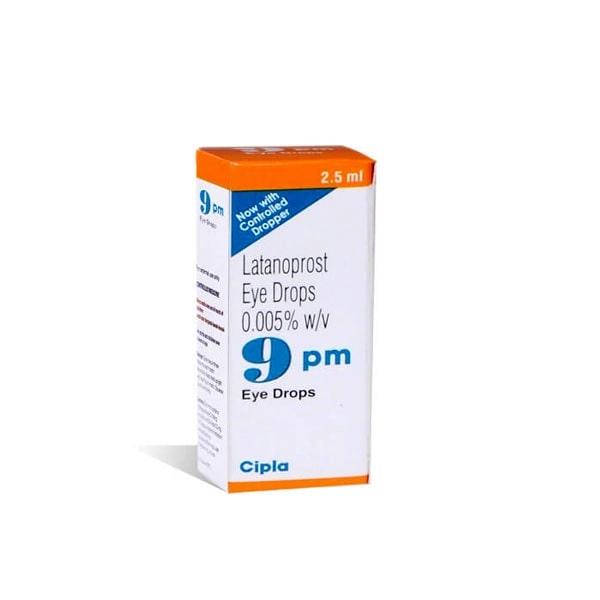
9 PM (latanoprost 0.005%) — once-daily prostaglandin analogue eye drop for open-angle glaucoma and ocular hypertension. Lowers IOP up to 33%. Bedtime dose.
✓ Medically reviewed by Morgan Ellis — Pharmacy Researcher · 8 years experience · Last reviewed: May 2026
⚡ Quick Answer — What is 9 PM Eye Drop?
9 PM Eye Drop is Latanoprost 0.005%, a once-daily prostaglandin eye drop that lowers eye pressure 25–33% in glaucoma. Apply one drop to each affected eye in the evening. Watch for iris darkening and eyelash growth.
📦 Every order is covered by our Reshipment Assurance Policy — if your parcel does not arrive within 20 business days, we reship it.
Why order from MedsBase
9 PM Eye Drop is sourced from a WHO-GMP certified manufacturer and shipped worldwide in plain, discreet packaging. Every order is covered by our Reshipment Assurance Policy — if it has not arrived after 20 business days we reship at no extra cost. Backed by 1,400+ verified customer reviews.
What is 9 PM Eye Drop?
9 PM Eye Drop is manufactured by Sun Pharma and contains Latanoprost 0.005% as a sterile ophthalmic solution. 9 PM Eye Drop 0.005% is a prostaglandin F2α analog used to lower raised intra-ocular pressure (IOP) in open-angle glaucoma and ocular hypertension. It is one of the most potent IOP-lowering eye drops available — typical reduction is 25–33% from baseline. The 2.5 mL bottle contains benzalkonium chloride preservative — patients with significant sensitivity should consider preservative-free alternatives.
How Latanoprost Works
Latanoprost is a synthetic structural analogue of prostaglandin F2α. It binds the FP prostanoid receptor in the ciliary body, increasing uveoscleral outflow (the secondary drainage pathway for aqueous humour). Because it works on the outflow side of the equation rather than reducing aqueous production, it is additive with beta-blockers, alpha-2 agonists, and carbonic anhydrase inhibitors. The lash-growth effect comes from FP-receptor activation in the dermal papilla of the eyelash follicle, which prolongs anagen phase and thickens individual hair shafts.
Indications
- Open-angle glaucoma: first-line monotherapy for newly diagnosed primary open-angle glaucoma (POAG) per AAO Preferred Practice Pattern 2020.
- Ocular hypertension: when IOP is consistently > 21 mmHg with risk factors (thin cornea, family history, African or Hispanic ancestry).
- Eyelash hypotrichosis (bimatoprost only — Latisse indication): cosmetic lash enhancement.
- Add-on therapy when first-line agent does not reach target IOP — additive with timolol, brimonidine, dorzolamide.
Dosing & Administration
| Indication | Dose |
|---|---|
| POAG / ocular hypertension | 1 drop in affected eye(s) once daily, in the evening |
| If a dose is missed | Skip and resume normal schedule next evening — do not double up |
| More than one drop? | Adding a second drop does not increase IOP-lowering — it actually reduces efficacy by saturating receptors. Strictly one drop per eye. |
| Multiple eye drops | Wait at least 5 minutes between different eye-drop products to avoid washout |
| Contact lenses | Remove before instillation; reinsert 15 minutes after |
Side Effects
Common (5–15%): ocular redness (conjunctival hyperaemia), eyelash thickening / lengthening / darkening, ocular pruritus, mild stinging on instillation, dry eye sensation.
Cosmetically notable:
- Iris pigmentation (1–2% over months to years): permanent darkening of light-coloured (blue, green, hazel) irises by stimulating iris stromal melanocytes. Brown irises usually unaffected. Lashes and periorbital skin may also darken.
- Periorbital fat atrophy / prostaglandin-associated periorbitopathy (PAP): deepening of the upper-lid sulcus, eyelid ptosis, enophthalmos. Most reported with bimatoprost > travoprost > latanoprost. Usually reversible 3–6 months after stopping.
- Periorbital skin pigmentation: reversible darkening of lid/peri-orbital skin from drug runoff.
Less common: cystoid macular oedema (CME) — especially in pseudophakic eyes or those with macular pathology; uveitis re-activation in patients with a history of uveitis; reactivation of herpes simplex keratitis.
Warnings & Contraindications
- Active uveitis or iritis — relative contraindication; can re-activate intraocular inflammation
- Pseudophakic eyes with torn posterior capsule, aphakia, or known macular oedema risk — increased risk of cystoid macular oedema
- Active herpes simplex keratitis — may reactivate viral disease
- Pregnancy / breastfeeding — Category C; avoid unless benefit clearly outweighs risk (theoretical uterine smooth-muscle activity)
- Children < 16 years — safety not established for cosmetic lash use
Storage
Store at room temperature (15–25°C / 59–77°F) away from direct sunlight. Do not freeze. Discard 28 days after first opening. Keep the bottle tightly capped between uses to prevent contamination.
Frequently Asked Questions
How long until I see results from 9 PM Eye Drop?
For glaucoma, IOP reduction begins within 4 hours of the first dose with maximum effect at 8–12 hours; steady-state IOP is reached at 4 weeks. For lash growth (bimatoprost), visible thickening at 4 weeks and full lash growth at 16 weeks.
What if I forget a dose?
Skip the missed dose and resume your normal once-nightly schedule. Do not double up — using two drops at once actually reduces efficacy because of receptor saturation.
Why does Latanoprost darken eye colour?
Latanoprost activates the FP prostanoid receptor on iris stromal melanocytes, stimulating melanin production. Lighter irises (blue, green, hazel) contain less baseline melanin and so show change more readily. The effect is permanent and may be asymmetric if only one eye is treated.
Can I use 9 PM Eye Drop if I wear contact lenses?
Yes, but remove your contacts before instillation and wait 15 minutes before re-inserting. The benzalkonium chloride preservative can be absorbed by soft lenses and cause irritation.
Is 9 PM Eye Drop safe in pregnancy?
Category C. Theoretical concerns about prostaglandin effects on uterine smooth muscle. Discuss with your ophthalmologist — most clinicians switch to a beta-blocker or brimonidine during pregnancy, or pause cosmetic lash use entirely.
What happens if I stop using 9 PM Eye Drop?
For glaucoma, IOP returns to baseline within 4 weeks of stopping. For cosmetic lash use, lashes return to their pre-treatment length and density 4–8 weeks after stopping. Iris darkening, however, is permanent.
Can I use 9 PM Eye Drop on my lower lashes?
No. The product is approved for upper-lash-line application only. Lower-lash application creates excessive runoff onto the cheek, increasing the risk of unwanted hair growth on skin and skin pigmentation changes.
Does 9 PM Eye Drop cause periorbital changes?
Yes — prostaglandin-associated periorbitopathy (PAP) describes the syndrome of deepening upper-lid sulcus, ptosis, and enophthalmos seen in 5–25% of long-term users. Bimatoprost has the highest reported rate; latanoprost the lowest. Usually reversible 3–6 months after stopping.
Can 9 PM Eye Drop be combined with other glaucoma drops?
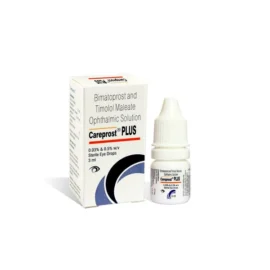
Yes — prostaglandin analogs are additive with beta-blockers, alpha-2 agonists, and carbonic anhydrase inhibitors because they target the outflow side. Wait 5 minutes between different drops. Fixed combinations such as bimatoprost+timolol exist for adherence.
What is the difference between Latanoprost and other prostaglandins?
All three (latanoprost, travoprost, bimatoprost) lower IOP 25–33%. Latanoprost has the gentlest side-effect profile. Travoprost has a slightly higher response rate. Bimatoprost is the most potent for both IOP and lash growth, but with the highest rate of conjunctival hyperaemia and PAP.
Other Eye-Care Medications
Customers viewing this product also consider these alternatives in our Eye Care range:
- Xalatan Eye Drop (latanoprost)
- Azopt Eye Drops (brinzolamide)
- Alphagan P Drop (brimonidine)
- Iotim Eye Drops (timolol)
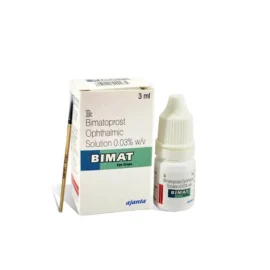
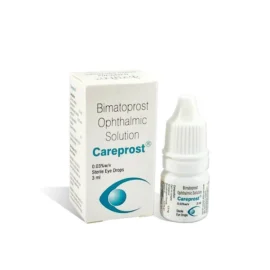
- Careprost (bimatoprost)
Medical Disclaimer
The information on this page is for educational purposes only and is not a substitute for medical advice from a qualified ophthalmologist or optometrist. Eye conditions can rapidly threaten sight — sudden vision loss, severe pain, or trauma is an ophthalmology emergency. Always consult an eye-care professional before starting, stopping, or changing any treatment.
More options in Eye Care
Ranked by recent MedsBase order volume — what other customers in this category are picking.
| Strength | 2.5ml (0.005%) |
|---|---|
| Quantity | 1 Bottle/s, 3 Bottle/s, 6 Bottle/s |
| Pharma Form | Eye Drop/s |
| Manufacturer | Cipla Inc |
| Treatment | Glaucoma, Ocular hypertension |
| Generic Brand | Latanoprost + Benzalkonium Chloride |
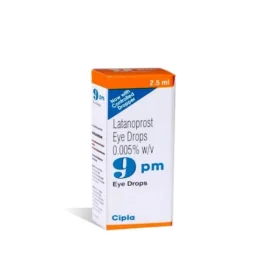 9 Pm Eye Drop
Q & A
9 Pm Eye Drop
Related products


Reviews
There are no reviews yet