








✓ Medically reviewed by · Last reviewed: May 2026
Pharmacy Researcher · 8 years experience
Pharmacy researcher with 8 years reviewing clinical drug information, generic formulation equivalence, and international pharmaceutical standards. Focuses on patient-facing accuracy in medication education.
Quick Answer: Traveling with medications safely comes down to a few rules: keep drugs in their original labeled containers, pack them in your carry-on, protect heat-sensitive medicines from high temperatures, dose by hours-since-last-dose rather than local clock time, carry enough for the whole trip plus extra, and check destination rules for anything restricted. Plan these before you leave, not at the airport.
You’ve booked the trip, the bags are half-packed, and then it hits you: what do I do about my medications? If you take anything daily — for blood pressure, diabetes, thyroid, mental health, birth control, or cholesterol — that question deserves a real answer, because the small mistakes are the ones that quietly ruin trips.
By the end of this guide you’ll know how to pack, store, dose, and document your prescriptions so they arrive intact, stay effective in the heat, keep working across time zones, and clear customs without drama. We’ll cover nine rules in total.
Two of them trip up even seasoned travelers: one about where you pack your pills, and one about a country that can confiscate a medication millions of people carry without a second thought. We’ll flag both as we go.
Key Takeaways
- ✔ Traveling with medications starts with one rule that overrides all others — and it’s not the one most people guess. (Rule 1.)
- ✔ Time-zone dosing has a simple fix, but getting it wrong can double or skip a dose. (Rule 5.)
- ✔ Some everyday medications are restricted or banned in certain countries — carrying the wrong one can mean detention. (Rule 8.)
- ✔ Heat can silently destroy a medication even when the pill looks perfectly fine.
- ✔ The single cheapest insurance for any trip: pack extra, and split your supply.
On this page
Why Traveling With Medications Changes the Rules
At home, your prescriptions run on autopilot: same cabinet, same time, same routine. Travel breaks all three. Your schedule shifts, the temperature swings, your bag disappears into a cargo hold, and you cross borders with different laws. Each of those changes is small on its own. Stacked together, they’re why medication problems are one of the most common causes of preventable travel disruption.
Here’s the reassuring part: none of it is complicated once you know the rules. Traveling with medications is a planning problem, not a medical one — and planning is something you can finish in an afternoon before you leave.
The travelers who run into trouble almost always made the same choice: they treated their medications as an afterthought, packed at the last minute, and assumed everything would work the way it does at home. The ones who sail through did the opposite. They thought about it once, early, and never had to think about it again.
The timing of that planning matters more than people expect. The single best move is to see your provider four to six weeks before an international trip — not because you’ll need all that time, but because it leaves room for the things that can’t be rushed: any travel vaccines, a letter for controlled medications, and an early refill so you actually have extra to pack. Leave it to the last week and you may find your pharmacy can’t fill early, or your doctor can’t fit you in. Early planning is what turns “I hope this works out” into “handled.”
Consider Marcus, 60 (an illustrative example, not a real patient). He takes a blood-pressure pill every morning and a cholesterol tablet at night. For a two-week trip across five time zones, he did three things before leaving: refilled early so he had a week of extra supply, packed everything in his carry-on in the original bottles, and wrote a one-line dosing plan for each medication. His flight got delayed, his checked bag arrived a day late — and none of it mattered, because his medicines were with him and his schedule was already written down. That’s the entire goal: make the medication question boring.
The stakes are highest for people with chronic conditions, which is most of us at some point. Roughly half of adults take at least one prescription medication, and that share climbs with age. If a daily pill is part of your life, traveling with medications isn’t an edge case — it’s a core part of trip planning, right alongside your passport and boarding pass.
How Heat and Cold Affect Your Medications
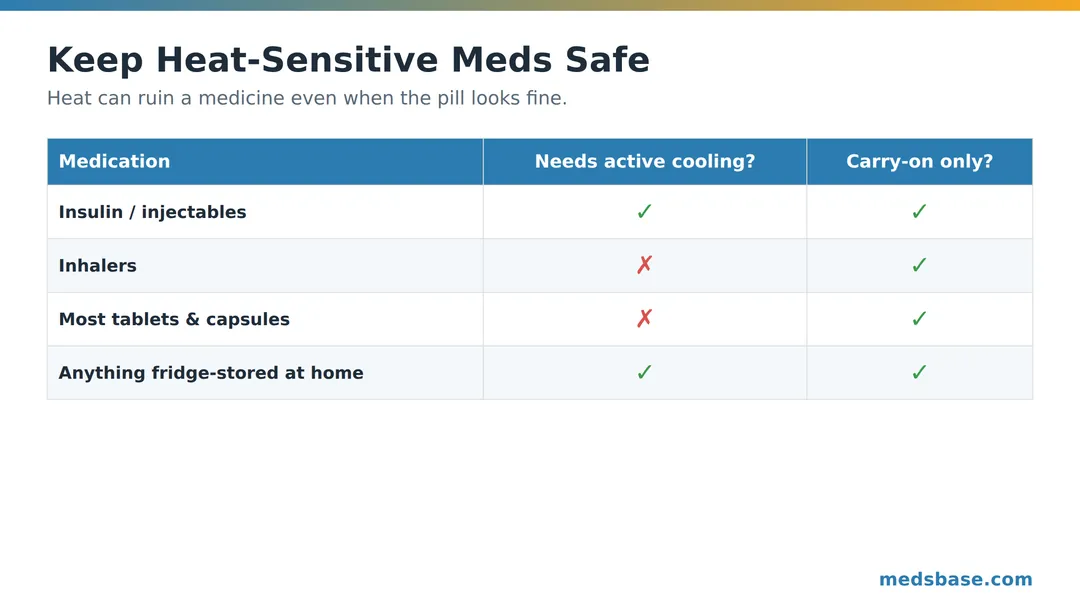
This is the risk people underestimate most, because damage is invisible. A tablet can lose potency in a hot car or a sun-baked beach bag while looking completely unchanged. Extreme temperatures degrade many medicines, and some are far more fragile than others.
Research Spotlight: Health authorities specifically warn that heat-sensitive medications — insulin, epinephrine auto-injectors (EpiPens), certain inhalers, and many liquid or biologic drugs — can lose effectiveness after heat exposure even when there’s no visible sign of damage, according to FDA guidance on traveling with prescriptions.
Most solid tablets and capsules tolerate normal conditions well, but summer travel isn’t normal conditions. A checked bag on hot tarmac, a rental car glovebox, or a poolside tote can all exceed a drug’s safe range. The fix is simple: keep medications with you, out of direct sun, and use an insulated pouch with a gel pack for anything that needs to stay cool.
One rule to remember: if a medication normally lives in your refrigerator, it needs active cooling the entire time you travel — not just “kept in the shade.”
Because heat is such a big piece of the picture, we’ve written a dedicated companion guide. If you’re traveling somewhere hot, read how to store medications in hot weather alongside this one — it goes deeper on temperature thresholds and cooling methods than we can here.
The 9 Essential Rules for Traveling With Medications
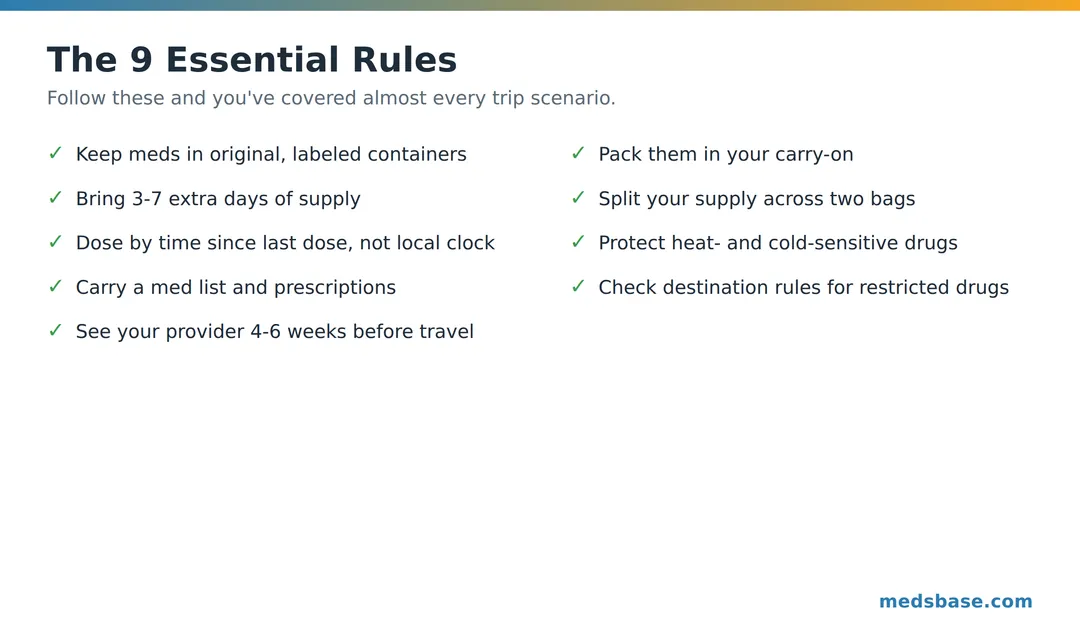
Here’s the core of the guide. Follow these and you’ve handled roughly every scenario a trip can throw at you.
| # | Rule | Why it matters |
|---|---|---|
| 1 | Keep meds in original, labeled containers | Proves what they are to customs and clinicians; loose pills raise red flags |
| 2 | Pack them in your carry-on | Checked bags get lost, delayed, and overheated |
| 3 | Bring extra — 3–7 days beyond the trip | Covers delays, cancellations, and spills |
| 4 | Split your supply across two bags | If one is lost or stolen, you still have medicine |
| 5 | Dose by time since last dose, not local clock | Prevents accidental double-dosing across time zones |
| 6 | Protect heat- and cold-sensitive drugs | Heat silently destroys potency |
| 7 | Carry a medication list + prescriptions | Speeds pharmacy refills and border questions |
| 8 | Check destination rules for restricted drugs | Some common meds are illegal abroad |
| 9 | See your provider 4–6 weeks before travel | Time for vaccines, letters, and extra supply |
Rule 1 is the one that overrides the rest. Original, clearly labeled containers are what let a customs officer, a foreign pharmacist, or an ER doctor instantly understand what you’re carrying. A weekly pill organizer is fine for daily use at your destination — but bring the original bottles too, especially across borders.
Rule 4 is the cheapest insurance you’ll ever buy. Splitting your supply between your carry-on and a travel companion’s bag (or your day pack) means a single lost bag never leaves you without medicine. It takes two minutes and has saved countless trips.
Air travel vs road trips: the rules shift
Not all travel stresses your medications the same way. On a flight, your enemies are lost luggage, security screening, and dry cabin air; the fix is carry-on packing and having your documentation handy. On a road trip, the enemy is almost always heat — a glovebox or trunk can hit temperatures that cook a medication in an afternoon. Never store medicine in a parked car in summer, even briefly. Keep it in the cabin with you, ideally in an insulated bag.
Cruises and remote destinations add a third wrinkle: limited access to pharmacies. If you’re going somewhere without an easy replacement source, lean harder on Rules 3 and 4 — bring more extra, and split it more carefully.
Different medications, different needs
The nine rules cover everyone, but a few common medication types deserve special attention when you’re traveling with medications:
- Insulin and injectables: temperature-critical. These need active cooling for the whole trip and a doctor’s note for airport security. Never let insulin freeze or bake.
- Inhalers: pressurized canisters are sensitive to extreme heat and altitude changes; keep them in the cabin, not a checked bag or hot car.
- Birth control pills: timing matters for reliability, so a time-zone plan is worth writing down (more on this below).
- Mental health medications: never skip doses while traveling — abrupt gaps can cause withdrawal effects or symptom rebound. Consistency is the whole point.
- Blood thinners: steady dosing protects you; carry proof, and don’t let a lost bag interrupt the schedule.
Clinical insight: Pharmacists often see travelers underestimate how long a “quick” delay can stretch. A single missed connection can turn a two-day margin into zero. That’s why “enough plus 3–7 days” isn’t padding — it’s the buffer that absorbs the delays travel routinely serves up.
Time Zones: The Dosing Question Everyone Asks
Fly east or west across several time zones and a simple question gets confusing fast: when do I take my next dose? Take it by the local clock and you might double up or skip; ignore the shift and a strict schedule drifts.
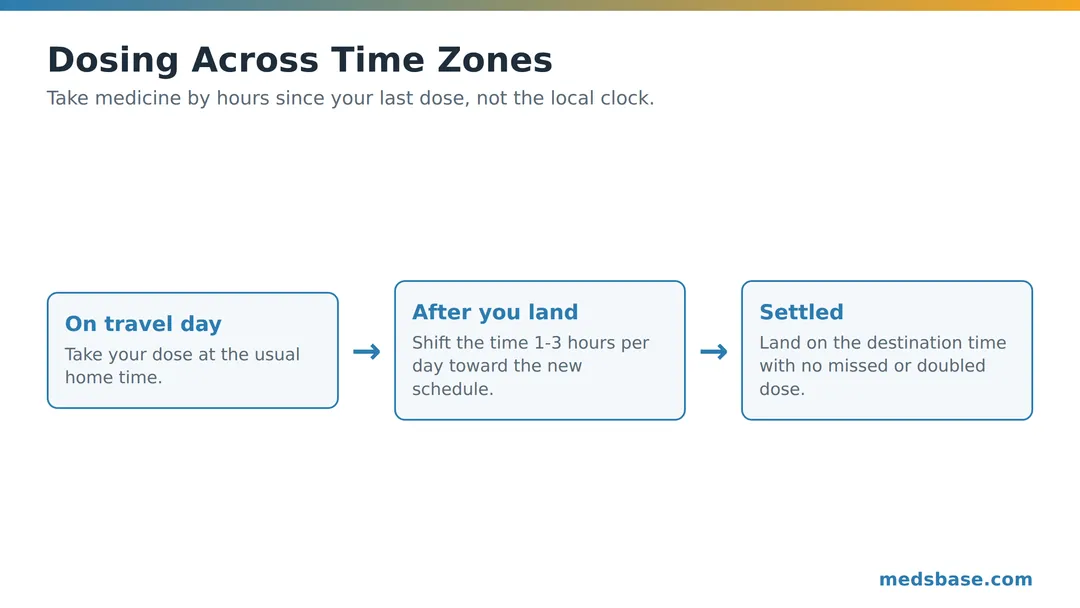
The guidance from health authorities is refreshingly clear: take your medicine based on the time since your last dose, not the local time of day. If you normally take a pill every 24 hours, keep taking it every 24 hours during travel, then gradually shift to your destination’s schedule over a day or two once you arrive.
For most once-daily medications, a few hours’ drift is harmless — you simply nudge the time each day until it lands where you want it. But some drugs are timing-sensitive, and getting this right genuinely matters:
- Insulin and diabetes medications — dosing is tied to meals and hours; ask your provider for a specific time-zone plan before you go.
- Birth control pills — the pill-free interval and timing window matter; a large clock swing can affect reliability.
- Blood thinners and heart medications — consistency protects you; don’t improvise.
A simple method that works for most once-daily medications: on travel day, take your dose at the usual home time. After you land, each day move the dose one to three hours toward your destination’s schedule until it lands where you want it. For a five-hour shift, that’s two or three days of gentle nudging — no missed or doubled doses, no math at midnight. If a medication is truly time-critical, your provider can give you an exact hour-by-hour plan instead.
Clinical insight: Pharmacists routinely tell travelers on daily medications for chronic conditions to write out their dosing plan before departure — one line per medication with the exact times. It sounds fussy, but decisions made calmly at home beat decisions made jet-lagged at 2 a.m. in a new city.
There’s one more time-related trap: the “which day is it” problem on long-haul flights that cross the international date line. If you fly from, say, North America to Australia, you can lose a calendar day entirely. For a once-daily medication that’s usually fine — you’re still dosing by the hours since your last dose. But for anything tied to a specific date (a weekly injection, a monthly medication), map it out with your pharmacist before you go so a “missing” day doesn’t scramble your schedule.
If you manage an ongoing condition like high blood pressure, this planning is non-negotiable — our guide to the best blood pressure medications explains why steady, consistent dosing is part of how these drugs protect you in the first place.
Crossing Borders: What Customs Cares About
This is Rule 8, and it’s the one that catches people off guard. A medication that’s routine at home can be controlled — or outright banned — somewhere else. The list changes by country and includes some surprisingly common drugs: certain strong painkillers, some ADHD stimulants, specific sleep aids, and even a few cold and allergy medicines containing ingredients restricted abroad.
The consequences aren’t trivial. Travelers have been detained for carrying medications that are perfectly legal in their home country. That’s not a reason to panic — it’s a reason to check.
Practical steps before an international trip:
- Look up your destination’s rules for each prescription, especially anything controlled. National health and embassy websites are the reliable sources.
- Carry a doctor’s letter stating your diagnosis, the medications, and doses — ideally on letterhead. Some countries expect this.
- Keep quantities reasonable — a personal supply (commonly up to 30–90 days depending on the country), not a stockpile.
- Keep everything labeled in original packaging, matching your documentation.
The CDC’s guidance on traveling abroad with medicine and the UK government’s rules on travelling with controlled medicines both walk through documentation and quantity requirements in more detail — worth a five-minute read before any overseas trip.
The one-line takeaway: if a medication is controlled at home, assume it needs paperwork abroad — and check the specific country.
At the security checkpoint
Airport security is smoother than most people fear, as long as you’re prepared. Medications — pills, liquids, and injectables — are generally allowed through screening, and medically necessary liquids are typically exempt from the usual small-container limits. A few habits make it painless:
- Declare medically necessary liquids and injectables to the screening officer rather than hiding them in your bag. Insulin, liquid medicines, and gel packs for cooling are expected; officers see them constantly.
- Keep them accessible, not buried at the bottom of a packed carry-on, so you can present them quickly.
- Have your documentation reachable — the labeled containers and, for controlled or injectable drugs, your doctor’s letter.
- Don’t stress about the pill organizer, but do carry the original bottles too, especially internationally.
Different countries run security differently, but the principle is universal: labeled, declared, and documented medications move through checkpoints easily. It’s the unlabeled baggie of loose pills that invites questions — which loops right back to Rule 1.
What Health Authorities Say
The good news is that official guidance from major health bodies is consistent, which makes it easy to trust. Here’s what the authorities agree on.
| Source | Key guidance | Reference |
|---|---|---|
| CDC Travelers’ Health | Pack meds in carry-on, in original containers; carry enough plus extra; know time-zone dosing | CDC |
| FDA | Store properly; some drugs lose potency in heat; keep labeled | FDA |
| CDC Pack Smart | Build a travel health kit; include prescriptions and a med list | CDC |
| GOV.UK | Check destination rules; carry proof and a letter for controlled drugs | GOV.UK |
What this means for you: the experts don’t disagree on the fundamentals, so you don’t have to sort through conflicting advice. Do the handful of things they all recommend — carry-on, original containers, extra supply, heat protection, and a pre-trip check — and you’ve covered the vast majority of real-world risk.
A last honest note: this is general guidance, and your situation may need more. Someone traveling with insulin, a controlled medication, or a complex regimen should get a personalized plan from their own doctor or pharmacist. The rules here get most travelers most of the way; a professional closes the gap for the rest.
Your Pre-Trip Medication Checklist
Print this, or copy it into your phone, and tick each box before you leave.
- ☐ Enough medication for the whole trip plus 3–7 extra days
- ☐ All meds in original, labeled containers
- ☐ Everything in your carry-on, supply split across two bags
- ☐ Insulated cooling for anything refrigerated
- ☐ A written medication list (drug, dose, timing) and copies of prescriptions
- ☐ A doctor’s letter for controlled or injectable medications
- ☐ Destination rules checked for restricted drugs
- ☐ A time-zone dosing plan, written per medication
- ☐ A small travel health kit (basics + your regular meds)
- ☐ Provider appointment done 4–6 weeks out if traveling internationally
If your destination is hot or sunny, add two more: review how to store medications in hot weather, and check whether any of your prescriptions appear on our list of medications that cause sun sensitivity — a sunburn on vacation is more likely if you’re taking one of them.
Related reading
Frequently Asked Questions
Can you bring prescription medications on a plane?
Yes. Prescription medications are allowed in carry-on bags, and that’s exactly where they should go — checked luggage gets lost, delayed, and overheated. Keep them in original labeled containers, and carry liquids and injectables with your prescription documentation to ease security screening.
How do you take medication across time zones?
Dose by the time since your last dose, not the local clock. Keep your normal interval (for example, every 24 hours) during travel, then gradually shift to the destination’s schedule over a day or two. For insulin, birth control, or heart medications, get a specific plan from your provider first.
How do you keep medication cold while traveling?
Use an insulated pouch or small cooler with a gel pack, and keep it in your carry-on out of direct sun. Anything that normally lives in your fridge — like insulin — needs active cooling the whole journey, not just shade. Confirm temperature ranges with your pharmacist.
Do you need a doctor’s note for medication abroad?
For ordinary medications, usually not — but a doctor’s letter is strongly recommended for controlled substances, injectables, and large or unusual supplies. Some countries require it. Carry the letter plus original labeled containers matching it.
How much medication can you travel with?
Bring enough for your whole trip plus a few extra days. Internationally, many countries limit you to a personal supply (often 30–90 days) and may ask for a prescription or medical certificate. Avoid traveling with stockpiles, and check your destination’s specific rules.
What if I run out or lose my medication while traveling?
This is why you pack extra and split your supply. If you still run short, your medication list and prescription copies help a local pharmacy or clinic help you faster. For international trips, your travel insurance or embassy can point you to options.
The Bottom Line
Traveling with medications isn’t hard — it’s just easy to forget until the last minute, which is exactly when it becomes stressful. Handle it early and it disappears as a worry: original containers, carry-on packing, extra supply split across bags, heat protection, a written time-zone plan, and a quick check of your destination’s rules. That’s the whole game.
Your immediate action: before you pack anything else, count your medication supply and add at least three extra days — the single habit that prevents the most trips-gone-wrong. Then work down the checklist above.
Heading somewhere hot? Read how to store medications in hot weather next. Managing blood pressure on the road? Our telmisartan vs losartan guide explains why steady dosing matters — useful reading before a trip that scrambles your schedule.
Medical Disclaimer
This article is general educational information, not medical advice. For personalized guidance on traveling with insulin, controlled substances, or a complex medication regimen, consult your doctor or pharmacist before you travel.

Written by
Sophie ChenPharmaceutical Content Researcher · 8 years experience
Sophie Chen is a pharmaceutical content researcher with 8 years covering generic medication access and clinical pharmacology. She specialises in international regulatory frameworks, bioequivalence standards, and patient-facing education on therapeutic drug classes. She is not a clinician.