








✓ Medically reviewed by · Last reviewed: May 2026
Pharmacy Researcher · 8 years experience
Pharmacy researcher with 8 years reviewing clinical drug information, generic formulation equivalence, and international pharmaceutical standards. Focuses on patient-facing accuracy in medication education.
You are scrolling through your phone before bed when a headline stops you: the medicine sitting in your kitchen cupboard has been recalled. Your stomach drops. You go and pick up the bottle, read the label twice, and your first instinct is to throw it in the bin and take nothing tomorrow morning.
Hold on. That instinct is the single most dangerous move available to you, and it is exactly what regulators spend their time trying to talk people out of. Knowing what to do if your medication is recalled takes about four minutes to learn, and the order of the steps matters far more than the speed.
By the end of this guide you will know how to check whether your specific bottle is affected, what the three recall classes actually mean for you, when stopping is genuinely necessary and when it is the riskier choice, and how to get a replacement without a gap in treatment. There is also a piece of published evidence about how people behaved during one of the largest recalls in modern memory — it is reassuring, and we will get to it.
- Your lot number decides everything — and most people never look at it.
- Regulators explicitly warn that stopping can be more harmful than the defect being recalled. That sentence surprises almost everyone.
- The three recall classes mean genuinely different things, and only one of them usually asks you to act.
- When one of the biggest recalls in recent history hit, the data shows patients did something smarter than panicking — details in the research section.
- Getting a replacement without a treatment gap is a specific, learnable sequence. Most people improvise it badly.
What Is a Drug Recall, and What Is It Not?
A drug recall is an action taken to remove a product from the market when something about it does not meet standards. It might be contamination, an impurity above acceptable limits, a dosage that does not dissolve properly, a labelling error, defective packaging, or a sterility problem.
Two things it is not: it is not a statement that the medicine has hurt anybody, and it is not automatically an instruction to you. Most recalls are precautionary, triggered by a quality test rather than a wave of injuries.
It also matters who starts one. According to how the FDA defines each recall class, recalls “may be conducted on a firm’s own initiative, by FDA request, or by FDA order under statutory authority.” In practice, most begin with the manufacturer. The regulator’s role is to oversee the recall strategy, check that customers were properly notified, and step in if the recall is not working.
There is a related term worth knowing so you do not confuse the two. A market withdrawal is when a product has a minor violation that would not be subject to legal action — the firm pulls it or corrects it. It is not classified as a recall at all. If you see that phrase, the bar being cleared is lower.
Bold takeaway: a recall is a statement about a batch, not a verdict on the medicine. The molecule in your prescription has not become unsafe. A specific run of production did not meet a specification.
How Does a Recall Reach Your Medicine Cabinet?
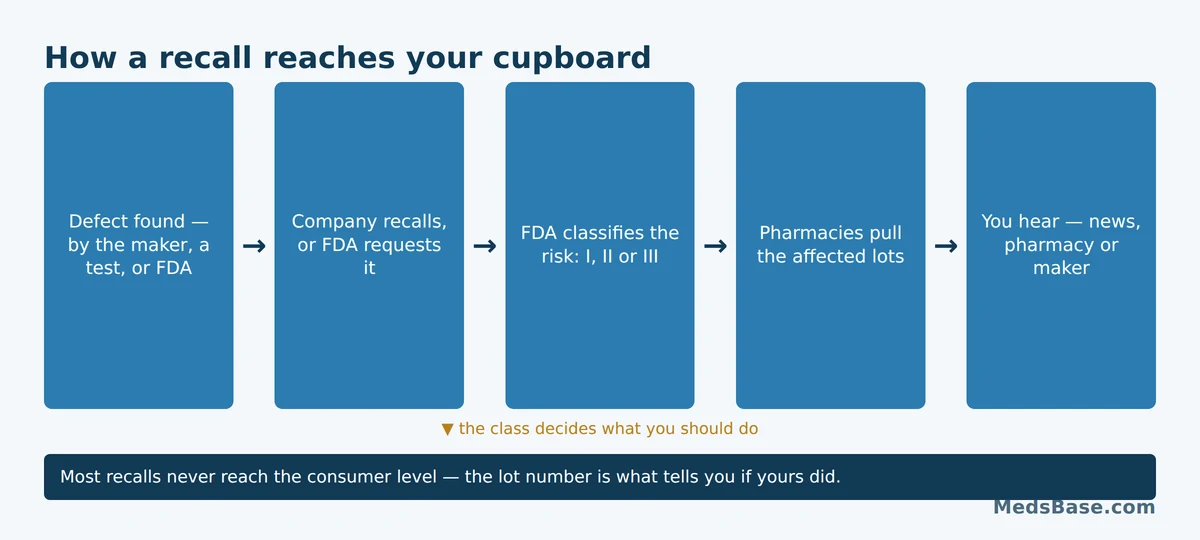
Think of the supply chain as a river with your pharmacy near the mouth. A defect is discovered somewhere upstream — during routine testing, an internal audit, an inspection, or after adverse-event reports accumulate. The company acts, or the FDA requests or orders action. The affected lots are identified.
From there the recall travels downstream, and how far it travels depends on the risk. Some recalls stop at the wholesale level, because the affected product is unlikely to cause harm and there is no point disturbing patients. Others go all the way to the consumer level, which is when your pharmacy calls you or the news picks it up.
That is why the lot number is the hinge of this entire process. Recalls are almost never “all of drug X, everywhere, forever.” They are “these batch numbers, made in this window.” Your bottle either carries one of those numbers or it does not, and until you check, you are guessing.
Here is a worked example of how it looks from the patient’s side: our guide to prednisolone eye drops covers how one eye-drop recall actually played out, including the awkward reality that an eye drop with a sterility concern is one of the cases where you genuinely should not carry on regardless.
The Three FDA Recall Classes — And What Each One Asks of You
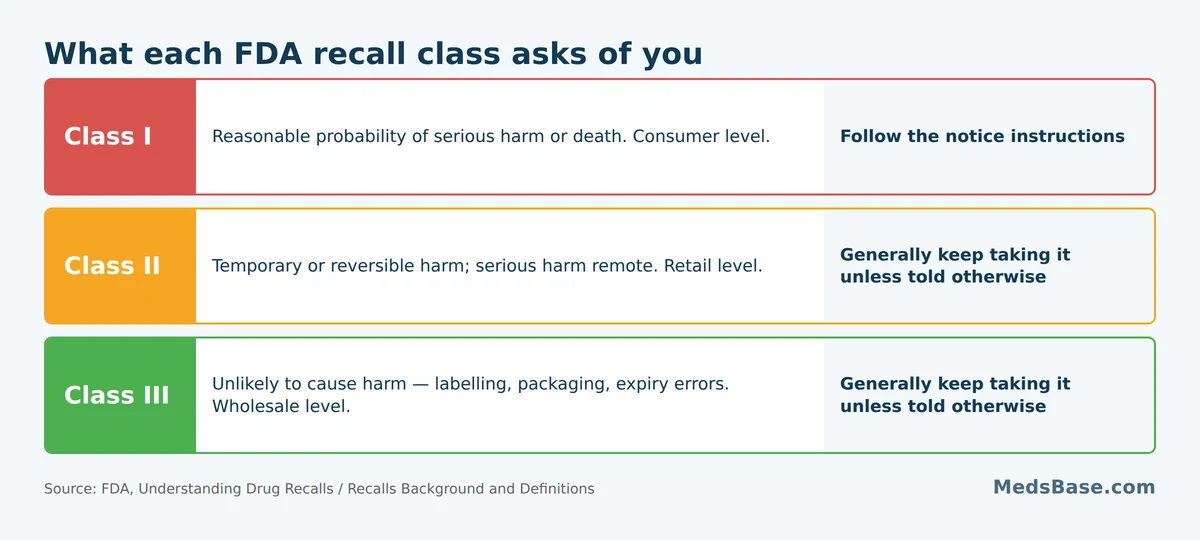
This is the part almost every consumer article skips, and it is the part that actually answers what to do if your medication is recalled. The FDA classifies recalls I, II or III by the degree of health hazard.
| Class | What it means | Usually conducted at | What you generally do |
|---|---|---|---|
| Class I | Reasonable probability that using the product will cause serious health consequences or death | Consumer level | Follow the instructions in the recall notice. These notices normally tell patients exactly what to do |
| Class II | May cause temporary or medically reversible harm; probability of serious harm is remote | Retail level | Generally continue taking the medicine unless the recalling company or FDA directs otherwise |
| Class III | Not likely to cause health consequences — for example minor labelling errors, defective packaging or incorrect expiry dates | Wholesale level | Generally continue taking the medicine unless directed otherwise |
What this means for you: if you find your medicine on a recall list and the notice does not tell you to stop, that silence is usually deliberate. Class II and III recalls exist to fix a supply-chain problem, not to change your dosing tonight.
Should You Stop Taking a Recalled Medication?
Now the open loop from the introduction, resolved. FDA’s consumer guidance states it about as bluntly as a regulator ever states anything: “In some instances, stopping your medicine may be more harmful to your health than continuing to take the recalled medicine.”
Sit with that for a second, because it inverts the instinct almost everyone has.
Consider what stopping actually means in practice. If you take a blood-pressure medicine and stop for a week, your blood pressure goes up for a week. If you take an anti-seizure medicine and stop abruptly, you risk a seizure. If you take a thyroid medicine and stop, your metabolism drifts. Those harms are immediate, predictable and proportional to how long you go without. The harm from most recalled batches is theoretical, small and cumulative over years.
The clearest illustration is impurity-driven recalls. On nitrosamine impurities — the class of contaminant behind several of the largest recalls of the past decade — FDA’s position on nitrosamine impurities is explicit: “Patients taking prescription medications with potential nitrosamine impurities should not stop taking their medications.” The agency also puts the risk in proportion, noting that someone taking a drug containing nitrosamines at or below the acceptable daily intake limit every day for 70 years is not expected to have an increased cancer risk.
There is one exception worth naming clearly. Over-the-counter medicines are a different calculation, because the consequence of a two-day gap in a decongestant or antacid is nothing. FDA’s own guidance reflects this: for OTC products with a potential impurity concern, consumers “may consider using other OTC products approved for their condition.” No phone call needed — just switch.
What Does the Research Say About How People Respond to Recalls?
In July 2018 several manufacturers recalled valsartan, a very widely used blood-pressure medicine, after nitrosamine impurities were detected. It was a genuine stress test of everything above: a huge patient population, alarming headlines about a probable carcinogen, and a drug people cannot safely abandon.
So what did patients do? Researchers tracked what patients actually did using dispensing data, and published the answer in the European Journal of Clinical Pharmacology in 2023.
| Measure | Before the recall | After the recall | What it tells you |
|---|---|---|---|
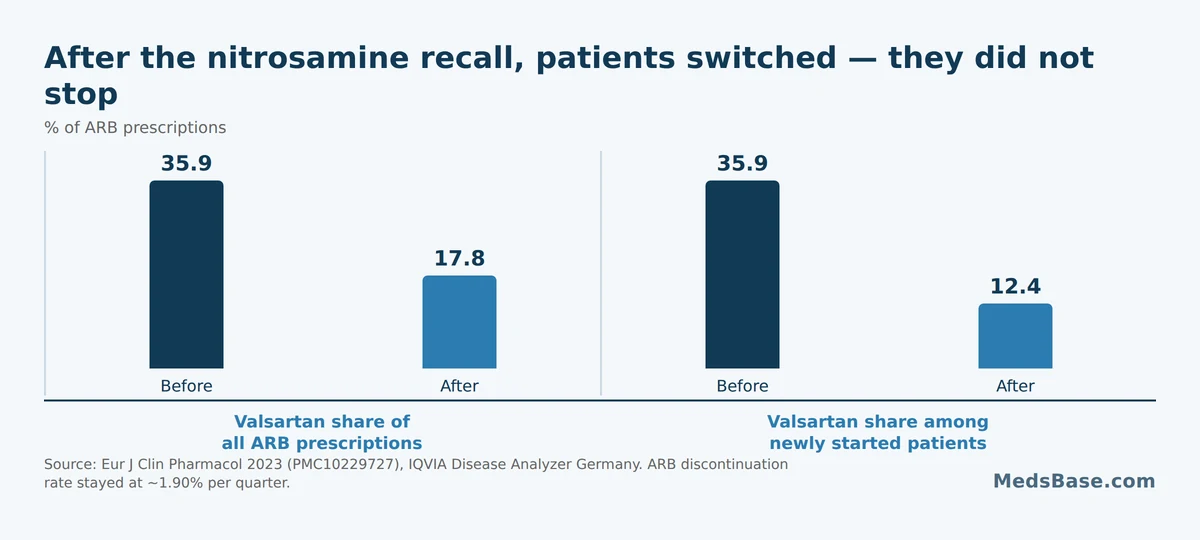
| Valsartan share of all ARB prescriptions | 35.9% | 17.8% | The recall worked — affected product left the market fast |
| Valsartan share among newly started patients | 35.9% | 12.4% | Prescribers steered new patients elsewhere even more sharply |
| Overall ARB discontinuation rate | ~1.90% per quarter | ~1.90% per quarter | Treatment did not break down — the number barely moved |
| Where patients went | — | Mostly candesartan, which became the most-prescribed ARB | People switched within the drug class |
The authors reported that increased switching from ARBs to a different drug class, or outright discontinuation, “were not observed.” Patients kept treating their blood pressure. They simply did it with a different tablet.
What this means for you: the system is designed to absorb this, and it does. Boiled down, what to do if your medication is recalled is almost always a substitution rather than a stop. If you find yourself framing the decision as “take it or take nothing,” you have skipped a step — and the step you skipped is the phone call.
Where the evidence is limited, it is worth saying so. This was one drug class, in one country’s dispensing data, during one recall. It tells you how a well-supplied system handles a substitutable medicine. It does not tell you much about a recall of something with no alternative, which is a harder problem and one where your prescriber’s judgement matters far more than any general rule.
Your Options Compared: Stop, Check, Call, or Return
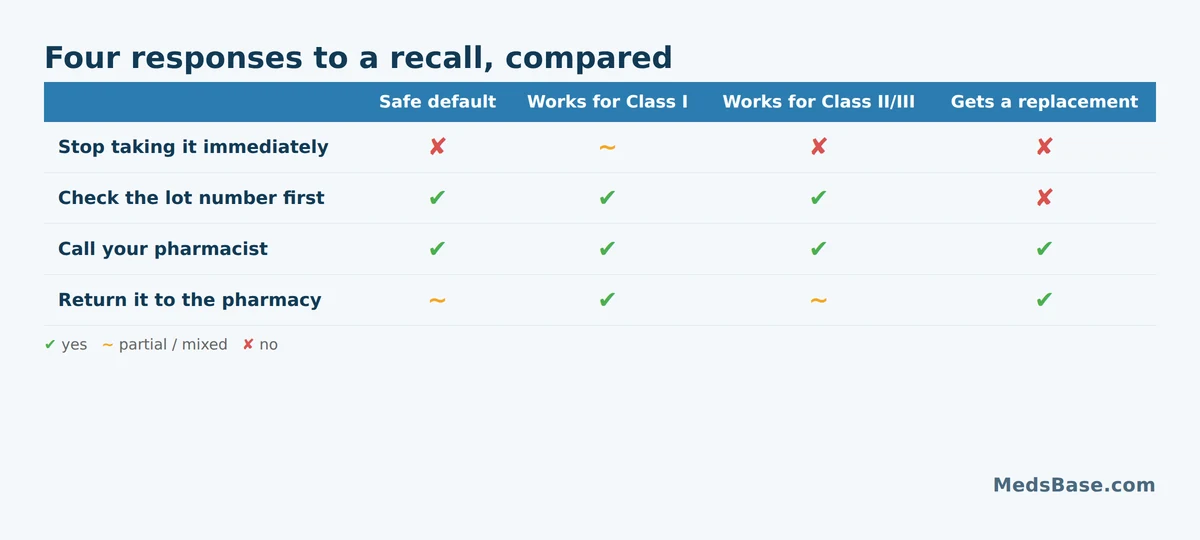
| Response | When it is right | When it backfires | Verdict |
|---|---|---|---|
| Stop taking it immediately | Class I notices that instruct you to stop; sterility problems in injections or eye drops | Any chronic medicine where a gap causes rebound or loss of control | Not a safe default — the riskiest instinct on this list |
| Check the lot number first | Always. It is the fastest way to find out you were never affected | Never backfires; only fails if the label has been discarded | The correct first move, every time |
| Call your pharmacist | Always, if your lot is affected or you cannot tell | Only if you use it to delay acting on an explicit Class I instruction | The decisive step — they have the list and the replacement stock |
| Return it to the pharmacy | Once you have a replacement in hand, or for a refund | If you hand back your only supply before the replacement exists | Right action, wrong order for most people |
Which one fits which situation? If you have the bottle in front of you, check the lot. If the lot matches, call. If the notice is Class I and tells you to stop, stop and call. The only sequencing error that reliably hurts people is returning or binning their supply before a replacement is secured — which creates exactly the treatment gap the recall itself rarely justifies.
What to Do If Your Medication Is Recalled: The Seven Steps, In Order
- Find the lot number before anything else. It is printed on the pharmacy label or the manufacturer’s carton, usually near the expiry date, marked “Lot”, “LOT” or “L”. Compare it against the recall notice. If it does not match, you are done — your supply is not affected.
- Read what the notice actually asks of you. Look for the class and for any patient instructions. A notice that tells you to stop will say so plainly; a notice that does not is telling you something too.
- Call your pharmacist, not the internet. They can check your dispensing record against the recall, confirm the class, and usually source unaffected stock. This single call replaces about an hour of searching.
- Do not create a gap. Keep taking your medicine unless the notice or your pharmacist tells you to stop. If you are switching, get the replacement first and hand back the old supply second.
- Ask what your replacement actually is. Usually it is the same molecule from a different manufacturer, which is not a downgrade — what six months of price data show about generics is a useful reality check if switching manufacturers makes you uneasy.
- Report anything you experienced. If you had a reaction while taking the recalled batch, tell your doctor and report it through MedWatch, the FDA’s adverse-event reporting programme, which accepts reports from patients and consumers directly. Reports are how the next problem gets caught earlier.
- Then sort out the refund. Companies commonly advise returning recalled medicines to the place of purchase, and most retailers have established return and refund policies for recalled products. This is a paperwork problem, and it can wait until step 4 is secure.
- Binning the packaging. The lot number lives on it, and without the lot number you cannot tell whether you were ever affected.
- Stopping a chronic medicine over a Class II or III recall — the most common and most harmful error.
- Returning your only supply before the replacement exists.
- Assuming your specific bottle is affected because the drug name is in the headline. Most of the time it is not.
- Buying a hurried replacement from an unverified seller because you are anxious about a gap. That trades a small theoretical risk for a much larger real one.
On that last point: supply anxiety is what pushes people toward sources they would normally avoid. WHO estimates that around 1 in 10 medical products in low- and middle-income countries fail quality testing, and its consistent advice is to avoid unauthorised vendors. If a recall leaves you needing continuity, MedsBase sources from WHO-GMP-certified manufacturers and no prescription is needed to order — but the calm route is still to call your pharmacist first, because they may have unaffected stock on the shelf today.
- How one eye-drop recall actually played out — a real case, including when carrying on is genuinely not an option.
- What six months of price data show about generics — because most recall replacements are a manufacturer switch.
- The medicines that quietly make you sun-sensitive — another “things nobody told me about my prescription” read.
Frequently Asked Questions
Q: Should I stop taking a recalled medication?
A: Usually not, and not automatically. FDA’s consumer guidance states that “in some instances, stopping your medicine may be more harmful to your health than continuing to take the recalled medicine.” Class I recall notices normally include specific patient instructions and should be followed. For Class II and Class III recalls, consumers can generally continue taking the medicine unless the recalling company or FDA directs otherwise. Check the lot number, read the notice, and call your pharmacist before changing anything.
Q: How do I find my medication lot number?
A: It is printed on the pharmacy label or on the manufacturer’s carton or bottle, usually close to the expiry date and marked “Lot”, “LOT” or “L”. Compare it to the lot numbers listed in the recall notice. Recalls almost always affect specific production batches rather than every unit of a medicine, so a non-matching lot number means your supply is not part of the recall. This is why keeping the original packaging until a bottle is finished is genuinely useful.
Q: What are the FDA recall classes?
A: There are three. Class I means there is a reasonable probability that using the product will cause serious health consequences or death; these are conducted at consumer level and are urgent. Class II means use may cause temporary or medically reversible harm, with serious harm remote; these are generally conducted at retail level. Class III means use is unlikely to cause health consequences, such as minor labelling errors or defective packaging, and is generally handled at wholesale level.
Q: How do I know if my medicine has been recalled?
A: Consumers usually learn through the news, or from a notification by the manufacturer, their pharmacy or their healthcare provider. The FDA also maintains a database of recalled medicines that includes the recall classification and the reason. Be aware that not all recalls are publicly announced — public notification is generally issued when a product has been widely distributed or poses a serious hazard, so a call from your pharmacy about something you never saw in the news is entirely normal.
Q: Can I get a refund for a recalled medication?
A: Often yes. Companies commonly advise consumers to return recalled medicines to their place of purchase, and most retailers have established return and refund policies for recalled products. The important thing is sequencing: secure your replacement supply first, then return the affected product. Handing back your only supply before a replacement is in hand creates a treatment gap that is usually more dangerous than the recall itself.
Q: What happens if I already took a recalled drug?
A: For most recalls, nothing. The majority are precautionary and involve impurities at levels well below the threshold for measurable harm, or defects such as labelling errors that carry no physical risk at all. If you experienced symptoms while taking the affected batch, tell your doctor and report it through FDA’s MedWatch programme. If the recall is Class I, follow the instructions in the notice and contact your prescriber promptly rather than waiting.
Q: Is a recalled medicine the same as a counterfeit or falsified one?
A: No, and the difference matters. A recall involves a legitimately manufactured product that failed to meet a specification, and it is caught by the regulated supply chain working as intended. Substandard and falsified products come from outside that chain — WHO estimates around 1 in 10 medical products in low- and middle-income countries fail quality testing. The practical lesson is not to react to a recall by buying from an unverified source.
Q: Do I need a prescription to replace a recalled medicine through MedsBase?
A: No prescription is needed to order from MedsBase.com, and all products are sourced from WHO-GMP-certified manufacturers. That said, if a recall has disrupted a medicine you take daily, your pharmacist is still the fastest route to continuity — they can often supply unaffected stock of the exact same product immediately.
The Bottom Line on What to Do If Your Medication Is Recalled
Here is the balanced verdict. A recall is the safety system working, not failing — and knowing what to do if your medication is recalled mostly means resisting the urge to act faster than the information you have. Check the lot number. Read the class. Call your pharmacist. Keep taking your medicine unless someone with your record in front of them tells you otherwise. The 2018 valsartan data shows what happens when people get this right at scale: prescriptions moved, treatment continued, and discontinuation barely twitched.
Your one immediate action, and it takes sixty seconds: go and look at the medicines you take daily and check that you still have the packaging with the lot number on it. If you have been decanting tablets into a pill organiser and binning the box, you have removed your own ability to answer the only question that matters. Keep the carton until the course is finished.
Curious about a medicine that quietly changed job from gout treatment to heart protection? Read colchicine for heart disease. And if you take an antihistamine daily and have wondered whether you picked the right one, Allegra vs Zyrtec settles it with actual numbers.

Written by
Sophie ChenPharmaceutical Content Researcher · 8 years experience
Sophie Chen is a pharmaceutical content researcher with 8 years covering generic medication access and clinical pharmacology. She specialises in international regulatory frameworks, bioequivalence standards, and patient-facing education on therapeutic drug classes. She is not a clinician.