








✓ Medically reviewed by · Last reviewed: May 2026
Pharmacy Researcher · 8 years experience
Pharmacy researcher with 8 years reviewing clinical drug information, generic formulation equivalence, and international pharmaceutical standards. Focuses on patient-facing accuracy in medication education.
nifedipine vs amlodipine — Nifedipine vs Amlodipine — 7 Key Differences Between Two Calcium Channel Blockers. Read on for an evidence-backed guide covering everything you need to know.

Hero Intro
Your doctor just mentioned starting you on a calcium channel blocker, and two names are echoing in your head: nifedipine and amlodipine. One works fast. The other lasts all day. One comes with a flushing sensation you can feel within minutes. The other quietly lowers your pressure while you sleep. The nifedipine vs amlodipine decision is one of the most common crossroads in blood pressure treatment — and the right choice depends on factors most patients never hear about.
Here’s what makes this comparison uniquely tricky: both medications belong to the exact same drug class. They’re both dihydropyridine calcium channel blockers. They both relax your blood vessels. On paper, they look almost interchangeable. But in your body, the experience of taking nifedipine vs amlodipine can feel completely different — from how quickly your pressure drops to which side effect shows up first.
By the end of this guide, you’ll understand exactly why doctors choose one over the other, which side effects to watch for, and the seven evidence-backed differences that determine which medication fits your life. Let’s start with the most important question most patients skip.
Key Takeaways: Nifedipine vs Amlodipine
- Same class, different pace: Both are dihydropyridine calcium channel blockers, but nifedipine acts within 10-30 minutes while amlodipine takes days to reach full effect.
- Half-life is the biggest difference: Nifedipine leaves your system in 2-7 hours (immediate-release); amlodipine stays for 30-50 hours — which changes everything about dosing and tolerability.
- Side effects diverge: Nifedipine users report more flushing, headache, and reflex tachycardia; amlodipine users more commonly experience ankle edema.
- Unique niches matter: Nifedipine is used for Raynaud’s phenomenon and preterm labor — amlodipine is not indicated for either condition.
- Never self-switch: Transitioning between these medications requires medical supervision — dose timing, formulation, and cross-tapering all need professional guidance.
Table of Contents
- What Are Nifedipine and Amlodipine?
- How Calcium Channel Blockers Lower Blood Pressure
- Nifedipine vs Amlodipine: 7 Key Differences
- Nifedipine vs Amlodipine: Head-to-Head Comparison Table
- Side Effects: Nifedipine vs Amlodipine
- Drug Interactions: What to Avoid With Each
- Who Should Take Nifedipine vs Amlodipine?
- Research Spotlight: What the Evidence Says
- Frequently Asked Questions
- The Bottom Line
Nifedipine vs Amlodipine: 7 Key Differences That Determine Which Blood Pressure Medication You Need
1. What Are Nifedipine and Amlodipine?
Before diving into the nifedipine vs amlodipine comparison, you need to understand what these medications actually are — and why two drugs from the same family behave so differently in your body.
Both nifedipine and amlodipine belong to a class of medications called dihydropyridine calcium channel blockers (DHP-CCBs). The “dihydropyridine” part matters: it means these drugs selectively target calcium channels in your blood vessel walls rather than your heart muscle. This selectivity is what makes them primarily blood-pressure-lowering agents rather than heart-rate-controlling drugs — a distinction that separates them from non-dihydropyridine CCBs like verapamil and diltiazem.
Nifedipine was first approved by the FDA in 1981 and was one of the earliest calcium channel blockers available. It comes in two fundamentally different formulations: immediate-release (IR) capsules — brand name Procardia — and extended-release (ER/XL) tablets — brand names Adalat CC and Procardia XL. The difference between these formulations is not minor; it transforms how the drug behaves, how often you take it, and what side effects you experience.
Amlodipine was developed later and approved in 1992 under the brand name Norvasc. Unlike nifedipine, amlodipine was designed from the start as a once-daily medication with an inherently long duration of action. There is no immediate-release version of amlodipine because its molecular structure gives it a natural half-life of 30 to 50 hours — no special formulation tricks needed. Today, amlodipine is one of the most prescribed blood pressure medications worldwide, available almost exclusively as a generic tablet.
The nifedipine vs amlodipine story starts here: one drug was retrofitted into a long-acting form through clever formulation engineering; the other was born long-acting. That origin story explains almost every clinical difference between them.
Who Is This For? / Who Should Avoid It?
This comparison is for you if:
- Your doctor has mentioned starting a calcium channel blocker and you want to understand the options before your next appointment
- You’re currently on nifedipine and experiencing side effects — wondering if amlodipine might be gentler
- You’re on amlodipine and curious whether nifedipine’s faster action could help with specific symptoms like Raynaud’s
- You’re a caregiver helping a family member navigate blood pressure treatment decisions
This comparison may not apply if:
- You have unstable angina or recent heart attack — CCB selection in acute coronary syndrome requires specialist cardiology input
- You have severe aortic stenosis — dihydropyridine CCBs can cause dangerous hypotension in this condition
- You’re pregnant or breastfeeding — nifedipine has specific pregnancy indications; amlodipine’s safety data is more limited
- You have significant liver impairment — both drugs are metabolized by CYP3A4 in the liver and may accumulate
2. How Calcium Channel Blockers Lower Blood Pressure
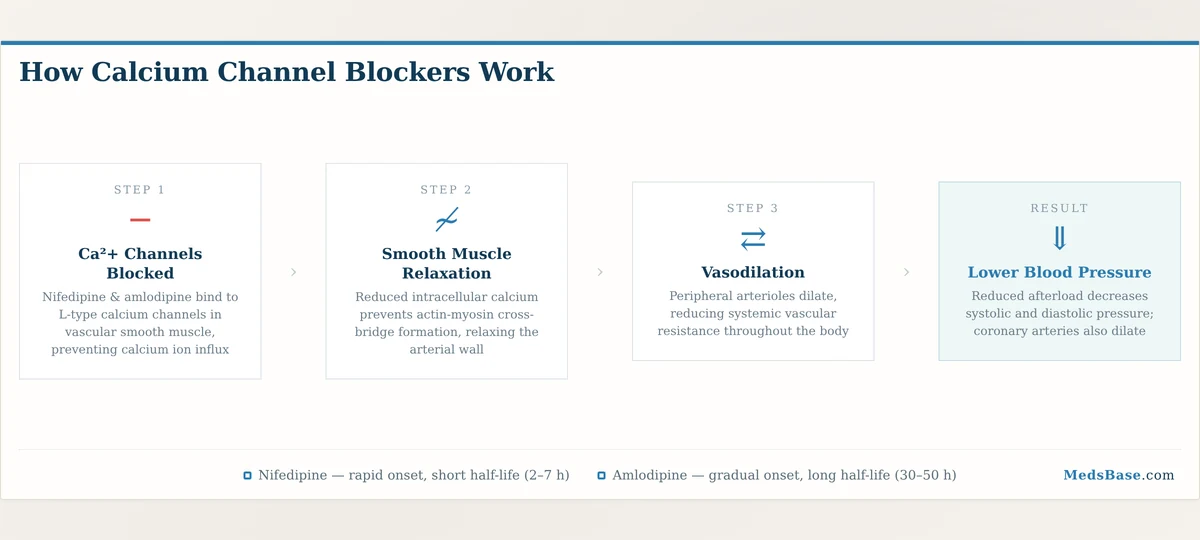
Both nifedipine and amlodipine block calcium ion entry into vascular smooth muscle, producing vasodilation and lower blood pressure.
To understand the nifedipine vs amlodipine comparison fully, you need to grasp the shared mechanism both drugs use — and the subtle differences in how they pull it off.
Your blood vessels are lined with smooth muscle cells that can contract or relax. When they contract, your vessels narrow, and your blood pressure rises. When they relax, your vessels widen — a process called vasodilation — and your pressure drops. The signal that tells these smooth muscle cells to contract travels through tiny gates in the cell membrane called L-type calcium channels. When calcium ions flow through these channels into the cell, the muscle contracts.
Both nifedipine and amlodipine work by blocking those L-type calcium channels in the smooth muscle of your blood vessel walls. Less calcium entering the cell means less contraction, which means more relaxation, wider vessels, and lower blood pressure. This mechanism is shared across all dihydropyridine CCBs — it’s the speed, duration, and tissue selectivity of the blockade that sets nifedipine vs amlodipine apart.
Here’s where the difference matters: nifedipine binds to and dissociates from the calcium channel relatively quickly, especially in its immediate-release form. This produces a sharp drop in blood pressure within 10 to 30 minutes — fast enough to be useful in a hypertensive emergency but abrupt enough to trigger the body’s counter-regulatory reflexes. Your baroreceptors sense the sudden pressure drop and respond by increasing your heart rate — the infamous reflex tachycardia that makes some patients feel jittery or palpitate after taking nifedipine IR.
Amlodipine, by contrast, binds to the calcium channel more slowly and dissociates very gradually. Blood pressure comes down over days rather than minutes, giving your baroreceptors time to adapt. This slower onset means less reflex tachycardia, smoother 24-hour blood pressure control, and — critically — better cardiovascular outcomes in long-term studies. The gradual nature of amlodipine’s action is why it became the preferred dihydropyridine CCB in modern hypertension guidelines like the 2017 ACC/AHA hypertension guidelines, which recommend long-acting agents over short-acting formulations for chronic management.
Understanding this mechanism is key to the entire nifedipine vs amlodipine decision: one drug opens the calcium channel blockade quickly and closes it quickly; the other opens it slowly and keeps it open all day and night.
3. Nifedipine vs Amlodipine: 7 Key Differences
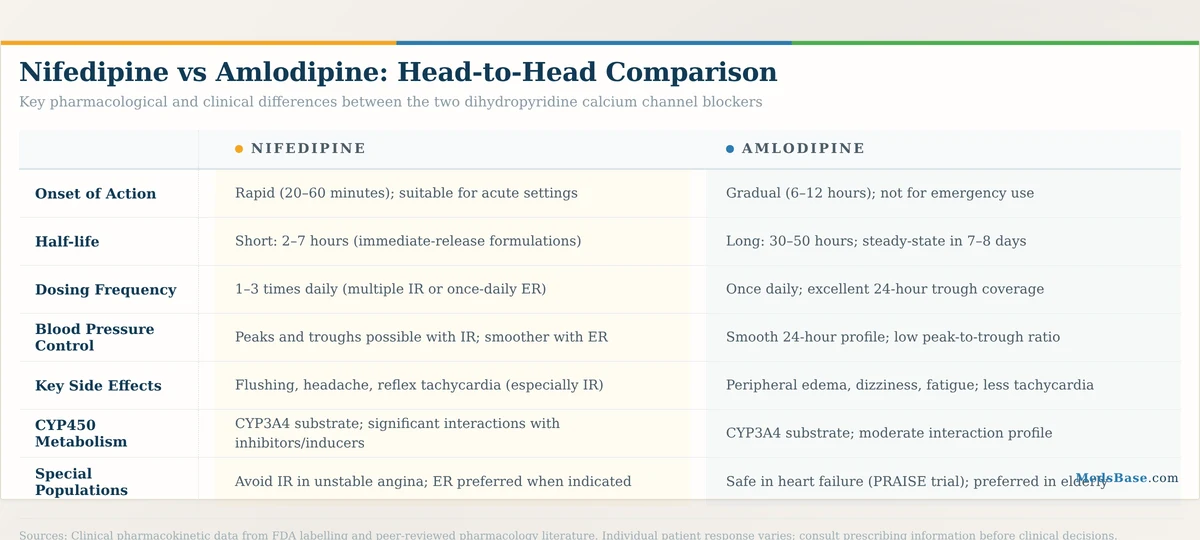
Amlodipine provides steady 24-hour blood pressure control, while nifedipine is preferred for rapid-onset situations.
Now for the comparison that brings you here. These seven evidence-backed differences in the nifedipine vs amlodipine equation are what determine which medication your doctor prescribes — and which one your body tolerates better.
Difference #1: Half-Life and Duration of Action
The single most important distinction in the nifedipine vs amlodipine comparison is half-life — the time it takes for half the drug to clear from your bloodstream. Nifedipine immediate-release has a half-life of just 2 to 7 hours, meaning it’s largely gone from your system between doses. This is why IR nifedipine requires dosing three to four times daily — and why missing a dose causes your blood pressure to spike back up within hours. Extended-release nifedipine formulations improve this somewhat, extending the half-life to approximately 7 to 12 hours with once-daily dosing, but even ER forms show more blood pressure variability than amlodipine.
Amlodipine’s half-life is 30 to 50 hours. This is not a typo. Amlodipine stays in your bloodstream for more than a full day after a single dose, which is why it reaches steady-state concentrations only after 7 to 8 days of consistent daily dosing. The clinical consequence is straightforward: forget your amlodipine one morning and your blood pressure barely moves. Forget your nifedipine IR and your pressure could rebound dangerously within hours. This pharmacokinetic difference, documented in the StatPearls pharmacology reference, is why guidelines consistently favor long-acting CCBs for chronic hypertension management.
Difference #2: Onset of Action
Flip side of the half-life coin: nifedipine works fast. Very fast. Immediate-release nifedipine begins lowering blood pressure within 10 to 30 minutes of swallowing the capsule, with peak effects at 30 to 60 minutes. This rapid onset makes it suitable for situations where you need blood pressure down now — hypertensive urgencies in a monitored setting, or acute vasospastic episodes in Raynaud’s phenomenon. According to NHS prescribing guidance, this rapid action is both nifedipine’s strength and its weakness: useful in acute scenarios, problematic in chronic daily use where smooth control matters more than speed.
Amlodipine takes days to reach its full blood-pressure-lowering effect. You might see a small drop after the first dose, but the medication’s full antihypertensive power doesn’t kick in until you’ve been taking it consistently for 5 to 7 days. Patients sometimes misinterpret this slow onset as the drug “not working” — a common reason for premature discontinuation. In reality, the gradual onset is a design feature: it avoids the baroreceptor shock that makes nifedipine IR users feel flushed and tachycardic. The BNF notes that amlodipine’s gradual onset contributes to its superior tolerability profile compared to shorter-acting dihydropyridines.
This nifedipine vs amlodipine onset difference leads to a practical rule of thumb: nifedipine for acute vasospasm or rapid pressure control, amlodipine for stable, long-term blood pressure management.
Difference #3: Formulation Complexity
Nifedipine exists in a maze of formulations that confuses even experienced patients: immediate-release capsules (5 mg and 10 mg), extended-release tablets with different release mechanisms (Adalat CC uses a coat-core osmotic system; Procardia XL uses a GITS — Gastrointestinal Therapeutic System), and multiple generics with subtly different pharmacokinetic profiles. The FDA considers nifedipine ER products from different manufacturers not automatically interchangeable without prescriber awareness, because the release mechanisms differ enough to affect blood pressure control at the margins. The NHS specifically warns that nifedipine brands should be prescribed by brand name where possible to avoid variations between different modified-release preparations.
Amlodipine has none of this complexity. It comes as a simple immediate-release tablet in strengths of 2.5 mg, 5 mg, and 10 mg — and because the drug itself has a 30-to-50-hour half-life, no extended-release formulation is needed. All generic amlodipine tablets are considered therapeutically equivalent. For patients who struggle with complex medication regimens or who travel frequently, the simplicity of amlodipine’s formulation is a meaningful advantage in the nifedipine vs amlodipine calculus.
Difference #4: Unique Clinical Indications
While both medications treat hypertension, nifedipine carries several unique indications that amlodipine does not share. Understanding these niche uses is critical to the nifedipine vs amlodipine decision.
Raynaud’s phenomenon: Nifedipine is a first-line pharmacological treatment for Raynaud’s — a condition where cold or stress triggers painful vasospasms in fingers and toes, turning them white, blue, then red. Nifedipine’s rapid vasodilatory effect directly counteracts these spasms. Multiple randomized controlled trials have shown nifedipine reduces the frequency and severity of Raynaud’s attacks by 30-50%. Amlodipine is sometimes used off-label for Raynaud’s but has far less evidence supporting its efficacy for this indication.
Preterm labor (tocolysis): Nifedipine is used off-label as a tocolytic agent to suppress premature uterine contractions. It works by relaxing uterine smooth muscle through the same calcium-channel mechanism. Meta-analyses comparing nifedipine to other tocolytics like atosiban have found it effective at delaying delivery by 48 hours to 7 days — buying critical time for antenatal corticosteroid administration. Amlodipine is not used for this purpose.
Hypertensive emergencies: In monitored settings like emergency departments, immediate-release nifedipine has historically been used for rapid blood pressure reduction in hypertensive urgencies — though this practice is now more restricted due to the risk of overly rapid, uncontrolled drops. Modern guidelines prefer titratable IV agents, but oral nifedipine remains part of the conversation in resource-limited settings.
Amlodipine’s additional indications are more aligned with chronic cardiovascular disease: it carries a formal indication for chronic stable angina and vasospastic angina (Prinzmetal’s angina), and is studied extensively in coronary artery disease populations.
Difference #5: Side Effect Profile
The nifedipine vs amlodipine side effect conversation is where most patients feel the difference most acutely. Both drugs cause vasodilation-related side effects — they’re expanding your blood vessels, after all — but the pattern and severity differ markedly.
Nifedipine — especially in its immediate-release form — is more likely to cause flushing, headache, and palpitations due to reflex sympathetic activation. When your blood pressure drops rapidly, your body fights back by releasing adrenaline, which speeds up your heart. This reflex tachycardia can feel like your heart is racing, pounding, or skipping beats — sensations that frighten patients and lead to discontinuation. Extended-release nifedipine reduces but does not eliminate this problem. Nifedipine also causes peripheral edema (ankle swelling), though typically less pronounced than amlodipine.
Amlodipine users report less flushing and palpitations because the gradual blood pressure decline triggers a milder reflex response. However, amlodipine is more strongly associated with peripheral edema — ankle and foot swelling that affects roughly 10-15% of patients at 10 mg doses. The edema is positional (worse after standing or sitting all day) and dose-dependent (more common at 10 mg than 5 mg). It is not dangerous — it’s a cosmetic and comfort issue, not a sign of heart failure — but it drives many patients to ask about alternatives. The mechanism is preferential arteriolar dilation without matching venodilation, which increases capillary hydrostatic pressure and forces fluid into surrounding tissues.
Gingival hyperplasia (gum overgrowth) is a class effect of all dihydropyridine CCBs but appears with slightly higher frequency in nifedipine users — likely because nifedipine’s peak concentrations are higher relative to amlodipine’s steady-state levels. Good oral hygiene reduces the risk substantially.
Difference #6: Dosing Convenience and Adherence
In the real world, the best blood pressure medication is the one you actually take every day. The nifedipine vs amlodipine adherence story splits along a clear line.
Amlodipine: once daily, any time of day, with or without food. Its 30-to-50-hour half-life creates an enormous forgiveness window — if you take it at 8 AM one day and 2 PM the next, your blood levels barely fluctuate. This pharmacokinetic forgiveness translates directly into real-world adherence advantages. Multiple studies, including the large ALLHAT trial, demonstrated amlodipine’s superior persistence rates compared to medications requiring multiple daily doses.
Nifedipine ER: once daily, but timing matters more. Extended-release nifedipine is labeled for once-daily dosing, but its shorter half-life (7-12 hours for ER forms) means that taking it at inconsistent times can produce noticeable blood pressure fluctuations by the end of the dosing interval. Nifedipine IR is a three-to-four-times-daily medication — a dosing schedule with notoriously poor real-world adherence. Studies consistently show that adherence rates drop below 50% for medications requiring three or more daily doses.
For patients who struggle with medication routines, this nifedipine vs amlodipine dosing gap can be the deciding factor. A once-daily medication you sometimes take late is far more protective than a three-times-daily medication you frequently skip.
Difference #7: Cost and Availability
Both nifedipine and amlodipine are available as affordable generics worldwide, but there are nuances in the nifedipine vs amlodipine cost comparison worth noting.
Amlodipine is one of the cheapest blood pressure medications on the market. As a simple immediate-release tablet manufactured at enormous scale by WHO-GMP-certified manufacturers around the world, amlodipine 5 mg and 10 mg tablets are available at prices that make them accessible to virtually every patient. The straightforward formulation — no extended-release technology needed — keeps manufacturing costs and therefore retail prices low.
Nifedipine ER tablets are typically more expensive than amlodipine because the extended-release technology (osmotic pumps, GITS systems, or matrix formulations) adds manufacturing complexity. Nifedipine IR capsules are less expensive but carry the adherence and safety baggage discussed above. For patients paying out of pocket, the cost differential between nifedipine ER and amlodipine can be meaningful over a lifetime of treatment.
For those seeking blood pressure medications without the hurdles of traditional healthcare systems, reputable online pharmacies stock both medications. If you’re exploring options for managing your nifedipine vs amlodipine decision, our guide to the best blood pressure medications covers availability, dosing ranges, and what to look for in a quality generic supplier.
4. Nifedipine vs Amlodipine: Head-to-Head Comparison Table
| Feature | Nifedipine | Amlodipine |
|---|---|---|
| Drug class | Dihydropyridine calcium channel blocker | Dihydropyridine calcium channel blocker |
| Half-life | IR: 2-7 hours ER: 7-12 hours |
30-50 hours |
| Dosing frequency | IR: 3-4 times daily ER: Once daily |
Once daily |
| Onset of action | 10-30 minutes (IR) | Gradual; full effect in 5-7 days |
| Peak effect | 30-60 minutes (IR); 6-12 hours (ER) | 6-12 hours after each dose |
| Available strengths | IR: 5 mg, 10 mg ER: 30 mg, 60 mg, 90 mg |
2.5 mg, 5 mg, 10 mg |
| Brand names | Procardia (IR) Adalat CC, Procardia XL (ER) |
Norvasc (brand); widely generic |
| Primary uses | Hypertension, Raynaud’s phenomenon, preterm labor (off-label), vasospastic angina | Hypertension, chronic stable angina, vasospastic angina |
| Most common side effects | Flushing, headache, palpitations, reflex tachycardia, peripheral edema, gingival hyperplasia, dizziness | Peripheral edema, flushing, dizziness, fatigue, palpitations (less common), gingival hyperplasia |
| Reflex tachycardia risk | Higher (especially IR form) | Lower (gradual onset blunts reflex) |
| Peripheral edema risk | Moderate (dose-dependent) | Higher (~10-15% at 10 mg) |
| Pregnancy category | Used for preterm labor; generally considered safer in pregnancy among CCBs | Limited pregnancy data; generally avoided unless benefit outweighs risk |
| Metabolism | CYP3A4 (liver) | CYP3A4 (liver) |
| Forgiveness window | Low (IR); Moderate (ER) | High (30-50 hr half-life) |
| Grapefruit interaction | Significant — can increase levels 2-3× | Moderate — less pronounced but still clinically relevant |
| Relative cost | IR: Lower; ER: Higher (formulation complexity) | Lower (simple tablet, no ER technology needed) |
5. Side Effects: Nifedipine vs Amlodipine — What Patients Actually Experience
The clinical trial data on nifedipine vs amlodipine side effects translates into real-world experiences that drive treatment decisions daily. Here’s what the numbers and patient reports tell us about tolerability.
| Side Effect | Nifedipine IR | Nifedipine ER | Amlodipine | Management Strategy |
|---|---|---|---|---|
| Peripheral edema | 10-15% | 10-20% | 10-15% (10 mg: ~15%) | Leg elevation, compression stockings, reduce dose, add ACE inhibitor/ARB |
| Headache | 15-25% | 10-20% | 7-10% | Typically resolves within 1-2 weeks; paracetamol if needed; lower starting dose |
| Flushing | 10-25% | 5-10% | 3-5% | Usually self-limiting; avoid hot drinks/alcohol near dosing time |
| Palpitations | 7-15% | 3-7% | 2-5% | More common with IR; switch to ER or amlodipine if persistent; rule out arrhythmia |
| Dizziness | 10-15% | 5-10% | 3-5% | Rise slowly from sitting/lying; avoid driving until you know how it affects you |
| Gingival hyperplasia | 1-5% | 1-3% | 1-2% | Excellent oral hygiene; regular dental cleanings; reversible upon discontinuation |
| Fatigue | 5-8% | 3-5% | 4-8% | Evening dosing may help; rule out excessive BP lowering |
| Constipation | 2-5% | 2-5% | 1-3% | Increase fiber and fluid intake; less common than with verapamil |
Two patterns jump out from this nifedipine vs amlodipine side effect comparison. First, nifedipine IR consistently produces higher rates of vasodilatory symptoms — headache, flushing, palpitations — because the rapid blood pressure drop triggers a stronger sympathetic nervous system counter-response. Extended-release nifedipine partially closes this gap but doesn’t eliminate it. Second, amlodipine’s dominant side effect is peripheral edema, which is mechanistically linked to arteriolar dilation rather than sympathetic activation — making it bothersome but generally not dangerous, as the NHS amlodipine guide confirms.
If you’re already taking amlodipine and struggling specifically with ankle swelling, our detailed guide to amlodipine side effects covers management strategies — from dose timing adjustments to compression stockings to combination therapy approaches that counteract the edema.
6. Drug Interactions: What to Avoid With Nifedipine vs Amlodipine
Both nifedipine and amlodipine are metabolized by the CYP3A4 enzyme in your liver. Any substance that inhibits or induces this enzyme will affect blood levels of either medication — but the clinical significance of these interactions differs in the nifedipine vs amlodipine comparison.
Grapefruit and grapefruit juice are the most famous CYP3A4 interaction with calcium channel blockers, and both medications are affected — but not equally. Nifedipine levels can increase two to three times when taken with grapefruit juice, because grapefruit furanocoumarins irreversibly inhibit intestinal CYP3A4, dramatically increasing the fraction of the dose that reaches your bloodstream. Amlodipine’s interaction with grapefruit is less pronounced — studies show a roughly 15-20% increase in amlodipine levels — because amlodipine’s inherently high oral bioavailability (64-90%) means there’s less room for grapefruit to amplify absorption. However, both medications carry official warnings against regular grapefruit consumption. For a complete breakdown of which medications interact with grapefruit, see our grapefruit drug interactions guide.
Strong CYP3A4 inhibitors — including clarithromycin, itraconazole, ketoconazole, and ritonavir — can significantly increase levels of both nifedipine and amlodipine. The BNF advises caution and possible dose reduction when either CCB is co-prescribed with these agents.
CYP3A4 inducers — rifampicin, carbamazepine, phenytoin, and St. John’s Wort — can reduce the effectiveness of both medications by accelerating their breakdown. Nifedipine is more vulnerable to this interaction because its shorter half-life means reduced levels translate more quickly into reduced blood pressure control. Amlodipine’s 30-to-50-hour half-life provides some buffer against enzyme induction, though significant interactions still occur.
Beta blockers — combining either CCB with a beta blocker is common and generally safe in hypertension treatment, but the nifedipine vs amlodipine distinction matters here. Nifedipine’s reflex tachycardia can partially counteract the heart-rate-lowering effect of beta blockers, while amlodipine’s more gradual action creates a smoother combination profile. Our calcium channel blockers vs beta blockers comparison explains when each class — and each combination — makes clinical sense.
Simvastatin deserves special mention: amlodipine increases simvastatin exposure by approximately 75%, and the FDA recommends limiting simvastatin to 20 mg daily when co-prescribed with amlodipine. Nifedipine does not carry this same restriction, making the nifedipine vs amlodipine choice relevant for patients who require higher-dose statin therapy.
Research Spotlight: What the Evidence Says About Nifedipine vs Amlodipine
Direct head-to-head comparisons of nifedipine vs amlodipine are surprisingly limited in the literature, but several key trials and meta-analyses illuminate the clinical picture:
ALLHAT (2002): The largest hypertension outcomes trial ever conducted established amlodipine as a first-line antihypertensive with outcomes equivalent to chlorthalidone and lisinopril for the primary endpoint of fatal coronary heart disease and nonfatal myocardial infarction. Amlodipine showed a 38% lower risk of stroke compared to lisinopril in a key secondary analysis. Nifedipine was not studied in ALLHAT.
ACTION Trial (2004): This landmark study of nifedipine GITS (extended-release) in 7,665 patients with stable angina demonstrated the safety of long-acting nifedipine in coronary artery disease populations — debunking earlier concerns about short-acting CCBs. Nifedipine GITS reduced the need for coronary angiography and bypass surgery, though it did not significantly reduce the primary efficacy endpoint of event-free survival.
ASCOT-BPLA (2005): The amlodipine-based regimen (with perindopril added as needed) outperformed the atenolol-based regimen across multiple cardiovascular endpoints, including a 23% reduction in fatal and nonfatal stroke. This trial solidified amlodipine’s position in modern hypertension guidelines.
Meta-analyses: A 2011 network meta-analysis in The Lancet ranked amlodipine among the most effective monotherapy agents for reducing systolic blood pressure. Nifedipine ER performed comparably in blood-pressure-lowering efficacy but with less outcomes data across broad populations.
Bottom line: The evidence base favors amlodipine for chronic hypertension management based on larger, longer outcomes trials. Nifedipine ER is an effective alternative with its own evidence foundation in specific populations (angina, elderly hypertensive patients in the INSIGHT and NICS-EH trials). The nifedipine vs amlodipine evidence gap is primarily about quantity and breadth of outcomes data, not a signal of nifedipine’s inferiority when used appropriately in its ER formulation.
7. Who Should Take Nifedipine vs Amlodipine?
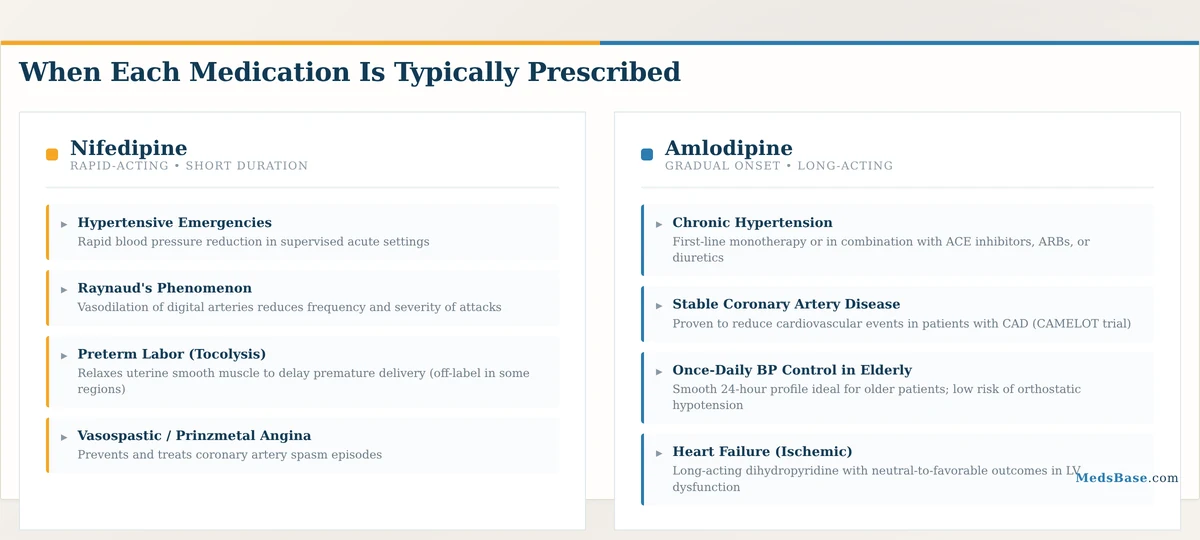
Nifedipine is commonly used for hypertensive emergencies and Raynaud’s, while amlodipine is a first-line option for chronic hypertension.
The nifedipine vs amlodipine decision ultimately maps to specific patient profiles. Here’s who tends to do better with each:
Consider nifedipine if:
- You have Raynaud’s phenomenon and need a medication that treats both your hypertension and your vasospastic episodes — nifedipine is uniquely evidence-backed for this dual role
- You are pregnant and require blood pressure control or tocolysis — nifedipine has more pregnancy safety data and is the preferred oral CCB in obstetric settings
- You have tried amlodipine and experienced intolerable ankle swelling — switching to nifedipine ER sometimes resolves the edema while maintaining blood pressure control
- You need the flexibility of an immediate-release formulation for acute vasospastic symptoms (under medical supervision) alongside a once-daily ER tablet for baseline control
- You are on high-dose simvastatin (above 20 mg) and want to avoid the amlodipine-simvastatin interaction
Consider amlodipine if:
- You need once-daily, simple dosing with maximum forgiveness if you occasionally take it late — amlodipine’s half-life is unmatched among oral antihypertensives
- You experienced palpitations, flushing, or headaches on nifedipine — amlodipine’s gradual onset dramatically reduces these vasodilatory symptoms
- You want the medication with the largest body of long-term cardiovascular outcomes evidence backing its use
- You prefer a generic tablet over a specialized extended-release formulation — all amlodipine generics are therapeutically equivalent
- You have stable angina alongside hypertension — amlodipine carries a formal angina indication supported by large trials
For a broader view of where calcium channel blockers fit among all blood pressure treatment options — including ACE inhibitors, ARBs, beta blockers, and diuretics — our comprehensive guide to the best blood pressure medications walks through every class, their evidence base, and which combinations work best for different patient profiles.
If your doctor has mentioned both options and you’re still weighing the nifedipine vs amlodipine choice, consider asking about a cross-class alternative. Our amlodipine vs lisinopril comparison explores the CCB-vs-ACE-inhibitor decision — a completely different mechanism of action that may suit patients who can’t tolerate either dihydropyridine.
8. Frequently Asked Questions
Which works faster — nifedipine or amlodipine?
Nifedipine works significantly faster — immediate-release nifedipine begins lowering blood pressure within 10 to 30 minutes. Amlodipine takes 5 to 7 days of consistent dosing to reach its full blood-pressure-lowering effect. In the nifedipine vs amlodipine comparison, nifedipine is the clear winner for speed, but speed is not always an advantage in chronic hypertension management where smooth, sustained control matters more than rapid onset.
Why does amlodipine cause more ankle swelling than nifedipine?
This is counterintuitive since both drugs are vasodilators, but amlodipine’s more pronounced arteriolar dilation — without matching venous dilation — increases the pressure in your capillaries, forcing fluid into surrounding tissues. Nifedipine, paradoxically, sometimes causes less edema because its shorter duration of action gives your vessels a partial recovery period between doses. The edema from both medications is dose-dependent and generally not dangerous, though it can be uncomfortable. Adding an ACE inhibitor or ARB often reduces the swelling by also dilating veins and equalizing capillary pressures.
Can I take nifedipine and amlodipine together?
No — this is never recommended. Nifedipine and amlodipine are both dihydropyridine calcium channel blockers with identical mechanisms of action. Taking them together would effectively double-dose the same drug class, dramatically increasing the risk of severe hypotension, reflex tachycardia, and peripheral edema without providing any additional therapeutic benefit. If one dihydropyridine isn’t sufficient, the standard approach is to add a medication from a different class — typically an ACE inhibitor, ARB, or thiazide diuretic.
Is nifedipine safe for long-term use?
Extended-release nifedipine is safe and effective for long-term use, with the ACTION trial confirming its cardiovascular safety over years of treatment. The cautionary history around nifedipine relates specifically to short-acting immediate-release capsules, which were linked in older observational studies to increased cardiovascular events — likely due to the rapid blood pressure fluctuations and reflex sympathetic activation they cause. Modern guidelines endorse long-acting nifedipine formulations for chronic hypertension management but explicitly recommend against short-acting nifedipine for this purpose.
Which is better for elderly patients — nifedipine or amlodipine?
Both are effective in elderly patients, and both feature in major hypertension trials enrolling older populations. The nifedipine vs amlodipine decision in elderly patients typically hinges on tolerability. Amlodipine’s gradual onset reduces the risk of orthostatic hypotension (blood pressure dropping when you stand up) — a major fall-risk concern in older adults. Nifedipine ER performed well in the NICS-EH trial specifically in elderly hypertensive patients, showing cardiovascular event reduction comparable to trichlormethiazide. If ankle edema is a concern with amlodipine, nifedipine ER at conservative doses (30 mg) is a reasonable alternative. For a deeper dive into blood pressure treatment considerations in older populations, see our guide to blood pressure medication for seniors.
Does nifedipine interact with grapefruit more than amlodipine?
Yes. Grapefruit juice increases nifedipine blood levels approximately two to three times by inhibiting intestinal CYP3A4. The interaction with amlodipine is less dramatic — roughly a 15-20% increase in blood levels — because amlodipine already has high oral bioavailability (64-90%), leaving less room for grapefruit to amplify absorption. However, both medications carry warnings against regular grapefruit consumption. If you occasionally consume grapefruit, amlodipine is the more forgiving option in the nifedipine vs amlodipine comparison.
Which is more effective for Raynaud’s phenomenon?
Nifedipine is the clear winner for Raynaud’s. It is a first-line pharmacological treatment with multiple randomized controlled trials demonstrating a 30-50% reduction in attack frequency and severity. Amlodipine is sometimes used off-label for Raynaud’s but has substantially less evidence supporting its efficacy — the slower onset that makes amlodipine better tolerated for hypertension also makes it less useful for the acute vasospasms that define Raynaud’s attacks.
Can I switch from nifedipine to amlodipine?
Yes — this is a common and generally straightforward transition when directed by a doctor. However, several technical factors matter: the nifedipine formulation you’re currently taking determines the timing of the switch; extended-release nifedipine to amlodipine is easier because both are once-daily; transitioning from nifedipine IR requires tapering the frequent doses while amlodipine levels build up over several days. The typical approach is to stop nifedipine and start amlodipine the next morning at a dose roughly equivalent — 30 mg nifedipine ER is approximately comparable to 5 mg amlodipine in blood-pressure-lowering effect, though individual responses vary. Blood pressure monitoring for the first week after the switch is essential.
9. The Bottom Line: Nifedipine vs Amlodipine
After examining every angle of the nifedipine vs amlodipine comparison — pharmacokinetics, side effects, evidence base, unique indications, practical dosing — a clear picture emerges. These two medications are siblings, not twins. They share a drug class and a mechanism of action, but their clinical personalities diverge in ways that matter for daily life.
Amlodipine is the steady, predictable choice: once-daily dosing, a half-life that forgives late doses, the largest outcomes evidence base of any dihydropyridine CCB, and a side effect profile centered on ankle swelling rather than palpitations. It fits the needs of most patients with uncomplicated chronic hypertension.
Nifedipine is the versatile specialist: fast-acting when needed for Raynaud’s vasospasms, evidence-backed for preterm labor, and available in both immediate and extended-release formulations that offer flexibility amlodipine cannot match. In its extended-release form, it is a safe, effective long-term antihypertensive — but its IR form belongs in acute scenarios, not daily chronic management.
The nifedipine vs amlodipine decision is not about which drug is “better” in the abstract. It’s about which drug fits your specific clinical situation: your blood pressure pattern, your tolerability needs, your other health conditions, your medication routine, and the unique indications that may tip the scale toward one over the other.
If you’re managing high blood pressure and exploring treatment options, both nifedipine and amlodipine are available as affordable generic medications produced by WHO-GMP-certified manufacturers. You can browse our full range of blood pressure medications to compare availability, strengths, and find the option that aligns with your doctor’s recommendation. No prescription is needed to order, and Worldwide Shipping ensures your treatment reaches you wherever you are.
Whichever medication you and your doctor choose, the most important factor in the nifedipine vs amlodipine equation is the same one that determines success with every blood pressure treatment: taking it consistently, monitoring your response, and communicating openly about any side effects that appear. The right medication is the one that brings your blood pressure to target and stays tolerable enough that you actually take it — every single day.
Medical Disclaimer
The information provided in this article is for educational and informational purposes only and is not intended as medical advice. Always consult a qualified healthcare professional before starting, stopping, or changing any medication. The side effect frequencies cited are based on clinical trial data and published literature; individual experiences may vary. This content does not establish a doctor-patient relationship. If you are experiencing a medical emergency, seek immediate medical attention. The medications discussed — nifedipine and amlodipine — are prescription medications; decisions about their use should always be made in consultation with a licensed healthcare provider who knows your full medical history.
Related Reading
- Amlodipine Side Effects: 10 Common Issues and How to Manage Them
- Amlodipine vs Lisinopril: 7 Key Differences Between Two Top Blood Pressure Medications
- Calcium Channel Blockers vs Beta Blockers: 8 Proven Differences to Know Before Choosing
- Grapefruit Drug Interactions: 12 Essential Warnings
- Best Blood Pressure Medications: 10 Evidence-Backed Drugs Across All Classes

Written by
Sophie ChenPharmaceutical Content Researcher · 8 years experience
Sophie Chen is a pharmaceutical content researcher with 8 years covering generic medication access and clinical pharmacology. She specialises in international regulatory frameworks, bioequivalence standards, and patient-facing education on therapeutic drug classes. She is not a clinician.