








✓ Medically reviewed by · Last reviewed: May 2026
Pharmacy Researcher · 8 years experience
Pharmacy researcher with 8 years reviewing clinical drug information, generic formulation equivalence, and international pharmaceutical standards. Focuses on patient-facing accuracy in medication education.
tranexamic acid — Tranexamic Acid — Uses, Dosage, Side Effects & Safety. Read on for an evidence-backed guide covering everything you need to know.
- Tranexamic acid is an antifibrinolytic — a medicine that stops clots from breaking down too quickly, which is why it reduces bleeding so effectively.
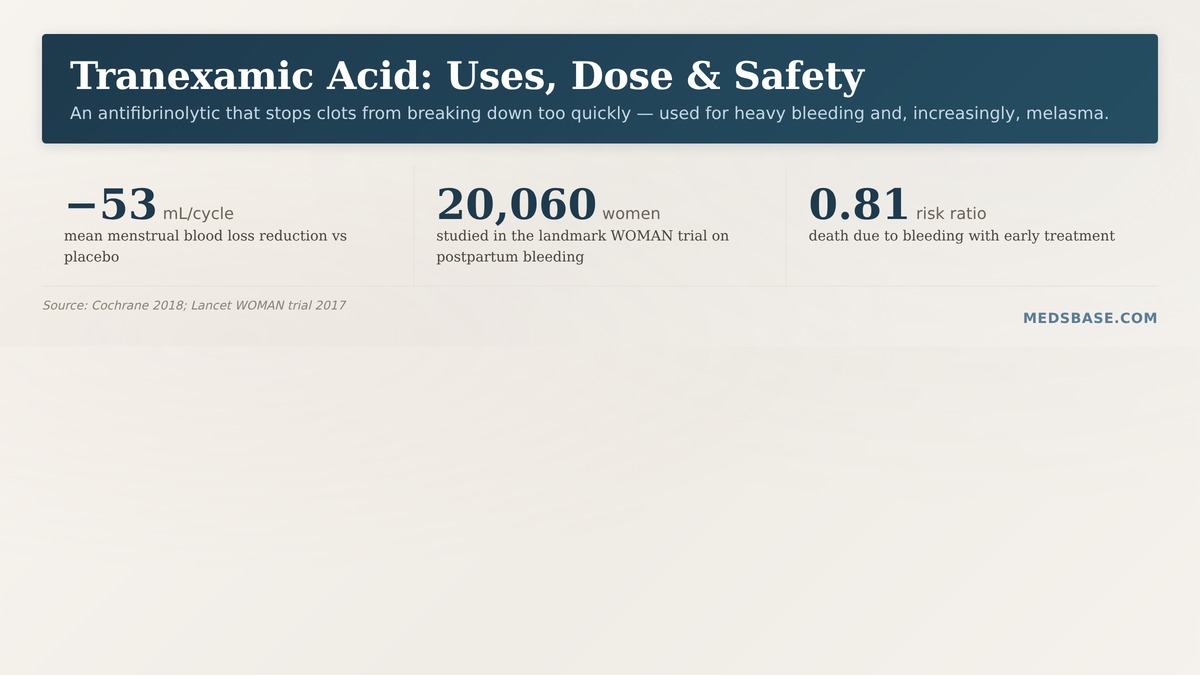
- It is a first-line treatment for heavy menstrual bleeding and a proven lifesaver in postpartum haemorrhage, cutting death from bleeding by about a fifth in a landmark trial.
- Oral tranexamic acid is also used off-label for melasma, but the evidence there is still maturing and the doses are lower.
- The one risk that matters most is blood clots — tranexamic acid is avoided in anyone with a history of thrombosis.
- It works fast and is cheap, but it is not a daily supplement: for heavy periods you take it only during the heavy days.
- What Is Tranexamic Acid?
- How Does Tranexamic Acid Work?
- Key Uses & Applications of Tranexamic Acid
- Tranexamic Acid Safety Profile, Side Effects & Dosage
- What Does the Research Say About Tranexamic Acid?
- Tranexamic Acid for Melasma — Does It Work?
- How to Use Tranexamic Acid
- Related Reading
- Frequently Asked Questions
- The Bottom Line
Here is a small fact that surprises almost everyone: one of the most useful medicines for heavy periods is a drug originally developed to stop bleeding in trauma and surgery. Tranexamic acid has been quietly doing heavy lifting in medicine for decades, and in the last few years it has crossed into dermatology as a treatment for melasma. By the end of this guide you will understand exactly how this medicine works, the three situations where it genuinely helps, the blood-clot risk you actually need to weigh, and the correct dose for heavy periods.
What Is Tranexamic Acid?
Tranexamic acid is an antifibrinolytic medication. In plain terms, it belongs to a class of drugs that stop blood clots from being broken down too quickly, which reduces bleeding. The NHS describes tranexamic acid as a medicine used to prevent or reduce heavy bleeding, most commonly in heavy periods and nosebleeds. It is a synthetic derivative of the amino acid lysine, which is why you may see it described as a lysine analogue.
It is worth knowing that the drug is widely available and inexpensive, which is part of why it has become a workhorse medicine across gynaecology, emergency care, and — more recently — dermatology.
How Does Tranexamic Acid Work?
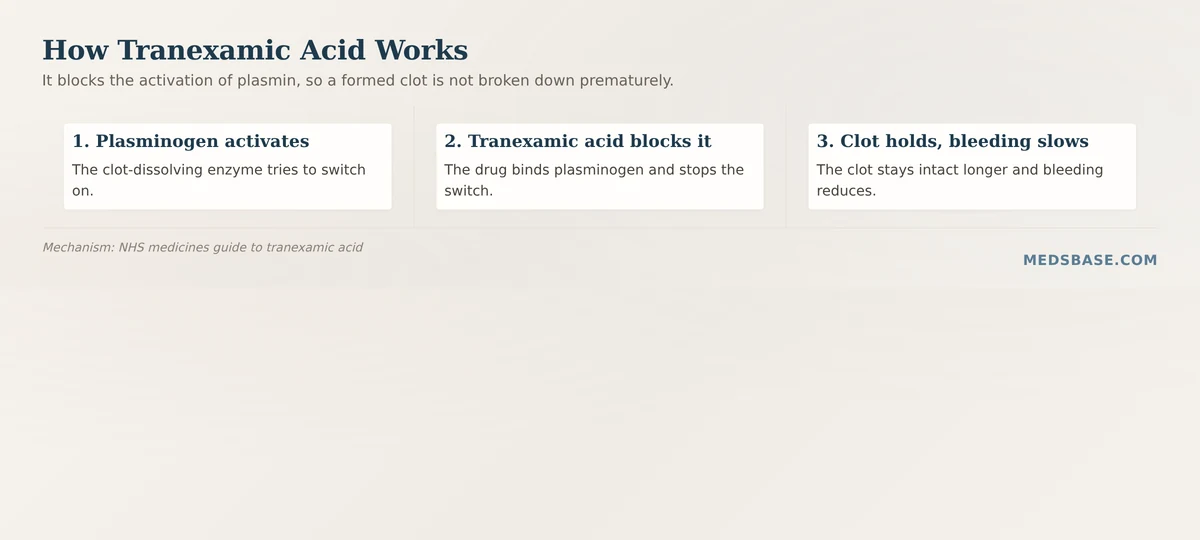
The body has a natural system that both forms and dissolves blood clots. When a clot has done its job, an enzyme called plasmin breaks it down — but plasmin first has to be switched on from an inactive form called plasminogen. Tranexamic acid binds to plasminogen and blocks that switch. With plasmin unable to form, the clot stays intact longer, and bleeding slows.
The analogy that helps most people: think of a clot as a dam, and plasmin as the water pressure that slowly erodes it. It lowers the water pressure, giving the dam time to hold. It does not “create” clotting out of nowhere — it preserves the clots your body has already formed, which is also the key to understanding its one big safety concern.
Key Uses & Applications of Tranexamic Acid
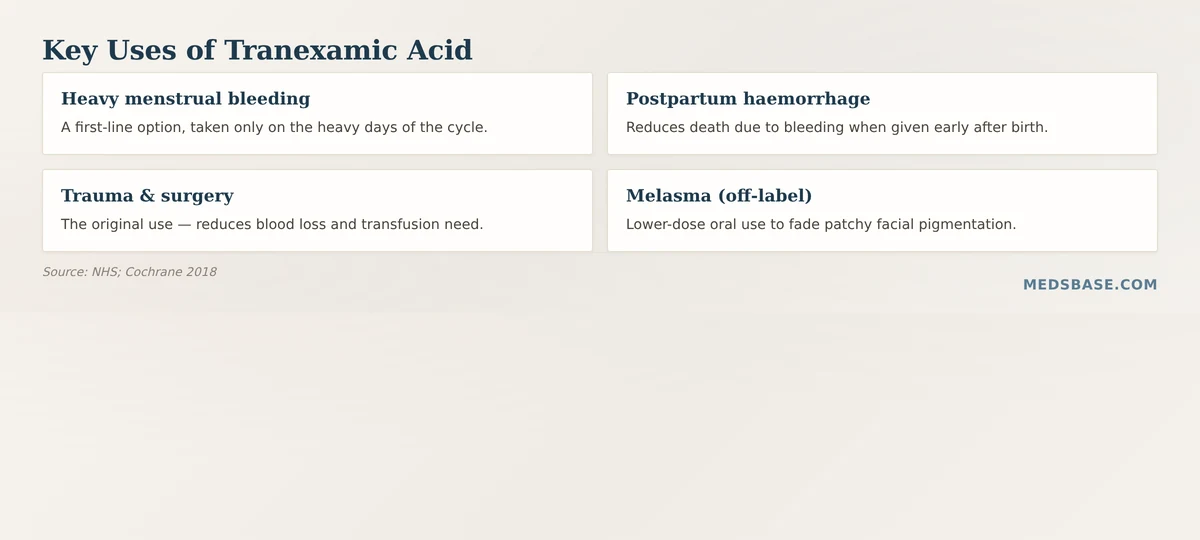
Tranexamic acid has several distinct, evidence-backed uses, and the dose and route change with each.
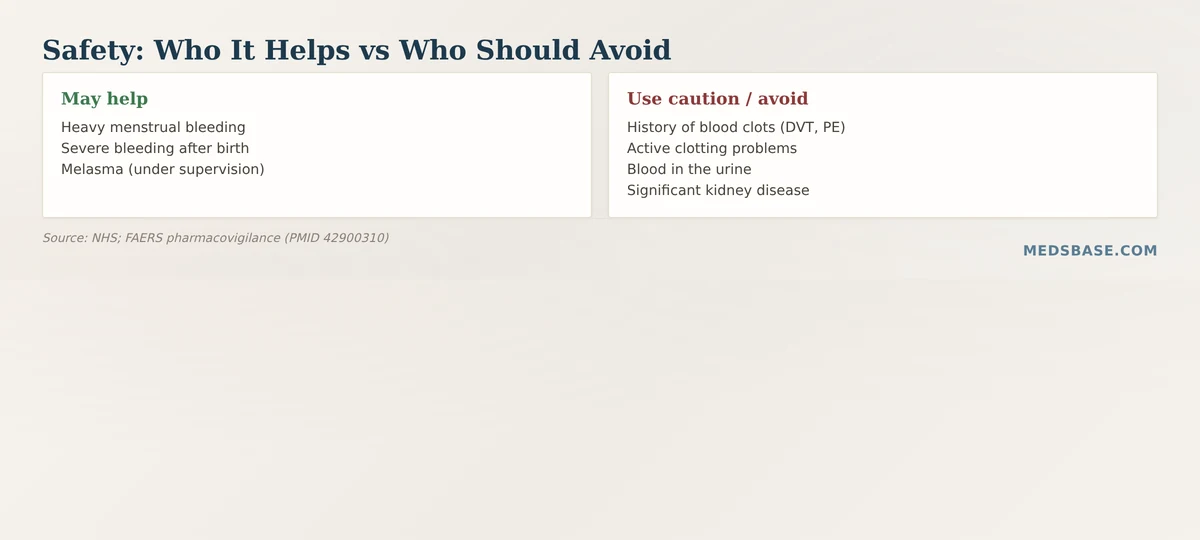
- For: adults with heavy menstrual bleeding, women at risk of postpartum haemorrhage, people with certain bleeding disorders, and (off-label) people with melasma.
- Avoid / use with caution: anyone with a history of blood clots (DVT, PE), people with active clotting problems, anyone with blood in the urine, and people with significant kidney disease. Pregnancy and breastfeeding need a doctor’s assessment.
Heavy Menstrual Bleeding
This is the most common reason tranexamic acid is prescribed. Heavy menstrual bleeding — losing so much blood that it disrupts daily life — affects a large share of women, and it is a first-line option because it is effective, fast, and inexpensive. It is typically taken only during the heavy days of the period, not continuously.
Postpartum Haemorrhage
Severe bleeding after childbirth is a leading cause of maternal death worldwide. Tranexamic acid given early has been shown to reduce death due to bleeding, which is why it is now part of many obstetric protocols. If you have explored women’s health treatment options before, you will recognize this as one of the rare medicines with genuinely life-saving evidence in this space.
Trauma and Surgical Bleeding
Outside gynaecology, it is used in trauma and surgery to reduce blood loss and the need for transfusion. This is the original use that first established the drug.
Melasma (off-label)
More recently, oral tranexamic acid has been used to treat melasma, the patchy facial pigmentation often triggered by hormones or sun exposure. This use is off-label in many regions, and the dose is much lower than the bleeding dose — we cover it in its own section below.
Tranexamic Acid Safety Profile, Side Effects & Dosage
The side-effect profile of tranexamic acid is generally mild, but there is one serious risk that frames everything.
| Side effect | Frequency | Severity | What to do |
|---|---|---|---|
| Nausea, vomiting, diarrhoea | Common | Mild | Take with food; report if persistent |
| Headache | Common | Mild | Standard relief; report if severe |
| Blood clots (DVT/PE) | Rare but serious | Severe | Avoid if history of thrombosis; seek urgent care for leg swelling or breathlessness |
| Visual disturbances | Rare | Moderate | Stop and report to a doctor promptly |
| Allergic reaction | Rare | Severe | Seek urgent medical help |
The headline risk is blood clots. Because it stabilises clots, tranexamic acid is not appropriate for anyone who has had a deep vein thrombosis, a pulmonary embolism, or a stroke caused by a clot, nor for people with active clotting problems. A 2026 pharmacovigilance study of tranexamic acid in the FAERS database characterised the thrombotic spectrum of reported adverse events, reinforcing that the clot risk is real and concentrated in people with existing risk factors.
Dosing for heavy menstrual bleeding is typically 1 g (two 500 mg tablets) taken three times a day for up to four days during the period. You should not take it for more than five days in a row, and if your bleeding is still heavy after two cycles, your doctor should review you.
What Does the Research Say About Tranexamic Acid?
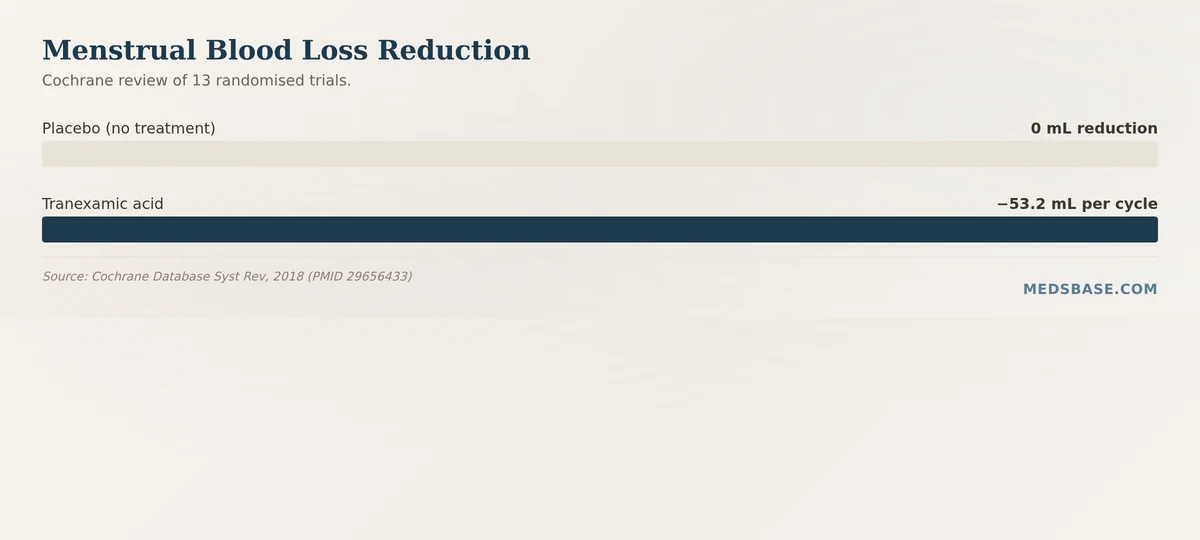
The evidence base for tranexamic acid is unusually strong for an inexpensive generic medicine.
| Study | Year | Finding | Source |
|---|---|---|---|
| Cochrane review (13 RCTs) | 2018 | Mean blood loss reduced by 53.2 mL/cycle vs placebo; ~3.3× higher odds of improvement | PMID 29656433 |
| WOMAN trial (20,060 women) | 2017 | Death due to bleeding cut: 1.5% vs 1.9% (RR 0.81); stronger if given within 3 hours | PMID 28456509 |
| FAERS pharmacovigilance | 2026 | Characterised the thrombotic spectrum of tranexamic acid adverse events | PMID 42900310 |
The landmark result here is the WOMAN trial, an international study of 20,060 women with postpartum haemorrhage. It found that early tranexamic acid reduced death due to bleeding from 1.9% to 1.5% — a risk ratio of 0.81 — and that the benefit was strongest when the drug was given within three hours of birth (1.2% vs 1.7%). Importantly, it did not increase adverse events, including thromboembolic events, which is reassuring given the drug’s mechanism.
For heavy periods, the Cochrane review is the definitive summary: across 13 randomised trials, tranexamic acid cut mean menstrual blood loss by about 53 mL per cycle, and if roughly 11% of women would improve without treatment, 43% to 63% improve with an antifibrinolytic. What this means for you: for the specific problem of heavy periods, it is one of the best-supported, most effective options available.
Tranexamic Acid for Melasma — Does It Work?
Melasma is stubborn, and the topical options — hydroquinone, tretinoin, azelaic acid — do not work for everyone. That has pushed tranexamic acid into dermatology, usually as a low-dose oral treatment (often 250 mg twice daily) or, increasingly, in topical or microneedling formulations.
The evidence is real but younger than the bleeding data. A randomized trial of a tranexamic acid cream for melasma found it could rival hydroquinone in some measures, and systematic reviews of microneedling with the drug suggest meaningful pigment improvement. However, the quality of the melasma evidence is lower than the menstrual-bleeding evidence, the doses and durations vary widely, and oral use for skin is off-label in many places.
The honest summary: tranexamic acid is a reasonable add-on for melasma when first-line topicals have under-delivered, but it is not the first thing to reach for, and oral use needs the same blood-clot caution as any other dose. If you are treating pigmentation, start with the well-studied topicals — see our hydroquinone cream guide and our skin care category for the full range.
Tranexamic Acid vs Other Treatments for Heavy Periods
Heavy menstrual bleeding has several first-line options, and tranexamic acid is only one of them. Understanding where it sits helps you have a better conversation with your doctor.
| Treatment | How it works | Notes |
|---|---|---|
| Tranexamic acid | Antifibrinolytic — stabilises clots | Taken only on heavy days; fast; inexpensive |
| NSAIDs (e.g. mefenamic acid) | Reduce prostaglandins | Also ease period pain; reduce flow less than TXA |
| Combined hormonal pill | Thins the lining | Good if contraception also wanted |
| Hormonal IUD (LNG-IUS) | Thins the lining long-term | Most effective at reducing flow over time |
| Surgery (ablation, etc.) | Removes lining | Reserved for severe, completed-family cases |
Tranexamic acid’s niche is the woman who wants something non-hormonal, fast-acting, and only on the days she needs it. It does not provide contraception, and it does not thin the uterine lining the way hormonal options do. The flip side is that it also does not carry hormonal side effects, which is exactly why many people prefer it.
How to Use Tranexamic Acid
Getting tranexamic acid right is mostly about timing and the right dose.
- Confirm the indication. Tranexamic acid is a prescription medicine — the reason you take it determines the dose and duration.
- For heavy periods, time it. Start when your bleeding is at its heaviest and take it for the few heavy days, not the whole cycle.
- Follow the dose. The usual adult dose is 1 g three times a day for up to four days (maximum five days in a row).
- Do not self-extend. Taking it longer than advised does not add benefit and does add risk.
- Report the red flags. New leg swelling, chest pain, or sudden breathlessness while taking tranexamic acid warrants urgent medical attention.
The mistakes to avoid are simple but common: taking it continuously when it is meant to be cyclical, using the oral skin-lightening dose without medical supervision, and overlooking a personal or family history of blood clots.
Frequently Asked Questions
Q: What is tranexamic acid used for?
A: Tranexamic acid is used to prevent or reduce heavy bleeding, most commonly heavy menstrual bleeding. It is also used in postpartum haemorrhage, trauma and surgical bleeding, and off-label for melasma.
Q: How does tranexamic acid work?
A: Tranexamic acid blocks the activation of plasminogen into plasmin, the enzyme that dissolves blood clots. By stopping clot breakdown, it helps bleeding slow and stop.
Q: Does tranexamic acid cause blood clots?
A: It can increase the risk of blood clots, which is why it is avoided in people with a history of deep vein thrombosis, pulmonary embolism, or other clotting problems. In routine short-course use for heavy periods, the risk is low but not zero.
Q: What is the tranexamic acid dose for heavy periods?
A: The usual adult dose is 1 g (two 500 mg tablets) taken three times a day for up to four days, starting when bleeding is heavy. It should not be taken for more than five days in a row.
Q: Can tranexamic acid be used for melasma?
A: Yes, but usually off-label, often as a low-dose oral treatment (around 250 mg twice daily) or in topical and microneedling formulations. The evidence is still maturing compared with the bleeding indications.
Q: Can I take tranexamic acid while pregnant?
A: Tranexamic acid is used to treat postpartum haemorrhage after delivery, but whether to take it during pregnancy is a decision for your doctor, who will weigh the benefits against the risks in your specific situation.
Q: How quickly does tranexamic acid work for heavy periods?
A: Most people notice a reduction in bleeding within the first day or two of taking it during their period, which is why it is started when bleeding is at its heaviest.
Q: Is tranexamic acid available over the counter?
A: In most places it is prescription-only, although some low-dose topical and cosmetic formulations may be available without prescription. Oral tranexamic acid for bleeding requires a prescription.
Q: How is tranexamic acid different from the hormonal pill for heavy periods?
A: Tranexamic acid is non-hormonal and taken only on heavy days, while the combined pill thins the uterine lining and is taken daily, providing contraception at the same time. It is a good fit when you want fast relief without hormones.
Q: Can tranexamic acid be used for nosebleeds?
A: Yes. Tranexamic acid is sometimes used to treat or prevent nosebleeds, including in people with hereditary bleeding disorders. The dose and route are decided by a doctor based on the cause of the bleeding.
Q: What should I do if I miss a dose of tranexamic acid?
A: Take the missed dose as soon as you remember, but if it is nearly time for your next dose, skip the missed one and continue your normal schedule. Do not take a double dose to make up for it.
The Bottom Line
Tranexamic acid is a rare thing in medicine: an inexpensive, decades-old generic with genuinely strong evidence across multiple uses. For heavy periods it is arguably a first choice; for severe postpartum bleeding it is life-saving; for melasma it is a reasonable, lower-confidence add-on. The single thing to carry away is the blood-clot caveat — it is a real risk, concentrated in people with existing risk factors, and it is exactly why this is a medicine to discuss with a doctor rather than self-prescribe. Your immediate action is to talk to a doctor or pharmacist about whether your bleeding pattern makes you a candidate. Wondering how other everyday medicines stack up? Read our guide to bepirovirsen for hepatitis B or our comparison of Voquenza vs omeprazole.

Written by
Sophie ChenPharmaceutical Content Researcher · 8 years experience
Sophie Chen is a pharmaceutical content researcher with 8 years covering generic medication access and clinical pharmacology. She specialises in international regulatory frameworks, bioequivalence standards, and patient-facing education on therapeutic drug classes. She is not a clinician.