








✓ Medically reviewed by · Last reviewed: May 2026
Pharmacy Researcher · 8 years experience
Pharmacy researcher with 8 years reviewing clinical drug information, generic formulation equivalence, and international pharmaceutical standards. Focuses on patient-facing accuracy in medication education.
bepirovirsen — Bepirovirsen (Hibsago) — the First Antisense Treatment for Chronic Hepatitis B, and What It Means for Patients. Read on for an evidence-backed guide covering everything you need to know.
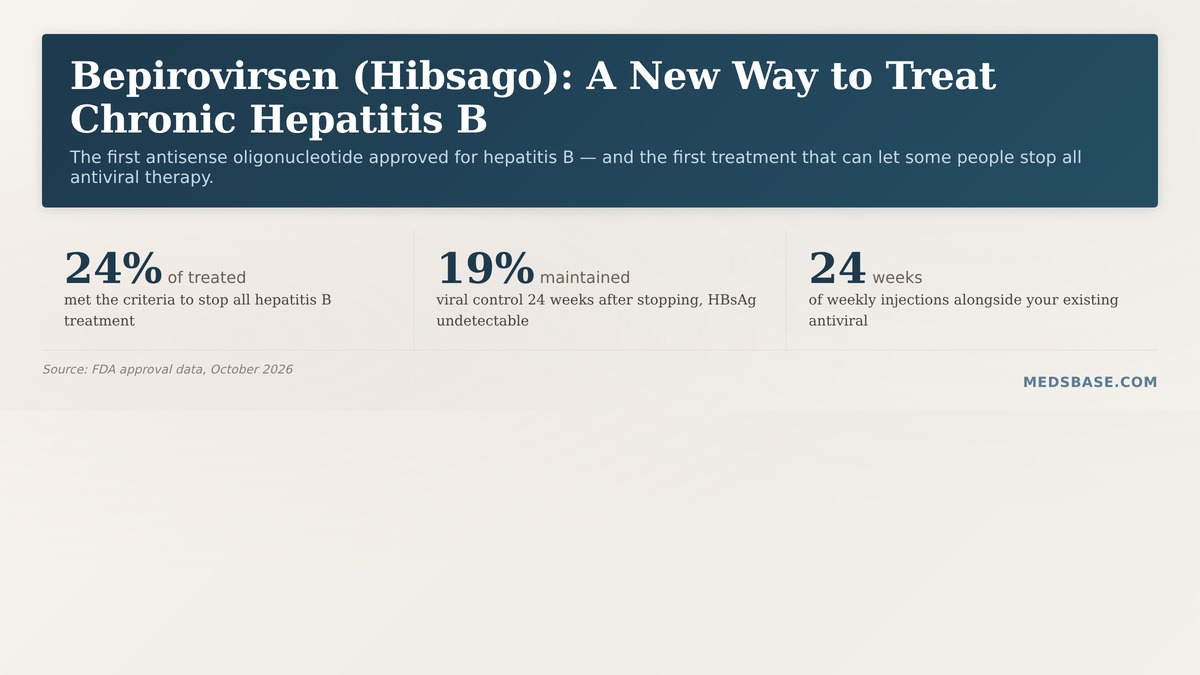
- On October 20, 2026, the FDA approved bepirovirsen (Hibsago) — the first antisense drug for chronic hepatitis B, and the first to let some patients stop all antiviral therapy.
- Bepirovirsen works differently from every hepatitis B pill before it: it targets the virus’s genetic instructions rather than just slowing its replication.
- In the pivotal trials, 24% of people on bepirovirsen met the criteria to stop therapy, and 19% still had the virus under control 24 weeks later.
- It is not for everyone — approval is limited to a specific subgroup without cirrhosis, and the drug carries a boxed warning for serious liver reactions and low platelets.
- It is not a “one and done” pill: bepirovirsen is a 24-week course of weekly injections taken alongside the antiviral you already take.
- What Is Bepirovirsen (Hibsago)?
- How Does Bepirovirsen Work?
- Who Is Eligible for Bepirovirsen?
- Bepirovirsen Safety Profile, Side Effects & Dosage
- What Does the Research Say About Bepirovirsen?
- Bepirovirsen vs Current Hepatitis B Antivirals
- How to Talk to Your Doctor About Bepirovirsen
- Related Reading
- Frequently Asked Questions
- The Bottom Line
For the estimated 254 million people worldwide living with chronic hepatitis B, treatment has meant one thing for decades: a daily pill you take indefinitely to keep the virus suppressed. That changed on October 20, 2026, when the FDA approved Hibsago (bepirovirsen), the first antisense oligonucleotide for chronic hepatitis B — and, more importantly, the first treatment that allows a meaningful minority of patients to stop all hepatitis B therapy and still keep the virus under control. By the end of this guide you will understand exactly how this drug works, who actually qualifies for it, what the real risks are, and whether it is worth a conversation with your own doctor.
What Is Bepirovirsen (Hibsago)?
Bepirovirsen is an antisense oligonucleotide — a lab-made strand of genetic material designed to stick to the hepatitis B virus’s own messenger RNA. It is sold under the brand name Hibsago and made by GSK. Unlike the nucleoside analogues most people with chronic hepatitis B take (such as entecavir or tenofovir), which suppress the virus while you keep taking them, it is aimed at a different target: the viral proteins, including the hepatitis B surface antigen (HBsAg), that keep the infection active.
Chronic hepatitis B is a long-term liver infection caused by the hepatitis B virus (HBV). According to the World Health Organization, the infection can lead over time to cirrhosis and liver cancer, and the CDC notes that many people do not know they carry it. Bepirovirsen’s approval is significant because it is the first drug that works toward the goal patients have asked about for years: a way to stop treatment altogether.
How Does Bepirovirsen Work?
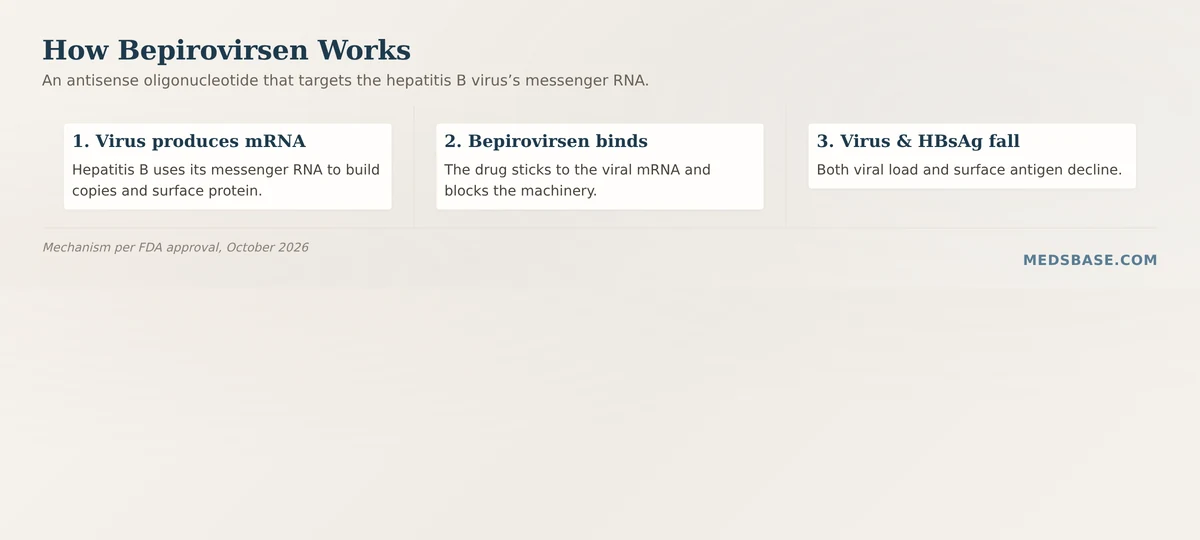
Here is where bepirovirsen stands apart. A virus reproduces by reading its own genetic instructions — messenger RNA — and using them to build copies of itself and its proteins. It is engineered to bind to the hepatitis B virus’s messenger RNA and block the machinery from using it. The result is a drop in both the amount of virus and the amount of HBsAg, the surface protein that signals an active hepatitis B infection.
A simple analogy helps. Think of the virus as a factory that needs a printed manual (mRNA) to keep producing its parts. The older antivirals slow the assembly line. Bepirovirsen throws away the manual, so the factory cannot keep making the surface protein that marks the infection as active. This is why the drug targets a goal — clearing HBsAg — that the daily pills were never designed to reach.
Suppression vs a Functional Cure: What Bepirovirsen Actually Changes
To understand why bepirovirsen matters, it helps to distinguish two different treatment goals that are often blurred together.
The daily antivirals — entecavir, tenofovir, and lamivudine — achieve viral suppression. They push the amount of virus in your blood down to undetectable levels, protect the liver from ongoing damage, and lower the risk of cirrhosis and liver cancer. But they do not usually clear the hepatitis B surface antigen (HBsAg), the protein marker of an active infection. As long as HBsAg remains positive, the virus is considered to be still present, and stopping the pills almost always lets it rebound.
What bepirovirsen is designed to do is different: it aims for HBsAg loss, sometimes called a functional cure. When HBsAg drops below the detection limit and stays there, the immune system has effectively gained the upper hand, and — for the people who reach this point — daily antiviral therapy may no longer be needed. This is the off-ramp that hepatitis B treatment has never really had.
The distinction also explains the modest headline numbers. Bepirovirsen does not produce HBsAg loss in everyone — far from it. But it produces it in a meaningful minority, which no prior therapy achieved at scale, and it is the first approved drug whose entire purpose is to get you to the point where treatment can stop.
Who Is Eligible for Bepirovirsen?
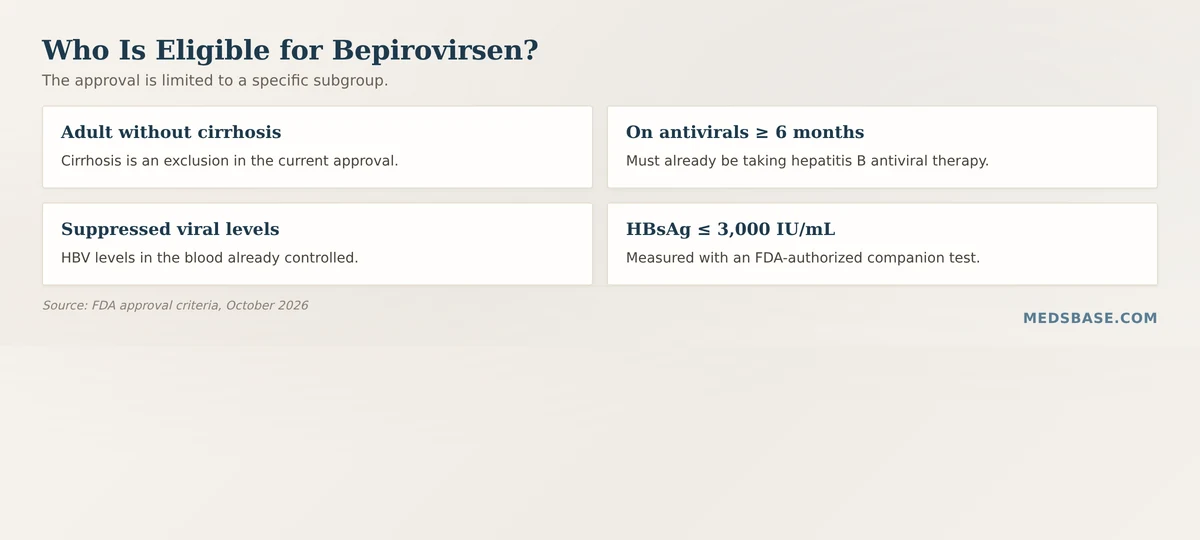
Bepirovirsen is not a first-line, everyone-takes-it treatment. The FDA approval is deliberately narrow, and you have to meet each of these conditions to be considered.
- For: adults with chronic hepatitis B without cirrhosis who have been taking hepatitis B antiviral therapy for at least six months, already have suppressed levels of the virus in their blood, and have an HBsAg level of 3,000 IU/mL or less on an FDA-authorized test.
- Avoid / not eligible: people with cirrhosis, anyone not already on stable antiviral therapy, and anyone with higher HBsAg levels. The boxed warnings also mean careful screening for people with existing liver problems or low platelets.
That HBsAg threshold is important, and it is why the FDA authorized the Roche Elecsys HBsAg II quant II assay as a companion diagnostic — a test used specifically to decide who is a candidate for bepirovirsen and to monitor them during treatment. If you have chronic hepatitis B, your HBsAg number is something your doctor can check, and it is now the single most useful number for deciding whether the treatment is even on the table.
Bepirovirsen Safety Profile, Side Effects & Dosage
Bepirovirsen is given as an injection under the skin for up to 24 weeks, while you continue your existing hepatitis B medicine — and you keep taking that existing medicine for at least 24 weeks after your last injection. Only after that, if you meet certain health and lab-test requirements, might you be able to stop.
Here is the side-effect picture, drawn from the FDA label:
| Side effect | Frequency | Severity | What to do |
|---|---|---|---|
| Injection site reactions | Common | Mild | Usually resolves; report if worsening |
| Fever | Common | Mild | Rest, fluids; report persistent fever |
| Fatigue | Common | Mild | Monitor; report if disabling |
| Headache | Common | Mild | Standard pain relief if appropriate |
| Serious liver reactions | Boxed warning | Severe | Immediate medical attention; regular blood tests required |
| Low platelets (thrombocytopenia) | Boxed warning | Severe | Increased bleeding risk; monitor counts |
The two boxed warnings deserve plain-language treatment. Bepirovirsen carries a warning for serious liver reactions and for low platelet counts, which can raise the risk of potentially life-threatening bleeding. The label also warns about worsening kidney function, serious inflammatory reactions such as vasculitis, and risks if the injection is not given correctly. This is why patients need regular blood tests and follow-up before and during treatment — it is not a drug you take and forget about.
What Does the Research Say About Bepirovirsen?
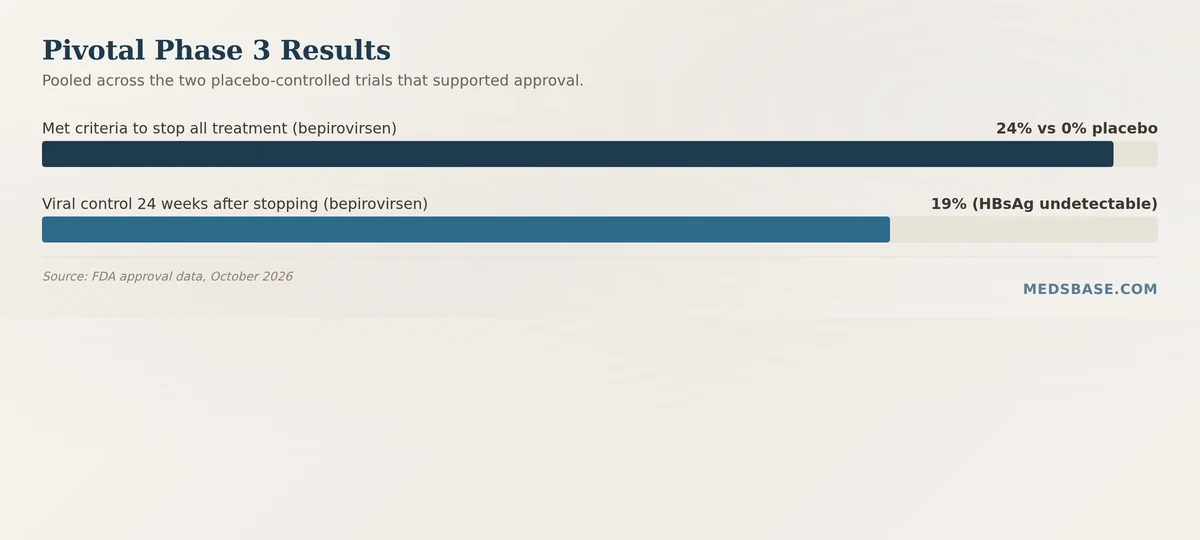
The approval rests on two placebo-controlled trials, and the numbers the FDA highlighted tell a clear story.
| Study | Year | Finding | Source |
|---|---|---|---|
| B-Clear (phase 2b) | 2022 | 9–10% achieved sustained HBsAg and HBV DNA loss at 24 weeks of therapy | NEJM (PMID 36346079) |
| Pivotal phase 3 trials (pooled) | 2026 | 24% met criteria to stop therapy vs 0% placebo; 19% maintained control 24 weeks after stopping | FDA approval data |
| Sequential Peg-IFN study | 2025 | Adding peginterferon after bepirovirsen may reduce post-treatment relapse | J Hepatol (PMID 39214467) |
In the earlier B-Clear trial published in the New England Journal of Medicine, researchers followed 457 participants and found that bepirovirsen 300 mg weekly for 24 weeks produced sustained HBsAg and HBV DNA loss in 9% to 10% of people — a result that, while modest in absolute terms, was the first time any drug had cleared the surface antigen in a meaningful fraction of patients. The later phase 3 trials improved on this: across the two studies, 24% of people on the drug met the requirements to stop their existing medicine, compared with none in the placebo group, and 19% still had the virus controlled — with HBsAg undetectable — 24 weeks after stopping all treatment.
A 2025 study in the Journal of Hepatology points to where this is heading next: sequential peginterferon after bepirovirsen may reduce post-treatment relapse, suggesting that combining the antisense approach with immune-stimulating interferon could push the numbers higher. What this means for you: it is a genuine first step toward a “functional cure” — a state where the virus is so suppressed you no longer need daily medicine — but the science is still maturing, and response rates are not yet high enough for everyone.
Worth noting about how the B-Clear trial actually dosed bepirovirsen: participants received loading doses at the start and then weekly injections, and the most successful group took 300 mg weekly for a full 24 weeks. The pivotal phase 3 trials that led to approval followed a similar schedule — weekly subcutaneous injections for up to 24 weeks, always alongside the participant’s existing antiviral. This combination design matters: it is not a replacement for your current pill during treatment, but a partner to it, with the hope of eventually making the pill unnecessary.
- If you are curious about bepirovirsen, the single most useful next step is to ask for your current HBsAg level — it is the number that determines eligibility.
- Confirm you have been on a hepatitis B antiviral for at least six months and that you do not have cirrhosis.
- Be prepared for regular blood tests before and during treatment; the monitoring is not optional.
Bepirovirsen vs Current Hepatitis B Antivirals
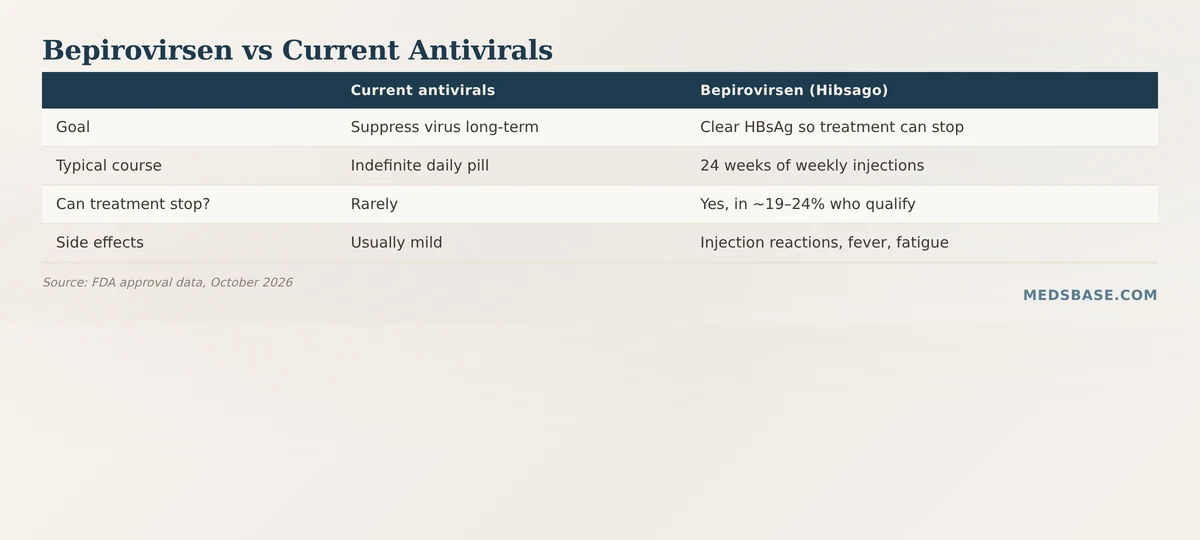
The daily antivirals most people know — entecavir, tenofovir, and lamivudine — are not being replaced by bepirovirsen. They serve different jobs, and it is actually taken alongside them.
| Current antivirals (entecavir, tenofovir) | Bepirovirsen (Hibsago) | |
|---|---|---|
| Goal | Suppress the virus long-term | Clear HBsAg so treatment can stop |
| Typical course | Indefinite daily pill | 24 weeks of weekly injections |
| Can treatment stop? | Rarely | Yes, in ~19–24% who qualify |
| Common side effects | Usually mild | Injection reactions, fever, fatigue |
| Monitoring | Routine | Regular blood tests (boxed warnings) |
The right frame is “and,” not “or.” Bepirovirsen is given in combination with your existing antiviral, and you keep taking that antiviral for months afterward. If the goal is simply to keep the virus quiet, the older pills do that well and cheaply. If the goal is to try to reach a point where you can stop, it is currently the only approved path.
How to Talk to Your Doctor About Bepirovirsen
If bepirovirsen sounds relevant to you, walk into the conversation prepared.
- Ask for your HBsAg level. The 3,000 IU/mL threshold is the single biggest gate. If your doctor has not tested it recently, that is step one.
- Confirm your eligibility. You need to be an adult without cirrhosis, on antivirals for at least six months, with suppressed viral levels.
- Review the warnings together. Make sure you understand the boxed warnings and the blood-test monitoring plan before committing.
- Set expectations. Around one in four eligible people meets the criteria to stop therapy, and just under one in five keeps the virus controlled afterward — a real chance, not a guarantee.
Bepirovirsen is a specialist-managed treatment in practice, and the decision to start it should sit with a doctor who manages hepatitis B regularly. If you are already treating your hepatitis B, you can explore chronic conditions treatment options on MedsBase and check your current antiviral.
Frequently Asked Questions
Q: What is bepirovirsen used for?
A: Bepirovirsen is used to treat chronic hepatitis B in certain adults without cirrhosis. It is taken together with existing antiviral therapy for up to 24 weeks, with the aim of lowering the hepatitis B surface antigen so that some patients can eventually stop all treatment.
Q: How does bepirovirsen work?
A: Bepirovirsen is an antisense oligonucleotide that binds to the hepatitis B virus’s messenger RNA, blocking the instructions the virus uses to copy itself and make viral proteins, including the surface antigen. This reduces both the amount of virus and the amount of HBsAg in the body.
Q: Is bepirovirsen a cure for hepatitis B?
A: Not a complete cure for everyone. In the pivotal trials, 24% of people on bepirovirsen met the criteria to stop treatment, and 19% still had the virus under control 24 weeks later with HBsAg undetectable. This is a “functional” outcome — the virus is suppressed without daily medicine — but most people do not yet achieve it.
Q: Who is eligible for bepirovirsen?
A: Adults with chronic hepatitis B without cirrhosis who have been on hepatitis B antivirals for at least six months, have suppressed viral levels, and have an HBsAg of 3,000 IU/mL or less on an FDA-authorized test.
Q: What are the most common bepirovirsen side effects?
A: The most common side effects, excluding lab abnormalities, are injection site reactions, fever, fatigue, and headache. Bepirovirsen also carries boxed warnings for serious liver reactions and low platelet counts.
Q: How is bepirovirsen given?
A: Bepirovirsen is injected under the skin weekly for up to 24 weeks, while you continue your existing hepatitis B medicine. You keep taking that existing medicine for at least 24 weeks after your last injection, then you may be able to stop if you meet certain health and lab-test requirements.
Q: Can bepirovirsen be used in cirrhosis?
A: No. The current approval is for adults without cirrhosis. People with cirrhosis are not part of the approved population, and they need different management from a liver specialist.
Q: How much does bepirovirsen cost?
A: As a newly approved branded biologic made by GSK, bepirovirsen is likely to be expensive, and coverage will vary by insurance. Cost data is still emerging. The antivirals people currently take for hepatitis B are far less expensive, which is why eligibility matters.
Q: How is bepirovirsen different from entecavir or tenofovir?
A: Entecavir and tenofovir are daily pills that suppress the virus while you keep taking them. Bepirovirsen is a 24-week course of weekly injections that targets the virus’s messenger RNA to lower the surface antigen, with the goal of letting some people stop all treatment.
Q: What happens after bepirovirsen treatment ends?
A: You continue your existing hepatitis B antiviral for at least 24 weeks after your last bepirovirsen injection. Your doctor then uses blood tests — including the HBsAg level — to decide whether you meet the requirements to stop that antiviral, and monitors you closely afterward.
Q: Does bepirovirsen work for everyone with hepatitis B?
A: No. It is approved only for a specific subgroup, and in the trials roughly one in four eligible people met the criteria to stop treatment. Response varies, and researchers are actively studying how to raise the response rate, including combining bepirovirsen with interferon.
The Bottom Line
Bepirovirsen is a genuine milestone, not a miracle. It is the first drug to clear the hepatitis B surface antigen in a meaningful number of patients and the first to make stopping all hepatitis B therapy a realistic, approved goal — but it is also a narrowly indicated, closely monitored, and still-improving treatment. Your immediate action, if this resonates, is simple: ask your doctor for your HBsAg level and whether you meet the eligibility criteria. Wondering how this fits into a broader picture of your health? Read our guide to tranexamic acid for another medication explainer, or see how we break down a head-to-head drug choice in Voquenza vs omeprazole.

Written by
Sophie ChenPharmaceutical Content Researcher · 8 years experience
Sophie Chen is a pharmaceutical content researcher with 8 years covering generic medication access and clinical pharmacology. She specialises in international regulatory frameworks, bioequivalence standards, and patient-facing education on therapeutic drug classes. She is not a clinician.
Pingback: Tranexamic Acid: 7 Proven Uses, Benefits & Safety Facts