








✓ Medically reviewed by · Last reviewed: May 2026
Pharmacy Researcher · 8 years experience
Pharmacy researcher with 8 years reviewing clinical drug information, generic formulation equivalence, and international pharmaceutical standards. Focuses on patient-facing accuracy in medication education.
Voquenza vs omeprazole — Voquenza vs Omeprazole — Which Acid Blocker Actually Works Better?. Read on for an evidence-backed guide covering everything you need to know.
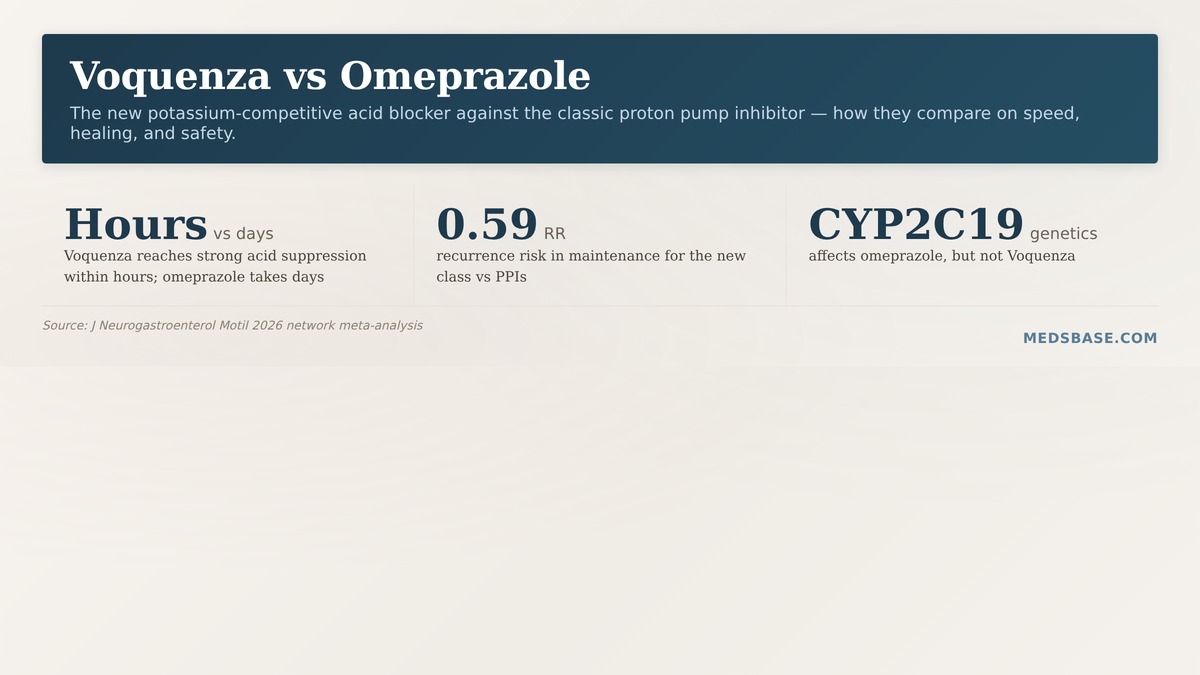
- Voquenza (vonoprazan) is a potassium-competitive acid blocker; omeprazole is a proton pump inhibitor — two different ways to switch off stomach acid.
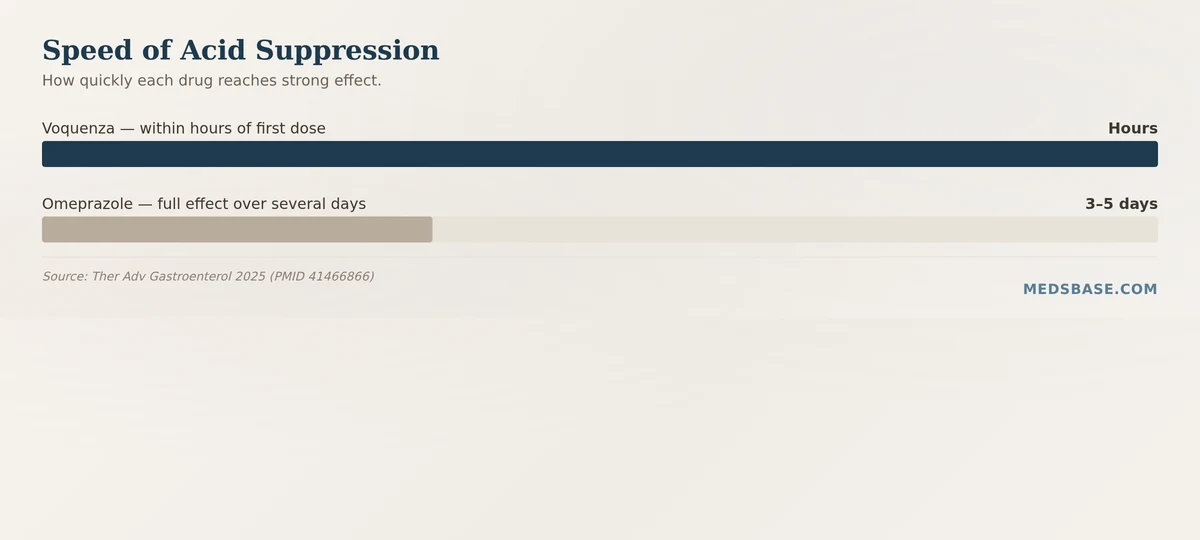
- Voquenza acts faster — within hours — while omeprazole takes several days to reach full effect.
- The biggest practical difference is genetics: omeprazole is broken down by the CYP2C19 enzyme, so it works less well in “fast metabolisers,” while Voquenza is largely unaffected.
- In erosive esophagitis, the new class heals severe cases slightly better and halves recurrence during maintenance.
- For ordinary heartburn and reflux, generic omeprazole remains a proven, inexpensive choice — Voquenza earns its place in harder-to-treat cases.
- What Are Voquenza and Omeprazole?
- How Do Voquenza and Omeprazole Work?
- Voquenza vs Omeprazole — Side-by-Side
- Safety Profile, Side Effects & Dosage
- What Does the Research Say About Voquenza vs Omeprazole?
- Which One Fits Which Situation?
- How to Use Each Medication
- Related Reading
- Frequently Asked Questions
- The Bottom Line
If you have ever stood in front of a pharmacy shelf — or stared at a prescription — wondering whether a newer, pricier acid medicine is actually better than the old standard, the Voquenza vs omeprazole question is for you. Voquenza (vonoprazan) is the first widely available member of a brand-new class of acid blockers, while omeprazole has been the world’s most-prescribed heartburn drug for decades. By the end of this guide you will know exactly how the two differ, which one the evidence favours, and which is the right choice for your situation.
What Are Voquenza and Omeprazole?
Omeprazole is a proton pump inhibitor (PPI). It was the first of its class and remains the reference point for acid suppression. The MedlinePlus guide to omeprazole describes it as a medicine that reduces stomach acid and is used to treat conditions such as gastroesophageal reflux disease (GERD) and stomach ulcers. It is available over the counter in many places and as a cheap generic.
Voquenza (vonoprazan) is a potassium-competitive acid blocker (P-CAB). According to its FDA-approved label, Voquenza is used to heal and maintain healing of erosive esophagitis and to eradicate H. pylori infection. It is newer, branded, and generally more expensive than generic omeprazole. In short, the Voquenza vs omeprazole matchup is a classic “new mechanism versus old reliable” story, and both have a legitimate place.
How Do Voquenza and Omeprazole Work?
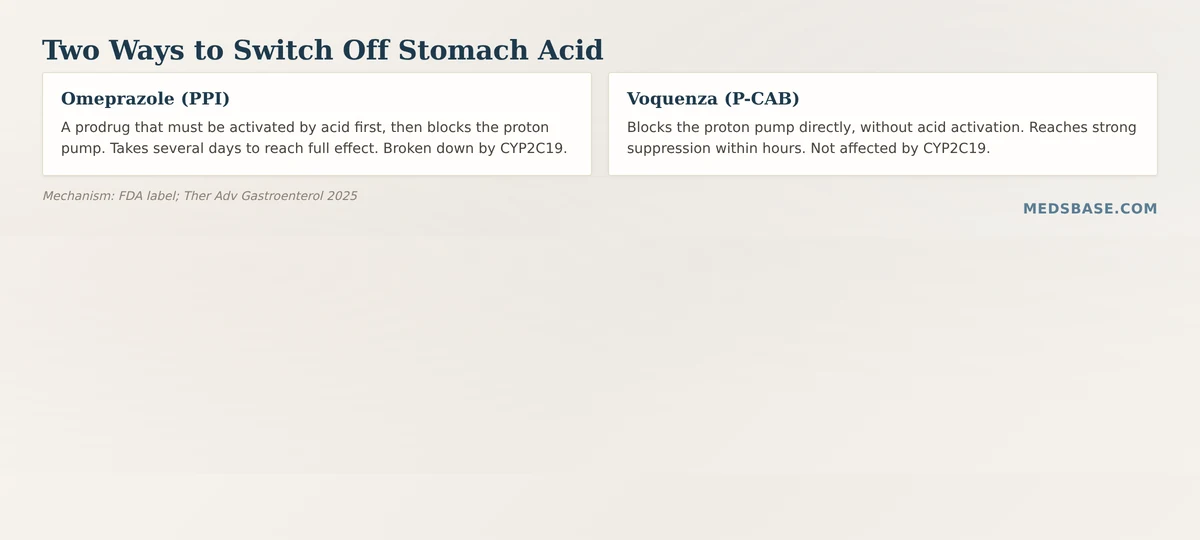
Both drugs ultimately switch off the same piece of machinery — the proton pump (the H+/K+ ATPase enzyme) that pushes acid into your stomach. The difference is how they get there, and understanding that difference is the key to the whole Voquenza vs omeprazole question.
Omeprazole is a “prodrug” that must first be activated by stomach acid, and then it binds to the proton pump. This means it takes a few days of daily dosing to accumulate enough active molecules to achieve full acid suppression. Omeprazole is also broken down in the liver by an enzyme called CYP2C19, and people inherit different versions of this enzyme — so the same dose can work well in one person and poorly in another.
Voquenza, by contrast, is active as soon as it is absorbed. It binds the proton pump directly and reversibly, without needing acid to activate it. This is why Voquenza reaches strong acid suppression within hours of the first dose. It is metabolised by a different pathway, so the CYP2C19 genetic difference that complicates omeprazole dosing matters far less for Voquenza. This mechanistic difference — direct and instant versus slow and acid-dependent — is the whole story behind the Voquenza vs omeprazole debate.
Voquenza vs Omeprazole — Side-by-Side
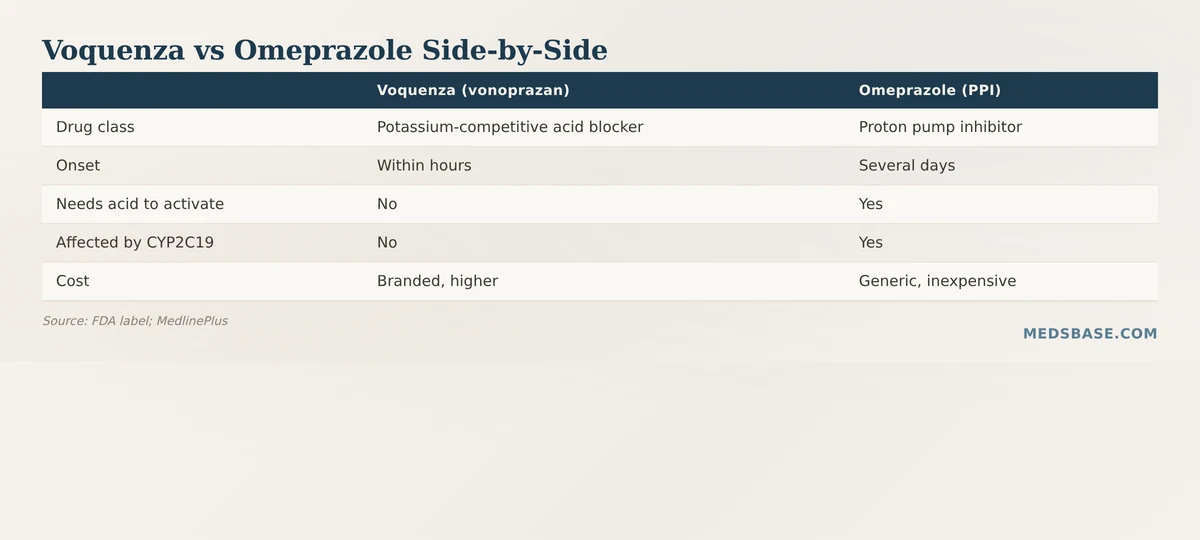
| Voquenza (vonoprazan) | Omeprazole (PPI) | |
|---|---|---|
| Drug class | Potassium-competitive acid blocker | Proton pump inhibitor |
| Onset of full effect | Within hours | Several days |
| Needs acid to activate? | No | Yes |
| Affected by CYP2C19 genetics? | No | Yes |
| Typical uses | Erosive esophagitis, H. pylori | GERD, ulcers, heartburn |
| Cost | Branded, higher | Generic, inexpensive |
The Voquenza vs omeprazole comparison really comes down to those middle rows. If you want speed and predictability, Voquenza has a clear mechanistic advantage. If you want a proven, cheap daily medicine for straightforward reflux, omeprazole remains hard to beat. Neither is strictly “better” — they are better for different people, which is the entire point of weighing the Voquenza vs omeprazole trade-off before you decide.
Safety Profile, Side Effects & Dosage
Both medicines are generally well tolerated, and the side-effect profiles overlap considerably. On the safety side, the Voquenza vs omeprazole comparison is close: neither drug has an obviously milder short-term profile, and both carry the same long-term considerations around acid suppression.
| Side effect | Voquenza | Omeprazole | Severity | What to do |
|---|---|---|---|---|
| Headache | Common | Common | Mild | Standard relief |
| Diarrhoea | Common | Common | Mild | Hydrate; report if persistent |
| Abdominal pain | Common | Common | Mild | Report if persistent |
| Nausea | Occasional | Occasional | Mild | Take with food |
| Low magnesium (long-term) | Rare | Rare but recognised | Moderate | Monitor on long-term use |
| Vitamin B12 deficiency (long-term) | Possible | Recognised | Moderate | Monitor on long-term use |
Omeprazole has a long track record, and its long-term concerns — notably reduced magnesium and vitamin B12 absorption — are well documented after years of continuous use. Voquenza is newer, so its long-term safety profile is still being written; it shares the same theoretical class concerns. Both are taken once daily. Omeprazole is usually taken 30–60 minutes before a meal, while Voquenza can be taken with or without food.
What Does the Research Say About Voquenza vs Omeprazole?
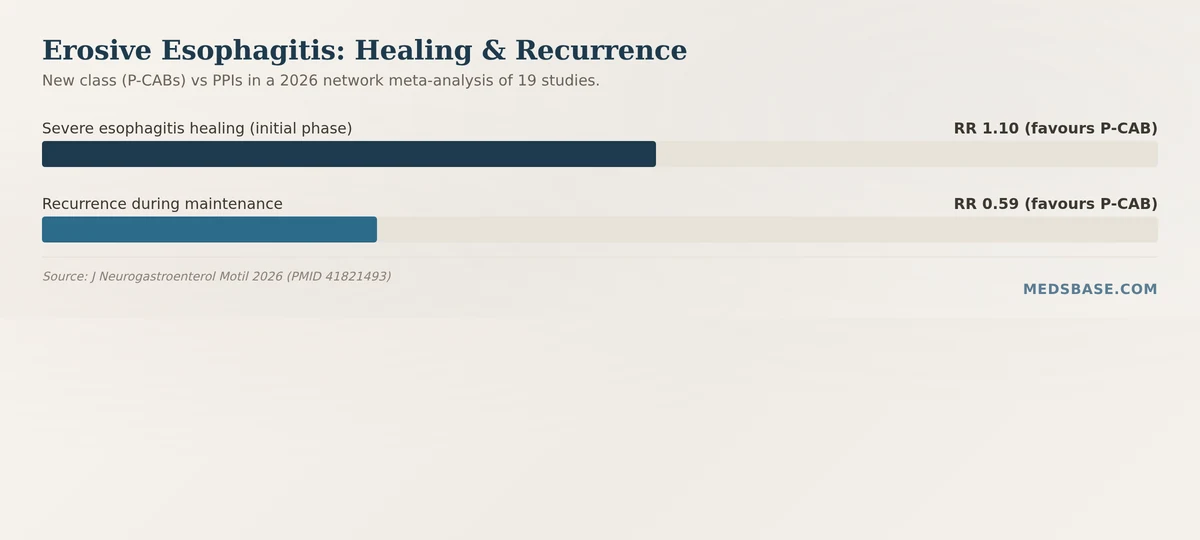
The head-to-head evidence for the Voquenza vs omeprazole question is strongest when the outcome is erosive esophagitis, the more severe form of acid damage to the oesophagus.
| Study | Year | Finding | Source |
|---|---|---|---|
| Network meta-analysis (19 studies) | 2026 | P-CABs superior initial healing of severe EE (RR 1.10); lower recurrence in maintenance (RR 0.59) | PMID 41821493 |
| EClinicalMedicine network meta-analysis | 2026 | P-CABs vs PPIs compared for erosive esophagitis efficacy and safety | PMID 41768276 |
| Meta-regression (7 RCTs, 3,754 pts) | 2025 | vonoprazan faster, more sustained acid suppression vs lansoprazole; PPIs leave 20–40% inadequate response | PMID 41466866 |
A 2026 network meta-analysis published in the Journal of Neurogastroenterology and Motility pooled 19 studies comparing five P-CABs (including vonoprazan) against PPIs. It found the new class was superior at healing severe erosive esophagitis in the initial phase (relative risk 1.10) and, crucially, cut the recurrence risk during maintenance treatment by about 40% (RR 0.59). A companion network meta-analysis in EClinicalMedicine reached the same broad conclusion on efficacy and safety. And a 2025 meta-regression of vonoprazan versus lansoprazole highlighted the real-world driver: 20–40% of people on PPIs respond inadequately, and vonoprazan’s faster, more sustained suppression is the reason it performs better in that subgroup.
What this means for you: the advantage of Voquenza over omeprazole is real but concentrated — it shows up most clearly in erosive esophagitis, especially severe or recurrent cases, and less dramatically in ordinary, occasional heartburn. So when you read strong headlines about the new acid blocker, remember that the Voquenza vs omeprazole data is genuinely favourable to Voquenza in the harder cases, while the everyday heartburn crowd is unlikely to notice much difference.
The CYP2C19 Genetic Difference, Explained
The single most important scientific reason the Voquenza vs omeprazole choice is not one-size-fits-all comes down to a liver enzyme called CYP2C19.
Omeprazole is broken down in the liver by CYP2C19, and people inherit different versions of this enzyme. “Extensive metabolisers” clear omeprazole quickly, which means the drug spends less time doing its job and acid suppression is weaker. “Poor metabolisers” clear it slowly, so the same dose lingers and works harder — which can actually be more effective but also raises the risk of over-suppression on high doses. Roughly a meaningful proportion of people carry variants that make them faster metabolisers, and for them a standard dose of omeprazole may simply not be enough.
Voquenza largely sidesteps this. It is metabolised by a different pathway (CYP3A4, among others), so the CYP2C19 genetic variation that complicates omeprazole dosing matters far less. In practical terms, this is why a person can find that omeprazole “worked for a while and then stopped” — the drug itself did not change, but their genetics were always working against it.
This is also why the Voquenza vs omeprazole question has a genuinely individual answer. If you have tried omeprazole at a standard dose and your reflux or esophagitis is not controlled, a CYP2C19 issue may be part of the story, and Voquenza is a logical next step. If omeprazole controls your symptoms, your genetics are clearly not getting in the way, and there is less reason to switch.
Voquenza vs Omeprazole: History and Cost
The cost side of the Voquenza vs omeprazole comparison is straightforward once you know the history.
Omeprazole was first approved in 1989 and has been generic for many years. Generics are cheap because multiple manufacturers compete to make the same molecule. That is why a month of omeprazole can cost just a few dollars, and why it is available over the counter in many countries.
Voquenza (vonoprazan) is far newer. It was developed in Japan, where it has been used since 2014, and was approved in the United States in 2023 for erosive esophagitis and H. pylori eradication. As a branded, on-patent drug, it costs substantially more, and insurance coverage often requires a prior authorisation or a documented failure on a cheaper PPI first.
So the economics reinforce the clinical logic: omeprazole is the inexpensive first-line default, and Voquenza is reserved — by both price and prescribing practice — for people who need its specific advantages, such as faster onset or independence from CYP2C19.
Which One Fits Which Situation?
Here is the practical verdict that ties the Voquenza vs omeprazole choice together.
- Occasional or mild heartburn, classic GERD: omeprazole (or any generic PPI) is usually the right first step — effective, cheap, and backed by decades of use.
- Erosive esophagitis that has not fully healed on a PPI: this is the clearest case for Voquenza, given the superior healing and lower recurrence in the data.
- Unpredictable response on omeprazole: if a PPI “worked then stopped,” a CYP2C19 issue may be at play, and Voquenza’s genetic independence makes it worth discussing.
- Cost-sensitive, stable on a PPI: there is no compelling reason to switch if omeprazole is controlling your symptoms well.
Stepping back, the Voquenza vs omeprazole decision is really a question of what you are treating and how well the cheaper option is working. Most people start on omeprazole, do well, and never need to think about Voquenza at all. The people who gain the most from Voquenza are the minority with erosive esophagitis that resists a standard PPI dose, or whose genetics blunt omeprazole’s effect. In other words, Voquenza vs omeprazole is not a fair fight on price — omeprazole wins that easily — but on speed and reliability in harder cases, Voquenza is the more capable tool.
If you are managing reflux or erosive esophagitis, you can browse acid reflux treatment options on MedsBase to see the range of PPIs available.
How to Use Each Medication
- Omeprazole: take once daily, 30–60 minutes before your first meal, and try to take it at the same time each day.
- Voquenza: take once daily with or without food, at a consistent time.
- Do not abruptly stop a long-term PPI. Stopping omeprazole suddenly after months of use can cause rebound acid, so taper under a doctor’s guidance.
- Tell your doctor about breakthrough symptoms. If you still get heartburn despite taking your acid medicine correctly, that is the conversation where Voquenza vs omeprazole becomes relevant.
- Report persistent side effects. Long-term use of either medicine warrants periodic checks of magnesium and B12.
Whichever side of the Voquenza vs omeprazole choice you land on, the fundamentals are the same: take the medicine consistently, at the right time relative to food, and do not stop a long-term PPI cold-turkey. Timing matters more for omeprazole than for Voquenza, which is one more small reason the newer drug can be easier to fit into a busy morning.
Frequently Asked Questions
Q: Is Voquenza better than omeprazole?
A: For erosive esophagitis, the evidence suggests Voquenza heals severe cases slightly better and reduces recurrence during maintenance. For ordinary heartburn and reflux, omeprazole is a proven, inexpensive choice and is often sufficient.
Q: How fast does Voquenza work?
A: Voquenza reaches strong acid suppression within hours of the first dose, because it blocks the acid pump directly without needing to be activated by acid. Omeprazole takes several days of daily dosing to reach its full effect.
Q: What is the difference between Voquenza and omeprazole?
A: Voquenza is a potassium-competitive acid blocker that acts directly and quickly and is not affected by CYP2C19 genetics. Omeprazole is a proton pump inhibitor that must be activated by acid first and is metabolised by CYP2C19, so its effect varies between people.
Q: Does Voquenza have fewer side effects than omeprazole?
A: The short-term side-effect profiles are similar, with headache and diarrhoea common to both. Omeprazole has a longer track record for long-term issues like low magnesium and vitamin B12, while Voquenza’s long-term profile is still emerging.
Q: Can you take Voquenza long-term?
A: Voquenza is approved for healing and maintaining healing of erosive esophagitis, which can involve longer-term use, but it should be used at the lowest effective dose and monitored like any long-term acid suppression.
Q: Is Voquenza covered by insurance?
A: Coverage varies widely. Voquenza is a newer branded drug, so it may cost more and require prior authorisation compared with generic omeprazole, which is inexpensive and widely covered.
Q: Why does omeprazole work for some people but not others?
A: Omeprazole is broken down by the CYP2C19 liver enzyme, and people inherit faster or slower versions of it. Fast metabolisers clear the drug quickly and may get less acid suppression — a difference that affects Voquenza far less.
Q: Can I switch from omeprazole to Voquenza?
A: Yes, under a doctor’s guidance. Switching is most worth considering if omeprazole is not controlling erosive esophagitis or you have a suspected CYP2C19 issue. Do not stop a long-term PPI abruptly because of rebound acid.
Q: Is Voquenza safer than omeprazole in the long term?
A: In the short term, both are well tolerated with similar side effects. Omeprazole has decades of data on long-term issues like low magnesium and vitamin B12, while Voquenza is newer and its long-term profile is still emerging. Neither is “risk-free” with years of continuous use.
Q: Which is stronger, Voquenza or omeprazole?
A: Voquenza generally produces faster and more complete acid suppression than omeprazole because it blocks the acid pump directly without needing activation. In the Voquenza vs omeprazole data, this translates to slightly better healing of severe erosive esophagitis and lower recurrence during maintenance.
Q: How much does Voquenza cost compared to omeprazole?
A: Voquenza is a branded drug and costs substantially more than generic omeprazole, which is inexpensive and often available over the counter. Because of the price gap, insurers usually require trying a cheaper PPI first.
The Bottom Line
The Voquenza vs omeprazole decision is less about “better” and more about “better for whom.” Voquenza wins on speed, predictability, and the erosive-esophagitis data; omeprazole wins on cost and a lifetime of real-world evidence for everyday reflux. Your immediate action is straightforward: if a PPI has stopped controlling your symptoms — especially if you have erosive esophagitis — ask your doctor whether Voquenza is worth trying; if omeprazole is working, stay the course. Want to understand another everyday medication in depth? Read our guide to tranexamic acid or our explainer on bepirovirsen for hepatitis B.

Written by
Sophie ChenPharmaceutical Content Researcher · 8 years experience
Sophie Chen is a pharmaceutical content researcher with 8 years covering generic medication access and clinical pharmacology. She specialises in international regulatory frameworks, bioequivalence standards, and patient-facing education on therapeutic drug classes. She is not a clinician.