







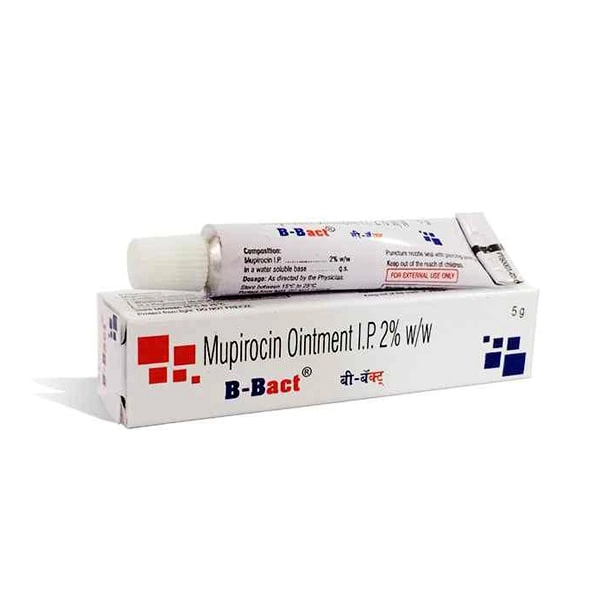
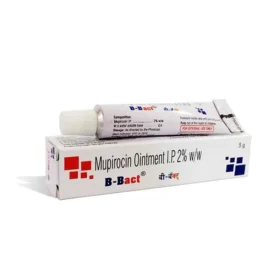
B-Bact Ointment
✅ Treats bacterial infections
✅ Reduces skin inflammation
✅ Promotes wound healing
✅ Prevents bacterial growth
✅ Safe for skin
✓ Medically reviewed by Morgan Ellis — Pharmacy Researcher · 8 years experience · Last reviewed: May 2026
⚡ Quick Answer — What is B-Bact Ointment?
B-Bact Ointment is a mupirocin 2% topical ointment (Glenmark) — a topical antibiotic for impetigo, secondary skin infections, and nasal MRSA decolonisation. Apply two-to-three times daily for 5–10 days. One of few effective topical anti-MRSA agents — use only for confirmed staphylococcal / streptococcal infection.
📦 Every order is covered by our Reshipment Assurance Policy — if your parcel does not arrive within 20 business days, we reship it.
Why order from MedsBase
Our generic medications are sourced from WHO-GMP certified manufacturers and shipped worldwide in discreet, plain packaging — no medication name on the parcel exterior. Card payments are routed through a regulated processor (statement descriptors include a regulated card-payment processor — never “MedsBase” or any medication name). Crypto and SEPA bank transfer are also accepted. Every order is backed by our Reshipment Assurance Policy.
How B-Bact Ointment works
B-Bact Ointment is a topical ointment containing mupirocin 2%, a polyketide antibiotic produced by Pseudomonas fluorescens. It binds bacterial isoleucyl-tRNA synthetase, blocking incorporation of isoleucine into bacterial proteins. It is bactericidal against Gram-positive cocci — especially Staphylococcus aureus (including MRSA) and Streptococcus pyogenes — at the high concentrations achievable in skin and nasal mucosa. Systemic absorption from intact skin is negligible.
Indications & dosing
| Indication | Use | Duration |
|---|---|---|
| Impetigo (bullous and non-bullous) | Apply a small amount to lesions three times daily | 5 days |
| Folliculitis / minor furunculosis | Apply three times daily after gentle cleansing | 5–10 days |
| Secondary infection of small wounds, abrasions | Apply two to three times daily | ≤ 10 days |
| Nasal MRSA decolonisation | Apply a pea-sized amount to each anterior nostril twice daily | 5 days |
| Prosthesis / surgical pre-operative MRSA decolonisation | Twice daily nasal application | 5–7 days pre-procedure |
Cover with a small dressing after application if practical — improves contact time and prevents inadvertent transfer to mucosa or other body sites.
Mupirocin is one of few effective topical anti-MRSA agents. Resistance — both low-level and high-level via plasmid-borne mupA — is rising in some hospitals. Use only for confirmed or strongly suspected staphylococcal / streptococcal skin infection or for MRSA decolonisation. Avoid use as a routine wound dressing or chronic ulcer cover, and never extend beyond 10 days without clinical review. Repeated short courses for recurrent furunculosis should be combined with hygiene measures (chlorhexidine wash, fresh towels / linens) to limit selection pressure.
Side effects
- Application-site burning, stinging, itching (~5%).
- Rash, contact dermatitis (rare).
- Nasal irritation with nasal application.
- Systemic absorption is negligible from intact skin; deep wounds may have higher absorption — particularly relevant if used on burns or large ulcers.
Contraindications
- Known mupirocin / polyethylene glycol hypersensitivity.
- Application to large open wounds or burns (PEG vehicle absorption with renal impairment risk).
- Application to mucous membranes other than the nasal vestibule (use the dedicated nasal preparation for nostrils).
- Prolonged use beyond 10 days without clinical review.
Drug interactions
Mupirocin has minimal systemic absorption from intact skin and no clinically relevant systemic drug interactions. Avoid concurrent application of other topical products on the same site to prevent dilution or pH-mediated inactivation.
Pregnancy & Breastfeeding
Topical mupirocin has negligible systemic absorption from intact skin and is considered safe in pregnancy and breastfeeding. Avoid the nipple area shortly before feeding to prevent oral exposure to the infant.
Storage
Store below 25 °C, away from direct sunlight and moisture. Keep in original packaging. Keep out of reach of children. Discard any unused tablets after the printed expiry date — degraded antibiotics can lose potency or release breakdown products.
Frequently Asked Questions
Can I use B-Bact Ointment on my child?
Yes — topical mupirocin is approved for use in children for impetigo and minor skin infections. Apply a thin layer two-to-three times daily and stop after 5–10 days unless your clinician extends.
How is it different from over-the-counter antiseptic creams?
Mupirocin is a true antibiotic with strong activity against Staphylococcus and Streptococcus. OTC antiseptic creams (chlorhexidine, povidone-iodine) are non-specific antimicrobials with broader but weaker action. Use mupirocin for confirmed bacterial skin infection; use antiseptic creams for general wound care.
How long until impetigo lesions clear?
Most cases improve substantially within 3–5 days. Clinical resolution by day 7 is the norm. Persistent lesions need a swab to check for resistance or atypical pathogen.
Can I use mupirocin on a stitched-up surgical wound?
Yes for ≤ 10 days if there is suspected staphylococcal contamination or infection; speak to the surgical team first. Routine prophylaxis on all clean surgical wounds is not recommended.
Does mupirocin work against MRSA?
Yes — mupirocin is one of few topical agents with reliable MRSA activity. It is the standard option for nasal MRSA decolonisation in 5-day twice-daily regimens, often combined with chlorhexidine body wash.
Why was my course only 5 days?
Five days is sufficient for most superficial skin infections AND limits the selection pressure for mupirocin-resistant strains. Persistent / recurrent infection needs swab + systemic antibiotics, not longer topical courses.
Can I use it inside my nose?
Yes — but only the dedicated nasal formulation (a less waxy paraffin base). Standard skin-grade mupirocin can be uncomfortable in the nostril; ask your pharmacist for the correct preparation.
Is it safe in pregnancy?
Yes — negligible systemic absorption from intact skin makes topical mupirocin one of the safest antibiotics in pregnancy and breastfeeding.
Will it interact with my oral antibiotics?
No — systemic levels are too low to interact. You can use topical and oral agents simultaneously when clinically indicated.
What if my infection comes back?
Recurrent staphylococcal skin infection often reflects nasal carriage. A 5-day twice-daily nasal mupirocin decolonisation course plus a chlorhexidine body wash regimen for 5 days will clear nasal Staph in > 80% of carriers — discuss with your clinician.
Other Antibiotics & Anti-Infective Medications
- Sofra Tulle (Framycetin gauze dressing) — wound infection
- Clocip (Clotrimazole) — antifungal alternative if mixed infection
- Augmentin (Amoxicillin + Clavulanic acid) — oral systemic if cellulitis develops
- Azee (Azithromycin) — oral macrolide alternative
- Cetil (Cefuroxime) — oral cephalosporin for skin / soft tissue
More options in Antibiotics
Ranked by recent MedsBase order volume — what other customers in this category are picking.

| Strength | 2% |
|---|---|
| Quantity | 1 Tube/s, 3 Tube/s, 6 Tube/s |
| Pharma Form | Tube/s |
| Manufacturer | Wallace Pharma |
| Treatment | Bacterial infections |
| Generic Brand | Mupirocin |
 B-Bact Ointment
Q & A
B-Bact Ointment
Related products



Reviews
There are no reviews yet