







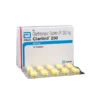
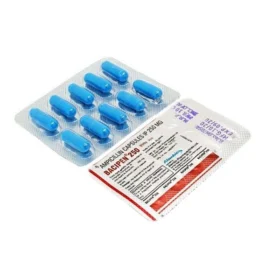
Bacipen
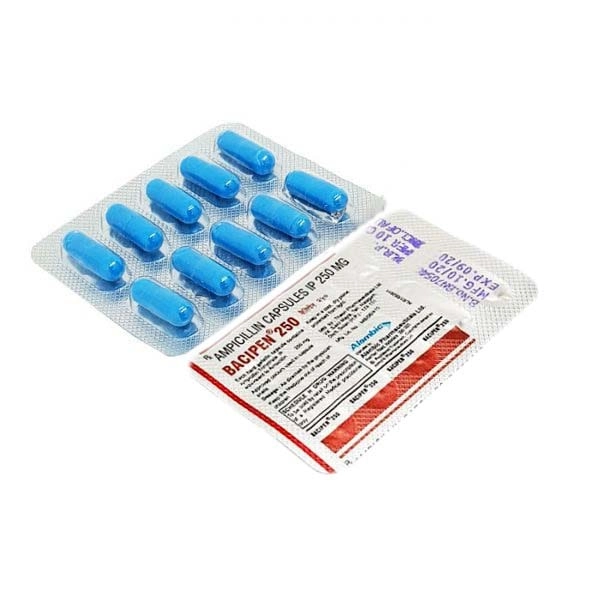
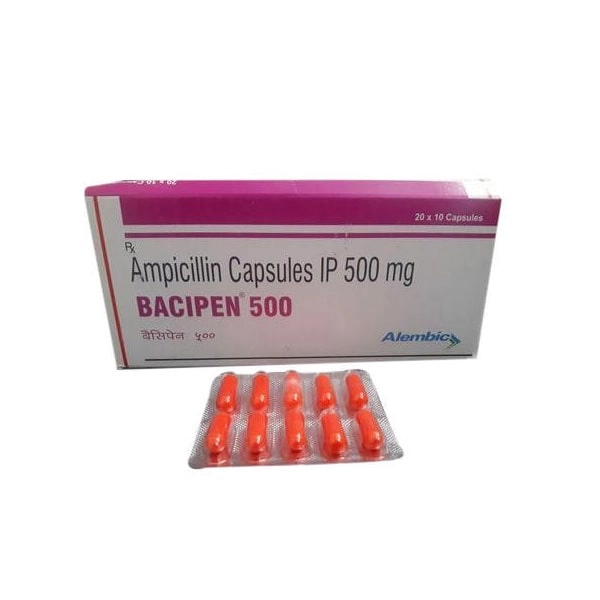
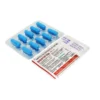
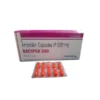
✅ Antibacterial properties
✅ Treats bacterial infections
✅ Prevents infection spread
✅ Safe for consumption
✅ Quick recovery time
✓ Medically reviewed by Morgan Ellis — Pharmacy Researcher · 8 years experience · Last reviewed: May 2026
⚡ Quick Answer — What is Bacipen?
Bacipen is an ampicillin capsule (250 mg / 500 mg, Bayer) — an aminopenicillin antibiotic. It is now mostly superseded by amoxicillin for outpatient use because of better oral absorption with amoxicillin. Take on an empty stomach (1 hour before food or 2 hours after).
📦 Every order is covered by our Reshipment Assurance Policy — if your parcel does not arrive within 20 business days, we reship it.
Why order from MedsBase
Our generic medications are sourced from WHO-GMP certified manufacturers and shipped worldwide in discreet, plain packaging — no medication name on the parcel exterior. Card payments are routed through a regulated processor (statement descriptors include a regulated card-payment processor — never “MedsBase” or any medication name). Crypto and SEPA bank transfer are also accepted. Every order is backed by our Reshipment Assurance Policy.
How Bacipen works
Bacipen contains ampicillin, an aminopenicillin functionally similar to amoxicillin but with poorer oral bioavailability (~50% vs 90%). It blocks bacterial cell-wall synthesis by binding penicillin-binding proteins. Spectrum: Streptococci, Listeria, Enterococcus faecalis, sensitive E. coli, Proteus mirabilis, Salmonella, Shigella, and Haemophilus influenzae. It is the drug of choice for Listeria monocytogenes meningitis and ampicillin-sensitive Enterococcus endocarditis. IV ampicillin is preferred over oral; this oral preparation is best reserved for outpatient indications where amoxicillin is unavailable.
Indications & dosing
| Indication | Standard dose | Duration |
|---|---|---|
| Mild–moderate UTI (sensitive organism) | 500 mg four times daily | 7 days |
| Otitis media / mild respiratory infection (alternative to amoxicillin) | 500 mg four times daily | 7–10 days |
| Listeria — pregnancy outpatient bridge to IV | 1 g four times daily | Refer to specialist |
| Salmonella / Shigella enteric infection (sensitive) | 500 mg four times daily | 5 days |
Note: oral ampicillin should be taken on an empty stomach (≥ 1 hour before or 2 hours after food) — food halves bioavailability. This is in contrast to amoxicillin, which can be taken with or without food.
Side effects
- Gastrointestinal: diarrhoea, nausea, vomiting, anorexia (5–20%). Diarrhoea more common with ampicillin/amp+clox than amoxicillin.
- Hypersensitivity: maculopapular rash (especially with concurrent EBV — characteristic ampicillin rash, not a true allergy), urticaria, angioedema, anaphylaxis. True IgE-mediated reactions are rare (~0.01% anaphylaxis) but cross-react with all beta-lactams to varying degrees.
- Candidiasis: oral thrush and vulvovaginal candidiasis are common with prolonged courses.
- Clostridioides difficile colitis: watch for new-onset watery diarrhoea, abdominal pain, fever during or up to 8 weeks after treatment.
- Hepatic: mild transaminase elevation; cholestatic hepatitis is rare but reported.
- Haematological: rare interstitial nephritis, neutropenia, eosinophilia with prolonged courses.
Contraindications & cautions
- Known IgE-mediated penicillin allergy (anaphylaxis, severe urticaria, angioedema, Stevens–Johnson) — choose a non-beta-lactam class.
- History of cephalosporin- or carbapenem-induced anaphylaxis — variable cross-reactivity.
- Active glandular fever (infectious mononucleosis) — high risk of widespread maculopapular rash; choose a different agent if possible.
- Severe renal impairment without dose adjustment.
Drug interactions
| Drug | Effect | Action |
|---|---|---|
| Methotrexate | Penicillins reduce renal clearance; risk of methotrexate toxicity | Monitor levels; consider holding antibiotic if methotrexate >100 mg/week |
| Combined oral contraceptive | Theoretical reduction in efficacy via gut-flora suppression — modern data show no clinically significant reduction | Counsel on additional barrier method only if breakthrough bleeding occurs |
| Probenecid | Reduces renal tubular secretion of penicillin; raises serum levels | Sometimes used clinically to extend dosing interval |
| Allopurinol | Increases incidence of penicillin-related rash | No dose change; counsel |
| Warfarin | Variable INR effect; case reports of both potentiation and reduction | Check INR 3–5 days into therapy |
Pregnancy & Breastfeeding
Aminopenicillins are category B (FDA) — extensively used in pregnancy and considered safe across all trimesters. Amoxicillin is the drug of choice for asymptomatic bacteriuria, group B streptococcal prophylaxis, and uncomplicated pyelonephritis in pregnancy. Excretion in breast milk is minimal and considered compatible with breastfeeding.
Storage
Store below 25 °C, away from direct sunlight and moisture. Keep in original packaging. Keep out of reach of children. Discard any unused tablets after the printed expiry date — degraded antibiotics can lose potency or release breakdown products.
This medicine is only effective against bacterial infections. Do not use it for viral illnesses (common cold, most sore throats, flu, COVID-19), do not stop early when you feel better, and do not save leftovers for future infections. Misuse drives drug-resistant bacteria like MRSA, ESBL, and CRE — the WHO ranks antimicrobial resistance among the top 10 global public-health threats.
Frequently Asked Questions
Should I take Bacipen with food?
Bacipen should be taken on an empty stomach: 1 hour before food or 2 hours after. Food can halve absorption of ampicillin and cloxacillin.
How quickly will I feel better?
Most patients with simple respiratory or urinary infections feel meaningfully better within 48–72 hours. If you are no better at 72 hours — or if you are getting worse — seek medical review. A bacterial culture or alternative antibiotic class may be needed.
Can I drink alcohol?
There is no direct interaction between aminopenicillins and alcohol — but heavy drinking weakens immune defences and slows recovery. Light social use is acceptable; avoid binge drinking during the course.
What if I miss a dose?
Take it as soon as you remember. If you are within 2 hours of the next scheduled dose, skip the missed dose — never double up. Repeated missed doses risk treatment failure and resistance emergence.
Is the rash I developed a true penicillin allergy?
A delayed maculopapular rash 5–10 days into a course is usually a non-IgE reaction and not a true allergy — re-challenge with future penicillins is often safe under clinical guidance. Hives, swelling of face/lips, wheeze or anaphylaxis ARE true allergies — record on your medical notes and avoid all penicillins.
Why not use this for a viral cold or flu?
Aminopenicillins are bactericidal — they only work on bacteria. Using them for viral illnesses provides no clinical benefit and accelerates resistance in your own gut and respiratory flora.
Do I need to take a probiotic alongside?
Saccharomyces boulardii or a multi-strain Lactobacillus product taken several hours apart from the antibiotic may reduce antibiotic-associated diarrhoea risk in adults — evidence strength is moderate. Stop if any GI symptoms.
Can I take this if I am also on methotrexate?
Penicillins can raise methotrexate levels and increase toxicity (mucositis, marrow suppression). Inform your prescriber — methotrexate may need to be held during the antibiotic course or levels checked.
Will it affect my contraceptive pill?
Modern evidence does not support a clinically significant reduction in pill efficacy with most antibiotics including penicillins. Continue your usual pill schedule — but use additional protection if you experience vomiting or diarrhoea, which can affect absorption.
What should I do if symptoms have not improved by day 3?
Return for medical review. The cause may be viral, the bacterium may be resistant, or there may be an abscess that requires drainage. Do not simply lengthen the course or escalate the dose without specialist input.
Other Antibiotics & Anti-Infective Medications
- Augmentin (Amoxicillin + Clavulanic acid) — broader spectrum
- Cetil (Cefuroxime) — second-generation cephalosporin
- Azee (Azithromycin) — penicillin-allergy alternative for respiratory infection
- Cifran (Ciprofloxacin) — fluoroquinolone for UTI / GI
- Doxt (Doxycycline) — atypical pneumonia / STIs
More options in Antibiotics
Ranked by recent MedsBase order volume — what other customers in this category are picking.

| Strength | 250 mg, 500 mg |
|---|---|
| Quantity | 30 Capsule/s, 60 Capsule/s, 90 Capsule/s |
| Pharma Form | Capsule/s |
| Manufacturer | Alembic Pharma |
| Treatment | Bacterial infections |
| Generic Brand | Ampicillin |
 Bacipen
Q & A
Bacipen
Related products



Reviews
There are no reviews yet