








✓ Medically reviewed by · Last reviewed: May 2026
Pharmacy Researcher · 8 years experience
Pharmacy researcher with 8 years reviewing clinical drug information, generic formulation equivalence, and international pharmaceutical standards. Focuses on patient-facing accuracy in medication education.
Nearly one in five adults treated for high blood pressure still can’t get their numbers down — even on three different pills. If that’s you, a headline this year probably caught your eye: regulators approved baxdrostat for resistant hypertension, the first genuinely new type of blood pressure drug in a generation. By the end of this article you’ll know exactly what it does, how much it actually lowered pressure in its main trial, who should steer clear of it, and — because it isn’t a generic yet — the affordable option that works on the very same hormone today.
Here’s the part most news stories skip: baxdrostat doesn’t work like the drugs you’re already taking. It reaches further up the chain. We’ll unpack that in plain English, and there’s one safety number worth watching closely — we’ll get to it in the safety section, because it decides who can take this drug at all.
- Baxdrostat is the first aldosterone synthase inhibitor — it blocks the making of a blood-pressure hormone, not just its receptor.
- In the pivotal BaxHTN trial, seated systolic pressure fell roughly 8.7–9.8 mmHg more than placebo — but that average hides who benefits most.
- It’s an add-on, not a starter drug — designed for pressure that stays high despite two or three medicines.
- One lab value can rule you out — and it’s the same reason your doctor will recheck bloodwork within weeks.
- Baxdrostat is brand-only for now; a much cheaper generic hits the same hormone pathway — we’ll name it.
- “Resistant” doesn’t always mean resistant — a surprising share of cases are something else entirely.
Table of Contents
- What is baxdrostat — and what is resistant hypertension?
- How baxdrostat works (the upstream switch)
- Key uses & who it’s really for
- Safety, side effects & the potassium question
- What the BaxHTN research actually showed
- Baxdrostat vs the alternatives you can get today
- Practical steps before you ever start it
- Frequently asked questions
- The bottom line
What Is Baxdrostat — and What Is Resistant Hypertension?
Baxdrostat is an oral aldosterone synthase inhibitor approved as add-on therapy for adults whose blood pressure stays high despite other medicines. It’s the first drug of its class, and it lowers pressure by cutting the body’s production of aldosterone — a hormone that tells your kidneys to hold onto salt and water. Less salt and water retained means less pressure in the pipes.
That definition matters because of the phrase “add-on.” Baxdrostat isn’t meant to be your first tablet. It’s built for a specific, frustrating problem.
So what counts as resistant hypertension? Clinicians generally use it to mean blood pressure that stays above goal despite three antihypertensive drugs from different classes — usually including a water pill (diuretic) — all taken at good doses. If it takes four or more drugs to reach goal, that’s often called “controlled resistant hypertension.” The NHS notes that high blood pressure frequently has no symptoms, which is exactly why it goes untreated for years and why some people land in the resistant category before they realise their numbers were ever a problem.
Here’s a catch worth naming early. A large slice of so-called resistant hypertension isn’t truly resistant at all. Sometimes it’s pseudo-resistance: missed doses, blood pressure that spikes only in the clinic (“white-coat effect”), a cuff that’s too small, or too much salt on the plate. Before anyone reaches for a brand-new drug, a good clinician rules those out first. We’ll come back to this in the practical-steps section, because getting it wrong wastes both money and time.
How Baxdrostat Works: The Upstream Switch
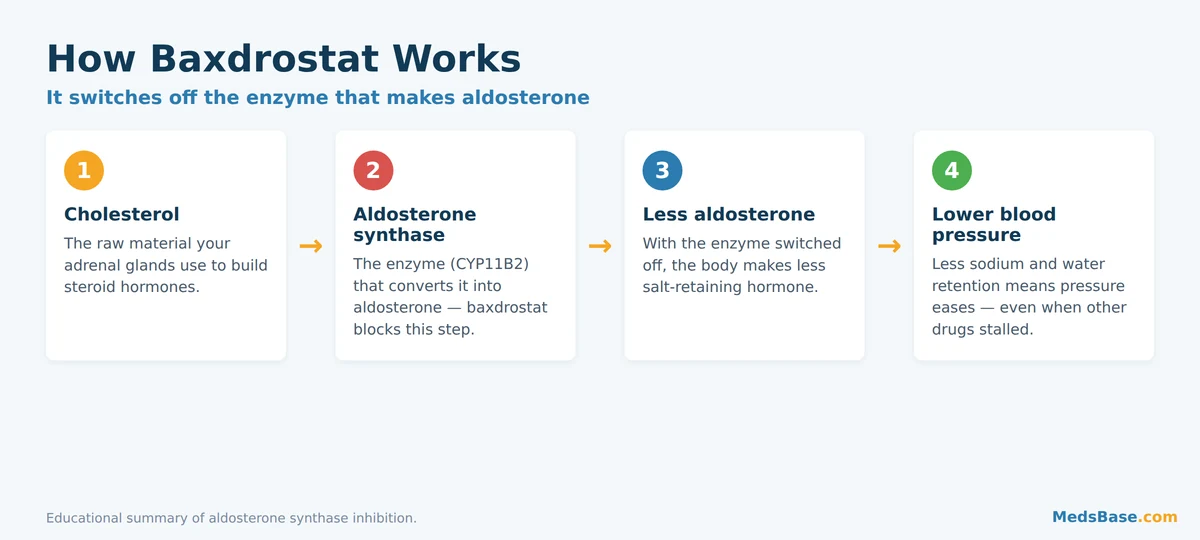
Picture your adrenal glands as a small factory that produces aldosterone. The final machine on that production line is an enzyme called aldosterone synthase (its technical name is CYP11B2). Older drugs that target this system, like spironolactone, work at the loading dock — they block the receptor where aldosterone would normally dock and give its orders. Baxdrostat works further back, at the machine itself, so less aldosterone gets built in the first place.
That’s the whole idea behind an aldosterone synthase inhibitor: turn down the supply rather than block the delivery. Because aldosterone drives salt and water retention, dialling down its production eases the volume load on your circulation, and pressure tends to fall.
The appeal of hitting the enzyme is precision. In theory, you lower aldosterone without some of the off-target hormonal effects that come from blocking the receptor broadly. Whether that translates into fewer real-world side effects for most people is still being studied — an honest “we’re watching this” rather than a settled fact.
One line to remember: baxdrostat lowers the hormone at its source, which is a different lever than almost every blood pressure pill you’ve taken before.
Why a whole new class matters now
For years, the standard playbook for stubborn blood pressure ran out of moves after the usual three or four drugs. Cardiologists knew that in many resistant cases, excess aldosterone was quietly driving the problem — holding onto salt no matter how many other pills you stacked on top. The trouble was that the main tool for it, a receptor blocker, brought hormonal side effects that some people simply couldn’t tolerate. An aldosterone synthase inhibitor is the first genuinely different way to attack that same root cause, which is why the approval drew so much attention. It doesn’t replace the foundation drugs; it gives the hardest-to-treat group a new lever when the old ones fall short.
Key Uses & Who It’s Really For
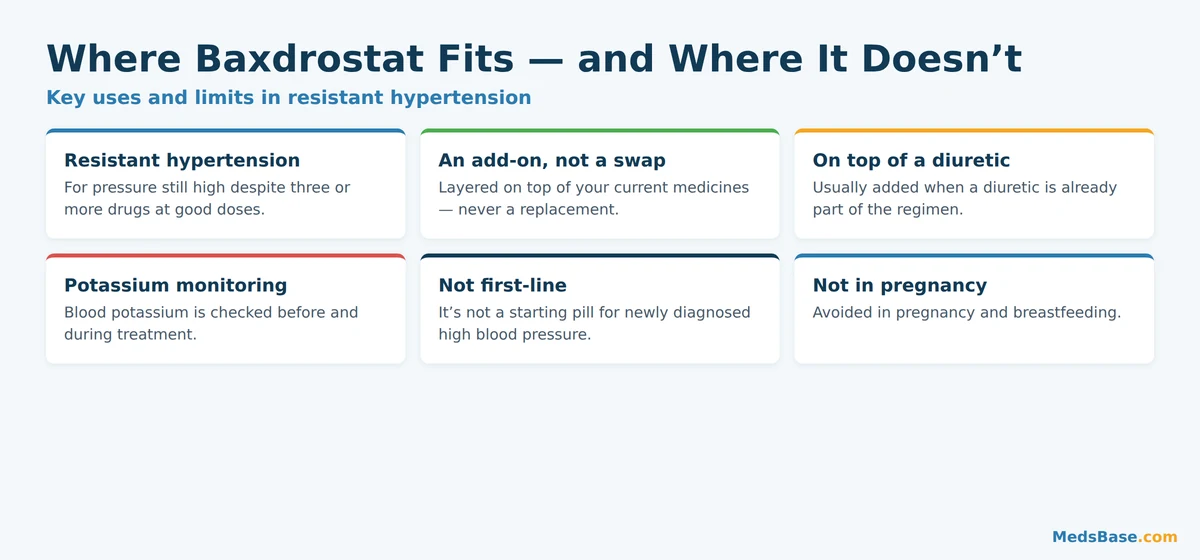
Baxdrostat’s approved role is narrow on purpose: it’s add-on therapy for adults with uncontrolled or resistant hypertension who are already on other medicines. It is not a first-choice pill for newly diagnosed high blood pressure, and it isn’t a substitute for the basics.
Where it fits best
- True resistant hypertension — pressure still above goal on three well-chosen drugs including a diuretic.
- Aldosterone-driven cases — people whose biology leans on the salt-retaining hormone baxdrostat targets.
- When a receptor blocker wasn’t tolerated — some patients can’t stay on spironolactone; a synthase inhibitor is a different approach to the same pathway.
Where it doesn’t belong
- Mild, newly diagnosed hypertension that hasn’t tried first-line drugs and lifestyle change.
- Pregnancy — hormone-pathway drugs are generally avoided; this is a talk-to-your-doctor situation.
- People prone to high potassium — the very mechanism that helps can push potassium up (more on that next).
Because baxdrostat is brand-only and prescriber-led, most readers land here to understand their options, not to buy this exact drug. That’s the right instinct. The good news is that the accessible, budget-friendly option we’ll name shortly hits the same hormone — and MedsBase stocks it without the prescription hurdle many people dread. Keep reading to the alternatives section.
Safety, Side Effects & the Potassium Question
Now the number we teased. Because baxdrostat lowers aldosterone, it can raise potassium — a condition called hyperkalemia. High potassium is usually silent but, at extremes, it can disturb heart rhythm. This single value is the main reason for careful patient selection and follow-up bloodwork.
The reassuring part: across the baxdrostat trials, confirmed high potassium (above 6 mmol/L) stayed uncommon — though pooled data put it at roughly five times the placebo rate (odds ratio about 5), and it occasionally led to stopping the drug. That’s a manageable, monitorable risk for the right patient — not a reason for panic, and not something to hand-wave away either.
| Side effect | Frequency | Severity | What to do |
|---|---|---|---|
| High potassium (hyperkalemia) | Uncommon (~1% at >6 mmol/L) | Potentially serious | Baseline + follow-up blood tests; report muscle weakness or palpitations |
| Low sodium (hyponatremia) | Uncommon | Mild–moderate | Monitor labs; watch for confusion, headache, fatigue |
| Dizziness / low blood pressure | Occasional | Usually mild | Stand up slowly; tell your doctor if faint |
| Headache | Occasional | Mild | Usually settles; hydrate |
| Fatigue | Occasional | Mild | Often improves; review if persistent |
A pharmacist’s practical note: the patients who run into trouble are usually the ones also taking other potassium-raising medicines — certain older blood pressure drugs, potassium supplements, or salt substitutes (which are often potassium chloride). If you take any of those, that’s exactly the conversation to have before starting. The safe path isn’t avoiding the drug — it’s testing potassium before and after, and knowing your own kidney function.
There’s a second lab to keep half an eye on: sodium. Because the drug reduces salt-and-water retention, sodium can occasionally dip too low, especially in older adults or those on other diuretics. It’s usually mild and picked up on the same blood test, but symptoms like new confusion, persistent headache or unusual fatigue are worth reporting rather than shrugging off. None of this makes baxdrostat a dangerous drug — it makes it a monitored one, which is a very different thing. The medicines that need no monitoring at all are often the ones doing the least.
That resolves the open loop from the intro: the one value that can rule you out is potassium, and it’s why bloodwork follows you into the first weeks of treatment.
What the BaxHTN Research Actually Showed
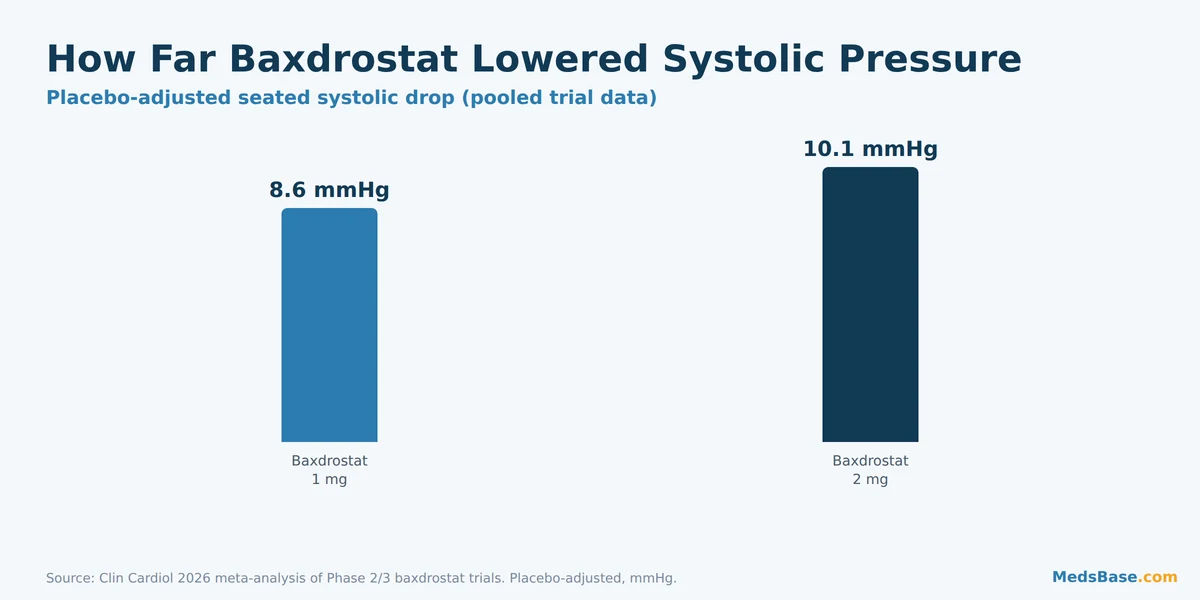
The approval rests largely on BaxHTN, a Phase 3 trial in patients with uncontrolled or resistant hypertension in which roughly 796 patients were randomised to baxdrostat or placebo on top of their existing blood pressure drugs. Pooling BaxHTN with the earlier baxdrostat studies, a 2026 meta-analysis of the Phase 2/3 trials quantified how far pressure actually fell — and what it cost in side effects.
| Study | Year | Key finding | Source |
|---|---|---|---|
| Baxdrostat trials (pooled) | 2026 | Placebo-adjusted seated systolic drop: ~8.6 mmHg (1 mg), ~10.1 mmHg (2 mg) | Clin Cardiol meta-analysis |
| Hyperkalemia (pooled) | 2026 | Potassium ≥6 mmol/L about 5× more likely than placebo (OR 5.14); still uncommon | Clin Cardiol meta-analysis |
| Class rationale (BaxHTN design) | 2025 | Aldosterone synthase inhibition lowers a hormone tied to salt retention and vascular strain | Trial-programme design |
Put the numbers in context. The absolute seated systolic drop from baseline was larger still — but a good chunk of any blood-pressure trial’s fall comes from the placebo effect and closer monitoring, which is why the placebo-adjusted figure of roughly 8.6–10.1 mmHg is the honest one to quote. The trial also met its secondary endpoints and the reductions held through the maintenance phase rather than fading after a few weeks, which matters for a condition you treat for life.
What this means for you: an extra ~9–10 mmHg off systolic pressure, on top of the drugs you already take, is clinically meaningful — enough to move many people from “uncontrolled” toward goal. To put it in perspective, epidemiological data suggest even a 10 mmHg systolic reduction is associated with a meaningfully lower long-term risk of stroke and heart events across populations — though that’s population-level association, not a promise for any one person. Averages also hide variation: some people respond strongly, others modestly. And these are blood-pressure-lowering results measured over months; the bigger question — whether baxdrostat itself cuts strokes and heart attacks over years — is still being studied. Early studies indicate the mechanism is sound; hard outcome data will take longer. That honesty is the point: a real number, real limits.
Take Sarah, 58 — a purely illustrative example. She’s on an ARB, a calcium channel blocker and a diuretic, exercises, watches her salt, and her home readings still sit around 150/92. Her doctor confirms she’s taking everything correctly, checks her potassium (normal), and adds an aldosterone-pathway drug. Within a couple of months her systolic drifts into the 130s. Sarah’s story isn’t a guarantee — plenty of people respond less — but it’s the pattern this class was built for: the well-managed patient who has genuinely run out of conventional room.
Baxdrostat vs the Alternatives You Can Get Today
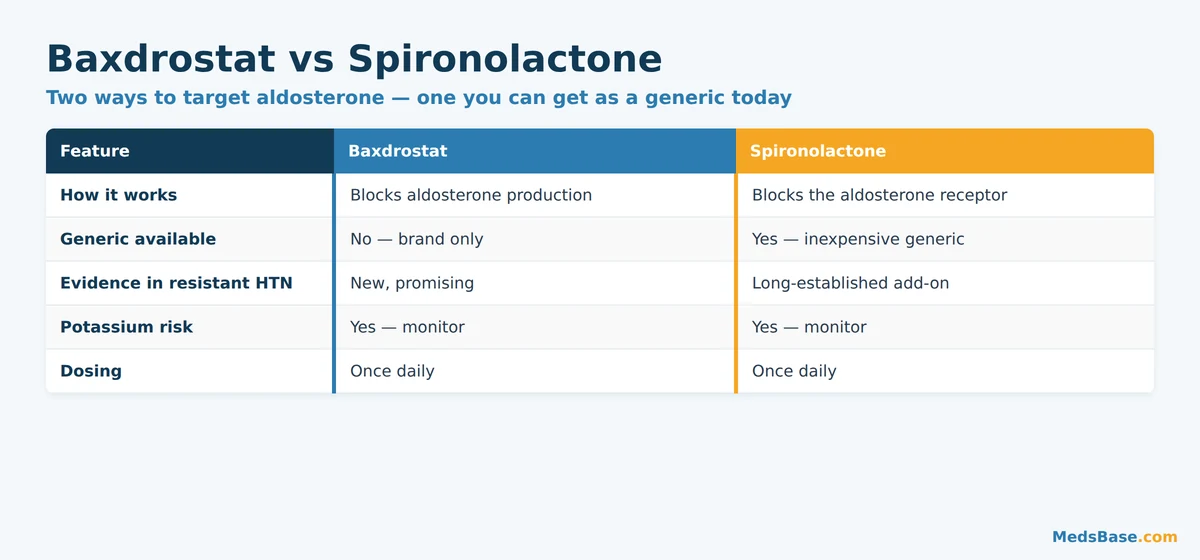
Here’s where it gets practical. Baxdrostat is impressive, but it’s brand-only and not yet available as a generic, which puts it out of reach for many people on cost alone. The encouraging news: there’s an older, inexpensive drug that works on the same aldosterone pathway — just at a different point.
That drug is spironolactone. It’s a mineralocorticoid receptor antagonist: instead of reducing aldosterone production, it blocks the receptor aldosterone acts on. In studies of resistant hypertension, spironolactone has long been one of the most effective add-on options — which is why guidelines often reach for it before anything exotic. The MedlinePlus spironolactone page covers its uses and the same potassium caution that applies to baxdrostat.
| Feature | Baxdrostat | Spironolactone | Standard triple therapy |
|---|---|---|---|
| Mechanism | Blocks aldosterone production (synthase) | Blocks aldosterone receptor | ACE/ARB + calcium blocker + diuretic |
| Approved role | Add-on for resistant/uncontrolled HTN | Add-on (well-established for resistant HTN) | First-line foundation |
| Generic available? | Not yet | Widely | Widely |
| Main lab to watch | Potassium | Potassium | Varies by drug |
| Extra note | Newest, precise, costly | Cheap; can cause breast tenderness in some men | The base everyone should optimise first |
Which fits which situation? If you’ve never optimised a receptor blocker and cost matters, spironolactone is the pragmatic first move — decades of use, pennies per dose, and strong resistant-hypertension evidence. Landmark research established spironolactone as one of the most effective add-on drugs when three agents aren’t enough, which is exactly why guidelines reach for it early. If you couldn’t tolerate spironolactone’s hormonal side effects — in some men it can cause breast tenderness — or your specialist wants the newest precision tool, baxdrostat becomes the conversation. Either way, the foundation — a sensible ACE inhibitor or ARB, a calcium channel blocker, and a diuretic at proper doses — should be solid first. For the full class-by-class picture, our guide to which blood pressure drug classes actually work lays out all ten evidence-backed options.
It’s also worth being clear-eyed about access. Baxdrostat’s newness and brand-only status mean cost and availability will shape who actually gets it in the near term, regardless of the science. Spironolactone doesn’t have that problem — it’s one of the most available cardiovascular drugs on the planet. For a lot of readers, the most useful outcome of a baxdrostat headline is simply learning that an affordable, same-pathway option they may not have tried yet already exists.
MedsBase stocks spironolactone as Aldactone — the accessible, same-pathway generic option to discuss with your clinician, available without the prescription barrier many pharmacies impose.
Practical Steps Before You Ever Start It
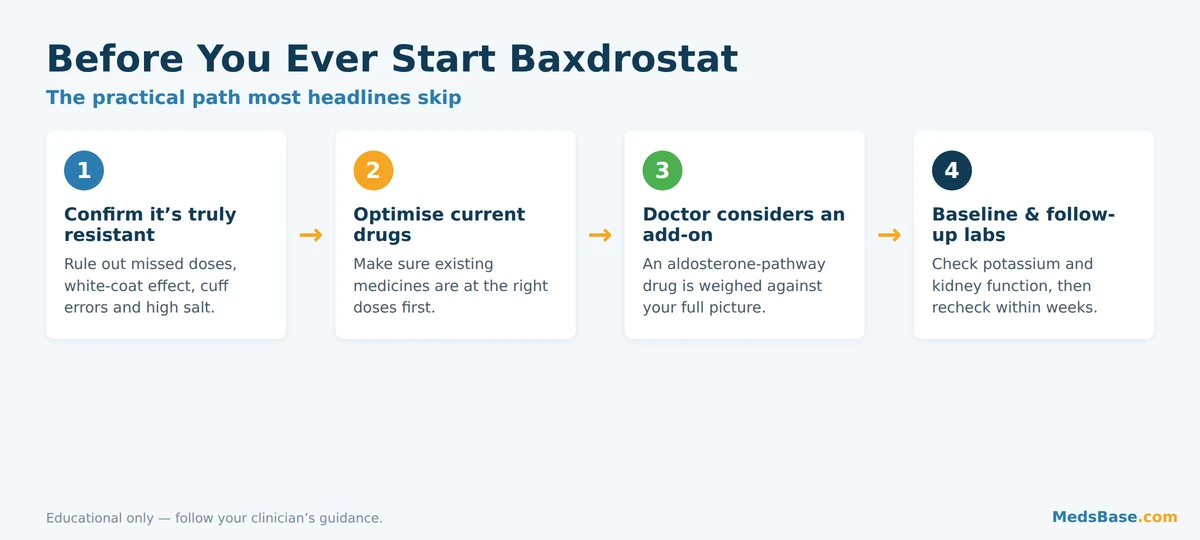
Whether the endpoint is baxdrostat or spironolactone, the runway looks the same. Rushing to a new drug before doing these steps is the most common mistake pharmacists see.
- Confirm it’s truly resistant. Rule out pseudo-resistance: check adherence honestly, use a correctly sized cuff, measure at home over a week, and review salt intake. Numbers that only spike in the clinic may not need a new drug at all.
- Optimise what you already take. Are your current three drugs at proper doses, and is one of them a diuretic? Under-dosing is common and fixable.
- Get baseline bloodwork. Potassium, sodium and kidney function before starting anything that touches the aldosterone pathway.
- Add on under guidance. Baxdrostat and spironolactone are add-ons, layered onto a solid base — not swaps for it.
- Recheck labs early. Potassium is usually rechecked within about one to four weeks, then periodically. This is non-negotiable, not optional.
Mistakes to avoid: doubling up on potassium-raising drugs without testing; stopping your existing pills when you add a new one; using potassium-based salt substitutes without telling your doctor; and treating a single high clinic reading as proof of resistance.
If you want to explore accessible options while you have that conversation, you can browse our Heart & Blood Pressure range to see what’s available — then bring specifics to your clinician rather than starting anything solo.
Frequently Asked Questions
Q: Is baxdrostat available as a generic?
A: No — baxdrostat is a brand-only, first-in-class drug and there is no generic version yet. That keeps its cost high for now. If price is a barrier, the same aldosterone pathway can be targeted with spironolactone, which is widely available as an inexpensive generic and has strong evidence in resistant hypertension.
Q: How much does baxdrostat lower blood pressure?
A: In pooled trial data, baxdrostat lowered seated systolic pressure by roughly 8.6 mmHg (1 mg) to 10.1 mmHg (2 mg) more than placebo, on top of existing medicines. That’s clinically meaningful, but individual responses vary — some people benefit more, others less.
Q: What is the difference between baxdrostat and spironolactone?
A: Both target aldosterone, but at different points. Baxdrostat is an aldosterone synthase inhibitor: it reduces how much aldosterone the body makes. Spironolactone is a receptor blocker: it stops aldosterone from acting once made. Baxdrostat is newer and brand-only; spironolactone is old, cheap and generic.
Q: Who should not take baxdrostat?
A: People with advanced kidney disease, a history of high potassium, or those already on potassium-raising drugs or supplements should be cautious. It’s generally avoided in pregnancy and breastfeeding. Anyone considering it needs baseline and follow-up potassium and kidney testing.
Q: Does baxdrostat cause high potassium?
A: It can. Because it lowers aldosterone, potassium may rise. In pooled trial data, confirmed potassium above 6 mmol/L stayed uncommon but was about five times more likely than with placebo — which is why bloodwork is checked before and after starting.
Q: What counts as resistant hypertension?
A: Broadly, blood pressure that stays above goal despite three different blood pressure drugs (usually including a diuretic) at good doses — or pressure that needs four or more drugs to control. Before that label is applied, clinicians rule out missed doses, white-coat effect, cuff errors and high salt intake.
Q: Can I stop my other blood pressure pills if I start an aldosterone drug?
A: No. Baxdrostat and spironolactone are add-ons designed to work alongside your existing medicines, not replace them. Stopping your foundation drugs can send pressure sharply back up. Any changes should be made only with your prescriber.
The Bottom Line
Baxdrostat for resistant hypertension is a genuine step forward — the first aldosterone synthase inhibitor, with a real ~9–10 mmHg systolic edge over placebo in patients whose pressure wouldn’t otherwise budge. It’s precise, it’s promising, and it targets a hormone pathway older drugs only reached indirectly. It’s also brand-only, prescriber-led, and requires potassium monitoring — so it’s a specialist’s tool, not a quick fix.
Your one immediate action: if you’re on three or more pressure drugs and still above goal, ask your clinician two questions — “Is this truly resistant, or could it be adherence, cuff size or salt?” and “Have we tried an aldosterone-pathway add-on like spironolactone yet?” That single conversation resolves most cases long before a brand-new drug is needed.
Still weighing the pieces? These are the natural next questions:
- Wondering how the everyday drugs stack up? Read which blood pressure medications are actually backed by evidence.
- Heading somewhere by car, boat or plane with your medicines? Our new guide to motion sickness medication pairs perfectly with a travel-ready medication routine.

Written by
Sophie ChenPharmaceutical Content Researcher · 8 years experience
Sophie Chen is a pharmaceutical content researcher with 8 years covering generic medication access and clinical pharmacology. She specialises in international regulatory frameworks, bioequivalence standards, and patient-facing education on therapeutic drug classes. She is not a clinician.