








✓ Medically reviewed by · Last reviewed: May 2026
Pharmacy Researcher · 8 years experience
Pharmacy researcher with 8 years reviewing clinical drug information, generic formulation equivalence, and international pharmaceutical standards. Focuses on patient-facing accuracy in medication education.
The appointment probably went something like this. Your gastroenterologist confirmed the inflammation sits in the lower part of your colon, said something brisk and reassuring about “starting with topical mesalamine”, and you nodded politely — and now you’re at the kitchen table, googling mesalamine suppository vs enema and wondering what exactly you agreed to. If that’s you, take a breath. This choice is far more practical than it first sounds, and by the end of this guide you’ll know which formulation matches which disease extent, how to use each one without dreading bedtime, and when adding an oral tablet genuinely raises your odds of remission. One number — 15 centimetres — settles most of the decision, and we’ll get to it shortly. There’s also a counterintuitive research finding about the swallowed version of this drug that surprises almost everyone. And if the whole subject makes you cringe, keep reading anyway: rectal therapy is among the best-evidenced treatments in ulcerative colitis, which is precisely why your GI reached for it first.
- A mesalamine suppository treats roughly the last 10–15 cm — the rectum — which makes it first-line for ulcerative proctitis. But it has a hard geographic limit.
- A 60 ml mesalamine enema can spread as far as the splenic flexure — the right tool for left-sided disease, if you can hold it in. There’s a technique, and it’s learnable.
- For disease within reach, the rectal route performs at least as well as swallowing the same drug — and guidelines put it first. The reason is mechanical, not chemical.
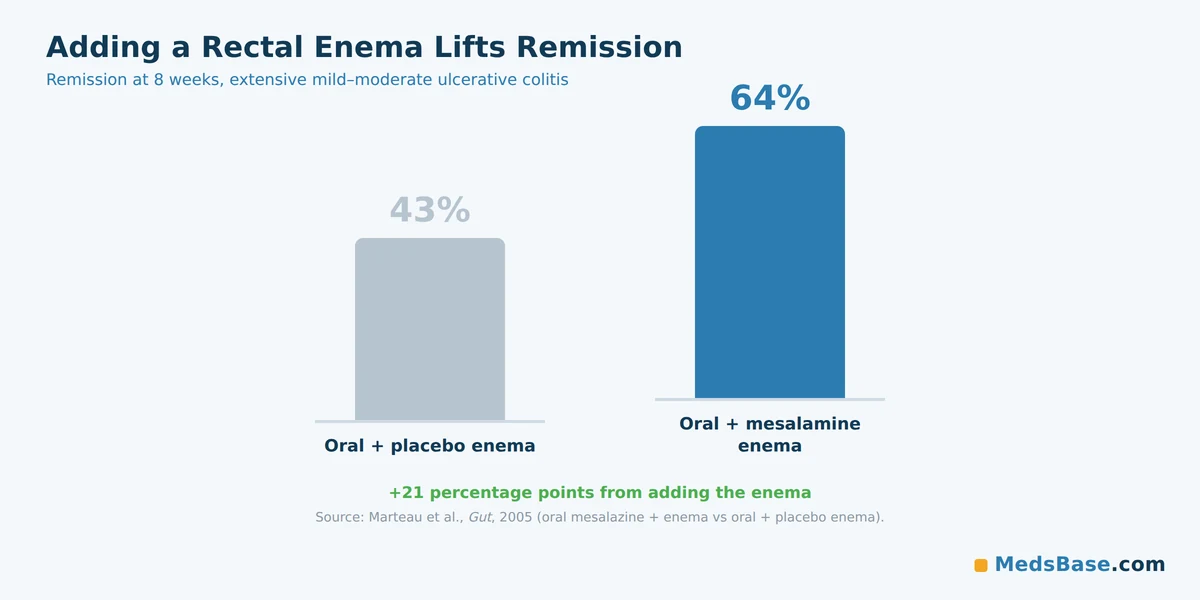
- For flares of more extensive disease, combining oral and rectal mesalamine lifted remission from 43% to 64% in a landmark trial.
- Mesalamine is not an antibiotic and not a steroid — a mix-up that quietly makes people quit it too early.
- Fever, heavy bleeding or weight loss means topical therapy alone is no longer the plan — that’s a prompt-doctor-visit situation, not a formulation question.
Table of Contents
- Mesalamine suppository vs enema: what are you actually choosing between?
- How rectal mesalamine works — why place beats dose
- Which formulation fits which disease extent?
- The head-to-head comparison table
- Safety, side effects & the red flags that change the plan
- What the research says about the rectal route
- How to actually use each one — without dreading bedtime
- Frequently asked questions
- The bottom line
Mesalamine Suppository vs Enema: What Are You Actually Choosing Between?
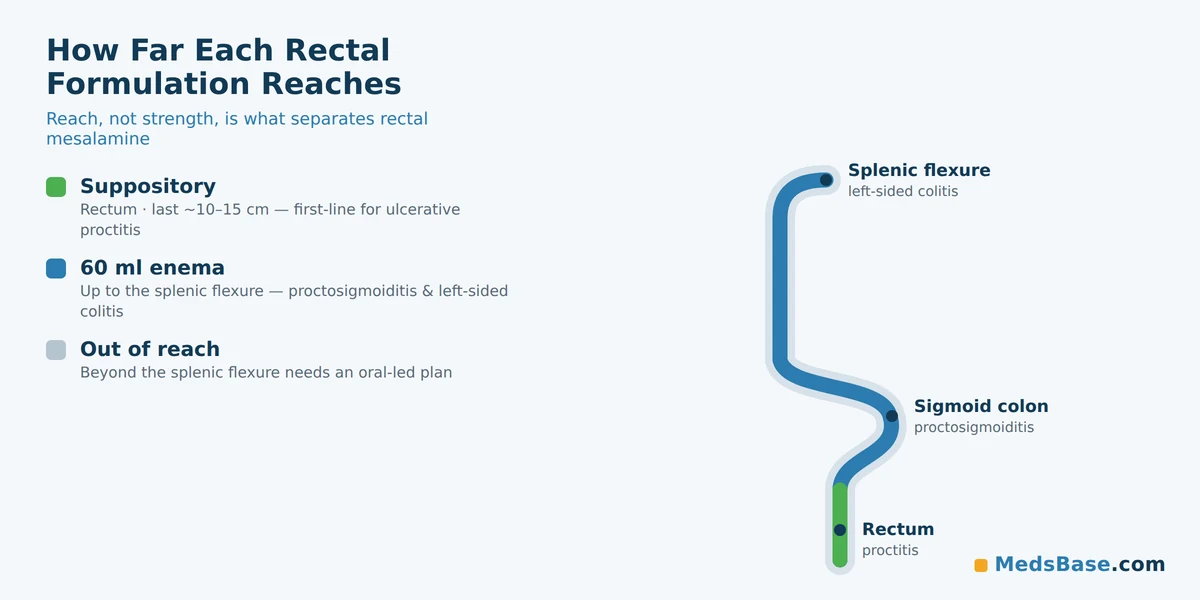
Rectal mesalamine is an anti-inflammatory drug — a 5-aminosalicylate, or 5-ASA — placed directly into the lower bowel. A mesalamine suppository is a solid, bullet-shaped dose that melts in the rectum and treats roughly the last 10–15 cm. A mesalamine enema is a 60 ml liquid that spreads further, up to the bend called the splenic flexure.
Same molecule, two delivery vehicles. The entire mesalamine suppository vs enema question comes down to one thing: how far up your colon the inflammation goes.
Before we get there, two things mesalamine is not — because this confusion genuinely changes how people take it. It is not an antibiotic: it doesn’t kill bacteria, and there’s no “course” to finish, because it works only while you keep using it. It is also not a steroid: it isn’t prednisone or budesonide, and it doesn’t carry the steroid baggage of bone thinning, weight gain or mood swings. It’s an anti-inflammatory that calms the bowel lining directly, which is why clinicians are comfortable using it long term.
Now the vocabulary that decides everything. Ulcerative colitis is described by its disease extent — how far the inflammation reaches from the rectum upward. Ulcerative proctitis means the rectum only. Proctosigmoiditis adds the sigmoid colon just above it. Left-sided ulcerative colitis extends up to the splenic flexure — the sharp bend under your ribs on the left. Anything beyond that is called extensive disease.
Dig out your last colonoscopy or sigmoidoscopy report — the sentence naming your disease extent is the single most useful line in this entire decision.
How Rectal Mesalamine Works — Why Place Beats Dose
Mesalamine is a contact drug. It calms inflammation in the bowel lining it physically touches, working from the inside surface rather than through your bloodstream — only a modest amount is absorbed into the body at all. Think of it like aloe on sunburn: it soothes exactly the skin it covers, and the skin it never reaches gets no benefit.
That’s why the swallowed version of the same molecule can disappoint in distal disease. Oral mesalamine tablets are engineered to release along the colon, but by the time the drug travels the full length of the bowel, what arrives at the rectum is diluted — and during an active flare, rapid transit can hurry it out before it delivers. The most inflamed segment in distal colitis is often the most under-dosed by mouth. Rectal delivery flips that: a high concentration lands precisely where the disease lives.
Here’s where it gets interesting. Because topical 5-ASA works by contact, the practical question is never “is this dose strong enough?” but “can this formulation physically reach the inflamed segment?” A suppository can’t treat what it can’t touch — and no dose increase fixes geography.
One line to remember: rectal mesalamine succeeds because it puts the drug where the disease actually is. Same molecule, different postcode.
Which Formulation Fits Which Disease Extent?
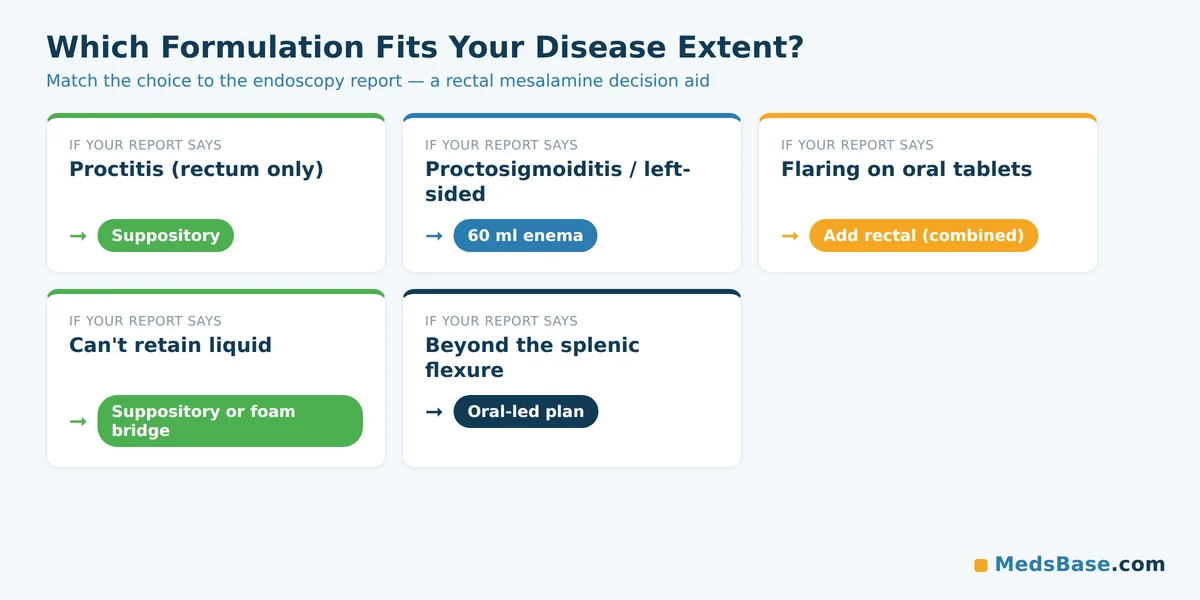
This is the section your GI summarised in one sentence. Here’s the fuller version — and it maps cleanly onto that endoscopy report you just dug out. The American College of Gastroenterology’s ulcerative colitis guideline builds its treatment recommendations around exactly this: match the therapy to the disease extent and severity.
The suppository: purpose-built for ulcerative proctitis
Here’s the 15-centimetre rule we promised. A mesalamine suppository melts against the rectal wall and holds a concentrated dose in roughly the last 10–15 cm of bowel. If your report says ulcerative proctitis — inflammation confined to the rectum — a suppository covers essentially all of it, which is why it’s the standard first choice for proctitis.
The practical upside is real. The routine takes under a minute, there’s no apparatus, nothing to prepare, and retention is easy: because it’s a small solid rather than 60 ml of liquid, most people hold it comfortably for hours, often overnight. For a treatment you may use nightly for weeks — and intermittently for the long haul — that convenience is not a small thing. It’s the difference between a therapy you actually take and one that sits in the bathroom cabinet.
Take Ana, 31 — an illustrative example, not a real patient. Diagnosed with proctitis, she quietly asked for “just tablets” because it felt less awkward, and limped along with partial relief for two months. When she finally switched to a nightly suppository, the bleeding settled within a couple of weeks. Gastroenterologists see this pattern constantly: the formulation nobody wants to talk about is the one that works.
The enema: coverage for proctosigmoiditis and left-sided ulcerative colitis
If your inflammation extends beyond the rectum into the sigmoid or descending colon, a suppository physically cannot reach it. This is enema territory. A 60 ml mesalamine enema, used lying on your left side and retained properly, spreads with gravity along the descending colon and can reach as far as the splenic flexure — covering proctosigmoiditis and left-sided ulcerative colitis.
The trade-off is technique. A liquid must be held in by you, not by anatomy, and an inflamed rectum is twitchy and uncooperative — which is why we’ve given the enema its own honest troubleshooting section later. Retention, not reach, is where enemas succeed or fail.
When you need both oral and topical
But there’s a catch worth knowing even if your disease is limited: for flares — and for anything beyond the splenic flexure — one route often isn’t enough. This is where combined oral and topical therapy earns its place.
The landmark evidence: in a randomised double-blind trial in Gut, patients with extensive mild-to-moderate ulcerative colitis all took oral mesalazine, and were randomised to add either a nightly mesalamine enema or a placebo enema. At eight weeks, remission was 64% with the real enema versus 43% without — a 21-point lift from adding the rectal route on top of tablets. A meta-analysis of twelve trials reached the same conclusion: combined therapy beat oral alone for inducing remission, with a number needed to treat of just five.
The logic runs both ways. The tablets blanket the whole colon and carry the maintenance load; the rectal dose concentrates firepower on the distal segment where symptoms like urgency and bleeding are generated. If you want the tablet half of the story, our full oral mesalamine guide walks through the delayed-release brands and how they differ. MedsBase also stocks oral mesalamine as Mesacol — check availability and agree the dose with your clinician, since oral and rectal doses are set independently.
Mesalamine Suppository vs Enema: The Head-to-Head Table
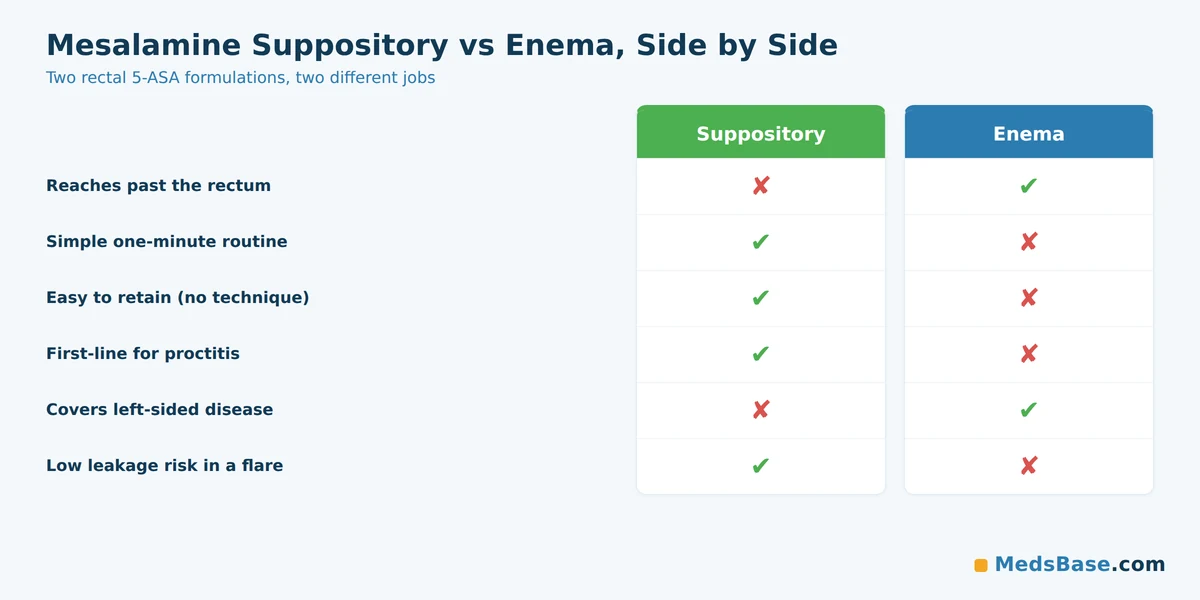
Here’s the whole decision in one place — the table to screenshot before your next appointment.
| Feature | Mesalamine suppository | Mesalamine enema |
|---|---|---|
| Reach | Rectum — roughly the last 10–15 cm | Up to the splenic flexure |
| Best-fit disease extent | Ulcerative proctitis | Proctosigmoiditis, left-sided ulcerative colitis |
| Form & typical adult dose | Solid; commonly 1,000 mg nightly | 60 ml liquid; commonly 4 g nightly |
| Retention target | 1–3 hours or longer — easy for most people | At least 30 minutes; ideally overnight (~8 h) |
| Technique required | Minimal — under a minute, no apparatus | Real technique — left side, slow squeeze, stay lying |
| Leakage risk during a flare | Low | Moderate — an inflamed rectum resists 60 ml |
| Discretion & routine | Simplest; travel-friendly | Needs a bed, a towel and an unhurried evening |
| Time to first improvement | Often within days to a few weeks | Often within days to a few weeks |
| Where it wins | Rectal disease; retention problems; simplicity | Disease beyond the rectum’s reach |
The verdict in three sentences. If your disease extent is proctitis, choose the suppository — it covers the whole inflamed segment with the easiest routine, and “stronger” formulations add nothing but hassle. If inflammation extends beyond the rectum but not past the splenic flexure, the enema is doing a job the suppository physically can’t. And if you’re flaring on oral tablets — at any distal extent — the evidence says add the rectal formulation rather than swap anything, because combined oral and topical therapy beats either alone.
Safety, Side Effects & the Red Flags That Change the Plan
Some genuinely reassuring context first: 5-ASAs are among the best-tolerated long-term drugs in all of gastroenterology, and the rectal route keeps absorption into the body modest. Most people notice either nothing or minor, settling-in effects in the first week or two. The MedlinePlus mesalamine rectal reference carries the full consumer list; here’s the practical version.
| Side effect | Frequency | Severity | What to do |
|---|---|---|---|
| Anal irritation or discomfort | Common early on | Mild | Usually settles; a water-based lubricant on the tip helps; persistent ask about switching formulation |
| Abdominal pain, cramping, gas | Common | Mild | Typically transient; mention it at review if it lingers |
| Headache or dizziness | Occasional | Mild | Hydrate; rise slowly; report if persistent |
| Leakage or urgency with enemas | Occasional, mostly during flares | Mild but demoralising | Technique fixes below — this is solvable, not a personal failure |
| Acute intolerance syndrome — cramping and bloody diarrhoea that mimics a flare | Rare | Serious | Stop and call your doctor; do not push through or increase the dose |
| Hypersensitivity (rash, fever, chest pain, swelling) | Rare | Serious | Seek urgent care |
| Kidney inflammation (interstitial nephritis) | Rare | Serious | Silent — which is why periodic kidney blood tests are part of mesalamine care |
That fourth-row promise from the intro resolves here, and so does a subtler trap: the rare acute intolerance syndrome looks exactly like the disease getting worse. If your symptoms clearly deteriorate after starting mesalamine, the right move is a phone call, not perseverance. Your clinician can tell flare from reaction; you shouldn’t have to guess.
What Does the Research Say About the Rectal Route?
Now for the finding we teased at the start — the one that surprises almost everyone. For disease within its reach, the formulation nobody wants to discuss performs at least as well as swallowing the same drug. In the Ford meta-analysis of 5-ASA trials, topical therapy was at least comparable to oral for active distal disease (relative risk 0.82, a trend favouring the rectal route that didn’t reach statistical significance), and for preventing relapse, intermittent topical 5-ASA actually beat oral tablets, with a number needed to treat of four.
| Study | Year | Key finding | Source |
|---|---|---|---|
| Marshall et al., Cochrane review | 2010 | Rectal 5-ASA vs placebo: pooled OR 8.87 for symptomatic improvement (8 trials); recommended as first-line for mild-moderate distal UC | Cochrane Database Syst Rev |
| Ford et al., meta-analysis (12 RCTs) | 2012 | Combined oral + topical superior to oral alone for inducing remission (NNT 5); topical ≥ oral for distal disease; intermittent topical better than oral for relapse prevention (NNT 4) | Am J Gastroenterol |
| Marteau et al., RCT | 2005 | Extensive mild/moderate UC: remission 64% with oral + mesalamine enema vs 43% with oral + placebo enema at 8 weeks; improvement 86% vs 68% | Gut |
| Rubin et al., ACG guideline | 2019 | US specialty-society guideline anchoring UC therapy choice to disease extent and severity | Am J Gastroenterol |
What this means for you: the research consistently rewards adding reach rather than adding strength. If your disease is distal, rectal mesalamine isn’t the consolation prize while you wait for “proper” tablets — the evidence base treats it as the lead therapy. And if you flare on tablets, the single best-evidenced next move is usually combined oral and topical therapy, not abandoning the 5-ASA class. One honest caveat: research suggests, it doesn’t promise — response varies between individuals, head-to-head topical-vs-oral superiority isn’t statistically settled, and the optimal dosing schedules are still debated. That’s a conversation for your GI, armed with your disease extent.
How to Actually Use Each One — Without Dreading Bedtime
A pharmacist’s honest reassurance before the steps: almost everyone finds this awkward for about three nights, and then it becomes as unremarkable as brushing your teeth. Routine kills embarrassment faster than anything we could write here.
Using mesalamine suppositories: the one-minute routine
- Time it for bedtime, ideally after a bowel movement — the longer it stays, the longer the contact time.
- Wash your hands. If the suppository has softened in a warm bathroom, cool it briefly (fridge or cold water while wrapped) — firm is easier to insert.
- Lie on your side with your upper knee drawn toward your chest.
- Insert pointed end first, a couple of centimetres beyond the sphincter, and stay lying down for a few minutes.
- Aim to keep it in for 1–3 hours or longer — overnight is ideal, per the MedlinePlus guidance. Most people sleep straight through.
MedsBase stocks rectal mesalamine as Pentasa Suppositories — see options and confirm the right strength for you with your doctor or pharmacist. No prescription needed.
Using a mesalamine enema: the technique that makes or breaks it
- Plan it as the last act of the day, after your final bowel movement — you’re going to stay in bed afterwards.
- Shake the bottle well and remove the cover; lay a towel over the sheet on the first few nights.
- Lie on your LEFT side, right knee bent up toward your chest. The left side matters: your descending colon runs down your left flank, so gravity becomes your delivery system, carrying the liquid toward the splenic flexure.
- Insert the tip pointing slightly toward your navel, then squeeze slowly and steadily — a rushed squeeze triggers urgency.
- Stay on your left side for at least 30 minutes. Best of all, simply go to sleep and retain it overnight — around 8 hours, per MedlinePlus.
What if you can’t hold a mesalamine enema in?
This deserves its own honest section, because it’s the number-one reason enemas get abandoned — and it’s fixable. During an active flare, the rectum is inflamed, spastic and intolerant of volume. Leakage or an immediate urge to evacuate is common physiology, not failure.
Three fixes, in order. First, audit the technique: left side, empty bowel beforehand, slow squeeze, no getting up — each of these measurably improves retention. Second, ask your GI about a bridge strategy: calm the rectum first with a suppository — or a 5-ASA foam where available, which is lower-volume and easier to hold — for a week or two, then step up to the full enema once retention becomes realistic. Third, if liquid retention never works for you, say so plainly at your review; an effective therapy you can actually retain beats an ideal one you can’t.
Pharmacists commonly see enemas abandoned after two messy nights — when the actual fix was a suppository bridge and a fresh start ten days later. Persistence has a strategy; it isn’t gritted teeth.
Mistakes to avoid with both formulations:
- Using either one standing up, or walking around straight after insertion.
- Judging retention during the worst week of a flare — that’s the bridge-strategy window.
- Stopping the moment symptoms settle. Mesalamine also prevents relapse, and the maintenance evidence for the rectal route is strong — stopping early is how remissions get shortened.
- Treating it like an antibiotic course with an end date. It works while you use it.
- Quietly dropping the oral tablets because the rectal therapy is going well — in combined oral and topical therapy, each half has its own job.
Frequently Asked Questions
Q: Is mesalamine an antibiotic or a steroid?
A: Neither. Mesalamine is a 5-aminosalicylate (5-ASA) — an anti-inflammatory that calms the bowel lining it touches directly. It doesn’t kill bacteria like an antibiotic, and it doesn’t suppress your immune system the way steroids such as prednisone do. That’s why it’s considered suitable for long-term maintenance use, and why there’s no “course” to finish — it works while you keep using it.
Q: How long do you keep a mesalamine enema in?
A: At least 30 minutes, lying on your left side — but the goal is much longer. The MedlinePlus guidance is to retain it for about 8 hours where possible, which is why the standard advice is to use it at bedtime after your last bowel movement and simply sleep with it in. Longer contact time means more drug delivered to the inflamed lining.
Q: How far does a mesalamine enema reach?
A: A 60 ml mesalamine enema, used correctly on your left side, can spread along the descending colon as far as the splenic flexure — the bend under your left ribs. That’s why it suits proctosigmoiditis and left-sided ulcerative colitis. A suppository, by contrast, treats only the rectum — roughly the last 10–15 cm.
Q: Can you use mesalamine suppositories and oral mesalamine together?
A: Yes — and for flares, that combination is often the best-evidenced move. Combined oral and topical 5-ASA beat oral therapy alone for inducing remission in a 12-trial meta-analysis (number needed to treat: five), and adding a nightly enema to tablets lifted remission from 43% to 64% in extensive disease. Doses are set independently, so confirm both with your clinician.
Q: What if I can’t hold a mesalamine enema in?
A: First, fix the technique: use it after a bowel movement, lie on your left side, squeeze slowly, and stay lying down. If an active flare makes retention impossible, ask your GI about bridging with a suppository or a 5-ASA foam for a week or two to calm the rectum, then stepping up to the enema. Leakage during a flare is common physiology — not a reason to abandon rectal therapy altogether.
Q: How long does rectal mesalamine take to work?
A: Many people begin to feel better within the first few days to weeks — typically less bleeding and urgency first. Full courses for inducing remission generally run several weeks, and your GI may then continue a maintenance schedule. If you’ve had no improvement after a few weeks, or you’re worsening, go back for review rather than simply persisting.
Q: Which is better for ulcerative proctitis — suppository or enema?
A: The suppository. Proctitis is confined to the rectum, which a suppository covers completely while being far easier to retain — so the enema’s extra reach adds nothing except inconvenience. Rectal 5-ASA is regarded as first-line therapy for mild-to-moderate distal disease, and for pure proctitis the suppository is the standard formulation choice.
Q: Do rectal mesalamine formulations work for maintenance, or only for flares?
A: Both. Beyond inducing remission, the rectal route helps keep you there: in pooled trial data, intermittent topical 5-ASA (for example, a few nights per week) outperformed oral tablets for preventing relapse of distal disease, with a number needed to treat of four. Many maintenance plans combine a reduced rectal schedule with oral therapy — the exact recipe is individual, so set it with your GI.
The Bottom Line
In the mesalamine suppository vs enema decision, geography wins: the suppository owns the last 10–15 cm and is first-line for ulcerative proctitis; the 60 ml enema earns its learning curve by reaching the splenic flexure for proctosigmoiditis and left-sided disease; and for flares or extensive colitis, combining oral and rectal mesalamine beats either alone — 64% versus 43% remission in the landmark trial. Neither formulation is the “embarrassing” option. Both are precision tools, and the evidence treats them as front-line medicine, not a fallback.
Your one immediate action: find the disease-extent line on your last endoscopy report — proctitis, proctosigmoiditis, or left-sided — match it to the table above, and take that match to your next appointment as a question: “Is this the formulation that actually reaches my inflammation?” If you’re comparing options in the meantime, you can browse mesalamine and related gut treatments in our Gastro Health range — no prescription needed.
Two natural next questions from here:
- Wondering about the tablet half of the plan — and how the oral brands differ? Read our complete oral mesalamine guide.
- Weighing wider options for gut symptoms beyond 5-ASAs? Start with the Gastro Health category and bring the shortlist to your GI.

Written by
Sophie ChenPharmaceutical Content Researcher · 8 years experience
Sophie Chen is a pharmaceutical content researcher with 8 years covering generic medication access and clinical pharmacology. She specialises in international regulatory frameworks, bioequivalence standards, and patient-facing education on therapeutic drug classes. She is not a clinician.