








✓ Medically reviewed by · Last reviewed: May 2026
Pharmacy Researcher · 8 years experience
Pharmacy researcher with 8 years reviewing clinical drug information, generic formulation equivalence, and international pharmaceutical standards. Focuses on patient-facing accuracy in medication education.
Picture opening your medicine cabinet to three or four bottles of colitis tablets, each on its own schedule. Lialda was built to replace that clutter with a single morning dose. It is one of the most widely prescribed anti-inflammatory treatments for ulcerative colitis, and its appeal is simple: fewer pills, taken once, releasing steadily where the inflammation actually lives.
By the end of this guide you will know exactly what Lialda does, how its clever coating works, who benefits most, what side effects to watch for, and how it stacks up against older mesalamine brands. One detail surprises almost everyone the first time they hear it — a reaction that can look identical to a colitis flare — and we will resolve that in the safety section. You will also see where lower-cost generic mesalamine fits in.
- Lialda delivers mesalamine to the entire colon — but a common habit around food can change how it works.
- It is a maintenance and induction medicine, not a fast-acting rescue drug — the timeline matters.
- One rare reaction mimics a flare so closely that even doctors pause — we name it below.
- Generic mesalamine delayed-release tablets are FDA-approved and therapeutically equivalent.
- Trial data show once-daily dosing works as well as splitting the dose — with a real adherence payoff.
- Lialda is not a cure; ulcerative colitis is lifelong, and staying on treatment is what keeps flares away.
What Is Lialda?
Lialda is a brand of oral mesalamine (also spelled mesalazine), a 5-aminosalicylic acid drug that reduces inflammation directly in the lining of the large intestine. Each delayed-release tablet holds 1.2 grams, and it is designed to be taken once a day to treat and maintain remission of mild-to-moderate ulcerative colitis.
Mesalamine has been a foundation of ulcerative colitis care for decades, but older versions asked a lot of patients — two, three, even four doses spread across the day. Lialda’s makers set out to solve a very human problem: people forget pills, and forgotten pills let colitis creep back. The answer was a tablet you swallow once, with breakfast, and then forget about until tomorrow.
Outside the United States you will meet the same medicine under other names, including Mezavant in the UK and Europe. The active ingredient is identical; only the label on the box changes. That matters because mesalamine for ulcerative colitis is sold in many equivalent forms, and knowing they share one molecule helps you compare cost and convenience without fear you are getting something weaker.
It helps to remember what the drug is up against. Ulcerative colitis is a chronic inflammatory bowel disease in which the immune system attacks the lining of the colon and rectum, leaving it raw, ulcerated, and prone to bleeding. Symptoms come in waves — periods of remission where you feel normal, broken by flares of urgent, bloody diarrhea and cramping. There is no on-off switch to cure it, so treatment aims to quiet the inflammation and stretch out the good stretches. That framing explains why a maintenance drug you take even when you feel fine, like Lialda, sits at the centre of long-term care rather than on the sidelines.
How Does Lialda Work?
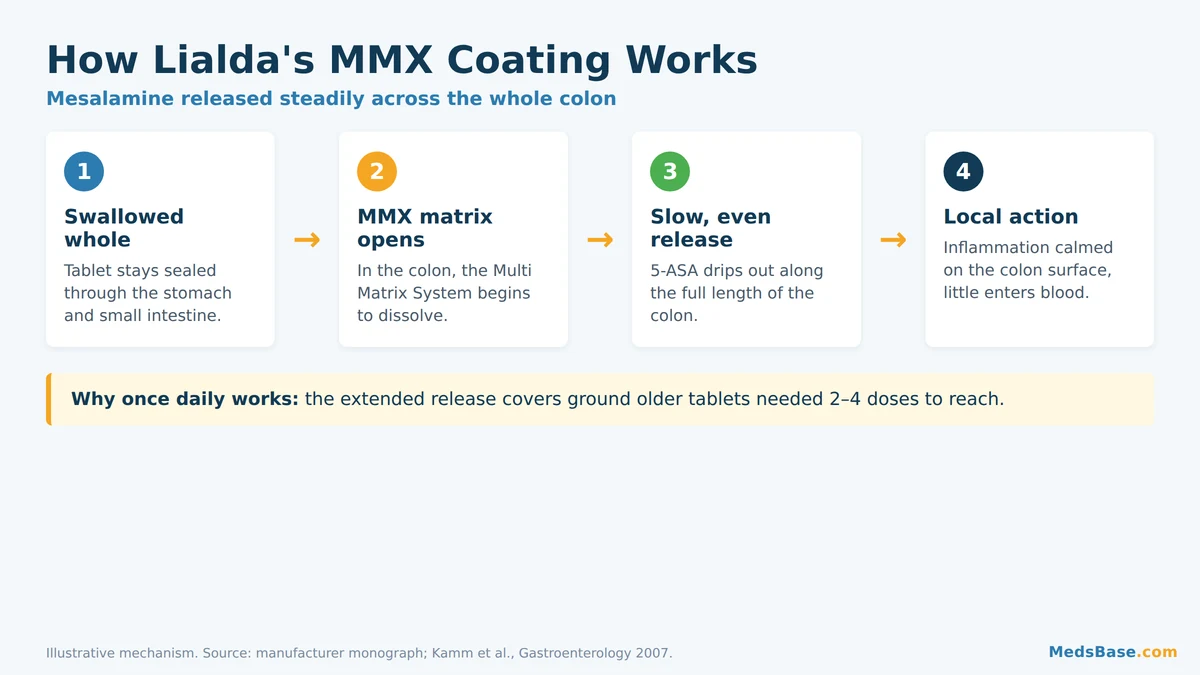
Lialda works by delivering mesalamine to the surface of the inflamed colon, where the drug dampens the local inflammatory chemicals driving ulcerative colitis. The trick is its MMX coating — a “Multi Matrix System” that keeps the tablet sealed through the stomach and small intestine, then releases the drug slowly along the whole length of the colon.
Think of it like a time-release sprinkler buried in a garden bed. A plain tablet would dump all its water in one spot near the entrance. The MMX design instead drips the medicine out gradually, so inflammation at the far end of the colon gets the same attention as the near end. This is why a single high-dose tablet can cover ground that older drugs needed several doses to reach.
Unlike steroids, which switch off inflammation body-wide and carry heavy long-term costs, mesalamine acts mostly where it lands. Very little enters the bloodstream in active form. That local action is the reason 5-ASA drugs like Lialda are considered gentle enough for years of continuous use, while steroids are reserved for short bursts.
The exact biology is still being pieced together, which is worth being honest about. Researchers believe mesalamine calms inflammation through several overlapping routes: it scavenges the reactive oxygen molecules that damage the gut lining, blocks inflammatory signalling pathways, and appears to activate a receptor called PPAR-gamma that helps switch inflamed cells back toward normal. You do not need to memorise any of that. The practical point is that mesalamine works on the colon’s surface rather than by suppressing your whole immune system — a meaningfully different risk profile from the stronger drugs used in severe disease.
Key Uses & Applications of Lialda
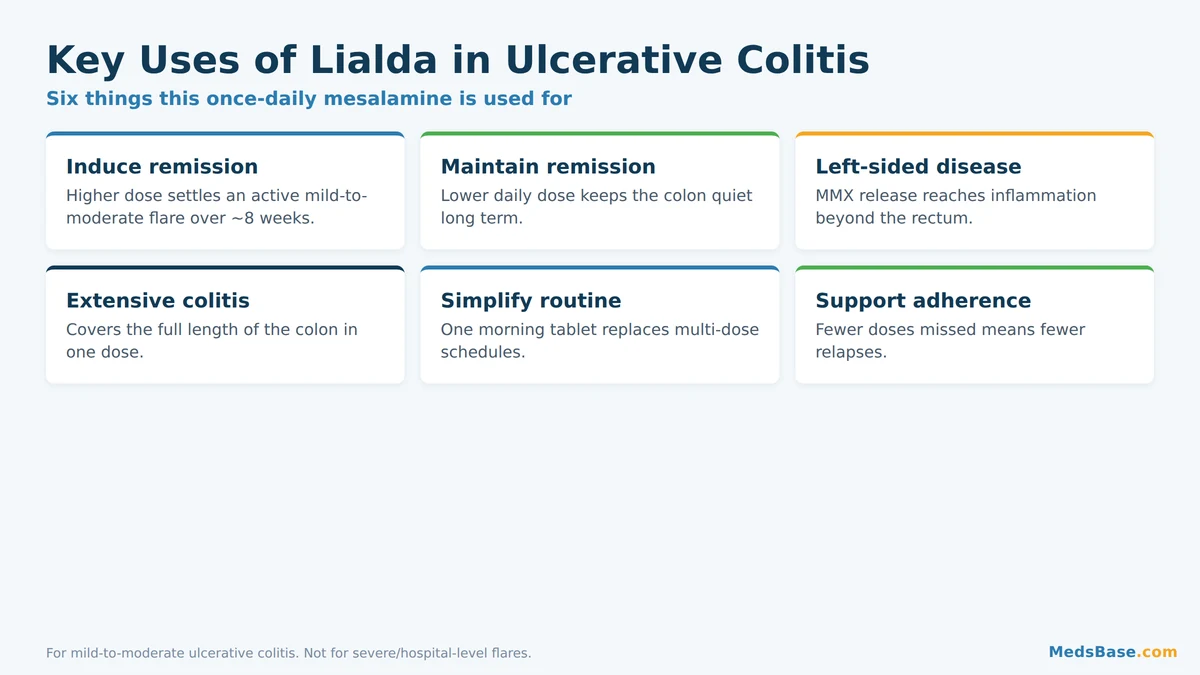
Lialda has two main jobs in ulcerative colitis: bringing an active flare under control (induction) and then keeping the disease quiet (maintenance). Both rely on the same steady, colon-wide delivery, and both are backed by controlled trials. Here is how those roles play out in real life.
A good fit if you: have mild-to-moderate ulcerative colitis, want a once-daily routine, or struggle to remember multiple doses.
Talk to a clinician first if you: have kidney disease, a known salicylate or aspirin allergy, severe liver problems, or a history of reacting badly to any mesalamine or sulfasalazine product. Lialda is not designed for severe or hospital-level flares, which need different treatment.
Inducing remission in an active flare
When symptoms flare — loose, bloody stools, urgency, cramping — a higher daily dose of Lialda (often 4.8 g, meaning four tablets once daily) is used to settle the inflammation over roughly eight weeks. It will not stop symptoms overnight, and that expectation gap is where many people give up too early. Steady improvement over days to weeks is the realistic goal.
Maintaining remission long term
Once the colon calms down, a lower daily dose keeps it that way. This is arguably Lialda’s most valuable role, because ulcerative colitis relapses when treatment stops. Many people stay on maintenance mesalamine for years, and the once-daily schedule is designed to make that marathon easier to sustain.
Consider an illustrative case. Take Priya, 34 (a hypothetical patient), diagnosed two years ago and stable on a three-times-daily mesalamine. The lunchtime dose was the problem — skipped on busy workdays, forgotten on weekends. Over a year those gaps added up, and a flare landed her back at the clinic. Switching to a single morning tablet removed the dose she kept missing. Her story is invented to make a point that the data backs up: the best regimen is usually the one that survives contact with a real, busy life.
Left-sided and extensive colitis
Because the MMX coating carries the drug across the full colon, Lialda suits people whose inflammation reaches beyond the rectum — so-called left-sided or extensive disease. For inflammation limited to the very end of the bowel, a clinician may add or prefer a rectal form. Suppositories such as Pentasa suppositories deliver mesalamine straight to the rectum, and are sometimes combined with oral therapy for stubborn low-down symptoms.
Lialda Safety Profile, Side Effects & Dosage
Lialda is generally well tolerated, and most side effects are mild — headache, gas, nausea, or belly discomfort that often eases with time. But a few reactions deserve real attention, and one of them is the detail we promised would surprise you. Read the table, then the note directly beneath it.
| Side effect | Frequency | Severity | What to do |
|---|---|---|---|
| Headache | Common | Mild | Usually settles; tell your clinician if persistent |
| Nausea, gas, indigestion | Common | Mild | Take with food; often improves within weeks |
| Abdominal pain, diarrhea | Common | Mild–moderate | Monitor; may overlap with a flare (see note) |
| Acute intolerance syndrome (worsening cramps, bloody diarrhea, fever) | Uncommon | Serious | Stop and seek medical advice — can mimic a flare |
| Kidney changes (raised creatinine, rarely nephritis) | Uncommon | Serious | Needs periodic kidney blood tests |
| Liver enzyme rise | Rare | Serious | Report yellowing skin/eyes; monitored on bloods |
| Allergic reaction (rash, hives, swelling, breathing trouble) | Rare | Serious | Seek urgent care immediately |
Here is the surprise. A small number of people develop a mesalamine intolerance reaction whose symptoms — cramping, bloody diarrhea, fever — look almost exactly like the ulcerative colitis it treats. Because the reaction impersonates a flare, the instinct is to take more medicine, which makes it worse. According to MedlinePlus, this is why any sudden worsening after starting Lialda is worth a same-day call to your clinician rather than a dose increase. That resolves the open loop from the intro.
On dosing: a typical induction course is 4.8 g once daily (four 1.2 g tablets together), stepping down to a maintenance dose your clinician sets. Tablets are swallowed whole — never split, crushed, or chewed, because that breaks the MMX coating and dumps the drug in the wrong place. Because of the kidney signal, most people have periodic blood tests to check renal function, especially in the first year.
What Does the Research Say?
The evidence base for mesalamine in ulcerative colitis is unusually deep, spanning decades of randomized trials and large meta-analyses. The picture that emerges is consistent: 5-ASA drugs like Lialda both induce and maintain remission better than placebo, and once-daily dosing holds up against split schedules. Here are four studies worth knowing.
| Study | Year | Finding | Source |
|---|---|---|---|
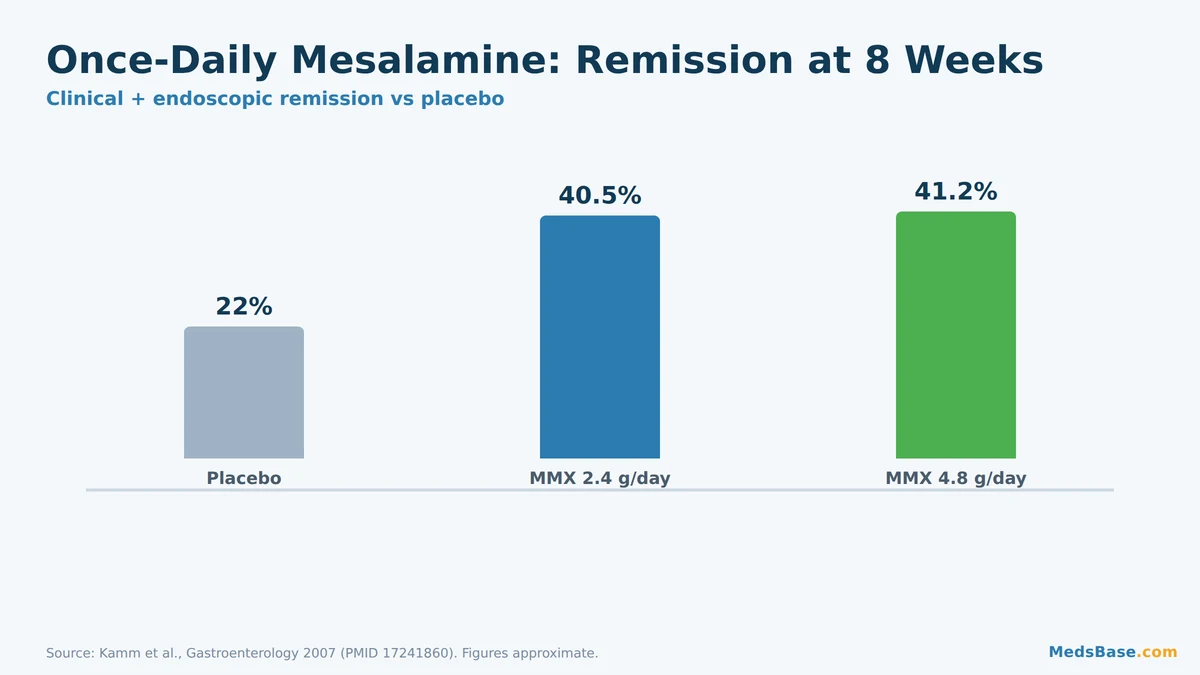
| Kamm et al., Gastroenterology | 2007 | Once-daily MMX mesalamine induced remission in ~40–41% at 8 weeks vs ~22% placebo | PubMed |
| Sandborn, Kamm, Lichtenstein et al., Aliment Pharmacol Ther | 2007 | Combined analysis (517 patients): remission 37.2% (2.4 g) and 35.1% (4.8 g) vs 17.5% placebo | PubMed |
| Murray et al., Cochrane Database Syst Rev | 2020 | Maintenance: ~37% of 5-ASA users relapsed vs ~55% on placebo; once-daily ≈ conventional dosing | PubMed |
| Kane et al., Am J Med | 2003 | Non-adherent patients had a 5.5-fold higher risk of relapse than adherent ones | PubMed |
What this means for you: the research suggests the exact number of times you split your dose matters far less than whether you actually take it. That last study is the quiet hero here — skipping doses raised relapse risk more than fivefold. A once-daily tablet you remember beats a three-times-daily one you don’t. This is the practical logic behind Lialda’s whole design, and it is worth weighing when you compare options.
Lialda vs Alternatives
Lialda is one of several oral mesalamine products, and they differ mainly in coating technology, dosing frequency, and cost — not in the active drug. Understanding those differences helps you and your clinician pick the one you are most likely to stick with. The table below compares the common options at a glance.
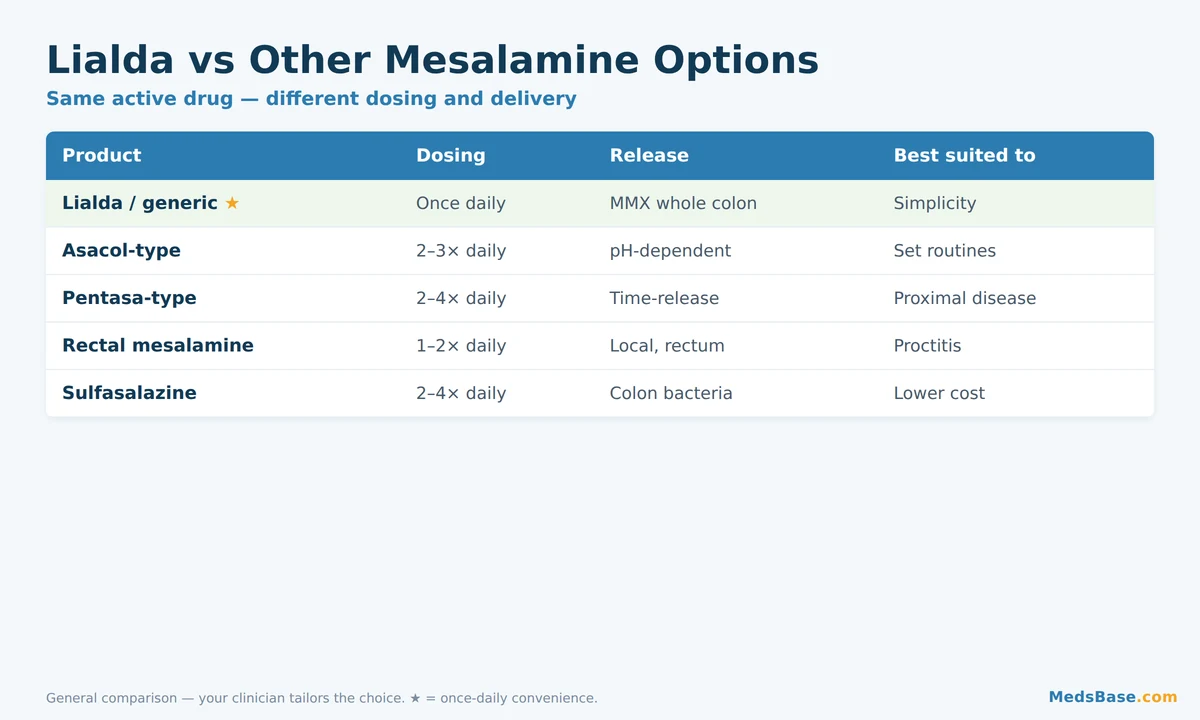
| Product | Active drug | Typical dosing | Release design | Best suited to |
|---|---|---|---|---|
| Lialda / generic (1.2 g tab) | Mesalamine | Once daily | MMX, whole colon | Simplicity; left-sided/extensive disease |
| Asacol-type (delayed-release) | Mesalamine | 2–3 times daily | pH-dependent coating | Established routines |
| Pentasa-type | Mesalamine | 2–4 times daily | Time-release, small bowel + colon | More proximal disease |
| Rectal mesalamine (suppository/enema) | Mesalamine | Once–twice daily | Local, rectum/lower colon | Proctitis, low-down flares |
| Sulfasalazine | 5-ASA + sulfapyridine | 2–4 times daily | Bacteria-cleaved in colon | Cost; coexisting joint symptoms |
Which one fits which situation? If your biggest challenge is remembering pills, Lialda’s once-daily rhythm is hard to beat. If you are already stable and comfortable on a multi-dose brand, there is little reason to switch. For inflammation confined to the rectum, a rectal form often works faster and at a lower total dose. Sulfasalazine remains a budget-friendly option, though its sulfa component causes more side effects for some people. If you want to see how these formulations line up day to day, browse the once-daily generic option Mesacol OD, which delivers the same mesalamine on a comparable schedule. Wondering how UC differs from its sister condition? Our guide to understanding Crohn’s disease explains why the two need different strategies.
How to Use Lialda — Practical Guidance
Getting the most from Lialda comes down to a few habits: take it consistently, take it whole, and take it with food. Small errors here quietly reduce how well the drug works, so it is worth doing right from day one. Follow these steps.
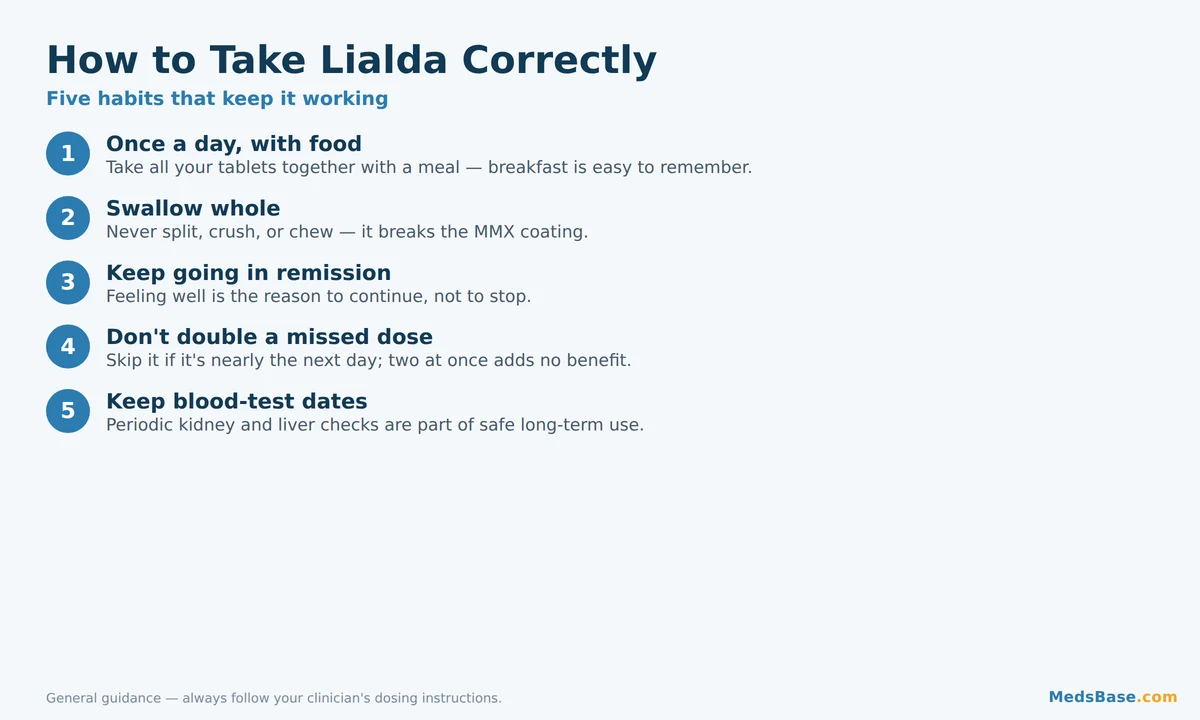
- Take all your tablets together, once a day, with a meal. Food helps the MMX system release the drug where it should. Breakfast is a common anchor because it is easy to remember.
- Swallow whole with water. Never split, crush, or chew — doing so breaks the coating and can release the drug too early, cutting its colon-wide effect.
- Keep going even when you feel well. Remission is not the finish line; it is the reason to keep taking maintenance mesalamine. Stopping is the single most common trigger for relapse.
- Don’t double up on a missed dose. If you forget, take it when you remember that day; if it is nearly the next day, skip it. Two doses at once offers no benefit and adds risk.
- Keep your blood-test appointments. Periodic kidney and liver checks are part of safe long-term use, not an optional extra.
A few mistakes to avoid: stopping the moment symptoms improve, taking it on a completely empty stomach out of habit, and assuming a sudden worsening is always “just the colitis” (remember the intolerance reaction). If you tolerate the brand well but want a lower-cost equivalent, generic delayed-release mesalamine tablets such as Mesacol contain the same active ingredient and are made by WHO-GMP-certified manufacturers. Always confirm any switch with your clinician so the dose matches.
What about other medicines and interactions? Mesalamine is fairly clean on this front, but a few combinations deserve a mention to your clinician or pharmacist. Taking it alongside other drugs that can stress the kidneys — long-term NSAIDs like ibuprofen, for example — may add up, which is another reason routine kidney monitoring matters. Mesalamine can also interact with azathioprine or 6-mercaptopurine (immune-suppressing drugs some people with colitis take) in a way that affects blood counts. And there is the vaccine caution worth repeating: avoid the varicella (chickenpox) vaccine within six weeks of mesalamine because of a theoretical Reye’s-syndrome risk. None of these rule the drug out; they simply belong on the list you review together.
- Ulcerative colitis diet: what to eat during a flare — food choices that ease symptoms.
- Is there a cure for inflammatory bowel disease? — the honest long-term picture.
- Gastro health medications — browse the full range for digestive conditions.
Frequently Asked Questions
Q: What is Lialda used for?
A: Lialda is used to treat mild-to-moderate ulcerative colitis and to keep it in remission. It contains mesalamine, a 5-ASA anti-inflammatory that acts directly on the colon lining. Doctors use higher doses to bring an active flare under control over about eight weeks, then a lower dose to prevent relapse long term. It is not used for severe, hospital-level flares, which need different treatment.
Q: How long does Lialda take to work?
A: Lialda works gradually, not instantly. Many people notice some improvement within one to two weeks, but the full effect for inducing remission is usually judged at around eight weeks. Because it is an anti-inflammatory maintenance drug rather than a rescue medicine, expecting overnight relief sets you up for disappointment. If you see no improvement after several weeks, your clinician may adjust the dose or reassess the diagnosis.
Q: Is there a generic for Lialda?
A: Yes. The FDA approved the first generic mesalamine delayed-release 1.2 g tablet in 2017, and it is rated therapeutically equivalent to Lialda. Generic mesalamine contains the identical active ingredient at the same strength, so it should work the same way. Generics can cost considerably less, which matters for a medicine many people take for years. Always confirm the switch with your clinician to keep your dose consistent.
Q: Can you take Lialda on an empty stomach?
A: It is best taken with food. Taking Lialda with a meal supports the way its MMX coating releases mesalamine along the colon, and it also reduces stomach upset for many people. Taking it on a completely empty stomach is a common habit that can subtly change absorption. Pairing the dose with breakfast is a simple way to stay both consistent and correct.
Q: What are the most serious side effects of Lialda?
A: Most side effects are mild, but a few are serious: kidney problems (which is why periodic blood tests are advised), liver enzyme changes, allergic reactions, and a mesalamine intolerance reaction that mimics a colitis flare. If you develop worsening cramps, bloody diarrhea, and fever soon after starting, contact your clinician the same day rather than increasing the dose. Urgent care is needed for any rash, swelling, or breathing difficulty.
Q: Lialda vs Asacol — what’s the difference?
A: Both contain mesalamine; the difference is delivery and dosing. Lialda uses MMX technology in a 1.2 g tablet taken once daily, while Asacol-type products use a pH-dependent coating usually taken two to three times a day. Trial evidence shows once-daily and multi-dose regimens work about equally well, so the choice often comes down to which schedule you will actually follow. Neither is “stronger” — they share one active drug.
Q: Can I stop Lialda once I feel better?
A: Generally no, not without medical advice. Ulcerative colitis is a chronic, relapsing condition, and mesalamine’s main long-term value is keeping remission going. Studies show stopping treatment sharply raises the chance of a flare, and non-adherence more than five-fold increased relapse risk in one analysis. Feeling well is a sign the medicine is working, not a signal to quit. Discuss any plan to reduce or stop with your clinician.
Q: Is Lialda safe to take long term?
A: For most people, yes. Mesalamine acts largely inside the colon with little entering the bloodstream, which is why it is considered suitable for years of continuous use. The main long-term safeguard is periodic monitoring of kidney function, since rare kidney effects can occur. People with existing kidney disease need extra caution. As with any long-term medicine, keep your review appointments and report new symptoms promptly.
The Bottom Line
Lialda earns its place by making a decades-old, well-evidenced medicine easier to live with: one high-dose tablet, once a day, releasing mesalamine across the whole colon. It reliably induces and maintains remission in mild-to-moderate ulcerative colitis, and the biggest study lesson is blunt — the medicine only works if you keep taking it. It is not a cure, and it is not a rescue drug for severe flares, but for steady day-to-day control it is a sensible first-line choice.
Your one immediate action: if a multi-dose schedule keeps tripping you up, ask your clinician whether a once-daily mesalamine like Lialda — or its lower-cost generic — would fit your life better. Then browse the options and match the dose you’re already prescribed.
Still weighing things up? Wondering whether IBD can ever be cured, or what to eat when symptoms strike? Our ulcerative colitis flare diet guide is the natural next read.

Written by
Sophie ChenPharmaceutical Content Researcher · 8 years experience
Sophie Chen is a pharmaceutical content researcher with 8 years covering generic medication access and clinical pharmacology. She specialises in international regulatory frameworks, bioequivalence standards, and patient-facing education on therapeutic drug classes. She is not a clinician.