








✓ Medically reviewed by · Last reviewed: May 2026
Pharmacy Researcher · 8 years experience
Pharmacy researcher with 8 years reviewing clinical drug information, generic formulation equivalence, and international pharmaceutical standards. Focuses on patient-facing accuracy in medication education.
You’ve had gout for years. You know the drill: a flare starts, you take colchicine, it settles. Then you catch a chest infection, your doctor prescribes a week of clarithromycin, and nobody mentions the gout tablets — because you didn’t think to, and the prescription came from a different clinic. You take both. Your dose hasn’t changed by a single milligram. But the amount of colchicine in your bloodstream has.
That scenario is the reason colchicine drug interactions deserve their own article rather than a line in a leaflet. With most medicines, an interaction means a slightly stronger or weaker effect. With this one, the FDA-approved label says something starker: fatal drug interactions have been reported, and in people with impaired kidneys or liver, life-threatening toxicity has occurred at therapeutic doses.
By the end of this you’ll know exactly which drugs matter, which of the three tiers each one falls into, what the label says the dose should become, and one timing rule that catches people out even when they do everything else right. There’s also a warning sign that gets mistaken for something else entirely — we’ll come to that in the safety section.
- Colchicine leaves your body by two separate routes — and one common antibiotic blocks both of them at once.
- The label sorts them into three tiers with three different dose reductions. Most patient information lists the drugs and skips the doses you actually need.
- There’s a lookback window measured in days, not hours, and it’s the rule people most often break.
- Kidney or liver impairment turns some of these combinations from “reduce the dose” into “don’t”.
- Statins and colchicine share one specific side effect — and the trial evidence on that combination is more reassuring than you’d expect.
What Colchicine Drug Interactions Actually Are
Colchicine drug interactions are combinations in which another medicine slows the removal of colchicine from your body, so that an unchanged dose produces a much higher blood level. The effect is not on how colchicine works — it works the same way — but on how much of it is present. Because colchicine has a narrow therapeutic index, the gap between a helpful level and a harmful one is small.
That last phrase is the whole problem, so it’s worth unpacking for you.
“Narrow therapeutic index” means your effective dose and your toxic dose sit close together. With paracetamol you’d need to take many times the correct dose before you were in real danger. With colchicine, doubling or tripling your blood level — which one of these interactions can do without you swallowing a single extra tablet — moves you meaningfully toward toxicity. Nothing about your prescription looks wrong. Your bottle says the same thing it said last month.
Colchicine drug interactions affect you most if you take colchicine for gout flares or gout prophylaxis, you have familial Mediterranean fever, or — increasingly — you take it long-term at a low dose for cardiovascular risk, which we cover in colchicine’s newer role in cardiovascular prevention. That last group matters here because if you take it daily for years, a new interacting prescription can land on top of your colchicine at any point.
How Colchicine Drug Interactions Happen — Two Exits, Both Blocked
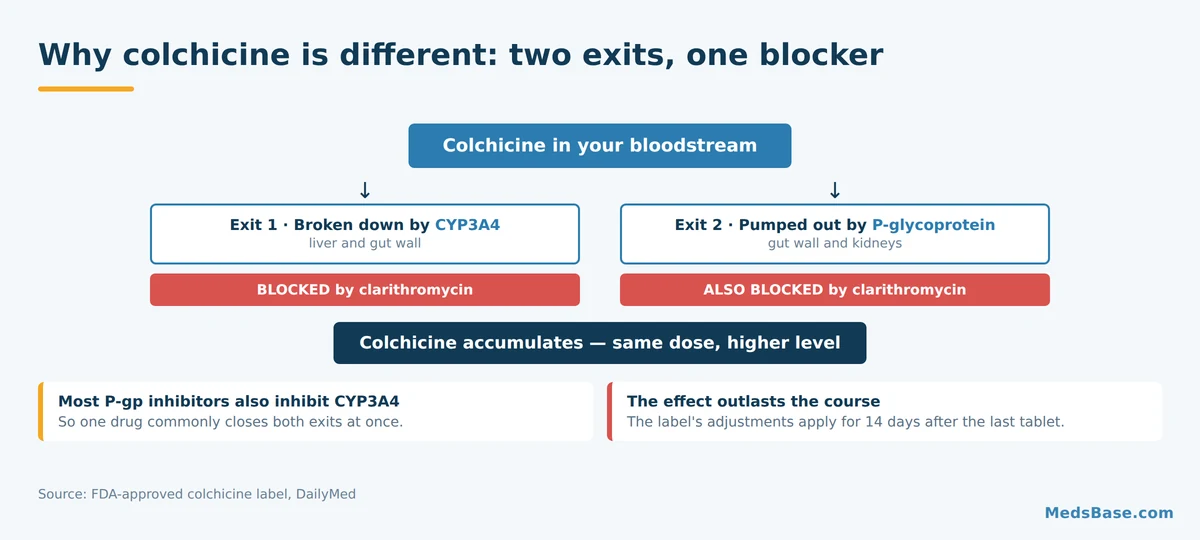
Almost all of them come down to one picture. Think of colchicine leaving your body through two doors.
Door one is metabolism. An enzyme called CYP3A4, working mainly in your liver and gut wall, chemically breaks colchicine down. The label is specific that of the cytochrome P450 enzymes tested, CYP3A4 was the one mainly involved.
Door two is transport. A pump called P-glycoprotein sits in your gut wall and kidneys and physically pushes colchicine back out — reducing how much gets absorbed in the first place and helping clear what did.
Most drugs rely on one dominant route. Block it and clearance slows, but the other route partly compensates. Colchicine relies on both. And here’s the trap: as the label puts it, drugs that inhibit P-glycoprotein most of which also inhibit CYP3A4. The same molecule tends to close both doors.
Clarithromycin is the textbook example of why this drug is different — it inhibits CYP3A4 strongly and inhibits P-glycoprotein too. Take it alongside your colchicine and you have not slowed one exit; you have shut both. The colchicine you take today is joined by more colchicine tomorrow, and your level climbs day after day while your dose stays identical.
This is also why grapefruit turns up on colchicine warning lists next to antiviral medicines, which strikes most people as absurd until they see the mechanism — grapefruit inhibits CYP3A4 in the gut wall, exactly as a drug would. If that surprises you, why grapefruit belongs on a drug-interaction list at all explains the food side in full.
The Three Tiers of Colchicine Drug Interactions — and What Changes
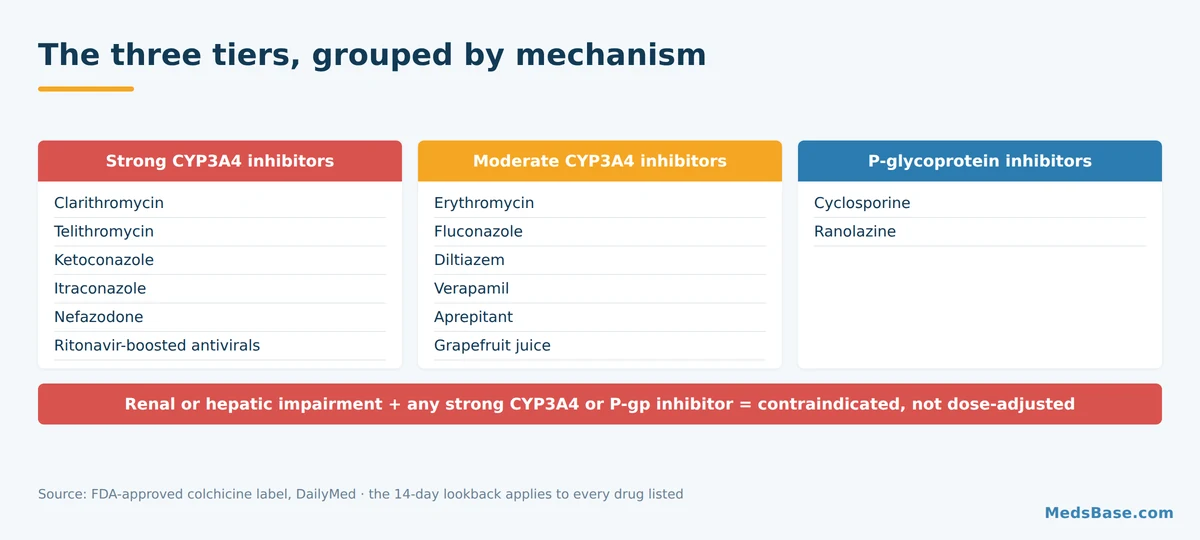
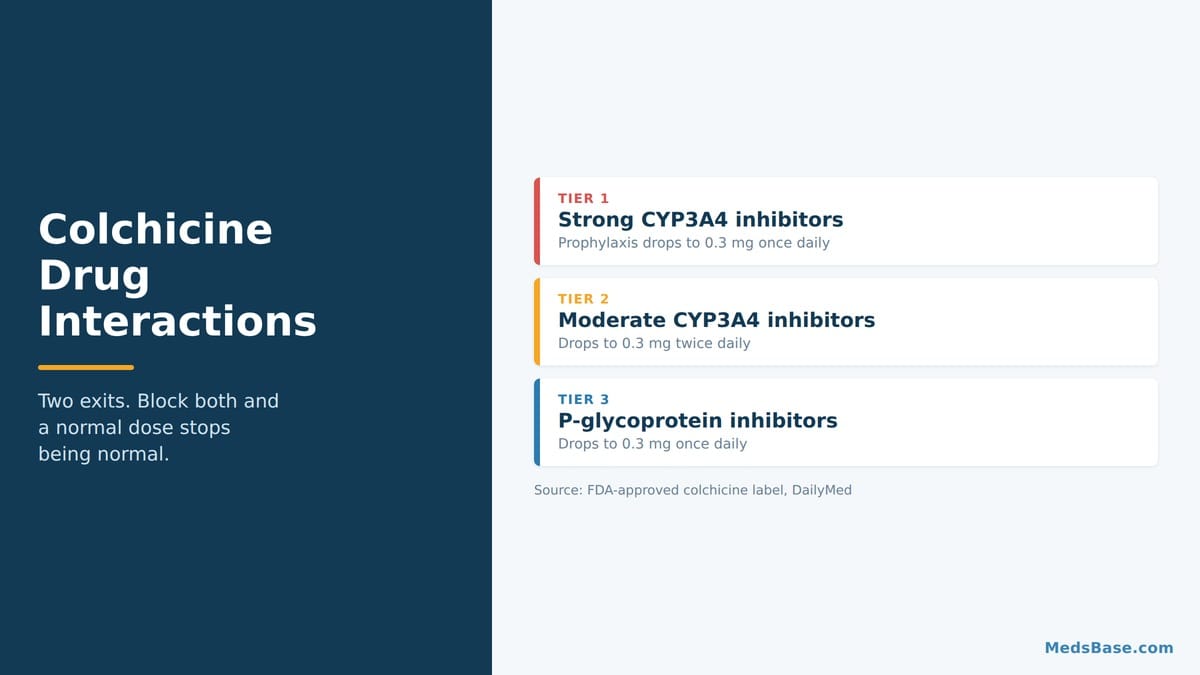
The FDA-approved label sorts colchicine drug interactions into three groups by mechanism, and gives each group its own dose reduction. Here is that structure, reproduced so you can check your own prescription against it.
| Tier | Drugs named on the label | Why it matters | Gout prophylaxis dose becomes | Gout flare dose becomes |
|---|---|---|---|---|
| Strong CYP3A4 inhibitors | Clarithromycin, telithromycin, ketoconazole, itraconazole, nefazodone, and the ritonavir-boosted antivirals (atazanavir, darunavir, indinavir, lopinavir, nelfinavir, saquinavir, tipranavir) | Significant increase in colchicine plasma levels; the label records that fatal colchicine toxicity has been reported with clarithromycin | 0.6 mg twice daily 0.3 mg once daily (or 0.6 mg once daily 0.3 mg every other day) | 1.2 mg then 0.6 mg after an hour 0.6 mg then 0.3 mg after an hour, not repeated within 3 days |
| Moderate CYP3A4 inhibitors | Erythromycin, fluconazole, diltiazem, verapamil, aprepitant, amprenavir/fosamprenavir, grapefruit juice | Significant increase anticipated; neuromuscular toxicity has been reported specifically with diltiazem and verapamil | 0.6 mg twice daily 0.3 mg twice daily, or 0.6 mg once daily | 1.2 mg then 0.6 mg 1.2 mg as a single dose, not repeated within 3 days |
| P-glycoprotein inhibitors | Cyclosporine, ranolazine | Significant increase; the label records that fatal colchicine toxicity has been reported with cyclosporine | 0.6 mg twice daily 0.3 mg once daily | 0.6 mg as a single dose, not repeated within 3 days |
Source: the FDA-approved colchicine label.
Now the rule that overrides every row above. If you have renal or hepatic impairment, the label does not tell you to reduce your dose when a strong CYP3A4 or P-glycoprotein inhibitor is involved. It contraindicates the combination outright — and states that in these patients, life-threatening and fatal colchicine toxicity has been reported with colchicine taken in therapeutic doses. Reduced kidney function is common, often mild enough that nobody has mentioned it to you, and extremely common in the older adults who take colchicine most.
There is a separate list worth knowing about: statins and fibrates. The label notes that taking atorvastatin, simvastatin, pravastatin, fluvastatin, lovastatin, gemfibrozil, fenofibrate, fenofibric acid or bezafibrate together with colchicine may potentiate the development of myopathy — and that patients with kidney problems and older adults are at increased risk even with normal liver and kidney function. This sits in a different category from the three tiers above, and it does not mean the combination is forbidden to you. It means that if you get muscle symptoms on that combination, they deserve attention rather than dismissal.
Warning Signs, Side Effects and the 14-Day Rule
Time to close the loop from the introduction — the warning sign that gets mistaken for something else.
Early colchicine toxicity looks to you like a stomach bug. Diarrhoea, nausea, vomiting, abdominal cramps. Those are also the drug’s most common ordinary side effects, which is exactly why you would shrug them off. The distinguishing feature isn’t the symptom; it’s your timing and your context. Gut upset that starts or worsens shortly after a new medicine joins your regimen is a different event from gut upset that has been mildly there for months.
| Side effect | Frequency | Severity | What to do |
|---|---|---|---|
| Diarrhoea | Most common reported reaction in gout prophylaxis trials | Usually mild, transient, reversible on lowering the dose | Tell your prescriber. New or worsening diarrhoea after a medication change needs review, not tolerance |
| Nausea, vomiting, abdominal pain | Common in flare treatment | Usually mild and transient | Same — the label notes these usually reverse on dose reduction |
| Muscle pain or weakness | Uncommon | Potentially serious | Stop and seek assessment. Myopathy, raised CPK and rhabdomyolysis are all recorded in the label |
| Numbness or tingling in hands and feet | Uncommon | Serious in context | Neuromuscular toxicity is a recognised effect, reported particularly with diltiazem and verapamil |
| Unusual bruising, bleeding, sore throat or repeated infections | Uncommon | Serious | Blood dyscrasias — myelosuppression, leukopenia, thrombocytopenia, aplastic anaemia — are listed. Needs prompt blood tests |
| Raised liver enzymes | Uncommon | Monitor | Detected on blood tests rather than felt |
One line worth remembering: if symptoms appear soon after any new prescription, the new prescription is a suspect until proven otherwise.
The 14-day rule
Here’s the timing detail that catches out people who otherwise do everything right, and it applies to every tier above. The label’s dose adjustments apply if you are taking an interacting drug or have recently completed treatment with one within the prior 14 days.
Fourteen days. Not “once you’ve finished the course.” If your seven-day course of clarithromycin ended last Tuesday, you are still inside the window. The inhibiting drug leaves your system faster than your enzyme and transporter activity recovers, so your clearance stays suppressed after the last tablet. Restarting your normal colchicine dose the morning after you finish an antibiotic is a genuinely common way to get this wrong.
What Does the Research Say About Colchicine Drug Interactions?
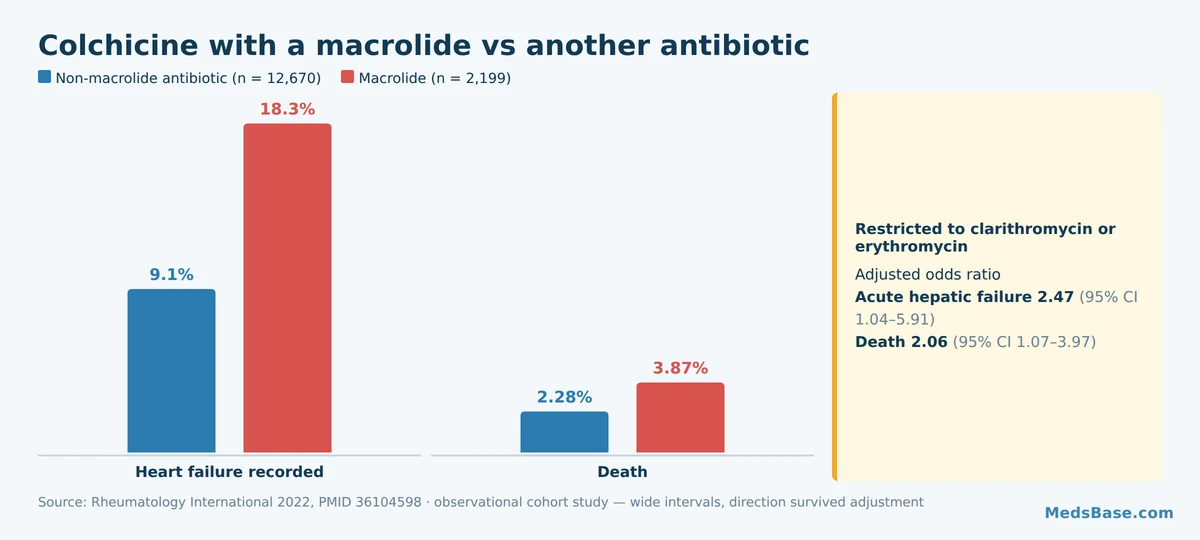
Beyond the label’s own warnings, there is direct outcome data on the highest-risk combination of all — the macrolide antibiotics.
| Study | Year | Finding | Source |
|---|---|---|---|
| Cohort study using electronic health records, Rheumatology International | 2022 | 2,199 patients on colchicine plus a macrolide compared with 12,670 on colchicine plus a non-macrolide antibiotic. Heart failure recorded in 18.3% of the macrolide group vs 9.1% (p < 0.0001); mortality 3.87% vs 2.28% (p < 0.0001). Restricted to clarithromycin or erythromycin, adjusted odds ratios were 2.47 (95% CI 1.04–5.91) for acute hepatic failure and 2.06 (95% CI 1.07–3.97) for death | PMID 36104598 |
| Case report, BMJ Case Reports | 2023 | Colchicine toxicity mimicking septic shock following co-prescription with clarithromycin, in a patient with normal renal and hepatic clearance. Specific toxicity tests not routinely available | PMID 37813551 |
| FDA-approved prescribing information | Current | Colchicine is a P-glycoprotein substrate; CYP3A4 is the main metabolising enzyme. Fatal interactions reported. Contraindicated with strong CYP3A4 or P-gp inhibitors in renal or hepatic impairment | DailyMed |
What this means for you: the authors of a cohort study of 14,869 patients concluded that colchicine should not be used at the same time as these antibiotics, or should be temporarily discontinued to avoid toxic levels. That is a strong conclusion, and it deserves two honest qualifiers. First, this was an observational cohort study, not a randomised trial — people prescribed macrolides may differ systematically from those prescribed other antibiotics, and no statistical adjustment fully removes that. Second, the odds-ratio confidence intervals are wide, with lower bounds close to 1.0, which tells you the size of the effect is uncertain even though its direction survived adjustment.
What is not uncertain is the mechanism, and the mechanism is what should drive the decision. A published case of colchicine toxicity mistaken for septic shock makes the practical point cleanly: this can happen in someone whose kidneys and liver are working normally.
When an Interaction Blocks Colchicine — The Alternatives
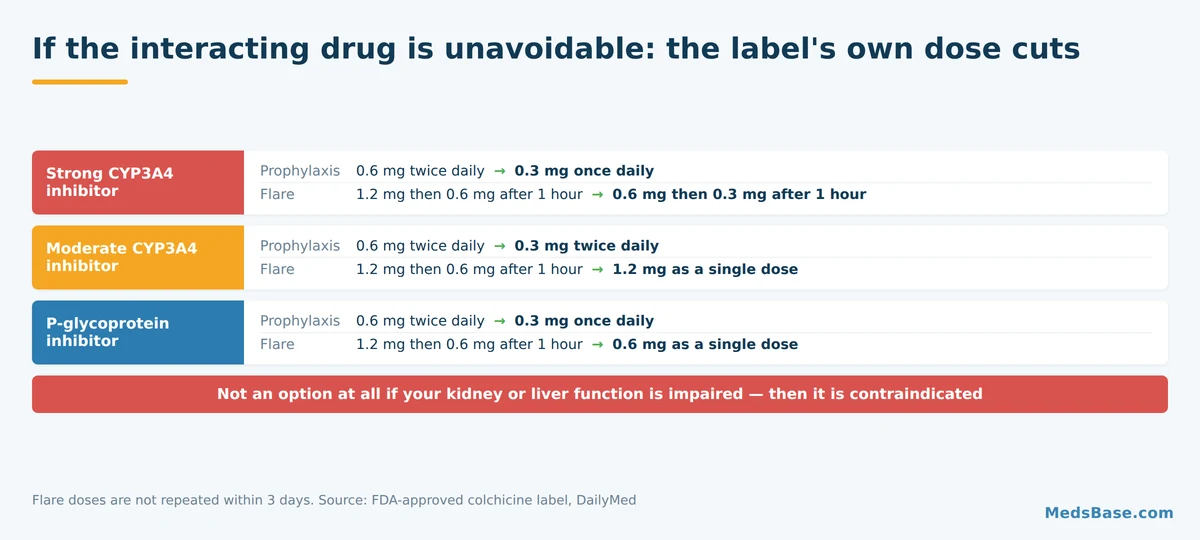
Suppose you need the interacting drug. If you have a real infection the antibiotic is not optional, and neither is an antiviral regimen or a transplant immunosuppressant. So what do colchicine drug interactions leave you with?
| Option | When it fits | Main limitation |
|---|---|---|
| Pause colchicine for the course, plus the 14-day window | Short antibiotic courses; colchicine used for prophylaxis rather than an active flare | You lose flare protection during the gap |
| Reduce colchicine to the label’s adjusted dose | When the label provides an adjusted dose and kidney and liver function are normal | Not available at all in renal or hepatic impairment with a strong inhibitor |
| Ask whether a non-interacting antibiotic will do | Frequently possible — the interaction risk is specific to macrolides like clarithromycin and erythromycin, not to antibiotics generally | Only your prescriber can judge whether the alternative covers the infection |
| A different anti-inflammatory for the flare | An active flare that needs treating now | Each alternative has its own cautions, particularly with kidney disease or stomach ulcers |
| Urate-lowering treatment for the longer term | Recurrent flares — treating the cause rather than each episode | Takes months to work; does nothing for today’s flare |
Which one fits which situation? If you take colchicine daily for prevention and need a short antibiotic course, pausing is usually the simplest answer — the risk of one unprotected fortnight is smaller than the risk of a doubled colchicine level. If you’re in an active flare when the interacting drug is prescribed, that is a conversation to have the same day rather than a decision to make alone. And if you’re needing colchicine often enough that these collisions keep happening, the more useful question is why the flares keep coming — how a gout flare is actually treated covers the immediate side, and lowering urate over time is what eventually makes the whole problem smaller.
MedsBase stocks colchicine as Goutnil alongside the urate-lowering options, and no prescription is needed to order — which makes it more important, not less, that you check your own interaction list before you start. Browse gout treatment options if you want to see what the alternatives look like.
Your Practical Safety Routine for Colchicine Drug Interactions
- Keep one written list of everything you take — prescriptions, over-the-counter medicines, supplements — and carry it. Most interactions are missed because no single person ever saw the whole list.
- Say “I take colchicine” at every new prescription and every pharmacy visit. Say the word out loud. Prescribers work from the records they can see, and records fragment across clinics.
- Ask one specific question when handed a new medicine: “Does this affect CYP3A4 or P-glycoprotein?” Any pharmacist can answer it in seconds, and it’s the question that maps directly onto the tiers above.
- Count fourteen days from the last tablet of an interacting course, not from the end of the course. Then restart your usual dose.
- Know your kidney function. If your eGFR is reduced, some of these combinations are contraindicated rather than adjustable. It’s a routine blood test and it changes the answer.
- Treat new gut symptoms after a medication change as a signal, not a nuisance. Report them rather than waiting them out.
- Restarting the normal colchicine dose the day after finishing an antibiotic. The window is 14 days.
- Assuming normal kidneys make you safe. The published case involved normal renal and hepatic clearance.
- Treating grapefruit as a health-food footnote. The label lists it in the same tier as prescription medicines.
- Assuming your GP and your specialist can see the same medication list. Often they can’t.
- Taking a leftover colchicine supply for a flare while on a drug you started since the last one.
- Stopping a statin on your own because of the myopathy note. That’s a discussion, not a self-service decision — and our page on statin intolerance covers what usually turns out to be behind muscle symptoms.
The MedlinePlus drug information for colchicine is a good page to keep bookmarked — it lists the patient-level warnings in plain language, including the grapefruit instruction.
Frequently Asked Questions
Q: What drugs should not be taken with colchicine?
A: The FDA-approved label groups colchicine drug interactions into three tiers. Strong CYP3A4 inhibitors include clarithromycin, telithromycin, ketoconazole, itraconazole, nefazodone and the ritonavir-boosted antivirals. Moderate CYP3A4 inhibitors include erythromycin, fluconazole, diltiazem, verapamil, aprepitant and grapefruit juice. P-glycoprotein inhibitors include cyclosporine and ranolazine. If you have kidney or liver impairment, combining your colchicine with a strong CYP3A4 or P-glycoprotein inhibitor is contraindicated for you rather than dose-adjusted.
Q: Can you take clarithromycin with colchicine?
A: This is the highest-risk of all the colchicine drug interactions and it needs your prescriber’s decision, not a self-managed one. The label records that fatal colchicine toxicity has been reported with clarithromycin and sets out substantially reduced colchicine doses if the combination is unavoidable. A 2022 cohort study found higher rates of heart failure and death among patients exposed to both, with the authors concluding colchicine should be temporarily discontinued rather than combined. Ask whether a non-macrolide antibiotic would treat your infection just as well.
Q: What are the first signs of colchicine toxicity?
A: Usually gastrointestinal — diarrhoea, nausea, vomiting and abdominal pain — which is precisely why you would mistake it for a stomach bug or dismiss it as an ordinary side effect. Later or more serious signs include muscle pain and weakness, numbness or tingling, and signs of low blood counts such as unusual bruising, bleeding or repeated infections. Your context matters more than your symptom: gut upset that begins after a new medicine joins your regimen should be reported the same week.
Q: Does colchicine interact with statins?
A: The label notes that atorvastatin, simvastatin, pravastatin, fluvastatin and lovastatin — along with the fibrates and cyclosporine — may potentiate the development of myopathy when taken with colchicine, and that people with kidney problems and older adults are at increased risk even with otherwise normal organ function. This is a monitoring matter rather than a prohibition. Muscle pain or weakness on the combination should be reported rather than tolerated, and once colchicine is stopped the label notes symptoms generally resolve within one week to several months.
Q: How long after stopping an antibiotic can you restart colchicine?
A: The label applies its dose adjustments to anyone who has completed treatment with an interacting drug within the prior 14 days. The inhibiting effect on your enzymes and transporters outlasts the drug itself, so clearance stays suppressed after the final tablet. Counting fourteen days from that last tablet, rather than restarting the next morning, is the safe reading — and your prescriber may advise differently based on your kidney function.
Q: Is colchicine safe with kidney disease?
A: It requires care and changes the interaction rules entirely. In severe renal impairment the label sets a starting dose of 0.3 mg daily for gout prophylaxis, and for treating a flare advises that a treatment course be repeated no more than once every two weeks. Critically, anyone with renal impairment should not receive colchicine together with a strong CYP3A4 or P-glycoprotein inhibitor at all — that combination is contraindicated, and the label states life-threatening and fatal toxicity has occurred at therapeutic doses in these patients.
Q: Does grapefruit really matter, or is that overcautious?
A: It is on the label in the moderate CYP3A4 inhibitor tier, alongside prescription medicines, with its own dose adjustment. Grapefruit inhibits CYP3A4 in the gut wall through the same mechanism a drug would. The practical answer is to avoid grapefruit and grapefruit juice while taking colchicine rather than trying to calculate a safe quantity.
Q: If I only take colchicine occasionally for flares, do interactions still matter?
A: Yes, and occasional use can be deceptively risky. Someone who takes colchicine twice a year is far less likely to remember it during an unrelated consultation, and far more likely to reach for a leftover supply without reviewing what else has changed since the last flare. The 14-day lookback applies regardless of how often you take it.
The Bottom Line on Colchicine Drug Interactions
Colchicine drug interactions are unusual because they can put you in danger without anything visible changing. Your dose stays the same, your prescription looks identical, and the level in your blood climbs anyway — because colchicine depends on two clearance routes and a single interacting drug can close both of yours.
The balanced verdict: this is a genuinely useful medicine with a genuinely narrow margin, and it is entirely manageable once you have the information. The three tiers are short enough for you to check. The dose adjustments are published. The 14-day window is simple to count. What makes people come unstuck is almost never a disregarded warning — it is a warning that never reached them, because two of their prescribers never saw the same list.
One thing you can do today: write down every medicine, supplement and over-the-counter product you take, put the list in your wallet or your phone, and show it at your next prescription of any kind. That single habit prevents more colchicine drug interactions from reaching you than any amount of reading.
Want a second plain-language read on this drug? The NHS medicines guide to colchicine sets out the same cautions independently. And if the underlying principle here interests you — that what else is in your system decides how much drug you actually get — the same argument runs through thyroid treatment, where we compare the thyroid drug with its own strict timing rules against the standard option.

Written by
Sophie ChenPharmaceutical Content Researcher · 8 years experience
Sophie Chen is a pharmaceutical content researcher with 8 years covering generic medication access and clinical pharmacology. She specialises in international regulatory frameworks, bioequivalence standards, and patient-facing education on therapeutic drug classes. She is not a clinician.