








✓ Medically reviewed by · Last reviewed: May 2026
Pharmacy Researcher · 8 years experience
Pharmacy researcher with 8 years reviewing clinical drug information, generic formulation equivalence, and international pharmaceutical standards. Focuses on patient-facing accuracy in medication education.
cold therapy vs heat therapy — Cold Therapy vs Heat Therapy: 5 Proven Rules for Choosing the Right Pain Relief. Read on for an evidence-backed guide covering everything you need to know.
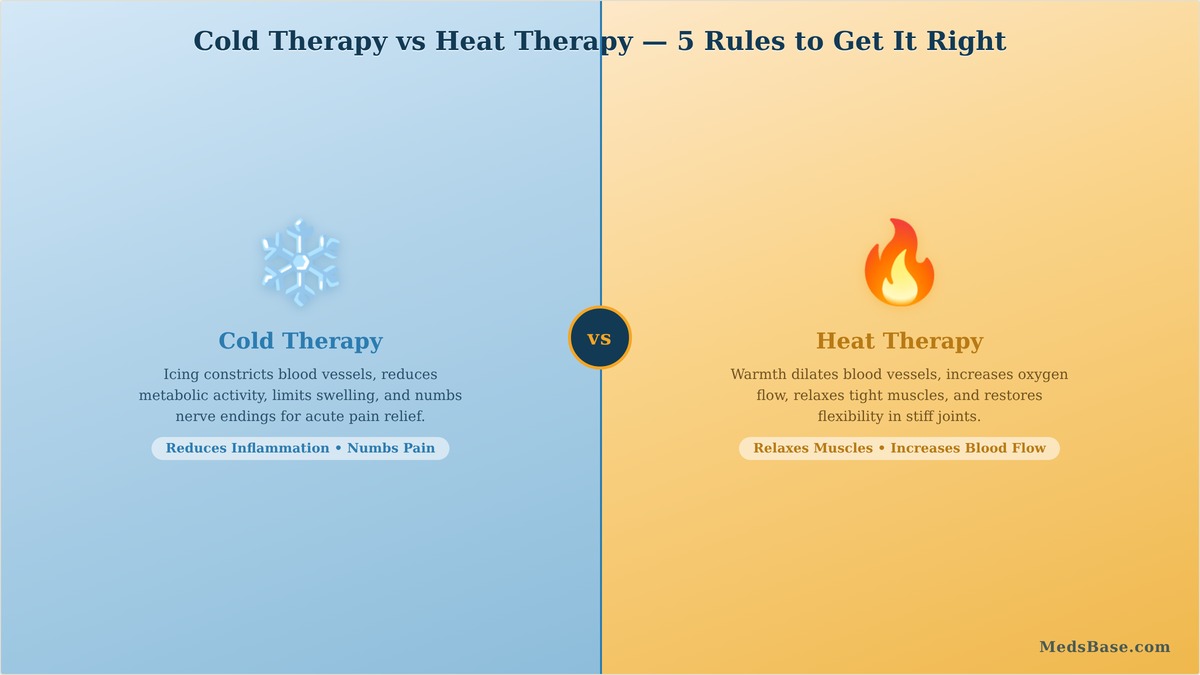
Cold therapy vs heat therapy — your back is spasming after a long day at your desk. You open the freezer, then pause at the heating pad drawer. Ice or heat? It is one of the most common pain-relief decisions people face — and roughly half of them get it wrong. Cold therapy vs heat therapy is not just a preference question. The two therapies work through opposite physiological mechanisms, and applying the wrong one can delay healing, worsen swelling, or prolong your pain.
Cold therapy vs heat therapy — the good news is that the decision is simpler than most people think — once you know five evidence-based rules. By the end of this article, you will know exactly which therapy to reach for, for nearly every type of pain, every time. You will also learn why some of what you were taught about icing injuries is being challenged by newer research — and what to do instead.
Key Takeaways: Cold Therapy vs Heat Therapy
- Cold therapy reduces inflammation and numbs pain — it is the right choice for acute injuries, fresh swelling, and post-exercise soreness. But the timing is critical, and newer research questions whether aggressive icing actually delays healing.
- Heat therapy relaxes muscles and increases blood flow — it is the right choice for chronic stiffness, muscle spasms, and arthritis pain. But using it on a fresh injury with swelling is one of the most common mistakes people make.
- The “48-hour rule” is a useful starting point but not the whole story — some conditions (like inflammatory arthritis) need cold even when chronic, and some muscle problems need heat even when acute.
- Alternating cold and heat has a specific use case — and it is more limited than most people assume. We cover exactly when it makes sense and when it does not.
- The safety rules for both therapies matter more than people realize — skin damage from improper use is surprisingly common and entirely preventable.
What Cold Therapy Actually Does to Your Body — Cold therapy vs heat therapy Explained
Cold therapy vs heat therapy — when you apply an ice pack to an injury, three things happen in rapid sequence. First, the cold triggers vasoconstriction — the blood vessels in the area narrow, reducing blood flow to the injured tissue. This limits the accumulation of swelling and inflammatory fluid that would otherwise pool in the area. Second, the reduced temperature slows nerve conduction velocity — essentially, the nerves transmit pain signals more slowly and less effectively, producing a numbing effect that provides immediate (though temporary) pain relief. Third, the metabolic rate of the cells in the cooled tissue drops, meaning they consume less oxygen — which matters because injured tissue often has compromised blood supply and limited oxygen availability.
This is the traditional rationale behind cold therapy vs heat therapy for acute injuries: cold limits the secondary damage that inflammation can cause when it overshoots. A 2015 systematic review on the effects of cryotherapy confirmed that cold therapy significantly reduces pain in acute musculoskeletal injuries compared to no treatment, with a moderate to large effect size — though the review also noted that the quality of evidence for faster return to activity was limited.
But here is where it gets interesting — and where the cold therapy vs heat therapy debate becomes more nuanced than the old first-aid manuals suggest. A 2020 review in the Journal of Athletic Training challenged a core assumption: does reducing inflammation actually speed healing, or does it delay it? Inflammation, after all, is the body’s repair mechanism — it brings immune cells, growth factors, and nutrients to the damaged tissue. Aggressive icing, the review authors argued, may blunt the very signals the body needs to initiate repair. The emerging consensus is that cold therapy for pain control is well-supported; cold therapy for aggressively suppressing all post-injury inflammation — the original RICE protocol philosophy — warrants caution.
Quick Answer: Cold therapy reduces swelling by constricting blood vessels and numbs pain by slowing nerve signals. It is most effective in the first 48 hours after an acute injury and for inflammatory flare-ups from conditions like rheumatoid arthritis or gout.
Cold therapy vs heat therapy: What Heat Therapy Actually Does to Your Body
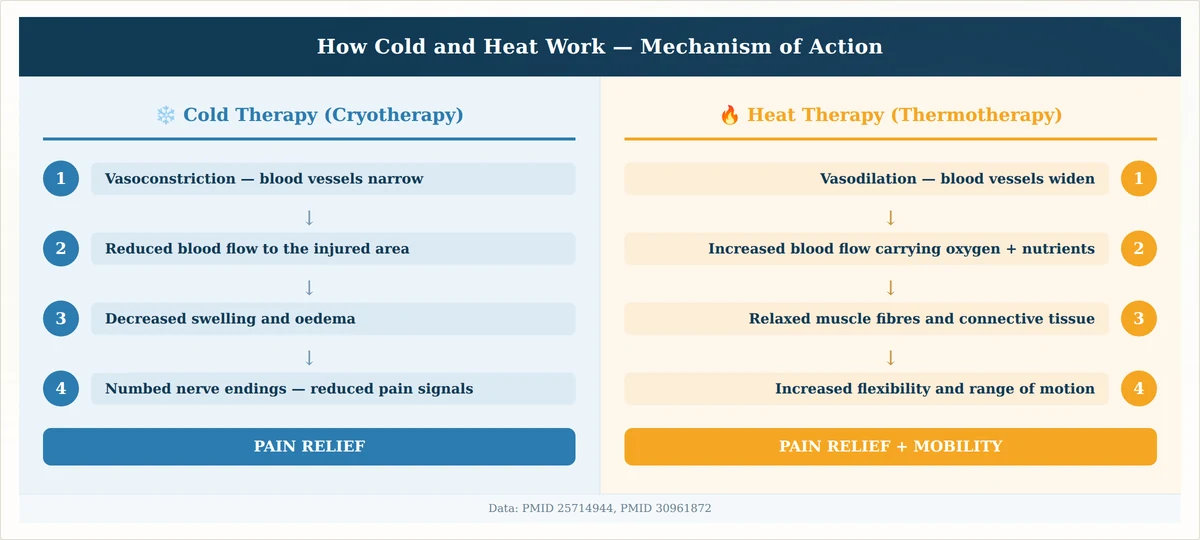
Cold therapy vs heat therapy — heat therapy works through the opposite mechanism. When you apply a heating pad, warm towel, or hot water bottle to an area, the blood vessels dilate — vasodilation — increasing blood flow to the tissue. This delivers oxygen and nutrients, flushes away metabolic waste products that accumulate in tense muscles, and physically relaxes muscle fibers that have been held in spasm or chronic contraction. The warmth also increases the elasticity of collagen fibers in tendons and ligaments, temporarily improving range of motion — which is why heat before stretching or physical therapy often produces better results.
A 2019 meta-analysis on thermotherapy for pain found that heat therapy produced clinically meaningful pain reduction across multiple chronic pain conditions, with the strongest evidence for chronic low back pain and osteoarthritis. Continuous low-level heat wraps — the kind that maintain a consistent ~40°C (104°F) for several hours — showed particularly strong results, with pain reductions of roughly 50% in some studies.
In the cold therapy vs heat therapy decision, heat is the answer for problems rooted in muscle tension, stiffness, and poor blood flow. It is not, however, the answer for fresh injuries or active inflammation — applying heat to a swollen, inflamed joint or a freshly sprained ankle amplifies the problem by increasing blood flow and inflammatory fluid accumulation.
Quick Answer: Heat therapy relaxes tight muscles, increases blood flow, and improves tissue flexibility. It is most effective for chronic muscle pain, stiffness, arthritis (osteoarthritis type), and pre-activity warm-up — but it should be avoided on fresh injuries with swelling or on areas of active inflammation.
Cold therapy vs heat therapy: Rule 1: Match the Therapy to the Injury Type
The single most useful rule in the cold therapy vs heat therapy decision is to identify what kind of problem you are treating. Pain falls broadly into two categories, and the therapy should match:
Choose COLD therapy when your pain involves:
- Visible swelling or puffiness around a joint or injury
- A recent injury (within the last 48 hours)
- Redness and heat in the affected area (signs of active inflammation)
- Sharp, acute pain that started suddenly
- An inflammatory arthritis flare (rheumatoid arthritis, gout, pseudogout)
- Post-exercise muscle soreness (the numbing effect provides relief)
Choose HEAT therapy when your pain involves:
- Muscle tightness, stiffness, or spasm without swelling
- Chronic aching pain that has lasted for weeks or months
- Stiffness that improves with movement
- Osteoarthritis joint pain (non-inflammatory type, no visible redness or swelling)
- Tension headaches (heat on the neck and shoulders)
- Pre-activity warm-up for stiff joints or tight muscles
Cold therapy vs heat therapy — the reason this distinction matters is that applying cold to a chronic muscle spasm does the opposite of what you want — it further tightens the already-contracted muscle. And applying heat to an actively inflamed joint adds fuel to the inflammatory fire. The cold therapy vs heat therapy choice is not about preference — it is about matching the physiology.
Rule 2: Follow the “48-Hour Rule” — With Important Exceptions
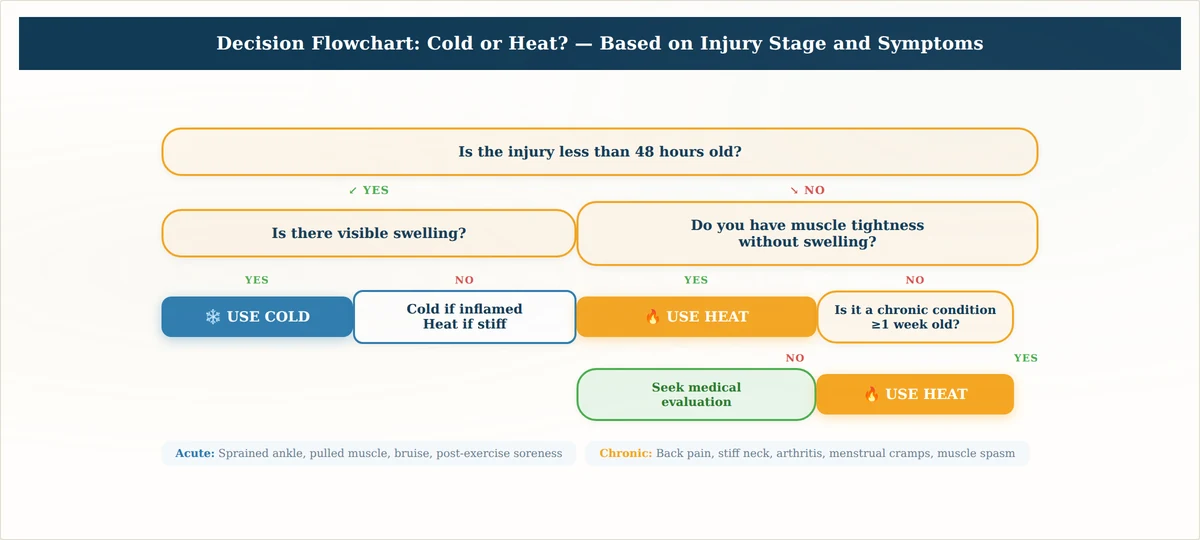
The 48-hour rule is the simplest framework for cold therapy vs heat therapy: if the injury or pain started less than 48 hours ago, use cold. If it has been more than 48 hours and there is no significant swelling remaining, you can introduce heat.
Cold therapy vs heat therapy — this rule works because the acute inflammatory phase — the period when swelling, redness, and the initial inflammatory cascade are at their peak — lasts roughly 48 to 72 hours for most soft-tissue injuries. Cold therapy during this window helps control that inflammatory response and provides pain relief. After this window, the repair phase begins, and the benefits of increased blood flow from heat therapy become more relevant.
Cold therapy vs heat therapy — but there are two important exceptions that the 48-hour rule does not capture:
Exception 1: Inflammatory arthritis never graduates to heat. Conditions like rheumatoid arthritis, gout, and pseudogout involve ongoing inflammatory processes. Even if the pain is chronic and the 48-hour window has long since passed, heat can worsen the inflammatory component. For these conditions, cold therapy is the default — for pain relief if nothing else — even months or years after diagnosis. Use heat only on surrounding muscles that are secondarily tight from guarding, and keep heat away from the actively inflamed joint itself.
Exception 2: Acute muscle spasm may benefit from heat immediately. A sudden muscle cramp or spasm — the kind that wakes you up in the middle of the night with a charley horse — involves no significant swelling or inflammatory process. Heat applied directly to the cramped muscle can relax the spasm within minutes. In this specific scenario, cold therapy vs heat therapy tips toward heat even though the event is acute — because the problem is muscular contraction, not inflammation.
Rule 3: Know When Neither Is the Right Answer
Cold therapy vs heat therapy is not always the right question — because sometimes neither is appropriate. Recognizing these situations prevents unnecessary delays in getting proper care:
- Suspected fracture or dislocation: Neither ice nor heat addresses the underlying problem. Immobilize the area and seek immediate medical evaluation. Ice can be used temporarily for pain relief while waiting for care, but do not let it delay you.
- Open wounds, burns, or broken skin: Do not apply ice or heat directly to broken skin. Both can cause further tissue damage and introduce infection risk.
- Areas with impaired sensation: If you have diabetic neuropathy, peripheral vascular disease, or any condition that reduces sensation in the affected area, avoid both ice and heat — you may not feel tissue damage occurring. This population is at high risk for burns from heat therapy and frostbite from cold therapy.
- Deep vein thrombosis (DVT) symptoms: If you have one-sided leg pain with swelling, warmth, and redness, applying heat may feel temporarily soothing but delays the diagnosis of a potentially life-threatening blood clot. These are the same pulmonary embolism warning signs we detail in our companion guide — if you have these symptoms, seek medical evaluation immediately rather than self-treating with heat.
- Severe, unexplained pain: Pain that is 8/10 or higher with no clear cause, or pain accompanied by fever, unexplained weight loss, or neurological symptoms (numbness, weakness, bowel or bladder changes), warrants medical evaluation before any self-treatment.
Rule 4: Follow the Right Timing Protocol for Each
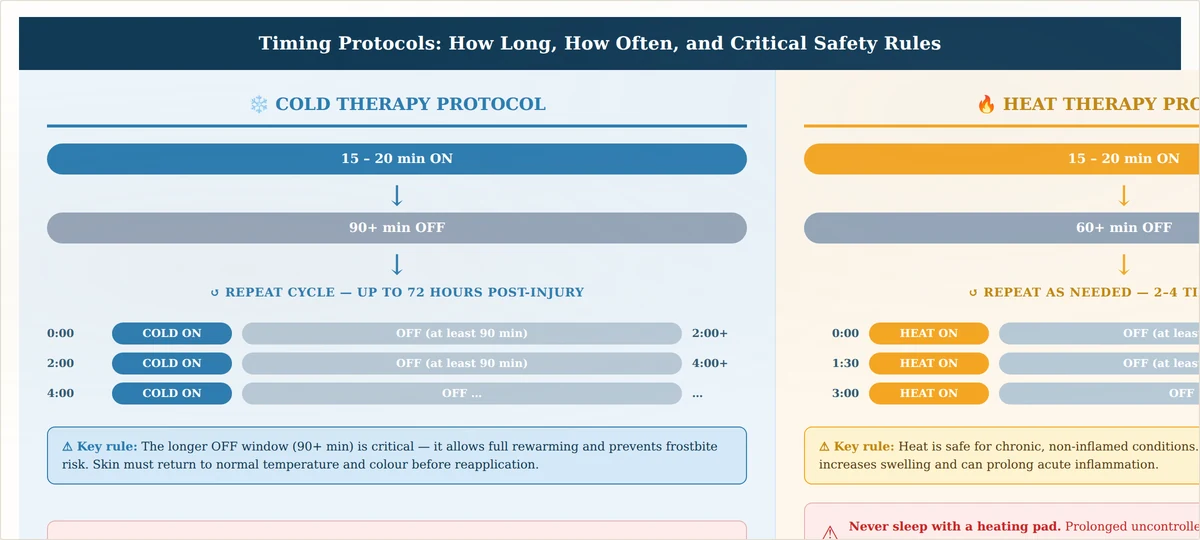
Cold therapy vs heat therapy — using cold therapy or heat therapy incorrectly — too long, too frequent, with inadequate barriers — can cause tissue damage. The safety protocols for each are straightforward:
Cold Therapy Protocol
- Duration: 15–20 minutes maximum per application. Longer does not provide additional benefit and increases the risk of frostbite, nerve damage, or cold-induced vasodilation (a rebound effect where blood vessels actually widen after prolonged cold).
- Frequency: At least 90 minutes between applications. This allows the tissue to return to normal temperature and prevents cumulative cold injury.
- Barrier: Always place a thin cloth or towel between the ice pack and your skin. Never apply ice directly to bare skin.
- When to stop: If the area becomes numb, stop. If you feel burning or stinging pain, stop immediately — these are early signs of cold injury.
Heat Therapy Protocol
- Duration: 15–20 minutes per application. Continuous low-level heat wraps (the adhesive type that maintain ~40°C) can be worn for up to 8 hours because they deliver lower, safer temperatures — but standard heating pads and hot water bottles should not exceed 20 minutes per session.
- Frequency: At least 60 minutes between applications.
- Barrier: As with cold, use a cloth barrier between the heat source and your skin.
- NEVER: Sleep with a heating pad or electric blanket set to high. Falling asleep on a heating pad is one of the most common causes of burn injuries from heat therapy. If you need overnight heat, use a low-temperature, auto-shutoff device only.
- When to stop: If the area becomes red or blotchy beyond normal warmth-related flushing, or if you feel burning pain, stop immediately.
Rule 5: Know When to Add Medication to the Mix
Cold therapy vs heat therapy are physical modalities — and for mild to moderate pain, they are often sufficient on their own. But when pain is severe, persistent, or disrupting sleep and daily function, combining physical therapy with the right medication produces the best results. The key is choosing the right medication for the right type of pain:
- For inflammatory pain (swollen joints, acute injuries, gout flares, arthritis flares): Oral NSAIDs like ibuprofen, naproxen, or diclofenac directly target the inflammatory pathway that cold therapy addresses locally. Using both together — cold on the affected joint plus an oral NSAID — provides complementary relief. Topical NSAID gels (diclofenac gel) applied directly to the painful area add a third layer of targeted relief.
- For muscle spasm and tension-type pain (back spasms, neck tension, muscle knots): Muscle relaxants or simple analgesics like acetaminophen pair well with heat therapy. The heat relaxes the muscle locally; the medication provides systemic relief and improves sleep quality, which is often disrupted by persistent muscle pain.
- For chronic pain conditions (osteoarthritis, chronic low back pain): A combination approach — heat before activity to improve mobility, cold after activity to calm any reactive inflammation, and around-the-clock anti-inflammatory or analgesic medication as prescribed — often provides the best functional outcomes.
If you are looking for pain relief medications to complement your cold therapy vs heat therapy approach, MedsBase offers a range of pain management options — including NSAIDs, muscle relaxants, and topical treatments — all available without a prescription. Browse the pain management category to find what is right for your needs.
Condition-by-Condition Quick-Lookup Table
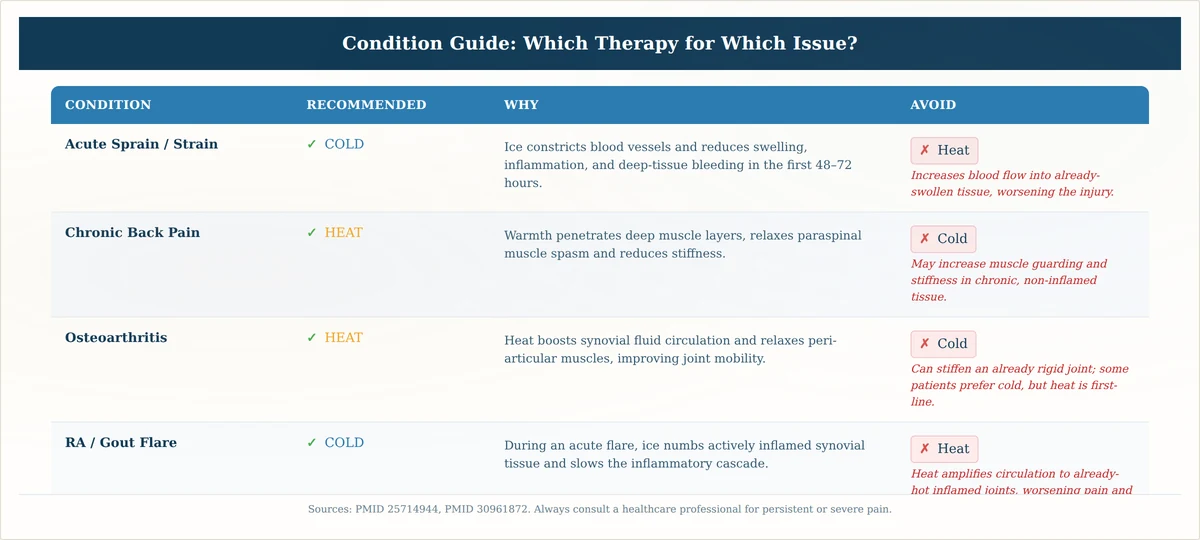
When you are in pain, you want the answer fast. Here is the cold therapy vs heat therapy decision for the most common pain conditions:
| Condition | Recommended | Why | Avoid |
|---|---|---|---|
| Acute ankle sprain (first 48h) | Cold | Reduces swelling, numbs pain | Heat — will increase swelling |
| Acute ankle sprain (after 48h, no swelling) | Heat | Promotes blood flow for healing | Cold — no longer needed for swelling control |
| Acute low back pain (sudden, sharp) | Cold (first 48h) | Reduces acute inflammation | Heat — may increase inflammatory response |
| Chronic low back pain (aching, stiff) | Heat | Relaxes tight paraspinal muscles | Cold — may worsen muscle tightness |
| Osteoarthritis (no visible swelling) | Heat | Relaxes stiff joints, improves mobility | Cold — can stiffen already-stiff joints |
| Rheumatoid arthritis / gout flare | Cold | Numbs pain, constricts inflamed vessels | Heat — worsens active inflammation |
| Muscle spasm / knot | Heat | Relaxes contracted muscle fibers | Cold — may worsen the contraction |
| Tension headache | Heat (neck/shoulders) | Relaxes the muscular trigger | Cold — less effective for muscle tension |
| Migraine headache | Cold (forehead/temples) | Vasoconstriction may reduce migraine intensity | Heat — vasodilation can worsen migraine |
| Menstrual cramps | Heat | Relaxes uterine smooth muscle | Cold — can worsen cramping |
| Tendonitis (e.g., tennis elbow) | Cold (after activity) | Reduces post-activity inflammation | Heat during acute phase |
| Post-exercise soreness (DOMS) | Cold | Numbs pain, reduces inflammation | Heat — limited benefit for DOMS |
| Plantar fasciitis (morning pain) | Heat (before getting up) | Loosens tight plantar fascia before weight-bearing | Cold in the morning — stiffens tissue further |
| Plantar fasciitis (after activity) | Cold | Calms post-activity inflammation | Heat — may increase inflammation after loading |
What Does the Research Actually Say?
The cold therapy vs heat therapy question has been studied extensively — but the quality and conclusions of that research have evolved significantly in recent years. Here is what the strongest evidence tells us:
| Study / Review | Year | Key Finding |
|---|---|---|
| Systematic review on cryotherapy for acute injury | 2015 | Cold therapy reduces acute injury pain by 30–40% compared to no treatment. Evidence for faster return to activity is weak. |
| Meta-analysis on heat therapy for pain | 2019 | Heat therapy produces clinically meaningful pain reduction for chronic low back pain and osteoarthritis. Continuous low-level heat wraps show the strongest results — roughly 50% pain reduction in several studies. |
| Review challenging RICE protocol | 2020 | Aggressive icing may delay soft-tissue healing by blunting the inflammatory signals needed for repair. Authors recommend using ice for pain control, not for complete inflammation suppression. |
| Study on continuous heat for low back pain | 2021 | Continuous low-level heat wrap therapy (8 hours) reduced acute low back pain by approximately 50% and reduced muscle stiffness significantly compared to placebo. |
The practical takeaway from this body of research: cold therapy vs heat therapy both work — but for different problems, through different mechanisms, and with different effect sizes. Cold therapy excels at short-term pain control for acute injuries and inflammatory flares. Heat therapy excels at functional improvement for chronic stiffness and muscle tension. And the newer research on icing raises valid questions about whether aggressive cold therapy after injury should be used for pain relief rather than with the goal of completely suppressing the inflammatory response.
What does this mean for you? Use ice when you are swollen, recently injured, or in an inflammatory flare — but limit it to 15–20 minute sessions for pain control. Use heat when you are stiff, tight, or dealing with chronic muscle pain. And if you are unsure, use the quick-lookup table above to guide your decision based on your specific condition.
Related Reading
- Exercise with Autoimmune Disease — How to Stay Active Without Triggering Flares — Covers recovery strategies including cold therapy for post-exercise joint pain in autoimmune conditions.
- Pulmonary Embolism Warning Signs — 7 Symptoms You Should Never Ignore — Leg pain with swelling could be a blood clot, not a muscle strain. Know the difference.
- Browse MedsBase pain management products — anti-inflammatory medications, muscle relaxants, and topical treatments to complement your pain relief strategy.
Frequently Asked Questions
Q: Should I use ice or heat for back pain?
A: It depends on the onset and nature of the pain. For acute, sudden back pain — the kind where you bent over and felt something “go” — use cold therapy for the first 48 hours to control inflammation. Lay an ice pack wrapped in a cloth across the painful area for 15–20 minutes at a time, every 2–3 hours. After 48 hours, or if the pain is chronic (you have had it for weeks or months) and characterized by stiffness and aching rather than sharp acute pain, switch to heat therapy. A 2021 study on continuous low-level heat wraps showed that this approach reduced acute low back pain by roughly 50%.
Q: Is heat or ice better for arthritis?
A: The critical distinction is the type of arthritis. For osteoarthritis — the wear-and-tear type without visible joint swelling — heat therapy is generally preferred. It relaxes the muscles surrounding stiff joints, increases blood flow, and improves mobility, especially in the morning or before activity. For inflammatory arthritis — rheumatoid arthritis, gout, or pseudogout, where joints are red, warm, and visibly swollen — cold therapy is the better choice. The cold constricts inflamed blood vessels, numbs pain, and does not add fuel to the inflammatory fire that is already active. Many people with inflammatory arthritis find that cold therapy provides the most reliable pain relief during flares, and they use heat only on the surrounding muscles that tighten up from guarding.
Q: Does ice slow down healing?
A: This is one of the most debated topics in sports medicine, and the honest answer is that the evidence is mixed. A 2020 review raised legitimate concerns: inflammation brings the immune cells, growth factors, and nutrients needed for tissue repair, and aggressively suppressing it with ice could theoretically delay the healing process. However, the same review acknowledged that ice is effective for pain control, and excessive inflammation itself can cause secondary tissue damage. The practical consensus that has emerged: use ice for pain management after acute injury — 15–20 minutes per session, with adequate breaks — rather than attempting to eliminate all post-injury inflammation. The goal is pain relief, not freezing the healing response entirely. For minor injuries, you may not need ice at all beyond the first few hours.
Q: How long should you ice an injury?
A: Apply ice or a cold pack for 15–20 minutes per session, with at least 90 minutes between sessions. This is not arbitrary — after about 20 minutes of cold exposure, the risk of cold-induced tissue damage (frostbite, nerve injury) begins to rise, and a phenomenon called cold-induced vasodilation can occur, where blood vessels paradoxically widen in response to prolonged cold, counteracting the anti-inflammatory effect. Always place a thin cloth between the ice and your skin — never apply ice directly. Ice the injury as often as every 2 hours during the first 48 hours after an acute injury. After 48 hours, if swelling has subsided and pain has transitioned from sharp to aching, you can begin transitioning to heat therapy.
Q: Can you alternate ice and heat?
A: Yes — but only in a specific scenario, and it is more limited than most people assume. Alternating cold and heat — called contrast therapy — is most useful for subacute injuries that are 3–7 days old, where some swelling remains but stiffness is becoming a bigger problem than inflammation. The protocol: 3–5 minutes of cold, followed immediately by 3–5 minutes of heat, repeated 3 times. The alternating vasoconstriction and vasodilation creates a pumping effect that may help move stagnant fluid out of the injured area. Do not alternate for fresh injuries (under 48 hours — use cold only), for open wounds, or for areas with impaired circulation. And do not use contrast therapy for inflammatory arthritis or acute gout — the heat component can worsen the flare.
Q: When should you not use heat therapy?
A: Avoid heat therapy in these situations: on any area with active swelling or visible inflammation (the heat will increase blood flow and worsen the swelling); on a fresh injury less than 48 hours old; on areas of impaired sensation (diabetic neuropathy, peripheral vascular disease — you may not feel a burn occurring); on areas with poor circulation or vascular insufficiency; over a suspected deep vein thrombosis or blood clot; directly over an area where you have recently applied topical pain relief creams or patches (the heat can drive too much medication into the bloodstream too quickly); on the abdomen during pregnancy; and over areas of infection or broken skin. If you are unsure whether your pain has an inflammatory component, default to cold — cold can do less harm if misapplied than heat can.
The Bottom Line
Cold therapy vs heat therapy is not a guessing game — it is a decision with clear rules. Cold reduces swelling and numbs pain; heat relaxes muscles and increases blood flow. The right choice for you depends on what kind of pain you have, how long you have had it, and whether there is swelling or inflammation present. Use the quick-lookup table above to get the right answer in seconds. Follow the safety protocols — 15–20 minutes per application, barrier between the source and your skin, and never sleep on a heating pad. And know when neither therapy is the answer and you need medical evaluation instead.
Your immediate action: the next time pain strikes, do not reach for whichever feels good in the moment. Identify the type of pain (inflammatory vs muscular, acute vs chronic), check the quick-lookup table, and apply the correct therapy with the correct protocol. This one habit change — matching therapy to physiology instead of to habit — will give you faster pain relief and better healing outcomes.
If physical therapy alone is not enough, MedsBase stocks a range of pain management medications — NSAIDs, muscle relaxants, and topical treatments — to complement your pain relief strategy. All available without a prescription. Browse the pain management category to find what you need.
What to read next: If joint pain from an autoimmune condition is part of your picture, read our guide on Exercise with Autoimmune Disease for evidence-based strategies to stay active without triggering flares. And if you are dealing with leg pain and swelling, make sure you can distinguish between a muscle injury and the pulmonary embolism warning signs that demand immediate medical attention.

Written by
Sophie ChenPharmaceutical Content Researcher · 8 years experience
Sophie Chen is a pharmaceutical content researcher with 8 years covering generic medication access and clinical pharmacology. She specialises in international regulatory frameworks, bioequivalence standards, and patient-facing education on therapeutic drug classes. She is not a clinician.