








✓ Medically reviewed by · Last reviewed: May 2026
Pharmacy Researcher · 8 years experience
Pharmacy researcher with 8 years reviewing clinical drug information, generic formulation equivalence, and international pharmaceutical standards. Focuses on patient-facing accuracy in medication education.
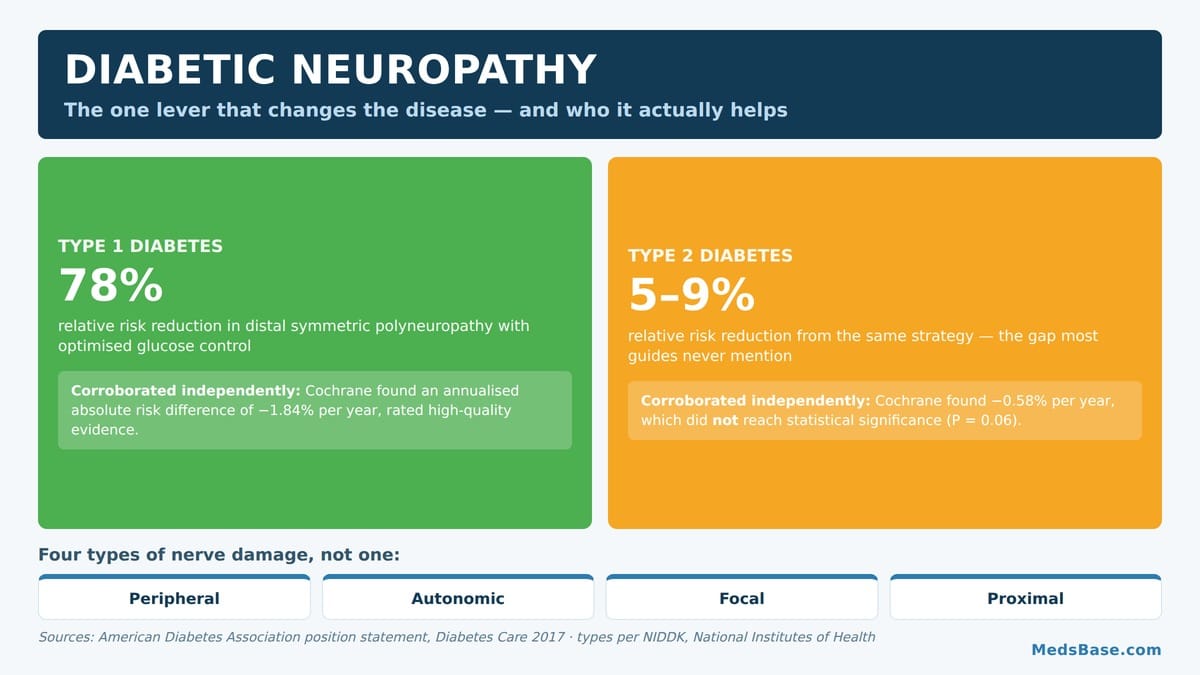
Quick Answer — Diabetic neuropathy is nerve damage caused by diabetes, most often affecting the feet first. Optimising blood glucose is the only intervention shown to slow the disease itself rather than mask symptoms — but its effect is far larger in type 1 diabetes than in type 2. Pain is treated separately, usually with pregabalin, duloxetine or gabapentin.
Most articles about diabetic neuropathy tell you that keeping your blood sugar down will protect your nerves. The research says that is only half true — and which half applies to you depends entirely on which type of diabetes you have.
That is not a technicality. In type 1 diabetes, optimised glucose control reduces the risk of developing the most common form of nerve damage by around 78%. In type 2 diabetes, the same strategy delivers roughly 5% to 9%. Both figures come from the American Diabetes Association position statement, and the gap between them is one of the most under-communicated facts in diabetes care.
By the end of this guide you will know what diabetic neuropathy actually is, which treatments change the disease versus which only change how it feels, when your feet should be checked and by what method, and where a popular supplement genuinely does and does not help.
There is also one symptom pattern that surprises almost everyone because it has nothing to do with feet at all. That comes in the types section.
- The prevention advice you have been given may not be calibrated to your diabetes type — the difference between the two is roughly tenfold.
- Nerve damage follows length, not location. There is a simple anatomical reason your toes go first, and it predicts what happens next.
- Pain relief and disease slowing are two different jobs. The drugs that do one do not do the other — a distinction that trips up a lot of people.
- One form of diabetic neuropathy has no pain at all — and it is arguably the most dangerous one.
- Screening starts at different times for type 1 and type 2, and the difference is not arbitrary.
- A widely recommended supplement has 2026 meta-analysis data behind it. The honest reading is more mixed than the marketing.
- What Is Diabetic Neuropathy?
- Why Your Feet Go First
- The Four Types of Diabetic Neuropathy
- Screening, Foot Risk and the Warning Signs
- What Does the Research Say About Diabetic Neuropathy?
- Diabetic Neuropathy Treatment vs the Alternatives
- How to Slow It Down — Practical Guidance
- Frequently Asked Questions
- The Bottom Line
What Is Diabetic Neuropathy?
Diabetic neuropathy is nerve damage caused by diabetes. The most common form, distal symmetric polyneuropathy, affects the longest nerves first — which is why symptoms usually begin in the toes and feet, then move upward, often symmetrically on both sides.
The symptoms people describe most are burning, tingling, numbness, sharp shooting pains, and an odd sensitivity where bedsheets feel painful against the skin. Many people notice it worst at night.
But here is the part that matters more than the symptom list: numbness is not the mild version of this condition. It is the dangerous version.
Pain at least tells you something is wrong. Numbness means an injury to your foot can go unnoticed — a blister, a small cut, a stone in your shoe — and that is the pathway to ulceration. We will come back to this in the screening section, because it drives the single most important practical habit in this entire article.
How Does Diabetic Neuropathy Develop?
Picture your nerves as electrical cables running from your spine to your fingers and toes. They need a steady, well-regulated environment to keep their insulation intact.
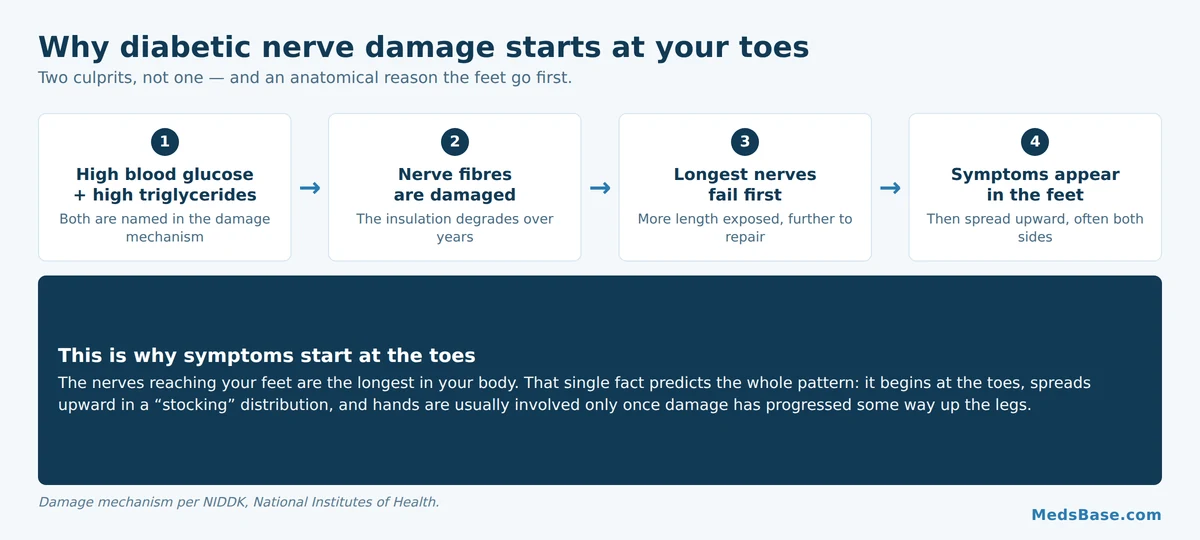
According to the US National Institute of Diabetes and Digestive and Kidney Diseases, “high blood glucose levels, also called blood sugar, and high levels of fats, such as triglycerides, in the blood from diabetes can damage your nerves.” Two culprits, not one — which is why this is not purely a sugar story.
Now the piece that explains the symptom pattern. The nerves running to your feet are the longest in your body. A cable that runs further has more surface exposed to a damaging environment, and it has further to send repair resources. So the longest nerves fail first.
That single fact predicts almost everything about how this condition behaves: it starts at the toes, it spreads upward in a “stocking” pattern, and hands typically become involved only once the damage has progressed some way up the legs.
The Four Types of Diabetic Neuropathy
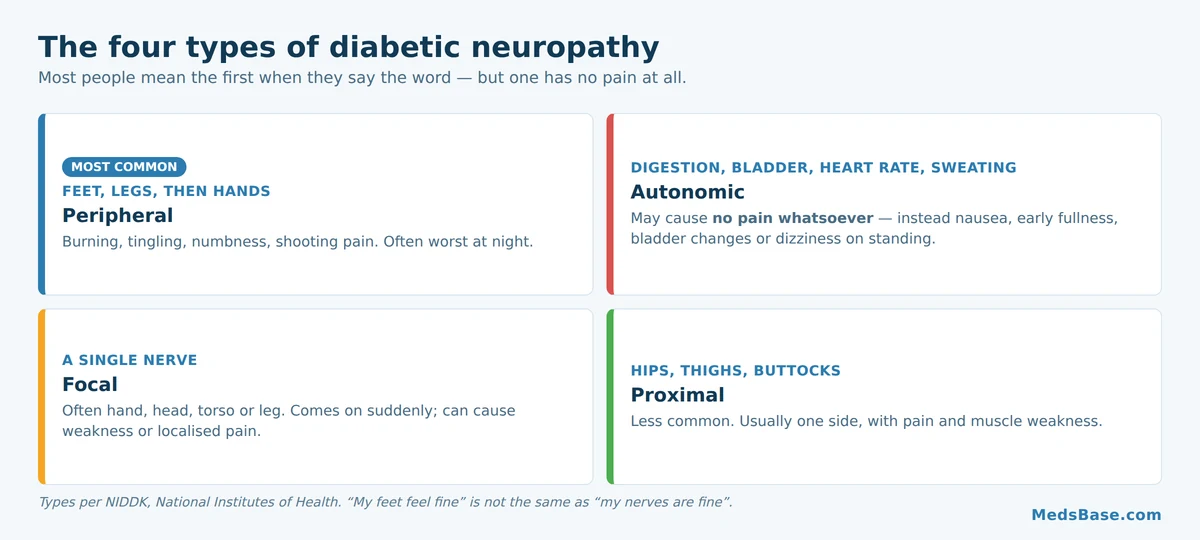
NIDDK names four. Most people mean the first when they say the word.
1. Peripheral neuropathy
Feet, legs, then hands and arms. Burning, tingling, numbness, shooting pain. This is the classic presentation and by far the most common.
2. Autonomic neuropathy
Here is the loop from the introduction, resolved. Autonomic nerves control the things you never consciously think about: digestion, bladder function, heart rate, sweating and sexual function. When these nerves are damaged there may be no pain whatsoever — instead you get unexplained nausea or fullness after small meals, bladder problems, dizziness on standing, or sweating changes.
This is why “my feet feel fine” is not the same as “my nerves are fine.” Autonomic symptoms are easy to attribute to something else entirely, and frequently are.
3. Focal neuropathies
Damage to a single nerve, often in the hand, head, torso or leg. These tend to come on suddenly and can cause noticeable weakness or localised pain. Carpal tunnel syndrome is a common example.
4. Proximal neuropathy
Less common, affecting the hips, thighs or buttocks, usually on one side, often with pain and muscle weakness.
- Have diabetes and any burning, tingling or numbness in your feet
- Have noticed reduced sensation, even without pain
- Have unexplained digestive, bladder or dizziness symptoms alongside diabetes
- Have had diabetes for several years and have never had a formal nerve check
- Have any open wound, ulcer, colour change or unusual warmth on a foot — this is urgent, not routine
- Have sudden one-sided weakness — that pattern needs assessing, not medicating
- Are pregnant or breastfeeding, since several nerve-pain medicines are not suitable
- Take multiple medicines already, since the common nerve-pain drugs have meaningful interactions
- Have kidney impairment, which changes the dosing of several of these drugs
Diabetic Neuropathy Safety: Screening, Foot Risk and Warning Signs
Screening timing is not arbitrary, and the two diabetes types differ. The ADA position statement recommends assessment for distal symmetric polyneuropathy “starting at diagnosis of type 2 diabetes and 5 years after the diagnosis of type 1 diabetes and at least annually thereafter.”
The reason for the gap is straightforward: type 2 diabetes is often present for years before it is diagnosed, so nerve damage may already exist on day one. Type 1 is usually identified promptly.
The statement also specifies the method: “All patients should have an annual 10-g monofilament testing to assess for feet at risk for ulceration and amputation.” A comprehensive assessment pairs your history with tests of small-fibre function (temperature or pinprick) and large-fibre function (vibration, using a 128-Hz tuning fork). Nerve conduction studies or a neurologist referral are, in the statement’s words, “rarely needed for screening.”
| Warning sign | Frequency | Severity | What to do |
|---|---|---|---|
| Burning or tingling in feet, worse at night | Common | Mild to moderate | Raise at your next appointment; treatable |
| Reduced or absent sensation | Common | Serious — often silent | Needs formal monofilament testing; daily self-checks |
| Any cut, blister or ulcer on a numb foot | Less common | Urgent | Same-day medical attention — do not wait |
| Dizziness on standing, early fullness, bladder changes | Under-recognised | Moderate | Mention explicitly; may be autonomic |
| Sudden one-sided weakness or localised pain | Uncommon | Moderate | Needs assessment; may be a focal neuropathy |
| Hypoglycaemia while tightening glucose control | Varies | Moderate to serious | Cochrane flags this as a genuine trade-off — review targets with your clinician |
An illustrative example — not a real patient. Take David, 62, who has had type 2 diabetes for nine years. He mentions burning in his right foot at his annual review and is started on a nerve-pain medicine, which helps. What he does not mention is that his left foot feels like nothing at all, because a foot that does not hurt does not feel like a problem worth raising. Six weeks later a seam in a new pair of shoes has rubbed a sore on that left heel, and he has not noticed. The foot that was treated was the one that hurt. The foot at risk was the quiet one — and this asymmetry, painful on one side and numb on the other, is common enough that clinicians ask about both feet separately.
If you take one habit from this article, make it the daily foot check — top, sole, and between the toes, with a mirror or a second pair of eyes if you cannot see easily. It costs thirty seconds and it is the practical answer to the numbness problem.
What Does the Research Say About Diabetic Neuropathy?
| Study | Year | Finding | Source |
|---|---|---|---|
| ADA position statement, Diabetes Care | 2017 | Glucose control cuts DSPN incidence by 78% (relative risk reduction) in type 1; 5–9% in type 2 | PMC6977405 |
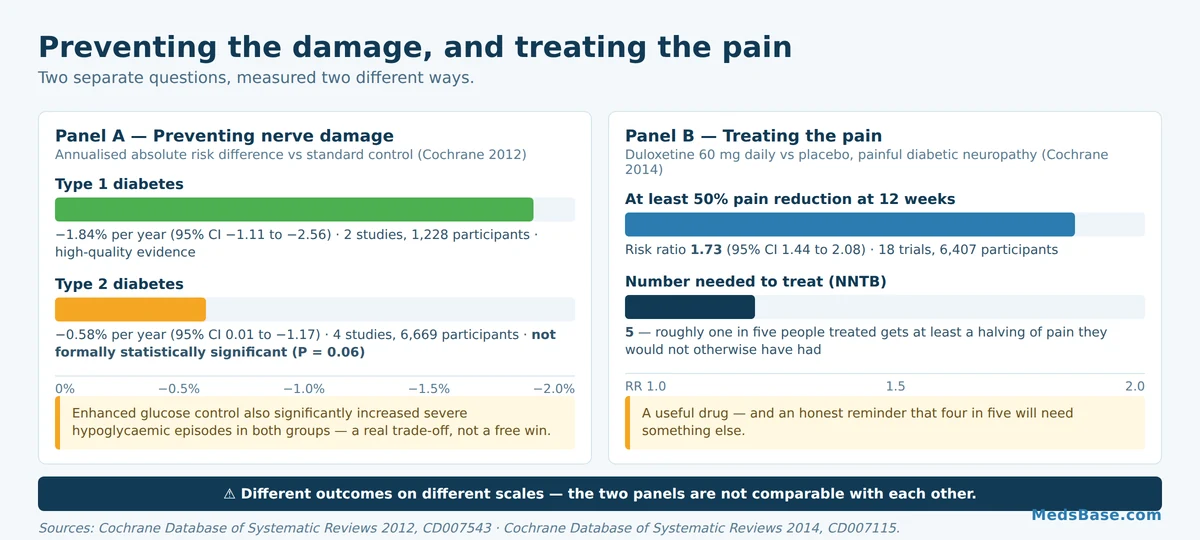
| Cochrane review, enhanced glucose control (17 studies) | 2012 | Annualised risk difference −1.84% (type 1, high-quality evidence); −0.58% (type 2, P = 0.06) | PMID 22696371 |
| Cochrane review, duloxetine (18 trials, 6,407 participants) | 2014 | Duloxetine 60 mg daily: RR 1.73 (95% CI 1.44–2.08) for ≥50% pain reduction at 12 weeks; NNTB 5 | PMID 24385423 |
| Meta-analysis of B-vitamin supplementation (13 RCTs, 834 participants) | 2026 | Improved some neuropathy scores and sural nerve function; no significant effect on pain (MD −0.44, 95% CI −1.77 to 0.89) | PMID 42452619 |
What this means for you: the duloxetine number is the most practically useful one here. A number needed to treat of 5 means roughly one in five people treated gets at least a halving of their pain that they would not have got otherwise. That is a genuinely useful drug — and also an honest reminder that four in five will need something else.
The ADA statement is candid about the type 2 picture, noting that “many people with type 2 diabetes develop DSPN despite adequate glucose control.” That is not a reason to abandon glucose control, which protects your eyes, kidneys and cardiovascular system regardless. It is a reason to pair it with realistic expectations and active symptom management rather than waiting for control alone to fix things.
Where the evidence is genuinely mixed, it is worth saying so. A 2026 meta-analysis of B-vitamin supplementation across 13 randomised trials found improvements in the Michigan Neuropathy Screening Instrument questionnaire and in sural nerve conduction velocity — but no significant effect on pain intensity on standard scales, with high heterogeneity between studies. One measure of examination score improved but did not reach the minimal clinically important difference. The authors’ own conclusion is that “substantial heterogeneity and risk of bias preclude firm recommendations for routine use.” B vitamins are not a substitute for glucose control, and the pain data does not support them as a painkiller.
Diabetic Neuropathy Treatment vs the Alternatives
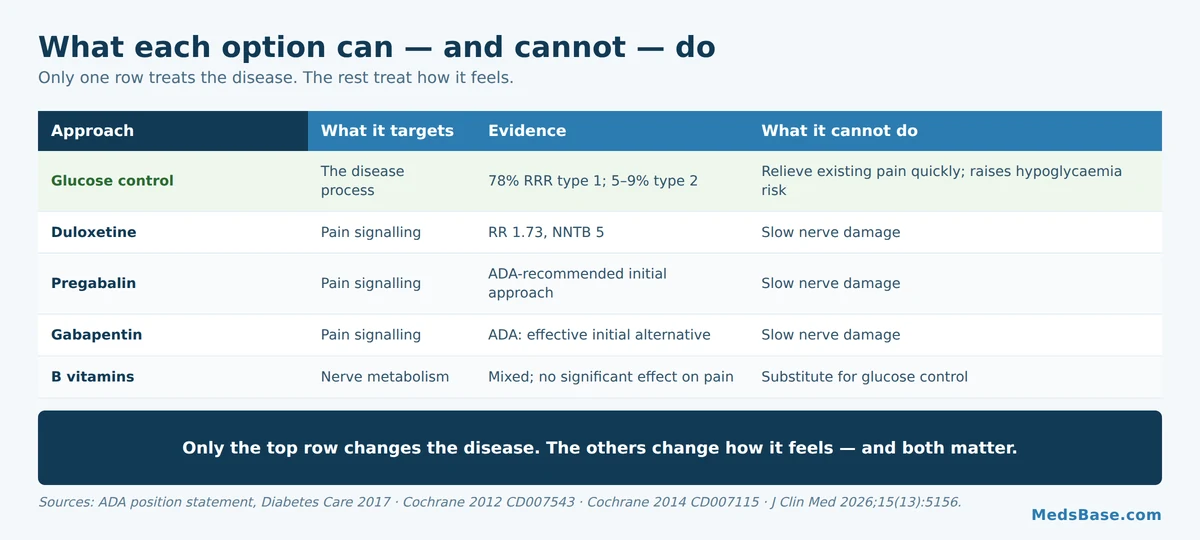
| Approach | What it targets | Evidence | What it cannot do |
|---|---|---|---|
| Optimised glucose control | The disease process | Strong in type 1 (78% RRR); modest in type 2 (5–9%) | Does not relieve existing pain quickly; raises hypoglycaemia risk |
| Pregabalin | Pain signalling | ADA-recommended initial approach | Does not slow nerve damage |
| Duloxetine | Pain signalling | RR 1.73, NNTB 5 (Cochrane) | Does not slow nerve damage |
| Gabapentin | Pain signalling | ADA: effective initial alternative | Does not slow nerve damage |
| B-vitamin supplementation | Nerve metabolism | Mixed; no significant pain effect | Not a substitute for glucose control |
| Daily foot inspection | Injury detection | Standard of care | Prevents complications, not the neuropathy itself |
Which one fits which situation? If you have been recently diagnosed and have minimal symptoms, glucose control is the highest-value action, and it is worth far more if you have type 1. If pain is your dominant problem today, glucose control will not fix it fast enough to matter — you need the pain conversation in parallel, not afterwards.
On the drug choice itself, the ADA statement is specific: “Consider either pregabalin or duloxetine as the initial approach in the symptomatic treatment for neuropathic pain in diabetes,” with gabapentin also usable as an effective initial approach depending on circumstances and interactions. If you are weighing the two gabapentinoids specifically, our head-to-head on gabapentin versus pregabalin covers the absorption difference that drives most of the practical distinction between them.
How to Slow Diabetic Neuropathy — Practical Guidance
So what does this mean for you day to day?
- Check your feet every single day. Top, sole, between the toes. This is the highest-value habit in the article, and it exists specifically because numbness hides injuries.
- Get the annual 10-g monofilament test. Ask for it by name if it is not offered — it is the specific test the ADA recommends for identifying feet at risk.
- Know your screening start date. From diagnosis if you have type 2; from five years after diagnosis if you have type 1; annually after that.
- Set glucose targets with your clinician rather than alone. Tighter control has real benefits and a real hypoglycaemia cost, and the balance is individual.
- Do not neglect blood fats. Triglycerides are named alongside glucose in the damage mechanism.
- Report numbness as loudly as you report pain. It is the symptom people under-report and clinicians most need to hear.
- Treat the pain in parallel, not afterwards. Waiting for glucose control to resolve pain leaves people untreated for months.
- Mention autonomic symptoms explicitly — digestion, bladder, dizziness on standing. They are rarely volunteered and easily attributed elsewhere.
Mistakes to avoid: assuming numbness is the mild version; expecting glucose control alone to relieve established pain; treating B vitamins as a painkiller; buying footwear that “feels fine” when your sensation is reduced, since fit cannot be judged by feel alone; and stopping a nerve-pain medicine after a few days because it has not worked yet — these drugs are titrated upward over weeks.
If your clinician has discussed pain treatment with you, you can browse the neuropathic pain medications MedsBase stocks — the range includes duloxetine as well as the gabapentinoids named above. No prescription is needed to order from MedsBase.com, though the dose and choice are worth agreeing with a clinician first, particularly if your kidney function is reduced.
- How the main nerve-pain medications compare across conditions — the wider treatment map beyond diabetes
- Gabapentin versus pregabalin, head to head — if you are choosing between the two
- The diabetes medication range — because glucose control is the lever that changes the disease
Frequently Asked Questions
Q: Can diabetic neuropathy be reversed?
A: Established nerve damage is generally not reversible, and no treatment reliably restores lost sensation. What the evidence supports is slowing progression — strongly in type 1 diabetes, modestly in type 2. Symptoms can often be improved substantially even when the underlying damage is not, which is why pain treatment and disease slowing are pursued at the same time rather than in sequence.
Q: What does diabetic nerve pain feel like?
A: Most commonly burning, tingling, pins and needles, or sharp shooting pain, usually starting in the toes and feet and often worse at night. Some people describe an oversensitivity where light touch, such as bedsheets, becomes painful. Others have no pain at all and only numbness — which is more dangerous, because injuries go unnoticed.
Q: How do you stop diabetic neuropathy from getting worse?
A: Optimising blood glucose is the only intervention shown to slow the disease process itself. The ADA statement reports a 78% relative risk reduction in type 1 diabetes but only 5–9% in type 2. Managing blood fats matters too, since triglycerides are named alongside glucose in the damage mechanism. Daily foot checks do not slow the neuropathy but prevent its worst complications.
Q: What is the best medication for diabetic nerve pain?
A: The ADA position statement recommends considering either pregabalin or duloxetine as the initial approach, with gabapentin also usable as an effective initial option depending on interactions and circumstances. Cochrane data puts duloxetine 60 mg at a risk ratio of 1.73 for at least halving pain at 12 weeks, with a number needed to treat of 5. Individual response varies a great deal.
Q: Does vitamin B12 help diabetic neuropathy?
A: The honest answer is partly, and not for pain. A 2026 meta-analysis of 13 randomised trials found B-vitamin supplementation improved some neuropathy screening scores and sural nerve conduction, but showed no significant effect on pain intensity, with substantial variation between studies. The authors concluded the evidence does not support firm recommendations for routine use. It is not a replacement for glucose control.
Q: When should I get my feet checked for nerve damage?
A: From diagnosis if you have type 2 diabetes, from five years after diagnosis if you have type 1, and at least annually after that. The specific test to ask for is 10-g monofilament testing, which identifies feet at risk of ulceration. Between appointments, check your own feet daily.
Q: Can you have diabetic neuropathy without any pain?
A: Yes, and it is common. Numbness alone is a frequent presentation, and autonomic neuropathy often produces no pain at all — instead causing digestive, bladder, heart-rate or sweating changes. Painless nerve damage still carries the ulceration risk, which is why sensation testing matters more than symptom reporting alone.
Q: Does tighter blood sugar control have any downsides?
A: Yes, and the Cochrane review is explicit about it. Enhanced glucose control significantly increased the risk of severe hypoglycaemic episodes in both type 1 and type 2 participants, and the authors say this must be weighed when judging the risk-benefit balance. Targets should be set with your clinician rather than pushed as low as possible.
The Bottom Line
Diabetic neuropathy is one condition with two quite different stories depending on which diabetes you have. If you have type 1, tightening glucose control is genuinely disease-modifying and the numbers are impressive. If you have type 2, the honest figure is far smaller — and knowing that should push you toward earlier screening and active symptom management rather than waiting for control alone to work.
The balanced verdict: glucose control remains worth doing for everyone, for reasons that extend well beyond nerves. But it is not a pain treatment, it is not fast, and in type 2 it is not a shield. Pain deserves its own plan, started in parallel.
One thing to do today: take your socks off and look at your feet properly — top, sole and between the toes. If sensation is reduced anywhere, book the monofilament test. That single check is the difference between a blister you notice and an ulcer you do not.
Wondering how nerve-pain drugs compare beyond diabetes? Read our guide to neuropathic pain treatment options. Choosing between the two most common options? Read gabapentin versus pregabalin, compared head to head.
Medical disclaimer: This article is for general information and is not medical advice. Diabetic neuropathy varies widely between individuals, and both glucose targets and pain treatments must be tailored to your kidney function, other medicines and overall health. Never adjust diabetes medication or start a nerve-pain medicine without speaking to a doctor or pharmacist. Any wound, ulcer or colour change on a foot with reduced sensation needs prompt medical attention.

Written by
Sophie ChenPharmaceutical Content Researcher · 8 years experience
Sophie Chen is a pharmaceutical content researcher with 8 years covering generic medication access and clinical pharmacology. She specialises in international regulatory frameworks, bioequivalence standards, and patient-facing education on therapeutic drug classes. She is not a clinician.