







Embeta XR-25
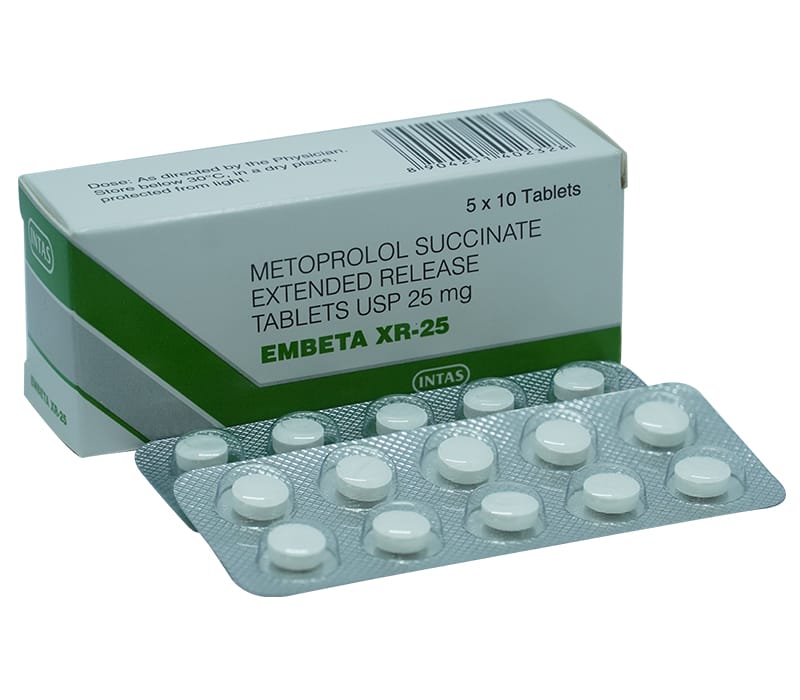
Embeta XR-25 is metoprolol succinate extended-release 25 mg — the starter strength in the heart-failure-with-reduced-ejection-fraction titration ladder. Titrate from 25 mg to 200 mg once daily over 8-12 weeks. Also for hypertension, angina. Swallow whole.
✓ Medically reviewed by Morgan Ellis — Pharmacy Researcher · 8 years experience · Last reviewed: May 2026
⚡ Quick Answer — What is Embeta XR-25?
Embeta XR-25 is a 25 mg (succinate ER) metoprolol extended-release tablet (succinate) from Emcure — cardioselective (beta-1 predominant). Primary use is hypertension; also used for angina, arrhythmia control, post-myocardial-infarction secondary prevention, and heart failure with reduced ejection fraction (HF-REF) (one of the three mortality-proven beta-blockers in HF-REF). Typical hypertension dose: Metoprolol tartrate IR: 100-200 mg/day in two divided doses. Metoprolol succinate ER: 100-200 mg once daily. Contraindicated in asthma (relative for cardioselective agents; absolute for non-selective), severe bradycardia, second/third-degree heart block, acute decompensated heart failure, and phaeochromocytoma without prior alpha-blockade. Do NOT stop abruptly — taper over 1-2 weeks to avoid rebound tachycardia / angina / MI.
📦 Every order is covered by our Reshipment Assurance Policy — if your parcel does not arrive within 20 business days, we reship it.
Why order from MedsBase
Our generic medications are sourced from WHO-GMP certified manufacturers and shipped worldwide in discreet, plain packaging — no medication name on the parcel exterior. Card payments are routed through a regulated processor (statement descriptors include a regulated card-payment processor — never “MedsBase” or any medication name). Crypto and SEPA bank transfer are also accepted. Every order is backed by our Reshipment Assurance Policy.
What Is Embeta XR-25?
Embeta XR-25 is an oral extended-release tablet (succinate) containing metoprolol 25 mg (succinate ER) from Emcure, supplied in 30-180 tablets. Metoprolol is a cardioselective (beta-1 predominant). Introduced 1975; one of the most widely-prescribed beta-blockers worldwide. Two salt forms with different pharmacokinetics: metoprolol tartrate (IR, short half-life, BD dosing) is used for hypertension and angina; metoprolol succinate (ER, 24-h half-life, once-daily) is the only metoprolol formulation with MERIT-HF evidence in heart failure with reduced ejection fraction (HF-REF).
How Metoprolol Lowers Blood Pressure
Beta-blockers reduce blood pressure through four mechanisms:
- Reduction of cardiac output — beta-1 blockade in the sinoatrial node reduces heart rate, and blockade in ventricular myocardium reduces contractility. Lower cardiac output = lower blood pressure.
- Renin-angiotensin suppression — beta-1 blockade in juxtaglomerular cells reduces renin release, lowering angiotensin II and aldosterone over 2-4 weeks. This accounts for much of the long-term BP effect.
- Central sympathetic reduction — lipophilic beta-blockers cross the blood-brain barrier and reduce central sympathetic outflow.
Beta-blockers are moderately lipophilic. Plasma half-life of metoprolol is 3-7 hours (tartrate IR), 24 hours (succinate ER).
Approved and Evidence-Based Uses
- Hypertension (primary indication)
- Angina pectoris
- Post-MI secondary prevention
- Heart failure with reduced ejection fraction (HF-REF) — metoprolol succinate only; titrate from 12.5/25 mg to 200 mg once daily over 8-12 weeks
- Atrial fibrillation rate control
- Supraventricular tachycardia
- Migraine prophylaxis — lipophilic beta-blockers work; atenolol does not
Embeta XR-25 Dosage
Adult hypertension dose: Metoprolol tartrate IR: 100-200 mg/day in two divided doses. Metoprolol succinate ER: 100-200 mg once daily.
Start low, titrate upward over 2-4 weeks to target BP (typically <140/90 in uncomplicated hypertension; <130/80 in diabetes, chronic kidney disease, or established cardiovascular disease). Check resting pulse before each dose-increase — do not titrate if <55 bpm.
Monitoring:
- Resting pulse and BP at 2, 4, and 8 weeks after starting or dose change
- Baseline ECG if any cardiac history; periodic ECG if symptoms change
- For HF-REF use: echocardiogram at 3 and 6 months; titrate toward target dose if tolerated
Administration: swallow whole with water. Sustained/extended-release formulations must NOT be crushed, chewed, or split — doing so delivers an IR dose with risk of bradycardia / hypotension.
Discontinuation: NEVER stop abruptly. Taper over 1-2 weeks (reduce by 25-50% every 3-5 days). Abrupt discontinuation causes rebound tachycardia, worsened angina, and — in patients with coronary disease — can precipitate myocardial infarction. This is one of the most important safety points for beta-blockers.
Side Effects
Common (>5%):
- Fatigue, lethargy — often adapts over 2-4 weeks
- Cold hands and feet (peripheral vasoconstriction)
- Bradycardia (check pulse; stop if <50 bpm)
- Exercise intolerance — maximum heart rate is blunted by beta blockade
- Dizziness, postural hypotension
- Sleep disturbance, vivid dreams / nightmares (lipophilic beta-blockers cross the blood-brain barrier)
- Reduced libido, erectile dysfunction (mostly at higher doses)
Less common: depression, reduced libido / erectile dysfunction, gastrointestinal upset, Raynaud-like cold intolerance, bronchospasm (more common with non-selective agents).
Important but uncommon:
- Masked hypoglycaemia in diabetics — beta-blockers blunt the tachycardia / tremor warning signs of low blood sugar. Monitor glucose more carefully; prefer nebivolol or bisoprolol in insulin-treated diabetes.
- Bronchospasm — can be severe in asthma / COPD. Absolute contraindication for non-selective agents; relative for cardioselective.
- Heart block or worsening heart failure — in susceptible patients. Start low, titrate slowly.
Contraindications & Cautions
- Severe asthma / severe COPD — relative contraindication (cardioselectivity is relative, not absolute)
- Second or third-degree atrioventricular block (without pacemaker)
- Sinus bradycardia <50 bpm
- Cardiogenic shock, decompensated heart failure requiring inotropes
- Severe peripheral arterial disease, Raynaud’s syndrome (relative)
- Phaeochromocytoma without prior alpha-blockade — paradoxical hypertensive crisis (never use a beta-blocker before alpha-blocker)
- Severe hepatic impairment (for extensively hepatic-metabolised agents: propranolol, metoprolol, carvedilol, labetalol)
- Severe renal impairment — dose adjustment needed for renal-excreted agents (atenolol, nadolol)
- Hypersensitivity to metoprolol
Pregnancy: Category C; cross the placenta; small risk of intrauterine growth restriction, neonatal bradycardia, and hypoglycaemia. Use only if benefit clearly outweighs risk; labetalol is the pregnancy-preferred beta-blocker.
Breastfeeding: small amounts in breast milk; generally considered compatible with monitoring.
Drug Interactions
- Verapamil, diltiazem (non-dihydropyridine CCBs) — additive bradycardia, heart block, and negative inotropy; generally avoid combination. Dihydropyridine CCBs (amlodipine, nifedipine) are safer to combine with beta-blockers.
- Other beta-blockers — do not combine; additive bradycardia
- Clonidine — if stopping clonidine, stop the beta-blocker first (several days before) to avoid rebound hypertensive crisis
- Insulin and sulphonylureas — mask hypoglycaemia warning signs; monitor glucose closely
- NSAIDs — reduce the antihypertensive effect of beta-blockers; avoid chronic combination
- CYP2D6 inhibitors (fluoxetine, paroxetine, quinidine, bupropion) — raise metoprolol levels; reduce dose or monitor closely
- Alcohol — additive hypotension and CNS depression (particularly for lipophilic agents)
Beta-Blocker Class at a Glance
| Beta-blocker | Selectivity | Best for |
|---|---|---|
| Propranolol (Inderal, Ciplar, Beloc) | Non-selective | Migraine, tremor, thyrotoxicosis, performance anxiety, HTN |
| Metoprolol | Cardioselective | Post-MI, HF-REF (succinate ER), angina, AF rate control |
| Carvedilol | Non-selective + α-1 | HF-REF (mortality evidence), post-MI |
| Bisoprolol | Highly cardioselective | HF-REF, HTN, angina, AF rate control |
| Nebivolol | Ultra-selective + NO | Elderly, metabolic syndrome, erectile dysfunction |
| Atenolol | Cardioselective (hydrophilic) | Angina, AF rate control (second-line for HTN) |
| Labetalol | Non-selective + α-1 | Pregnancy hypertension, hypertensive crisis |
Cardioselectivity is relative — at doses above 100 mg the beta-1 selectivity diminishes and bronchospasm risk rises. Prefer nebivolol in asthmatic or COPD patients where a beta-blocker is essential.
Storage
Store Embeta XR-25 below 25°C. Keep out of reach of children — accidental paediatric beta-blocker ingestion can cause life-threatening bradycardia and hypoglycaemia.
Frequently Asked Questions
How long does Embeta XR-25 take to lower blood pressure?
You should see some BP reduction within 1-2 days of starting; the full antihypertensive effect takes 2-4 weeks (driven by the gradual renin-angiotensin suppression, not the immediate heart-rate effect). Measure BP at home at the same time each day to track response.
Can I take Embeta XR-25 if I have asthma?
Metoprolol is cardioselective, so it is relatively safer in asthma than non-selective agents. However, cardioselectivity is relative — at higher doses beta-2 blockade can still occur. In severe or brittle asthma, avoid all beta-blockers if possible. In mild asthma or COPD, use with monitoring and inhaler access.
Why should I never stop Embeta XR-25 abruptly?
Abrupt discontinuation causes rebound tachycardia and worsened angina within 24-48 hours, driven by up-regulation of beta receptors during chronic blockade. In patients with coronary artery disease, this can precipitate myocardial infarction or unstable angina. Always taper over 1-2 weeks when stopping.
Will Embeta XR-25 affect my exercise performance?
Yes — beta blockade blunts the heart-rate response to exercise, so your maximum pulse is lower and you fatigue faster at high intensities. For recreational exercise most people adapt; for competitive endurance athletes, beta-blockers can meaningfully impair performance and are banned in precision sports (shooting, archery — where they reduce physiological tremor).
Will Embeta XR-25 affect my blood sugar if I have diabetes?
Beta-blockers mask the tachycardia / tremor / palpitation warning signs of hypoglycaemia, making low blood sugar harder to detect. They can also blunt the counter-regulatory glucose response. Monitor glucose more frequently on a beta-blocker, particularly if on insulin or sulphonylureas. Nebivolol and bisoprolol have the best metabolic profile.
Can I drink alcohol on Embeta XR-25?
Moderate alcohol is generally acceptable but alcohol potentiates the hypotensive and CNS-depressant effects. Stand up slowly after drinking. Alcohol is also an independent BP-raiser; reducing intake can improve BP control independent of Embeta XR-25.
Does Embeta XR-25 cause weight gain?
Older beta-blockers (propranolol, atenolol, metoprolol) are associated with modest weight gain (1-3 kg) and worsening of insulin sensitivity over time. Nebivolol and carvedilol are weight-neutral or slightly weight-favourable due to their vasodilator components. For patients with metabolic syndrome, nebivolol is the preferred beta-blocker when one is needed.
Is Embeta XR-25 safe in pregnancy?
Category C. Use only if benefit clearly outweighs risk. For antihypertensive use in pregnancy, labetalol is the preferred beta-blocker; methyldopa and nifedipine are the two other pregnancy-safe options.
Can I take Embeta XR-25 with other BP medications?
Yes — beta-blockers combine well with dihydropyridine calcium-channel blockers (amlodipine), ACE inhibitors (ramipril, lisinopril), ARBs (losartan, telmisartan, olmesartan), and thiazide diuretics (HCTZ). Avoid combination with non-dihydropyridine CCBs (verapamil, diltiazem) — additive bradycardia and heart-block risk.
Where can I buy Embeta XR-25 online?
You can buy Embeta XR-25 (metoprolol 25 mg (succinate ER) extended-release tablet (succinate), 30-180 tablets) from MedsBase with discreet packaging and worldwide shipping.
Related Beta-Blockers & Antihypertensives
- Betapro SR — Propranolol 80 mg SR
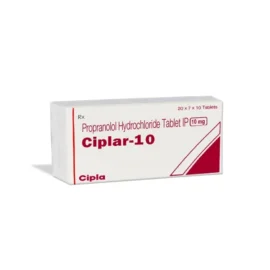
- Ciplar — Propranolol 10 mg (Cipla)
- Concor — Bisoprolol 5/10 mg (HTN dose)
- Inderal — Propranolol IR 20/40 mg (AstraZeneca)
- Nebilong — Nebivolol 2.5 mg
- Nilol — Atenolol + Nifedipine combo
- Browse all High Blood Pressure Medications
Related Alternatives
Other products in Chronic Conditions that customers also view:
More options in High Blood Pressure Medication
Ranked by recent MedsBase order volume — what other customers in this category are picking.
| Strength | 25 mg |
|---|---|
| Quantity | 30 Tablet/s, 60 Tablet/s, 90 Tablet/s, 180 Tablet/s |
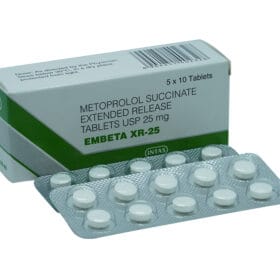 Embeta XR-25
Q & A
Embeta XR-25
Related products

Reviews
There are no reviews yet