








✓ Medically reviewed by · Last reviewed: May 2026
Pharmacy Researcher · 8 years experience
Pharmacy researcher with 8 years reviewing clinical drug information, generic formulation equivalence, and international pharmaceutical standards. Focuses on patient-facing accuracy in medication education.
Most people assume that if two drugs share the same active ingredient, one must simply be the “better” version. With Pentasa vs Lialda, the research says otherwise — and understanding why turns a confusing pharmacy choice into an easy one. Both tablets are mesalamine, the workhorse anti-inflammatory for ulcerative colitis. Neither is stronger. What differs is where and when each one releases the medicine inside you — and that single detail is what makes your doctor pick one over the other.
By the end of this guide you’ll know exactly how the two formulations differ, which suits which pattern of disease, why one means far fewer tablets a day, and whether a lower-cost equivalent exists. There’s also a common belief about switching between them that catches patients out — we’ll clear it up in the FAQ.
- Pentasa and Lialda are the same active drug — mesalamine — so neither is inherently “better.”
- Pentasa releases gradually from the small intestine onward; Lialda releases in the colon, triggered by pH.
- Lialda is usually once daily; Pentasa typically needs several doses — a real difference for sticking with it.
- Head-to-head research finds no meaningful gap in effectiveness or safety — the choice is practical, not clinical superiority.
- Where your disease sits in the gut can tip the decision — one formulation reaches higher up.
- A cheaper generic mesalamine can hit the same target — we’ll show what to ask about.
Table of Contents
- What are Pentasa and Lialda?
- How the two release mesalamine differently
- Key uses & who each suits
- Safety, side effects & dosing
- What the research says
- Pentasa vs Lialda — the head-to-head
- How to take mesalamine correctly
- Frequently asked questions
- The bottom line
What Are Pentasa and Lialda?
Pentasa and Lialda are both oral mesalamine (5-ASA) tablets used to treat ulcerative colitis and keep it in remission. Mesalamine is a topical-acting anti-inflammatory — meaning it works directly on the lining of the gut rather than throughout the body — and it’s a first-line drug for mild-to-moderate ulcerative colitis, both to calm a flare and to maintain remission afterward. The NHS describes mesalamine (an aminosalicylate) as a mainstay of ulcerative colitis care.
So if they’re the same drug, why two products? Because getting mesalamine to the right part of the gut is a genuine engineering problem. Swallow a plain tablet and the small intestine would absorb the drug before it reached the inflamed colon. Mesalamine works best in direct contact with the bowel lining, so a formulation that gives up its cargo too early wastes much of the dose. Every mesalamine brand solves that problem a different way — and Pentasa and Lialda solve it almost oppositely, which is precisely why comparing them is worth your time rather than a coin toss.
Here’s the loop to hold onto: one of these tablets starts letting the medicine out much earlier in your digestive tract than the other. That earlier release isn’t better or worse in general — but it can be decisive depending on where your disease lives. We’ll resolve it in the uses section.
One more honest note up front: mesalamine is a mainstay for ulcerative colitis but is poorly effective in Crohn’s disease, because its main activity is in the large intestine rather than the small bowel. Keep that in mind if you’ve seen these names mentioned for Crohn’s.
How the Two Release Mesalamine Differently
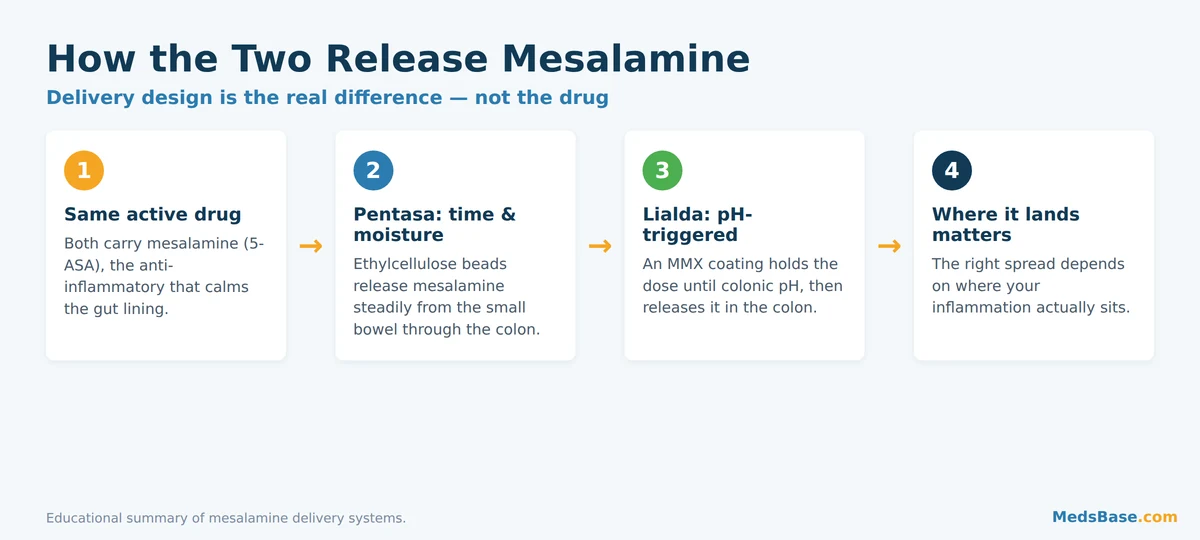
This is the heart of the Pentasa vs Lialda question, and it’s simpler than it sounds.
Pentasa wraps mesalamine in tiny ethylcellulose-coated granules that release the drug by time, not acidity. Because the release is pH-independent, it begins early — in the duodenum, at the top of the small intestine — and continues steadily all the way through to the colon. Think of it as a slow, continuous trickle that covers a long stretch of gut.
Lialda uses a different trick: an MMX (multi-matrix) system with a pH-dependent outer coating. The coating stays sealed through the stomach and small intestine and only dissolves when it reaches the higher pH of the colon — then the multi-matrix core spreads the drug throughout the large bowel. Think of it as a package that stays locked until it arrives at the right destination, then unpacks fully.
One line to remember: Pentasa trickles from the small intestine down; Lialda unlocks in the colon — same medicine, two delivery philosophies.
Key Uses & Who Each Suits
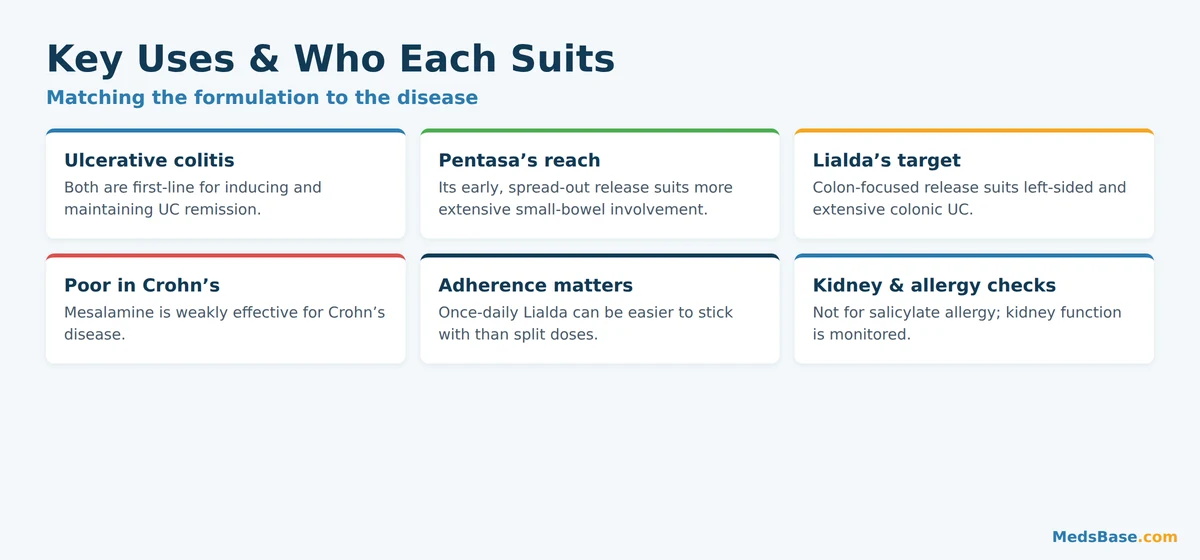
Both formulations are approved for the same core job — treating and maintaining ulcerative colitis — but their release patterns nudge them toward slightly different patients.
Where Pentasa fits
- Disease that extends higher up, including small-bowel involvement, where its early, continuous release covers more ground.
- Patients who tolerate multiple daily doses and want broad gut coverage.
Where Lialda fits
- Colonic ulcerative colitis, where its targeted colonic release lands the drug where it’s needed.
- Anyone who struggles with pill schedules — its once-daily dosing is a genuine adherence advantage.
For newly diagnosed readers, pairing the medicine with the right food helps — our guide on what to eat during a UC flare covers the practical side that tablets alone don’t. And if you want the full single-drug deep-dive on the once-daily option, our complete Lialda (mesalamine) guide goes further than we can here.
Take Priya, 29 — a purely illustrative example. Newly diagnosed with left-sided ulcerative colitis, she’s handed a prescription for a multi-dose mesalamine and, three weeks in, keeps forgetting the midday tablet on busy clinic days. Her flare never quite settles. At her follow-up she mentions the missed doses honestly; her gastroenterologist switches her to a once-daily formulation at an equivalent dose. Nothing about the drug changed — the same 5-ASA is doing the same job — but a schedule she can actually keep is what finally holds her remission. Priya’s story is the quiet lesson of this whole comparison: the “best” mesalamine is usually the one you’ll take consistently.
Where the other mesalamine formats fit
Pentasa and Lialda aren’t the only two 5-ASA options, and knowing the wider family helps the comparison make sense. Other oral mesalamine products use pH-dependent coatings that release mainly in the lower small intestine and colon, sitting somewhere between Pentasa’s early trickle and Lialda’s colon-only unlock. And when disease is confined to the very end of the bowel — the rectum or lower colon — a rectal 5-ASA (a suppository or enema) can deliver the drug straight to the inflamed tissue, sometimes more effectively than any tablet. Many people with more extensive disease use a tablet and a rectal product together during a flare. The point isn’t that one format wins; it’s that “mesalamine” is a toolkit, and matching the tool to your disease location is the real skill.
Safety, Side Effects & Dosing
Reassuringly, mesalamine is one of the better-tolerated drugs in gastroenterology — but “well tolerated” isn’t “side-effect-free,” and one rare reaction deserves respect.
| Side effect | Frequency | Severity | What to do |
|---|---|---|---|
| Headache | Common | Mild | Usually settles; hydrate, review if persistent |
| Nausea / diarrhea | Common | Mild | Take with food if it helps; tell your doctor if severe |
| Abdominal pain / gas | Occasional | Mild | Often improves; monitor |
| Paradoxical worsening (mesalamine intolerance) | Rare | Can mimic a flare | Symptoms worsen on the drug — contact your doctor promptly |
| Kidney effects (interstitial nephritis) | Rare | Potentially serious | Periodic kidney checks; report reduced urination or swelling |
Typical mesalamine dosing runs broad — generally in the range of about 1.5 to 4.8 grams a day, varying by preparation and whether you’re treating a flare or maintaining remission, as the MedlinePlus mesalamine reference outlines. The headline practical difference is frequency: Lialda is usually taken once daily, while Pentasa is typically split across several doses.
A pharmacist’s practical note: the reaction that trips people up is the rare paradoxical intolerance — where mesalamine itself causes cramping, bloody stools or fever that look exactly like a colitis flare. Patients understandably assume the disease is worsening and take more, when the answer may be the opposite. If your symptoms flare shortly after starting or increasing a 5-ASA, flag it rather than self-escalating. Because 5-ASA drugs can rarely affect the kidneys, clinicians often check kidney function periodically — a quiet safeguard worth keeping up.
That resolves the safety loop: the surprise isn’t a common side effect, it’s a rare one that disguises itself as the disease.
What the Research Says
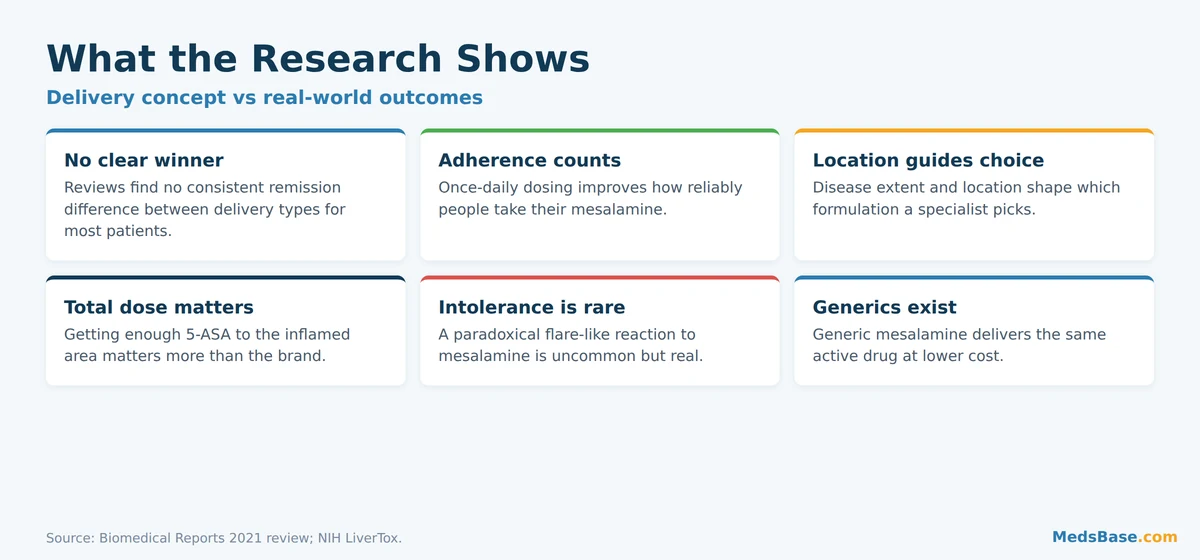
The evidence on Pentasa vs Lialda is refreshingly undramatic.
| Evidence | Focus | Key finding | Source |
|---|---|---|---|
| Comparative formulation review | pH-dependent vs constant release | No clear difference in remission outcomes between delivery types for most patients | PMC review |
| Clinical reference | Mesalamine in UC vs Crohn’s | First-line in ulcerative colitis; poorly effective in Crohn’s | NIH LiverTox |
| Practical data | Dosing frequency | Once-daily formulations improve adherence vs multiple daily doses | Peer-reviewed |
What this means for you: stop looking for the “stronger” tablet — comparative research suggests it doesn’t exist here. The meaningful variables are dosing convenience, where your disease sits, and cost. Early studies and reviews consistently land on “similar efficacy, different practicality.” Where evidence is limited — for instance, fine distinctions in specific disease patterns — it’s genuinely limited, and your gastroenterologist’s read of your case matters more than any general ranking.
Pentasa vs Lialda — the Head-to-Head
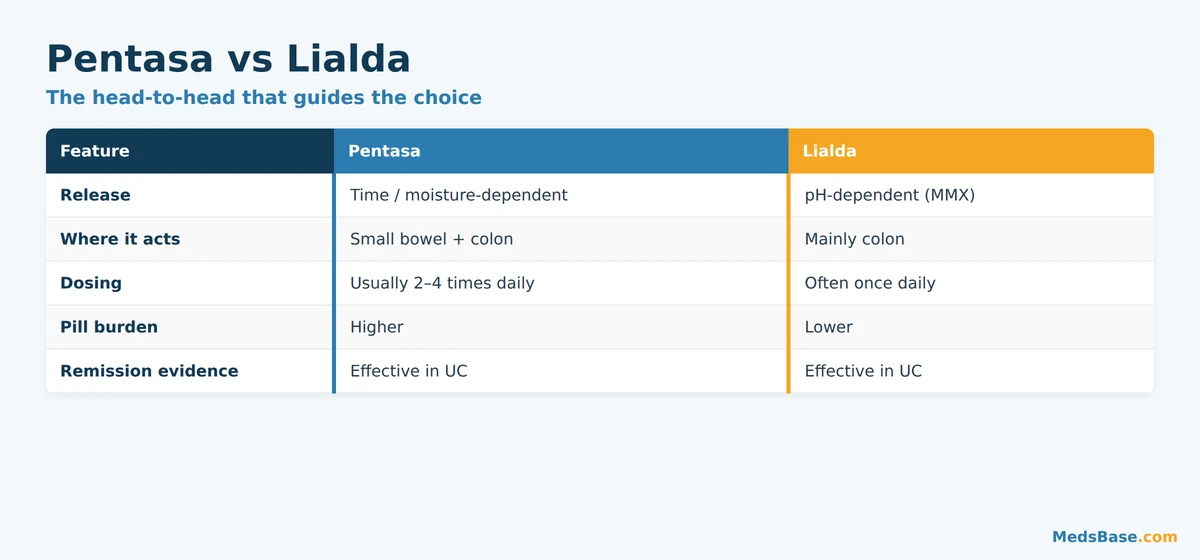
Here’s the comparison you came for, distilled.
| Feature | Pentasa | Lialda |
|---|---|---|
| Active drug | Mesalamine (5-ASA) | Mesalamine (5-ASA) |
| Release mechanism | Time-dependent, pH-independent (ethylcellulose) | pH-dependent MMX (multi-matrix) |
| Where it releases | Small intestine colon (early, continuous) | Colon (targeted) |
| Typical dosing | Several times daily | Usually once daily |
| Disease-location edge | Broader/higher gut coverage | Colonic UC |
| Efficacy/safety difference | No clear advantage either way | |
| Generic availability | Generic mesalamine available | Generic mesalamine available |
Which fits which situation? If sticking to a schedule is your biggest hurdle, Lialda’s once-daily dosing is the pragmatic winner — fewer chances to miss a dose. If your disease extends higher into the small bowel, Pentasa’s early, continuous release earns its place. Neither is a clinical upgrade over the other; the formulation-comparison review and NIH LiverTox reference both point to practicality as the deciding factor.
Reading your own situation
You can usually predict which way your gastroenterologist will lean by asking three plain questions about yourself. How reliably can I take pills? If honestly the answer is “not very,” once-daily dosing removes the biggest failure point. Where is my disease? Colon-limited disease is squarely Lialda’s territory; involvement higher up nudges toward Pentasa’s broader reach. What can I afford to stay on for years? Because this is lifelong maintenance for many people, a generic mesalamine that you’ll actually keep buying can beat a pricier brand you ration. Notice that none of those questions is “which is stronger” — because, as the research keeps showing, that isn’t the question that decides good outcomes here. The winning tablet is the one that fits your gut, your routine and your budget at the same time.
It’s also worth setting expectations on timing. Mesalamine isn’t an instant painkiller; it’s an anti-inflammatory that works over days to weeks. Whether you’re on Pentasa, Lialda or a generic, judge it over a fair window with your doctor rather than a few doses — and never quit early just because the first week feels slow. Consistency is what turns 5-ASA from a tablet into a remission.
And the budget angle: because the active ingredient is identical, a generic mesalamine often delivers the same drug at lower cost. Brand-name 5-ASA can be surprisingly expensive for a medicine you take indefinitely, and over years that gap adds up — which is exactly why it’s worth asking whether a generic once-daily formulation would suit you just as well. MedsBase stocks once-daily Mesacol OD and standard Mesacol as accessible mesalamine options to discuss with your gastroenterologist — plus Pentasa Suppositories when disease is limited to the lower rectum and a topical 5-ASA makes more sense than a tablet. As always, switching brands or formulations is a conversation to have with your specialist, not a solo swap.
Why the “not a solo swap” caution matters: because the formulations release differently and their doses aren’t milligram-for-milligram interchangeable, a self-directed switch can accidentally under- or over-dose the inflamed tissue. A gastroenterologist sets the correct equivalent dose and, if needed, times the change so your remission isn’t disturbed. Done properly, moving to a more convenient or affordable mesalamine is low-drama; done blindly, it’s a common cause of an avoidable flare.
How to Take Mesalamine Correctly
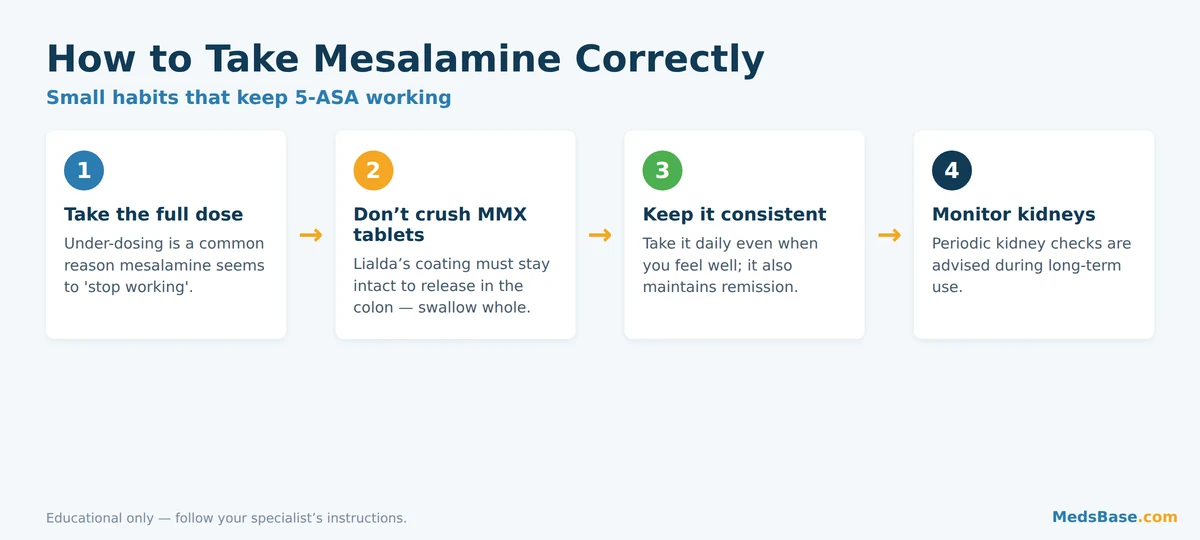
Whether you land on Pentasa, Lialda or a generic, these habits keep 5-ASA working.
- Follow the food instructions on your specific product. Some formulations are taken with food, others without — the label matters.
- Keep the schedule consistent. Steady blood and tissue levels beat erratic dosing; set reminders if you’re on a multi-dose product.
- Don’t crush or chew controlled-release tablets. It wrecks the delivery system that gets the drug to the right place.
- Don’t stop when you feel well. Maintenance therapy prevents relapse; stopping early is a leading cause of flares.
- Keep up periodic check-ups. Kidney function is monitored occasionally on long-term 5-ASA — don’t skip those tests.
Mistakes to avoid: treating “feeling fine” as a reason to quit; crushing extended-release tablets into food; assuming a flare-like reaction always means the disease and never the drug; and switching formulations without telling your doctor. To compare accessible formats in one place, you can browse our Gastro Health range and bring specifics to your appointment.
Why adherence quietly beats formulation
If there’s a single theme running through the Pentasa vs Lialda debate, it’s this: the formulation nuances are real but small, and adherence is large. Studies of long-term maintenance consistently show that people who take their 5-ASA reliably stay in remission longer than those who don’t — and once-daily dosing measurably improves how reliably people take it. That’s the practical reason a gastroenterologist might steer a forgetful patient toward Lialda-style once-daily dosing even though the drug inside is the same. The best-engineered release system in the world does nothing sitting in the blister pack.
What if mesalamine isn’t enough?
Mesalamine is first-line for mild-to-moderate ulcerative colitis, but it isn’t the whole treatment ladder. If flares keep breaking through despite good adherence and an optimised dose, gastroenterologists may add a short course of steroids to settle an acute flare, or step up to other maintenance drugs for more stubborn or extensive disease. None of that means mesalamine “failed” — it means the disease needed more, and that’s a normal, well-trodden path. The takeaway for anyone comparing Pentasa and Lialda: get the 5-ASA foundation right and take it consistently, but keep the follow-up appointments so your specialist can adjust the plan if your colon asks for more. This is a marathon condition, not a one-decision one.
Frequently Asked Questions
Q: Is Pentasa or Lialda better for ulcerative colitis?
A: Neither is clearly better for effectiveness — both are mesalamine and comparative research finds no meaningful gap in remission outcomes. The choice comes down to practicality: Lialda’s once-daily dosing suits people who struggle with schedules, while Pentasa’s early, continuous release suits disease that extends higher in the gut. Your gastroenterologist matches the formulation to your case.
Q: What is the difference between Pentasa and Lialda?
A: Both contain mesalamine, but they release it differently. Pentasa uses a time-dependent, pH-independent coating that starts releasing in the small intestine and continues to the colon. Lialda uses a pH-dependent MMX system that stays sealed until it reaches the colon. The practical results are different dosing frequency and different gut coverage.
Q: Can you switch from Pentasa to Lialda?
A: Often yes, but not as a like-for-like tablet swap you do yourself. Because the formulations release differently and doses aren’t identical, switching should be planned by your doctor, who will set the correct equivalent dose and schedule. Never assume one tablet of one equals one tablet of the other.
Q: How many times a day do you take Pentasa vs Lialda?
A: Lialda is typically taken once daily, which is one of its main advantages. Pentasa is usually taken several times a day. If remembering multiple doses is hard for you, that difference is worth raising with your prescriber — better adherence often matters more than any subtle formulation nuance.
Q: Is there a generic for Lialda?
A: Yes — generic mesalamine (including once-daily formulations) is available and delivers the same active drug, often at lower cost. Since the medicine itself is identical, a generic can be a sensible, budget-friendly option to discuss with your gastroenterologist rather than paying brand prices.
Q: Does mesalamine work for Crohn’s disease?
A: Not reliably. Mesalamine is a first-line drug for ulcerative colitis, but it’s poorly effective in Crohn’s disease because its main activity is in the large intestine rather than the small bowel. If you have Crohn’s, your treatment plan will usually center on different medications — ask your specialist what’s appropriate.
Q: Do you take Pentasa and Lialda with food?
A: Follow your specific product’s label — it’s not one-size-fits-all. Some mesalamine formulations are designed to be taken with food and others without, because food can subtly affect how the release system behaves. If you’re unsure, a pharmacist can confirm the right way to take your exact product, and keeping that habit consistent day to day matters as much as the food question itself.
Q: Is long-term mesalamine safe to stay on?
A: For most people, yes — mesalamine is one of the better-tolerated long-term drugs in gastroenterology, which is a big part of why it’s used for maintenance. The main long-term watch-point is kidney function, checked periodically with a simple blood test. Staying on maintenance therapy while you feel well is usually far safer than stopping and risking a flare, but the duration is always a decision to make with your gastroenterologist.
The Bottom Line
On Pentasa vs Lialda, the honest verdict is liberating: you’re not choosing between a strong drug and a weak one. You’re choosing between two smart delivery systems for the same medicine. Lialda wins on convenience with once-daily dosing; Pentasa wins on reach with early, continuous release for higher gut involvement. For most people with colonic ulcerative colitis, the once-daily option is the easier habit to keep — and a generic mesalamine can match it for less.
Your one immediate action: at your next appointment, ask your gastroenterologist two questions — “Given where my disease is, does release location matter for me?” and “Is a once-daily or generic mesalamine appropriate for me to stay on long term?” Those two answers settle the choice faster than any comparison chart, and they keep the decision where it belongs: with the specialist who knows your gut.
Still mapping out your treatment? These are the natural next questions:
- Want the full single-drug picture? Read our complete Lialda (mesalamine) guide.
- Managing day-to-day symptoms? Start with what to eat during a UC flare.

Written by
Sophie ChenPharmaceutical Content Researcher · 8 years experience
Sophie Chen is a pharmaceutical content researcher with 8 years covering generic medication access and clinical pharmacology. She specialises in international regulatory frameworks, bioequivalence standards, and patient-facing education on therapeutic drug classes. She is not a clinician.