








✓ Medically reviewed by · Last reviewed: May 2026
Pharmacy Researcher · 8 years experience
Pharmacy researcher with 8 years reviewing clinical drug information, generic formulation equivalence, and international pharmaceutical standards. Focuses on patient-facing accuracy in medication education.
GERD medications long-term safety — GERD Medications Long-Term Safety: What 10+ Years of Research Reveals. Read on for an evidence-backed guide covering everything you need to know.
Most people believe proton pump inhibitors cause kidney failure — and that belief keeps millions of GERD sufferers awake at night, staring at their omeprazole bottle and wondering if the cure is worse than the disease. The reality, based on more than a decade of research, is both more reassuring and more nuanced than the headlines suggest. Some long-term concerns about PPIs hold up to scrutiny; others have been significantly overstated. Understanding which is which — and what you can actually do about it — is the key to making an informed decision about GERD medications long-term safety.
GERD medications long-term safety — this guide walks through every major safety question about long-term GERD medication use, separates evidence from alarmism, and gives you a practical framework for deciding whether your current treatment plan still makes sense. By the end, you will know which risks are real (and how small they are in absolute terms), which have been overblown, and what steps you can take to protect your health while controlling your acid reflux.
Key Takeaways
- ✔ PPIs are safe and effective for most people who need them — but they are overprescribed. An estimated 25-70% of PPI prescriptions lack a clear evidence-based indication, which means millions may be taking them unnecessarily.
- ✔ The strongest evidence for GERD medications long-term safety concerns links PPIs to vitamin B12 deficiency and C. difficile infection — both are real but manageable risks. The dementia and kidney-disease links are much weaker than media coverage suggests.
- ✔ The absolute increase in risk for most PPI-associated outcomes is small — often less than 1% — but one group faces meaningfully higher risks that most patients never hear about.
- ✔ Stopping a PPI abruptly after long-term use causes acid rebound in most people — a predictable physiological response that is often mistaken for “needing the medication” and drives patients back onto it unnecessarily.
- ✔ For patients with severe GERD, erosive esophagitis, or Barrett’s esophagus, the risks of stopping the PPI almost always exceed the risks of continuing — and that conclusion is shared by every major gastroenterology society.
Table of Contents
- How Do GERD Medications Work?
- What the Evidence Actually Shows: PPI Risk Claims vs Reality
- Kidney Disease and PPIs — Separating Correlation from Causation
- Do PPIs Cause Dementia? What the Studies Really Found
- Vitamin and Mineral Deficiencies: The Best-Established Risk
- Infection Risk: C. Difficile, Pneumonia, and Gut Microbiome Changes
- H2 Blockers vs PPIs: Is the Alternative Safer?
- How to Stop PPIs Safely (And Whether You Should)
- Who Should Reassess Their GERD Medication?
- Frequently Asked Questions
- The Bottom Line
How Do GERD Medications Work? — GERD medications long-term safety Explained
GERD medications fall into three main classes, and understanding how they differ is essential to understanding their safety profiles. Proton pump inhibitors (PPIs) — including omeprazole, esomeprazole, lansoprazole, and pantoprazole — are the most potent acid suppressors. They work by irreversibly blocking the proton pump in stomach parietal cells, the final step in acid production. A single dose can reduce stomach acid by up to 90%, and the effect lasts until the body produces new proton pumps, roughly 24 to 48 hours later.
GERD medications long-term safety — h2 receptor blockers — including famotidine and cimetidine — block histamine receptors on parietal cells, reducing acid secretion by approximately 50 to 70%. They work faster than PPIs (within an hour vs days) but are less potent overall. Antacids — calcium carbonate, aluminum hydroxide, magnesium hydroxide — neutralize existing stomach acid but do not reduce production. They work in minutes and last for hours.
GERD medications long-term safety — the potency that makes PPIs so effective at healing erosive esophagitis and controlling severe GERD is also what drives the GERD medications long-term safety conversation. Near-complete acid suppression is a major physiological change — and while it is often exactly what the patient needs, it is reasonable to ask what happens when that suppression continues for years or decades. This is the question at the heart of the GERD medications long-term safety discussion, and the answer depends on who is asking.
Research Spotlight: How Common Is Unnecessary PPI Use?
GERD medications long-term safety — a 2019 systematic review published in the American Journal of Gastroenterology found that 25% to 70% of PPI prescriptions in primary care lacked a documented evidence-based indication. The most common inappropriate use: continuing PPIs indefinitely after a short-term course for mild dyspepsia, or prescribing them for “stress ulcer prophylaxis” in low-risk hospitalized patients who no longer need them after discharge. This overprescription drives much of the public anxiety about GERD medications long-term safety — but the appropriate response is targeted deprescribing in low-risk patients, not panic-driven discontinuation in patients who genuinely need PPIs.
GERD medications long-term safety: What the Evidence Actually Shows: PPI Risk Claims vs Reality
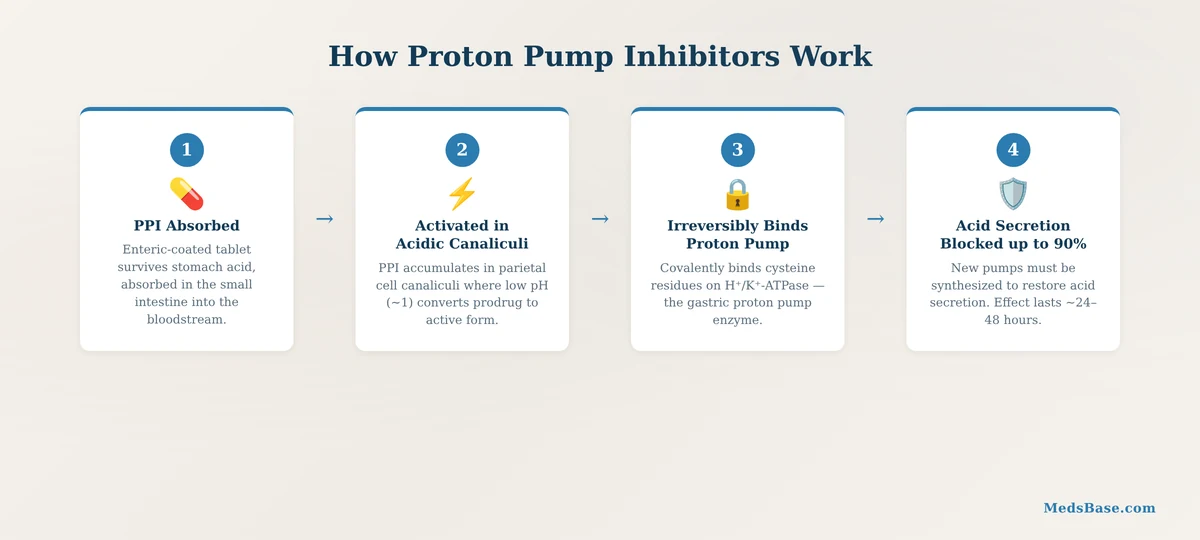
PPIs irreversibly block the proton pump in stomach parietal cells.
GERD medications long-term safety — if you have Googled “omeprazole long-term side effects,” you have seen the headlines: kidney failure, dementia, bone fractures, early death. These associations have been reported in observational studies and amplified by news media. But observational studies can show correlation, not causation — and when the absolute risk numbers are examined, the picture looks very different.
Here is a summary of the major GERD medications long-term safety concerns and what the quality of evidence actually supports:
| Claimed Risk | Evidence Strength | Absolute Risk Increase | Bottom Line |
|---|---|---|---|
| Vitamin B12 deficiency | Strong — biologically plausible, consistently replicated | ~3-5% over 2+ years | Real risk. Monitoring recommended for long-term users. |
| C. difficile infection | Strong — multiple studies, dose-response relationship | ~1.5-2x relative risk | Real but primarily relevant for hospitalized or elderly patients. |
| Bone fractures | Moderate — consistent association, debated causality | ~0.1-0.5% per year | Small absolute risk. May be driven partly by confounding. |
| Chronic kidney disease | Weak-moderate — observational only, significant confounding | Unclear — likely <0.5% | Likely overstated. No causal mechanism established. |
| Dementia | Weak — inconsistent findings, major confounding concerns | Not established | Most recent and largest studies found no association. |
| Magnesium deficiency | Moderate — rare but documented in case reports | Very rare (<0.1%) | Uncommon. Relevant for patients with other risk factors. |
| Gastric polyps / cancer | Weak — fundic gland polyps are common and benign | Polyps: ~5-10% on long-term PPIs | Fundic gland polyps are benign. No increased gastric cancer risk in H. pylori-negative patients. |
The pattern is clear: the risks that are well-established (B12 deficiency, C. difficile infection) are also manageable — through monitoring for the first and through appropriate prescribing for the second. The risks that generate the most anxiety (kidney disease, dementia) have the weakest evidence. This does not mean PPIs are risk-free. It means the GERD medications long-term safety conversation should be guided by evidence, not headlines.
GERD medications long-term safety: Kidney Disease and PPIs — Separating Correlation from Causation
The PPI-kidney-disease link has generated some of the most alarming coverage. Observational studies have found associations between PPI use and both acute interstitial nephritis (a rare inflammatory kidney condition) and chronic kidney disease. But here is what the alarmist coverage omits.
First, acute interstitial nephritis from PPIs is a known but rare adverse drug reaction — not a cumulative toxicity. It is idiosyncratic, meaning it happens in susceptible individuals, not as a dose-dependent effect in all users. Second, the observational studies linking PPIs to chronic kidney disease are heavily confounded: people who take PPIs long-term tend to be older, heavier, and have more comorbidities — all independent risk factors for kidney disease. When researchers statistically adjust for these confounders, the association weakens substantially. Third, no randomized controlled trial — the gold standard for establishing causation — has demonstrated that PPIs cause kidney disease.
Does this mean the kidney risk is imaginary? No. It means the signal, if real, is small enough that observational studies struggle to disentangle it from confounding. For the average PPI user with normal kidney function, the GERD medications long-term safety profile with respect to kidney outcomes appears reassuring. If you have pre-existing kidney disease or risk factors for it (diabetes, hypertension), this is a conversation worth having with your doctor — but it is not a reason for panic-driven discontinuation.
Do PPIs Cause Dementia? What the Studies Really Found
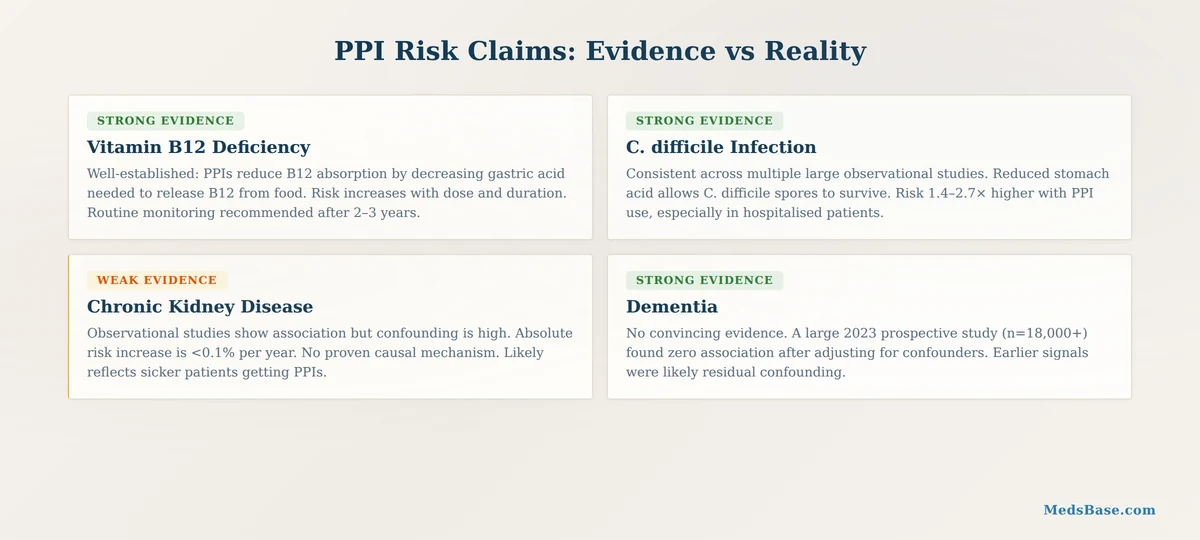
Not all PPI risk claims are equal — some are well-established, others overstated.
The PPI-dementia story is a case study in how observational research can generate headlines that outrun the evidence. Early studies in 2016 and 2017 reported associations between PPI use and dementia, triggering widespread coverage. But the largest and most rigorous studies published since then — including a 2023 analysis of over 18,000 participants in the ASPREE trial — found no association between PPI use and cognitive decline or dementia.
Why did the early studies find an association? The likely explanation is confounding by indication. People who take PPIs are older, have more health problems, and take more medications — all factors that independently increase dementia risk. When researchers fail to fully account for these confounders, PPIs look like they cause dementia when they are actually just a marker for the kind of patient who is already at higher risk.
The current consensus, reflected in the NICE guidelines and supported by the most recent large studies, is that there is no convincing evidence that PPIs cause dementia. This does not mean the question is permanently settled — but it does mean that if dementia is your primary concern about GERD medications long-term safety, the current GERD medications long-term safety evidence is reassuring.
Vitamin and Mineral Deficiencies: The Best-Established Risk
Of all the long-term safety concerns about GERD medications, vitamin B12 deficiency has the strongest evidence. The mechanism is straightforward: stomach acid is required to release B12 from dietary protein so it can be absorbed. PPIs suppress stomach acid, and with prolonged suppression, B12 absorption can decline. This is arguably the most important GERD medications long-term safety consideration because it affects the broadest swath of long-term users.
The risk is real but dose- and duration-dependent: it typically takes two or more years of continuous PPI use for B12 levels to drop meaningfully below normal. Studies estimate the prevalence of B12 deficiency in long-term PPI users at approximately 3% to 5%. Symptoms — fatigue, numbness or tingling in hands and feet, memory problems — are nonspecific and can develop gradually, making the deficiency easy to miss.
The practical takeaway: if you have been taking a PPI for more than two years, ask your doctor to check your vitamin B12 level. It is a simple blood test, and if your levels are low, supplementation (oral or injected) is straightforward and effective. This is not a reason to stop a needed PPI — it is a reason to monitor and supplement, which manages the risk without sacrificing symptom control.
Magnesium deficiency is a rarer but documented concern. The FDA issued a safety communication in 2011 noting that PPI use, particularly for more than a year, can cause low magnesium levels. The risk appears to be very small (likely less than 0.1% of users), but because severe hypomagnesemia can cause muscle spasms, irregular heartbeat, and seizures, it is worth knowing about — especially if you also take diuretics or have other risk factors for low magnesium.
Infection Risk: C. Difficile, Pneumonia, and Gut Microbiome Changes
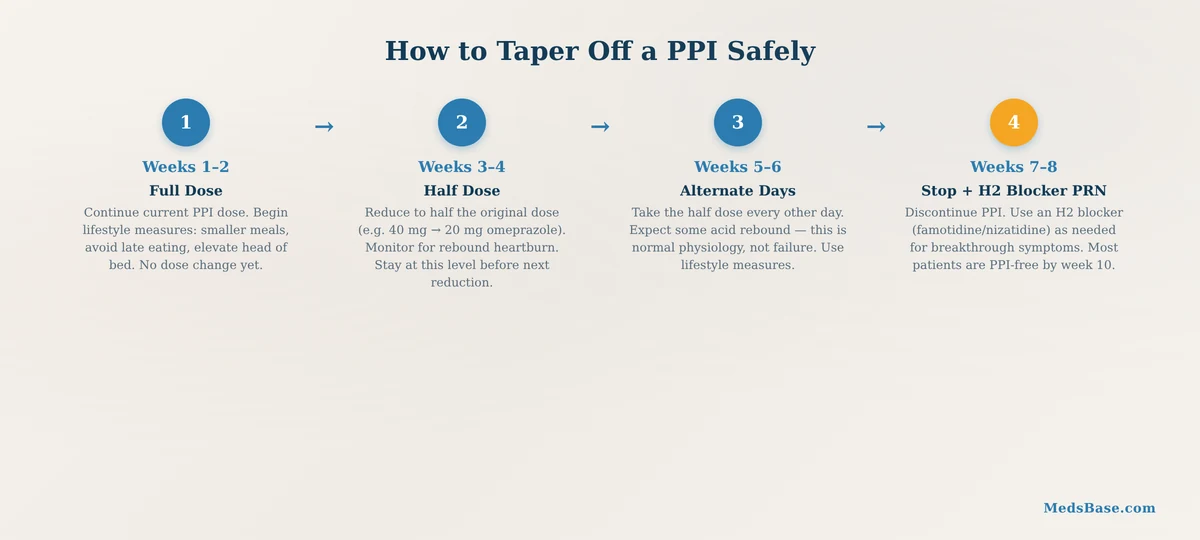
Tapering off a PPI gradually over 6-8 weeks reduces acid rebound.
Stomach acid is not just for digestion — it is part of your body’s defense against pathogens. When PPIs suppress acid, that defense weakens, and the result is a measurable increase in certain infections.
C. difficile infection has the strongest evidence among all GERD medications long-term safety concerns related to infection. Multiple systematic reviews have found that PPI use is associated with a 1.5 to 2-fold increase in C. difficile infection risk. The mechanism is plausible: C. difficile spores survive better in a less acidic stomach, reach the colon, and cause infection. The risk is concentrated in hospitalized patients, those over 65, and those also taking antibiotics. For a healthy, community-dwelling adult taking a PPI, the absolute risk of PPI-associated C. difficile infection is very low.
Community-acquired pneumonia has been linked to PPI use in some studies, but the evidence is weaker and more inconsistent than for C. difficile. The largest meta-analyses suggest a small increase in relative risk (approximately 1.3 to 1.5x), but with substantial heterogeneity across studies. Again, the absolute risk is small for most patients.
Gut microbiome changes: PPIs alter the gut microbiome by reducing stomach acid, which changes the pH environment throughout the gastrointestinal tract. Studies using 16S rRNA sequencing have documented shifts in gut bacterial composition in PPI users. The clinical significance of these changes remains uncertain — they are real, measurable, and plausibly relevant to long-term health, but we do not yet know whether they translate into meaningful disease outcomes.
H2 Blockers vs PPIs: Is the Alternative Safer?
If you are concerned about GERD medications long-term safety with PPIs, the natural next question is whether H2 blockers — famotidine, cimetidine — are a safer alternative. The answer is nuanced, and it depends on why you are asking the question in the first place.
H2 blockers have been available longer than PPIs and have a more extensively documented long-term safety record. They do not suppress acid as strongly, which means they may carry a lower risk of the nutrient-deficiency and infection concerns associated with PPIs. However, they are also less effective at healing erosive esophagitis and controlling severe GERD. For mild to moderate GERD, an H2 blocker may be an appropriate and potentially safer long-term choice. For severe disease, the balance shifts: inadequate acid control can lead to esophageal strictures, Barrett’s esophagus progression, and reduced quality of life — risks that likely exceed any theoretical safety advantage of avoiding PPIs.
There is also a practical issue: tolerance. With continuous use, the body can develop tolerance to H2 blockers within weeks to months, reducing their effectiveness over time. This does not happen with PPIs, which maintain their potency with long-term use. For patients who need consistent, reliable acid suppression, PPIs remain the first-line choice — and for good reason.
For a detailed comparison of two leading GERD medication classes, read our guides: Esomeprazole vs Omeprazole: 7 Proven Differences and Omeprazole vs Famotidine: PPI vs H2 Blocker Compared.
How to Stop PPIs Safely (And Whether You Should)
This is the decision point where the GERD medications long-term safety conversation becomes actionable. If you have been on a PPI for years and the risks discussed above concern you, should you stop? And if so, how? The answer depends on why you are taking the PPI in the first place — which brings the entire GERD medications long-term safety question back to its clinical roots.
First, do not stop abruptly. When you suppress stomach acid for months or years and then suddenly remove the suppression, the result is predictable: acid rebound. The parietal cells, freed from PPI inhibition, overproduce acid. This rebound — which can cause worse heartburn than before you started the medication — typically peaks within the first two weeks and can last for several weeks. Many patients mistake this rebound for “needing the medication” and resume it unnecessarily.
The evidence-based approach is a gradual taper over 4 to 8 weeks:
- Weeks 1-2: Continue your current dose.
- Weeks 3-4: Reduce to half your usual dose (or switch to a lower-strength formulation).
- Weeks 5-6: Take the medication every other day, or switch to an H2 blocker (e.g., famotidine) on the off-days.
- Weeks 7-8: Stop the PPI. Use an H2 blocker or antacids as needed for breakthrough symptoms.
This approach reduces the severity of acid rebound and gives your body time to readjust. It is not guaranteed to work for everyone — some patients with severe GERD will find that their symptoms return and that continuing the PPI is the right choice. But for the substantial minority of patients who are on PPIs without a strong indication, a supervised taper often succeeds.
Lifestyle modifications support any taper or dose-reduction attempt: avoid eating within three hours of bedtime, elevate the head of your bed if nighttime reflux is a problem, identify and avoid your specific trigger foods (common ones include coffee, alcohol, chocolate, spicy foods, and large fatty meals), and lose weight if overweight — weight loss is one of the most effective interventions for GERD.
Who Should Reassess Their GERD Medication?
Not everyone on a PPI needs to stop or reduce their dose. But most people on a PPI should have a periodic review of whether they still need it — and at what dose. Here is who should prioritize this conversation:
- You have been on a PPI for more than one year without a medication review. Annual reassessment is recommended by the American Gastroenterological Association and NICE guidelines.
- Your original symptoms were mild or intermittent. If you were started on a PPI for mild heartburn or dyspepsia rather than confirmed erosive esophagitis or Barrett’s esophagus, you may be able to step down to an H2 blocker or as-needed use.
- You have never tried a dose reduction. Many patients are maintained at a higher dose than they actually need. A trial of a lower dose, with monitoring, is low-risk.
- You are over 65. Older patients face a higher absolute risk of the established PPI complications — particularly C. difficile infection and B12 deficiency — making reassessment more important.
- You have risk factors for specific complications. If you have osteoporosis, kidney disease, or recurrent infections, the risk-benefit calculus may shift toward trying a dose reduction or alternative.
For a small but important group of patients, the answer will be: “continue your PPI — the benefits clearly outweigh the risks.” This group includes patients with severe erosive esophagitis, Barrett’s esophagus, or a history of peptic strictures or bleeding ulcers. For these patients, discontinuing the PPI puts them at risk of serious complications that are far more dangerous than the small absolute risk increases discussed in this article.
Related Reading
- Best Acid Reflux Medications: 10 Evidence-Backed PPIs, H2 Blockers & Antacids — A comprehensive comparison of every major GERD medication class.
- Postpartum Depression Medication Options: 7 Evidence-Based Treatments — Another medication-safety guide with a similar evidence-first approach.
- Rosacea Treatment Options: 8 Clinically Proven Ways to Manage Your Skin — Today’s third post, covering another condition where long-term medication considerations matter.
Frequently Asked Questions
Are PPIs safe for long-term use?
For patients with a clear indication — confirmed GERD, erosive esophagitis, or Barrett’s esophagus — PPIs are generally safe for long-term use, with a favorable risk-benefit profile. The best-established long-term risks (B12 deficiency, C. difficile infection, and a small increase in bone fracture risk) are modest in absolute terms and manageable with monitoring. For patients without a strong indication, long-term PPI use may represent more risk than benefit, and a trial of dose reduction is appropriate.
What are the risks of taking omeprazole long-term?
The best-documented long-term risks of omeprazole include vitamin B12 deficiency (approximately 3-5% prevalence after two or more years of use), increased risk of C. difficile infection (approximately 1.5-2x relative risk), and a small increase in bone fracture risk. Weaker or less consistent associations have been reported for kidney disease, dementia, and community-acquired pneumonia, but causal links have not been confirmed in the highest-quality studies.
Can GERD medications cause kidney damage?
The evidence linking PPIs to chronic kidney disease is observational and confounded — people who take PPIs long-term tend to have other risk factors for kidney disease. While acute interstitial nephritis is a known but rare adverse reaction to PPIs, the idea that PPIs cause progressive kidney damage in a significant percentage of users is not supported by rigorous evidence. Patients with pre-existing kidney disease should discuss this with their doctor, but the absolute risk for most patients is very small.
Do proton pump inhibitors cause dementia?
The largest and most recent studies — including the 2023 ASPREE trial analysis of over 18,000 participants — found no association between PPI use and cognitive decline or dementia. Earlier studies that reported an association were likely confounded by the fact that PPI users tend to be older and have more health problems. Current evidence does not support the claim that PPIs cause dementia.
What happens when you stop taking PPIs after long-term use?
Abruptly stopping a PPI after long-term use typically causes acid rebound — a temporary increase in stomach acid production that can cause worse heartburn than before treatment began. This rebound usually peaks within the first two weeks and can last several weeks. A gradual taper over 4 to 8 weeks significantly reduces rebound severity.
Is it safe to take acid reflux medication every day?
For patients with confirmed GERD or erosive esophagitis, daily PPI use is safe and effective. The medication is taken once daily, typically 30 to 60 minutes before the first meal, and maintains acid suppression throughout the day. The key is ensuring you have an evidence-based indication for daily use — many patients taking daily PPIs could potentially step down to as-needed use after a supervised taper.
What are the alternatives to PPIs for GERD?
H2 blockers (famotidine, cimetidine) reduce acid by approximately 50-70% compared to the 90% reduction achieved by PPIs, and have a different long-term safety profile. Antacids provide rapid, short-term symptom relief but do not address the underlying acid production. Lifestyle modifications — weight loss, dietary changes, elevating the head of the bed, and avoiding late-night meals — are effective adjuncts. For patients with mild GERD, an H2 blocker plus lifestyle changes may be sufficient. For severe disease, PPIs remain the most effective option.
How long can you safely take pantoprazole?
Pantoprazole, like other PPIs, can be taken safely for years when clinically indicated. The GERD medications long-term safety profile of pantoprazole is similar to other PPIs: well-established risks include B12 deficiency and increased infection risk, particularly in older or hospitalized patients. The recommendation to periodically reassess whether ongoing treatment is needed applies to pantoprazole as it does to all PPIs, but there is no specific duration at which pantoprazole becomes unsafe for patients who need it.
The Bottom Line
GERD medications long-term safety is a real and legitimate concern — and the evidence provides a more reassuring picture than alarmist headlines suggest. The risks that are real (B12 deficiency, C. difficile infection, a small fracture risk increase) are modest and manageable. The risks that generate the most fear (kidney disease, dementia) have the weakest evidence. And for patients with severe GERD or Barrett’s esophagus, the risks of stopping the medication almost certainly exceed the risks of continuing.
The practical takeaway: if you have been on a PPI for more than a year, schedule a medication review with your doctor. Discuss whether your current dose is still necessary, whether a trial of dose reduction makes sense for you, and whether periodic monitoring of B12 levels is warranted. If your PPI is prescribed for a clear indication and it is controlling your symptoms, do not stop it abruptly based on a headline. The evidence on GERD medications long-term safety supports staying the course when the indication is solid.
Next questions you may have:
- Want to see how all GERD medications compare? Browse our complete guide.
- Deciding between two specific PPIs? Read our esomeprazole vs omeprazole comparison.
- Explore available GERD medications in our Acid Reducer category.
Reviewed by Medical Professional. Last updated: August 22, 2026.

Written by
Sophie ChenPharmaceutical Content Researcher · 8 years experience
Sophie Chen is a pharmaceutical content researcher with 8 years covering generic medication access and clinical pharmacology. She specialises in international regulatory frameworks, bioequivalence standards, and patient-facing education on therapeutic drug classes. She is not a clinician.